


 Скачать презентацию Academic Staff Annual Performance Review A matter of
3c5612eb94c008bb7c048ebad9cf3f4e.ppt
- Количество слайдов: 19
 Academic Staff Annual Performance Review A matter of compliance An initiative for quality
 2012 -2013 SOE CASI Members Staci Francis—Assistant Dean for Human Resources (CASI Chair) L 259 Education Building 1000 Bascom Mall • 262 -6139 sfrancis@education. wisc. edu Nancy Blake - Office of Education Outreach and Partnerships 264 Teacher Education Building 225 North Mills St • 262 -4650 nblake@education. wisc. edu Linda Endlich—Media, Education Resources and Information Technology (MERIT) 109 K Teacher Education Building 2631632 lendlich@wisc. edu Ann Fillback Watt— Center on Education & Work (CEW) 1078 D Educational Sciences 265 -3173 afwatt@education. wisc. edu Ben Fortney— Office of Testing and Evaluation Services 365 Educational Sciences 262 -7708 bfortney@wisc. edu Ann Halbach—Education Portfolios and Career Services (EPCS) 141 Educational Sciences 262 -8119 ah@education. wisc. edu Jerry Jordon—Student Diversity Programs 103 Education Building 262 -8119 Christine Maidl Pribbenow- WI Center for Educational Research (WCER) 564 Education Sciences (608) 263 -4256 cmpribbenow@wisc. edu Patricia (Trici) Schraeder - Department of Communication Sciences & Disorders 1975 Willow Drive 265 -4809 pbschrae@wisc. edu
 Rationale Documentation is necessary for: Merit Title change Base salary adjustment Job security Awards and distinctions Shared governance UW-Madison climate
 COMPLIANCE Quote from Chapter 8 Performance Appraisals: (http: //www. ohr. wisc. edu/polproced/UPPP/0802. htm) "8. 02 ACADEMIC STAFF PERFORMANCE REVIEWS Academic Staff Performance Review Academic staff shall be reviewed annually in a manner appropriate to their work setting and responsibilities. . "
 QUALITY Four major purposes of performance review: ØProvide quality assurance ØPromote professional development ØPromote performance improvement ØProvide feedback for renewal (Danielson, 2001)
 One of Many Tools The School of Education CASI created this PPR tool, but it is not meant to replace a PPR process that a program already has in place (e. g. , WCER, EOP). This PPR tool is offered as one alternative a program may choose to adopt. Using a variety of performance review tools are fine.
 Two Phases of Performance Review ØFormative Phase ØSummative Phase (Bloom, Hastings, & Madaus, 1971; ASHA, 2006; Stones, 1994)
 Phase I Formative Phase Promote self reflection Growth oriented Evidence based Meaningful Non-threatening
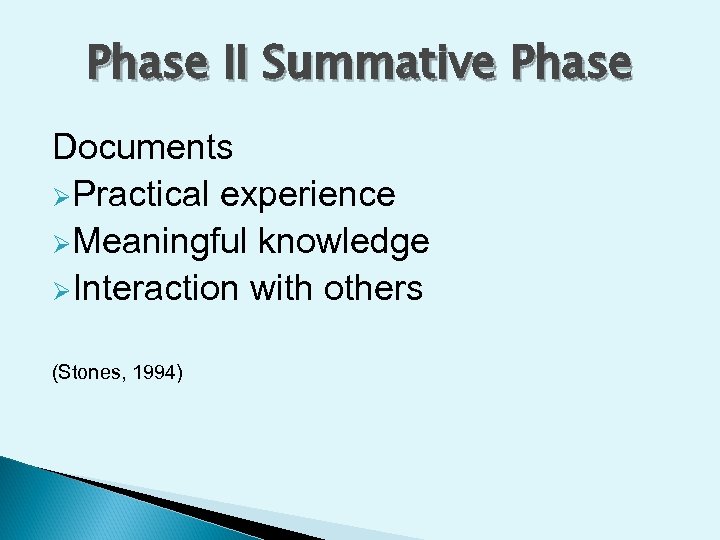 Phase II Summative Phase Documents ØPractical experience ØMeaningful knowledge ØInteraction with others (Stones, 1994)
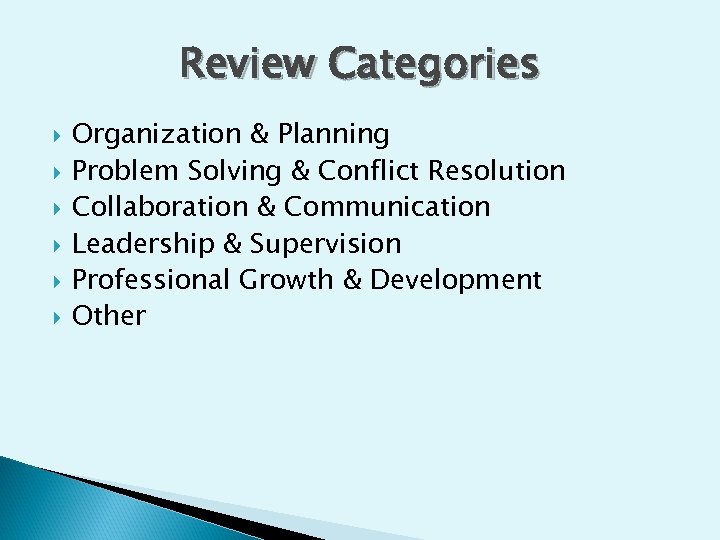 Review Categories Organization & Planning Problem Solving & Conflict Resolution Collaboration & Communication Leadership & Supervision Professional Growth & Development Other
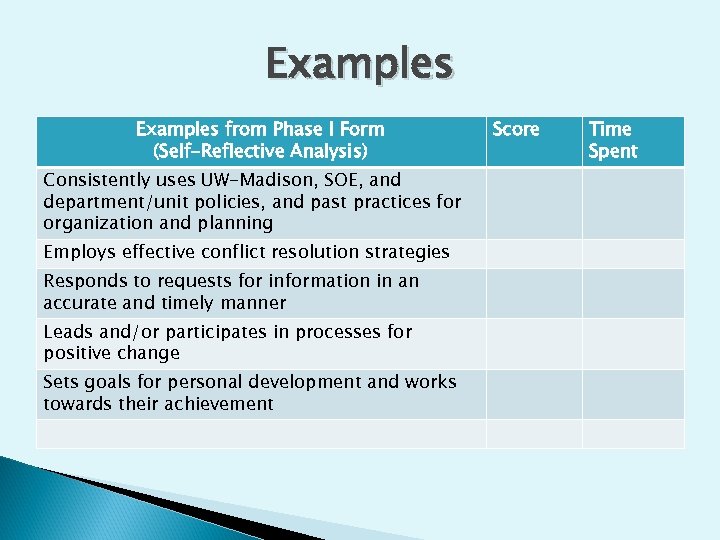 Examples from Phase I Form (Self-Reflective Analysis) Consistently uses UW-Madison, SOE, and department/unit policies, and past practices for organization and planning Employs effective conflict resolution strategies Responds to requests for information in an accurate and timely manner Leads and/or participates in processes for positive change Sets goals for personal development and works towards their achievement Score Time Spent
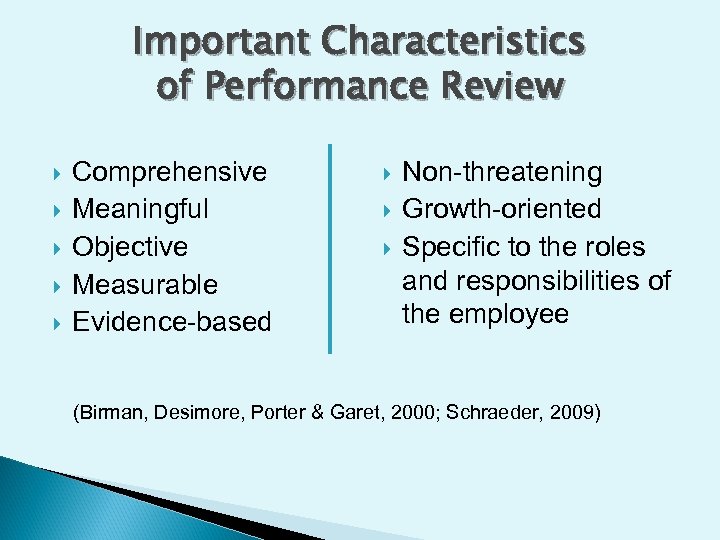 Important Characteristics of Performance Review Comprehensive Meaningful Objective Measurable Evidence-based Non-threatening Growth-oriented Specific to the roles and responsibilities of the employee (Birman, Desimore, Porter & Garet, 2000; Schraeder, 2009)
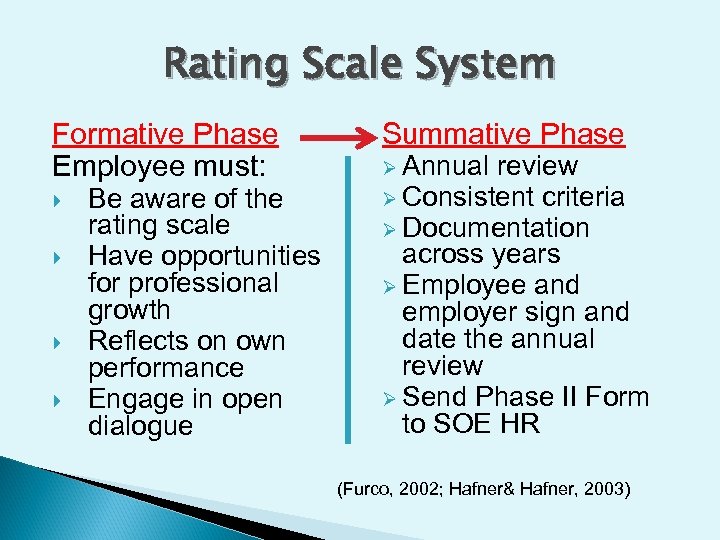 Rating Scale System Formative Phase Employee must: Be aware of the rating scale Have opportunities for professional growth Reflects on own performance Engage in open dialogue Summative Phase Ø Annual review Ø Consistent criteria Ø Documentation across years Ø Employee and employer sign and date the annual review Ø Send Phase II Form to SOE HR (Furco, 2002; Hafner& Hafner, 2003)
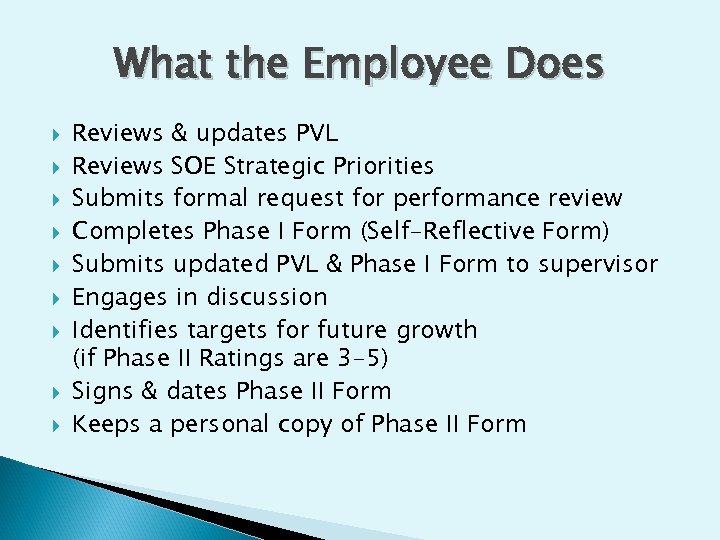 What the Employee Does Reviews & updates PVL Reviews SOE Strategic Priorities Submits formal request for performance review Completes Phase I Form (Self-Reflective Form) Submits updated PVL & Phase I Form to supervisor Engages in discussion Identifies targets for future growth (if Phase II Ratings are 3 -5) Signs & dates Phase II Form Keeps a personal copy of Phase II Form
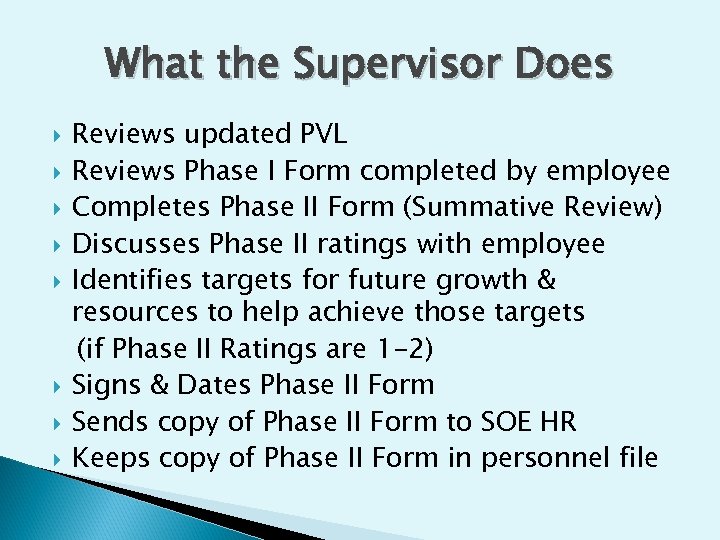 What the Supervisor Does Reviews updated PVL Reviews Phase I Form completed by employee Completes Phase II Form (Summative Review) Discusses Phase II ratings with employee Identifies targets for future growth & resources to help achieve those targets (if Phase II Ratings are 1 -2) Signs & Dates Phase II Form Sends copy of Phase II Form to SOE HR Keeps copy of Phase II Form in personnel file
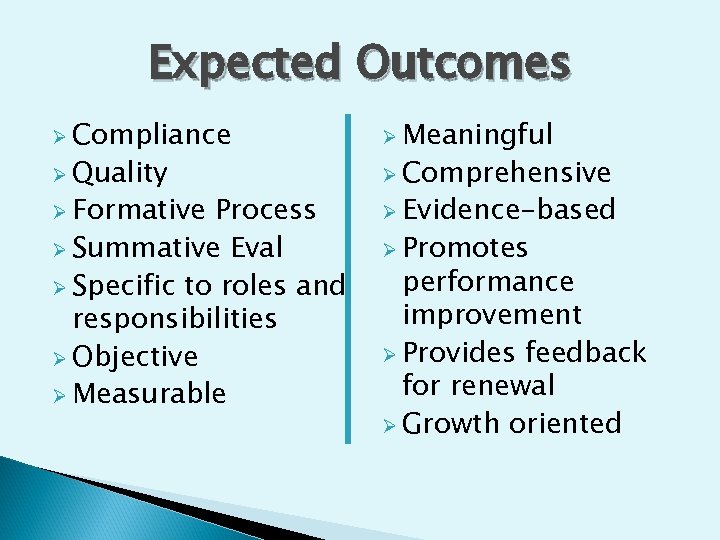 Expected Outcomes Ø Compliance Ø Meaningful Ø Formative Ø Evidence-based Ø Quality Process Ø Summative Eval Ø Specific to roles and responsibilities Ø Objective Ø Measurable Ø Comprehensive Ø Promotes performance improvement Ø Provides feedback for renewal Ø Growth oriented
 Bibliography American Speech-Language-Hearing Association. (2001). Guidelines for developing formative assessment plans for implementation of new standards for the Certificate of Clinical Competence. Retrieved May 12, 2005, from www. asha. org/about/credentialing/accreditation/CAA_Formative_Assess. htm American Speech-Language-Hearing Association. (2006). Professional Performance Review Process for the School-Based Speech-Language Pathologist [Guidelines]. Available from www. asha. org/policy. Birman, B. , Desimone, L. , Porter, A. , & Garet, M. (2000). Designing professional development that works. Educational Leadership, 57(8), 28– 32. Bloom, B. S. , Hastings, J. T. , & Madaus, G. F. (1971). Handbook on formative and summative evaluation of student learning. New York: Mc. Graw-Hill. Brown, J. C. (2000, June). Costs and benefits of reflective supervision. Asha Administration and Supervision, 3– 5, 15– 18. Danielson, C. (2001). New trends in teacher evaluation. Educational Leadership, 58(5), 12– 15.
 Bibliography Ferraro, J. M. (2000). Teacher mentoring as professional development, ERIC Digest (ED 4), Retrieved May 12, 2005, from http: //www. ericdigests. org/2001 -3/reflective. htm Furco, A. (2002). Self-assessment rubric for the institutionalization of service learning in higher education. Retrieved Oct. 10, 2009 from: http: //www. paccompact. org/documents/Furcorubric. pdf Hafner, J. & Hafner, P. (2003). Quantitative analysis of the rubric as an assessment tool: An empirical study of student peer-group rating. International Journal of Science Education, 25(12), 1509 -1528. Harris, A. (1998). Effective teaching: A review of the literature. School Leadership & Management, 18(2), 169– 183. EJ 563 868. Mc. Carthy, M. P. (2003, October). Promoting problem-solving and selfevaluation in clinical education through a collaborative approach to supervision. Asha Administration and Supervision, 20– 26.
 Bibliography Saras, L. (2003, October). Reflective journals: A tool in a clinical supervision model. Perspectives on Administration and Supervision, 11, 25– 26. Schraeder, T. (2009). Ethical issues related to professional performance review for the school-based speech-language pathologist. Presented at the New Jersey Speech-Language Hearing Association Annual Convention, Atlantic City, New Jersey, May, 2009. Schon, D. A. (1996). Educating the reflective practitioner: Toward a new design for teaching and learning in the professions. San Francisco: Jossey-Bass. Stones, E. (1994). Reform in teacher education: The power and the pedagogy. Journal of Teacher Education, 45, 310– 318. Vega-Barachowitz, C. D. (2003, June). Review of the reflective practitioner. Perspectives on Administration and Supervision, 11, 14– 15