 Скачать презентацию Academic Quality is Enhanced Achievements are Documented Accountability
45dc72926f6a0b319f299e367ffef306.ppt
- Количество слайдов: 53







Academic Quality is Enhanced Achievements are Documented Accountability is Demonstrated Improvement Is Made Based on Assessment and Evaluation
Regional accrediting agencies are recognized by the US DOE and CHEA and accredit institutions within a prescribed geographic region. Regional accreditors accredit entire institutions, not individual programs or subject content areas.
Accreditation affirms that institutions. Have clearly defined and appropriate educational objectives; Have conditions under which objectives can reasonably be achieved; Are substantially accomplishing their objectives; and Are reasonably organized, staffed, and supported to continue to do so.





Standard Element Number and Title (Conceptual Framework) Example Standard 2. B - Educational Program Planning and Assessment






Each accredited and candidate institution is expected to engage in ongoing planning to achieve its mission and goals, evaluate how well, and in what ways, it is accomplishing its mission and goals, and demonstrate that it uses the results for broad-based, continuous planning and evaluation.
Expected learning outcomes are identified and published for each degree and certificate program. Regular and systematic assessment documents that students have achieved these outcomes. Educational assessment processes are clearly defined, encompass all offerings, conducted regularly, and integrated into overall planning and evaluation.




This policy is intended to apply to the broadest possible definition of distance delivery of instruction. Degree programs and credit courses may or may not be delivered exclusively via telecommunications.
Institutions are expected to conduct some form of substantive performance evaluation of all faculty members at least once within each five-years of service. The evaluation should be collegial, participatory, and use multiple indices of assessment.

An accredited or candidate institution may not lend the prestige or authority of its accreditation to authenticate courses or programs offered under contract with other organizations unless it demonstrates oversight and responsibility for those offerings in compliance with Commission standards, principles, and practices.




If headed in the wrong direction, going faster isn’t better.

What are your institution’s expectations of itself?



Does your institution fulfill its mission? Are institutional goals achieved? Are intended outcomes realized? Is institutional integrity maintained? Does your institution continuously improve? How do you know? What is your evidence?



Identify institutional outcomes Identify criteria that measure intended institutional/program outcomes Collect data based upon the criteria Assess, analyze, and evaluate the data Indicate how results are used in planning Develop and implement change strategies



Executive Summary Succinct, comprehensive snapshot Provides institutional context Major changes since last evaluation Summary of major findings Implications Plans for improvement
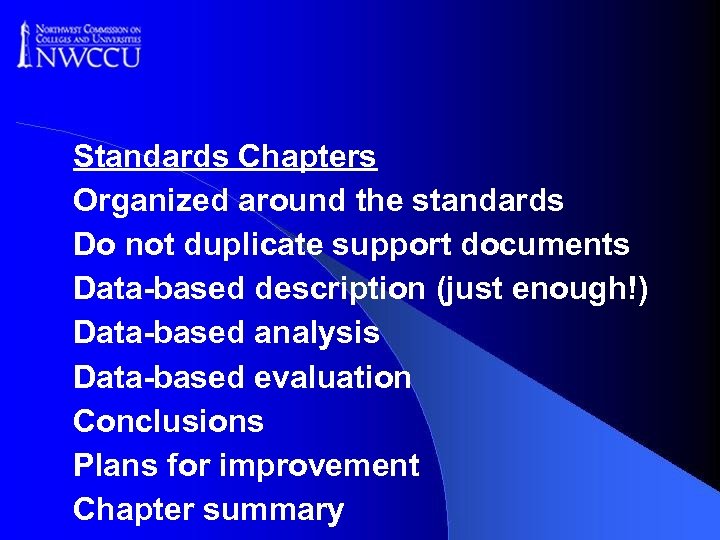
Standards Chapters Organized around the standards Do not duplicate support documents Data-based description (just enough!) Data-based analysis Data-based evaluation Conclusions Plans for improvement Chapter summary
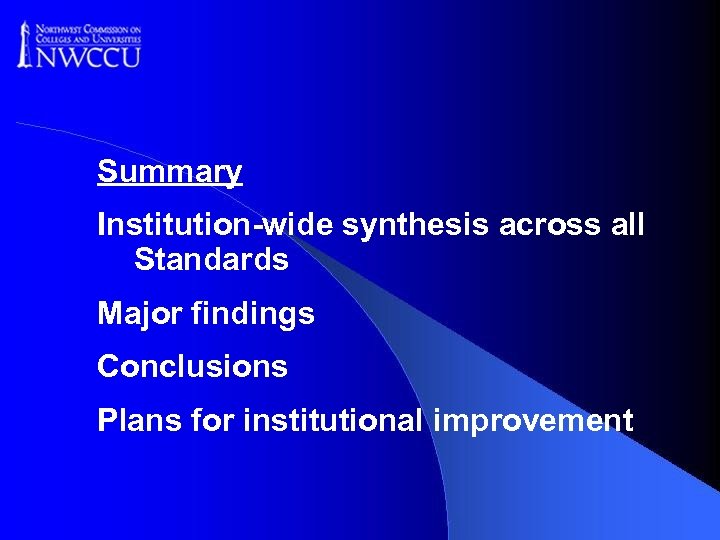
Summary Institution-wide synthesis across all Standards Major findings Conclusions Plans for institutional improvement








 Скачать презентацию Academic Quality is Enhanced Achievements are Documented Accountability
45dc72926f6a0b319f299e367ffef306.ppt