


 Скачать презентацию Academic Advising The Key to Student Success Conference
819d7ee544382957a4cbb2ab3b3451d7.ppt
- Количество слайдов: 35
 Academic Advising: The Key to Student Success Conference on Innovation Dallas, Texas March 11, 2013
 Presenters • Terry O’Banion—President Emeritus, League for Innovation & Chair of the Graduate Faculty, National American University • Joyce C. Romano—Vice President for Student Affairs, Valencia College
 Academic Advising Academic advising is the second most important function in the community college. If it is not conducted with the utmost efficiency and effectiveness, the most important function in the college—instruction— will fail to achieve its purpose of ensuring that students succeed in navigating the curriculum to completion.
 What Is Academic Advising ? 1. Exploration of Life Goals 2. Exploration of Vocational Goals 3. Program Choice 4. Course Choice 5. Scheduling Courses
 Knowledge & Skills Required Exploring Life Goals • Knowledge of student characteristics and development • Understanding of decision making process • Knowledge of psychology and sociology • Skills in counseling techniques • Appreciation of individual differences • Belief in worth and dignity of all students • Belief that all students have potential.
 Knowledge & Skills Required • • • Exploring Vocational Goals All included in “exploring life goals” plus the following: Knowledge of vocational fields Skill in interpretation of tests Under standing f changing nature of o work in society Acceptance of all fields of work as worthy and dignified.
 Knowledge & Skills Required • • • Program Choice Knowledge of programs available in the college Knowledge of requirements of programs Knowledge of university requirements for transfer programs Knowledge of how others have performed in the program Knowledge of follow up success
 Knowledge & Skills Required Course Choice • Knowledge of courses available • Knowledge of any special information regarding courses (prerequisites, offered only in certain times, transferability) • Rules and regulations of the college regarding probation and suspension, limit on course load (academic and work limitations) • Knowledge of honors courses or remedial courses • Knowledge of instructors and their teaching styles • Knowledge of student's ability through test scores, high school record, etc. • Knowledge of course content
 Knowledge & Skills Required Scheduling Courses • Knowledge of schedule • Knowledge of the systems of scheduling and changing the schedule • Knowledge of work and commuting requirements.
 Life. Map: A Learning-Centered System for Student Success Valencia College Orlando, Florida
 Systemic Change at Valencia – 1995 -2003 • Life. Map Conceptual Model: 1995 – 1999 • Life. Map system development: 1999 – 2002 (and continuing) • Atlas system design and development: 2000 -2002 (and continuing) • Re-designed Student Services (Integrated Services Model) design and development: 2001 -2003 (and continuing)
 Building an Advising System • • • Focus on measurable results Conceptual model for foundation Look from the student perspective outward Start with reality but design for ideal The “whole” is more than the sum of the parts (system alignment) • Faculty and staff development (ongoing) • How are we doing? (Feedback to stakeholders – Keep going deeper) • Review and evolution (organic system)
 Connection and Direction Students are more likely to persist if they: • Feel safe, welcome, respected, and acknowledged – make social as well as academic connections – hold and sense from others a belief in their potential • Are both challenged and supported academically – can link new learning to prior knowledge – engage actively in their learning – have multiple opportunities to give and receive constructive feedback • Have a plan for completion
 Life. Map Theory Foundation • • • Frost, 1991 Gordon and Sears, 1997 Hossler and Schmidt, 1990 O’Banion, 1994 Tinto, 1993
 LIFEMAP: Mission Statement A system of shared responsibilities between students and the college that results in social and academic integration, education and career plans, and the acquisition of study and life skills.
 LIFEMAP : sm Ideal Model of Student Progression • • • College Transition Introduction to College Progression to Degree Graduation Transition Life Long Learning
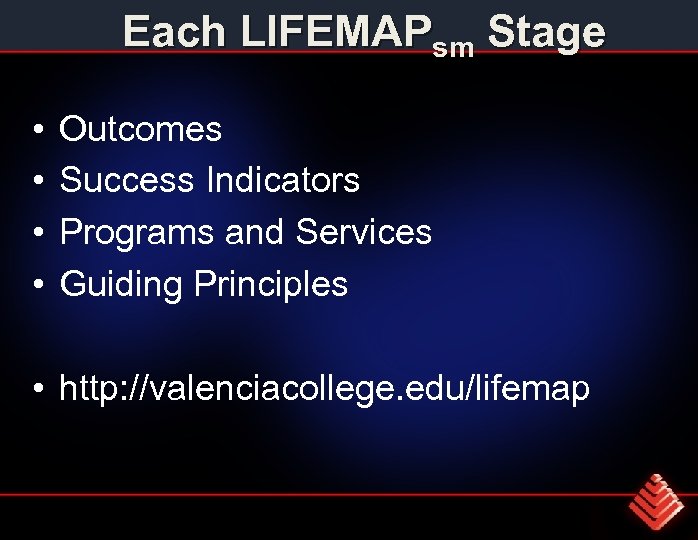 Each LIFEMAPsm Stage • • Outcomes Success Indicators Programs and Services Guiding Principles • http: //valenciacollege. edu/lifemap
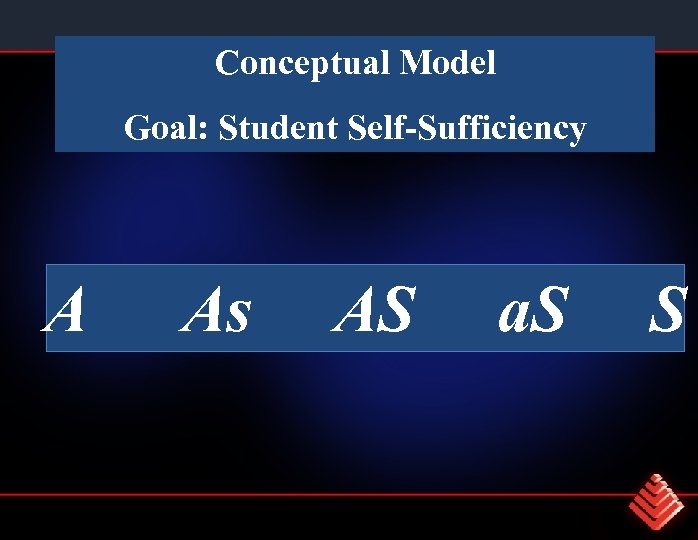 Conceptual Model Goal: Student Self-Sufficiency A As AS a. S S
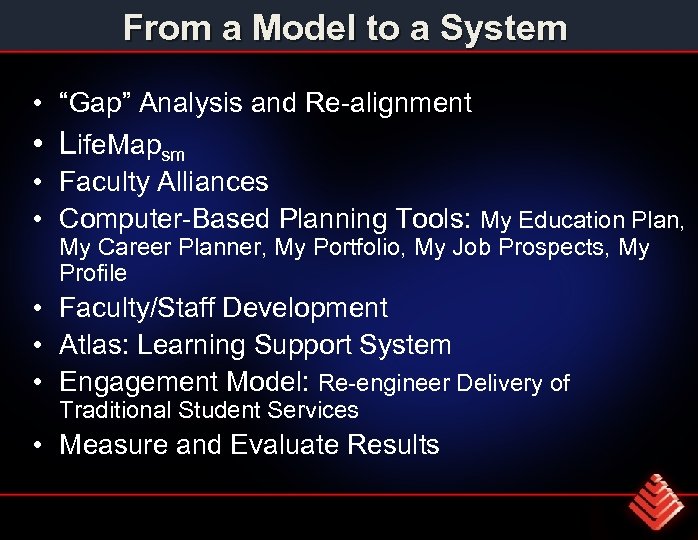 From a Model to a System • “Gap” Analysis and Re-alignment • Life. Mapsm • Faculty Alliances • Computer-Based Planning Tools: My Education Plan, My Career Planner, My Portfolio, My Job Prospects, My Profile • Faculty/Staff Development • Atlas: Learning Support System • Engagement Model: Re-engineer Delivery of Traditional Student Services • Measure and Evaluate Results
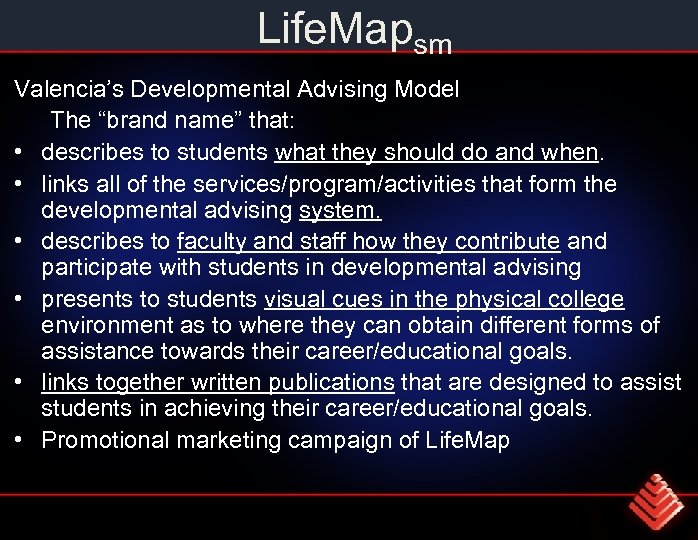 Life. Mapsm Valencia’s Developmental Advising Model The “brand name” that: • describes to students what they should do and when. • links all of the services/program/activities that form the developmental advising system. • describes to faculty and staff how they contribute and participate with students in developmental advising • presents to students visual cues in the physical college environment as to where they can obtain different forms of assistance towards their career/educational goals. • links together written publications that are designed to assist students in achieving their career/educational goals. • Promotional marketing campaign of Life. Map
 Life. Map Student Handbook • Chapters follow O’Banion model (life, career, and educational goals, building a schedule, success tips, learning outcomes) • College services are listed in the chapter related to the goals they support. • Includes self assessments and interpretations. • Calendar pages like “Day Timer” include key college dates. • “To Do” cues are listed on each calendar page and are tied to Developmental Advising Stages with icons. • “Been There” quotes add advice from peers.
 Faculty Alliances • Career or Education Plans as part of Student Motivation (Susan Frost, 1991) • Inclusive classrooms • Engagement in learning strategies • Connection and Direction are critical to student success • A “Competency” of Valencia Faculty • Included in Teaching and Learning Academy curriculum (continuing contract process) • Faculty Life. Map Groups • Faculty Life. Map Guidebook corollary to Life. Map Student Handbook • Life. Map Certificate (new in 2012 -13) • http: //valenciacollege. edu/faculty/development
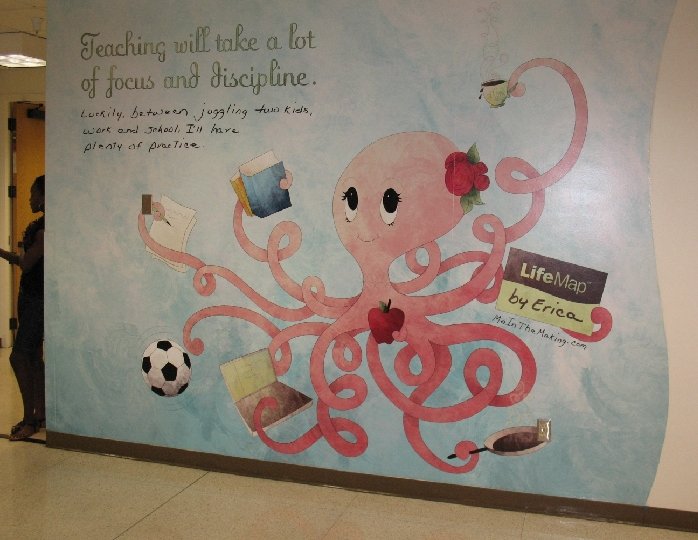
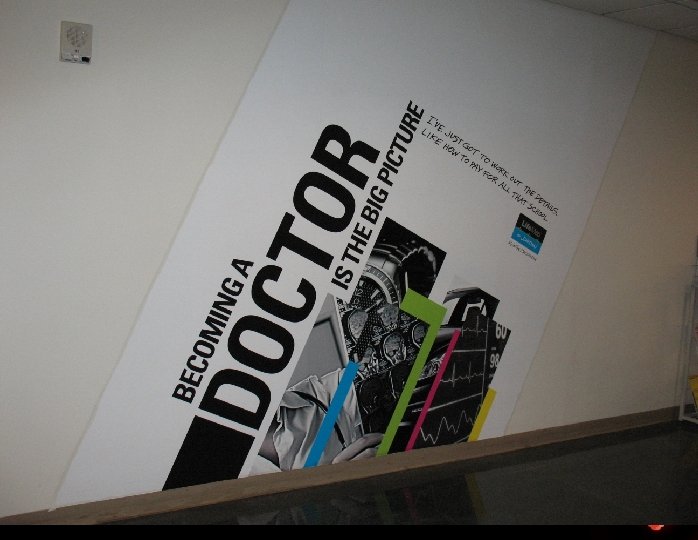
 2010 Life. Map Marketing Campaign • • • Life. Map is a process, a journey, not a “thing” Create your own “unique” Life. Map Use college resources, people and programs Peer models for student “life stories” (6) Environmental campaign features the Peers Specialized web site that connects Life. Map resources inside and outside of Valencia “meinthemaking. com” • “Call to action” and follow through important • Office signage as “wayfinding” for students
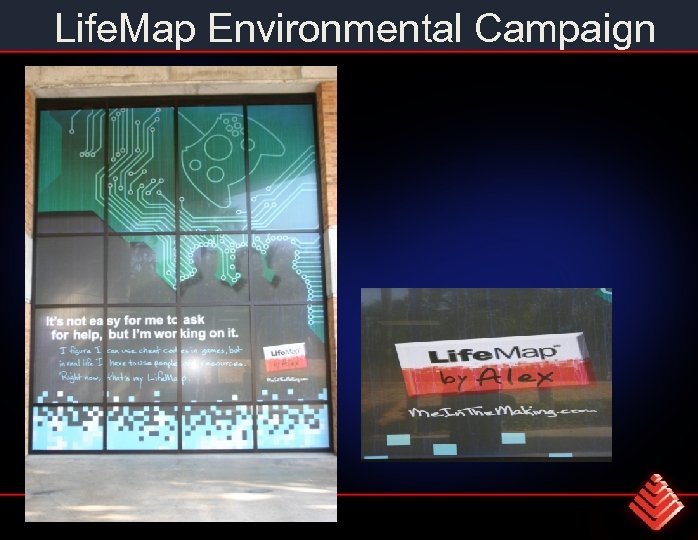 Life. Map Environmental Campaign

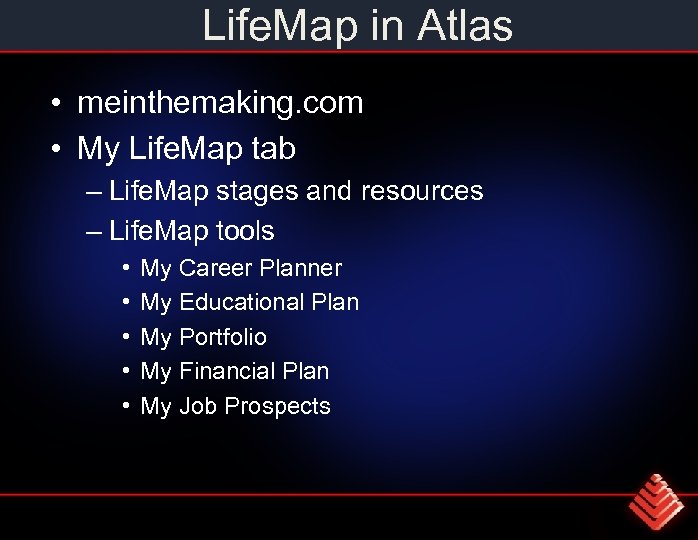 Life. Map in Atlas • meinthemaking. com • My Life. Map tab – Life. Map stages and resources – Life. Map tools • • • My Career Planner My Educational Plan My Portfolio My Financial Plan My Job Prospects
 Re Design of Student Service Delivery With Student LEARNING as the design principle: • Emphasize level of assistance students are seeking rather than the content. • Create staff positions whose primary job is working directly with students and staff positions whose primary job is processing and verifying information. • Focus on students LEARNING process, not just getting answers to questions. • View technology as a tool to enhance learning, not to drive our processes
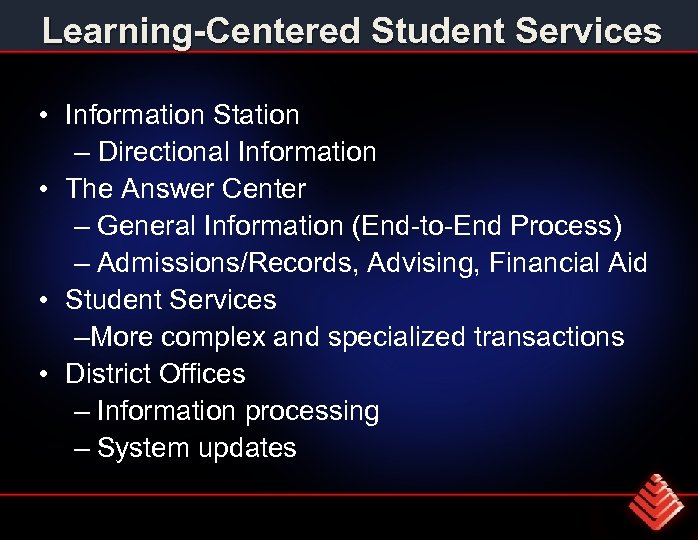 Learning Centered Student Services • Information Station – Directional Information • The Answer Center – General Information (End-to-End Process) – Admissions/Records, Advising, Financial Aid • Student Services –More complex and specialized transactions • District Offices – Information processing – System updates
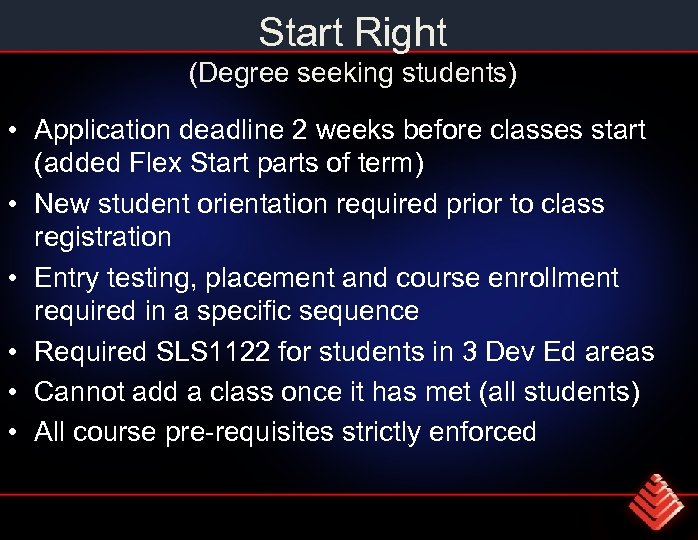 Start Right (Degree seeking students) • Application deadline 2 weeks before classes start (added Flex Start parts of term) • New student orientation required prior to class registration • Entry testing, placement and course enrollment required in a specific sequence • Required SLS 1122 for students in 3 Dev Ed areas • Cannot add a class once it has met (all students) • All course pre-requisites strictly enforced
 Coming Soon Academic Advising: The Key to Student Success Terry O’Banion—Editor Available from AACC
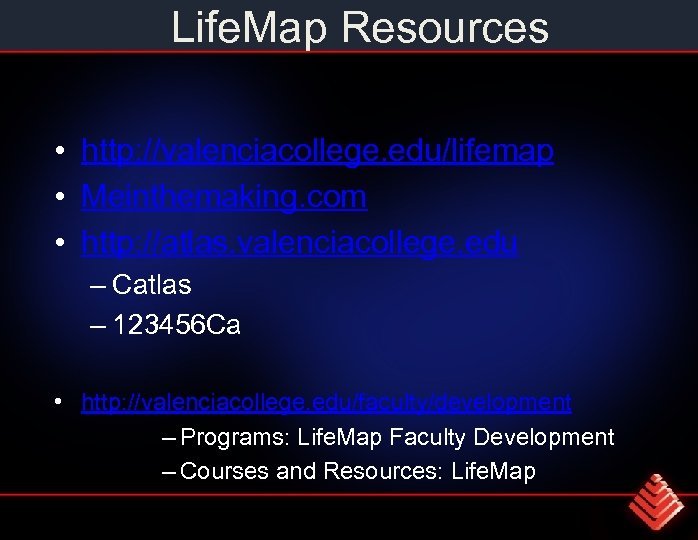 Life. Map Resources • http: //valenciacollege. edu/lifemap • Meinthemaking. com • http: //atlas. valenciacollege. edu – Catlas – 123456 Ca • http: //valenciacollege. edu/faculty/development – Programs: Life. Map Faculty Development – Courses and Resources: Life. Map
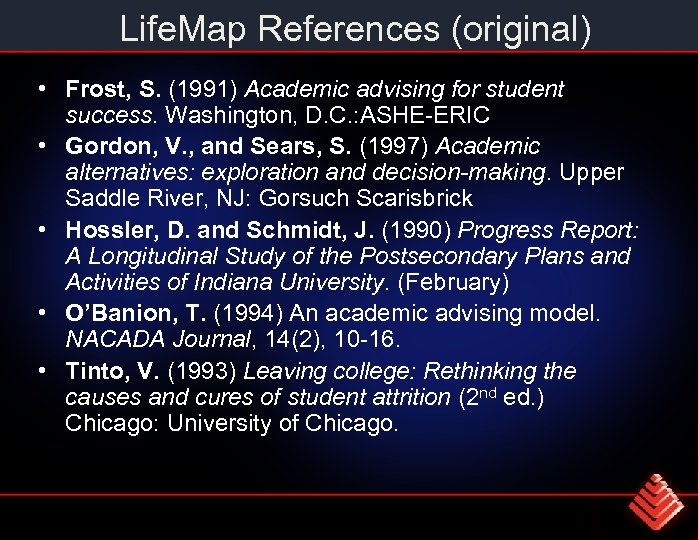 Life. Map References (original) • Frost, S. (1991) Academic advising for student success. Washington, D. C. : ASHE-ERIC • Gordon, V. , and Sears, S. (1997) Academic alternatives: exploration and decision-making. Upper Saddle River, NJ: Gorsuch Scarisbrick • Hossler, D. and Schmidt, J. (1990) Progress Report: A Longitudinal Study of the Postsecondary Plans and Activities of Indiana University. (February) • O’Banion, T. (1994) An academic advising model. NACADA Journal, 14(2), 10 -16. • Tinto, V. (1993) Leaving college: Rethinking the causes and cures of student attrition (2 nd ed. ) Chicago: University of Chicago.
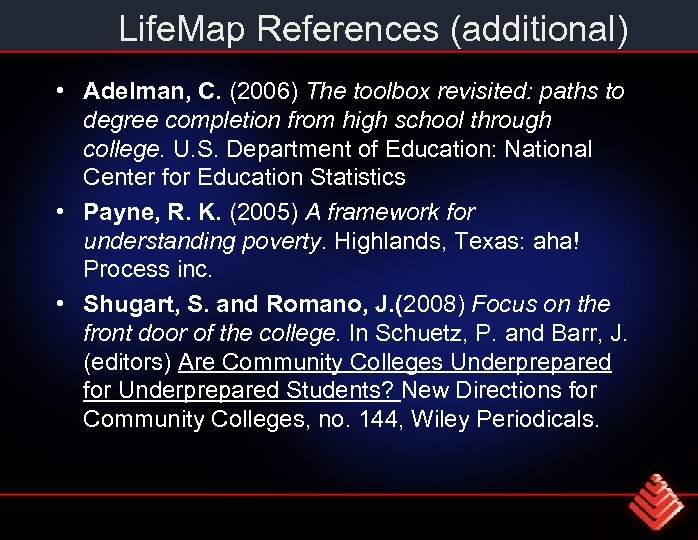 Life. Map References (additional) • Adelman, C. (2006) The toolbox revisited: paths to degree completion from high school through college. U. S. Department of Education: National Center for Education Statistics • Payne, R. K. (2005) A framework for understanding poverty. Highlands, Texas: aha! Process inc. • Shugart, S. and Romano, J. (2008) Focus on the front door of the college. In Schuetz, P. and Barr, J. (editors) Are Community Colleges Underprepared for Underprepared Students? New Directions for Community Colleges, no. 144, Wiley Periodicals.