 Скачать презентацию Abundance biomass and production of Oithona similis in
d60324ba15a068a36868d77e342792cf.ppt
- Количество слайдов: 1



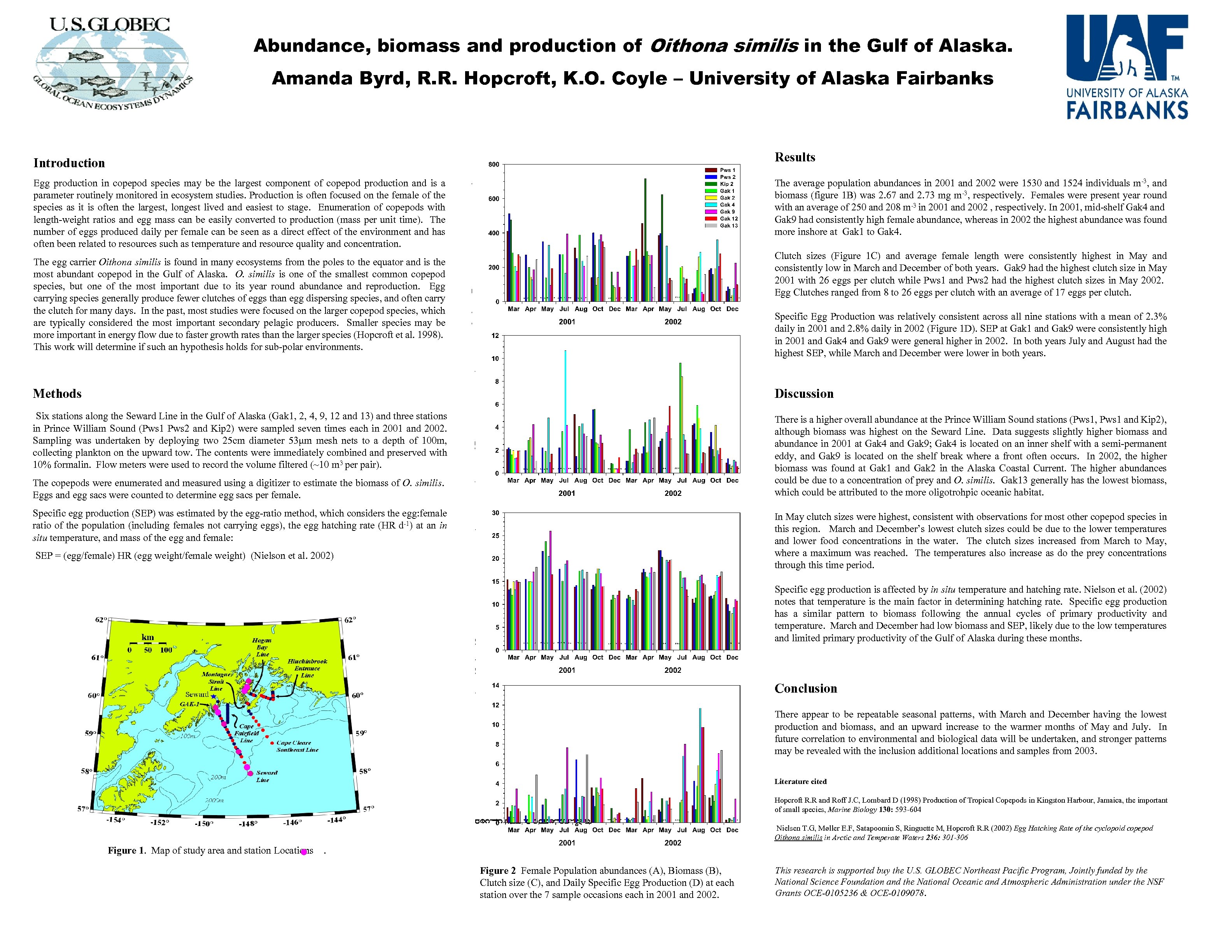
Abundance, biomass and production of Oithona similis in the Gulf of Alaska. Amanda Byrd, R. R. Hopcroft, K. O. Coyle – University of Alaska Fairbanks Results Introduction The average population abundances in 2001 and 2002 were 1530 and 1524 individuals m-3, and biomass (figure 1 B) was 2. 67 and 2. 73 mg m-3, respectively. Females were present year round with an average of 250 and 208 m-3 in 2001 and 2002 , respectively. In 2001, mid-shelf Gak 4 and Gak 9 had consistently high female abundance, whereas in 2002 the highest abundance was found more inshore at Gak 1 to Gak 4. Clutch sizes (Figure 1 C) and average female length were consistently highest in May and consistently low in March and December of both years. Gak 9 had the highest clutch size in May 2001 with 26 eggs per clutch while Pws 1 and Pws 2 had the highest clutch sizes in May 2002. Egg Clutches ranged from 8 to 26 eggs per clutch with an average of 17 eggs per clutch. Specific Egg Production was relatively consistent across all nine stations with a mean of 2. 3% daily in 2001 and 2. 8% daily in 2002 (Figure 1 D). SEP at Gak 1 and Gak 9 were consistently high in 2001 and Gak 4 and Gak 9 were general higher in 2002. In both years July and August had the highest SEP, while March and December were lower in both years. Egg production in copepod species may be the largest component of copepod production and is a parameter routinely monitored in ecosystem studies. Production is often focused on the female of the species as it is often the largest, longest lived and easiest to stage. Enumeration of copepods with length-weight ratios and egg mass can be easily converted to production (mass per unit time). The number of eggs produced daily per female can be seen as a direct effect of the environment and has often been related to resources such as temperature and resource quality and concentration. The egg carrier Oithona similis is found in many ecosystems from the poles to the equator and is the most abundant copepod in the Gulf of Alaska. O. similis is one of the smallest common copepod species, but one of the most important due to its year round abundance and reproduction. Egg carrying species generally produce fewer clutches of eggs than egg dispersing species, and often carry the clutch for many days. In the past, most studies were focused on the larger copepod species, which are typically considered the most important secondary pelagic producers. Smaller species may be more important in energy flow due to faster growth rates than the larger species (Hopcroft et al. 1998). This work will determine if such an hypothesis holds for sub-polar environments. Methods Discussion Six stations along the Seward Line in the Gulf of Alaska (Gak 1, 2, 4, 9, 12 and 13) and three stations There is a higher overall abundance at the Prince William Sound stations (Pws 1, Pws 1 and Kip 2), although biomass was highest on the Seward Line. Data suggests slightly higher biomass and abundance in 2001 at Gak 4 and Gak 9; Gak 4 is located on an inner shelf with a semi-permanent eddy, and Gak 9 is located on the shelf break where a front often occurs. In 2002, the higher biomass was found at Gak 1 and Gak 2 in the Alaska Coastal Current. The higher abundances could be due to a concentration of prey and O. similis. Gak 13 generally has the lowest biomass, which could be attributed to the more oligotrohpic oceanic habitat. in Prince William Sound (Pws 1 Pws 2 and Kip 2) were sampled seven times each in 2001 and 2002. Sampling was undertaken by deploying two 25 cm diameter 53μm mesh nets to a depth of 100 m, collecting plankton on the upward tow. The contents were immediately combined and preserved with 10% formalin. Flow meters were used to record the volume filtered (~10 m 3 per pair). The copepods were enumerated and measured using a digitizer to estimate the biomass of O. similis. Eggs and egg sacs were counted to determine egg sacs per female. Specific egg production (SEP) was estimated by the egg-ratio method, which considers the egg: female ratio of the population (including females not carrying eggs), the egg hatching rate (HR d-1) at an in situ temperature, and mass of the egg and female: In May clutch sizes were highest, consistent with observations for most other copepod species in this region. March and December’s lowest clutch sizes could be due to the lower temperatures and lower food concentrations in the water. The clutch sizes increased from March to May, where a maximum was reached. The temperatures also increase as do the prey concentrations through this time period. SEP = (egg/female) HR (egg weight/female weight) (Nielson et al. 2002) Specific egg production is affected by in situ temperature and hatching rate. Nielson et al. (2002) notes that temperature is the main factor in determining hatching rate. Specific egg production has a similar pattern to biomass following the annual cycles of primary productivity and temperature. March and December had low biomass and SEP, likely due to the low temperatures and limited primary productivity of the Gulf of Alaska during these months. Conclusion There appear to be repeatable seasonal patterns, with March and December having the lowest production and biomass, and an upward increase to the warmer months of May and July. In future correlation to environmental and biological data will be undertaken, and stronger patterns may be revealed with the inclusion additional locations and samples from 2003. Literature cited Hopcroft R. R and Roff J. C, Lombard D (1998) Production of Tropical Copepods in Kingston Harbour, Jamaica, the important of small species, Marine Biology 130: 593 -604 Nielsen T. G, Møller E. F, Satapoomin S, Ringuette M, Hopcroft R. R (2002) Egg Hatching Rate of the cyclopoid copepod Oithona similis in Arctic and Temperate Waters 236: 301 -306 Figure 1. Map of study area and station Locations . Figure 2 Female Population abundances (A), Biomass (B), Clutch size (C), and Daily Specific Egg Production (D) at each station over the 7 sample occasions each in 2001 and 2002. This research is supported buy the U. S. GLOBEC Northeast Pacific Program, Jointly funded by the National Science Foundation and the National Oceanic and Atmospheric Administration under the NSF Grants OCE-0105236 & OCE-0109078.
Скачать презентацию Abundance biomass and production of Oithona similis in
d60324ba15a068a36868d77e342792cf.ppt