 Скачать презентацию Abstract Due to the variable nature of the
a2b00c74198294fb66c953bd70bc1a3a.ppt
- Количество слайдов: 1



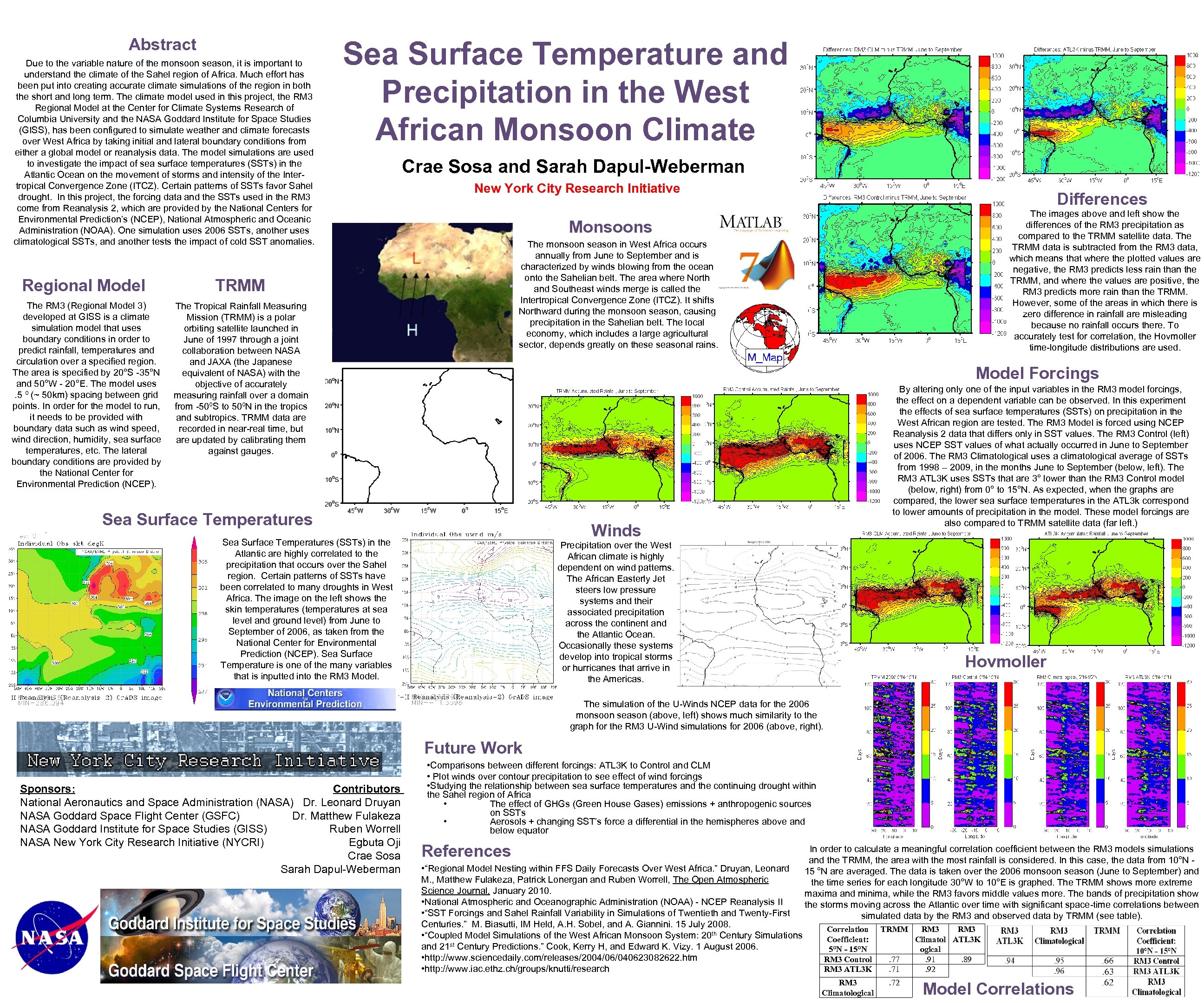
Abstract Due to the variable nature of the monsoon season, it is important to understand the climate of the Sahel region of Africa. Much effort has been put into creating accurate climate simulations of the region in both the short and long term. The climate model used in this project, the RM 3 Regional Model at the Center for Climate Systems Research of Columbia University and the NASA Goddard Institute for Space Studies (GISS), has been configured to simulate weather and climate forecasts over West Africa by taking initial and lateral boundary conditions from either a global model or reanalysis data. The model simulations are used to investigate the impact of sea surface temperatures (SSTs) in the Atlantic Ocean on the movement of storms and intensity of the Intertropical Convergence Zone (ITCZ). Certain patterns of SSTs favor Sahel drought. In this project, the forcing data and the SSTs used in the RM 3 come from Reanalysis 2, which are provided by the National Centers for Environmental Prediction’s (NCEP), National Atmospheric and Oceanic Administration (NOAA). One simulation uses 2006 SSTs, another uses climatological SSTs, and another tests the impact of cold SST anomalies. Regional Model Crae Sosa and Sarah Dapul-Weberman New York City Research Initiative Differences The images above and left show the differences of the RM 3 precipitation as compared to the TRMM satellite data. The TRMM data is subtracted from the RM 3 data, which means that where the plotted values are negative, the RM 3 predicts less rain than the TRMM, and where the values are positive, the RM 3 predicts more rain than the TRMM. However, some of the areas in which there is zero difference in rainfall are misleading because no rainfall occurs there. To accurately test for correlation, the Hovmoller time-longitude distributions are used. Monsoons The monsoon season in West Africa occurs annually from June to September and is characterized by winds blowing from the ocean onto the Sahelian belt. The area where North and Southeast winds merge is called the Intertropical Convergence Zone (ITCZ). It shifts Northward during the monsoon season, causing precipitation in the Sahelian belt. The local economy, which includes a large agricultural sector, depends greatly on these seasonal rains. TRMM The RM 3 (Regional Model 3) developed at GISS is a climate simulation model that uses boundary conditions in order to predict rainfall, temperatures and circulation over a specified region. The area is specified by 20°S -35°N and 50°W - 20°E. The model uses. 5 º (~ 50 km) spacing between grid points. In order for the model to run, it needs to be provided with boundary data such as wind speed, wind direction, humidity, sea surface temperatures, etc. The lateral boundary conditions are provided by the National Center for Environmental Prediction (NCEP). Sea Surface Temperature and Precipitation in the West African Monsoon Climate The Tropical Rainfall Measuring Mission (TRMM) is a polar orbiting satellite launched in June of 1997 through a joint collaboration between NASA and JAXA (the Japanese equivalent of NASA) with the objective of accurately measuring rainfall over a domain from -50ºS to 50ºN in the tropics and subtropics. TRMM data are recorded in near-real time, but are updated by calibrating them against gauges. Model Forcings Sea Surface Temperatures By altering only one of the input variables in the RM 3 model forcings, the effect on a dependent variable can be observed. In this experiment the effects of sea surface temperatures (SSTs) on precipitation in the West African region are tested. The RM 3 Model is forced using NCEP Reanalysis 2 data that differs only in SST values. The RM 3 Control (left) uses NCEP SST values of what actually occurred in June to September of 2006. The RM 3 Climatological uses a climatological average of SSTs from 1998 – 2009, in the months June to September (below, left). The RM 3 ATL 3 K uses SSTs that are 3° lower than the RM 3 Control model (below, right) from 0° to 15°N. As expected, when the graphs are compared, the lower sea surface temperatures in the ATL 3 k correspond to lower amounts of precipitation in the model. These model forcings are also compared to TRMM satellite data (far left. ) Winds Sea Surface Temperatures (SSTs) in the Atlantic are highly correlated to the precipitation that occurs over the Sahel region. Certain patterns of SSTs have been correlated to many droughts in West Africa. The image on the left shows the skin temperatures (temperatures at sea level and ground level) from June to September of 2006, as taken from the National Center for Environmental Prediction (NCEP). Sea Surface Temperature is one of the many variables that is inputted into the RM 3 Model. Precipitation over the West African climate is highly dependent on wind patterns. The African Easterly Jet steers low pressure systems and their associated precipitation across the continent and the Atlantic Ocean. Occasionally these systems develop into tropical storms or hurricanes that arrive in the Americas. Hovmoller The simulation of the U-Winds NCEP data for the 2006 monsoon season (above, left) shows much similarity to the graph for the RM 3 U-Wind simulations for 2006 (above, right). Future Work Sponsors: Contributors National Aeronautics and Space Administration (NASA) Dr. Leonard Druyan NASA Goddard Space Flight Center (GSFC) Dr. Matthew Fulakeza NASA Goddard Institute for Space Studies (GISS) Ruben Worrell NASA New York City Research Initiative (NYCRI) Egbuta Oji Crae Sosa Sarah Dapul-Weberman • Comparisons between different forcings: ATL 3 K to Control and CLM • Plot winds over contour precipitation to see effect of wind forcings • Studying the relationship between sea surface temperatures and the continuing drought within the Sahel region of Africa • The effect of GHGs (Green House Gases) emissions + anthropogenic sources on SSTs • Aerosols + changing SST’s force a differential in the hemispheres above and below equator References • “Regional Model Nesting within FFS Daily Forecasts Over West Africa. ” Druyan, Leonard M. , Matthew Fulakeza, Patrick Lonergan and Ruben Worrell, The Open Atmospheric Science Journal, January 2010. • National Atmospheric and Oceanographic Administration (NOAA) - NCEP Reanalysis II • “SST Forcings and Sahel Rainfall Variability in Simulations of Twentieth and Twenty-First Centuries. ” M. Biasutti, IM Held, A. H. Sobel, and A. Giannini. 15 July 2008. • “Coupled Model Simulations of the West African Monsoon System: 20 th Century Simulations and 21 st Century Predictions. ” Cook, Kerry H, and Edward K. Vizy. 1 August 2006. • http: //www. sciencedaily. com/releases/2004/06/040623082622. htm • http: //www. iac. ethz. ch/groups/knutti/research In order to calculate a meaningful correlation coefficient between the RM 3 models simulations and the TRMM, the area with the most rainfall is considered. In this case, the data from 10°N 15 °N are averaged. The data is taken over the 2006 monsoon season (June to September) and the time series for each longitude 30°W to 10°E is graphed. The TRMM shows more extreme maxima and minima, while the RM 3 favors middle values more. The bands of precipitation show the storms moving across the Atlantic over time with significant space-time correlations between simulated data by the RM 3 and observed data by TRMM (see table). Correlation Coefficient: 5°N - 15°N RM 3 Control RM 3 ATL 3 K TRMM RM 3 Climatological . 72 RM 3 Climatol ATL 3 K ogical. 91. 89. 92 . 77 . 71 Model Correlations
Скачать презентацию Abstract Due to the variable nature of the
a2b00c74198294fb66c953bd70bc1a3a.ppt