 Скачать презентацию ABS Best Practice Standard Handbook Launch of
a1065cd49085541be2e2daa18fd7d7d8.ppt
- Количество слайдов: 28



ABS Best Practice Standard + Handbook Launch of the ABS Management Tool Side Event ABS Working Group 6 Meeting Geneva January 22, 2008 Sponsored by SECO Developed by: IISD, Stratos Inc. , Jorge Cabrera
Event Purpose Ø Introduce and launch the ABS Management Tool – Final version Ø Discuss use of the ABS-MT as: § A voluntary best practice standard to facilitate ABS activities § An instrument for capacity building + sharing of best practices 2
Background to the ABS-MT The Swiss government’s purpose with this project is to develop a management tool to support the implementation of the provisions of the CBD on access and Benefit Sharing: • • Facilitating access - providing guidance to industry and researchers as users of genetic resources Ensuring prior informed consent and fair and equitable sharing of benefits – for governments and communities as providers of genetic resources 3
History of Involvement Ø Co-chair ABS Expert Panel (1999/2000) Ø Study on certification system - bio prospecting (2001) Ø Swiss Guidelines (Inf. doc) as an input to Bonn Guidelines (2002) Ø Good Practice for Academic Research on Genetic Resources – Swiss Academy of Sciences (2005) Ø Development and testing of ABS MT (2004 – 2007) Ø Publication of ABS-Management Tool (2008) 4
Importance of this new Tool Ø Support implementation of the Bonn Guidelines and International Regime Ø Responds to the ABS capacity building action plan (COP decision VII/19 f) Ø Encourage commercial opportunities for access and development of genetic resources – under agreed terms 5
ABS Management Tool Project Phase 1 (2003 - 2004) § Research on ABS and other standards § Development of working draft Management Tool § International Advisory Committee Phase 2 (2004 – 2007) § § § Field Testing Outreach and stakeholder consultations Assessment of implementation options Revision and finalization of the ABS-MT International Advisory Committee Phase 3 (ABS WG 5 2007 – March 2008) § International consultation on implementation and use 6
ABS Management Tool Project Supported by Ø Swiss State Secretariat for Economic Affairs (SECO) Executed by Ø International Institute for Sustainable Development Ø Stratos Inc. Ø Jorge Cabrera 7
Project Activities Development of the Management Tool: § § § Working Draft + User Guide – 2004 Revised Working Draft – 2006 Best Practice Standard and Handbook – 2007 • Online accessibility in English, French and Spanish Outreach and Stakeholder Engagement Field Testing of the ABS – MT Design of an Implementation Plan and TOR 8
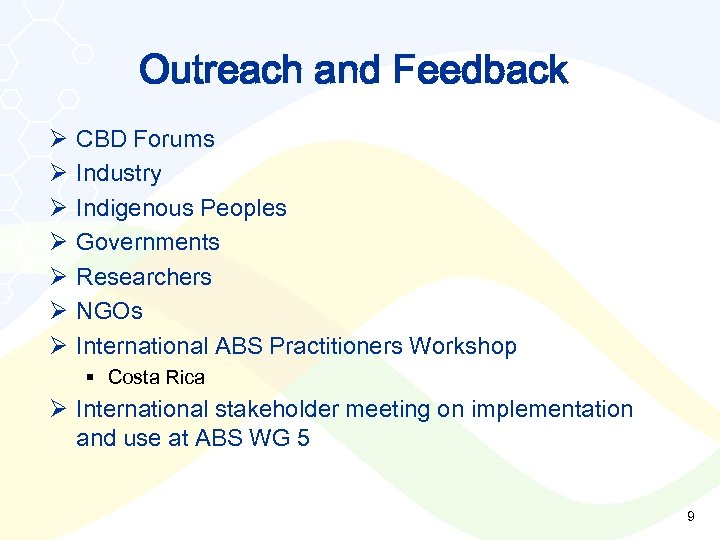
Outreach and Feedback Ø Ø Ø Ø CBD Forums Industry Indigenous Peoples Governments Researchers NGOs International ABS Practitioners Workshop § Costa Rica Ø International stakeholder meeting on implementation and use at ABS WG 5 9
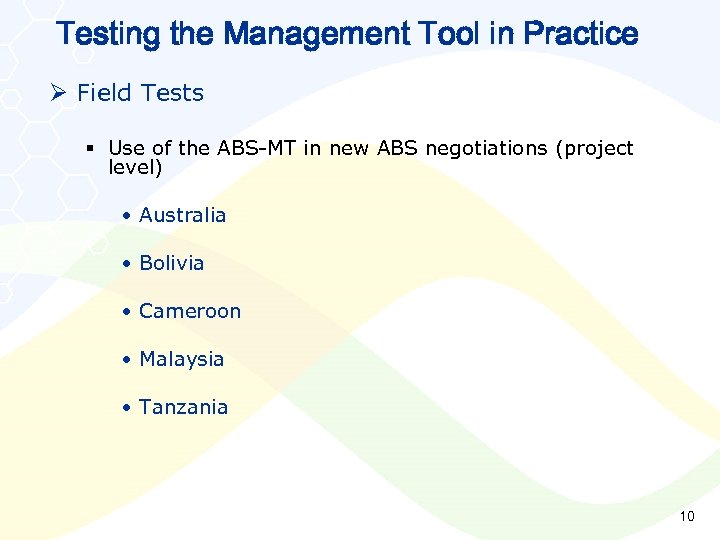
Testing the Management Tool in Practice Ø Field Tests § Use of the ABS-MT in new ABS negotiations (project level) • Australia • Bolivia • Cameroon • Malaysia • Tanzania 10
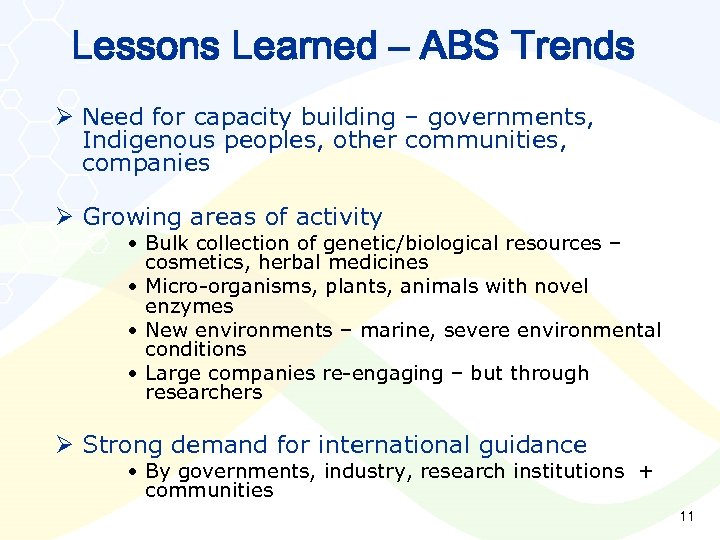
Lessons Learned – ABS Trends Ø Need for capacity building – governments, Indigenous peoples, other communities, companies Ø Growing areas of activity • Bulk collection of genetic/biological resources – cosmetics, herbal medicines • Micro-organisms, plants, animals with novel enzymes • New environments – marine, severe environmental conditions • Large companies re-engaging – but through researchers Ø Strong demand for international guidance • By governments, industry, research institutions + communities 11
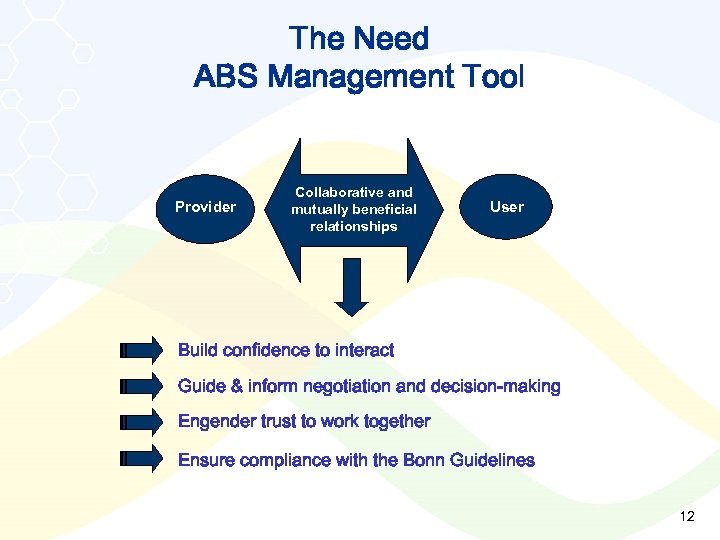
The Need ABS Management Tool Provider Collaborative and mutually beneficial relationships User Build confidence to interact Guide & inform negotiation and decision-making Engender trust to work together Ensure compliance with the Bonn Guidelines 12
What the ABS – MT Provides ØVoluntary best practice standard and handbook provides neutral guidance and tools on ABS practice for Users and Providers to ensure compliance with the Bonn Guidelines and CBD requirements ØA structured process and fair and equitable means for participating in and making decisions about ABS negotiations and the implementation of ABS agreements 13
Application of the ABS – MT Ø The ABS-MT applies to all stages of genetic resource activity: § Prior to access § Access (collection and bio-discovery) § Academic research § Research and development § Commercialization and commercial use Ø The ABS-MT is relevant to many sectors: § Pharmaceuticals § Botanicals + Neutraceuticals § Biotechnology § Horticulture including ornamentals § Agriculture (except where the FAO ITGRFA applies) 14
Application of the ABS – MT ØThe ABS-MT can be used by: § Large and small companies § Governments § Local and indigenous communities § Academic researchers – where future potential for commercial interest § Public and private research institutions § Holders of ex situ collections e. g. gardens, genetic resource collections § Intermediaries 15
16
Ø Insert volume 1 divider from MT 17
18
Management Processes Ø Use in an Organization’s Management System or Procedures Ø Other Management Considerations: § The Participation of Indigenous and Local Communities § Documentation and Information-management sharing § Reporting § Emerging Practices on Certificate of Origin/Compliance with National Law 19
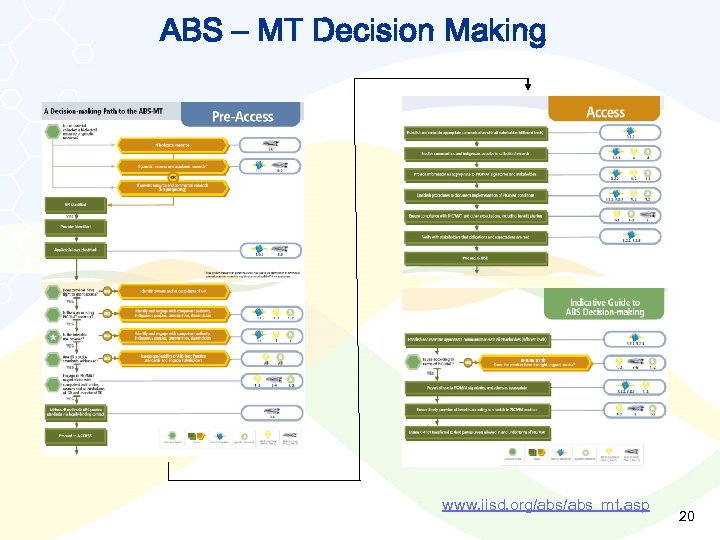
ABS – MT Decision Making www. iisd. org/abs_mt. asp 20
21
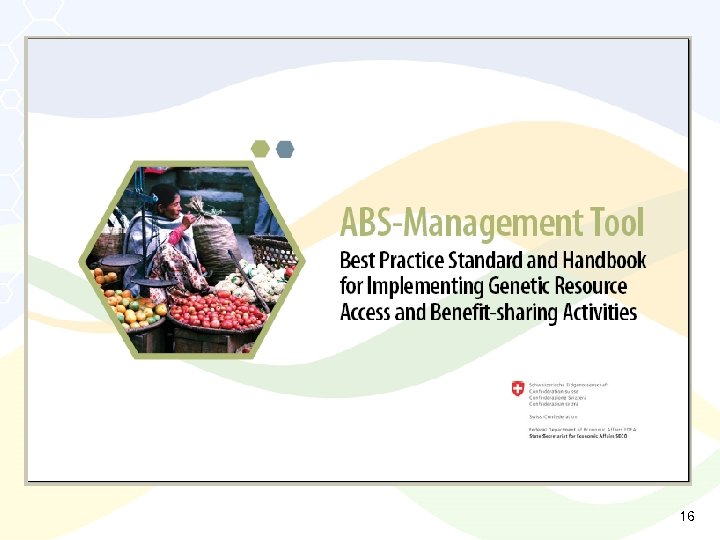
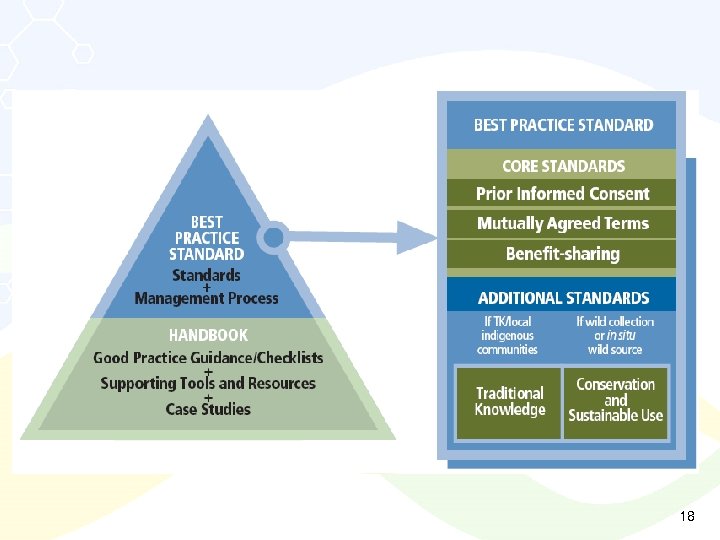
The Handbook Ø Part 1: Good Practice Guidance Ø Part 2: Supporting Tools § § § Roadmap of interaction with national legal frameworks ABS agreement matrix for GR users Material transfer agreements Model contract outline Guidance on negotiating strategies Links to sector-specific guidelines Ø Part 3: Case Studies 22
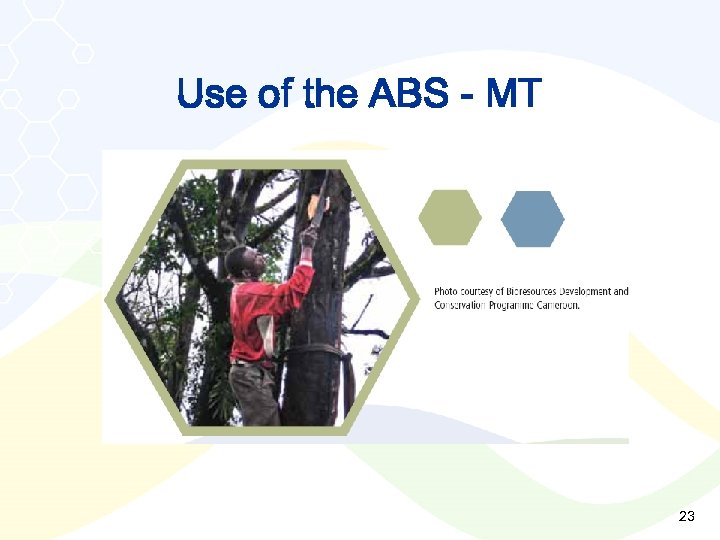
Use of the ABS - MT 23
Use of the ABS - MT 1) A voluntary best practice standard to facilitate ABS negotiations between users and providers of genetic resources 2) A substantive basis for building capacity with national governments, companies, researchers and communities 3) A mechanism for sharing of best practices 24
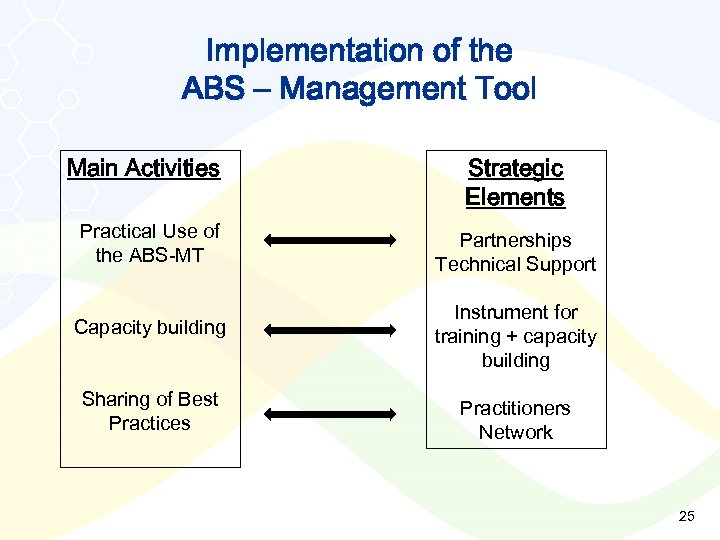
Implementation of the ABS – Management Tool Main Activities Strategic Elements Practical Use of the ABS-MT Partnerships Technical Support Capacity building Instrument for training + capacity building Sharing of Best Practices Practitioners Network 25
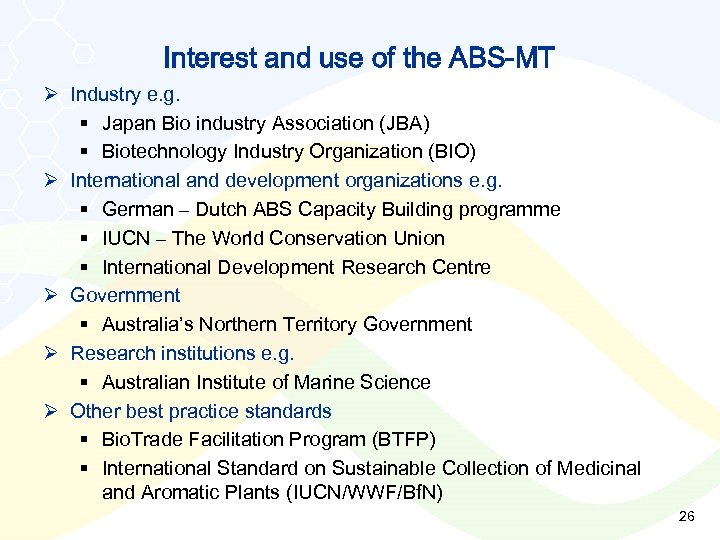
Interest and use of the ABS-MT Ø Industry e. g. § Japan Bio industry Association (JBA) § Biotechnology Industry Organization (BIO) Ø International and development organizations e. g. § German – Dutch ABS Capacity Building programme § IUCN – The World Conservation Union § International Development Research Centre Ø Government § Australia’s Northern Territory Government Ø Research institutions e. g. § Australian Institute of Marine Science Ø Other best practice standards § Bio. Trade Facilitation Program (BTFP) § International Standard on Sustainable Collection of Medicinal and Aromatic Plants (IUCN/WWF/Bf. N) 26
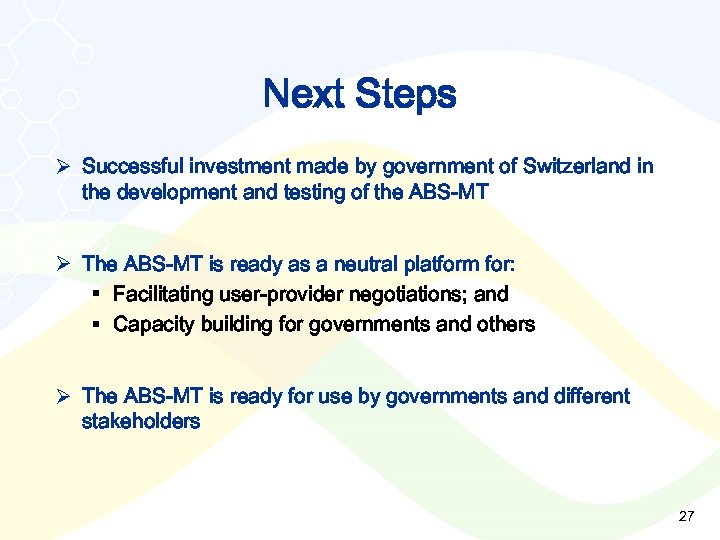
Next Steps Ø Successful investment made by government of Switzerland in the development and testing of the ABS-MT Ø The ABS-MT is ready as a neutral platform for: § Facilitating user-provider negotiations; and § Capacity building for governments and others Ø The ABS-MT is ready for use by governments and different stakeholders 27
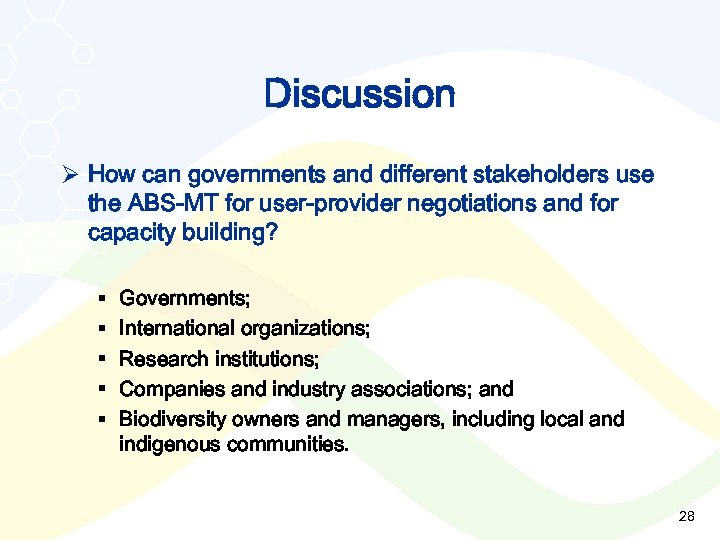
Discussion Ø How can governments and different stakeholders use the ABS-MT for user-provider negotiations and for capacity building? § § § Governments; International organizations; Research institutions; Companies and industry associations; and Biodiversity owners and managers, including local and indigenous communities. 28
Скачать презентацию ABS Best Practice Standard Handbook Launch of
a1065cd49085541be2e2daa18fd7d7d8.ppt