 Скачать презентацию About Omics Group OMICS Group International through its
5cd247488db38c9645239e021f489ee9.ppt
- Количество слайдов: 33




About Omics Group OMICS Group International through its Open Access Initiative is committed to make genuine and reliable contributions to the scientific community. OMICS Group hosts over 400 leading-edge peer reviewed Open Access Journals and organize over 300 International Conferences annually all over the world. OMICS Publishing Group journals have over 3 million readers and the fame and success of the same can be attributed to the strong editorial board which contains over 30000 eminent personalities that ensure a rapid, quality and quick review process.

About Omics Group conferences • OMICS Group signed an agreement with more than 1000 International Societies to make healthcare information Open Access. OMICS Group Conferences make the perfect platform for global networking as it brings together renowned speakers and scientists across the globe to a most exciting and memorable scientific event filled with much enlightening interactive sessions, world class exhibitions and poster presentations • Omics group has organised 500 conferences, workshops and national symposium across the major cities including San. Francisco, Omaha, Orlado, Rayleigh, Santa. Clara, Chicag o, Philadelphia, Unitedkingdom, Baltimore, San. Antanio, Du bai, Hyderabad, Bangaluru and Mumbai.
2 nd International Conference and Exhibition on 16 Giugno 2014 Lasers, Optics & Photonics, Philadelphia 8 -10 Sept, 2009 Liquid droplet whispering-gallery-mode optical resonators Gianluca Gagliardi National Institute of Optics (INO), Italian Research Council Napoli, ITALY Via Campi Flegrei 34, 80078 Pozzuoli (NA) Tel. +39 081 8675423 – email: gianluca. gagliardi@ino. it
Outline Ø Introduction to WGMs Ø WGM of liquid droplets in the near IR Ø Laser frequency locking to WGMs Ø Cavity ring-down spectroscopy in droplet resonators Ø Wavelength-shift tracking for dissolved particles Ø WGMs detection of NPs in the visible Ø Conclusions and outlook
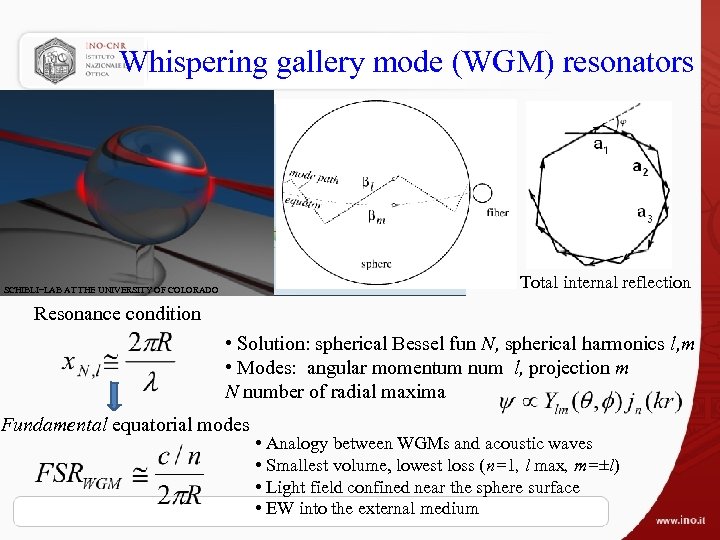
Whispering gallery mode (WGM) resonators Total internal reflection SCHIBLI−LAB AT THE UNIVERSITY OF COLORADO Resonance condition • Solution: spherical Bessel fun N, spherical harmonics l, m • Modes: angular momentum num l, projection m N number of radial maxima Fundamental equatorial modes • Analogy between WGMs and acoustic waves • Smallest volume, lowest loss (n=1, l max, m=±l) • Light field confined near the sphere surface • EW into the external medium
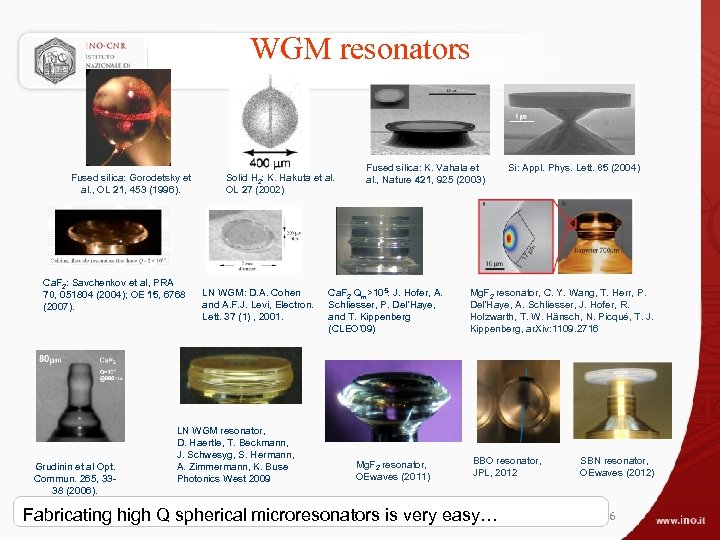
WGM resonators Fused silica: Gorodetsky et al. , OL 21, 453 (1996). Ca. F 2: Savchenkov et al, PRA 70, 051804 (2004); OE 15, 6768 (2007). Grudinin et al Opt. Commun. 265, 3338 (2006). Solid H 2: K. Hakuta et al. OL 27 (2002) LN WGM: D. A. Cohen and A. F. J. Levi, Electron. Lett. 37 (1) , 2001. LN WGM resonator, D. Haertle, T. Beckmann, J. Schwesyg, S. Hermann, A. Zimmermann, K. Buse Photonics West 2009 Fused silica: K. Vahala et al. , Nature 421, 925 (2003) Ca. F 2 Qm>105: J. Hofer, A. Schliesser, P. Del’Haye, and T. Kippenberg (CLEO’ 09) Mg. F 2 resonator, OEwaves (2011) Si: Appl. Phys. Lett. 85 (2004) Mg. F 2 resonator, C. Y. Wang, T. Herr, P. Del'Haye, A. Schliesser, J. Hofer, R. Holzwarth, T. W. Hänsch, N. Picqué, T. J. Kippenberg, ar. Xiv: 1109. 2716 BBO resonator, JPL, 2012 Fabricating high Q spherical microresonators is very easy… SBN resonator, OEwaves (2012) 6
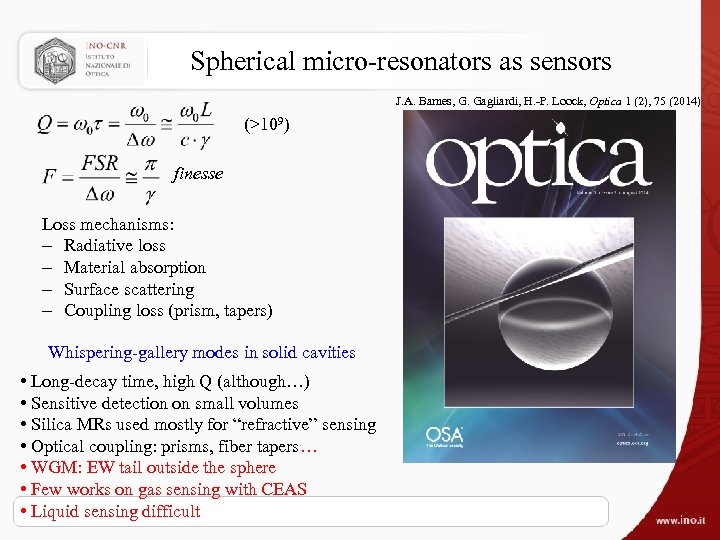
Spherical micro-resonators as sensors J. A. Barnes, G. Gagliardi, H. -P. Loock, Optica 1 (2), 75 (2014) (>109) finesse Loss mechanisms: – Radiative loss – Material absorption – Surface scattering – Coupling loss (prism, tapers) Whispering-gallery modes in solid cavities • Long-decay time, high Q (although…) • Sensitive detection on small volumes • Silica MRs used mostly for “refractive” sensing • Optical coupling: prisms, fiber tapers… • WGM: EW tail outside the sphere • Few works on gas sensing with CEAS • Liquid sensing difficult
Liquid droplet resonators: motivations • Optical cavities with relatively-high Q-factor ( 105 -107) • Analyte or particles inside resonator • Full interaction with WGM mode, not only evanescent field • Ease of fabrication • How to couple light into a liquid resonator • How to handle it • Deal with evaporation if water…
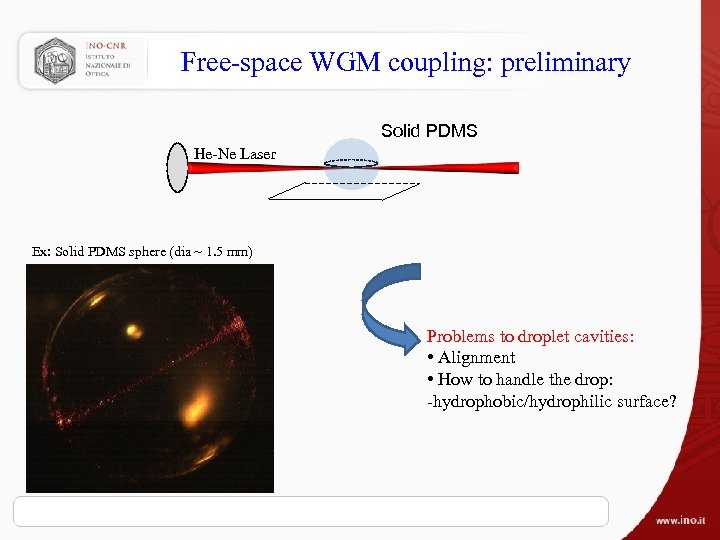
Free-space WGM coupling: preliminary Solid PDMS He-Ne Laser Ex: Solid PDMS sphere (dia ~ 1. 5 mm) Problems to droplet cavities: • Alignment • How to handle the drop: -hydrophobic/hydrophilic surface?
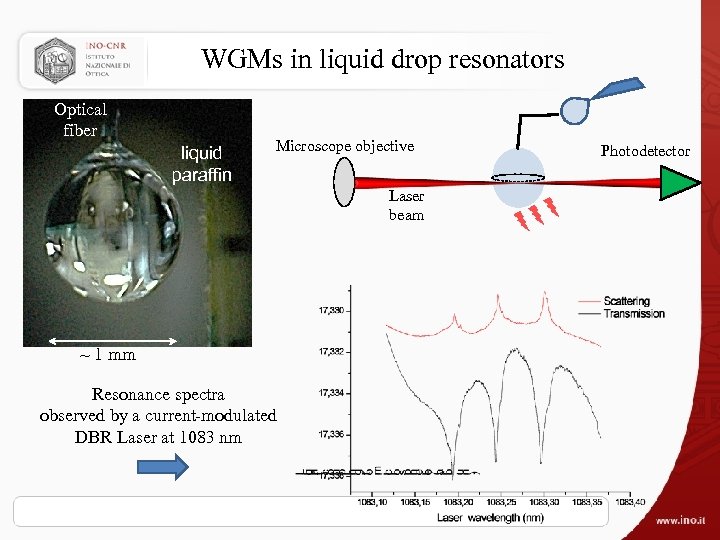
WGMs in liquid drop resonators Optical fiber liquid paraffin Microscope objective Laser beam ~ 1 mm Resonance spectra observed by a current-modulated DBR Laser at 1083 nm Photodetector
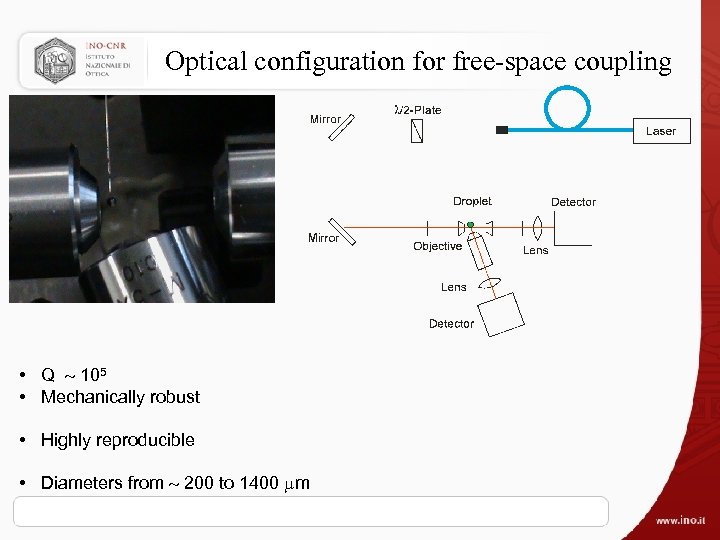
Optical configuration for free-space coupling • Q 105 • Mechanically robust • Highly reproducible • Diameters from 200 to 1400 m
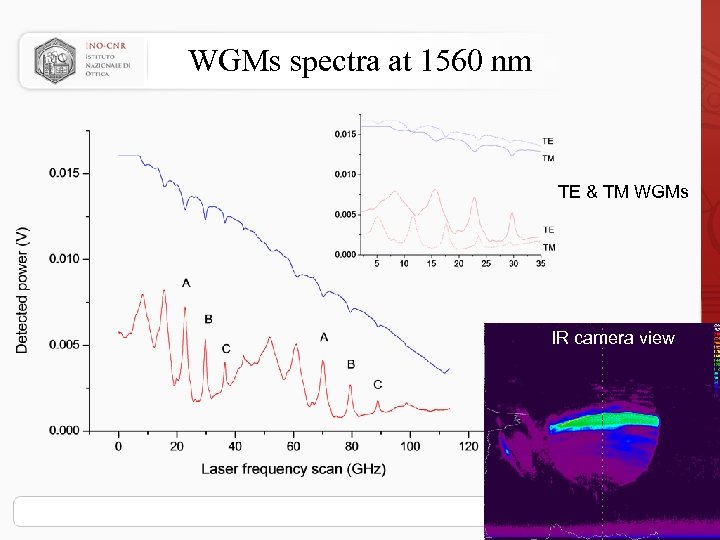
WGMs spectra at 1560 nm TE & TM WGMs IR camera view
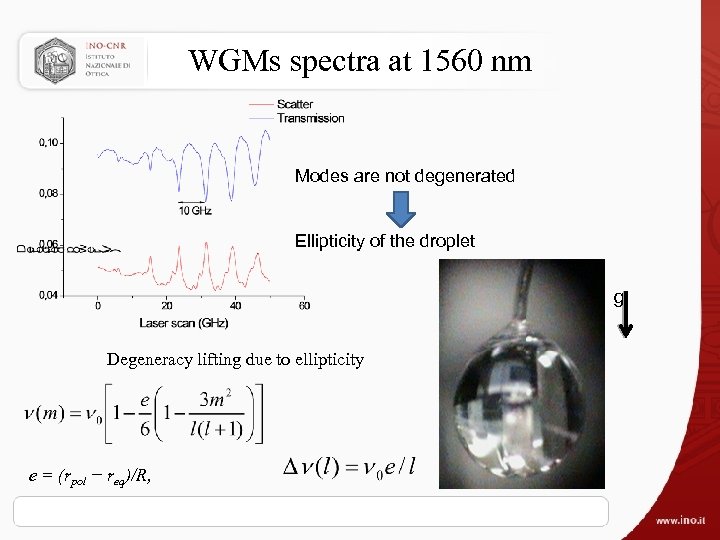
WGMs spectra at 1560 nm Modes are not degenerated Ellipticity of the droplet g Degeneracy lifting due to ellipticity e = (rpol − req)/R,
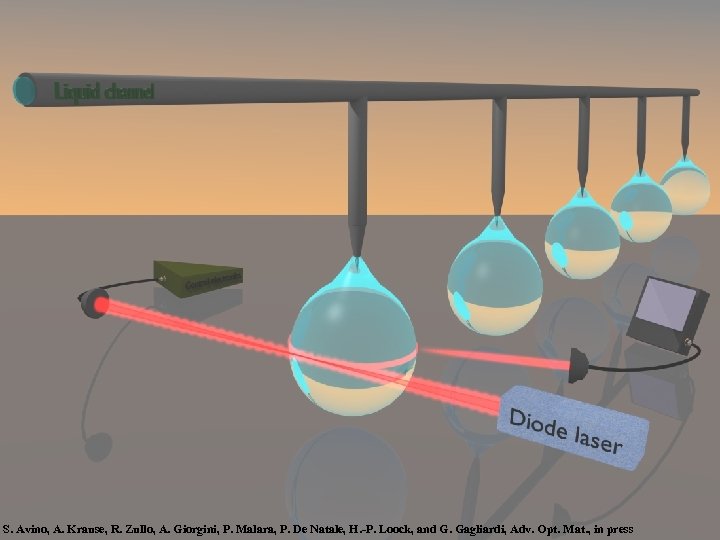
S. Avino, A. Krause, R. Zullo, A. Giorgini, P. Malara, P. De Natale, H. -P. Loock, and G. Gagliardi, Adv. Opt. Mat. , in press
Laser-frequency locking to WGMs Locking the laser emission frequency to the cavity modes allows -Real-time tracking of the resonance -No need for laser scan -Reduced need for fitting or post-processing -WGM shift measurements below the HWHM possible -static or dynamic measurements possible Very-low noise techniques can be used to extract a suitable signal for locking & measure tiny effects in the cavity… (G. Gagliardi e al. , Science 330, 1081 -1084 (2010))
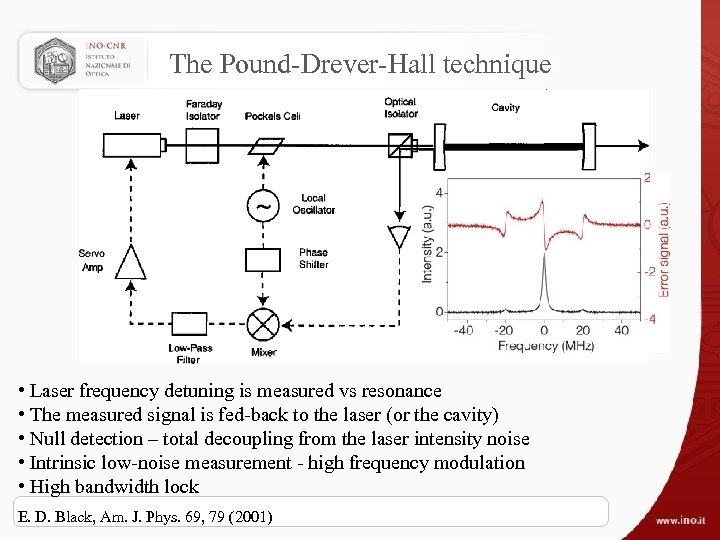
The Pound-Drever-Hall technique • Laser frequency detuning is measured vs resonance • The measured signal is fed-back to the laser (or the cavity) • Null detection – total decoupling from the laser intensity noise • Intrinsic low-noise measurement - high frequency modulation • High bandwidth lock E. D. Black, Am. J. Phys. 69, 79 (2001)
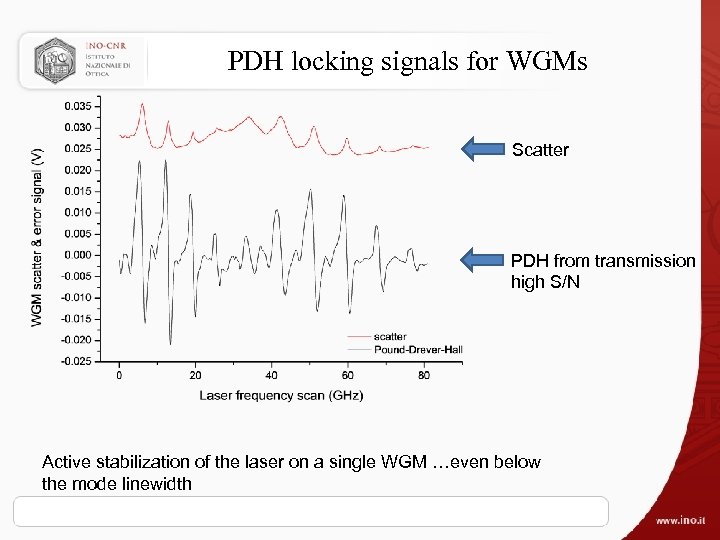
PDH locking signals for WGMs Scatter PDH from transmission high S/N Active stabilization of the laser on a single WGM …even below the mode linewidth
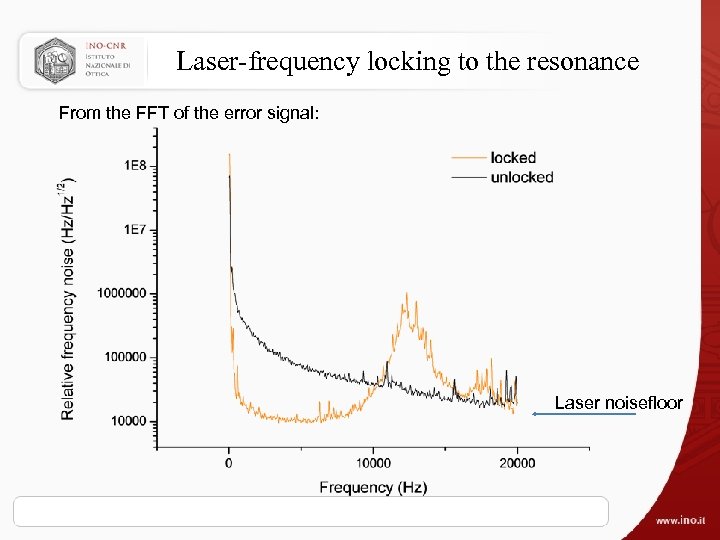
Laser-frequency locking to the resonance From the FFT of the error signal: Laser noisefloor
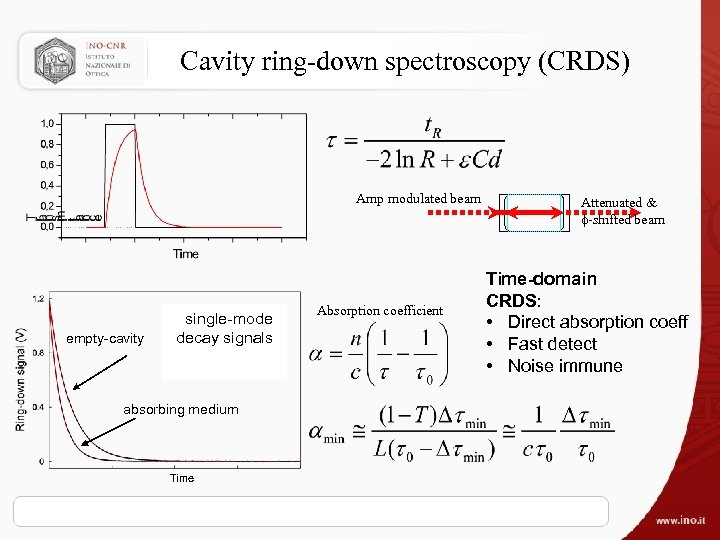
Cavity ring-down spectroscopy (CRDS) Amp modulated beam empty-cavity single-mode decay signals absorbing medium Time Absorption coefficient Attenuated & -shifted beam Time-domain CRDS: • Direct absorption coeff • Fast detect • Noise immune
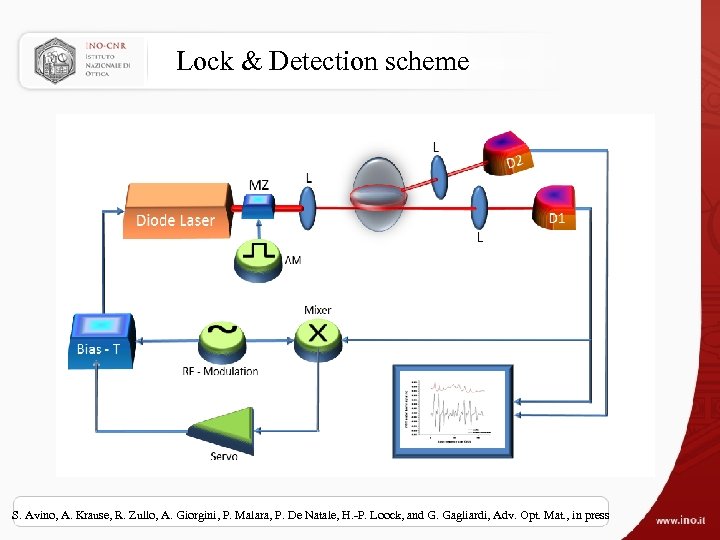
Lock & Detection scheme S. Avino, A. Krause, R. Zullo, A. Giorgini, P. Malara, P. De Natale, H. -P. Loock, and G. Gagliardi, Adv. Opt. Mat. , in press
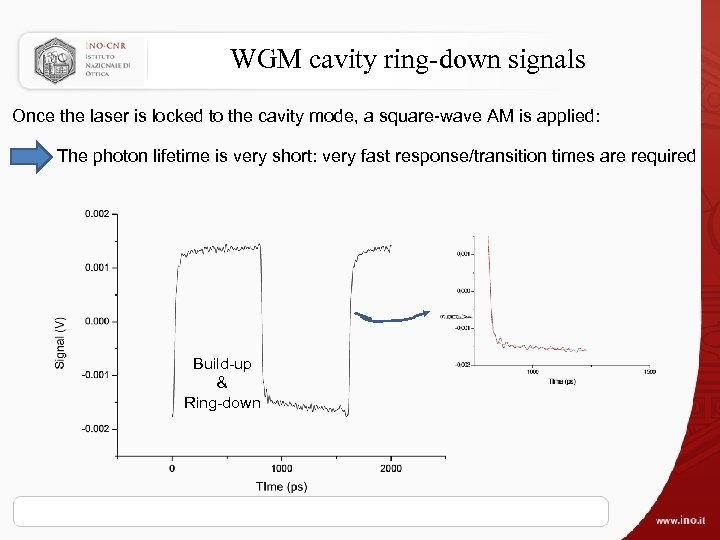
WGM cavity ring-down signals Once the laser is locked to the cavity mode, a square-wave AM is applied: The photon lifetime is very short: very fast response/transition times are required Build-up & Ring-down
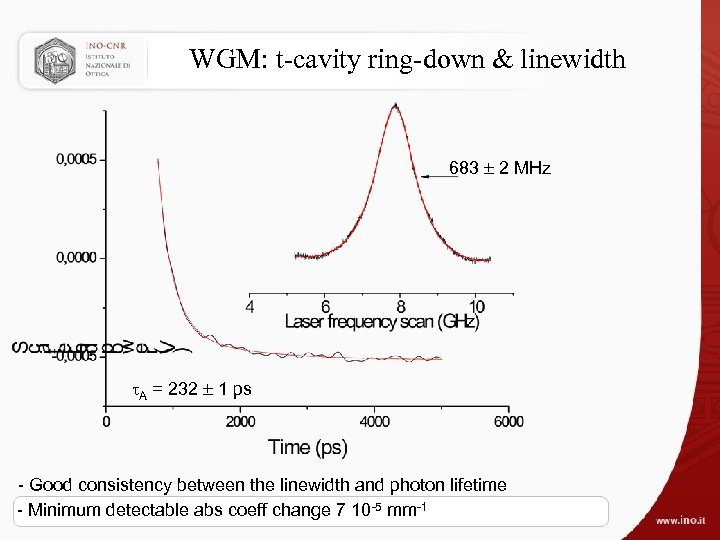
WGM: t-cavity ring-down & linewidth 683 2 MHz A = 232 1 ps - Good consistency between the linewidth and photon lifetime - Minimum detectable abs coeff change 7 10 -5 mm-1
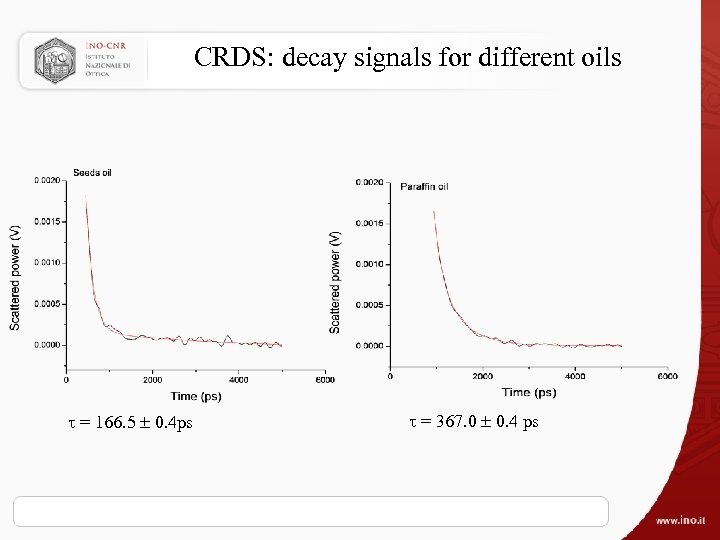
CRDS: decay signals for different oils = 166. 5 0. 4 ps = 367. 0 0. 4 ps
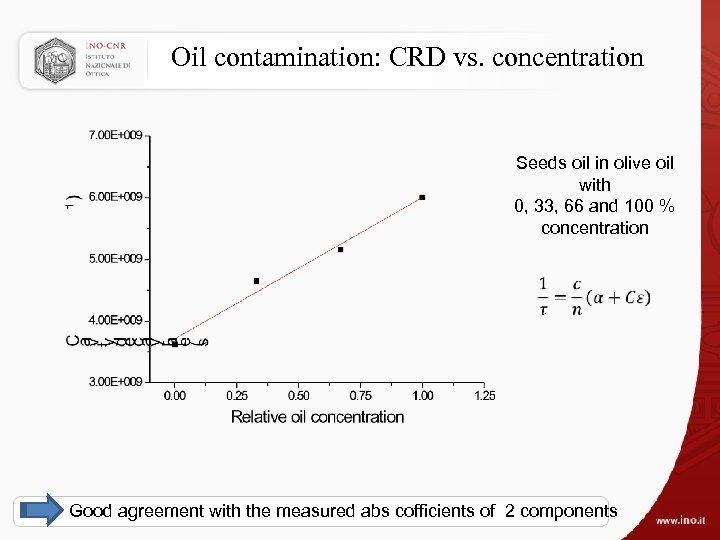
Oil contamination: CRD vs. concentration Seeds oil in olive oil with 0, 33, 66 and 100 % concentration Good agreement with the measured abs cofficients of 2 components
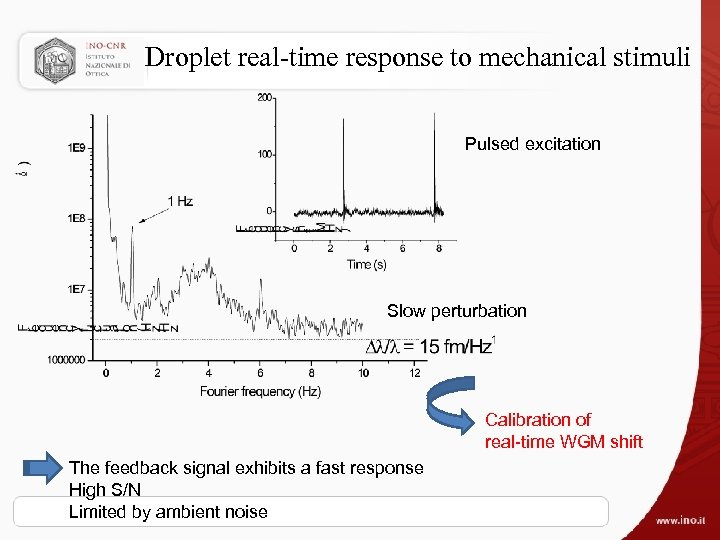
Droplet real-time response to mechanical stimuli Pulsed excitation Slow perturbation Calibration of real-time WGM shift The feedback signal exhibits a fast response High S/N Limited by ambient noise
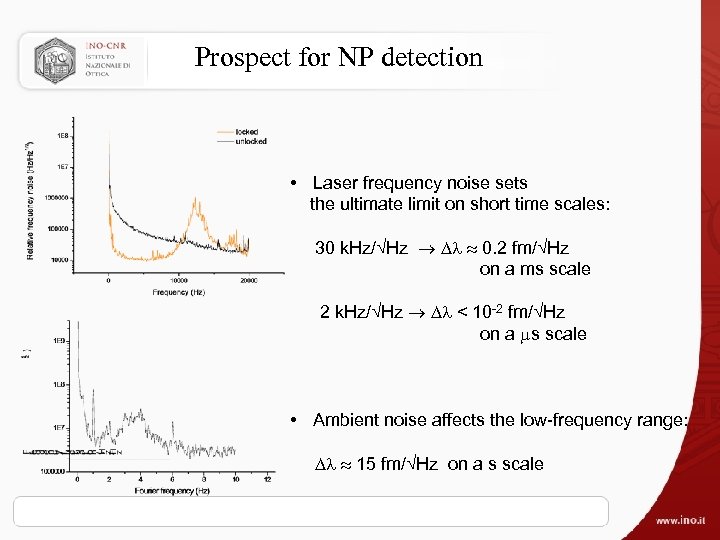
Prospect for NP detection • Laser frequency noise sets the ultimate limit on short time scales: 30 k. Hz/ Hz 0. 2 fm/ Hz on a ms scale 2 k. Hz/ Hz < 10 -2 fm/ Hz on a s scale • Ambient noise affects the low-frequency range: 15 fm/ Hz on a s scale
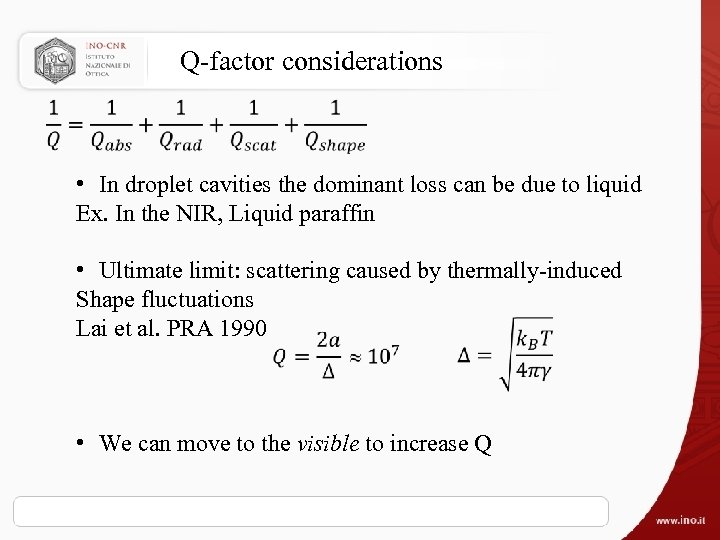
Q-factor considerations • In droplet cavities the dominant loss can be due to liquid Ex. In the NIR, Liquid paraffin • Ultimate limit: scattering caused by thermally-induced Shape fluctuations Lai et al. PRA 1990 • We can move to the visible to increase Q
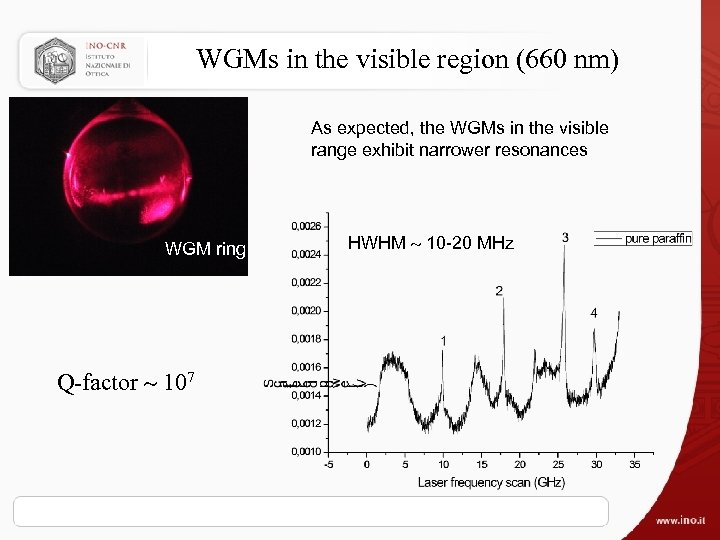
WGMs in the visible region (660 nm) As expected, the WGMs in the visible range exhibit narrower resonances WGM ring Q-factor 107 HWHM 10 -20 MHz
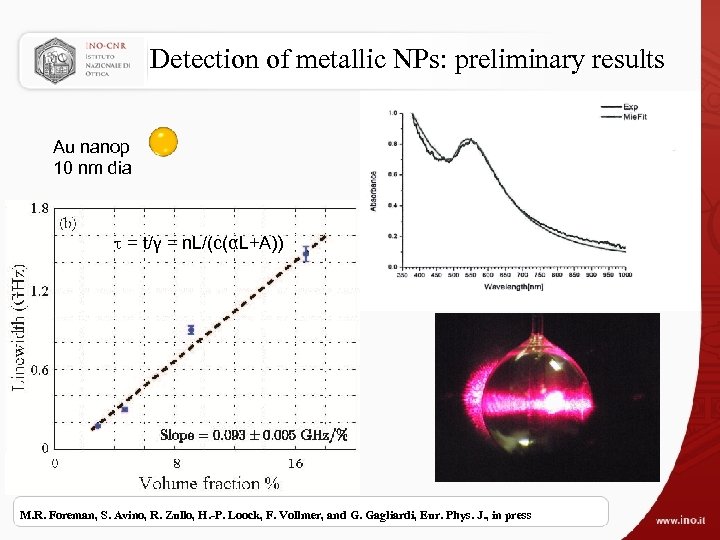
Detection of metallic NPs: preliminary results Au nanop 10 nm dia = t/γ = n. L/(c(αL+A)) M. R. Foreman, S. Avino, R. Zullo, H. -P. Loock, F. Vollmer, and G. Gagliardi, Eur. Phys. J. , in press
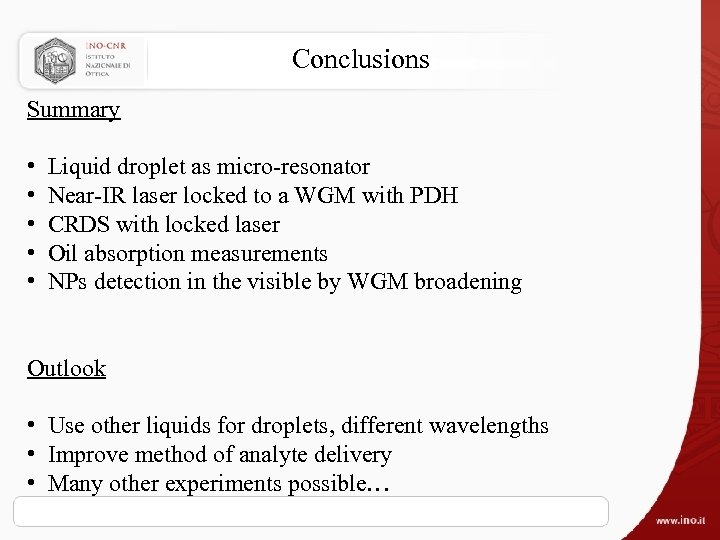
Conclusions Summary • • • Liquid droplet as micro-resonator Near-IR laser locked to a WGM with PDH CRDS with locked laser Oil absorption measurements NPs detection in the visible by WGM broadening Outlook • Use other liquids for droplets, different wavelengths • Improve method of analyte delivery • Many other experiments possible…
Acknowledgments INO «Optical Sensors» group Saverio Avino (research fellow) Pietro Malara (research fellow) Antonio Giorgini (post-doc) Rosa Zullo (post-doc) Maria. Luisa Capezzuto (grad student) Anika Krause (grad student) Long-term Scientific collaborations: Short-term visitors: H. P. Loock, Queen’s University, Kingston (CAN) Matthias Fabian (Limerick University, IR) Helen Waechter (Queen’s University, CAN) Financial support - University and Research Ministry PON progr - CNR (RSTL project) - CNR Short-term mobility program Dept Chemistry, Queen’s Univ, Kingston (CAN) Max Planck, Erlangen (D) Koch University, Istanbul (TK) Lawrence Berkeley National Laboratory, Molecular Foundry (USA) Central Glass and Ceramic Research Inst. -CISR, Calcutta (IN)
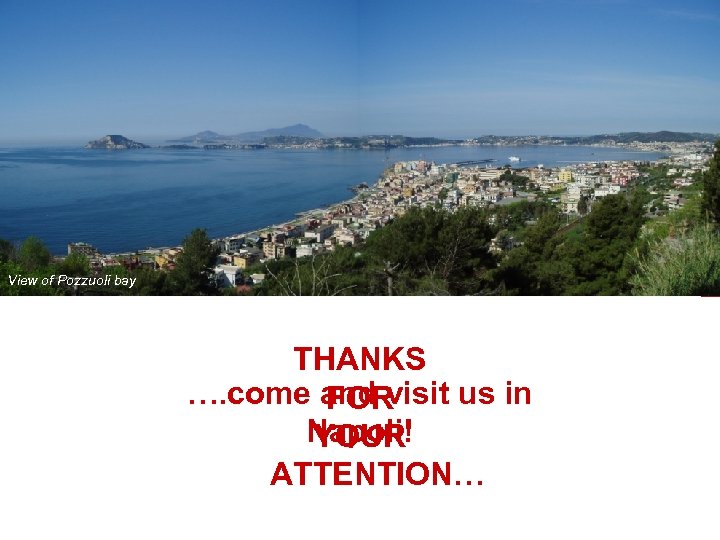
View of Pozzuoli bay THANKS …. come and visit us in FOR Napoli! YOUR ATTENTION…

Let Us Meet Again We welcome all to our future group conferences of Omics group international Please visit: www. omicsgroup. com www. Conferenceseries. com http: //optics. conferenceseries. com/
Скачать презентацию About Omics Group OMICS Group International through its
5cd247488db38c9645239e021f489ee9.ppt