 Скачать презентацию About OMICS Group is an amalgamation of Open
4c7c09298641d0dba0d918e7be453e81.ppt
- Количество слайдов: 29



About OMICS Group is an amalgamation of Open Access Publications and worldwide international science conferences and events. Established in the year 2007 with the sole aim of making the information on Sciences and technology ‘Open Access’, OMICS Group publishes 700+ online open access scholarly journals in all aspects of Science, Engineering, Management and Technology journals. OMICS Group has been instrumental in taking the knowledge on Science & technology to the doorsteps of ordinary men and women. Research Scholars, Students, Libraries, Educational Institutions, Research centers and the industry are main stakeholders that benefitted greatly from this knowledge dissemination. OMICS Group also organizes 1000+ International conferences annually across the globe, where knowledge transfer takes place through debates, round table discussions, poster presentations, workshops, symposia and exhibitions.
OMICS International Conferences OMICS International is a pioneer and leading science event organizer, which publishes around 700+ open access journals and conducts over 500 Medical, Clinical, Engineering, Life Sciences, Pharma scientific conferences all over the globe annually with the support of more than 1000 scientific associations and 30, 000 editorial board members and 3. 5 million followers to its credit. OMICS Group has organized 1000+ conferences, workshops and national symposiums across the major cities including San Francisco, Las Vegas, San Antonio, Omaha, Orlando, Raleigh, Santa Clara, Chicago, Philadelphia, Baltimore, United Kingdom, Valencia, Dubai, Beijing, Hyderabad, Bengaluru and Mumbai.
Extractable and Leachable Studies of Parenteral Infusion and Transfusion Products Jianfeng Hong Dujuan Lu, Ming Du and Robert Payton Medical Device Division, Fresenius Kabi USA LLC. 3 Corporate Drive, Lake Zurich, Illinois 60047, USA
Overview § § § § Fresenius Kabi. Extractable and Leachable Study Designs. Extractable and Leachables Test Work Flows. Determinations of ID/Quantification Thresholds (AET) for Extractable and Leachable Compounds. Risk Assessments of Extractables and Leachables Selections of Target leachable Compounds in migration / Stability studies Analytical Method Development and Validation of Target Leachable Testing Summary © Copyright Fresenius Kabi AG 19 March 2018 4
Fresenius Kabi § A global companies with 33, 000 employees (part of Fresenius Group). Global Headquarters: Bad Homburg, Germany. § North American Headquarter: Lake Zurich, IL, USA. FK has two Divisions: Pharmaceutical and Medical Devices. Pharmaceutical Division: ü Parenteral and enteral nutrition products ü Intravenous generic drugs § Medical Device Division: ü Pumps, disposable (filter, bags, tubing). Whole blood collection processing and for transfusion medicine and cell therapies. ü Blood components may be used for: treatment of surgical patients, cancer patients and people with life threatening conditions. © Copyright Fresenius Kabi AG 19 March 2018 5
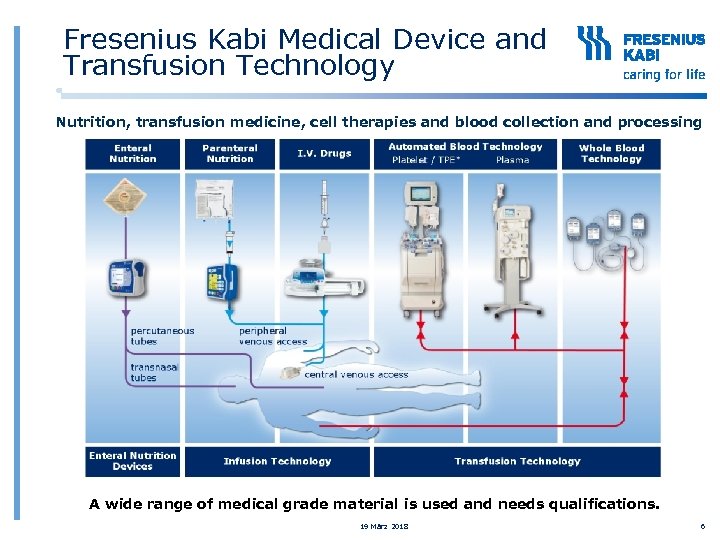
Fresenius Kabi Medical Device and Transfusion Technology Nutrition, transfusion medicine, cell therapies and blood collection and processing A wide range of medical grade material is used and needs qualifications. 19 März 2018 6
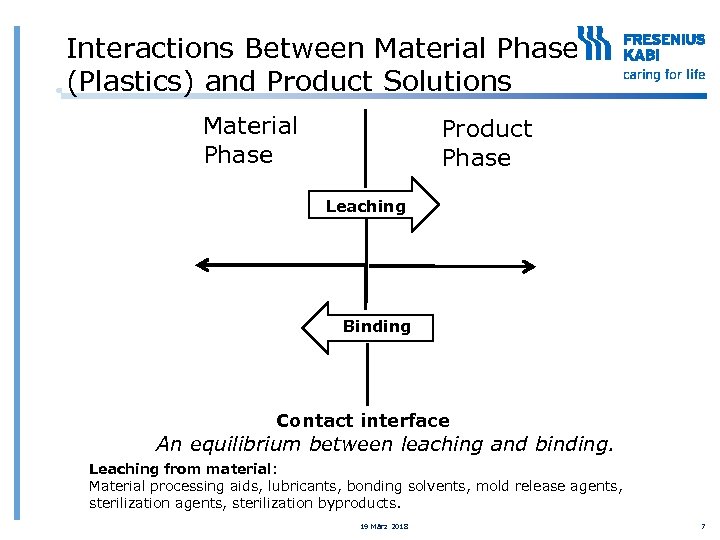
Interactions Between Material Phase (Plastics) and Product Solutions Material Phase Product Phase Leaching Binding Contact interface An equilibrium between leaching and binding. Leaching from material: Material processing aids, lubricants, bonding solvents, mold release agents, sterilization byproducts. 19 März 2018 7
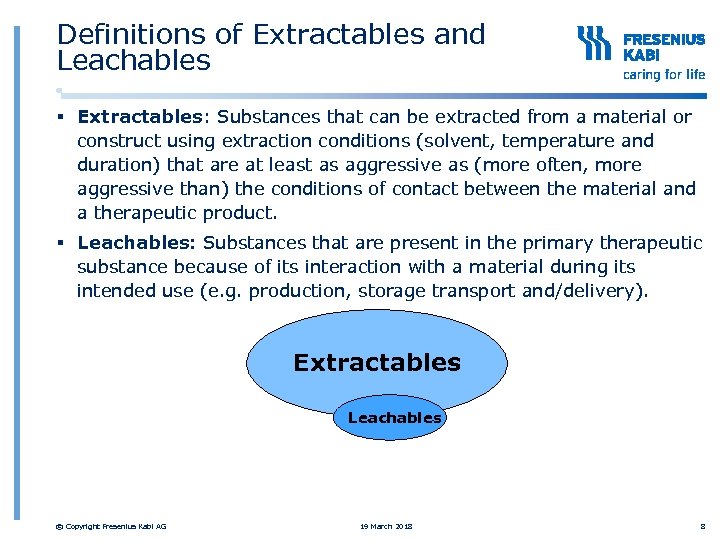
Definitions of Extractables and Leachables § Extractables: Substances that can be extracted from a material or construct using extraction conditions (solvent, temperature and duration) that are at least as aggressive as (more often, more aggressive than) the conditions of contact between the material and a therapeutic product. § Leachables: Substances that are present in the primary therapeutic substance because of its interaction with a material during its intended use (e. g. production, storage transport and/delivery). Extractables Leachables © Copyright Fresenius Kabi AG 19 March 2018 8
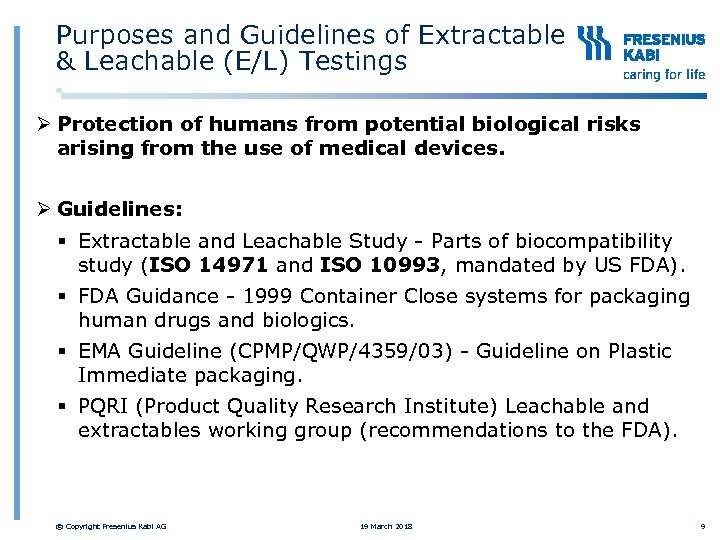
Purposes and Guidelines of Extractable & Leachable (E/L) Testings Ø Protection of humans from potential biological risks arising from the use of medical devices. Ø Guidelines: § Extractable and Leachable Study - Parts of biocompatibility study (ISO 14971 and ISO 10993, mandated by US FDA). § FDA Guidance - 1999 Container Close systems for packaging human drugs and biologics. § EMA Guideline (CPMP/QWP/4359/03) - Guideline on Plastic Immediate packaging. § PQRI (Product Quality Research Institute) Leachable and extractables working group (recommendations to the FDA). © Copyright Fresenius Kabi AG 19 March 2018 9
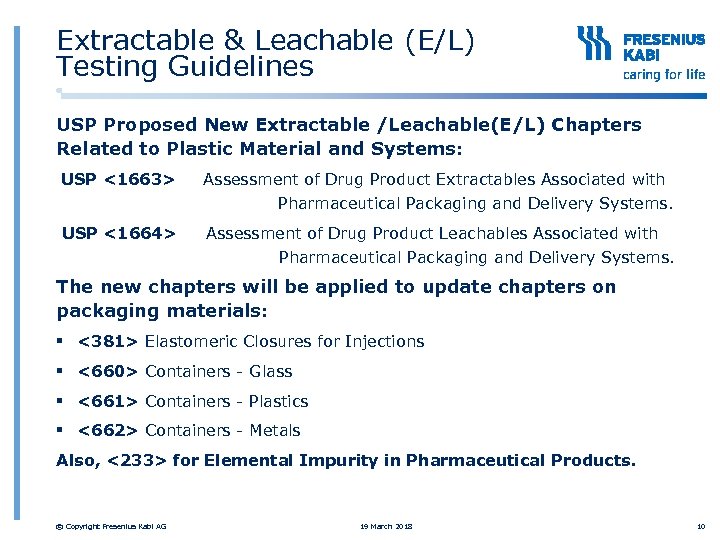
Extractable & Leachable (E/L) Testing Guidelines USP Proposed New Extractable /Leachable(E/L) Chapters Related to Plastic Material and Systems: USP <1663> Assessment of Drug Product Extractables Associated with Pharmaceutical Packaging and Delivery Systems. USP <1664> Assessment of Drug Product Leachables Associated with Pharmaceutical Packaging and Delivery Systems. The new chapters will be applied to update chapters on packaging materials: § <381> Elastomeric Closures for Injections § <660> Containers - Glass § <661> Containers - Plastics § <662> Containers - Metals Also, <233> for Elemental Impurity in Pharmaceutical Products. © Copyright Fresenius Kabi AG 19 March 2018 10
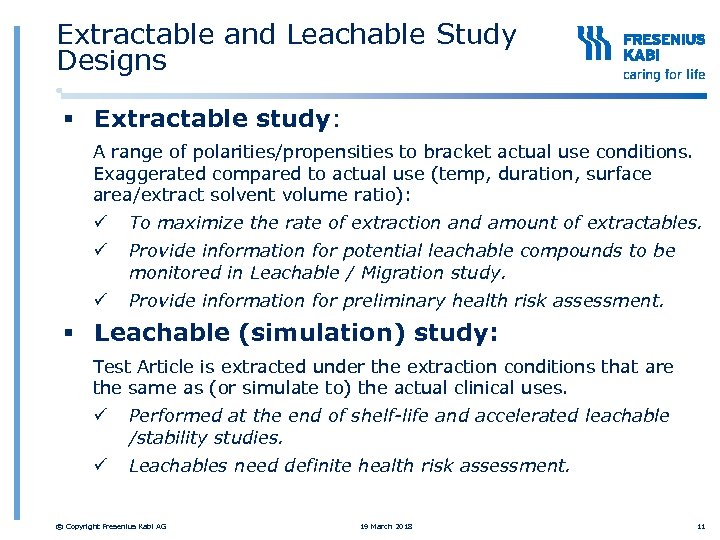
Extractable and Leachable Study Designs § Extractable study: A range of polarities/propensities to bracket actual use conditions. Exaggerated compared to actual use (temp, duration, surface area/extract solvent volume ratio): ü To maximize the rate of extraction and amount of extractables. ü Provide information for potential leachable compounds to be monitored in Leachable / Migration study. ü Provide information for preliminary health risk assessment. § Leachable (simulation) study: Test Article is extracted under the extraction conditions that are the same as (or simulate to) the actual clinical uses. ü Performed at the end of shelf-life and accelerated leachable /stability studies. ü Leachables need definite health risk assessment. © Copyright Fresenius Kabi AG 19 March 2018 11
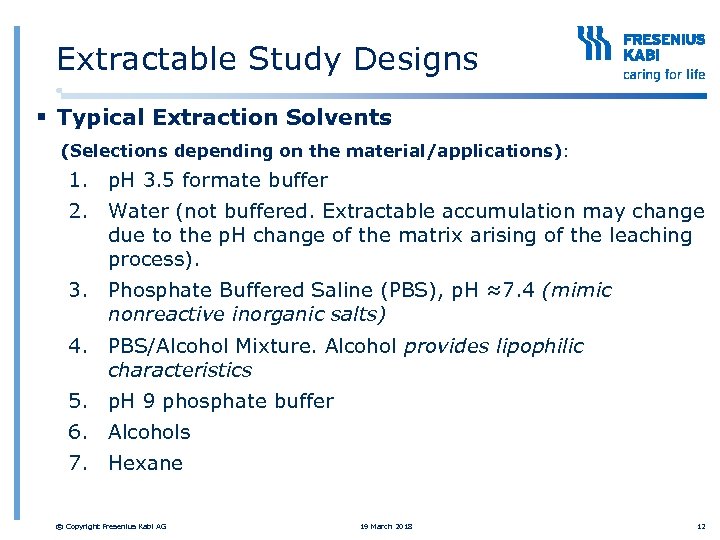
Extractable Study Designs § Typical Extraction Solvents (Selections depending on the material/applications): 1. p. H 3. 5 formate buffer 2. Water (not buffered. Extractable accumulation may change due to the p. H change of the matrix arising of the leaching process). 3. Phosphate Buffered Saline (PBS), p. H ≈7. 4 (mimic nonreactive inorganic salts) 4. PBS/Alcohol Mixture. Alcohol provides lipophilic characteristics 5. p. H 9 phosphate buffer 6. Alcohols 7. Hexane © Copyright Fresenius Kabi AG 19 March 2018 12
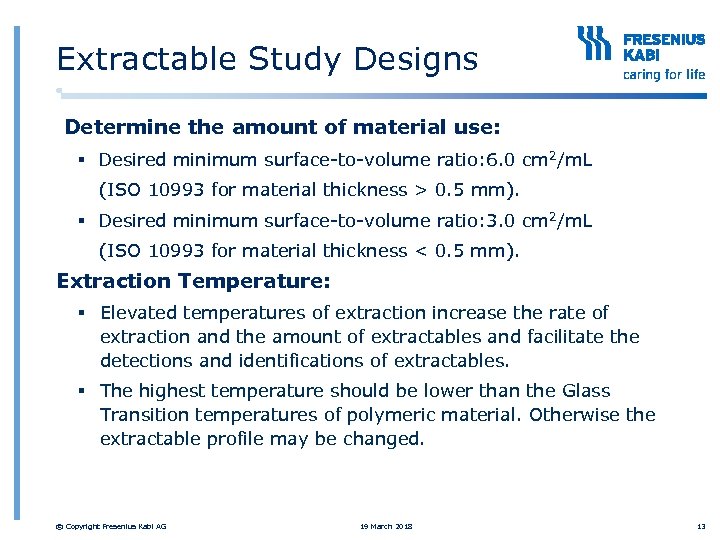
Extractable Study Designs Determine the amount of material use: § Desired minimum surface-to-volume ratio: 6. 0 cm 2/m. L (ISO 10993 for material thickness > 0. 5 mm). § Desired minimum surface-to-volume ratio: 3. 0 cm 2/m. L (ISO 10993 for material thickness < 0. 5 mm). Extraction Temperature: § Elevated temperatures of extraction increase the rate of extraction and the amount of extractables and facilitate the detections and identifications of extractables. § The highest temperature should be lower than the Glass Transition temperatures of polymeric material. Otherwise the extractable profile may be changed. © Copyright Fresenius Kabi AG 19 March 2018 13
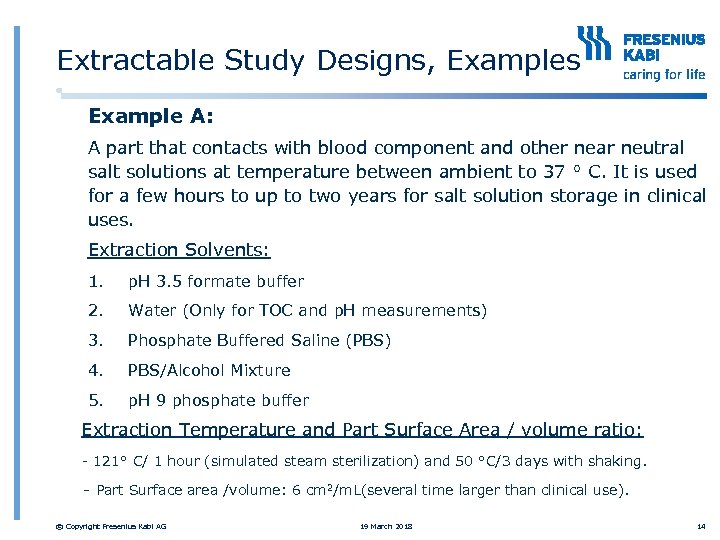
Extractable Study Designs, Examples Example A: A part that contacts with blood component and other near neutral salt solutions at temperature between ambient to 37 ° C. It is used for a few hours to up to two years for salt solution storage in clinical uses. Extraction Solvents: 1. p. H 3. 5 formate buffer 2. Water (Only for TOC and p. H measurements) 3. Phosphate Buffered Saline (PBS) 4. PBS/Alcohol Mixture 5. p. H 9 phosphate buffer Extraction Temperature and Part Surface Area / volume ratio: - 121° C/ 1 hour (simulated steam sterilization) and 50 °C/3 days with shaking. - Part Surface area /volume: 6 cm 2/m. L(several time larger than clinical use). © Copyright Fresenius Kabi AG 19 March 2018 14
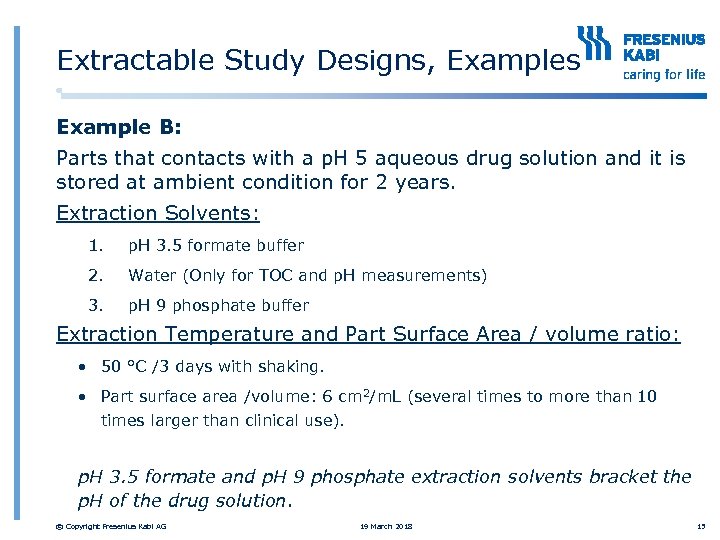
Extractable Study Designs, Examples Example B: Parts that contacts with a p. H 5 aqueous drug solution and it is stored at ambient condition for 2 years. Extraction Solvents: 1. p. H 3. 5 formate buffer 2. Water (Only for TOC and p. H measurements) 3. p. H 9 phosphate buffer Extraction Temperature and Part Surface Area / volume ratio: • 50 °C /3 days with shaking. • Part surface area /volume: 6 cm 2/m. L (several times to more than 10 times larger than clinical use). p. H 3. 5 formate and p. H 9 phosphate extraction solvents bracket the p. H of the drug solution. © Copyright Fresenius Kabi AG 19 March 2018 15
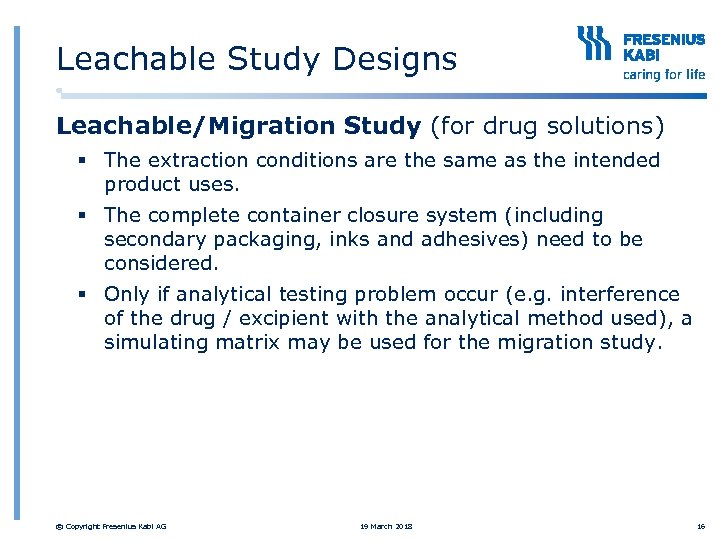
Leachable Study Designs Leachable/Migration Study (for drug solutions) § The extraction conditions are the same as the intended product uses. § The complete container closure system (including secondary packaging, inks and adhesives) need to be considered. § Only if analytical testing problem occur (e. g. interference of the drug / excipient with the analytical method used), a simulating matrix may be used for the migration study. © Copyright Fresenius Kabi AG 19 March 2018 16
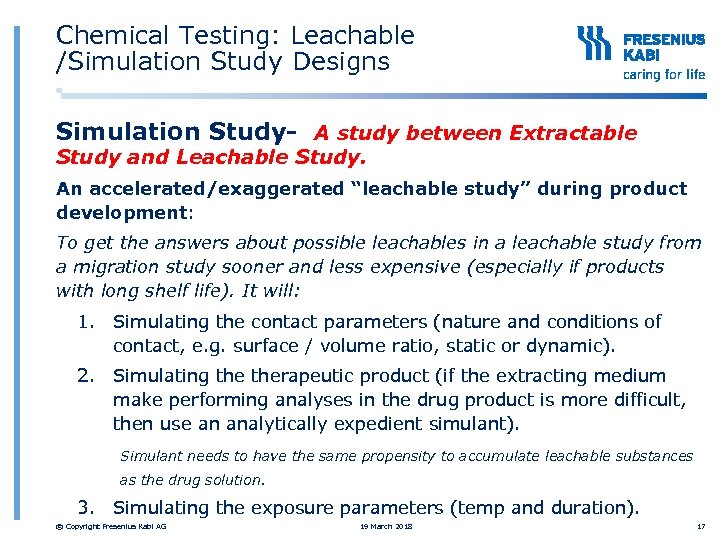
Chemical Testing: Leachable /Simulation Study Designs Simulation Study- A study between Extractable Study and Leachable Study. An accelerated/exaggerated “leachable study” during product development: To get the answers about possible leachables in a leachable study from a migration study sooner and less expensive (especially if products with long shelf life). It will: 1. Simulating the contact parameters (nature and conditions of contact, e. g. surface / volume ratio, static or dynamic). 2. Simulating therapeutic product (if the extracting medium make performing analyses in the drug product is more difficult, then use an analytically expedient simulant). Simulant needs to have the same propensity to accumulate leachable substances as the drug solution. 3. Simulating the exposure parameters (temp and duration). © Copyright Fresenius Kabi AG 19 March 2018 17
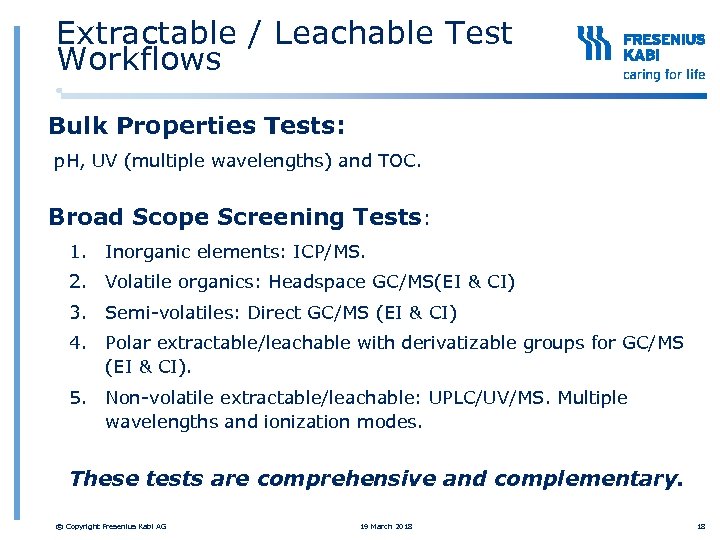
Extractable / Leachable Test Workflows Bulk Properties Tests: p. H, UV (multiple wavelengths) and TOC. Broad Scope Screening Tests: 1. Inorganic elements: ICP/MS. 2. Volatile organics: Headspace GC/MS(EI & CI) 3. Semi-volatiles: Direct GC/MS (EI & CI) 4. Polar extractable/leachable with derivatizable groups for GC/MS (EI & CI). 5. Non-volatile extractable/leachable: UPLC/UV/MS. Multiple wavelengths and ionization modes. These tests are comprehensive and complementary. © Copyright Fresenius Kabi AG 19 March 2018 18
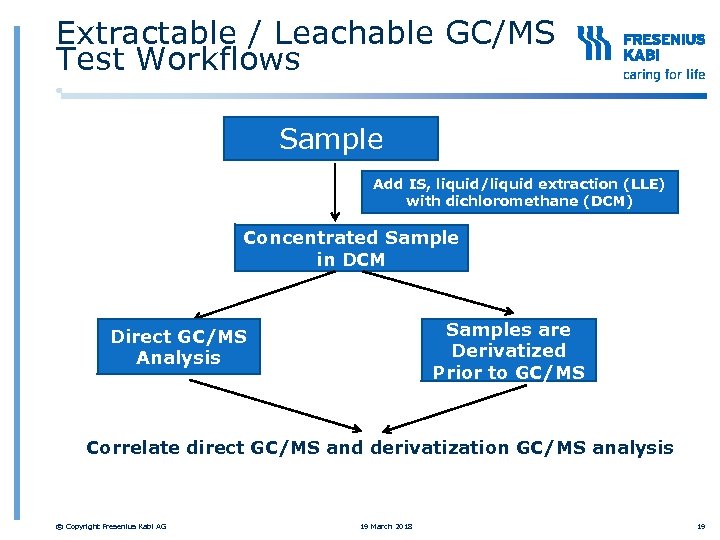
Extractable / Leachable GC/MS Test Workflows Sample Add IS, liquid/liquid extraction (LLE) with dichloromethane (DCM) Concentrated Sample in DCM Samples are Derivatized Prior to GC/MS Direct GC/MS Analysis Correlate direct GC/MS and derivatization GC/MS analysis © Copyright Fresenius Kabi AG 19 March 2018 19
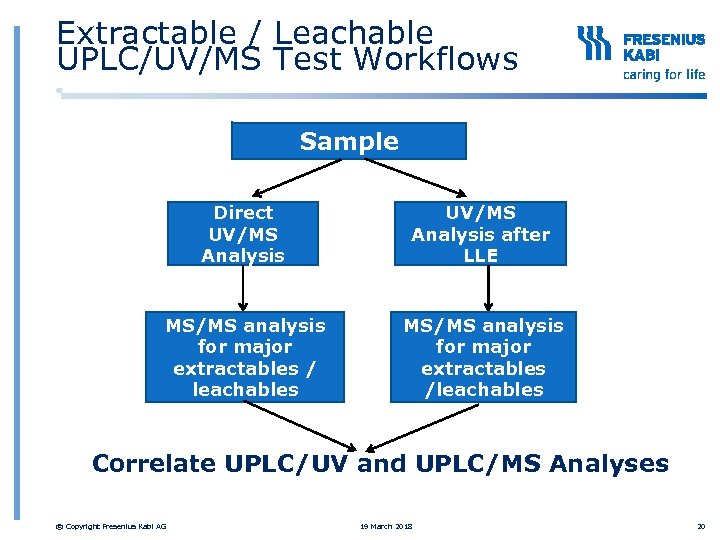
Extractable / Leachable UPLC/UV/MS Test Workflows Sample Direct UV/MS Analysis after LLE MS/MS analysis for major extractables / leachables MS/MS analysis for major extractables /leachables Correlate UPLC/UV and UPLC/MS Analyses © Copyright Fresenius Kabi AG 19 March 2018 20
Inorganic, Formate and Acetate Extractable / Leachable Analysis Work Flows Elemental Analysis (more than 30 elements) ICP/MS. Most elements are detected at low ppb levels. Need to develop appropriate ICP method for detections of elemental extractable / leachable in different matrices. Formate and Acetate Analysis (if needed): An UPLC/UV assay. LOD at sub ppm levels. Depending on the material to evaluate. © Copyright Fresenius Kabi AG 19 March 2018 21
Toxicological Evaluations and Analytical Evaluation Thresholds (AET) Guidelines: § ICH Q 3 C Impurities: Guideline for Residual Solvents. § USP Elemental Impurity New Chapter <232> and <233>. § CPMP/SWP/QWP/4446/00 Guideline on the Specification Limits for Residuals of Metal Catalysts § CPMP/SWP/5199/02 Guideline on the Limits of Genotoxic Impurities § ICH M 7 Assessment and Control of DNA Reactive (mutagenic) Impurities in Pharmaceutical to Limit Potential Carcinogenic Risk. Note: "Applications of this guideline (M 7) to leachables associated with drug product packaging is not intended, but the safety risk assessment principles outlined in this guideline for limiting potential carcinogenic risk can be used if warranted”. AET Calculations: Based on permitted daily exposure (PDE) limits, the dosing and container / material surface area. © Copyright Fresenius Kabi AG 19 March 2018 22
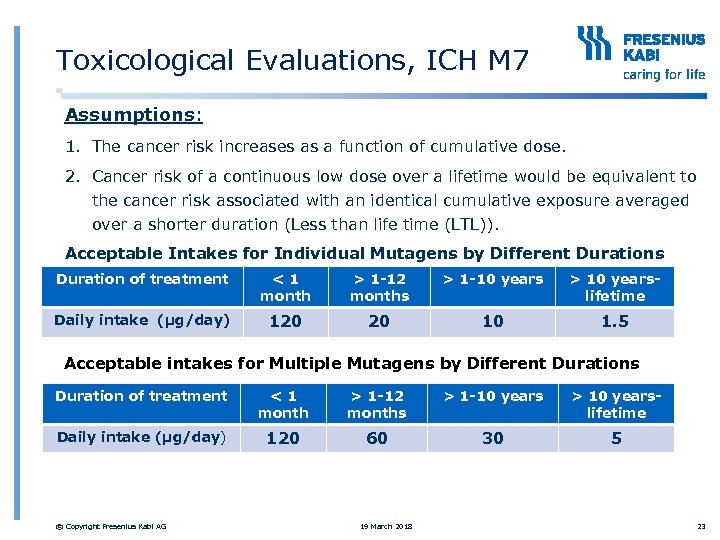
Toxicological Evaluations, ICH M 7 Assumptions: 1. The cancer risk increases as a function of cumulative dose. 2. Cancer risk of a continuous low dose over a lifetime would be equivalent to the cancer risk associated with an identical cumulative exposure averaged over a shorter duration (Less than life time (LTL)). Acceptable Intakes for Individual Mutagens by Different Durations Duration of treatment <1 month > 1 -12 months > 1 -10 years > 10 yearslifetime Daily intake (µg/day) 120 20 10 1. 5 Acceptable intakes for Multiple Mutagens by Different Durations Duration of treatment <1 month > 1 -12 months > 1 -10 years > 10 yearslifetime Daily intake (µg/day) 120 60 30 5 © Copyright Fresenius Kabi AG 19 March 2018 23
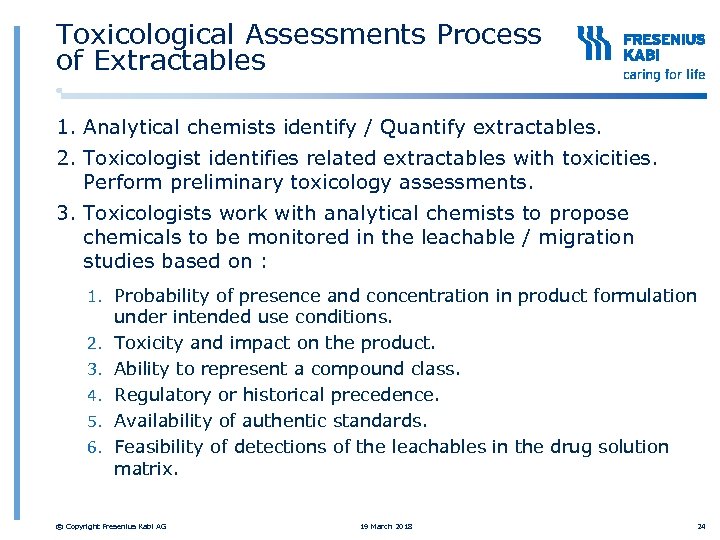
Toxicological Assessments Process of Extractables 1. Analytical chemists identify / Quantify extractables. 2. Toxicologist identifies related extractables with toxicities. Perform preliminary toxicology assessments. 3. Toxicologists work with analytical chemists to propose chemicals to be monitored in the leachable / migration studies based on : 1. Probability of presence and concentration in product formulation 2. 3. 4. 5. 6. under intended use conditions. Toxicity and impact on the product. Ability to represent a compound class. Regulatory or historical precedence. Availability of authentic standards. Feasibility of detections of the leachables in the drug solution matrix. © Copyright Fresenius Kabi AG 19 March 2018 24
Analytical Method Validations for Testing Leachable in Migration/Stability Study § The analytical methods shall be developed in the actual products. § The method shall be adequately sensitive and LOQ/LOD should be derived based on the permitted daily exposure (PDE) of the products. Method Validation Parameters: 1. Limit of Detection (LOD) and Limit of Quantitation (LOQ) 2. Accuracy / Precision 3. Linearity 4. Intermediate Precision 5. Solution Stability(standard, sample and mobile phase, etc. ) © Copyright Fresenius Kabi AG 19 March 2018 25
Migration/Stability Study of Leachable and Toxicological Evaluation 1. Analytical chemists identify / quantify leachable in actual products at end of shelf life. 2. Perform toxicological assessment after the testing of leachable in the migration study. 3. Evaluate each leachable and compare its concentration with its PDE and taking into account how the product is used. 4. Discuss above information and provide conclusions in the toxicological evaluation report. © Copyright Fresenius Kabi AG 19 March 2018 26
Summary Ø Extractable/leachable testing processes for medical device and pharmaceutical container are developed and they are compliant to applicable guidelines and are risk-management based. Ø The risk assessments are based on the material characteristics, intended uses and considerations of effects on health of donors and patients. Ø The processes have been successful for supporting new product development and material changes that meet regulatory requirements and protect the health of patients and donors. © Copyright Fresenius Kabi AG 19 March 2018 27
Questions or Comments? Contact: Jianfeng. hong@fresenius-kabi. com 3 Corporate Drive, Fresenius Kabi, USA LLC Lake Zurich, IL 60047, USA © Copyright Fresenius Kabi AG 19 March 2018 28
Let us meet again. . We welcome you all to our future conferences of OMICS International 2 nd International Conference and Expo on Parenterals and Injectables On October 24 -26, 2016 at Istanbul, Turkey http: //parenteralsinjectables. pharmaceuticalconferences. com/
Скачать презентацию About OMICS Group is an amalgamation of Open
4c7c09298641d0dba0d918e7be453e81.ppt