 Скачать презентацию About Midterm Exam 3 l l When and
8fe0f4b794a5789e45e2a60782460dc9.ppt
- Количество слайдов: 16



About Midterm Exam 3 l l When and where çThurs April 21 th , 5: 45 -7: 00 pm çRooms: Same as Exam I and II, See course webpage. çYour TA will give a brief review during the discussion session. Coverage: Chapts 9 – 12 (4 chapters) Format çClosed book, 20 multiple-choices questions (format as in practice exams) ç 1 page 8 x 11 formula sheet allowed, must be self prepared, no photo copying/download-printing of solutions, lecture slides, etc. çBring a calculator (but no lap-top computer). Only basic calculation functionality can be used. Bring a 2 B pencil for Scantron. çFill in your ID and section # ! Special requests: çIf different from Exam II, email me at than@hep. wisc. edu çOne alternative exam: 3: 30 pm – 4: 45 pm, Thurs Mar. 24, Cham 5280 (as before). 4/18/11 Phys 201, Spring 2011 1
Chapter 13: Fluids Lecture 25 ç Density ç Pressure in fluids ç Variation of pressure with depth in a fluid ç Buoyancy and Archimedes’ principle 4/18/11 Phys 201, Spring 2011 2
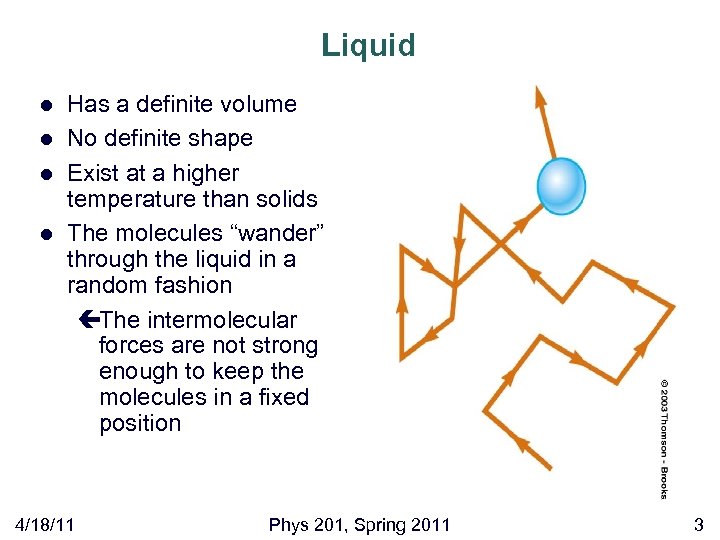
Liquid l l Has a definite volume No definite shape Exist at a higher temperature than solids The molecules “wander” through the liquid in a random fashion çThe intermolecular forces are not strong enough to keep the molecules in a fixed position 4/18/11 Phys 201, Spring 2011 3
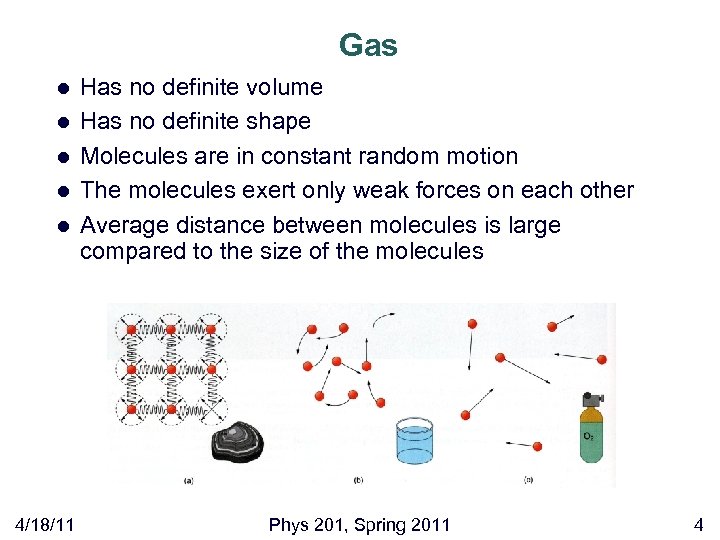
Gas l l l 4/18/11 Has no definite volume Has no definite shape Molecules are in constant random motion The molecules exert only weak forces on each other Average distance between molecules is large compared to the size of the molecules Phys 201, Spring 2011 4
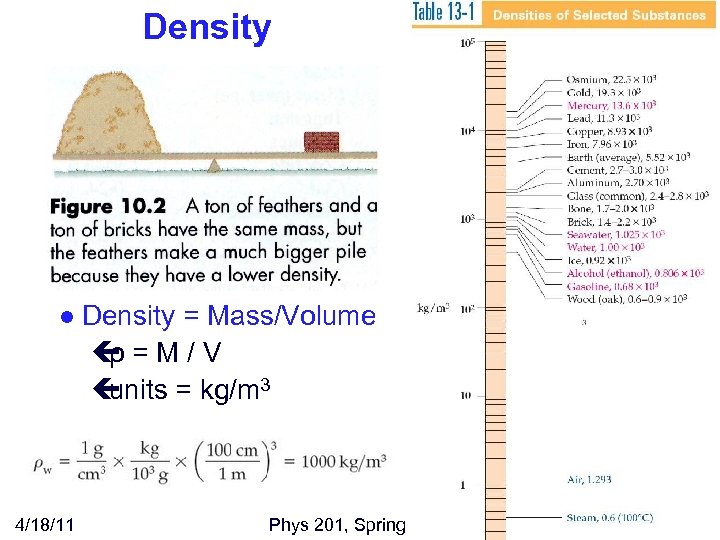
Density l 4/18/11 Density = Mass/Volume ç =M/V ρ ç units = kg/m 3 Phys 201, Spring 2011 5
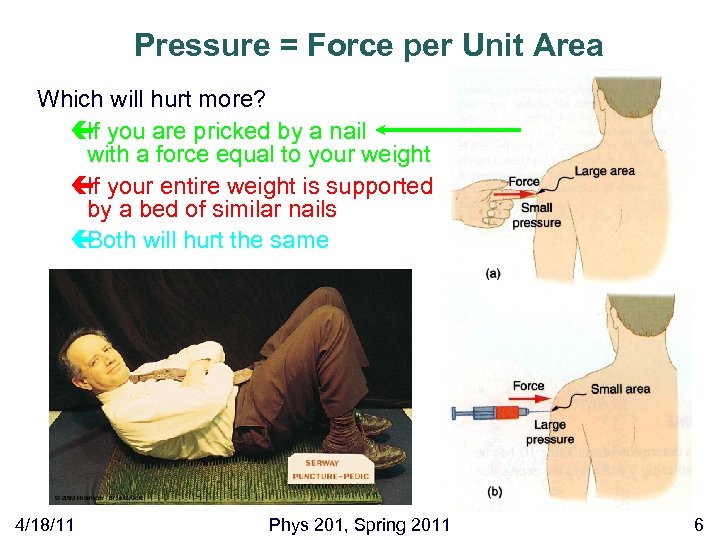
Pressure = Force per Unit Area Which will hurt more? ç you are pricked by a nail If with a force equal to your weight ç your entire weight is supported If by a bed of similar nails ç Both will hurt the same 4/18/11 Phys 201, Spring 2011 6
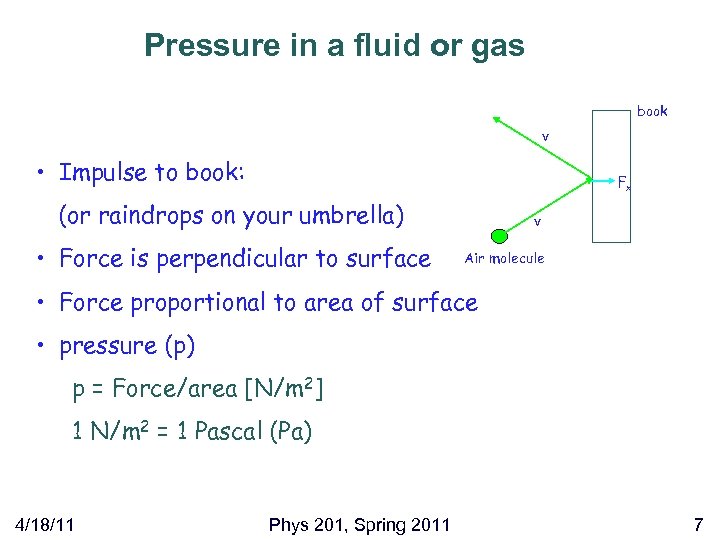
Pressure in a fluid or gas book v • Impulse to book: Fx (or raindrops on your umbrella) • Force is perpendicular to surface v Air molecule • Force proportional to area of surface • pressure (p) p = Force/area [N/m 2] 1 N/m 2 = 1 Pascal (Pa) 4/18/11 Phys 201, Spring 2011 7
Atmospheric Pressure Even when there is no breeze, air molecules are continuously bombarding everything around - results in pressure. Normal atmospheric pressure = 1. 01 x 105 Pa 4/18/11 Phys 201, Spring 2011 8
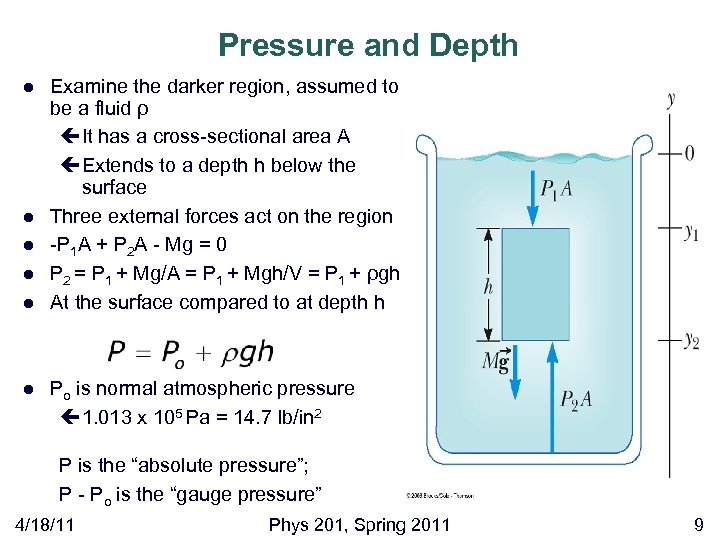
Pressure and Depth l l l Examine the darker region, assumed to be a fluid ρ ç It has a cross-sectional area A ç Extends to a depth h below the surface Three external forces act on the region -P 1 A + P 2 A - Mg = 0 P 2 = P 1 + Mg/A = P 1 + Mgh/V = P 1 + ρgh At the surface compared to at depth h Po is normal atmospheric pressure ç 1. 013 x 105 Pa = 14. 7 lb/in 2 P is the “absolute pressure”; P - Po is the “gauge pressure” 4/18/11 Phys 201, Spring 2011 9
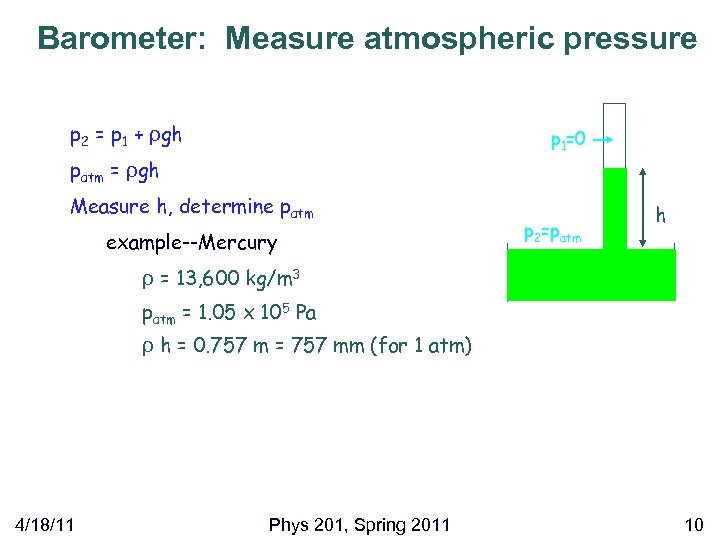
Barometer: Measure atmospheric pressure p 2 = p 1 + ρgh p 1=0 patm = ρgh Measure h, determine patm example--Mercury p 2=patm h ρ = 13, 600 kg/m 3 patm = 1. 05 x 105 Pa ρ h = 0. 757 m = 757 mm (for 1 atm) 4/18/11 Phys 201, Spring 2011 10
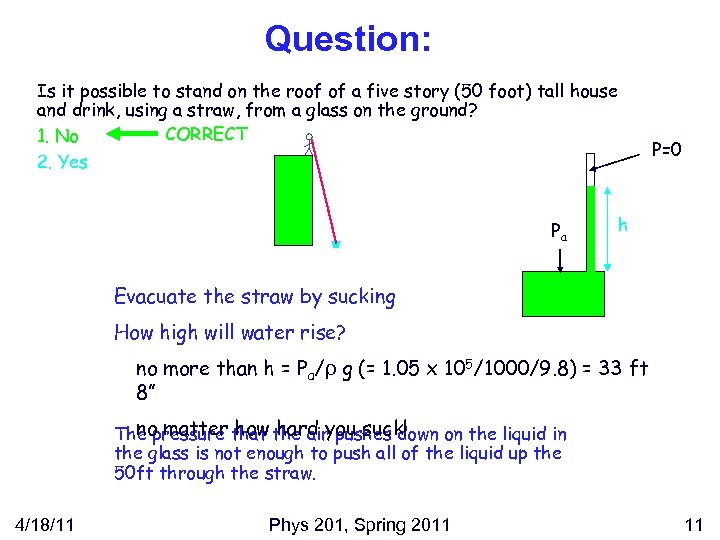
Question: Is it possible to stand on the roof of a five story (50 foot) tall house and drink, using a straw, from a glass on the ground? CORRECT 1. No 2. Yes Pa P=0 h Evacuate the straw by sucking How high will water rise? no more than h = Pa/ρ g (= 1. 05 x 105/1000/9. 8) = 33 ft 8” no matter how hard you suck! The pressure that the air pushes down on the liquid in the glass is not enough to push all of the liquid up the 50 ft through the straw. 4/18/11 Phys 201, Spring 2011 11
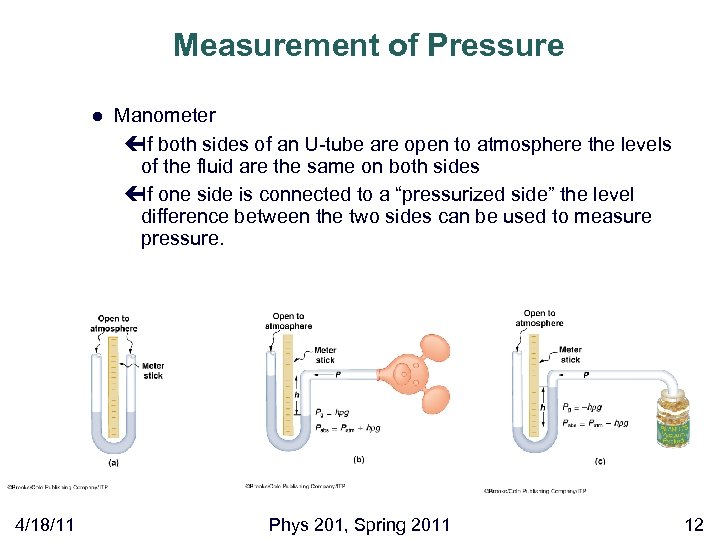
Measurement of Pressure l 4/18/11 Manometer çIf both sides of an U-tube are open to atmosphere the levels of the fluid are the same on both sides çIf one side is connected to a “pressurized side” the level difference between the two sides can be used to measure pressure. Phys 201, Spring 2011 12
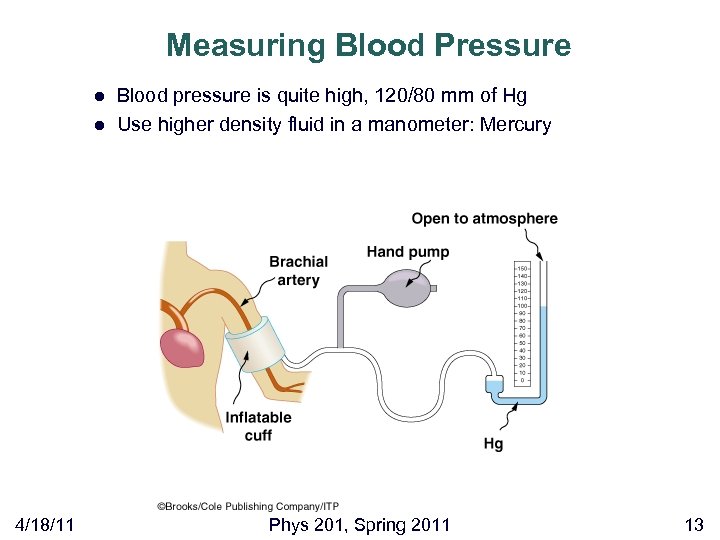
Measuring Blood Pressure l l 4/18/11 Blood pressure is quite high, 120/80 mm of Hg Use higher density fluid in a manometer: Mercury Phys 201, Spring 2011 13
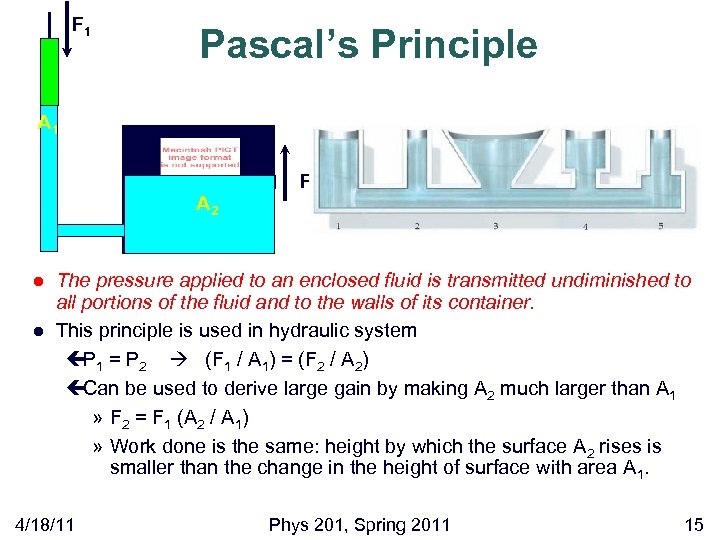
F 1 Pascal’s Principle A 1 A 2 l l F 2 The pressure applied to an enclosed fluid is transmitted undiminished to all portions of the fluid and to the walls of its container. This principle is used in hydraulic system çP 1 = P 2 (F 1 / A 1) = (F 2 / A 2) çCan be used to derive large gain by making A 2 much larger than A 1 » F 2 = F 1 (A 2 / A 1) » Work done is the same: height by which the surface A 2 rises is smaller than the change in the height of surface with area A 1. 4/18/11 Phys 201, Spring 2011 15
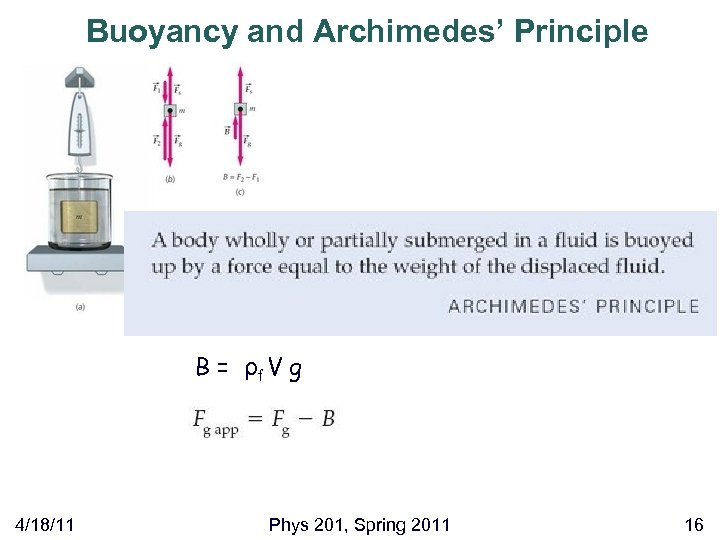
Buoyancy and Archimedes’ Principle B = ρf V g 4/18/11 Phys 201, Spring 2011 16
King Hiero II of Syracuse’s Crown King Hiero II asked Archimedes to check if his crown was pure gold. Archimedes knew l l ρgold = 19. 3 x 10³ kg/m 3 , ρw = 1. 00 x 103 kg/m 3 weighed: Wc = Fg = 7. 84 N in air W’c = F’g = 6. 86 N in water l Archimedes’ principle: B = Wc - W’c = 0. 98 N = Fw = V ρw g V g = 0. 98 N/ ρw l Thus, the crown density: ρc = M/V = Wc / V g = (7. 84 N /0. 98 N) ρw = 8 kg/m 3 < ρgold King Hiero II was cheated ! 4/18/11 Phys 201, Spring 2011 17
Скачать презентацию About Midterm Exam 3 l l When and
8fe0f4b794a5789e45e2a60782460dc9.ppt