 Скачать презентацию ABL mission creep alternative engagement scenarios for high
f948a51cdc3666b9a7b035b241f79194.ppt
- Количество слайдов: 29



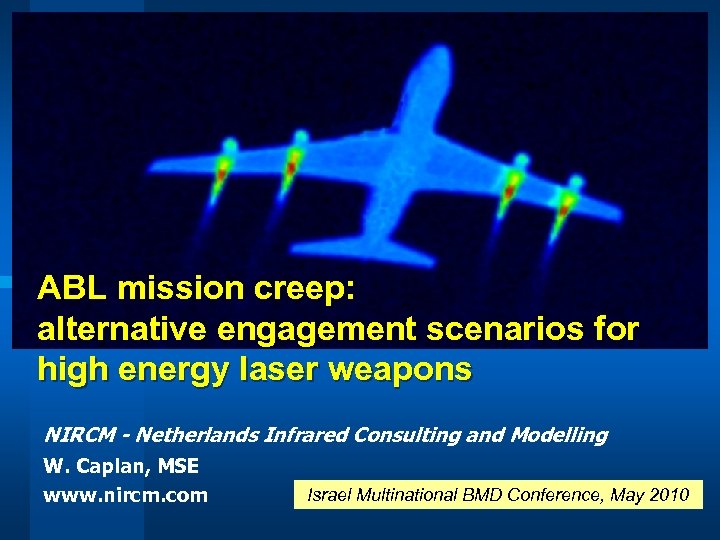
ABL mission creep: alternative engagement scenarios for high energy laser weapons NIRCM - Netherlands Infrared Consulting and Modelling W. Caplan, MSE www. nircm. com Israel Multinational BMD Conference, May 2010
OVERVIEW l Description of ABL (Airborne Laser) weapon system l Adaptive optics (AO) l Operating environment l ABL engagement zone l Alternative targets and functions l Summary IMDA May 2010 © NIRCM 2010 p. 2
Baseline for discussion l Emitted beam power one million watts (1, 000 W) l Effective range 200 km l Optic aperture 150 cm l Wavelength 1. 315 υm - Short Wave Infrared (SWIR) l Atmospheric absorption negligible ( τ > 0. 99 ) IMDA May 2010 © NIRCM 2010 p. 3
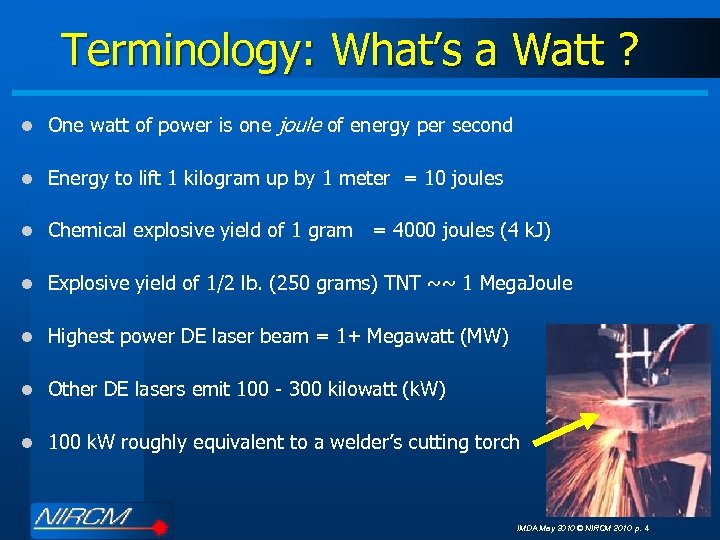
Terminology: What’s a Watt ? l One watt of power is one joule of energy per second l Energy to lift 1 kilogram up by 1 meter = 10 joules l Chemical explosive yield of 1 gram = 4000 joules (4 k. J) l Explosive yield of 1/2 lb. (250 grams) TNT ~~ 1 Mega. Joule l Highest power DE laser beam = 1+ Megawatt (MW) l Other DE lasers emit 100 - 300 kilowatt (k. W) l 100 k. W roughly equivalent to a welder’s cutting torch IMDA May 2010 © NIRCM 2010 p. 4
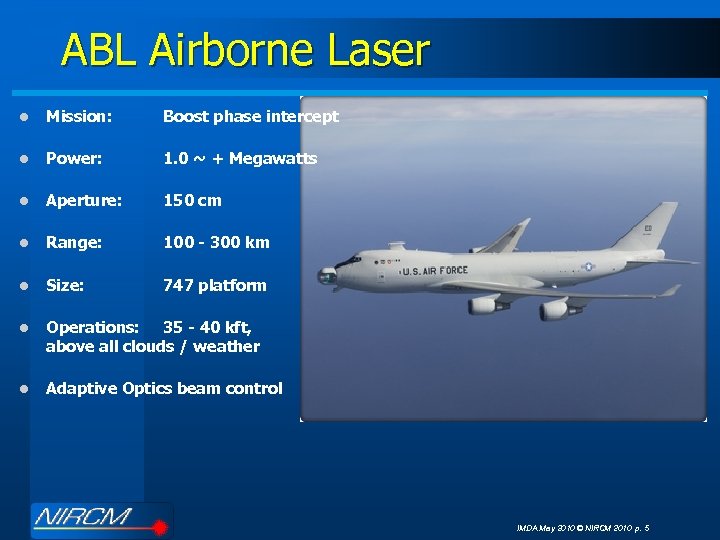
ABL Airborne Laser l Mission: Boost phase intercept l Power: 1. 0 ~ + Megawatts l Aperture: 150 cm l Range: 100 - 300 km l Size: 747 platform l Operations: 35 - 40 kft, above all clouds / weather l Adaptive Optics beam control IMDA May 2010 © NIRCM 2010 p. 5
ABL main features l COIL laser with adaptive optics beam control – chemical laser occupies nearly entire payload of Boeing 747 aircraft l Three other major sensor systems integrated – Target acquisition sensor (infrared search track IRST + range) – Target track laser (fine track with range) – Beam control laser (measures atmosphere for compensation) l Adaptive Optics beam control system – required for compensating atmospheric turbulence in the beam path – the key technology (along with high energy laser) for system effectiveness l Designed to destroy ballistic missile in boost phase – delivers enough energy (heat) to melt or burn booster while under high mechanical load during launch l ABL operating altitude ~ 40 kft (12 km) above almost all weather IMDA May 2010 © NIRCM 2010 p. 6
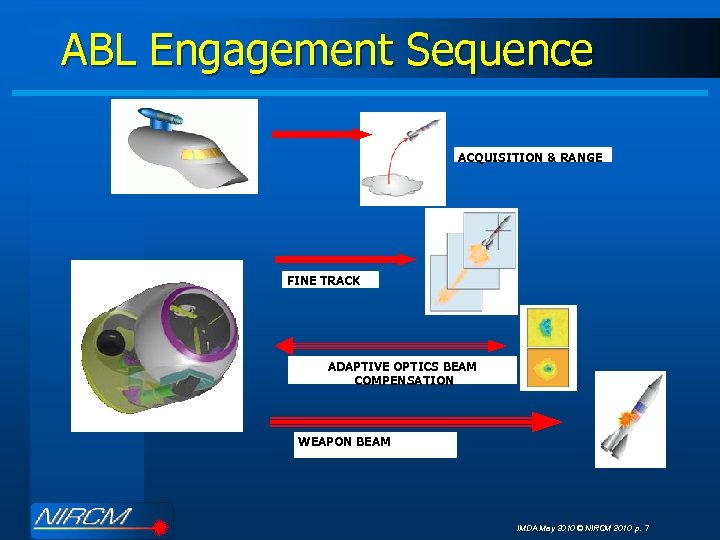
ABL Engagement Sequence ACQUISITION & RANGE FINE TRACK ADAPTIVE OPTICS BEAM COMPENSATION WEAPON BEAM IMDA May 2010 © NIRCM 2010 p. 7
Adaptive optics enables the ABL l High energy laser beam propagation (range) is limited by four main factors – – beam quality diffraction propagation through turbulent atmosphere thermal blooming l Beam quality & diffraction can be improved by design; thermal blooming is not a major factor in ABL engagements l Effects of turbulence can be reduced with adaptive optics – measures (with a laser) in real time the turbulence along the path – controls microscopic shape of a flexible mirror to compensate (pre-distort) the high energy beam with distortions 180° out of phase IMDA May 2010 © NIRCM 2010 p. 8
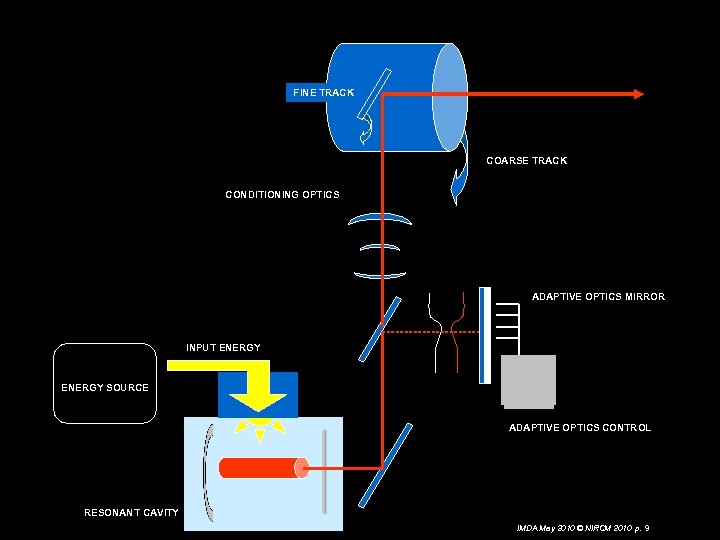
FINE TRACK COARSE TRACK CONDITIONING OPTICS ADAPTIVE OPTICS MIRROR INPUT ENERGY SOURCE ADAPTIVE OPTICS CONTROL RESONANT CAVITY IMDA May 2010 © NIRCM 2010 p. 9
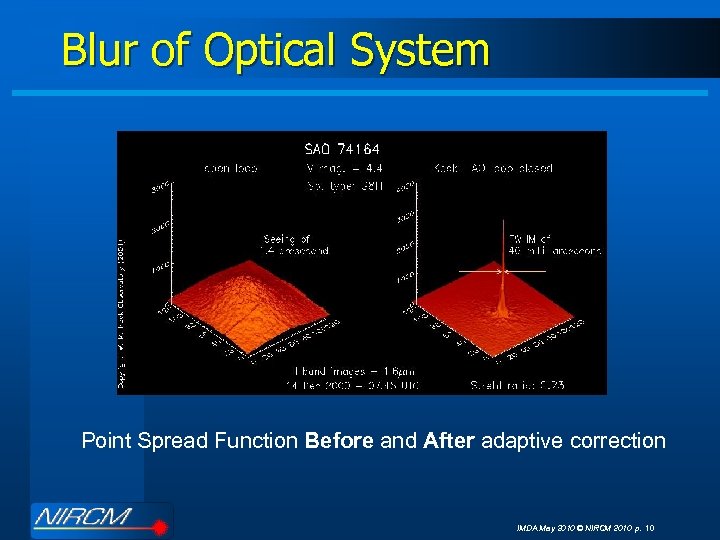
Blur of Optical System Point Spread Function Before and After adaptive correction IMDA May 2010 © NIRCM 2010 p. 10
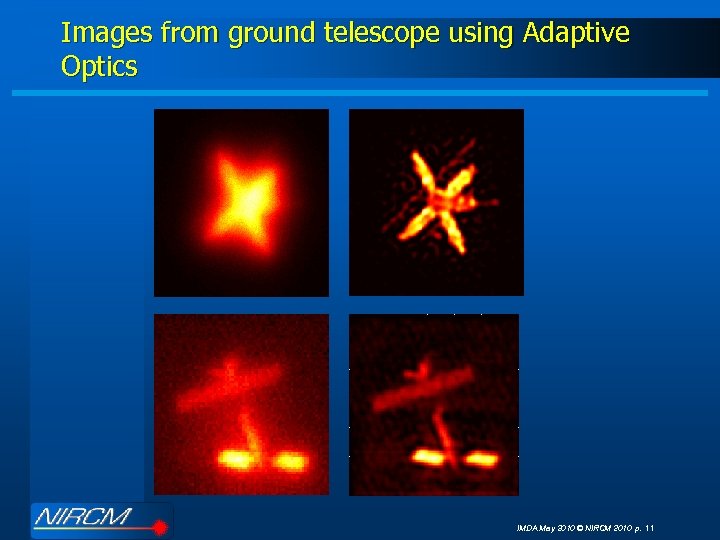
Images from ground telescope using Adaptive Optics IMDA May 2010 © NIRCM 2010 p. 11
Operating environment l ABL operates at 12, 000 m altitude l Attack on the ballistic missile begins as the target enters this altitude also l Aside from the weather of the troposphere, above this altitude atmospheric turbulence decreases significantly l Beam propagation improves rapidly with beam elevation angle IMDA May 2010 © NIRCM 2010 p. 12
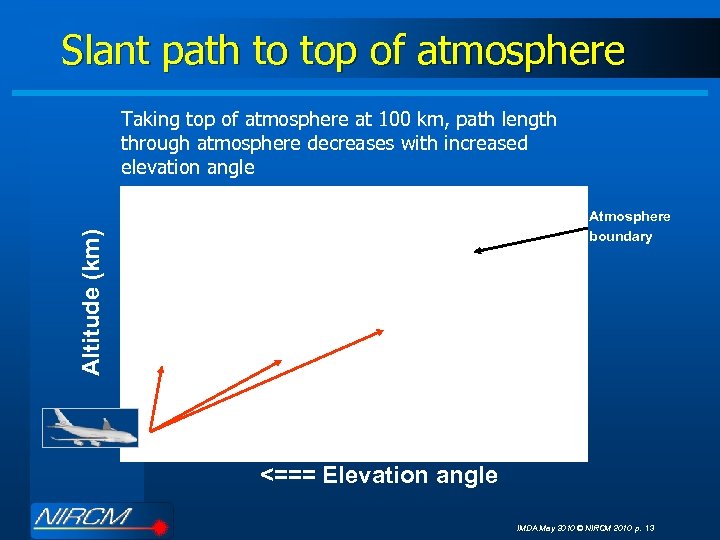
Slant path to top of atmosphere Taking top of atmosphere at 100 km, path length through atmosphere decreases with increased elevation angle Altitude (km) Atmosphere boundary <=== Elevation angle IMDA May 2010 © NIRCM 2010 p. 13
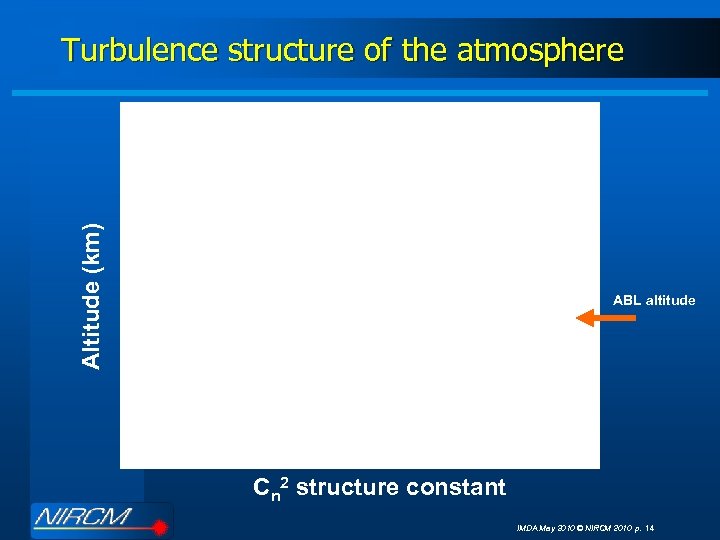
Altitude (km) Turbulence structure of the atmosphere ABL altitude Cn 2 structure constant IMDA May 2010 © NIRCM 2010 p. 14
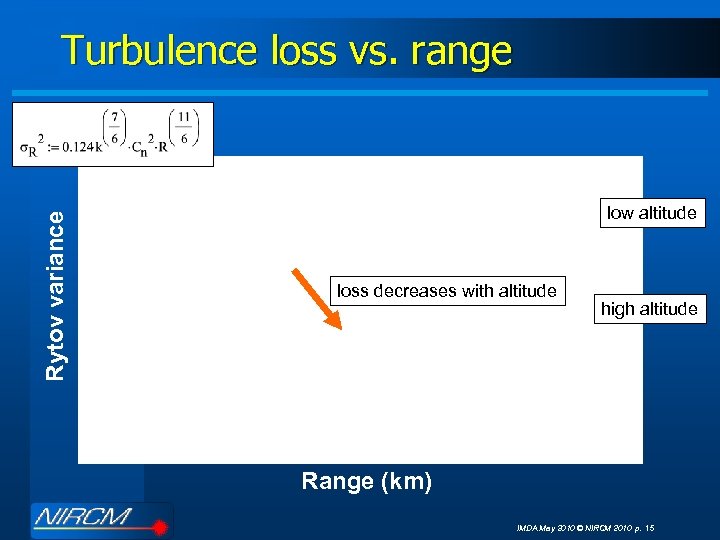
Rytov variance Turbulence loss vs. range low altitude loss decreases with altitude high altitude Range (km) IMDA May 2010 © NIRCM 2010 p. 15
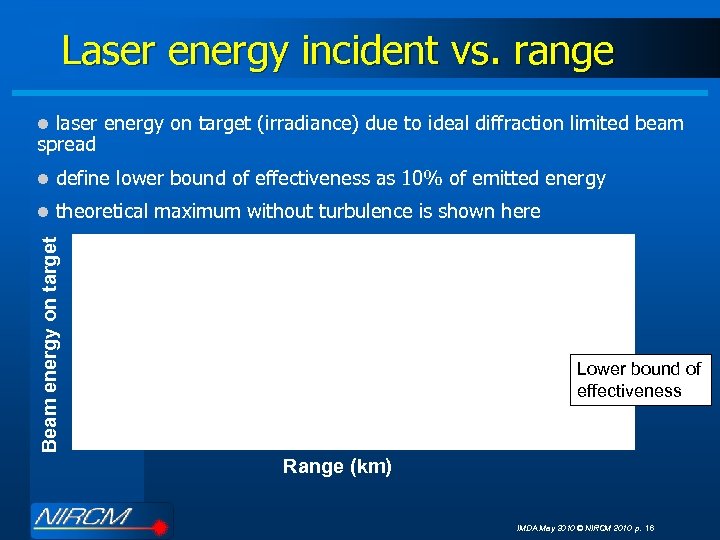
Laser energy incident vs. range laser energy on target (irradiance) due to ideal diffraction limited beam spread l define lower bound of effectiveness as 10% of emitted energy l theoretical maximum without turbulence is shown here Beam energy on target l Lower bound of effectiveness Range (km) IMDA May 2010 © NIRCM 2010 p. 16
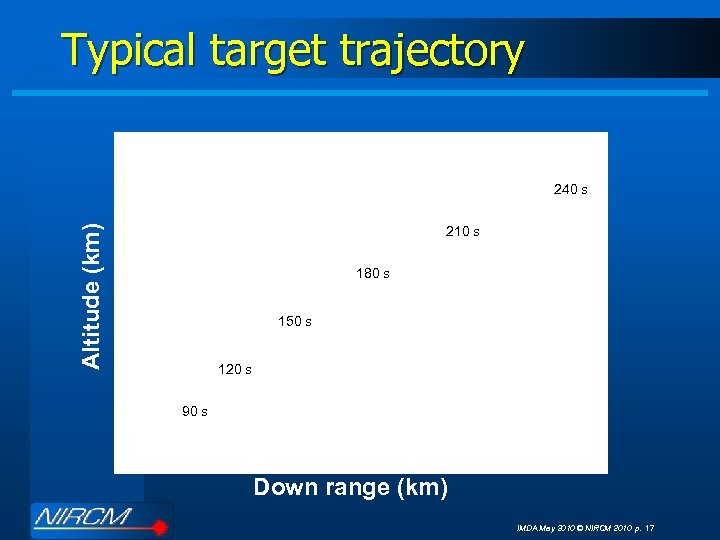
Typical target trajectory 240 s Altitude (km) 210 s 180 s 150 s 120 s 90 s Down range (km) IMDA May 2010 © NIRCM 2010 p. 17
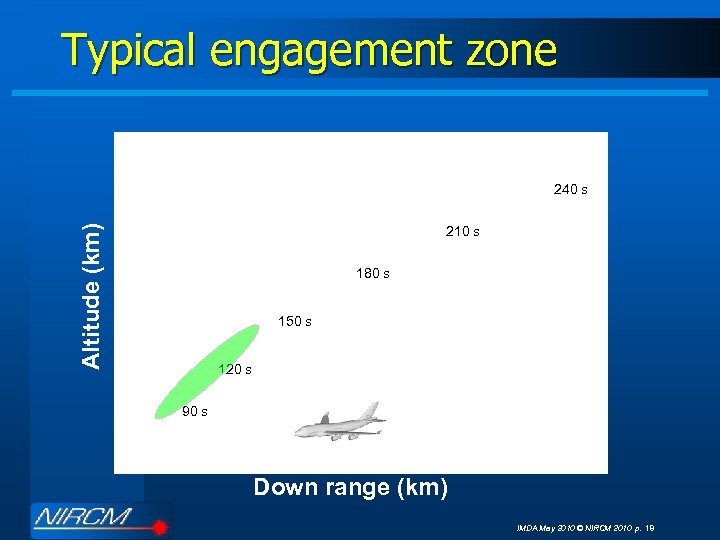
Typical engagement zone 240 s Altitude (km) 210 s 180 s 150 s 120 s 90 s Down range (km) IMDA May 2010 © NIRCM 2010 p. 18
Trajectory, laser range, low turbulence define engagement zone l Given an estimate for effective range of boost-phase kill l Given that turbulence effects decrease rapidly with increased elevation angle l Given that beam divergence exo-atmosphere allows much longer effective range l Results in favorable conditions for post-boost target engagement IMDA May 2010 © NIRCM 2010 p. 19
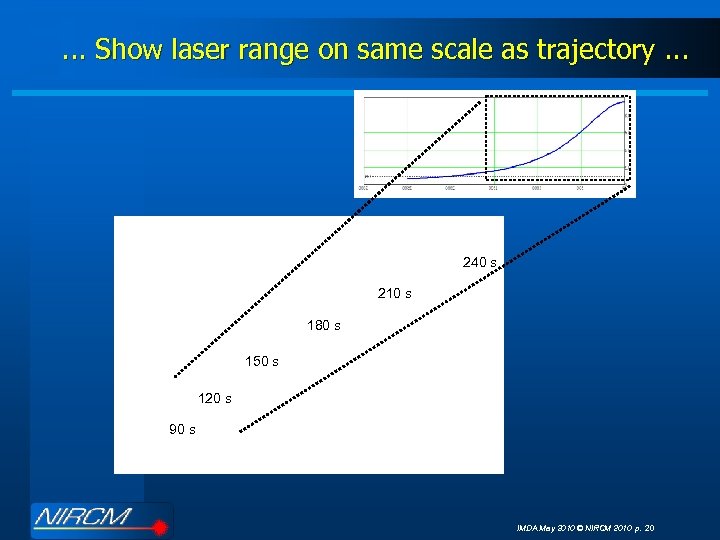
. . . Show laser range on same scale as trajectory. . . 240 s 210 s 180 s 150 s 120 s 90 s IMDA May 2010 © NIRCM 2010 p. 20
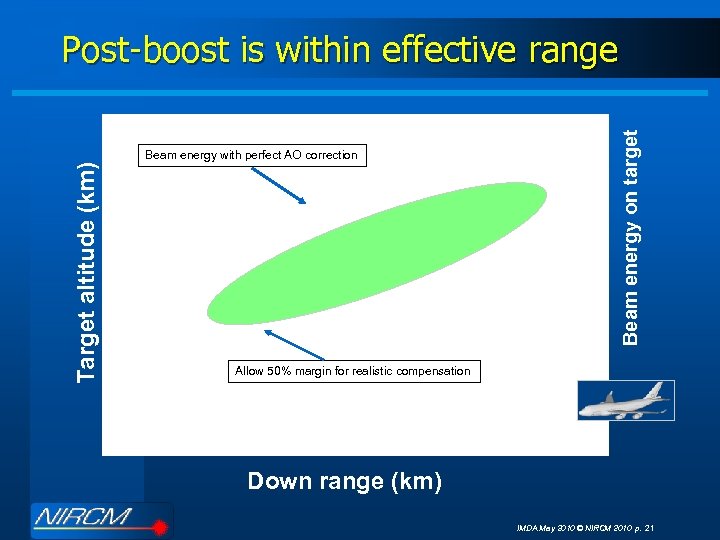
Target altitude (km) Beam energy with perfect AO correction Beam energy on target Post-boost is within effective range Allow 50% margin for realistic compensation Down range (km) IMDA May 2010 © NIRCM 2010 p. 21
What is "effective" range ? l Primary mission is against boosting missile – l attack on booster / stage post-burnout is ineffective ABL can deliver at least 50% energy in post-boost engagement zone – – engagement for approaching targets other engagement geometries not considered l Effective range depends on the susceptibility of the target to heat damage l Possible targets – – – l RV post-boost vehicle "bus" decoys or other penetration aids Other functions – – – decoy discrimination real-time imaging of events precision track IMDA May 2010 © NIRCM 2010 p. 22
ABL against post-boost objects l Possible targets – RV • reentry vehicle very hardened against heat damage • not a good candidate target for high energy laser attack – post-boost vehicle "bus" • mechanical parts, fuel tanks, etc. susceptible to high energy attack • usually a very small engagement time opportunity – decoys or other penetration aids • light weight objects, thin-skinned balloons, etc. very susceptible to laser attack • damage of objects other than RVs only effective in coordination with the entire missile defense battlespace l Other functions – decoy discrimination • response of low mass objects to laser beam can discriminate between targets and decoys if tracked with suitable sensors (MWIR or LWIR) – real-time imaging of events • imaging post-boost may assist battle management for other defense systems – precision track • likewise, precision track may assist battle management for other defense systems IMDA May 2010 © NIRCM 2010 p. 23
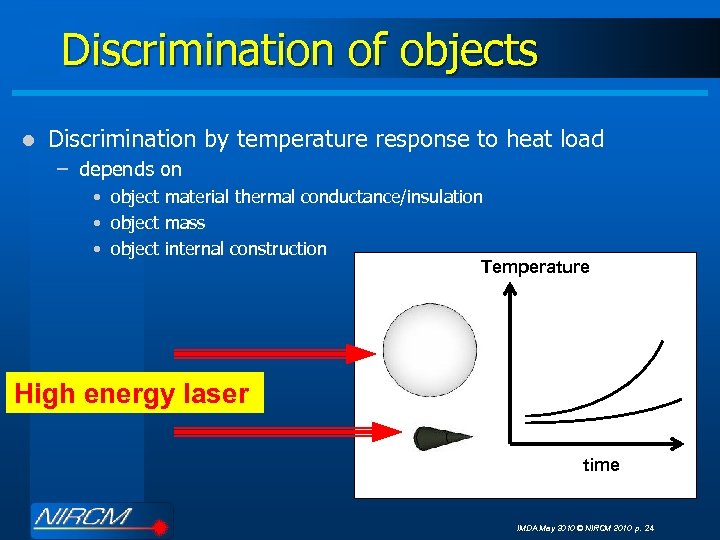
Discrimination of objects l Discrimination by temperature response to heat load – depends on • object material thermal conductance/insulation • object mass • object internal construction Temperature High energy laser time IMDA May 2010 © NIRCM 2010 p. 24
Further comments on post-boost l Target discrimination functions – decoy discrimination • response of low mass objects to laser beam requires some significant energy but probably not 1 MW • damage or destruction of some objects may only complicate the battlespace – real-time imaging of events • ABL beam control sensors have high resolution focal planes • discrimination by imaging post-boost may not be useful without modification to system optics – precision track • precision track may be time-shared between multiple objects • caveat: some post-boost objects may not return enough signal from the beacon illumination beam control laser l Considering all of the above. . . – a powerful laser for thermal discrimination may be useful, but not as powerful as the COIL – If discrimination from altitude of 40, 000 ft is a useful function, may not require capability of the ABL – A suitable HALE (High Altitude Long Endurance) platform with a kilowatt-class laser and 80 cm optical aperture may meet the same functional requirements IMDA May 2010 © NIRCM 2010 p. 25
Consider look-down: lower elevation targets l Beam propagation severely limited looking down into lower atmosphere l Possible targets are hostile aircraft, attacking SAMs l Self-defense against hostile aircraft – can expect effective range well over 100 km, probably greater than range against ballistic missiles – target acquisition and IFF at long ranges may be difficult – can also defend upper airspace for other HVAA in vicinity l Self-defense against large high-altitude SAMs – – expect SAMs to be less susceptible than aircraft, but still possible engagement time for SAM flyout is limited - may not be enough target acquisition would be challenging (MAWs and RWR not suitable) engagement geometry may not be possible IMDA May 2010 © NIRCM 2010 p. 26
Summary l ABL beam propagation geometry is favorable for post-boost engagement / tracking l Primary target is a "hardened" target for HE laser l Secondary targets and / or discrimination may be useful function l Precision image & track may be useful function l Should be considered in the battle management context IMDA May 2010 © NIRCM 2010 p. 27
Questions. . . IMDA May 2010 © NIRCM 2010 p. 28
Reference. . . IMDA May 2010 © NIRCM 2010 p. 29
Скачать презентацию ABL mission creep alternative engagement scenarios for high
f948a51cdc3666b9a7b035b241f79194.ppt