 Скачать презентацию ABET for the Public Service Strategic Policy Framework
c180b219040d0b2289faf9312ac0362c.ppt
- Количество слайдов: 24



ABET for the Public Service: Strategic Policy Framework Presentation to Kwa. Zulu-Natal ABET Indaba 22 June 2009 1
Objective To provide an overview of the Draft ABET Policy Framework for Public Service 2
Outline of Presentation The ABET in the Public Service: Strategic Policy Framework 1. 2. 3. 4. Basic Assumptions Compounding Factors Overview of Policy Options Way Forward 3
1 BASIC ASSUMPTIONS 4
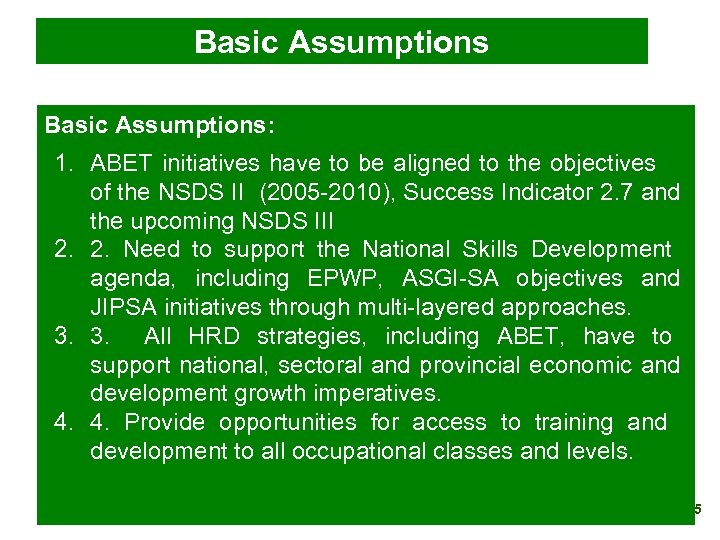
Basic Assumptions: 1. ABET initiatives have to be aligned to the objectives of the NSDS II (2005 -2010), Success Indicator 2. 7 and the upcoming NSDS III 2. 2. Need to support the National Skills Development agenda, including EPWP, ASGI-SA objectives and JIPSA initiatives through multi-layered approaches. 3. 3. All HRD strategies, including ABET, have to support national, sectoral and provincial economic and development growth imperatives. 4. 4. Provide opportunities for access to training and development to all occupational classes and levels. 5
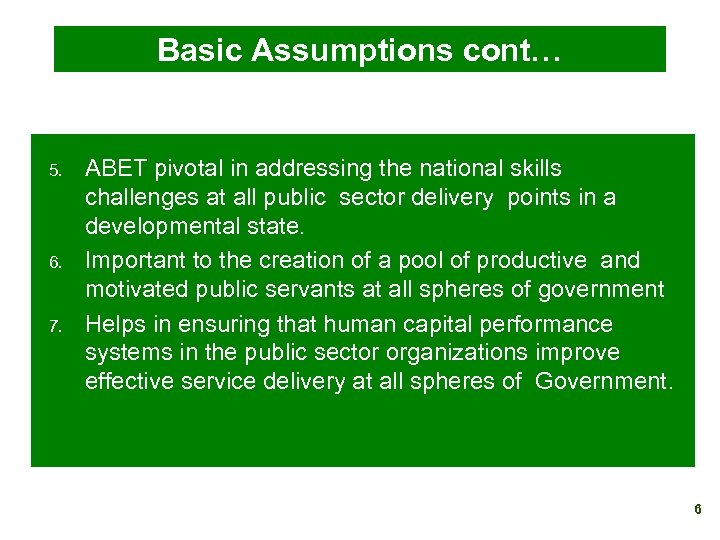
Basic Assumptions cont… 5. 6. 7. ABET pivotal in addressing the national skills challenges at all public sector delivery points in a developmental state. Important to the creation of a pool of productive and motivated public servants at all spheres of government Helps in ensuring that human capital performance systems in the public sector organizations improve effective service delivery at all spheres of Government. 6
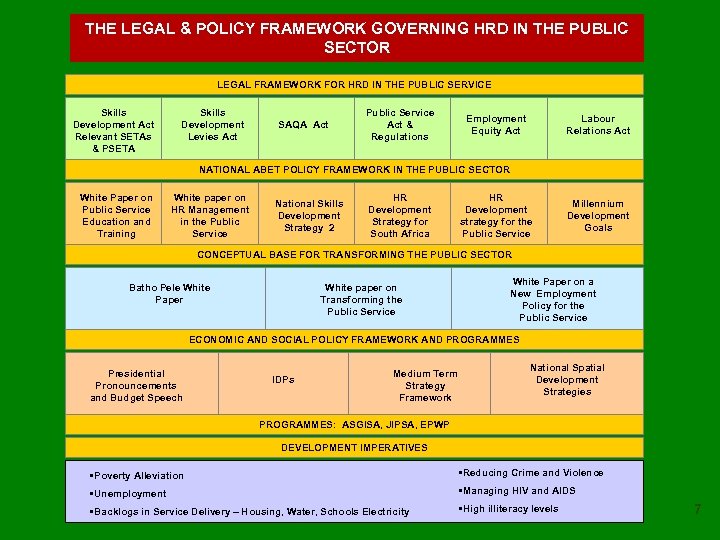
THE LEGAL & POLICY FRAMEWORK GOVERNING HRD IN THE PUBLIC SECTOR LEGAL FRAMEWORK FOR HRD IN THE PUBLIC SERVICE Skills Development Act Relevant SETAs & PSETA Skills Development Levies Act SAQA Act Public Service Act & Regulations Employment Equity Act Labour Relations Act NATIONAL ABET POLICY FRAMEWORK IN THE PUBLIC SECTOR White Paper on Public Service Education and Training White paper on HR Management in the Public Service National Skills Development Strategy 2 HR Development Strategy for South Africa HR Development strategy for the Public Service Millennium Development Goals CONCEPTUAL BASE FOR TRANSFORMING THE PUBLIC SECTOR Batho Pele White Paper White paper on Transforming the Public Service White Paper on a New Employment Policy for the Public Service ECONOMIC AND SOCIAL POLICY FRAMEWORK AND PROGRAMMES Presidential Pronouncements and Budget Speech IDPs Medium Term Strategy Framework National Spatial Development Strategies PROGRAMMES: ASGISA, JIPSA, EPWP DEVELOPMENT IMPERATIVES §Poverty Alleviation §Reducing Crime and Violence §Unemployment §Managing HIV and AIDS §Backlogs in Service Delivery – Housing, Water, Schools Electricity §High illiteracy levels 7
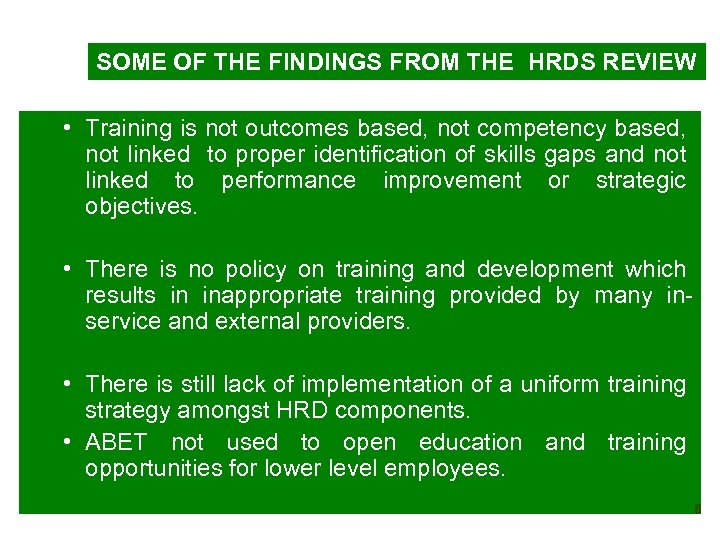
SOME OF THE FINDINGS FROM THE HRDS REVIEW • Training is not outcomes based, not competency based, not linked to proper identification of skills gaps and not linked to performance improvement or strategic objectives. • There is no policy on training and development which results in inappropriate training provided by many inservice and external providers. • There is still lack of implementation of a uniform training strategy amongst HRD components. • ABET not used to open education and training opportunities for lower level employees. 8
2 COMPOUNDING FACTORS 9
COMPOUNDING FACTORS • Minimal attention paid to institutional arrangements and the effect of these relationships on the blazing of an ABET policy path. • Attention has not moved from structural arrangements, to what happens within structures, and how these processes, relations, etc. could be harnessed to optimise policy implementation. • Access opportunities not consistent with PDPs, career paths and performance assessments 10
COMPOUNDING FACTORS CONT… • Current interventions not addressing challenges of equity • The nature and extent of the challenge not adequately quantified. • The product offering not packaged in a manner that addresses the challenge 11
3 POLICY FRAMEWORK 12
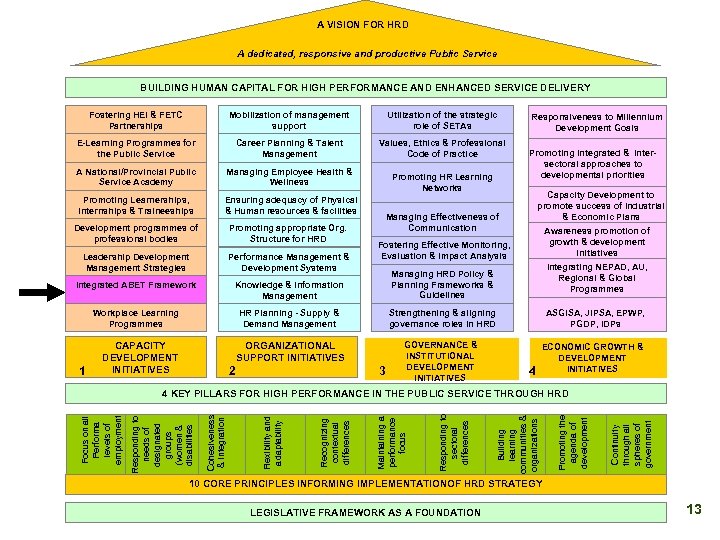
A VISION FOR HRD A dedicated, responsive and productive Public Service BUILDING HUMAN CAPITAL FOR HIGH PERFORMANCE AND ENHANCED SERVICE DELIVERY Fostering HEI & FETC Partnerships Mobilization of management support Utilization of the strategic role of SETAs E-Learning Programmes for the Public Service Career Planning & Talent Management Values, Ethics & Professional Code of Practice A National/Provincial Public Service Academy Managing Employee Health & Wellness Promoting Learnerships, Internships & Traineeships Ensuring adequacy of Physical & Human resources & facilities Promoting HR Learning Networks Responsiveness to Millennium Development Goals Promoting integrated & intersectoral approaches to developmental priorities Capacity Development to promote success of Industrial & Economic Plans Managing Effectiveness of Communication Development programmes of professional bodies Promoting appropriate Org. Structure for HRD Leadership Development Management Strategies Performance Management & Development Systems Integrated ABET Framework Knowledge & Information Management Managing HRD Policy & Planning Frameworks & Guidelines Workplace Learning Programmes HR Planning - Supply & Demand Management Strengthening & aligning governance roles in HRD ORGANIZATIONAL SUPPORT INITIATIVES GOVERNANCE & INSTITUTIONAL DEVELOPMENT INITIATIVES 1 CAPACITY DEVELOPMENT INITIATIVES 2 Awareness promotion of growth & development initiatives Fostering Effective Monitoring, Evaluation & Impact Analysis 3 Integrating NEPAD, AU, Regional & Global Programmes ASGISA, JIPSA, EPWP, PGDP, IDPs 4 ECONOMIC GROWTH & DEVELOPMENT INITIATIVES Continuity through all spheres of government Promoting the agenda of development Building learning communities & organizations Responding to sectoral differences Maintaining a performance focus Recognizing contextual differences Flexibility and adaptability Cohesiveness & Integration Responding to needs of designated groups (women & disabilities Focus on all Performa levels of employment 4 KEY PILLARS FOR HIGH PERFORMANCE IN THE PUBLIC SERVICE THROUGH HRD 10 CORE PRINCIPLES INFORMING IMPLEMENTATIONOF HRD STRATEGY LEGISLATIVE FRAMEWORK AS A FOUNDATION 13
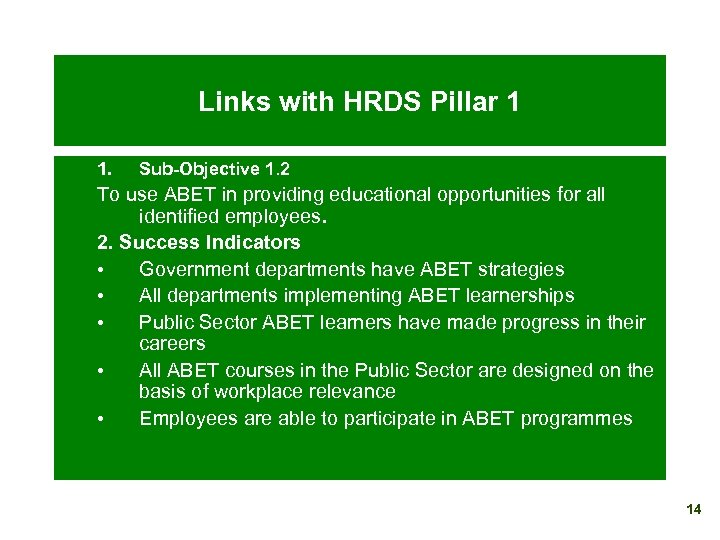
Links with HRDS Pillar 1 1. Sub-Objective 1. 2 To use ABET in providing educational opportunities for all identified employees. 2. Success Indicators • Government departments have ABET strategies • All departments implementing ABET learnerships • Public Sector ABET learners have made progress in their careers • All ABET courses in the Public Sector are designed on the basis of workplace relevance • Employees are able to participate in ABET programmes 14
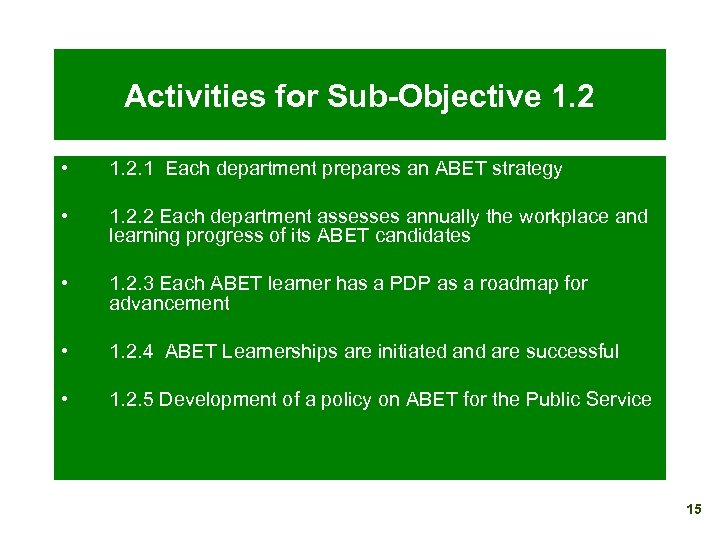
Activities for Sub-Objective 1. 2 • 1. 2. 1 Each department prepares an ABET strategy • 1. 2. 2 Each department assesses annually the workplace and learning progress of its ABET candidates • 1. 2. 3 Each ABET learner has a PDP as a roadmap for advancement • 1. 2. 4 ABET Learnerships are initiated and are successful • 1. 2. 5 Development of a policy on ABET for the Public Service 15
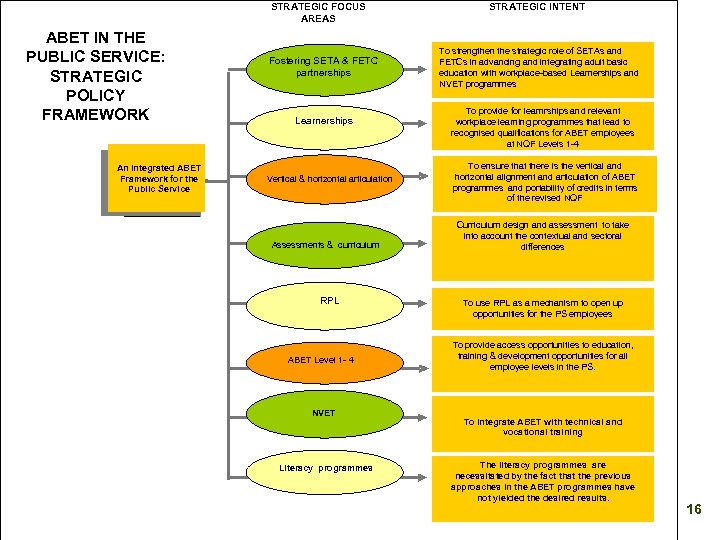
STRATEGIC FOCUS AREAS ABET IN THE PUBLIC SERVICE: STRATEGIC POLICY FRAMEWORK An Integrated ABET Framework for the Public Service Fostering SETA & FETC partnerships Learnerships Vertical & horizontal articulation Assessments & curriculum RPL ABET Level 1 - 4 NVET Literacy programmes STRATEGIC INTENT To strengthen the strategic role of SETAs and FETCs in advancing and integrating adult basic education with workplace-based Learnerships and NVET programmes To provide for learnrships and relevant workplace learning programmes that lead to recognised qualifications for ABET employees at NQF Levels 1 -4 To ensure that there is the vertical and horizontal alignment and articulation of ABET programmes and portability of credits in terms of the revised NQF Curriculum design and assessment to take into account the contextual and sectoral differences To use RPL as a mechanism to open up opportunities for the PS employees To provide access opportunities to education, training & development opportunities for all employee levels in the PS. To integrate ABET with technical and vocational training The literacy programmes are necessitated by the fact that the previous approaches in the ABET programmes have not yielded the desired results. 16
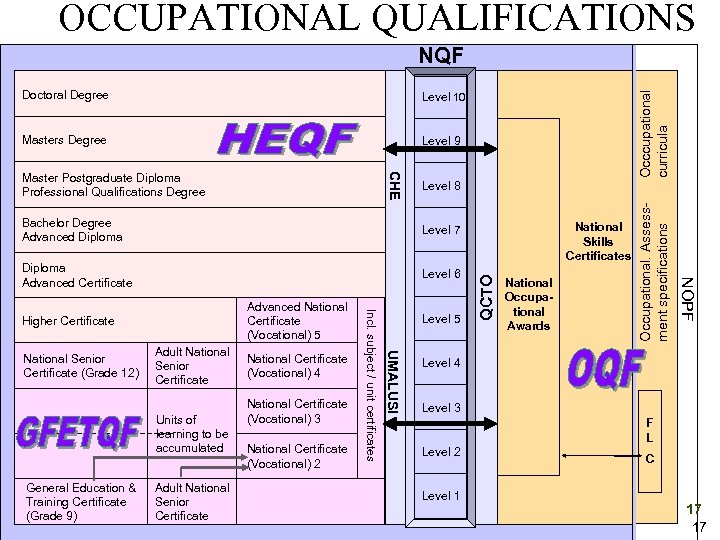
OCCUPATIONAL QUALIFICATIONS NQF Level 10 Masters Degree Level 9 Level 8 Level 7 Level 6 Higher Certificate Adult National Senior Certificate Units of learning to be accumulated General Education & Training Certificate (Grade 9) Adult National Senior Certificate National Certificate (Vocational) 4 National Certificate (Vocational) 3 National Certificate (Vocational) 2 Level 5 UMALUSI National Senior Certificate (Grade 12) Incl. subject / unit certificates Advanced National Certificate (Vocational) 5 QCTO Diploma Advanced Certificate National Skills Certificates National Occupational Awards NOPF Bachelor Degree Advanced Diploma Occupational. Assessment specifications CHE Master Postgraduate Diploma Professional Qualifications Degree Occcupational curricula Doctoral Degree Level 4 Level 3 F L Level 2 Level 1 C 17 17
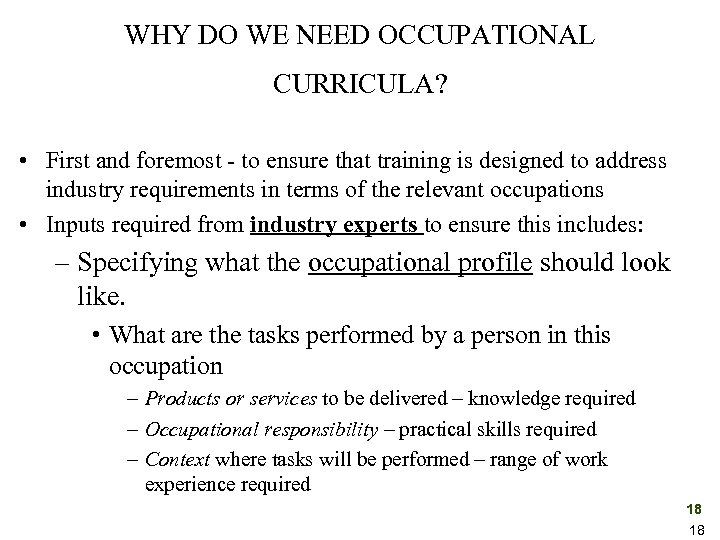
WHY DO WE NEED OCCUPATIONAL CURRICULA? • First and foremost - to ensure that training is designed to address industry requirements in terms of the relevant occupations • Inputs required from industry experts to ensure this includes: – Specifying what the occupational profile should look like. • What are the tasks performed by a person in this occupation – Products or services to be delivered – knowledge required – Occupational responsibility – practical skills required – Context where tasks will be performed – range of work experience required 18 18
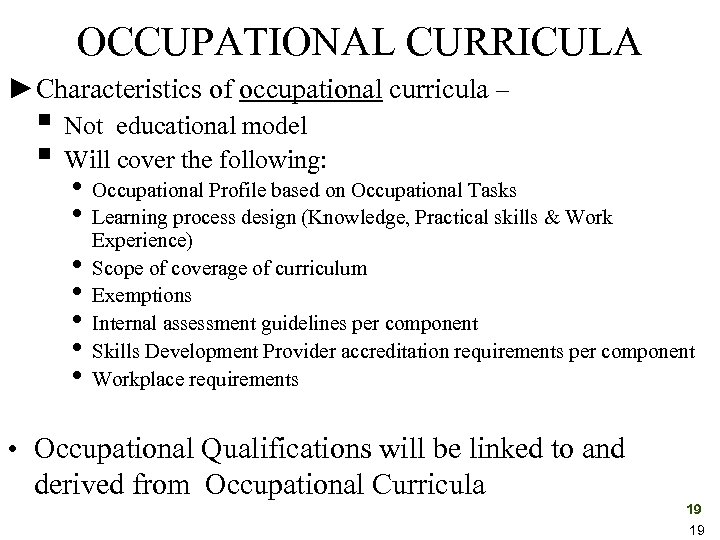
OCCUPATIONAL CURRICULA ►Characteristics of occupational curricula – § Not educational model § Will cover the following: • • Occupational Profile based on Occupational Tasks Learning process design (Knowledge, Practical skills & Work Experience) Scope of coverage of curriculum Exemptions Internal assessment guidelines per component Skills Development Provider accreditation requirements per component Workplace requirements • Occupational Qualifications will be linked to and derived from Occupational Curricula 19 19
4 WAY FORWARD 20
PRINCIPLES • The development and adoption of an ABET Policy Framework for the promotion and support of Adult Basic Education and Training in the Public Service. • Development of a more responsive and transformational model of ABET. • A model anchored by the broad strategic national developmental agenda • Utilization of RPL as a tool for access. 21
PRINCIPLES CONT… • Articulates horizontally and vertically within the NQF framework with Learnerships and Vocational Education and Training in FET • Allows portability of credits ito revised NQF • Learner-driven and outcomes-based • Driven by principles of access, redress, equity, relevance and quality. • Promotes lifelong-learning in the workplace. 22
PRINCIPLES CONT… • Promotes andragogic methodologies • Allows and promotes the use of IT as a learning tool, including e-learning • Promotes multiple-literacies 23
Thank you Discussion 24
Скачать презентацию ABET for the Public Service Strategic Policy Framework
c180b219040d0b2289faf9312ac0362c.ppt