 Скачать презентацию ABA Forum on Construction Div 4 Literature Review 1
4af8a9609662162ce2d575ac7f478765.ppt
- Количество слайдов: 27



ABA Forum on Construction Div. 4—Literature Review 1. Measuring the Impacts of the Delivery System on Project— Design-Build and Design-Bid-Build NIST GCR 02 -840 1

Authors Stephen R. Thomas Candace L. Macken Tae Hwan Chung Inho Kim Construction Industry Institute Funded by NIST 2

National Institute of Standards and Technology (NIST) Founded in 1901 Non-regulatory federal agency within the U. S Department of Commerce. Mission to promote U. S. innovation and industrial competitiveness by advancing measurement science, standards, and technology in ways that enhance economic security and improve our quality of life. 3

NIST employs about 2, 900 scientists, engineers, technicians, and support and administrative personnel. Hosts about 2, 600 associates and facility users from academia, industry, and other government agencies. Partners with 1, 600 manufacturing specialists and staff at about 400 locations around the country. 4

Using Database of Construction Industry Institute (CII) CII is based at The University of Texas at Austin Consortium of more than 100 leading owner, engineering-contractor, and supplier firms from both the public and private arenas. Purpose: to enhance the business effectiveness and sustainability of the capital facility life cycle through research, related initiatives, and industry alliances. 5
“What Gets Measured Gets Improved" Since the establishment of CII in 1983, its members and academia have collaborated to produce Best Practices to improve the cost effectiveness of capital facility project execution. The mission of CII Benchmarking & Metrics is to quantify this value and to provide assessment to participants. 6
Benchmarking & Metrics Participants receive benchmarking training. Input project performance into secure benchmarking site. Real-time project performance may be assessed in both graphical and tabular format against a large sample of projects from some of the industry’s most reputable firms. Over 1, 882 owner and contractor projects valued at more than $98 billion in total installed costs. 7
CII 2010 Performance Assessment In 2009, CII began to take steps to enable the secure collection of project performance data from around the world by investing in sector‐specific metrics and a next‐generation (Next. Gen) Benchmarking System. Partnering with universities and research organizations across the globe to allow companies to have access to CII Benchmarking through a dedicated network of servers. The key will be transparency in giving these companies an unlimited ability to mine project data. 8
CII has assessed 1, 931 projects representing over $98 Billion Involved 133 companies submitting at least one project Produced over 40 Benchmarking reports and publications Today, the program employs eight staff members to advance project performance through benchmarking research. 9
Focus on Metrics by Sector 1) Pharmaceutical and Biotechnology Projects North America, Europe, Asia 2) Upstream Oil and Gas Projects Worldwide (7 locations) 3) Downstream Oil and Gas Projects Worldwide (6 locations) 4) Oil Sands Projects North America 5) Healthcare Projects North America 6) Power Generation and Transmission Projects Worldwide 7) Aviation Projects North America 8) Metals and Mining Projects Worldwide 10
Well heeled Members Fortune 500 and ENR 400 organizations Substantial contributions by executive personnel working on CII core processes is expected in addition to the annual dues. Active participation and in-kind contributions are critical to CII’s success. Annual Dues: $36, 000 Core Process Participation: 4 people minimum 11
The Database for the DB-DBB (2002) Article Benchmarking and Metrics questionnaire. All U. S. and international projects submitted to CII by owners and contractors between 1997 and 2000. 1, 000 Projects as of 2000 326 Owner reported projects were used; 291 contractor projects were used. (617 distinct projects) 12
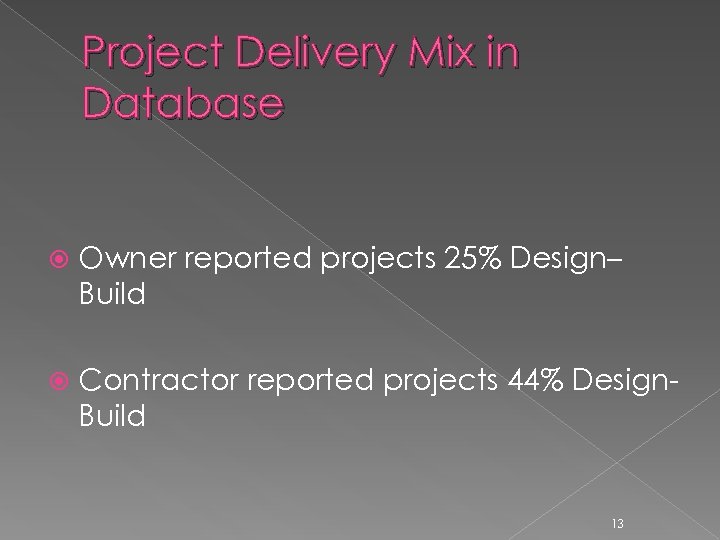
Project Delivery Mix in Database Owner reported projects 25% Design– Build Contractor reported projects 44% Design. Build 13
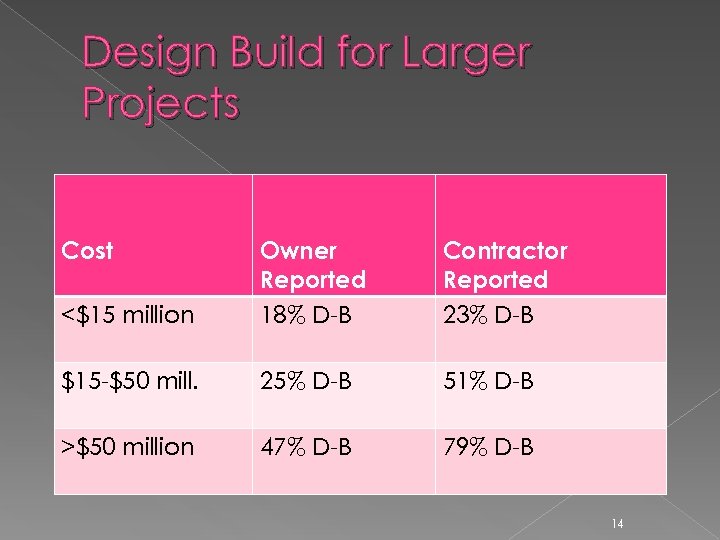
Design Build for Larger Projects Cost <$15 million Owner Reported 18% D-B Contractor Reported 23% D-B $15 -$50 mill. 25% D-B 51% D-B >$50 million 47% D-B 79% D-B 14
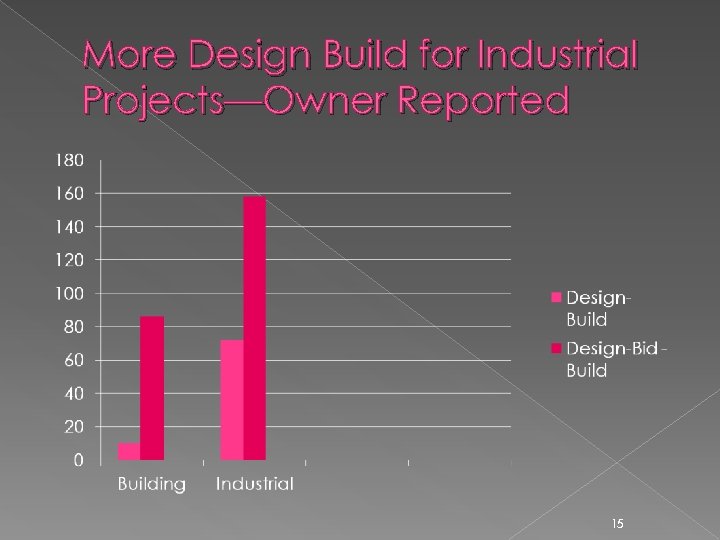
More Design Build for Industrial Projects—Owner Reported 15
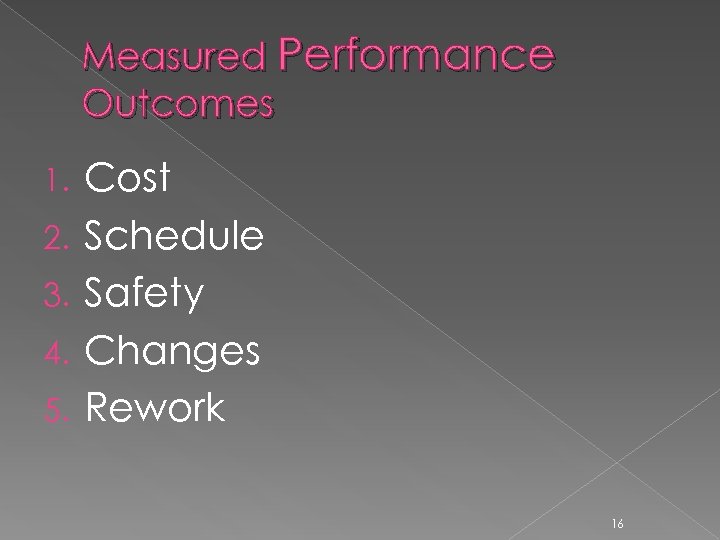
Measured Performance Outcomes 1. 2. 3. 4. 5. Cost Schedule Safety Changes Rework 16
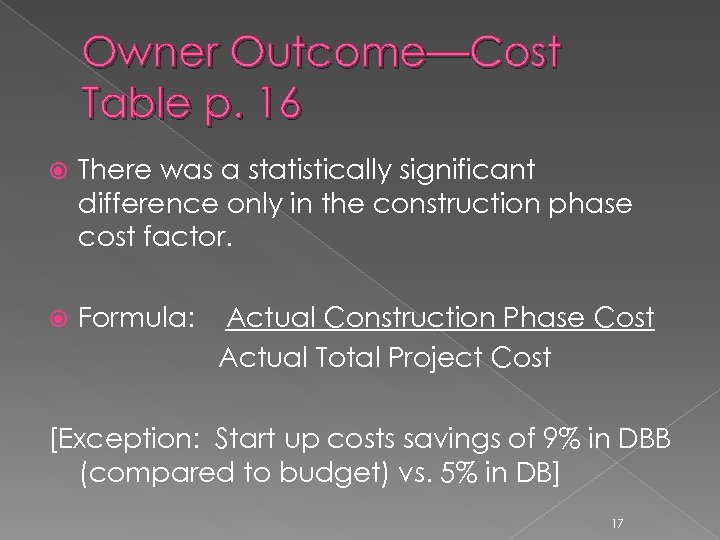
Owner Outcome—Cost Table p. 16 There was a statistically significant difference only in the construction phase cost factor. Formula: Actual Construction Phase Cost Actual Total Project Cost [Exception: Start up costs savings of 9% in DBB (compared to budget) vs. 5% in DB] 17
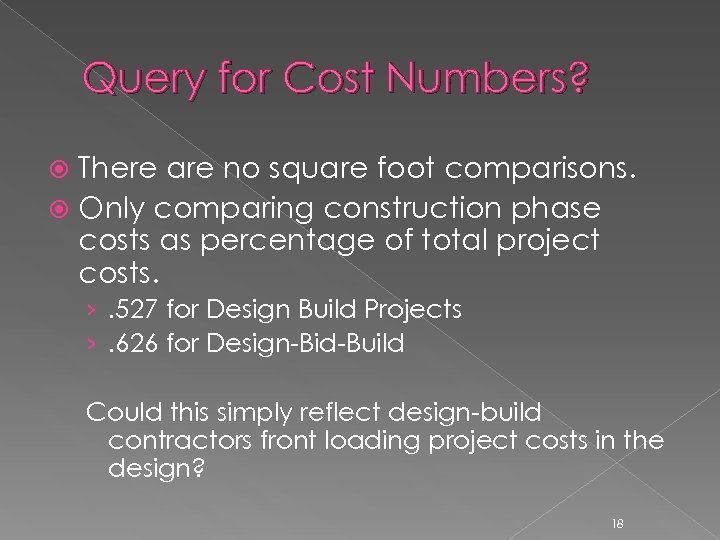
Query for Cost Numbers? There are no square foot comparisons. Only comparing construction phase costs as percentage of total project costs. ›. 527 for Design Build Projects ›. 626 for Design-Bid-Build Could this simply reflect design-build contractors front loading project costs in the design? 18
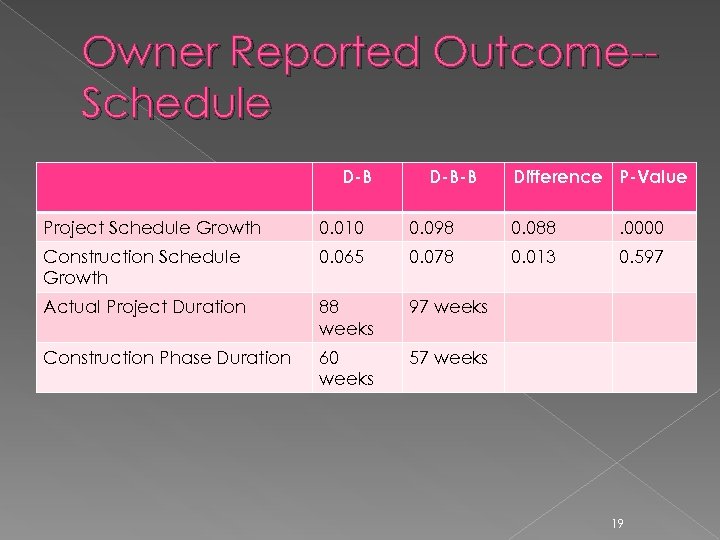
Owner Reported Outcome-Schedule D-B-B Difference P-Value Project Schedule Growth 0. 010 0. 098 0. 088 . 0000 Construction Schedule Growth 0. 065 0. 078 0. 013 0. 597 Actual Project Duration 88 weeks 97 weeks Construction Phase Duration 60 weeks 57 weeks 19
Owner Reported Outcome. Safety No significant difference reported 20
Owner Reported Changes/Rework Design Build projects reported fewer changes and rework. [Uncertain whether due to the fact that when the same company performs both design and construction functions, there may be a disincentive to report or record certain changes, or whether due to increased efficiency] 21
Contractor Reporting--Cost Contractors reported that Design-Bid. Build Project generally performed better, but performance outcomes were not significantly different. P. 17. 22
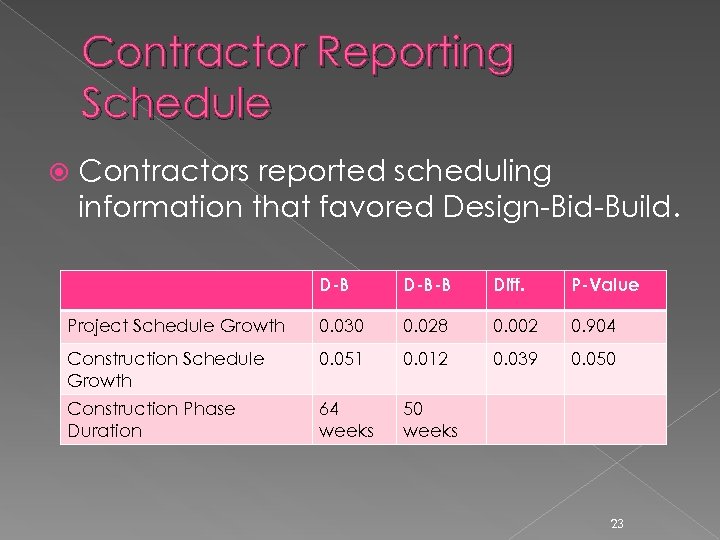
Contractor Reporting Schedule Contractors reported scheduling information that favored Design-Bid-Build. D-B-B Diff. P-Value Project Schedule Growth 0. 030 0. 028 0. 002 0. 904 Construction Schedule Growth 0. 051 0. 012 0. 039 0. 050 Construction Phase Duration 64 weeks 50 weeks 23
Industrial vs. Buildings? Comparing DBB building projects and DBB industrial projects, there were generally better outcomes for industrial projects than for buildings. In four of five cost categories for which comparable data was available, DBB industrial projects outperformed DBB buildings. DBB industrial projects also outperformed DBB Building projects on most schedule metrics. 24
Summary Average DB project was $80. 5 million Average DBB project was $22. 7 million DB delivery tended to yield better performance outcomes for Owner reported projects. Less clear advantage for Contractor reported projects. 25
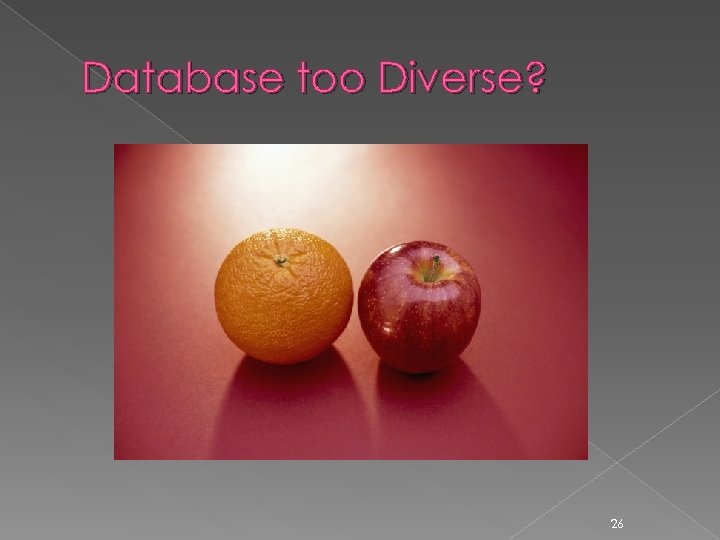
Database too Diverse? 26

Roland Nikles Rogers Joseph O’Donnell San Francisco rnikles@rjo. com
Скачать презентацию ABA Forum on Construction Div 4 Literature Review 1
4af8a9609662162ce2d575ac7f478765.ppt