 Скачать презентацию Ab initio Alloy Thermodynamics Recent Progress and Future
eeac8d050a25091201e2439ffb44a6cc.ppt
- Количество слайдов: 29



Ab initio Alloy Thermodynamics: Recent Progress and Future Directions Axel van de Walle Mark Asta Materials Science and Engineering Department, Northwestern University Gerbrand Ceder Materials Science and Engineering Department, MIT Chris Woodward Air Force Research Laboratory, Wright-Patterson AFB This work was supported by: NSF under program DMR-0080766 and DMR-0076097. DOE under contract no. DE-F 502 -96 ER 45571. AFOSR-MEANS under grant no. F 49620 -01 -1 -0529
Goals • Describe the current capabilities of ab initio thermodynamic calculations • Illustrate how the Alloy Theoretic Automated Toolkit (ATAT) can help perform such calculations ATAT homepage: http: //cms. northwestern. edu/atat/
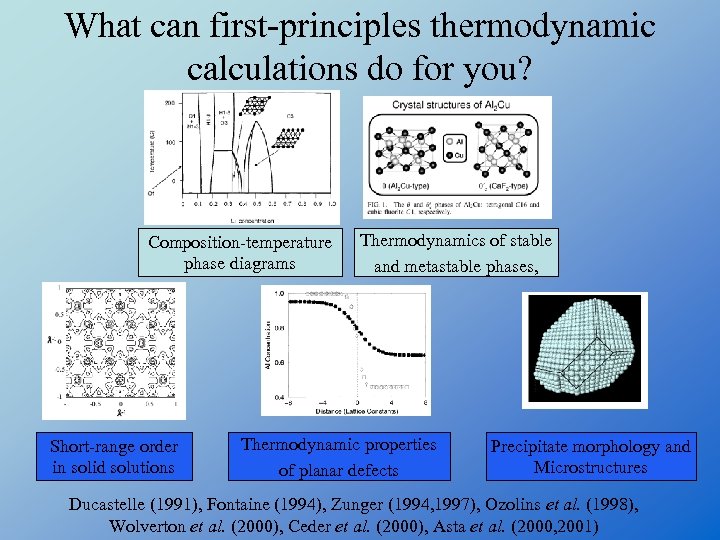
What can first-principles thermodynamic calculations do for you? Composition-temperature phase diagrams Short-range order in solid solutions Thermodynamics of stable and metastable phases, Thermodynamic properties of planar defects Precipitate morphology and Microstructures Ducastelle (1991), Fontaine (1994), Zunger (1994, 1997), Ozolins et al. (1998), Wolverton et al. (2000), Ceder et al. (2000), Asta et al. (2000, 2001)
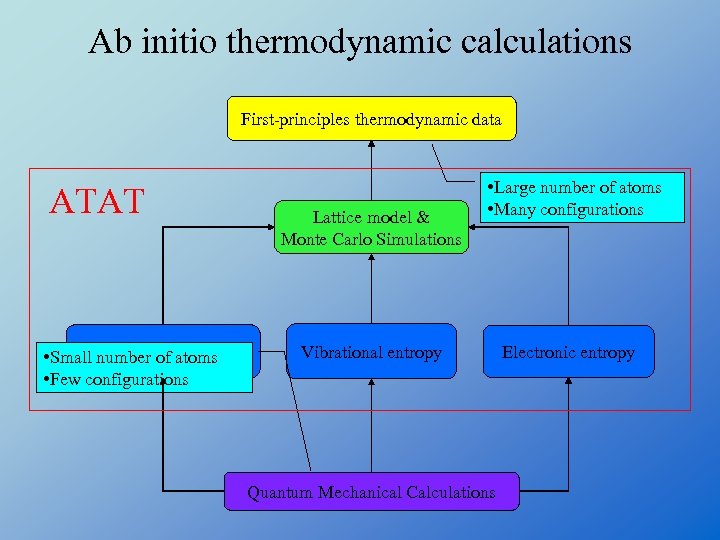
Ab initio thermodynamic calculations First-principles thermodynamic data ATAT Enthalpy • Small number of atoms • Few configurations Lattice model & Monte Carlo Simulations • Large number of atoms • Many configurations Vibrational entropy Quantum Mechanical Calculations Electronic entropy
Outline • Methodology – Modeling configurational disorder – Modeling lattice vibrations • Applications (Ti-Al and Al-Mo-Ni) – Sample input files – Sample outputs • Recent innovations
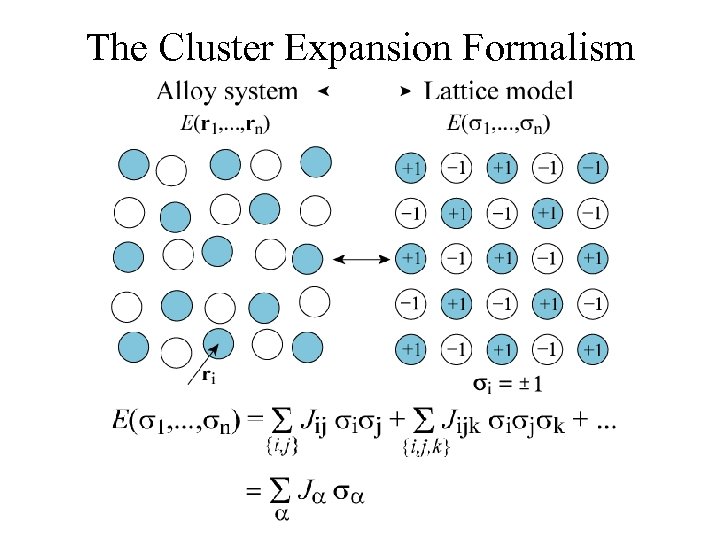
The Cluster Expansion Formalism
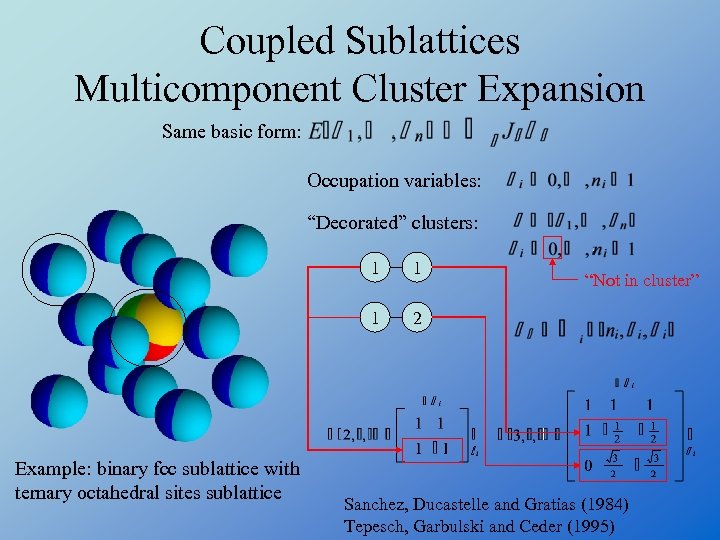
Coupled Sublattices Multicomponent Cluster Expansion Same basic form: Occupation variables: “Decorated” clusters: 1 1 Example: binary fcc sublattice with ternary octahedral sites sublattice 1 2 “Not in cluster” Sanchez, Ducastelle and Gratias (1984) Tepesch, Garbulski and Ceder (1995)
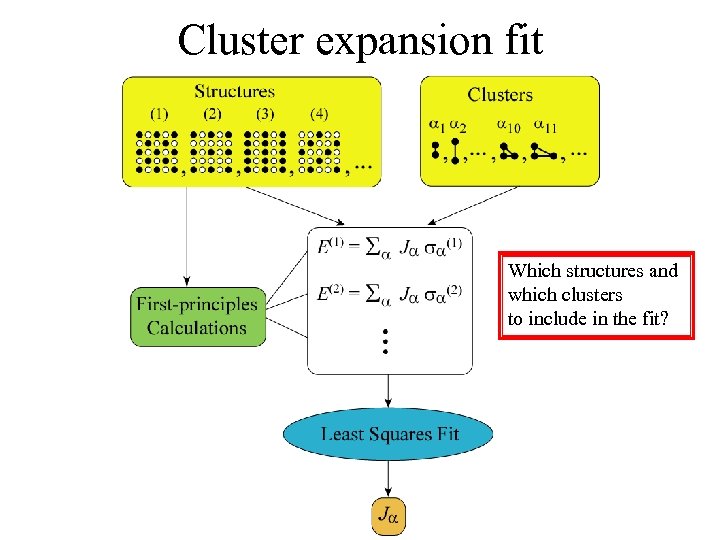
Cluster expansion fit Which structures and which clusters to include in the fit?
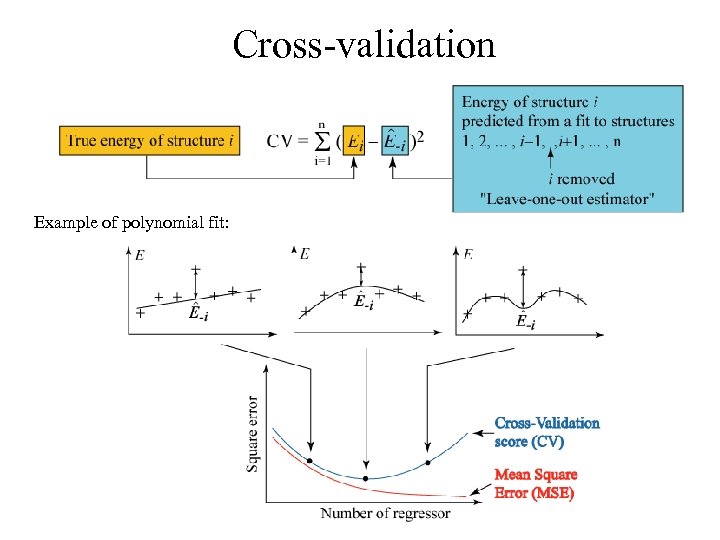
Cross-validation Example of polynomial fit:
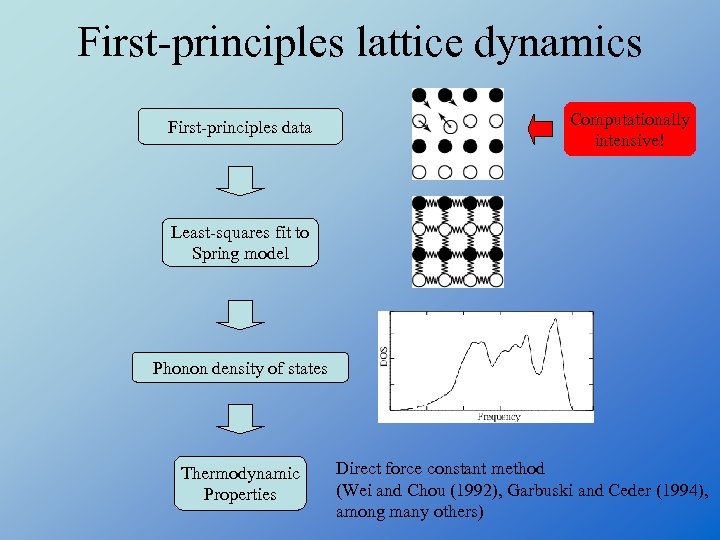
First-principles lattice dynamics First-principles data Computationally intensive! Least-squares fit to Spring model Phonon density of states Thermodynamic Properties Direct force constant method (Wei and Chou (1992), Garbuski and Ceder (1994), among many others)
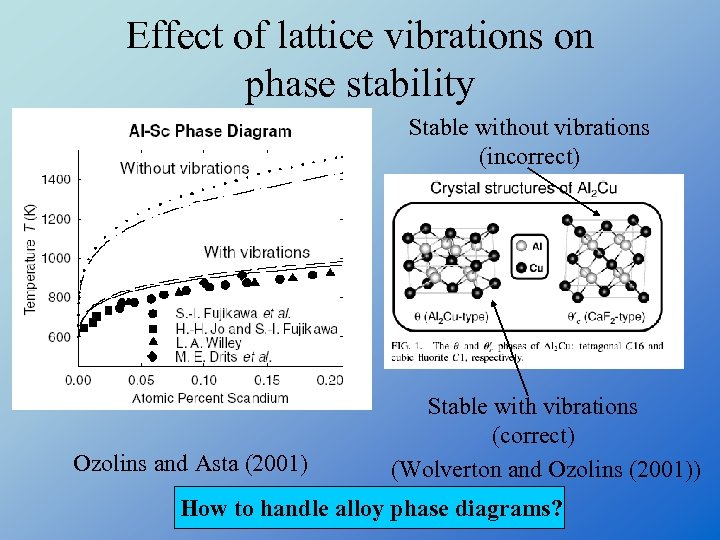
Effect of lattice vibrations on phase stability Stable without vibrations (incorrect) Ozolins and Asta (2001) Stable with vibrations (correct) (Wolverton and Ozolins (2001)) How to handle alloy phase diagrams?
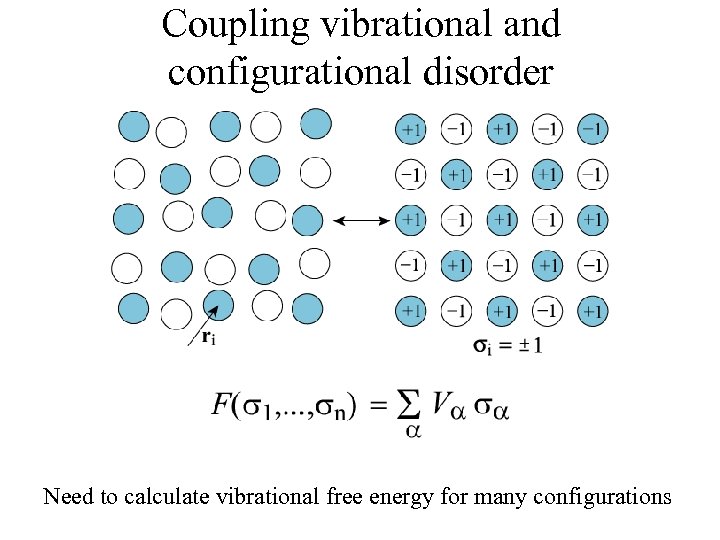
Coupling vibrational and configurational disorder Need to calculate vibrational free energy for many configurations
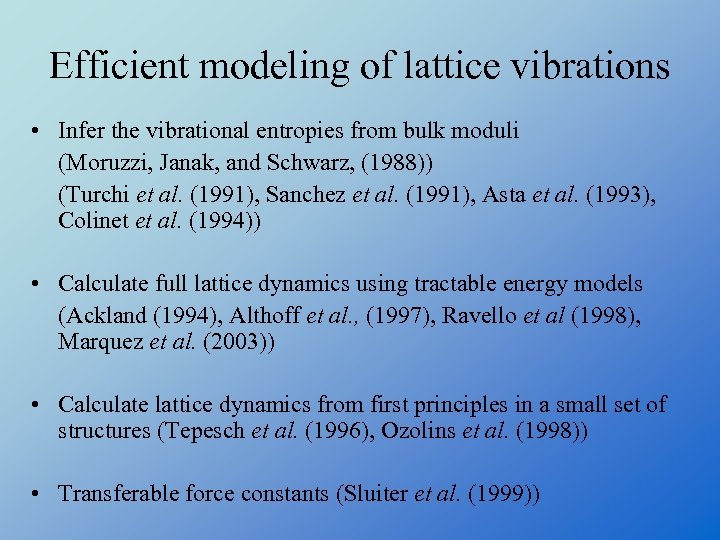
Efficient modeling of lattice vibrations • Infer the vibrational entropies from bulk moduli (Moruzzi, Janak, and Schwarz, (1988)) (Turchi et al. (1991), Sanchez et al. (1991), Asta et al. (1993), Colinet et al. (1994)) • Calculate full lattice dynamics using tractable energy models (Ackland (1994), Althoff et al. , (1997), Ravello et al (1998), Marquez et al. (2003)) • Calculate lattice dynamics from first principles in a small set of structures (Tepesch et al. (1996), Ozolins et al. (1998)) • Transferable force constants (Sluiter et al. (1999))
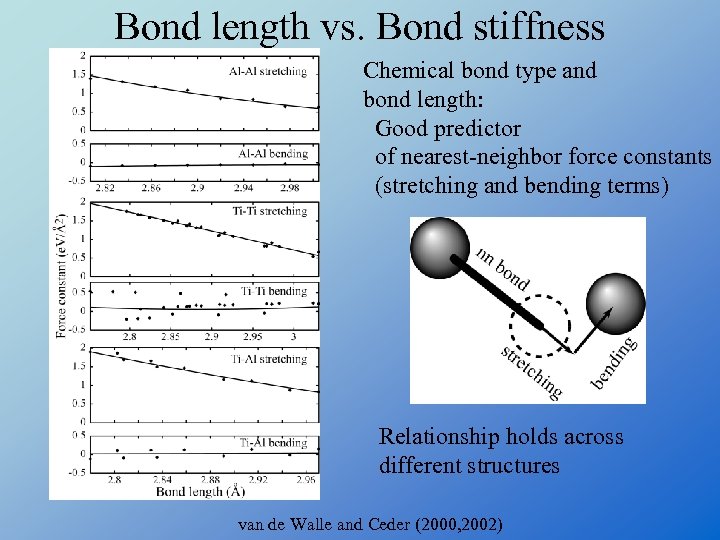
Bond length vs. Bond stiffness Chemical bond type and bond length: Good predictor of nearest-neighbor force constants (stretching and bending terms) Relationship holds across different structures van de Walle and Ceder (2000, 2002)
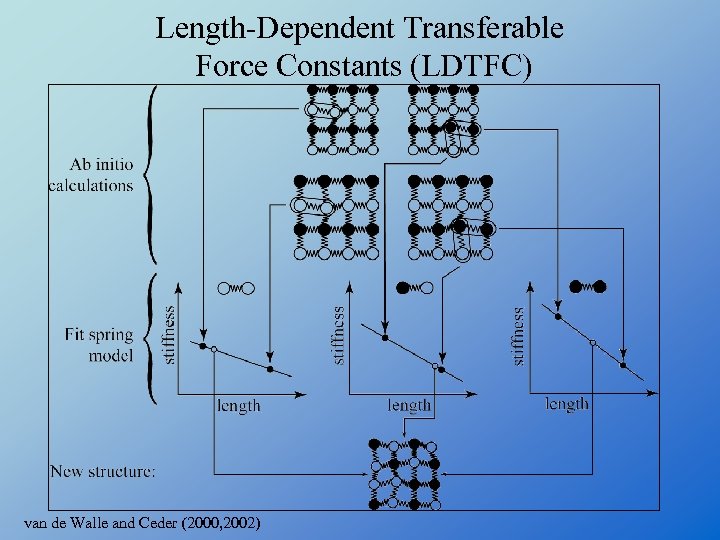
Length-Dependent Transferable Force Constants (LDTFC) van de Walle and Ceder (2000, 2002)
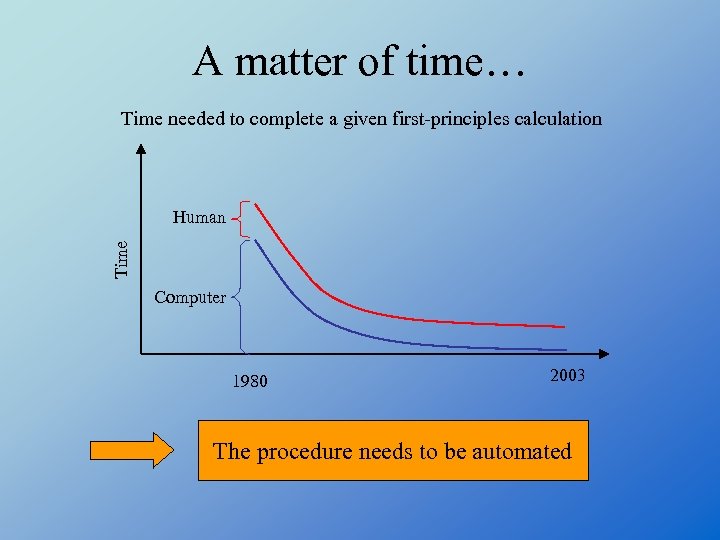
A matter of time… Time needed to complete a given first-principles calculation Time Human Computer 1980 2003 The procedure needs to be automated
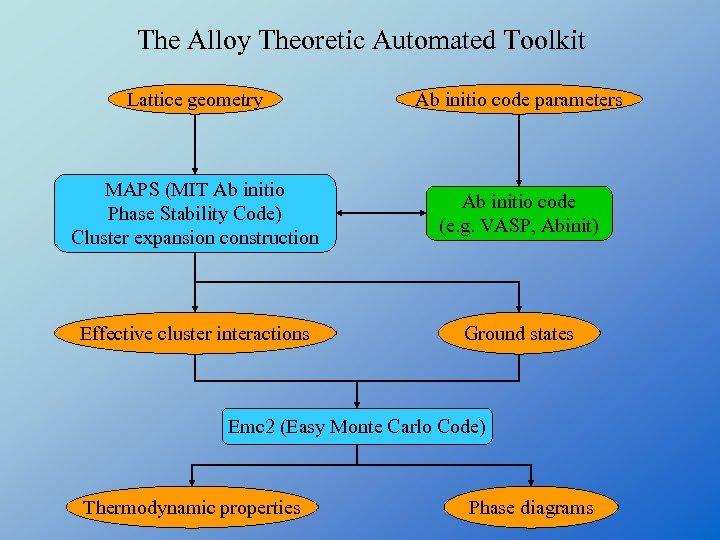
The Alloy Theoretic Automated Toolkit Lattice geometry Ab initio code parameters MAPS (MIT Ab initio Phase Stability Code) Cluster expansion construction Ab initio code (e. g. VASP, Abinit) Effective cluster interactions Ground states Emc 2 (Easy Monte Carlo Code) Thermodynamic properties Phase diagrams
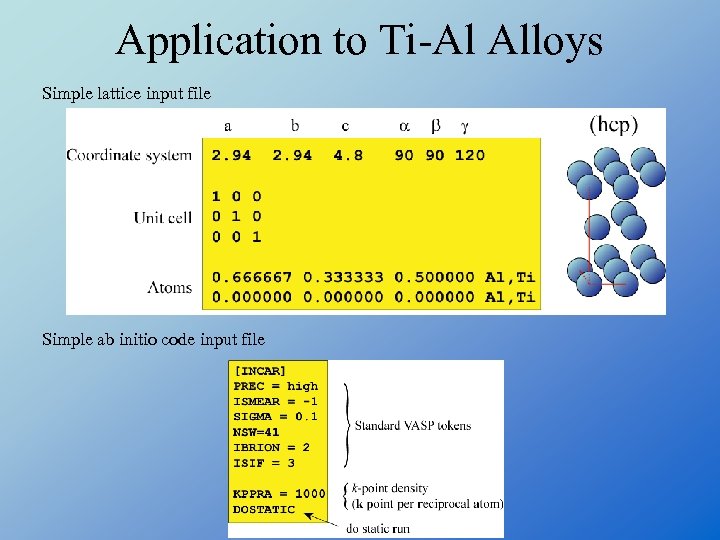
Application to Ti-Al Alloys Simple lattice input file Simple ab initio code input file
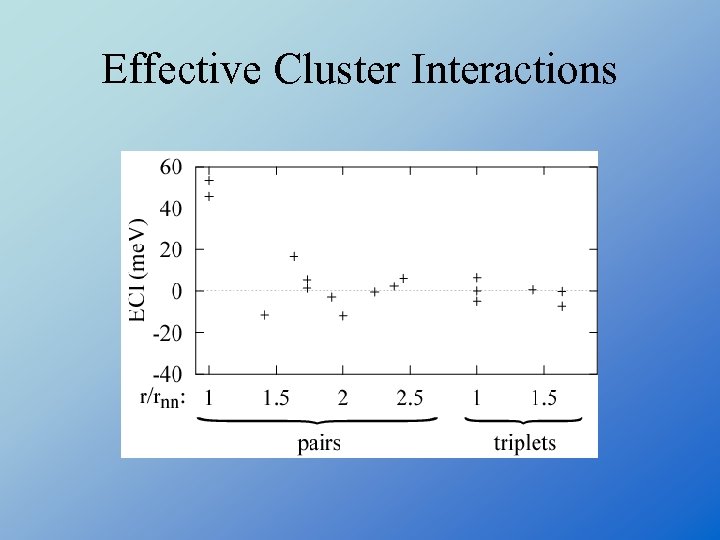
Effective Cluster Interactions
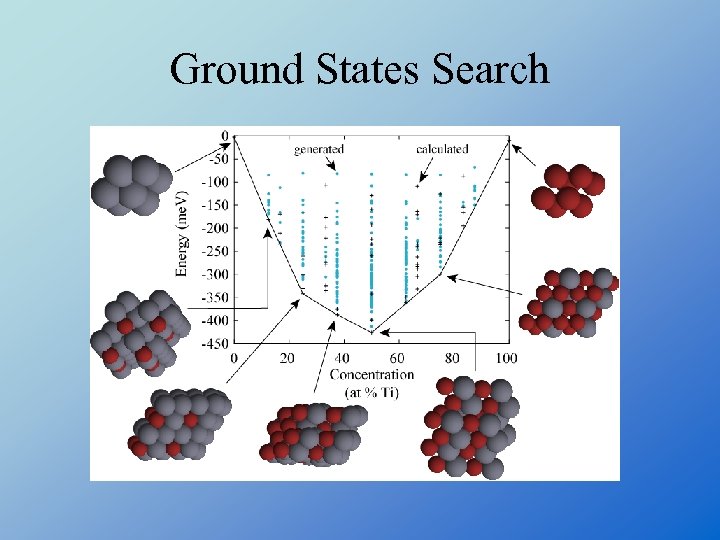
Ground States Search
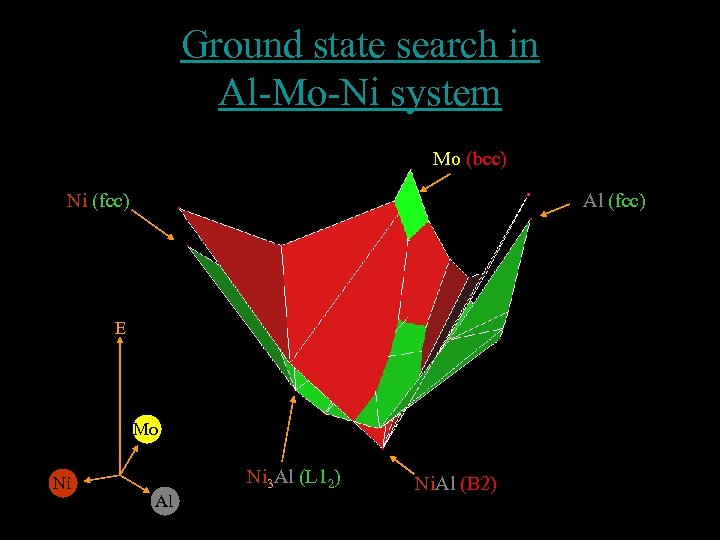
Ground state search in Al-Mo-Ni system Mo (bcc) Ni (fcc) Al (fcc) E Mo Ni Ni 3 Al (L 12) Al Ni. Al (B 2)
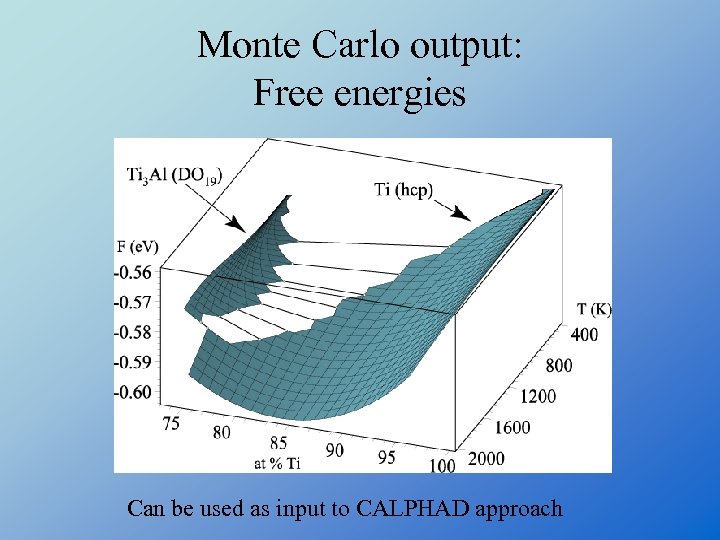
Monte Carlo output: Free energies Can be used as input to CALPHAD approach
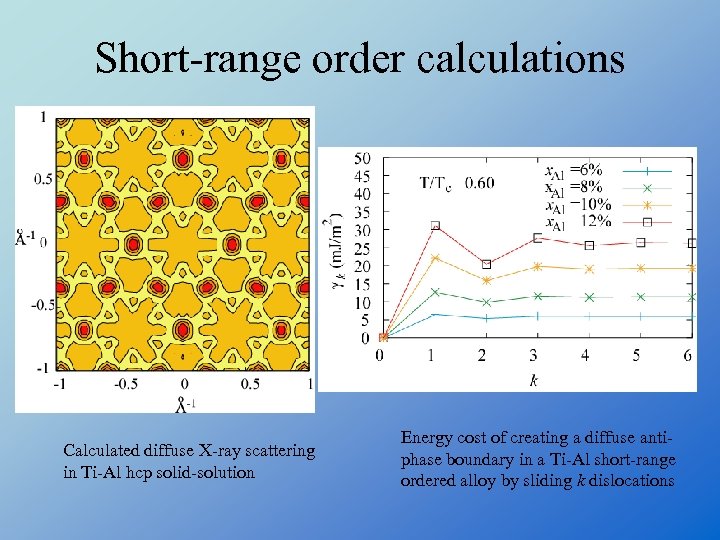
Short-range order calculations Calculated diffuse X-ray scattering in Ti-Al hcp solid-solution Energy cost of creating a diffuse antiphase boundary in a Ti-Al short-range ordered alloy by sliding k dislocations
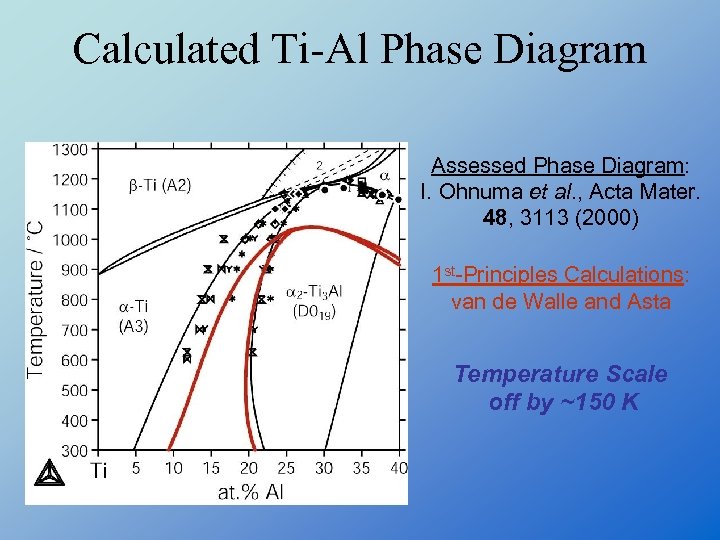
Calculated Ti-Al Phase Diagram Assessed Phase Diagram: I. Ohnuma et al. , Acta Mater. 48, 3113 (2000) 1 st-Principles Calculations: van de Walle and Asta Temperature Scale off by ~150 K
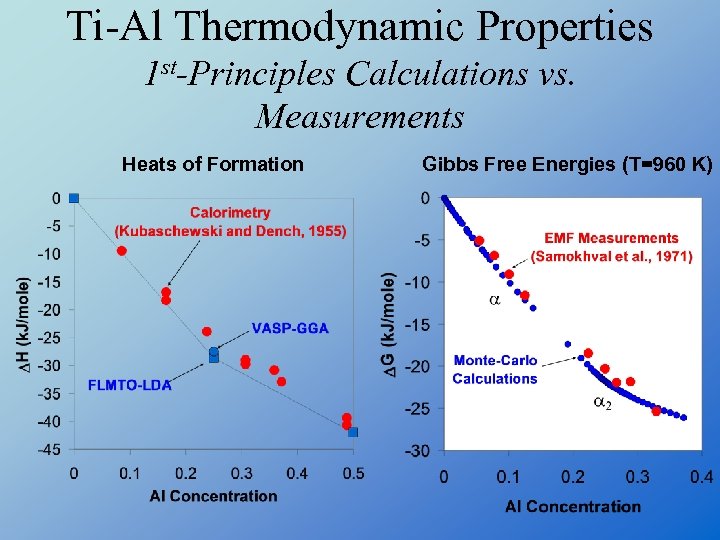
Ti-Al Thermodynamic Properties 1 st-Principles Calculations vs. Measurements Heats of Formation Gibbs Free Energies (T=960 K)
Recent Additions to ATAT • Generation of multicomponent Special Quasirandom Structures (SQS) • General lattice dynamics calculations • Support for GULP and Abinit
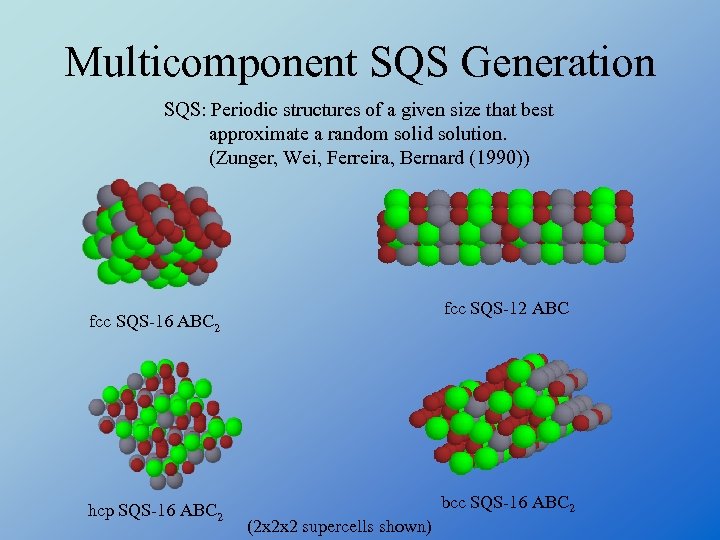
Multicomponent SQS Generation SQS: Periodic structures of a given size that best approximate a random solid solution. (Zunger, Wei, Ferreira, Bernard (1990)) fcc SQS-12 ABC fcc SQS-16 ABC 2 hcp SQS-16 ABC 2 bcc SQS-16 ABC 2 (2 x 2 x 2 supercells shown)
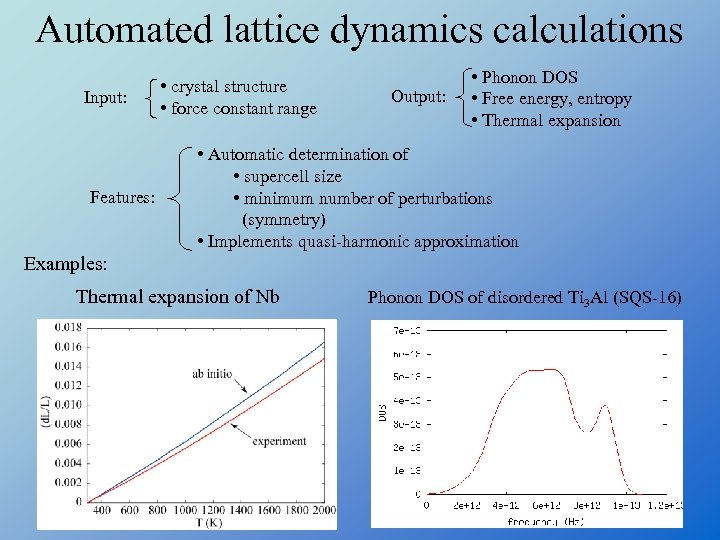
Automated lattice dynamics calculations Input: Features: • crystal structure • force constant range Output: • Phonon DOS • Free energy, entropy • Thermal expansion • Automatic determination of • supercell size • minimum number of perturbations (symmetry) • Implements quasi-harmonic approximation Examples: Thermal expansion of Nb Phonon DOS of disordered Ti 3 Al (SQS-16)
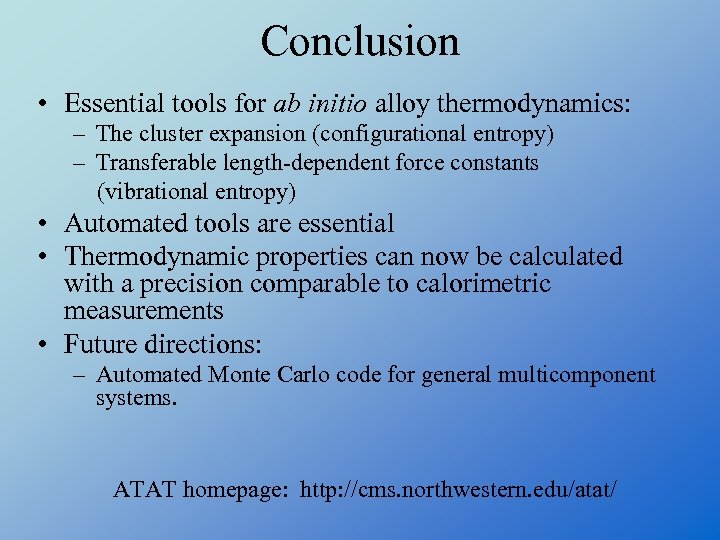
Conclusion • Essential tools for ab initio alloy thermodynamics: – The cluster expansion (configurational entropy) – Transferable length-dependent force constants (vibrational entropy) • Automated tools are essential • Thermodynamic properties can now be calculated with a precision comparable to calorimetric measurements • Future directions: – Automated Monte Carlo code for general multicomponent systems. ATAT homepage: http: //cms. northwestern. edu/atat/
Скачать презентацию Ab initio Alloy Thermodynamics Recent Progress and Future
eeac8d050a25091201e2439ffb44a6cc.ppt