


 Скачать презентацию AATS 2005 conference — Advanced Automated Transport Systems
3e3ead42ac6b33d5f3a8163da8ccc7d1.ppt
- Количество слайдов: 41
 AATS 2005 conference - Advanced Automated Transport Systems University of Bologna November 7, 2005 Arno Mong Daastoel Inno. Trans, Norway amd@innotrans. net Inno. Trans
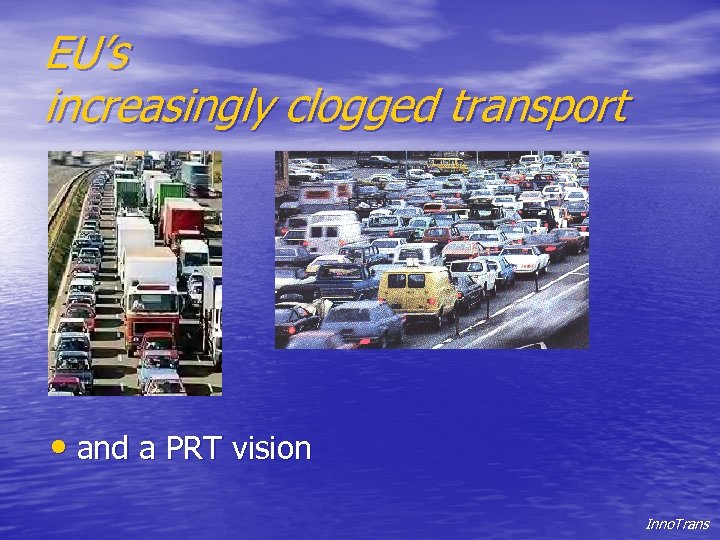 EU’s increasingly clogged transport • and a PRT vision Inno. Trans
 EU transport sector • 20 % of GNP of most nations • € 1000 billion market • 2/3 rd costs related to manpower • Physical transport is a tech laggard (compared to communication in general) Ø Severe problems – on all levels a) Space: local, regional, national, continental b) Quality of life: Health, environment, time, expenses Inno. Trans
 “The European Miracle” 1. City State Mercantilism • A sensible experience: 15 th CenturyüIncreased life span üHuge growth per capita • The Wealth of Cities üPopulation density – “friction and fire” üMany trades: Communication and Innovation (- the internet will super fuel innovation) Inno. Trans
 “The European Miracle” 2. National Mercantilism • Ruler’s duty: Create & protect prosperity • Create infrastructure ü ü ü Administration Standards: Grammar, Education, Law, Credit Transport • “National Cities” through integrating transport • “Artificial population density” Inno. Trans
 Learning by Experience: The Art of Borrowing (i. e. espionage and theft of knowledge from the leader) ü Sumeria 3500 -2500 BC ü Phoenicia 1500 -500 BC (+ China 500 BC-) ü Byzantium 667 -1400 AD ü Italian cities 700 -1600 AD ü The Netherlands 1500 -1700 ü Britain 1600 -1900 ü USA 1800 -2000 ü Germany, Russia, Japan 1863+ ü Korea, Taiwan 1953ü China, India 1989 - Inno. Trans
 Transport in History – Water - large scale public works • Irrigation Ø Ø India – Harappa culture 3000 BC Egypt – King Menes 3000 BC Sumeria – King Hammurabi 1760 BC China - Karez & Dujiangyan systems 250 BC Ø Ø Egypt – Upper Nile 4000 BC, Nile to Red Sea 404 BC Mesopotamia - Shatt-el-hai Canal – Eufrates and Tigris 2200 BC China - Wild Goose Canal 600 BC, Grand Canal, 600 AD Germany – Charlemagne: Rhine and Danube 793 AD - finished 1846, new 1992 Netherlands’ single lock 1065, Flemish double lock 1364 France - Briare Canal 1604, Languedoc Canal 1666 Sweden – Mälaren, 1606, Göta Canal 1810 USA – Lake Michigan & Mississippi 1683, Erie Canal 1825 England, Manchester 1759 Germany – Kiel Canal 1784; Mittelland Canal, 1905 onwards • Canals Ø Ø Ø Inno. Trans
 Transport in History – Urban - large scale public works • Water supply - networks Ø Assyrian aqueducts 700 BC (longest was 80 km ) Ø Roman aqueducts – Aqua Appia 312 BC; Eifel 80 AD; Carthage 200 AD • Sewers (plumbing) Ø Sumeria 4000 BC (Iraq) Ø Harappa 3000 (Pakistan) Ø Minoan 2500 (Crete) Ø Rome 800 BC Ø China 200 BC Ø London (1668), Paris, Berlin, Hamburg 1840 s AD Inno. Trans
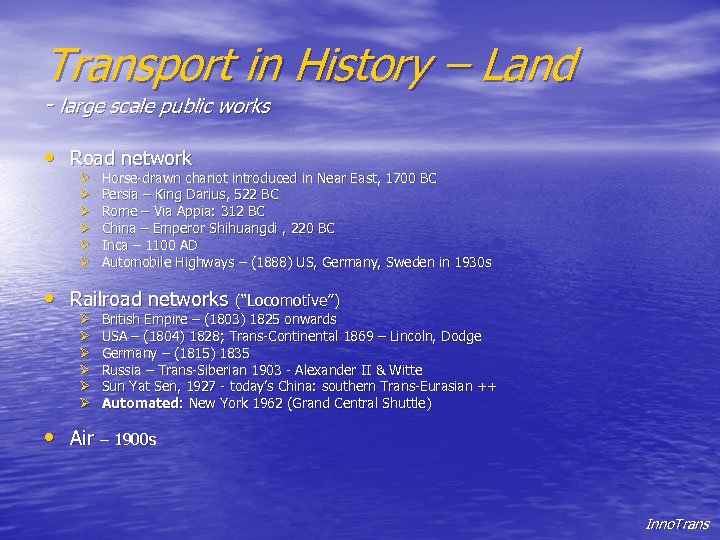 Transport in History – Land - large scale public works • Road network Ø Ø Ø Horse-drawn chariot introduced in Near East, 1700 BC Persia – King Darius, 522 BC Rome – Via Appia: 312 BC China – Emperor Shihuangdi , 220 BC Inca – 1100 AD Automobile Highways – (1888) US, Germany, Sweden in 1930 s • Railroad networks (“Locomotive”) Ø Ø Ø British Empire – (1803) 1825 onwards USA – (1804) 1828; Trans-Continental 1869 – Lincoln, Dodge Germany – (1815) 1835 Russia – Trans-Siberian 1903 - Alexander II & Witte Sun Yat Sen, 1927 - today’s China: southern Trans-Eurasian ++ Automated: New York 1962 (Grand Central Shuttle) • Air – 1900 s Inno. Trans
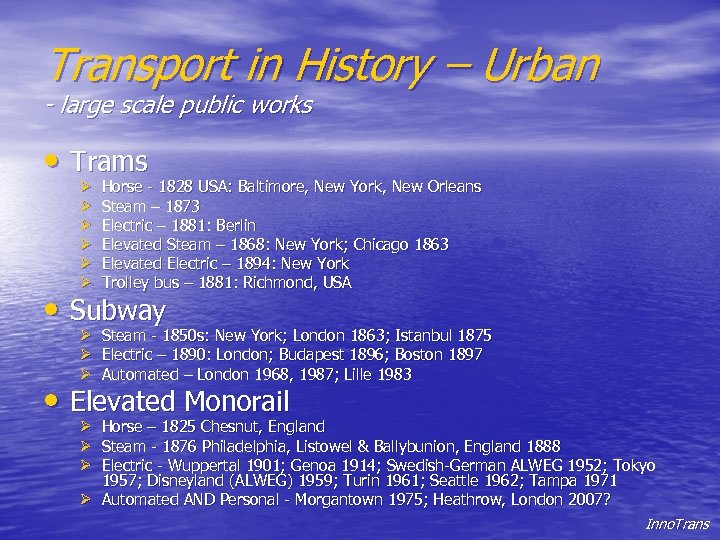 Transport in History – Urban - large scale public works • Trams Ø Ø Ø Horse - 1828 USA: Baltimore, New York, New Orleans Steam – 1873 Electric – 1881: Berlin Elevated Steam – 1868: New York; Chicago 1863 Elevated Electric – 1894: New York Trolley bus – 1881: Richmond, USA Ø Ø Ø Steam - 1850 s: New York; London 1863; Istanbul 1875 Electric – 1890: London; Budapest 1896; Boston 1897 Automated – London 1968, 1987; Lille 1983 • Subway • Elevated Monorail Horse – 1825 Chesnut, England Steam - 1876 Philadelphia, Listowel & Ballybunion, England 1888 Electric - Wuppertal 1901; Genoa 1914; Swedish-German ALWEG 1952; Tokyo 1957; Disneyland (ALWEG) 1959; Turin 1961; Seattle 1962; Tampa 1971 Ø Automated AND Personal - Morgantown 1975; Heathrow, London 2007? Ø Ø Ø Inno. Trans
 Transport in History – Symbols - Preconditions for Communication • ‘National’ Standards Ø Alphabet – Sumeria 3500 BC Ø ‘Grammar’, mathematics, calendar and time – Sumeria • Media Ø Books by mechanical mass printing - China 868; Germany 1448 AD Ø Newspapers – China, Roman Empire etc. ; Europe 1600 s AD Inno. Trans
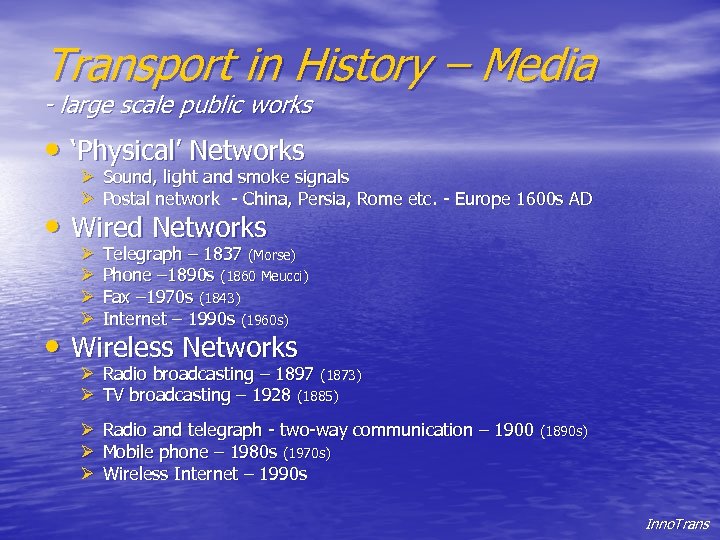 Transport in History – Media - large scale public works • ‘Physical’ Networks Ø Sound, light and smoke signals Ø Postal network - China, Persia, Rome etc. - Europe 1600 s AD • Wired Networks Ø Ø Telegraph – 1837 (Morse) Phone – 1890 s (1860 Meucci) Fax – 1970 s (1843) Internet – 1990 s (1960 s) • Wireless Networks Ø Radio broadcasting – 1897 (1873) Ø TV broadcasting – 1928 (1885) Ø Ø Ø Radio and telegraph - two-way communication – 1900 Mobile phone – 1980 s (1970 s) Wireless Internet – 1990 s (1890 s) Inno. Trans
 EU after 1989 - Fall of “Berlin Wall” • For EU to integrate (- into one efficient market) EU needs • Standards ü Taxation (“harmony”) ü Finance ü Transport • New transport links ü East-West + old problem: ü North-South, through the mountains - Pyrenees and the Alps Inno. Trans
 EU White Paper 2001: “European transport policy for 2010: time to decide” • “Transport is the essential driver” - of industry, trade, way of life, EU integration • After 1992 - no harmonious integration Result: • Growing congestion, delays, and pollution Inno. Trans
 Today - EU suffocates üTransport, increased share of GDP – substituting welfare üIncreasing congestion chokes EU ü Continent less competitive ü Harms the environment ØHarms general living standards Inno. Trans
 EU-congestion affects • Road : 10% of network: 7 500 km • Rail : 20% of network: 16 000 km - Freight: 18 kmph, poor punctuality • Air : 30 % > 15 minutes delayed ØCost : 0, 5 % of GDP p/a ; 1% in 2010 Inno. Trans
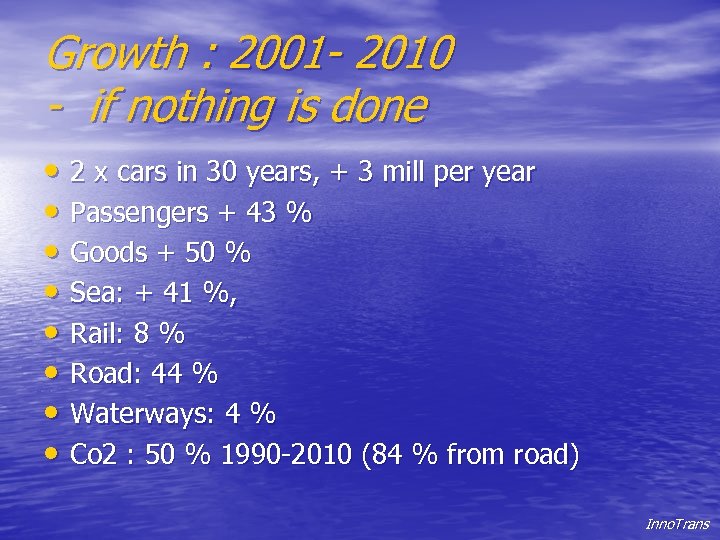 Growth : 2001 - 2010 - if nothing is done • 2 x cars in 30 years, + 3 mill per year • Passengers + 43 % • Goods + 50 % • Sea: + 41 %, • Rail: 8 % • Road: 44 % • Waterways: 4 % • Co 2 : 50 % 1990 -2010 (84 % from road) Inno. Trans
 EU policy will (“wishful thoughts”) • Decouple growth – in GNP & transport • Shift mode : transport to rail • Eliminate bottlenecks : invest • Place user in centre Inno. Trans
 EU Goals (defensive and modest) • Freight +38 % instead of 50 % • Passenger + 21 % instead of 43 % • 200 mill ton reduction of CO 2 Inno. Trans
 Urban transport • Better use of cars • Improve rail tremendously • Increased cost of transport transferred to improved quality, corridors ØBUT: EU can only propose, local authorities decide Inno. Trans
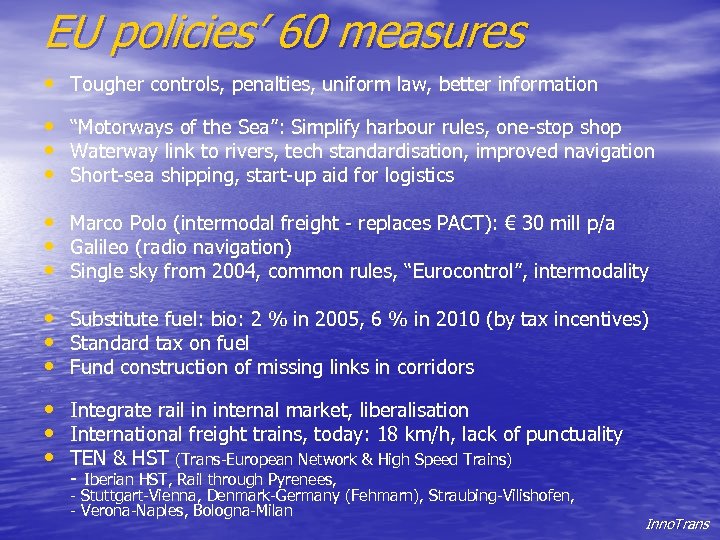 EU policies’ 60 measures • Tougher controls, penalties, uniform law, better information • “Motorways of the Sea”: Simplify harbour rules, one-stop shop • Waterway link to rivers, tech standardisation, improved navigation • Short-sea shipping, start-up aid for logistics • Marco Polo (intermodal freight - replaces PACT): € 30 mill p/a • Galileo (radio navigation) • Single sky from 2004, common rules, “Eurocontrol”, intermodality • Substitute fuel: bio: 2 % in 2005, 6 % in 2010 (by tax incentives) • Standard tax on fuel • Fund construction of missing links in corridors • Integrate rail in internal market, liberalisation • International freight trains, today: 18 km/h, lack of punctuality • TEN & HST (Trans-European Network & High Speed Trains) - Iberian HST, Rail through Pyrenees, - Stuttgart-Vienna, Denmark-Germany (Fehmarn), Straubing-Vilishofen, - Verona-Naples, Bologna-Milan Inno. Trans
 Comments - on EU Goals & Measures • Goals ü Too modest ü Matters will deteriorate • Measures ü Only negative (will increase costs and inefficiency of the economy: less competitive) ü Patchworks - on old technologies (high-tech is used to ‘polish’ old solutions) Inno. Trans
 Single Market – late 1980 s initiatives Main architect: Jaques Delors et. al. (then EU Commissioner, form. Finance Minister of France, under Mitterand) 1) Customs Union (model: German Zollverein, 1818 -1888) 2) Harmonious taxation & regulations (contracts etc. ) 3) Common money - EMU 1989, €uro 1992 (2002) 4) TEN 1992 (Trans-European Networks) Inno. Trans
 The continental TEN project • 1993: “TEN- Trans-European Networks” - 14 projects under H. Christoffersen • Italy 2003: ”The Tremonti Plan” • Austria 2006 ? Inno. Trans
 2003: Italy as EU chairman: ”The Tremonti Plan” • FT: “Transport is key to growth, EU says” • 20 bn Euros for TENs • € 70 bn infrastructure spending plan = ”prime pumping” Inno. Trans
 Coming EU mid-term review (of White Paper - preliminary development 2004) • Freight up > than GDP growth • People up < than GDP growth • NB! - today practically zero growth • Dramatic change - when growth picks up Inno. Trans
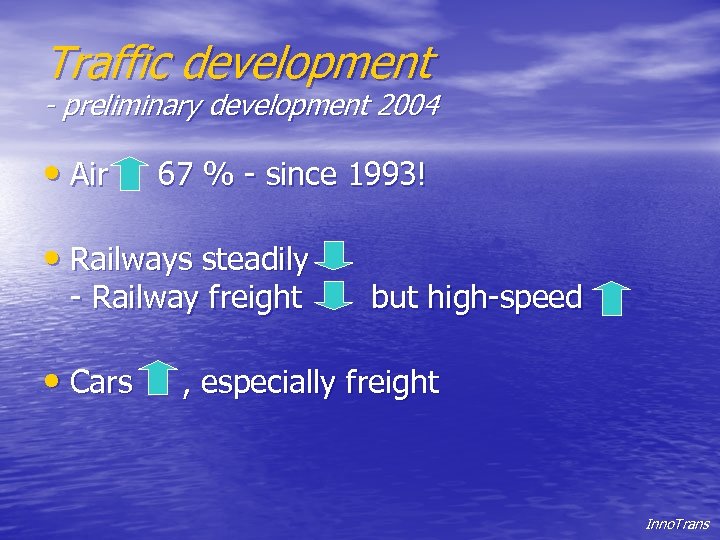 Traffic development - preliminary development 2004 • Air 67 % - since 1993! • Railways steadily - Railway freight • Cars but high-speed , especially freight Inno. Trans
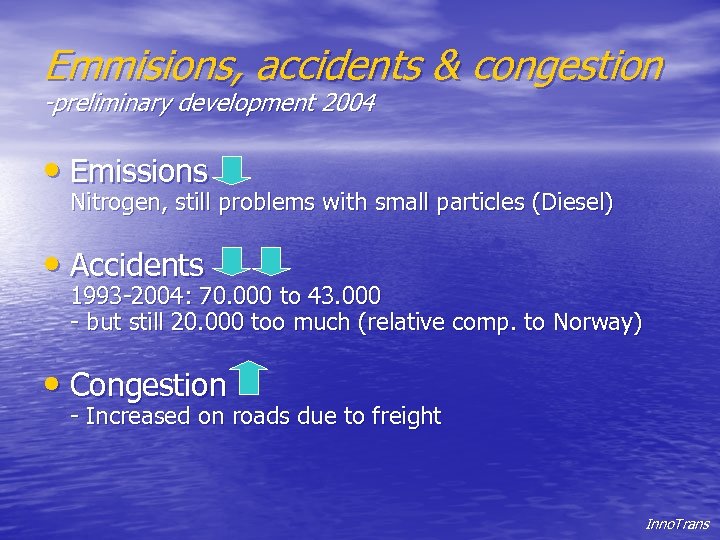 Emmisions, accidents & congestion -preliminary development 2004 • Emissions Nitrogen, still problems with small particles (Diesel) • Accidents 1993 -2004: 70. 000 to 43. 000 - but still 20. 000 too much (relative comp. to Norway) • Congestion - Increased on roads due to freight Inno. Trans
 Improvement depends on connecting two issues 1) Innovative Transport + 2) Innovative Finance Inno. Trans
 Innovative Transport - 1 • EU support ? - Solve freight problem (door-to-door - as with transport of people) • Plan in principle – long term - New national networks “from the bottom” Inno. Trans
 Innovative Transport -2 • Utilise tech. potential 1) Automation 2) On-vehicle switching • Integrate: 1) Modes: People & Goods etc. 2) Levels: Local, regional, national, continental networks (1 x 1 meter beam can carry 1 ton/meter = even containers and mineral ore) Inno. Trans
 Public goods & responsibility 1) Concentrated costs - like private goods 2) Widely distributed benefits - in space and time - unlike private goods Ø Systematic under-investment - if market alone is responsible Ø Governments & EU must act Inno. Trans
 Use PRT for ‘Prime Pumping’ EU • Historical parallels ü Railroads & Telegraph – UK, USA, Germany, Russia etc. ü Highways and automobiles - USA, Germany, Sweden etc. ü Internet Inno. Trans
 (Over-)Mature Industrial Nations - in Europe • High social spending; pensions and health • Little investment in infrastructure ØStagnating growth Inno. Trans
 Mature exceptions • USA Deindustrialisation § Unsocial § Unsustainable bubble to pop (real estate, derivatives, triple deficits) • Japan: Continued industrialisation § Investment in infrastructure § No outsourcing of advanced processes Inno. Trans
 Developing Nations • High growth: Taiwan, China etc. ØHigh investment in infrastructure - creates ü “physical trickle down”: high general activity and improved efficiency ü “Transport – the carpet of industry” ü Transport as efficiency-improving “locomotive” of the economy Inno. Trans
 Financing EU’s grand projects • Both Delors and Tremonti plans: • Finance through EIB (European Investment Bank) • Problem! Lack of: 1) National will and financial ability (in member states) 2) EU funding sources (ECB is disallowed from printing money AND channel them to infrastructure - (ECB = European Central Bank) • Therefore, use traditional private financing: Bonds Ø “Crowding out” effect (i. e. draining and pushing out private investment) Ø Loose ‘spark’ from prime pumping Ø Loose extra growth Inno. Trans
 Traditional Finance - for infrastructure and growth • Public ØFund from tax revenue • Mixed Private/Public ØToll stations ØLease ØBOT versions – (Build Operate Transfer) Inno. Trans
 Mixed Innovative Finance - for infrastructure and growth Shared risk and profit: ØMicrofinance ØIslamic banking ØPartnerships Ltd. - since 2001 + ØLand taxation (Henry George etc. ) Inno. Trans
 National Innovative Finance - for infrastructure and growth 1) Print money (and: !!) 2) Channel to productive purposes - cf. Ragnar Frisch: The Oslo channelling model Ø Growth without inflation - due to rise in efficiency and production Inno. Trans
 Conclusion The solutions are at hand “This great enterprise will pay for itself, and all that is required of the Governments can be expressed in one word, and that is -ENERGY. ” (Friedrich List, The National System of Political Economy, 1841, p. 435) Arno Mong Daastoel Inno. Trans, Norway: amd@innotrans. net ph: +47. 6300 8590 Inno. Trans