 Скачать презентацию AASHTO HUMAN RESOURCES SUBCOMMITTEE MEETING LITTLE ROCK ARKANSAS
247110e0a30751a0cc21d67b369edc08.ppt
- Количество слайдов: 172



AASHTO HUMAN RESOURCES SUBCOMMITTEE MEETING LITTLE ROCK, ARKANSAS May 8, 2012 SEX, DRUGS, AND ROCK & ROLL Carolyn B. Witherspoon Cross Gunter Witherspoon & Galchus, P. C. 500 President Clinton Ave. , Suite 200 Little Rock, AR 72201 cspoon@cgwg. com (501) 371 -9999 / Fax: (501) 371 -0035
Sexting in the Workplace 2
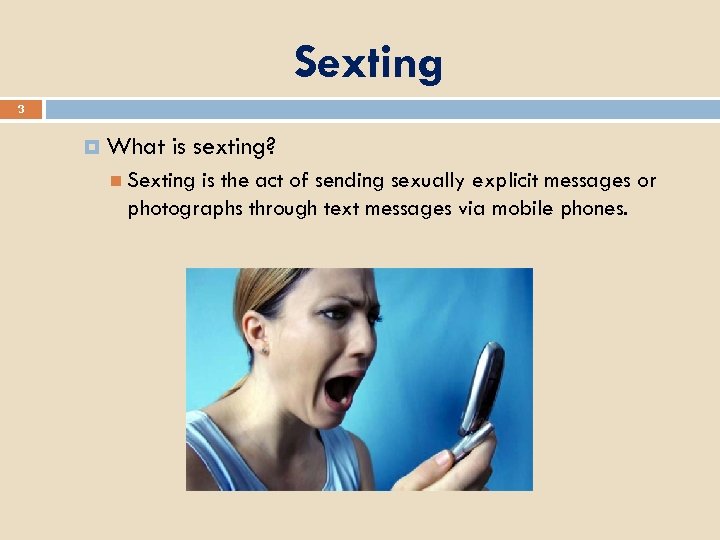
Sexting 3 What is sexting? Sexting is the act of sending sexually explicit messages or photographs through text messages via mobile phones.
Sexting 4 A 2009 survey revealed approximately 4. 1 billion texts are transmitted in the U. S. every day. Since then, this number is suspected to have risen to over 5 billion texts per day. Three-fourths of corporate employees today use smart phones.
Sexting and Cell Phone Privacy 5 Whose phone is it, anyway? When public employers provide employees with cell phones and similar devices, employees are left to wonder whose phone it really is. Generally, the more the employee pays for the phone, the more likely a court is to rule that the phone is in that employee’s control. Similarly, the more exclusive the employee’s access is (particularly to the employer), the more likely it is to be considered in the employee’s possession, even if the employer is paying a portion of the bill.
Privacy Issues 6 O’Connor v. Ortega (1987) Dr. Ortega had been the head of the psychiatric residency program at Napa State Hospital, a mental hospital, for 17 years. He bought a new Apple computer to use at work. He paid for half of the cost, and the other half had been donated by some of the residents A month later, Ortega asked Dr. Dennis O'Connor, his boss, to sign some thank-you letters to the residents who had made contributions.
Privacy Issues 7 O’Connor v. Ortega (1987) Two months later, Ortega suspended a resident for missing a rotation. The resident claimed Ortega was retaliating against him for not having contributed to the computer’s purchase. An investigation was opened, and Ortega’s office was searched thoroughly, with personal belongings being found and kept. Ortega was put on administrative leave and later fired. He sued. The district court found that the search of his office was reasonable, because it was “inventoried, ” not searched.
Privacy Issues 8 O’Connor v. Ortega (1987) The appellate court reversed, stating that “the entry into the office seems to have been for no other purpose than to secure evidence for use in the ongoing investigation of Ortega. “ The Supreme Court reversed the appellate court’s decision. The court stated: "Individuals do not lose Fourth Amendment rights merely because they work for the government, instead of a private employer. "
Privacy Issues 9 O’Connor v. Ortega (1987) The U. S. Supreme Court based employee privacy rights on the “operational realities of the workplace. ” The Court required a balancing of the employee's “legitimate expectation of privacy against the government's need for supervision, control, and the efficient operation of the workplace. ” The Court did not, however, focus on electronic sources, but instead mentioned the employee's office, desk, or file cabinets.
Privacy Issues 10 O’Connor v. Ortega (1987) This opinion vested a large amount of discretion in government employers, where written policies dictated standards of privacy. A government employer’s warrantless search is reasonable if it is “justified at its inception” and if “the measures adopted are reasonably related to the objectives of the search and not excessively intrusive in light of” the circumstances
Searches by the Employer 11 From Ortega to Quon As mentioned, the Ortega Court did not, however, focus on electronic sources, but instead mentioned the employee's office, desk, or file cabinets. City of Ontario v. Quon (2011) Jeff Quon was a police sergeant and member of the SWAT Team for the Ontario Police Department. The city issued pagers to SWAT team members for work usage. The computer policy that stated that the city had the right to “monitor and log all network activity… with or without notice” was applied to the pagers.
Searches by the Employer 12 City of Ontario v. Quon’s supervisor told him he did not plan to audit employees’ text messages, so long as they paid personally for any overage charges for personal use, which Quon did. When reviewing the usage amount, Quon’s supervisor saw that Quon had been sending sexually explicit messages to his wife and another officer. The Supreme Court considered whether the city’s review of Quon’s text message transcripts was an unreasonable search violating his expectation of privacy.
Searches by the Employer 13 City of Ontario v. Quon The Supreme Court stated that the Fourth Amendment applies when the government acts in its capacity as an employer, which protects the “privacy, dignity, and security of persons against certain arbitrary and invasive acts by officers of the Government. ” The Court ruled that the classic two-part test to determine whether the government, as an employer, has conducted an unlawful search will still be used.
Searches by the Employer 14 City of Ontario v. Quon First, the Court considers the “operational realities” of the workplace to determine whether an employee’s Fourth Amendment rights are implicated. Second, where the employee has a legitimate privacy interest, an employer’s intrusion on that expectation for “noninvestigatory, work-related purposes, as well as for investigations of work-related conduct, ” will be judged by a reasonableness standard, in light of all the circumstances.
Searches by the Employer 15 City of Ontario v. Quon The Court ruled that, because the computer policy stated clearly that audits may occur, the search was not unreasonable. Because the search was reasonable, petitioners did not violate respondents' Fourth Amendment rights, and the court below erred by concluding otherwise. The judgment of the Court of Appeals for the Ninth Circuit is reversed, and the case is remanded for further proceedings consistent with this opinion.
Today’s Standard 16 What government employers should do: 1) Post and/or include in handbook a clear policy regarding all technology usage. 2) Include in the policy that all technology issued by the government/employer is subject to review/audits, including all content therein. This includes phones, computers, PDA’s, etc. 3) Make it clear that the policy applies to all devices for which the employer pays, even if the employee pays for part of the usage.
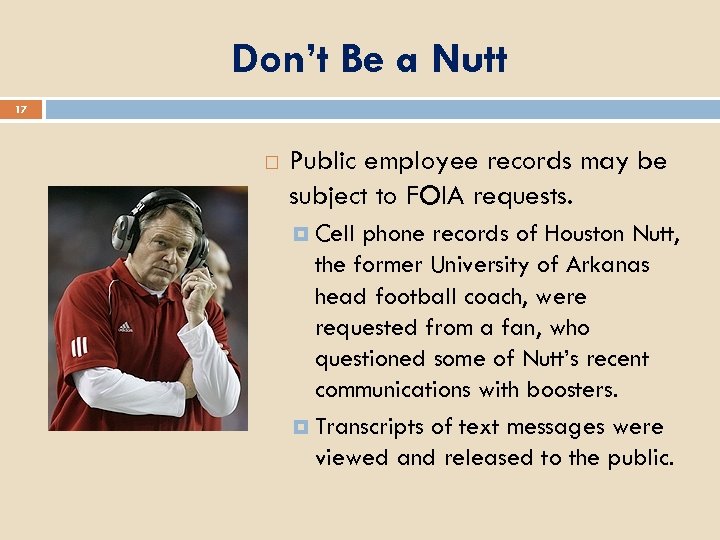
Don’t Be a Nutt 17 Public employee records may be subject to FOIA requests. Cell phone records of Houston Nutt, the former University of Arkanas head football coach, were requested from a fan, who questioned some of Nutt’s recent communications with boosters. Transcripts of text messages were viewed and released to the public.
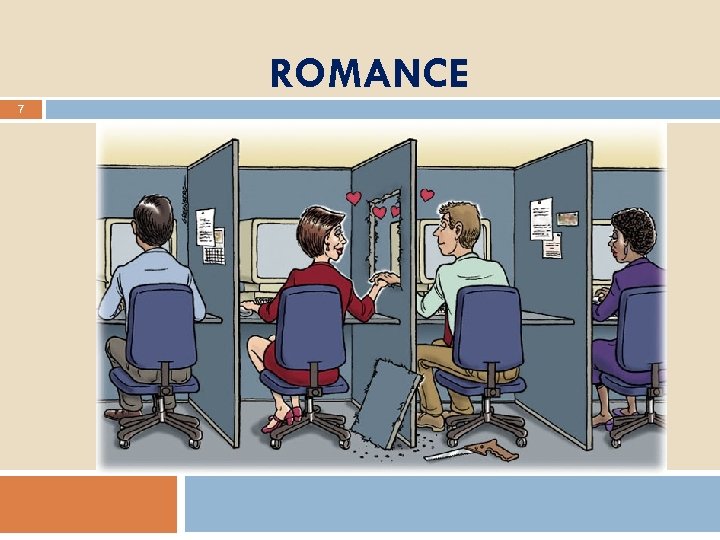
ROMANCE 7
WORKPLACE ROMANCES 19 Why People Engage in Workplace Romances Long hours people spend at work. Work is a non-threatening environment where people meet potential dating partners and learn more about them.
WORKPLACE ROMANCES 20 Why People Engage in Workplace Romances When the romance flourishes, those in the relationship are “happy. ” When partners work for the same employer, each has someone to talk to about their problems at work because the other understands and can help resolve issues.
WORKPLACE ROMANCES 21 Almost Everyone is Doing It!! 59% of employees have participated in an office romance 65% of employees reported that the shaky economy has no effect on their willingness to take romantic risks at work 1/3 of those who have had office romances have engaged in workplace trysts.
WORKPLACE ROMANCES 22 Dangers of Workplace Romance
WORKPLACE ROMANCES 23 Dangers of Workplace Romance 1. 2. 3. Loss of attention to work. Jealousy among co-workers. Potential for antagonism between the individuals if a break up occurs.
WORKPLACE ROMANCES 24 Legal Challenges Sexual Harassment (Quid Pro Quo) Claims Retaliation Claims Hostile Work Environment Claims Invasion of Privacy and Wrongful Termination Claims Intentional Infliction of Emotional Distress Assault and Battery
WORKPLACE ROMANCES 25 Sexual Harassment (Quid Pro Quo) Claims After a supervisor ends a relationship with a subordinate, the subordinate will sometimes assert an after-the-fact sexual harassment claim. Usually, the subordinate contends he or she was coerced into the relationship and employment or various prerequisites of employment were conditioned upon the exchange of sexual favors.
WORKPLACE ROMANCES 26 Retaliation Claims When a subordinate ends a relationship with a supervisor, the supervisor may be accused of retaliation if the subordinate suffers any adverse employment action.
WORKPLACE ROMANCES 27 Hostile Work Environment Typically occurs where a combination of sexual comments, jokes, etc. take place between the couple prior to the relationship dissolving. Other employees who witness the office romance may also feel slighted and raise such a claim – must be widespread favoritism.
WORKPLACE ROMANCES 28 Hostile Work Environment Faragher v. City of Boca Raton, 524 U. S. 775 (1998) The Supreme Court held that in order to be actionable under Title VII, the sexual harassment must be so severe and pervasive that it alters the conditions of the victim’s employment and creates an abusive working environment.
WORKPLACE ROMANCES 29 Faragher v. City of Boca Raton The Court noted that a sexually objectionable environment must be: Both objectively and subjectively offensive, One that a reasonable person would find hostile or abusive, and One that the victim in fact did perceive to be so.
WORKPLACE ROMANCES 30 Faragher v. City of Boca Raton Courts are directed to determine whether an environment is sufficiently hostile or abusive by looking at all the circumstances, including: The frequency of the discriminatory conduct; The severity of the discriminatory conduct; Whether the conduct is physically threatening or humiliating, or a mere offensive utterance; and Whether the conduct unreasonably interferes with an employee's work performance.
WORKPLACE ROMANCES 31 Faragher v. City of Boca Raton An employer may be indirectly liable for sexual harassment by a superior if: (1) the harassment occurs within the scope of the superior’s employment; (2) the employer assigns performance of a non-delegable duty to a supervisor and an employee is injured because of the supervisor’s failure to carry out that duty; or (3) there is an agency relationship which aids the supervisor’s ability or opportunity to harass.
WORKPLACE ROMANCES 32 Invasion of Privacy & Wrongful Termination Claims When employers penalize employees for dating, the affected employees may be able to assert an invasion of privacy claim.
WORKPLACE ROMANCES 33 Intentional Infliction of Emotional Distress (IIED) Elements (1) defendant acted intentionally or recklessly; (2) defendant’s conduct was extreme and outrageous; (3) causation (4) resulting in severe emotional distress A claim for IIED can be brought against an individual supervisor.
WORKPLACE ROMANCES 34 IIED - Hess v. Treece, 286 Ark. 434 (1985) Appellee Mark Treece had been an employee of the Little Rock Police Department since 1973. In late 1980 he met appellant Bob Hess when he dropped off Jayma Stephens, Hess' girlfriend, at Hess' house and some unfriendly words were exchanged between the parties. Treece testified that in April 1981 he saw Hess following him. In Spring 1982, Treece was informed by one of his superior officers, Capt. Timothy Daley, that Hess had called the Police Department to complain about Treece being at his apartment when he was supposed to be at work.
WORKPLACE ROMANCES 35 Hess v. Treece During this conversation, according to Daley, Hess stated that he would have Treece's job at any cost, and that he was conducting surveillance of Treece and other officers. An internal police investigation of this complaint found Treece innocent of the charges. In April 1982 Treece talked to Hess' bookkeeper. She told Treece that Hess had asked her to watch and report on Treece's movements.
WORKPLACE ROMANCES 36 Hess v. Treece The court stated, “The fact that appellee happened to be a city employee should not deprive him of protection from outrageous conduct, nor should the fact that appellant happened to be a City Director relieve him of responsibility for his actions. ” The Arkansas Supreme Court upheld the lower court’s ruling in favor of Treece, finding substantial evidence to support the verdict of outrageous conduct and also to support the award of damages, both compensatory and punitive.
WORKPLACE ROMANCES 37 Assault & Battery Elements of Assault: (1) an act intended to cause apprehension of harmful or offensive contact (2) that does cause apprehension of such contact in the victim Elements of Battery: (1) an intent to cause harmful or offensive contact (2) and harmful or offensive contact to the plaintiff Claims for assault & battery can be brought against an individual supervisor.
WORKPLACE ROMANCES 38 Employer approaches to protect against the legal impact of workplace relationships: “Love Contracts” No-Fraternization Policies
WORKPLACE ROMANCES 39 No-Fraternization Policies What does it mean to fraternize? When office. two people have a relationship within the
WORKPLACE ROMANCES 40 No-Fraternization Policies First Type Prohibits supervisory employees from dating non-management employees. Rationale – the disparity of power between the two could be viewed as creating a situation where the employee was under duress to enter into or stay in the relationship.
WORKPLACE ROMANCES 41 No-Fraternization Policies Second type –Prohibits supervisors from dating any employees, but allows nonsupervisory employees to date each other. Third type –Prohibits any dating in the workplace (strict policy).
WORKPLACE ROMANCES 42 No-Fraternization Policies vs. Employee Privacy
WORKPLACE ROMANCES 43 What kind of policy is right for you?
WORKPLACE ROMANCES 44 Advantages of NOT having a No. Fraternization Policy Allows management flexibility in establishing corporate culture and letting it change as the firm may experience a fluctuation of employees within the firm. Company can still address harassment issues through its anti-harassment policy.
WORKPLACE ROMANCES 45 Disadvantages of NOT having a nofraternization policy Employees may not be on notice as to what kinds of behavior are prohibited, thus providing an opening for an invasion of privacy argument. Employer does not have the strong evidence that the consistent enforcement of a no-fraternization policy, which goes over and above a policy merely prohibiting harassment and discrimination, provides in court.

Social Networking 46
Social Networking 47 Types of Social Networking: Forums Blogs Micro-blogging Photo (e. g. Twitter) Sharing Video Sharing Professional (e. g. Linked. In) Purely Social (e. g. Facebook) Bookmarking
Social Networking 48 Trends Time Americans spent surfing Facebook: August 2010 - 41. 1 million minutes August 2009 - 20. 8 million minutes Largest Ages growing demographic on Facebook: 35 and older http: //www. allfacebook. com/facebook-surpasses-google-in-time-spent-on-sitedomestically-2010 -09
Big Four of Social Media http: //www. getbusymedia. com/the-social-media-download-the-big-four/
Social Media – Why People Use It Keeping in touch Networking Sharing and acquiring information Meeting new people Winning prizes
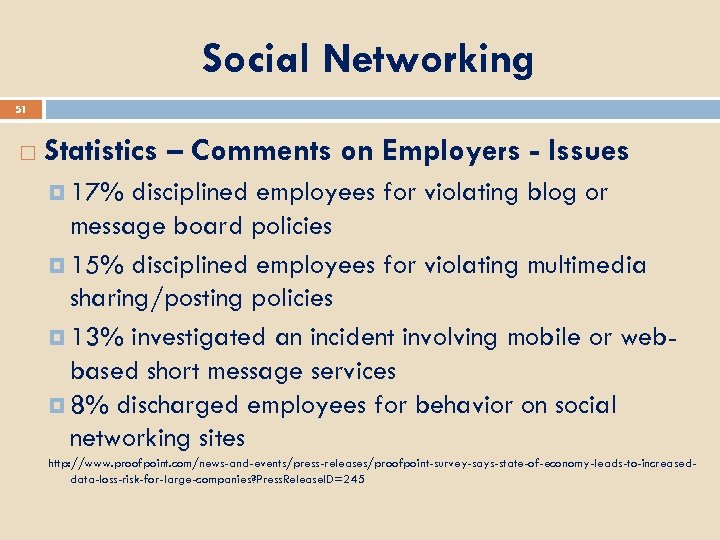
Social Networking 51 Statistics – Comments on Employers - Issues 17% disciplined employees for violating blog or message board policies 15% disciplined employees for violating multimedia sharing/posting policies 13% investigated an incident involving mobile or webbased short message services 8% discharged employees for behavior on social networking sites http: //www. proofpoint. com/news-and-events/press-releases/proofpoint-survey-says-state-of-economy-leads-to-increaseddata-loss-risk-for-large-companies? Press. Release. ID=245
Social Networking 52 What is a Blog? An online journal Can contain anything the author wishes to publish Potential Risks/Downside: Invasion of Privacy Defamation Sexual Harassment Productivity Drains & Economic Damage
Social Networking 53 Blog Risks to Employers May be held accountable for employee posts about products/services if misleading Knowledge of discriminatory or harassing content may expose employer to liability Employers have not yet been held liable for employee blog content However, liability has been imposed for employee email & internet conduct.
Social Networking 54 Blog Risks for Employers FTC endorsement guidelines require that bloggers discussing or reviewing products & services must disclose any connection between blogger and maker of the product Employers can be held liable for permitting a hostile work environment based on what employees say online. Blakely v. Continental Airlines, 164 N. J. 38 (2000).
Social Networking 55 What is Twitter? A free blogging service that lets users post short answers, known as “tweets, ” to the question: What are you doing? Risks Tweets create the same risk issues that blogs in general create Because they are instantaneous messages, they are generally not well thought-out, creating more potential for poor judgment.
Social Networking 56 What is Twitter?
Social Networking 57 What is “pure” Social Networking? Sites purely for allowing users to stay in touch with people whom they know. Best examples are Facebook and My. Space Potential Risks (between employees and employees/employers) Defamation Invasion of Privacy Sexual Harassment
Social Networking 58 Defamation A false statement Publication To a third party That causes damages to the person defamed Defense: Truth
Social Networking 59 Invasion of Privacy Appropriation of name or likeness Publicity given to private life Matter publicized would be highly offensive to a reasonable person AND Is not of a legitimate concern to the public Publicity placing a person in a false light
Social Networking 60 Sexual Harassment – Examples: Sending explicit pictures Having explicit pictures on social network site “Sexting”
Social Networking 61 Urban Dictionary: Dooced – to lose one’s job because of one’s website
Social Networking 62 Examples quoted in the media of people who lost their jobs because of Social Networking Posts:
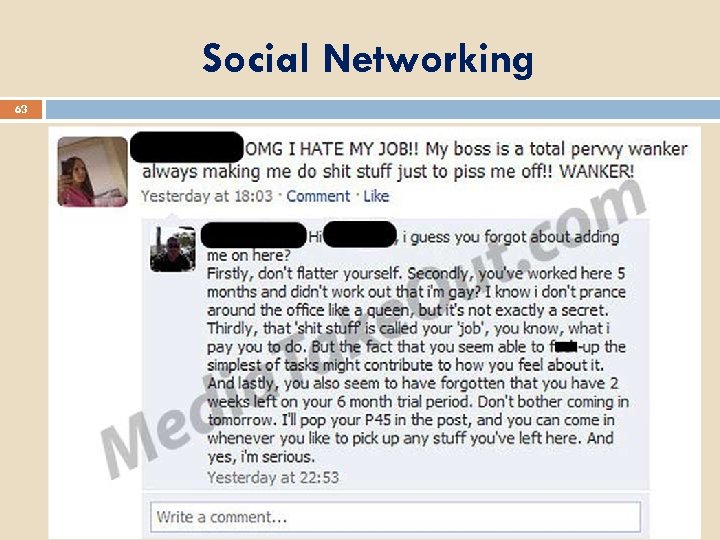
Social Networking 63
Social Networking 64 Philadelphia Eagles Gate Keeper Upset that Eagles let free agent Brian Dawkins sign with Denver Broncos Fired after 6 years on job for Facebook post: “Damn Eagles R Retarded!!”
Harassment via Facebook A Texas teacher was terminated this spring for using Facebook to harass a fellow teacher. Set up a fake Facebook account for the other teacher and disclosed the teacher’s financial information, photograph and address.
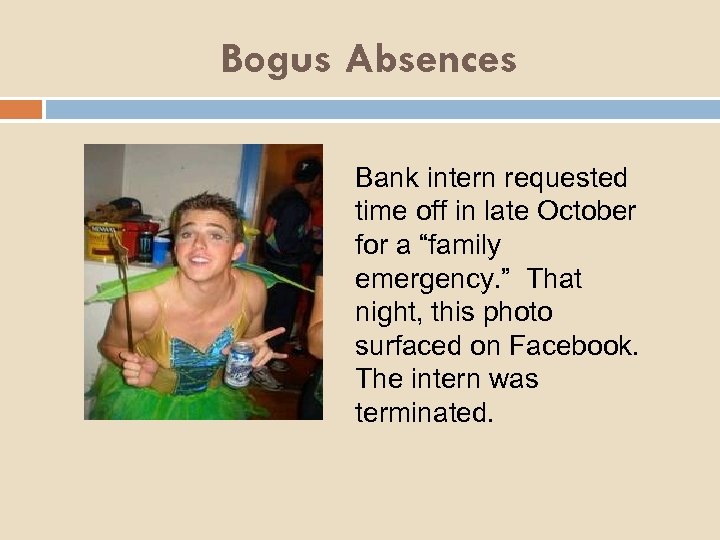
Bogus Absences Bank intern requested time off in late October for a “family emergency. ” That night, this photo surfaced on Facebook. The intern was terminated.
How Does Social Media Affect Businesses? CAN I LOOK A JOB APPLICANT UP ON FACEBOOK/LINKED IN/SOCIAL MEDIA UNIVERSE?
Risks of Searching Social Media: Inaccurate Information There is no guarantee that information obtained from a social networking site is accurate. Individuals have had their pictures stolen from social networking sites and uploaded to fake social networking profiles. Inaccurate information could lead to poor employment decisions.
Risks of Searching Social Media: Fair Credit Reporting Act (“FCRA”) Enacted to ensure that information used to make decisions about consumers is accurate Requires an employer to give an applicant written notice and obtain permission before obtaining a consumer report on the applicant Social networking sites allow employers to gain a wealth of information without providing applicants with the required written notice or permission.
Risks of Searching Social Media: Terms of Service Violations Virtually all social networking sites include a “Non -Commercial Use” clause. Researching individuals for the purposes of employment decision-making would violate this clause.
Technology Policies Can Protect Employers may be able to reduce the risk of liability for workplace technology use by keeping tabs on how employees are using their computers, email, and other electronic communications at work. 71
Technology Policies Can Protect Employers Companies should enact a comprehensive internet, email, and phone-use policies which addresses the proper use of the systems and the potential for the monitoring of electronic communications Stay on top of how employer’s duties and obligations are affected by new technology New online technologies and trends in use by employees must be addressed by broad policies 72
Technology Policies Make sure technology policies address the following issues: Monitoring of employees – when & how Company property – identify & define What is appropriate use of company property? What is prohibited use of company property? What personal use of company property is allowed? “For business only” purposes are difficult to enforce 73
Technology Policies Make sure technology policies address the following issues: Electronic devices used to communicate or transmit information Unauthorized internal or external communication of confidential or proprietary information should be prohibited Expectations Make of privacy it clear that employees should expect none 74
Technology Policies Don’t assume employees have knowledge of what content and conduct is appropriate Make policies CLEAR. It is easier to discipline for improper use. Exempt protected concerted activities. 75
Social Networking 76 Creating a Policy that Works A good policy Protects trade secrets Addresses customer, employer & employee privacy
Social Networking Draft policies carefully to insure against discrimination or harassment cases a policy that works Inappropriate, harassing, offensive, defamatory or discriminatory content in any electronic communication, personal or business-related, should be prohibited Creating Prohibit specific actions, such as sending offensive materials or storing or accessing them 77
Social Networking 78 Creating a Policy that Works Topics covered: Use of Company resources for personal business Company policies apply online Unauthorized use of Company name and trademarks, logos, etc. Inappropriate disclosures Inappropriate comments not otherwise legally protected
Social Networking 79 Creating a Policy that Works Avoiding an “overly broad” policy: Remember that employees have a right to share information regarding working conditions Employees can be prohibited from using company logos or trademarks and from posting disparaging information about company products and services Employees should be prohibited from violating EEO/harassment laws. Employees should provide a disclaimer that the opinions are their own and not those of the company.
Social Networking Companies should distribute copies of the policy to all employees and require written acknowledgement and consent to the policy Obtain consent prior to monitoring Always insure employees have been directly informed of Company policy Place a message on your computer system’s “splash screen” about privacy rights 80
81 COPING WITH EMPLOYEE DRUG USE Recreational and Prescription Drugs
Coping with Employee Drug Use 82 Direct Cost of Drug Abuse to U. S. Industry $85 billion per year Including lost time, reduced productivity, lost employment, injuries and crime Source: Metropolitan Life Insurance Company
Coping with Employee Drug Use 83 According to the National Survey on Drug Use & Health… Of the estimated 19. 3 million illicit drug users aged 18 or older in 2009, 12. 9 million (66. 6 %) were employed either full or part time.
Coping with Employee Drug Use 84 Prescription Drug Abuse – What is it? Use of prescription pain relievers, tranquilizers, stimulants or sedatives without a prescription simply for the feeling the drug causes.
Coping with Employee Drug Use 85 Among persons aged 12 or older in 2008 -2009 who used pain relievers non-medically in the previous 12 months: 55. 3% got the drug from a friend or relative for free; Another 17. 6% reported they got the drug from one doctor; Only 4. 8% got pain relievers from a drug dealer or other stranger; and 0. 4% bought them on the Internet. In 2009, 7. 0 million (2. 8%) persons aged 12 or older used prescription-type psychotherapeutic drugs non-medically in the previous month. http: //oas. samhsa. gov/NSDUH/2 k 9 Results. htm
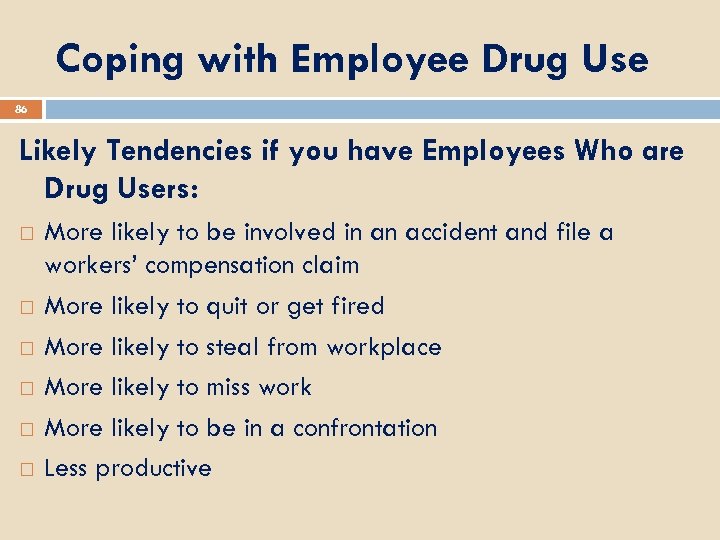
Coping with Employee Drug Use 86 Likely Tendencies if you have Employees Who are Drug Users: More likely to be involved in an accident and file a workers’ compensation claim More likely to quit or get fired More likely to steal from workplace More likely to miss work More likely to be in a confrontation Less productive
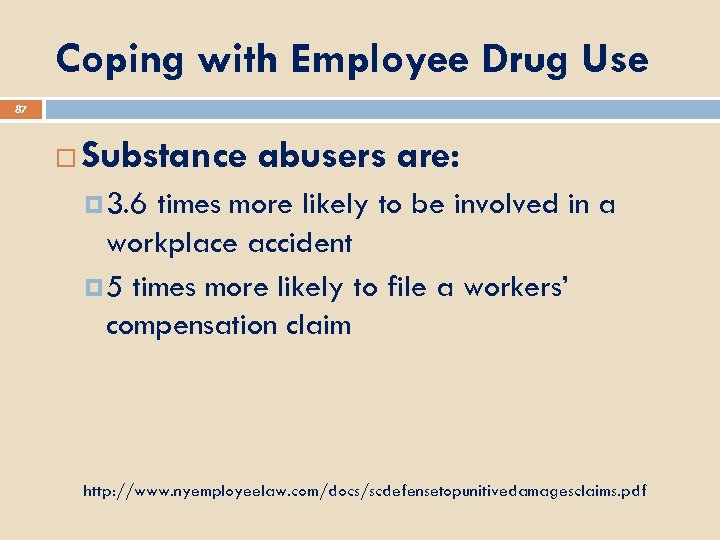
Coping with Employee Drug Use 87 Substance abusers are: 3. 6 times more likely to be involved in a workplace accident 5 times more likely to file a workers’ compensation claim http: //www. nyemployeelaw. com/docs/scdefensetopunitivedamagesclaims. pdf
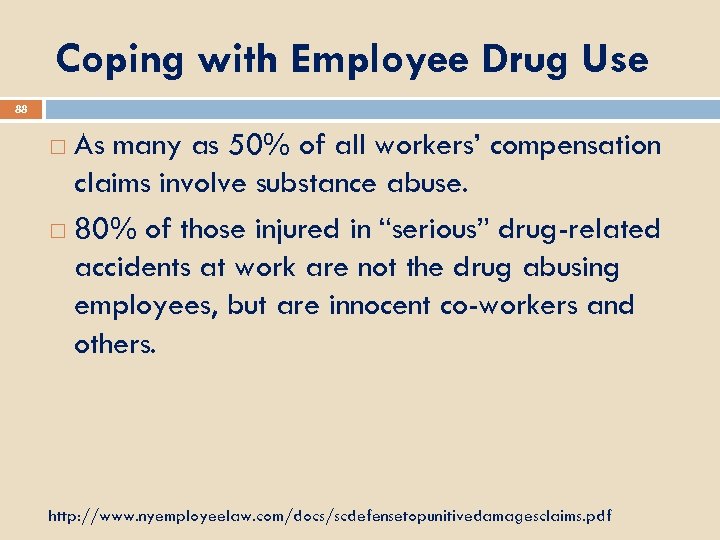
Coping with Employee Drug Use 88 As many as 50% of all workers’ compensation claims involve substance abuse. 80% of those injured in “serious” drug-related accidents at work are not the drug abusing employees, but are innocent co-workers and others. http: //www. nyemployeelaw. com/docs/scdefensetopunitivedamagesclaims. pdf
Coping with Employee Drug Use 89 Employer Responses to Problems
Coping with Employee Drug Use 90 Three (3) Choices: Ignore it Discipline without drug testing Implement Substance Abuse program involving 1 or 2 elements: Drug Testing Rehabilitation
Coping with Employee Drug Use 91 Legal Challenges Employers Face Validity of Tests and Procedures Errors Chain of Custody Problems Invasion of Privacy Defamation Wrongful Termination Note: Certain states disallow certain types of tests – e. g. , hair or oral fluids.
Coping with Employee Drug Use 92 Americans with Disabilities Act (ADA) Concerns The EEOC has taken the position that employers and their designees—physicians, clinics, third-party administrators—may not require individuals being tested to indicate, prior to testing, if the individual is taking any medications, even if that medication may produce a positive test result.
Coping with Employee Drug Use 93 Americans with Disabilities Act (ADA) Concerns If an individual tests positive, the employer, either by one of its employees or a thirdparty, must determine whether the individual had a legitimate reason for testing positive. The ADA excludes users of illicit drugs and those who take prescription drugs unlawfully from its protection.
Drug Testing 94 “Urinalysis required by a government employer for the purpose of detecting illegal drug use is a search protected by the Fourth Amendment. ” See Skinner v. Railway Labor Executives' Ass'n, 489 U. S. 602, 61718 (1989); National Treasury Employees Union v. Von Raab, 489 U. S. 656, 678 -79 (1989). The Fourth Amendment, however, does not proscribe all searches; it bars only unreasonable ones.
Drug Testing 95 The permissibility of a particular practice "is judged by balancing its intrusion on the individual's Fourth Amendment interests against its promotion of legitimate governmental interests. " Skinner, 489 U. S. at 619. The need for testing must be important enough to override the individual's privacy interest, sufficiently vital to suppress the Fourth Amendment's normal requirement of individualized suspicion. Chandler v. Miller, 520 U. S. 305 (1997).
Drug Testing 96 Basis of Government Drug Testing Government employees have rights entitling them to due process protection when faced with discipline or discharge for drugs. The right to be exposed to fair testing policies are derived from the Constitution as well as from the right to contract, to engage in the common occupations of life, and to maintain one's employment and standing in the community.
Drug Testing 97 What Substantive Rights Do Government Employees Have? In substance the basic drug testing protections are as follows: All employees should have notice of drug testing prior to implementation of or exposure to the testing program. All employees should be entitled to test accuracy including having an initial test confirmed by a method of greater or equal sensitivity.
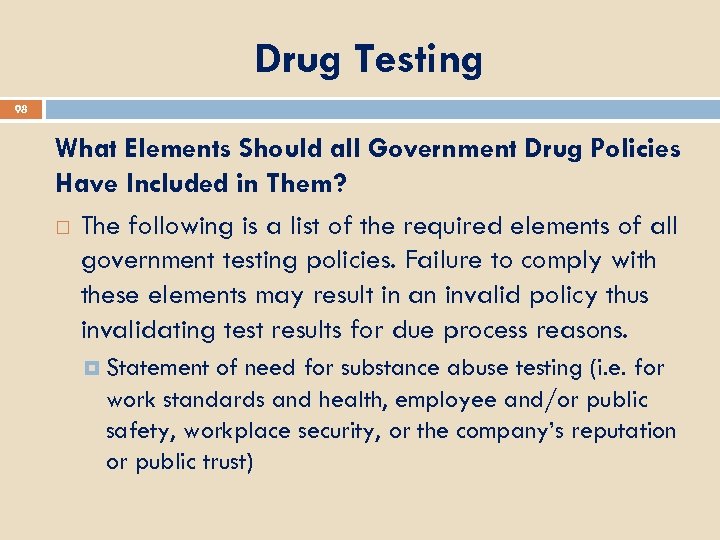
Drug Testing 98 What Elements Should all Government Drug Policies Have Included in Them? The following is a list of the required elements of all government testing policies. Failure to comply with these elements may result in an invalid policy thus invalidating test results for due process reasons. Statement of need for substance abuse testing (i. e. for work standards and health, employee and/or public safety, workplace security, or the company’s reputation or public trust)
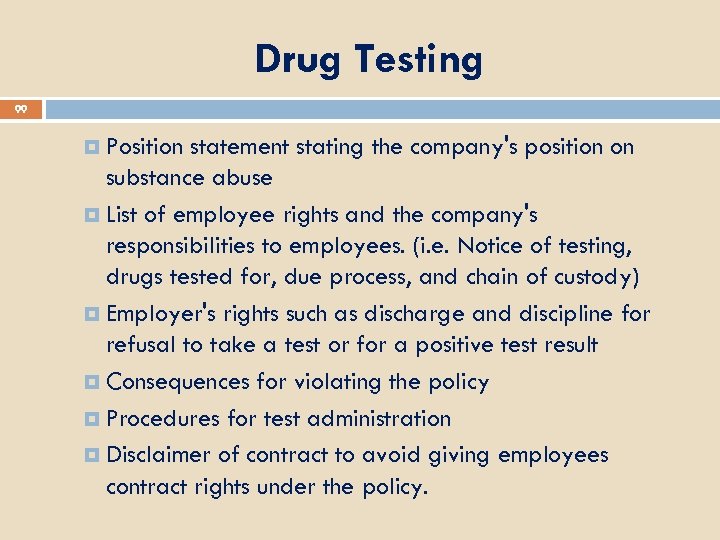
Drug Testing 99 Position statement stating the company's position on substance abuse List of employee rights and the company's responsibilities to employees. (i. e. Notice of testing, drugs tested for, due process, and chain of custody) Employer's rights such as discharge and discipline for refusal to take a test or for a positive test result Consequences for violating the policy Procedures for test administration Disclaimer of contract to avoid giving employees contract rights under the policy.
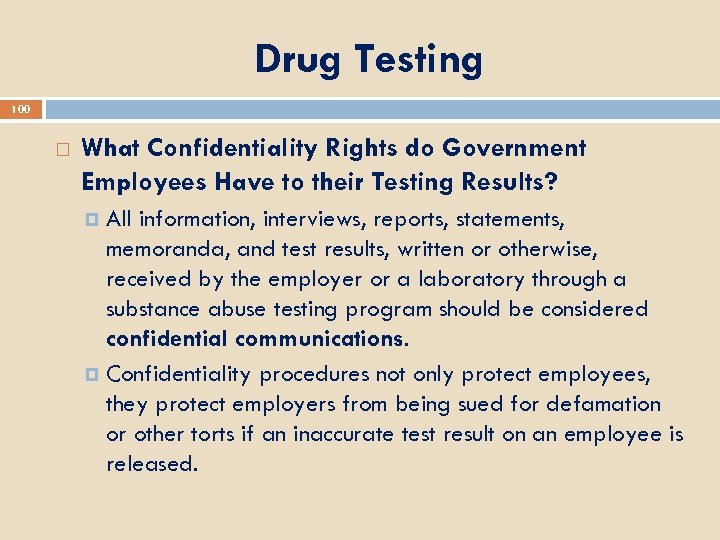
Drug Testing 100 What Confidentiality Rights do Government Employees Have to their Testing Results? All information, interviews, reports, statements, memoranda, and test results, written or otherwise, received by the employer or a laboratory through a substance abuse testing program should be considered confidential communications. Confidentiality procedures not only protect employees, they protect employers from being sued for defamation or other torts if an inaccurate test result on an employee is released.
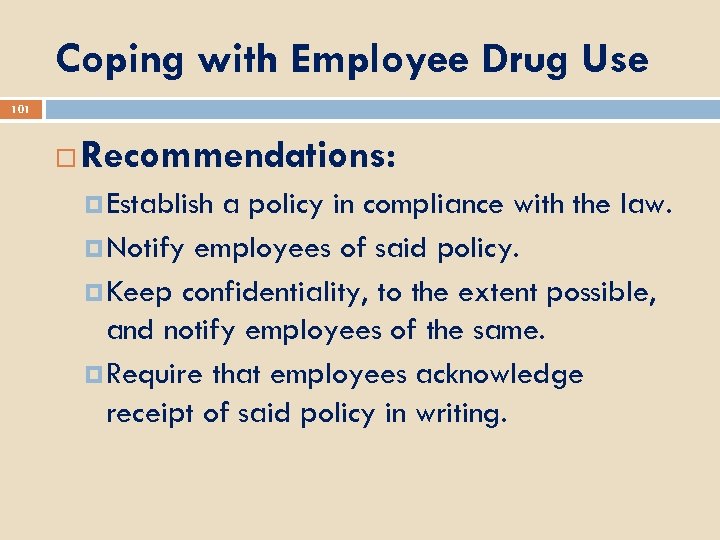
Coping with Employee Drug Use 101 Recommendations: Establish a policy in compliance with the law. Notify employees of said policy. Keep confidentiality, to the extent possible, and notify employees of the same. Require that employees acknowledge receipt of said policy in writing.
102 Regulating Employee Appearance Weight, Dress, Tattoos & Body Piercings
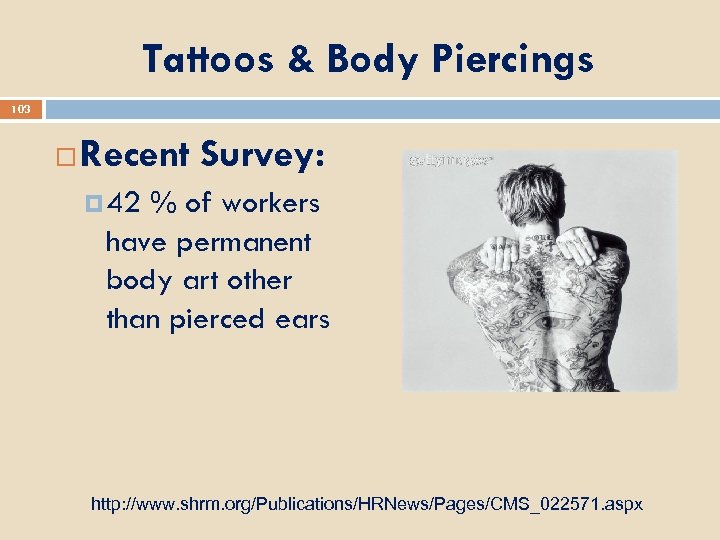
Tattoos & Body Piercings 103 Recent Survey: 42 % of workers have permanent body art other than pierced ears http: //www. shrm. org/Publications/HRNews/Pages/CMS_022571. aspx
Tattoos & Body Piercings 104 The “Norm” 30 years ago, 1 in 100 people in the US had tattoos. Now, 1 in 10 Americans have them, and 1/3 of those aged 25 -30 have tattoos. While society is becoming more liberated and expressive, some employers are having a hard time accepting body art and piercings in the workplace. http: //www. workingworld. com/articles/Tattoos-and-Piercings-in-the-Workplace
Tattoos & Body Piercings 105 Private vs. Public Sector Employers Public sector employers must carefully balance if the employee’s “speech” is a matter of public concern or pursuant to official duties “Speech” that is not a matter of public concern or that is made pursuant to an official duty is not insulated from employer discipline. Private sector employers’ right to enforce a legitimate dress code typically trumps the employee’s right to free speech. Both public and private employers must not discriminate against speech on the basis of protected status, e. g. , Title VII protects religious expression.
Tattoos & Body Piercings 106 Protected Speech Roberts KY v. Ward, 468 F. 3 d 963 (6 th Cir. 2006) State Parks Dept. employee filed suit alleging that his First Amendment rights were violated after he was terminated for refusing to follow the Department’s “Professional Appearance Policy, ” which prohibited any visible tattoos and body piercings—with the exception of ear lobes for women only. The employee was terminated for displaying a U. S. Navy tattoo.
Tattoos & Body Piercings 107 Protected Speech Roberts v. Ward The court identified two situations when a state employer’s limitation upon the speech of its employees can violate the First Amendment: Instances where a public employee speaks out about some functioning branch of government for which he works—a matter on which he is “uniquely qualified to comment” by virtue of his job status AND Instances where the speech is unrelated to the job of the employee and involves matters of public concern.
Tattoos & Body Piercings 108 Protected Speech Roberts The v. Ward employee argued that his tattoo involved a matter of public concern because it expressed his “support, loyalty and affection for the U. S. Navy. ” The court held that the display of the tattoo was not a matter of public concern and some dress code limitations are permissible.
Tattoos & Body Piercings 109 Protected Speech Riggs v. City of Fort Worth, 229 F. Supp. 2 d 572 (N. D. Tex. 2002) A Fort Worth police officer with numerous tattoos on his arms and legs filed suit after he was transferred from the bike unit and ordered to wear long sleeves and pants to cover his tattoos. The officer alleged that he was discriminated against because of his race (Caucasian), sex (male), and national origin (Celtic).
Tattoos & Body Piercings 110 Protected Speech Riggs The v. City of Fort Worth Police Department had a dress code that contained no specific provisions regarding tattoos but required that “personnel … shall wear such uniform and insignia as the Chief of Police prescribes. ” The court held that the tattoos were not protected speech and even if they were, they were not speech addressing a “legitimate public concern. ” The court noted the police department needed only a “rational basis” to require the officer to wear pants and long sleeves.
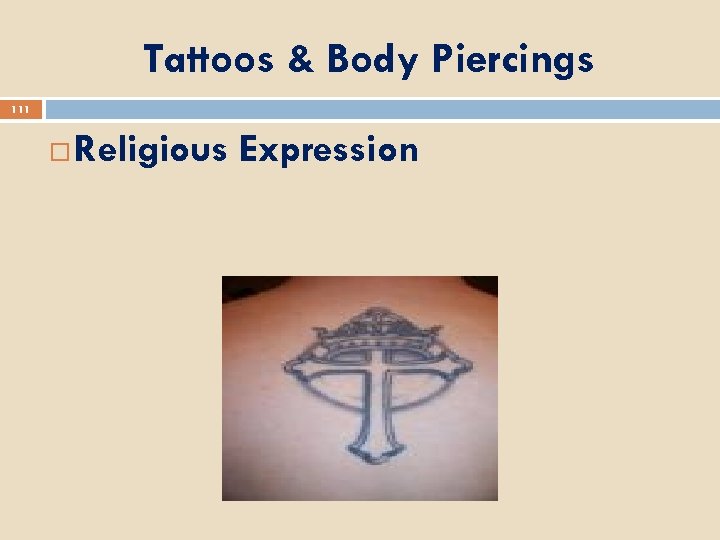
Tattoos & Body Piercings 111 Religious Expression
Tattoos & Body Piercings 112 Religious Expression Applicable Title law VII of the Civil Rights Act prohibits discrimination against employees on the basis of religion. An employer must offer a reasonable accommodation to resolve a conflict between an employee’s sincerely held religious belief and a condition of employment.
Tattoos & Body Piercings 113 Religious Expression Swartzentruber v. Gunite Corp. , 99 F. Supp. 2 d 976 (N. D. Ind. 2000) A Ku Klux Klan member sued his employer after he was forced to cover a tattoo of a hooded man standing next to a burning cross. The employee claimed to be a member of the Church of the American Knights of the Ku Klux Klan and that the tattoo depicted a sacred symbol of his religion.
Tattoos & Body Piercings 114 Religious Expression Swartzentruber v. Gunite Corp The employee failed to present evidence that covering the tattoo at work conflicted with his religious beliefs. The court held that even if the employee had presented such evidence, allowing the employee to work with the tattoo covered was a reasonable accommodation because of the offensive nature of the tattoo to other employees.
Tattoos & Body Piercings 115 Religious Expression Cloutier v. Costco Wholesale Corp. , 390 F. 3 d 126 (1 st Cir. 2004) An employee alleged religious discrimination when she was terminated for wearing facial jewelry The employee claimed to be a member of the Church of Body Modification The employee was terminated for absenteeism because she refused to remove her facial jewelry
Tattoos & Body Piercings 116 Religious Expression Cloutier Costco v. Costco Wholesale Corp offered to allow her to return to work if she would wear clear spacers or cover the jewelry with a bandage. The employee stated that her religious beliefs required her to display her jewelry at all times. The court found the employer had provided a reasonable accommodation The appellate court subsequently found the employee’s desired accommodation—complete waiver of the policy— was an undue hardship on the employer
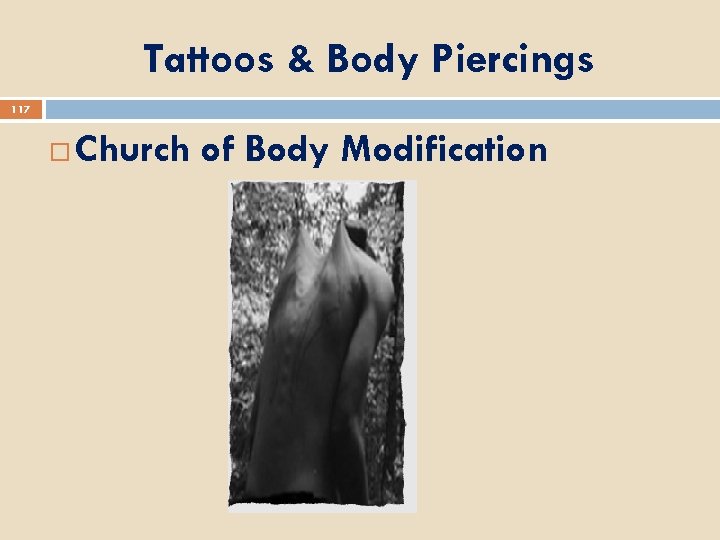
Tattoos & Body Piercings 117 Church of Body Modification
Tattoos & Body Piercings 118 Employer Solutions to Tattoo & Body Piercing Issues
Tattoos & Body Piercings 119 Policies Should address whether jewelry or tattoos pose a conflict with: The employee’s ability to perform effectively in their position; or The specific work environment the employee is in.
Tattoos & Body Piercings 120 Policies Factors to determine whether jewelry and tattoos pose a conflict: Safety to self and others Productivity or performance of tasks Perceived offense on the basis of race, sex, religion, etc. Community norms Customer complaints Inturri v. City of Hartford, Conn. , 365 F. Supp. 2 d 240 (2005) Cloutier v. Costco Wholesale Corp. , 390 F. 3 d 126 (2004)
Weight 121 Employer Regulation of Employee Weight
Weight 122 Obesity Research released in 2010 by Duke University found that the yearly cost to employers of obesity among full-time employees was $73. 1 billion. Presenteeism, lost productivity incurred when employees try to work despite health problems, costs employers $12. 1 billion per year, nearly twice as much as their medical costs.
Weight 123 Obesity Severely obese individuals with a body mass index of 35 or higher accounted for 61% of all obese employee costs, though they represent only 37% of the overall obese population. Among those with a BMI of 40 or more— roughly 100 lbs. overweight—these costs amounted to $16, 900 per capita for women and $15, 500 for men in this weight class.
Weight 124 Employee Wellness Programs as a Solution
Weight 125 Employee Wellness Programs Any workplace-sponsored program that attempts to help employees live healthier lifestyles. Two approaches: Simple - includes having lunch break walks or adding a few lines in a company newsletter to remind people the company is offering flu shots Extensive – employing consultants to assist with improving employee health or providing easy-touse, inexpensive services that contribute to good health.
Weight 126 Employee Wellness Programs Potential The Issues Health Insurance Portability and Accountability Act (HIPAA) amended ERISA, the Internal Revenue Code, and the Public Health Service Act in 1996. HIPAA generally prohibits group health plans from basing the entitlement to benefits or incentives on a “health factor” of an individual.
Weight 127 Employee Wellness Programs “Health Factors” generally include: Health status Medical condition (including physical & mental illnesses) Claims experience Receipt of healthcare Medical history Genetic information Evidence of insurability Disability
Weight 128 HIPPA Approved Programs Two types: Reactive Proactive
Weight 129 Employee Wellness Programs Compliance Despite this general prohibition, the regulations interpreting HIPAA include an exception for bona fide wellness programs. This allows employers to enact employee wellness plans without the burden and expense of HIPAA compliance.
Weight 130 Non-HIPPA Permitted Wellness Programs Test for HIPAA exception: Available to “similarly situated individuals” AND The reward is unrelated to a health care plan OR The reward is related to the health care plan but it is NOT contingent on satisfying a standard related to a health status factor.
Weight 131 The Rehabilitation Act of 1973 Also has some potential applicability. The Act prohibits discrimination against an otherwise qualified individual with handicaps, solely on the basis of that handicap, in any program which receives federal assistance.
Weight 132 The Rehabilitation Act of 1973 Most cases filed under this law relate to discrimination based on the employee’s weight by the employer. Only a few cases have been successful.
Weight 133 Cook v. State of Rhode Island, Dept. of MHRH (1 st Cir. 1993). The Cook case was the first time a federal appellate court addressed whether, and under what conditions, obesity is covered by the Rehabilitation Act. In this case, the court ruled that the employer had discriminated against a job candidate based on what they claimed was a disability: Cook was just over 5 ft. tall and weighed 320 lbs. In the application process, the employer (MHRH) found no limits on Cook’s capabilities in the position, but MHRH still claimed that her weight kept her from being able to work sufficiently and would promote absenteeism.
Weight 134 Cook v. State of Rhode Island, Dept. of MHRH Consequently, MHRH refused to hire Cook. A jury awarded Cook compensatory damages in the amount of $100, 000. In analyzing Cook’s claims, the court based its analysis on the Rehabilitation Act. The court upheld all damages the jury below had awarded Cook, stating that there was ample evidence to support the verdict.
Weight 135 Cook v. State of Rhode Island, Dept. of MHRH Under the regulatory framework, a person "is regarded as having an impairment" if: (a) he or she has a physical impairment that does not substantially limit a major life activity, but that is perceived by an employer as constituting such a limitation; or (b) has a physical impairment that substantially limits major life activities only as the result of the attitudes of others toward such impairment; or (c) has none of the impairments but is treated as having such an impairment.
Weight 136 The American’s with Disabilities Act (ADA) The ADA also has some potential applicability.
Weight 137 Legal Constraints – ADA Three ways a wellness plan could violate the ADA: Mandating wellness program participation; Using information obtained in the program in a way that violates ADA confidentiality requirements; Using information gained through the wellness program to discriminate against employees who are not as physically fit as management thinks they should be.
Weight 138 Legal Constraints – ADA Compliance issues also arise when wellness programs offered by the employer do not offer a reasonable accommodation for employees with known disabilities and when an employer inappropriately inquires about medical conditions.
Weight 139 Legal Constraints – ADA The ADA does allow employers to conduct medical examinations and inquiries that are part of its wellness program without having to show that the examination or inquiry is jobrelated or consistent with business necessity if such examinations and activities are voluntary.
Weight 140 Legal Constraints – ADA The EEOC has stated that wellness programs are “voluntary” as long as an employer neither requires participation nor penalizes employees who do not participate. An employer having a wellness program that involves medical examinations or inquiries will need to determine whether its program complies with the ADA’s voluntary requirement
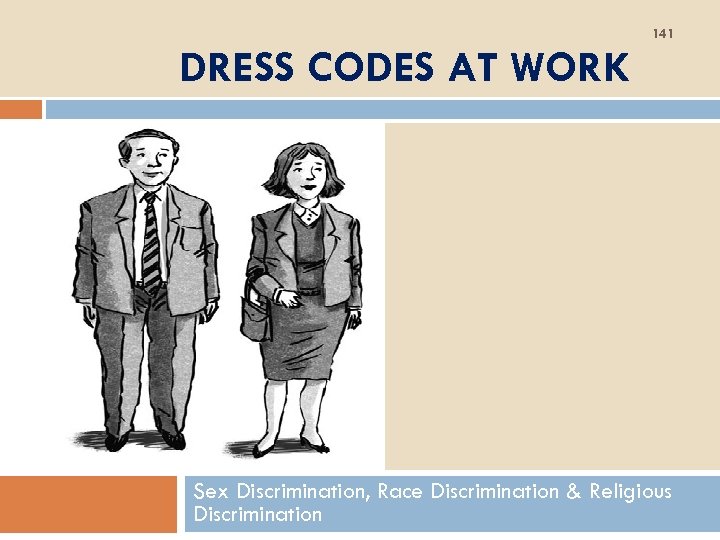
141 DRESS CODES AT WORK Sex Discrimination, Race Discrimination & Religious Discrimination
DRESS CODES AT WORK 142 Can your dress code policy prohibit certain clothes?
Dress Codes at Work 143 Yes, With Three Caveats: Sex Discrimination Race Discrimination Religious Discrimination
Dress Codes at Work 144 Sex Discrimination
Dress Codes at Work 145 Sex Discrimination Price Waterhouse v. Hopkins, 49 U. S. 229 (1989) Female employee received evaluations suggesting that she walk, talk, and dress more femininely to improve her chances of achieving partnership in the firm A plurality of the Supreme Court held that the firm had engaged in “sexual stereotyping, ” which was a violation of Title VII.
Dress Codes at Work 146 Race Discrimination
Dress Codes at Work 147 Race Discrimination An employer may invite race discrimination claims if its dress code or appearance policy impacts only a particular race or group. Similarly, an employer may not discriminate against ethnic attire that otherwise complies with the dress code.
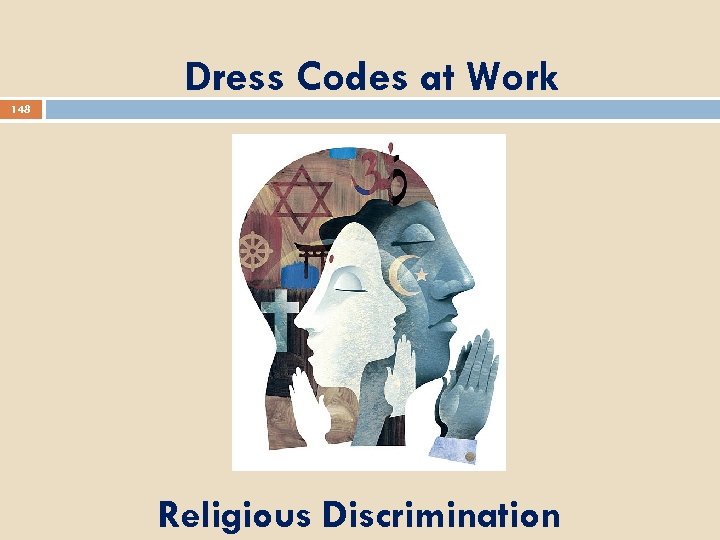
Dress Codes at Work 148 Religious Discrimination
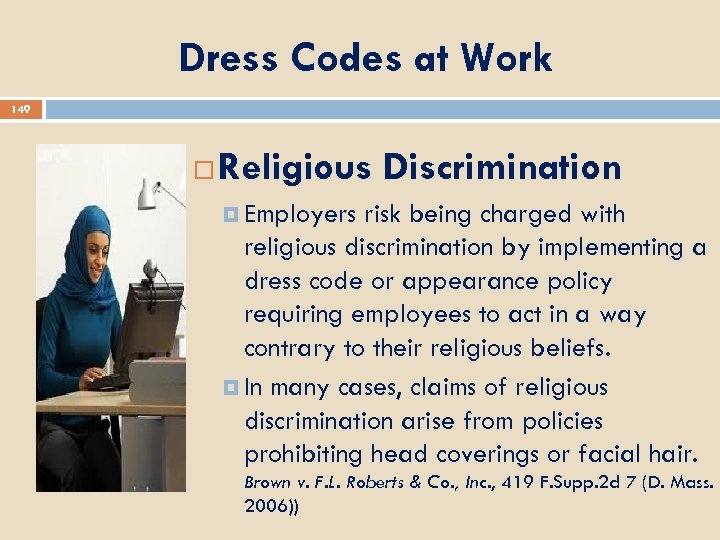
Dress Codes at Work 149 Religious Discrimination Employers risk being charged with religious discrimination by implementing a dress code or appearance policy requiring employees to act in a way contrary to their religious beliefs. In many cases, claims of religious discrimination arise from policies prohibiting head coverings or facial hair. Brown v. F. L. Roberts & Co. , Inc. , 419 F. Supp. 2 d 7 (D. Mass. 2006))
Dress Codes at Work 150 Religious Discrimination An employee could prevail on a religious discrimination claim if the employer cannot demonstrate that accommodating the employee would create an "undue hardship” An "undue hardship" requirement can be met by showing that the employee's proposed accommodation imposes more than a de minimis— small or insignificant—financial or non-economic cost to the business.
Dress Codes at Work 151 Religious Discrimination An employer is not required to grant an employee claiming religious discrimination a blanket exemption from a "no facial jewelry" policy if the purpose of the policy is to project a professional business image. An employer should make reasonable accommodations, where possible, such as placing the employee in a substantially equal position, away from the customer's view, if such does not constitute an undue hardship.
Dress Codes at Work 152 Religious Discrimination EEOC v. Kelly Services, 598 F. 3 d 1022 (8 th Cir. Minn. 2010) A company had a dress policy prohibiting headwear and loose-fitting clothing to prevent loose apparel from being caught in the machines and causing injuries. Suliman, a Muslim woman applied for a job at the company. As part of her religion, she wore a khimar on her head. She was told to remove it for safety reasons if she desired to obtain the job at the company.
Dress Codes at Work 153 Religious Discrimination EEOC The v. Kelly Services court ruled that the employer had a legitimate, nondiscriminatory reason for not allowing the headwear. Furthermore, the EEOC failed to show in its suit that the reason Suliman did not get the job was a pretext for discrimination. The district court granted summary judgment to the employer, and the appellate court affirmed.
Dress Codes at Work 154 Religious Discrimination Finnie v. Lee County, 2012 U. S. Dist. LEXIS 6679 (N. D. Miss. Jan. 17, 2012) The defendant (the jail/employer) sought summary judgment, which was granted on all charges except for the plaintiff’s retaliation claim. The plaintiff in this case was a woman who had worked at a county jail. She converted to Pentecostalism and decided she could no longer wear the pants that were part of her uniform for work. Instead, she insisted on wearing a long skirt every day.
Dress Codes at Work 155 Religious Discrimination Finnie The v. Lee County plaintiff told her superior that her religion disallowed her to wear pants. She was granted leave, as she had accrued paid time off. When it was time for her to return, she asked if the policy had been changed to accommodate her. She was told to she was required to wear pants and, when she refused to comply, was fired. The plaintiff sued, claiming that her First Amendment rights had been violated. The court stated that the policy did not target religion and only “incidentally affects” the plaintiff’s religious practices.
Dress Codes at Work 156 Religious Discrimination Finnie The v. Lee County court asserted that the “pants-only” policy addressed concerns of uniformity and neutrality. Furthermore, it was a legitimate and critical concern that an officer wearing a skirt could be at risk, as she might be unable to properly defend herself against detainees. This, the court ruled, was a compelling interest sufficient to warrant the policy. The court thus granted the jail’s motion for summary judgment on all of the plaintiff’s First Amendment claims.
Dress Codes at Work 157 Religious Discrimination Brown v. F. L. Roberts & Co. , Inc. , 419 F. Supp. 2 d 7 (D. Mass. 2006) A “no facial hair policy” for employees who came in contact with customers was not discriminatory and transferring Brown to a job without customer contact was a reasonable accommodation Court noted there is no legal basis for requiring that company dress code policies be consistent across divisions
Objectionable Music & Art 158
Objectionable Music & Art 159 Conflicts Music escaping into the unwilling ears of nearby workers—there is always “spillover” One listener’s Nirvana is another person’s idea of hell; so if music amplifies workplace tension, it’s probably best to curtail it. Employees exposed to objectionable music may bring claims of discrimination.
Objectionable Music & Art 160 Conflicts – Racial Discrimination EEOC v. Novellus Systems, Inc. , C-07 -4787 RS (N. D. Cal. 2008) Employee’s co-worker liked rap music, constantly playing it and rapping along even though the songs contained the “N-word. ” The employee, an African American, complained several times over a year’s time to his supervisors that the lyrics he was forced to listen to were offensive. When the supervisors failed to act, the employee contacted the EEOC.
Objectionable Music & Art 161 Conflicts – Racial Discrimination EEOC The v. Novellus Systems, Inc. EEOC sued and stated that while it was not in the business of judging anyone’s musical taste, racially offensive language does not belong in the workplace —even when disguised as popular culture. The suit eventually settled for $168, 000. The employer agreed to amends its harassment policy to refer specifically to harassment through the playing of music
Objectionable Music & Art 162 Conflicts – Religious & Gender Discrimination EEOC v. The Vail Corporation, 07 -cv-02035 REB-KLM An emergency services supervisor at the Keystone Resort alleged that she was subjected to harassment based on her Christian religion and her gender, denied religious accommodation and treated less favorably than her male colleagues.
Objectionable Music & Art 163 Conflicts – Religious & Gender Discrimination EEOC The v. The Vail Corporation employee’s supervisor forbade her and other Christian employees from discussing their beliefs while at work or listening to Christian music while on duty because it might offend other employees. Similar restrictions were not imposed on music with profanity or lyrics promoting violence against women—two things the claimant found offensive.
Objectionable Music & Art 164 Conflicts – Religious & Gender Discrimination EEOC The v. The Vail Corporation EEOC claimed the employer also failed to accommodate the employee’s religious beliefs in some scheduling requests and sexually harassed her by letting managers tell sexual jokes and make graphic comments in the workplace. The Vail Corporation paid $80, 000 to settle the religious and sexual discrimination suit.
Objectionable Music & Art 165 Gender Discrimination Slayton v. Ohio Dep't of Youth Services, 2000 WL 272263 (6 th Cir. ) U. S. Court of Appeals upheld a $125, 000 damages award based, in part, on a coworker's playing "misogynistic rap music" and displaying "music videos depict[ing] an array of sexually provocative conduct. "
Objectionable Music & Art 166 Objectionable Art research has proven that art in the workplace has a measurable, positive influence on both clients and employees. The world’s top companies invest in workplace art as they recognize its role as an effective form of internal branding However, art that is seen as politically offensive, misogynistic, or sexually themed can lead to harassment liability. Marketing
Objectionable Music & Art 167 Objectionable Art Robinson v. Jacksonville Shipyards, Inc. , 760 F. Supp. 1486 (M. D. Fla. 1991). A shipyard company employed a female welder who was continually subjected to nude and partially nude pictures posted by her male co-workers. The conduct violated Title VII because the plaintiff belonged to a protected category and was subject to unwelcome harassment based on sex that affected a term or condition of employment, and the employer knew or should have known about the harassment and failed to take remedial action.
Objectionable Music & Art 168 Objectionable Art Robinson The v. Jacksonville Shipyards, Inc. court issued an injunction barring the possession or display of any "sexually suggestive, sexually demeaning, or pornographic" materials in the workplace, defining "sexually suggestive" as covering anything that "depicts a person of either sex who is not fully clothed. . . and who is posed for the obvious purpose of displaying or drawing attention to private portions of his or her body. "
Objectionable Music & Art 169 Objectionable Art Other A Examples library employee complained about a coworkers posting a New Yorker cartoon that used the word “penis” with no sexually suggestive connotation. The library ordered that it be taken down. A Penn State professor complained that a print of Goya's Naked Maja hanging in a classroom constituted sexual harassment. The school administration removed the painting, citing as one reason the risk of harassment liability.
Objectionable Music & Art 170 Objectionable Art Other Examples An employee at Murfreesboro (Tenn. ) City Hall complained about a painting depicting a partly naked woman, so the City Attorney took down. The Artistic Freedom Under Attack, a People for the American Way report, lists eight instances where employees claimed nude public art constituted workplace harassment. In each instance, the art was taken down in order to avoid potential litigation. http: //www. lawmemo. com/articles/cyberspace. htm
Objectionable Music & Art 171 Objectionable Art Other In Examples Dayton, OH, an artist's adaptation of Titian's Venus painting was removed because "employees felt they were being sexually harassed by the painting. ”
172 ANY QUESTIONS? May 8, 2012
Скачать презентацию AASHTO HUMAN RESOURCES SUBCOMMITTEE MEETING LITTLE ROCK ARKANSAS
247110e0a30751a0cc21d67b369edc08.ppt