


 Скачать презентацию AAFC s International Role in Science and Innovation Dr
a08939384065188df684f46d6481c836.ppt
- Количество слайдов: 18
 AAFC’s International Role in Science and Innovation Dr Campbell Davidson, Agriculture and Agri-Food Canada, International Science Ottawa, Ontario, Canada CGD- International Science – March 2005 - Genetic Resources
 Overview – Agenda • The AAFC International Science Team and what is their key role? • An overview of objectives and ideas relative to International agriculture research issues.
 International Issues and concerns According to the United Nations Development Programme: • World population is 6. 3 billion people: • • Current estimates of World resource allow for 2780 cal person per day. • • Minimal requirement is 2300 cal. Distribution and Production issues remain an issue 2. 8 billion people don’t have access to the minimal calorie requirements Potential Solutions: • • by 2025: an estimated 7. 8 billion people Innovation, training, economic growth, North-South technology transfer, Examples of concerns: • Water resources, soil sustainability, biodiversity availability
 S&T investment at the International level The Prime Minister of Canada’s Advisory Committee on Science and Technology: “International S&T activities are necessary for advancing knowledge, creating wealth and improving quality of life. ” – Researchers should collaborate and exchange scientific information with other countries: > to help stay abreast of the latest scientific developments – Researchers should be encouraged to participate in collaborative research projects - team effectiveness and efficiencies – Governments need to effectively participate in and contribute to international scientific forums > to make good decisions regarding science-based issues
 A Broad Vision for Science The AAFC International Science Team and what is their role? Facilitating Linkages to World Science: - To enhance the knowledge base and - Contribute to World Wellness
 AAFC current involvement in International science collaboration – requires a National focus: • • • 54 Science MOUs with 38 countries • AAFC provides expert advice and program delivery to CIDA and IDRC projects • Expertise directed towards International Societies, Journals, Universities and Conferences • Key involvement with several inter-governmental organisations such as OECD, FAO, IICA etc Over 50 foreign organisations Over 300 on-going bilateral and multilateral scientific projects
 AAFC Science and Innovation Strengths - Potential Areas of Collaboration • • • Major Research areas within AAFC Sustainable production: • Crop Science (cereals, potato, canola), Animal Science, Soil and Water management; IPM: • Bio-control, emerging diseases, alien invasive species; Food: • Storage and processing, meat science, post-harvest handling; Biodiversity: • Genetic resource collections and genebanks Biotechnology: • Genomics, molecular characterization, bio-products Reflecting key National Programs within AAFC
 Four Main working objectives for International Science Group • We have interpreted our Prime Ministers directions into four different avenues: • Science to Science collaboration • Science for market and trade • Science directed towards developing country issues • Science directed towards International obligations
 Science to Science • To enhance science and innovation; • Exchanges and cooperative projects; • • • Generally short term projects Learning and developing new techniques Capacity building on both sides Post Doctoral Programs; • • Often on a scientist to scientist basis Sharing work experiences Helping to train the next generation. Enhancing AAFC science and innovation and helping to brand Canada for excellence
 Science for Market and Trade • • Support Canada market and trade development Supporting the export and utilization of Canadian products • • Value added products Functional foods Nutraceuticals To provide science expertise to address developing countries issues
 Provide science expertise to address needs of developing countries Provide expertise for developing country issues • Initial focus on sustainable production and food safety and quality • Critical information for decision making • • Food Security and Food Safety are critical issues Canadian target of 5% of our R and D budget • Priority countries for assistance since our programs have limited resources
 Cooperating with Inter-governmental organisations to increase world wellness • To cooperate with multi-lateral organisations to increase world wellness (e. g. FAO, CGIAR, CBD, IICA) • Helping to meet Canada’s and AAFC’s international obligations • Intergovernmental commitments such as: • FAO • • FAO - Commission on Genetic Resources Committee on Agriculture • International Treaty on Plant Genetic Resources for Food and Agriculture • Future Harvest Centres of the CGIAR – funded through CIDA • Scientific value and cooperation to the world (e. g. CABI) and the region (IICA) • Access to knowledge or material exchange (GBIF)
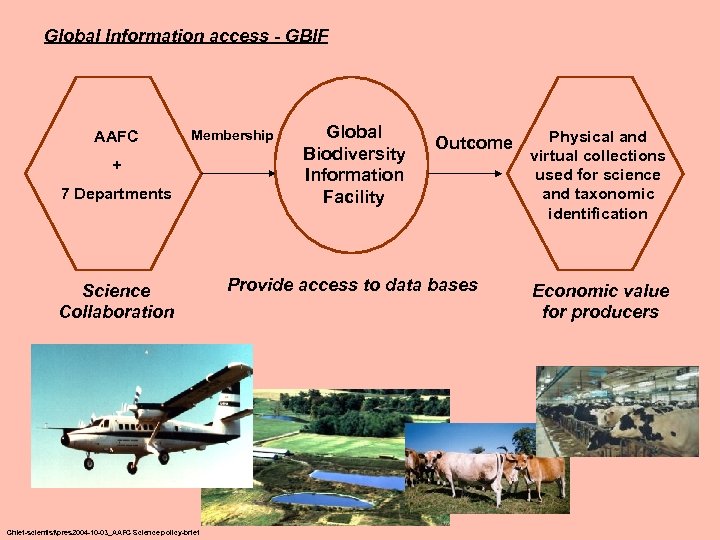 Global Information access - GBIF AAFC Membership + 7 Departments Science Collaboration Chief-scientistpres 2004 -10 -03_AAFC Science policy-brief Global Biodiversity Information Facility Outcome Provide access to data bases Physical and virtual collections used for science and taxonomic identification Economic value for producers
 Research and Technical Cooperation Examples in the America's • Recent examples - Multi-country and bilateral agreements in the America's (excluding the USA): – Argentina Armenia Brazil Canada Chile Czech Republic South Africa Switzerland Syria USA - Improvement of codling moth SIT to facilitate expansion and field application - Duration: 2002 -2007 – Argentina - Improvement of codling moth SIT to facilitate expansion and field application – 2002 -2007 – Brazil - Improvement of codling moth SIT to facilitate expansion and field application and improved management of codling moth in Brazil – 2001 -2007 – Mexico Netherlands Peru Scotland USA China Ireland - Phytophthora infestans (potato and tomato late blight) population dynamics, genotype x environment interactions, host resistance and chemical control reduction – 2002 -2007 – Brazil – Embryo transfer in milk cows – 2001 -2003 – Brazil - Study of the impact of pre-slaughter procedures on the welfare of pigs and pork quality variation at tropical climate conditions – 2001 -2005 – Chile - Nutrient and water requirements for new sweet cherry cultivars – 20022006
 Research and Technical Cooperation Examples in the America's - continued • Recent examples - Multi-country and bilateral agreements in the America's (excluding the USA): – Mexico - Regulation of photoconidiation and mycelia growth in Trichoderma – 2004 -2009 – Columbia - Phylogenomics of Trichoderma (biocontrol fungi) from neotropical soils – 2002 -2009 – Brazil - Effects des acides gras sur la reproduction de la vache laitière – 2002 – 2003 – Brazil - Transfert de chaleur en milieu poreux applicable aux produits horticoles frais – 2002 -2005 – Mexico, USA and Canada – Dry bean genetic resources (NORGENPROCINORTE) 2004 - 2007 – All the America's – Regional PGR Networks (IICA) and the Global Crop Diversity Trust - Plant Genetic Conservations Strategy Development – 2005 – on-going
 Conclusions • The AAFC International team is developing and implementing a new strategy for international science; – Coordination of approaches and delivery through the Office of the Chief Scientist International – Dr. Yvon Martel; – Developing better assessment methods and internal governance for international science collaboration; – Scientific cooperation is often completed on a bilateral basis; scientist to scientist or country to country; > Increasing efforts for multilateral / multi-stakeholder collaboration due to the integrated nature of many of the issues.
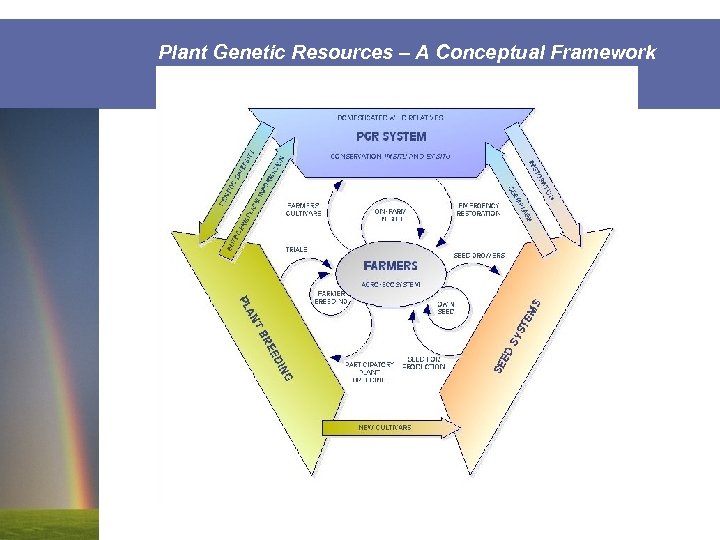 Plant Genetic Resources – A Conceptual Framework
 Thank you for the opportunity to share information about our programs in Agriculture and Agri-Food Canada • Questions? • Contact information: – Dr. Campbell Davidson – AAFC – International Science – 930 Carling Ave. Ottawa, Ontario, Canada, K 1 A 0 C 5 – 613 -694 -2521; 613 -759 -7771 (fax) – cdavidson@agr. gc. ca