 Скачать презентацию AAAI Fall Symposium North Falmouth MA November 15
2f7bfc06f5a9d22adf7e295fab00557e.ppt
- Количество слайдов: 17



AAAI Fall Symposium, North Falmouth, MA, November 15 -17, 2002 (or why “Etiquette” and what Dimensions and Definitions the @#$% does he mean by of Etiquette that anyway? ) Christopher A. Miller Smart Information Flow Technologies St. Paul, MN
AAAI-Spring Symposium on Adaptive User Interfaces—March, 2000 “Rules of Etiquette” or How a Mannerly AUI should Comport Itself to Gain Social Acceptance and be Perceived as Gracious and Well-Behaved in Polite Society Chris Miller 2
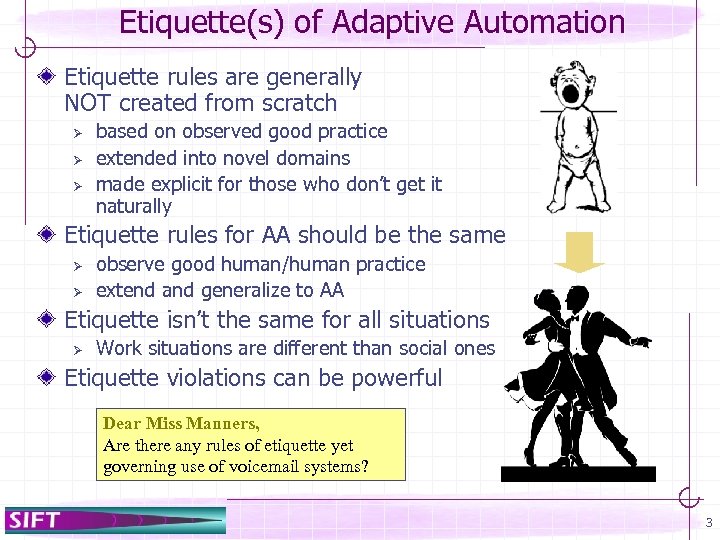
Etiquette(s) of Adaptive Automation Etiquette rules are generally NOT created from scratch Ø Ø Ø based on observed good practice extended into novel domains made explicit for those who don’t get it naturally Etiquette rules for AA should be the same Ø Ø observe good human/human practice extend and generalize to AA Etiquette isn’t the same for all situations Ø Work situations are different than social ones Etiquette violations can be powerful Dear Miss Manners, Are there any rules of etiquette yet governing use of voicemail systems? 3
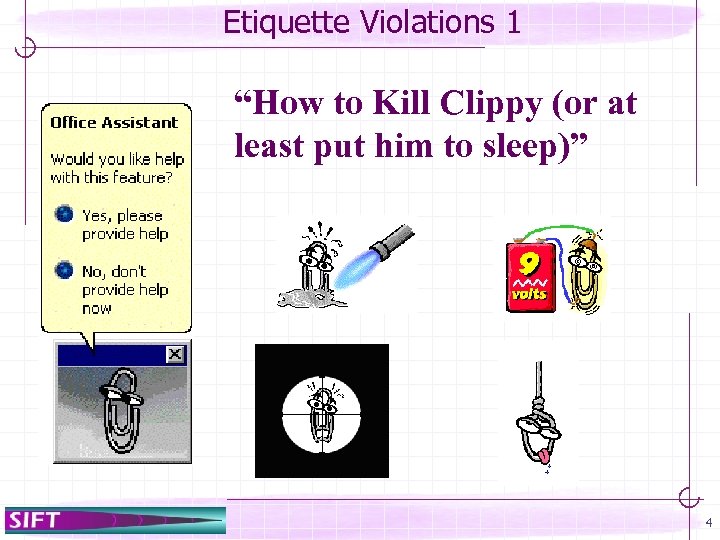
Etiquette Violations 1 “How to Kill Clippy (or at least put him to sleep)” 4
Etiquette Violations 2 5
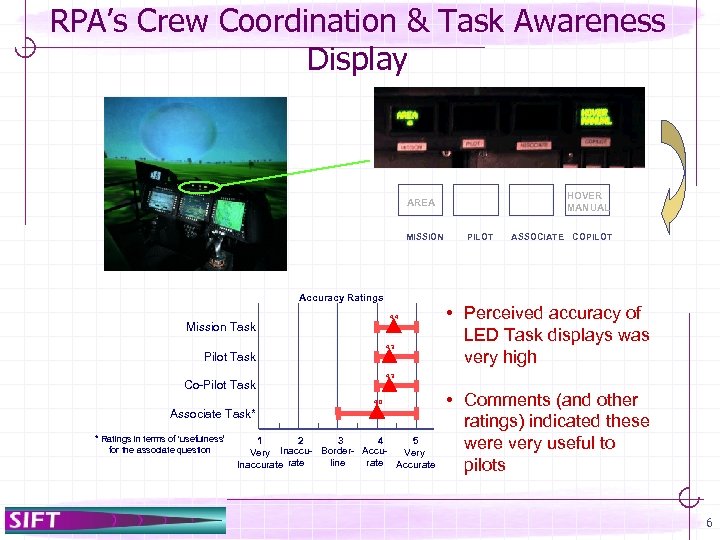
RPA’s Crew Coordination & Task Awareness Display HOVER MANUAL AREA MISSION Accuracy Ratings 4. 4 Mission Task 4. 3 Pilot Task ASSOCIATE COPILOT • Perceived accuracy of LED Task displays was very high 4. 3 Co-Pilot Task 4. 0 Associate Task* * Ratings in terms of ‘usefulness’ for the associate question PILOT 2 3 4 1 5 Very Inaccu- Border- Accu. Very line rate Accurate Inaccurate • Comments (and other ratings) indicated these were very useful to pilots 6
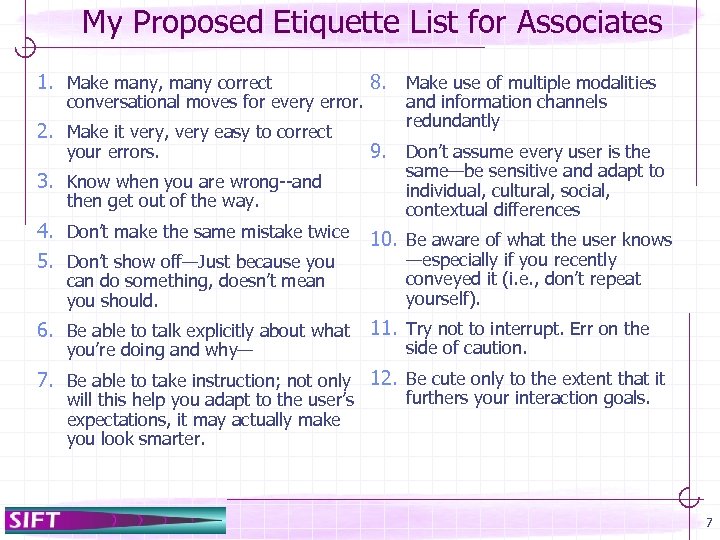
My Proposed Etiquette List for Associates 1. Make many, many correct conversational moves for every error. 2. Make it very, very easy to correct your errors. 3. Know when you are wrong--and then get out of the way. 8. Make use of multiple modalities and information channels redundantly 9. Don’t assume every user is the same—be sensitive and adapt to individual, cultural, social, contextual differences 4. Don’t make the same mistake twice 5. Don’t show off—Just because you 10. Be aware of what the user knows 6. Be able to talk explicitly about what 11. Try not to interrupt. Err on the can do something, doesn’t mean you should. you’re doing and why— —especially if you recently conveyed it (i. e. , don’t repeat yourself). side of caution. 7. Be able to take instruction; not only 12. Be cute only to the extent that it will this help you adapt to the user’s expectations, it may actually make you look smarter. furthers your interaction goals. 7
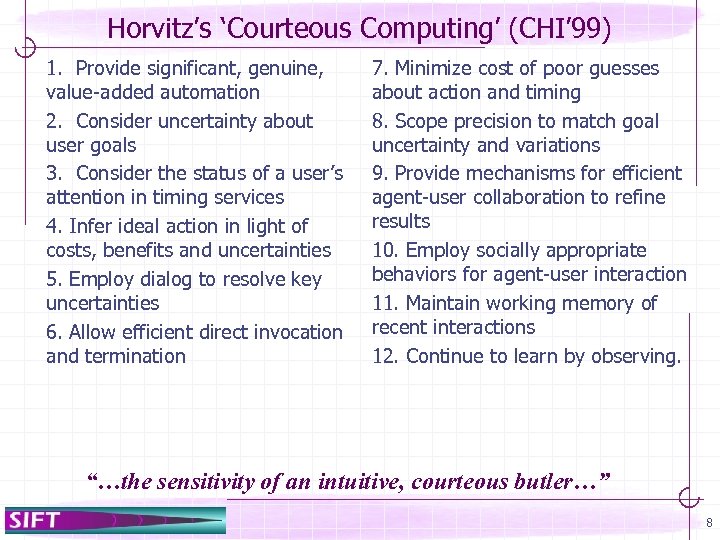
Horvitz’s ‘Courteous Computing’ (CHI’ 99) 1. Provide significant, genuine, value-added automation 2. Consider uncertainty about user goals 3. Consider the status of a user’s attention in timing services 4. Infer ideal action in light of costs, benefits and uncertainties 5. Employ dialog to resolve key uncertainties 6. Allow efficient direct invocation and termination 7. Minimize cost of poor guesses about action and timing 8. Scope precision to match goal uncertainty and variations 9. Provide mechanisms for efficient agent-user collaboration to refine results 10. Employ socially appropriate behaviors for agent-user interaction 11. Maintain working memory of recent interactions 12. Continue to learn by observing. “…the sensitivity of an intuitive, courteous butler…” 8
Etiquette is … 1 “… the defined roles and acceptable behaviors or interaction moves of each participant in a common ‘social’ setting … Etiquette rules create an informal contract between participants in a social interaction allowing expectations [and interpretations] to be formed and used about the behavior of others. ” --(from the Symposium description) 9
Etiquette is … 2 “…(1) the body of prescribed social usages. (2) Any special code of behavior … : ‘In the code of military etiquette, silence and fixity are forms of deference’ (Ambrose Bierce). … Synonyms: propriety, decorum, protocol. ” --American Heritage Dictionary Etiquette as “the Social Niceties” versus etiquette as domain conventions 10
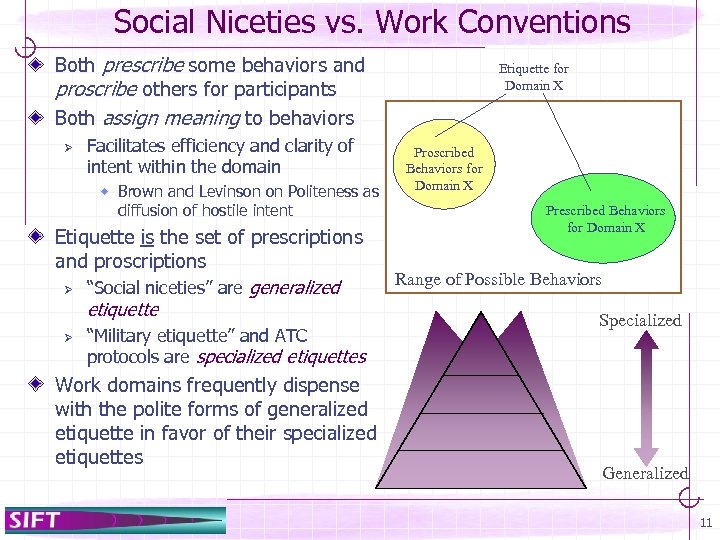
Social Niceties vs. Work Conventions Both prescribe some behaviors and proscribe others for participants Both assign meaning to behaviors Ø Facilitates efficiency and clarity of intent within the domain w Brown and Levinson on Politeness as diffusion of hostile intent Etiquette is the set of prescriptions and proscriptions Ø “Social niceties” are generalized etiquette Ø “Military etiquette” and ATC protocols are specialized etiquettes Work domains frequently dispense with the polite forms of generalized etiquette in favor of their specialized etiquettes Etiquette for Domain X Proscribed Behaviors for Domain X Prescribed Behaviors for Domain X Range of Possible Behaviors Specialized Generalized 11
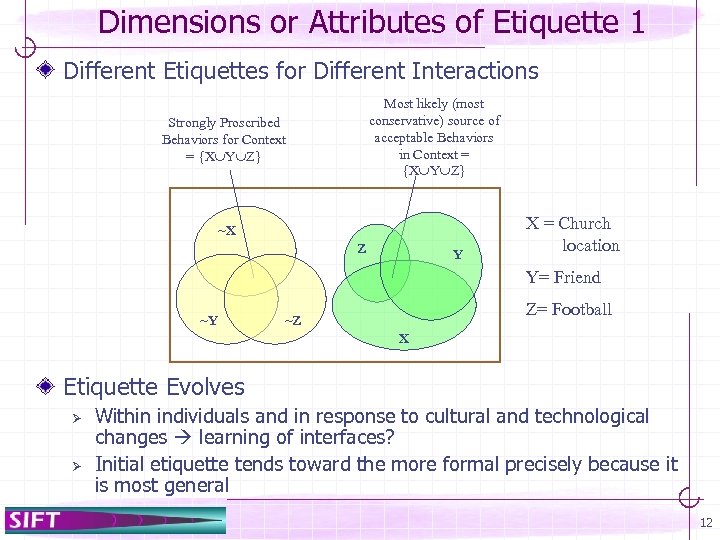
Dimensions or Attributes of Etiquette 1 Different Etiquettes for Different Interactions Most likely (most conservative) source of acceptable Behaviors in Context = {X Y Z} Strongly Proscribed Behaviors for Context = {X Y Z} ~X Z Y X = Church location Y= Friend ~Y Z= Football ~Z X Etiquette Evolves Ø Ø Within individuals and in response to cultural and technological changes learning of interfaces? Initial etiquette tends toward the more formal precisely because it is most general 12
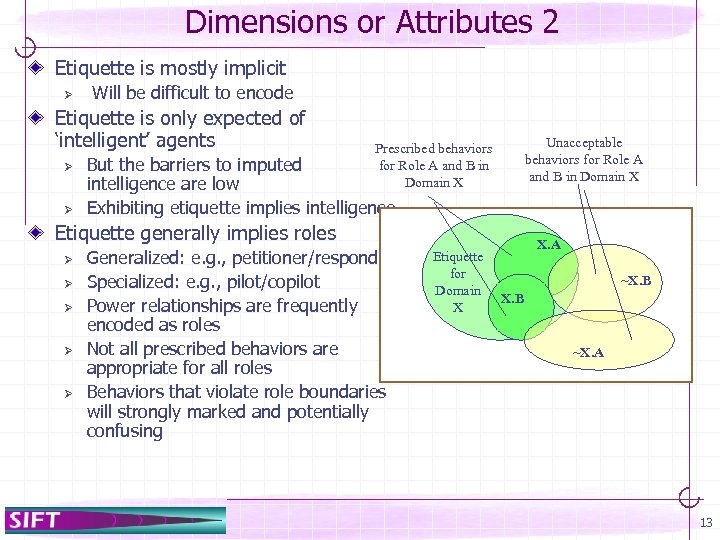
Dimensions or Attributes 2 Etiquette is mostly implicit Ø Will be difficult to encode Etiquette is only expected of ‘intelligent’ agents Ø Ø Unacceptable behaviors for Role A and B in Domain X Prescribed behaviors for Role A and B in Domain X But the barriers to imputed intelligence are low Exhibiting etiquette implies intelligence Etiquette generally implies roles Ø Ø Ø Generalized: e. g. , petitioner/responder Specialized: e. g. , pilot/copilot Power relationships are frequently encoded as roles Not all prescribed behaviors are appropriate for all roles Behaviors that violate role boundaries will strongly marked and potentially confusing Etiquette for Domain X X. A ~X. B ~X. A 13
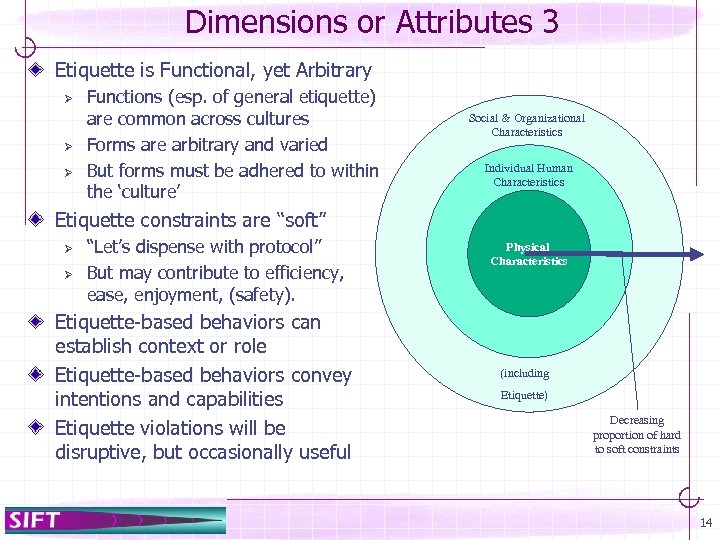
Dimensions or Attributes 3 Etiquette is Functional, yet Arbitrary Ø Ø Ø Functions (esp. of general etiquette) are common across cultures Forms are arbitrary and varied But forms must be adhered to within the ‘culture’ Social & Organizational Characteristics Individual Human Characteristics Etiquette constraints are “soft” Ø Ø “Let’s dispense with protocol” But may contribute to efficiency, ease, enjoyment, (safety). Etiquette-based behaviors can establish context or role Etiquette-based behaviors convey intentions and capabilities Etiquette violations will be disruptive, but occasionally useful Physical Characteristics (including Etiquette) Decreasing proportion of hard to soft constraints 14
The etiquette perspective in Design Acknowledges that computers and automation will be regarded as social actors (Reeves & Nass, 1996). Attempts to understand, predict and/or influence human+machine system behavior through attention to those social parameters Questions from the Etiquette Perspective If this system were replaced by an ideal human, how would (would we like) that human to behave differently? If a human were to provide this information/recommendation/action in this way, how would s/he be perceived by colleagues? 15
Questions What is etiquette? What does it mean in Human-Machine interactions? How might we design for good HCI etiquette? Ø Ø Now, with current technologies and applications In the future Would it buy us anything if we did? Ø Ø Is etiquette anything different from what we already do? Will it provide sufficient added value to justify the cost? 16
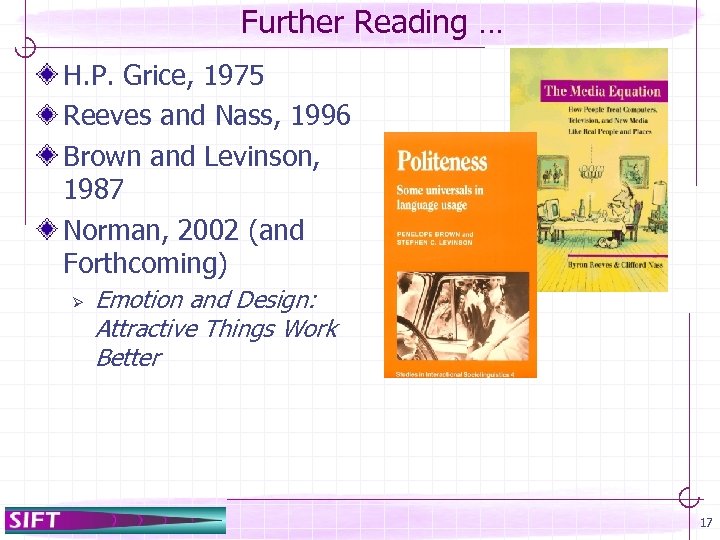
Further Reading … H. P. Grice, 1975 Reeves and Nass, 1996 Brown and Levinson, 1987 Norman, 2002 (and Forthcoming) Ø Emotion and Design: Attractive Things Work Better 17
Скачать презентацию AAAI Fall Symposium North Falmouth MA November 15
2f7bfc06f5a9d22adf7e295fab00557e.ppt