 Скачать презентацию A_RD_2 Collaboration on the ATF 2 project at
c52ca3cde0314dd984a8375941dc0236.ppt
- Количество слайдов: 38



A_RD_2 Collaboration on the ATF 2 project at KEK and on the ILC Machine Detector Interface Benoit BOLZON (LAPP) for KEK, LAL, LAPP & LLR colleagues FJPPL’ 10, LAPP, 15 -17 June 2010 1
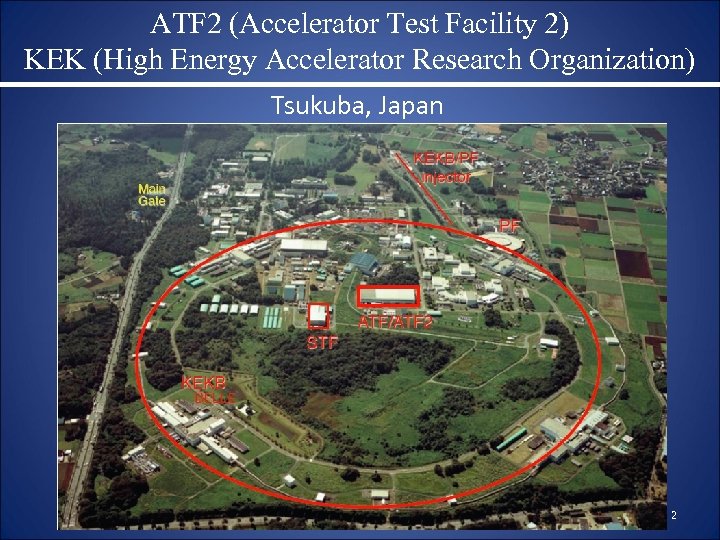
ATF 2 (Accelerator Test Facility 2) KEK (High Energy Accelerator Research Organization) Tsukuba, Japan 2
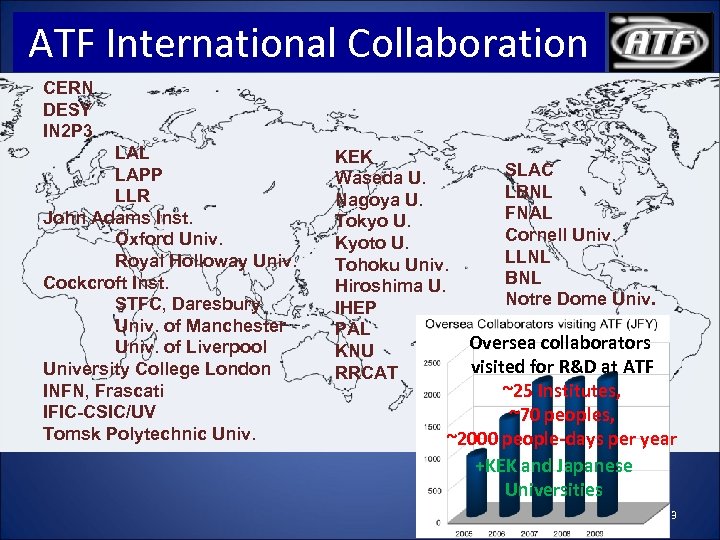
ATF International Collaboration CERN DESY IN 2 P 3 LAL LAPP LLR John Adams Inst. Oxford Univ. Royal Holloway Univ. Cockcroft Inst. STFC, Daresbury Univ. of Manchester Univ. of Liverpool University College London INFN, Frascati IFIC-CSIC/UV Tomsk Polytechnic Univ. KEK Waseda U. Nagoya U. Tokyo U. Kyoto U. Tohoku Univ. Hiroshima U. IHEP PAL KNU RRCAT SLAC LBNL FNAL Cornell Univ. LLNL BNL Notre Dome Univ. Oversea collaborators visited for R&D at ATF ~25 Institutes, ~70 peoples, ~2000 people-days per year +KEK and Japanese Universities 3
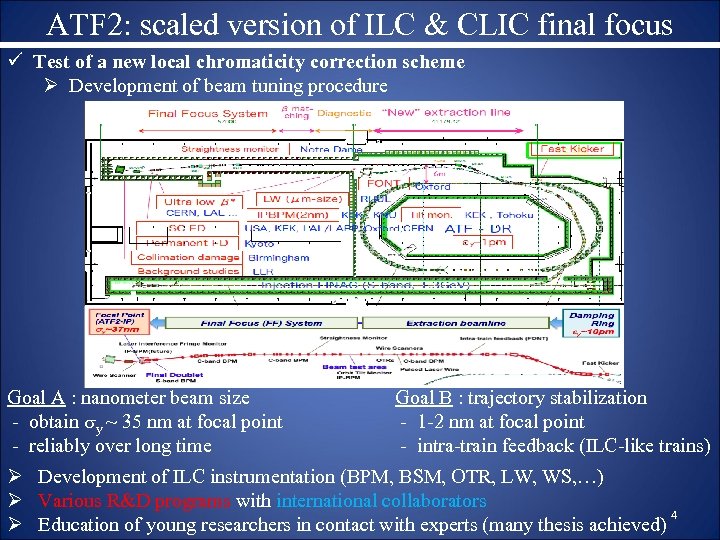
ATF 2: scaled version of ILC & CLIC final focus ü Test of a new local chromaticity correction scheme Ø Development of beam tuning procedure Goal A : nanometer beam size - obtain y ~ 35 nm at focal point - reliably over long time Goal B : trajectory stabilization - 1 -2 nm at focal point - intra-train feedback (ILC-like trains) Ø Development of ILC instrumentation (BPM, BSM, OTR, LW, WS, …) Ø Various R&D programs with international collaborators 4 Ø Education of young researchers in contact with experts (many thesis achieved)
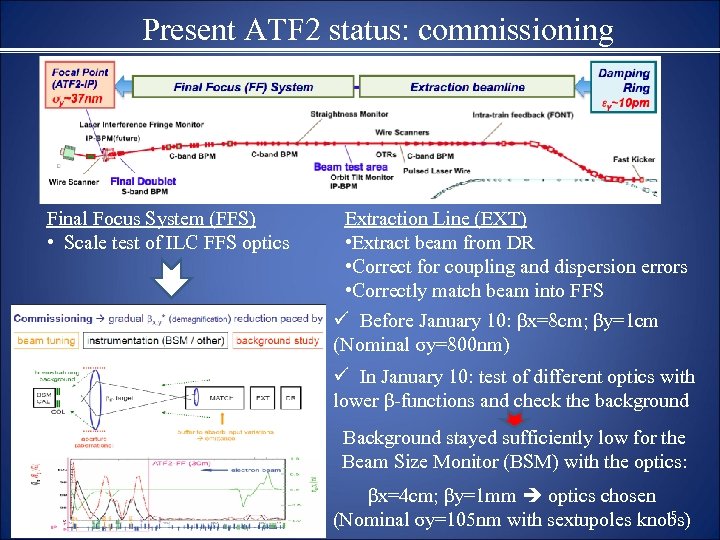
Present ATF 2 status: commissioning Final Focus System (FFS) • Scale test of ILC FFS optics Extraction Line (EXT) • Extract beam from DR • Correct for coupling and dispersion errors • Correctly match beam into FFS ü Before January 10: βx=8 cm; βy=1 cm (Nominal σy=800 nm) ü In January 10: test of different optics with lower β-functions and check the background Background stayed sufficiently low for the Beam Size Monitor (BSM) with the optics: βx=4 cm; βy=1 mm optics chosen 5 (Nominal σy=105 nm with sextupoles knobs)
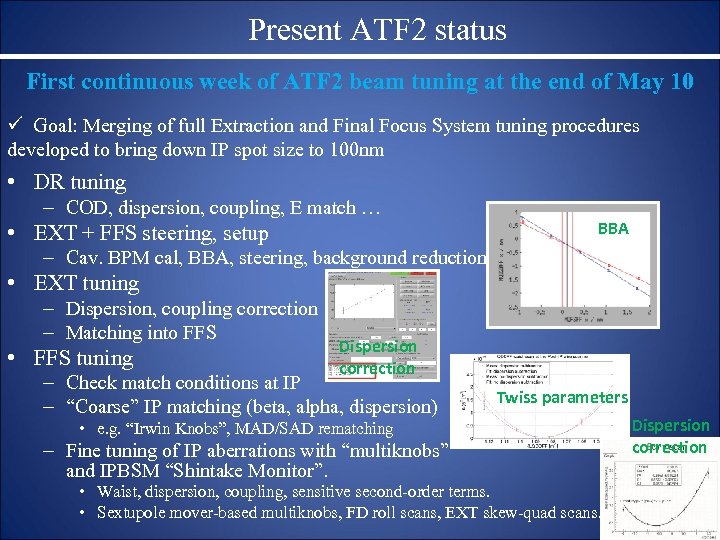
Present ATF 2 status First continuous week of ATF 2 beam tuning at the end of May 10 ü Goal: Merging of full Extraction and Final Focus System tuning procedures developed to bring down IP spot size to 100 nm • DR tuning – COD, dispersion, coupling, E match … • EXT + FFS steering, setup BBA – Cav. BPM cal, BBA, steering, background reduction • EXT tuning – Dispersion, coupling correction – Matching into FFS • FFS tuning Dispersion correction – Check match conditions at IP – “Coarse” IP matching (beta, alpha, dispersion) Twiss parameters • e. g. “Irwin Knobs”, MAD/SAD rematching – Fine tuning of IP aberrations with “multiknobs” and IPBSM “Shintake Monitor”. • Waist, dispersion, coupling, sensitive second-order terms. • Sextupole mover-based multiknobs, FD roll scans, EXT skew-quad scans… Dispersion correction 6
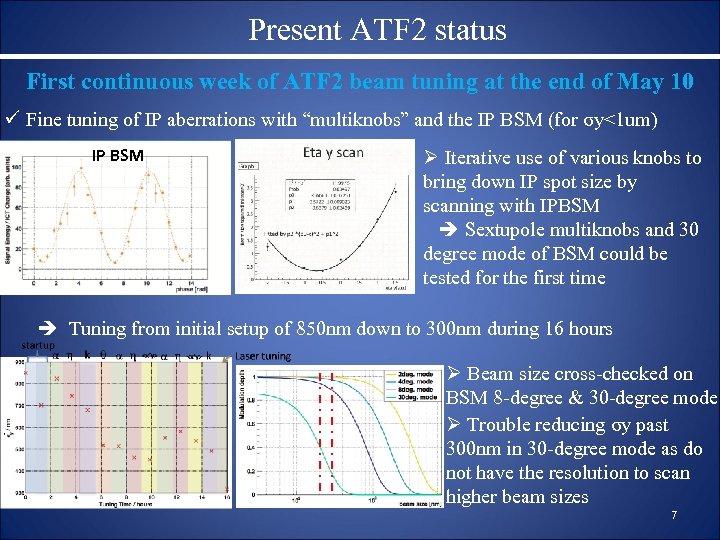
Present ATF 2 status First continuous week of ATF 2 beam tuning at the end of May 10 ü Fine tuning of IP aberrations with “multiknobs” and the IP BSM (for σy<1 um) IP BSM Ø Iterative use of various knobs to bring down IP spot size by scanning with IPBSM Sextupole multiknobs and 30 degree mode of BSM could be tested for the first time Tuning from initial setup of 850 nm down to 300 nm during 16 hours Ø Beam size cross-checked on BSM 8 -degree & 30 -degree mode Ø Trouble reducing σy past 300 nm in 30 -degree mode as do not have the resolution to scan higher beam sizes 7
ATF short term plan: October 2010 - June 2011 ü Achievement of a vertical beam size of 37 nm for December 2010 Ø Two continuous weeks of ATF 2 beam tuning are requested in the fall of 2010 ü Precision analyses of betatron oscillation propagation to reconstruct R and T matrices Ø Check sextupole correctness, any abnormal higher order fields and transfer matrices between sextupoles ü Final doublet mounting & alignment precision issue of field quality ? Ø re-measure + assessment… ü Background simulation & measurement to assess lower β* feasibility ü Encourage collaborators to develop and automate their beam tuning tasks in the control system, e. g. via the Flight Simulator or V-system ü Systematically monitor IP size versus beam fluctuations & explicit changes ü Studies of fast kicker for ILC should be finished 8
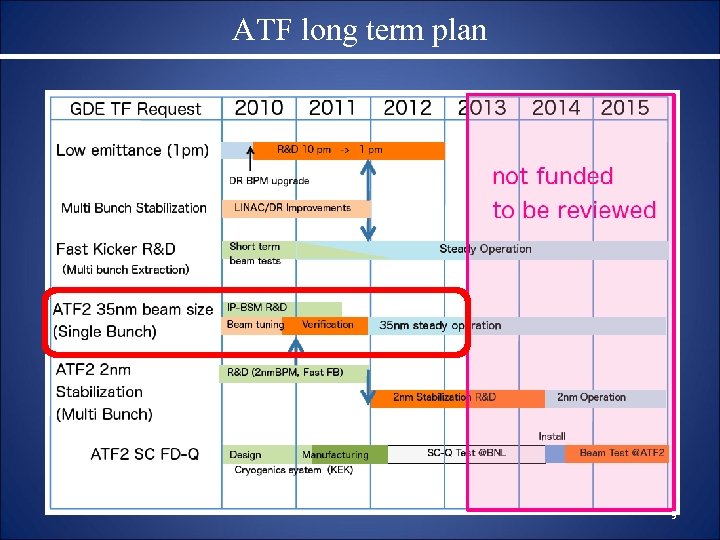
ATF long term plan 9
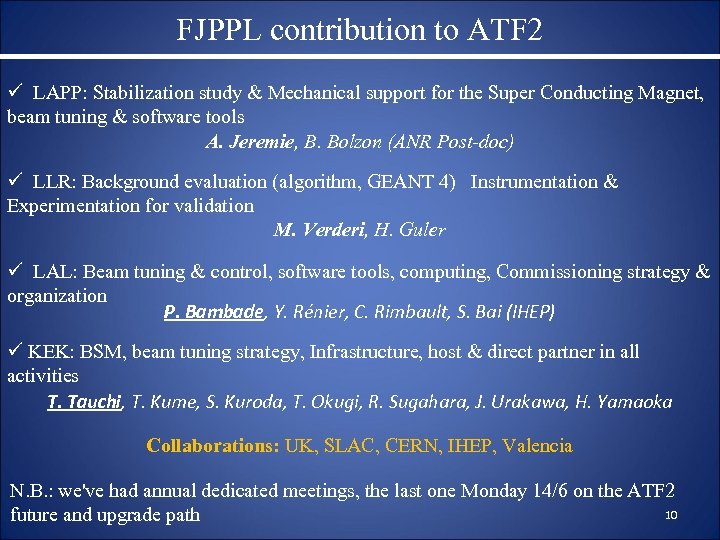
FJPPL contribution to ATF 2 ü LAPP: Stabilization study & Mechanical support for the Super Conducting Magnet, beam tuning & software tools A. Jeremie, B. Bolzon (ANR Post-doc) ü LLR: Background evaluation (algorithm, GEANT 4) Instrumentation & Experimentation for validation M. Verderi, H. Guler ü LAL: Beam tuning & control, software tools, computing, Commissioning strategy & organization P. Bambade, Y. Rénier, C. Rimbault, S. Bai (IHEP) ü KEK: BSM, beam tuning strategy, Infrastructure, host & direct partner in all activities T. Tauchi, T. Kume, S. Kuroda, T. Okugi, R. Sugahara, J. Urakawa, H. Yamaoka Collaborations: UK, SLAC, CERN, IHEP, Valencia N. B. : we've had annual dedicated meetings, the last one Monday 14/6 on the ATF 2 10 future and upgrade path
LAPP : Beam tuning & Software tools 11
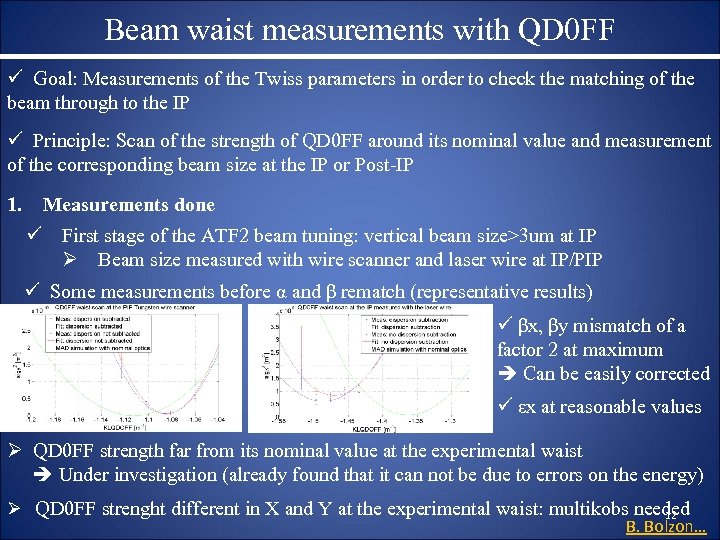
Beam waist measurements with QD 0 FF ü Goal: Measurements of the Twiss parameters in order to check the matching of the beam through to the IP ü Principle: Scan of the strength of QD 0 FF around its nominal value and measurement of the corresponding beam size at the IP or Post-IP 1. Measurements done ü First stage of the ATF 2 beam tuning: vertical beam size>3 um at IP Ø Beam size measured with wire scanner and laser wire at IP/PIP ü Some measurements before α and β rematch (representative results) ü βx, βy mismatch of a factor 2 at maximum Can be easily corrected ü εx at reasonable values Ø QD 0 FF strength far from its nominal value at the experimental waist Under investigation (already found that it can not be due to errors on the energy) Ø QD 0 FF strenght different in X and Y at the experimental waist: multikobs needed 12 B. Bolzon…
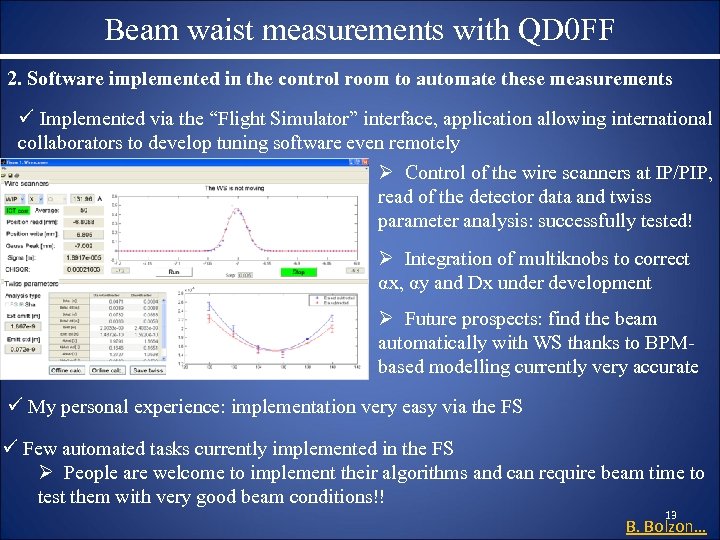
Beam waist measurements with QD 0 FF 2. Software implemented in the control room to automate these measurements ü Implemented via the “Flight Simulator” interface, application allowing international collaborators to develop tuning software even remotely Ø Control of the wire scanners at IP/PIP, read of the detector data and twiss parameter analysis: successfully tested! Ø Integration of multiknobs to correct αx, αy and Dx under development Ø Future prospects: find the beam automatically with WS thanks to BPMbased modelling currently very accurate ü My personal experience: implementation very easy via the FS ü Few automated tasks currently implemented in the FS Ø People are welcome to implement their algorithms and can require beam time to test them with very good beam conditions!! 13 B. Bolzon…
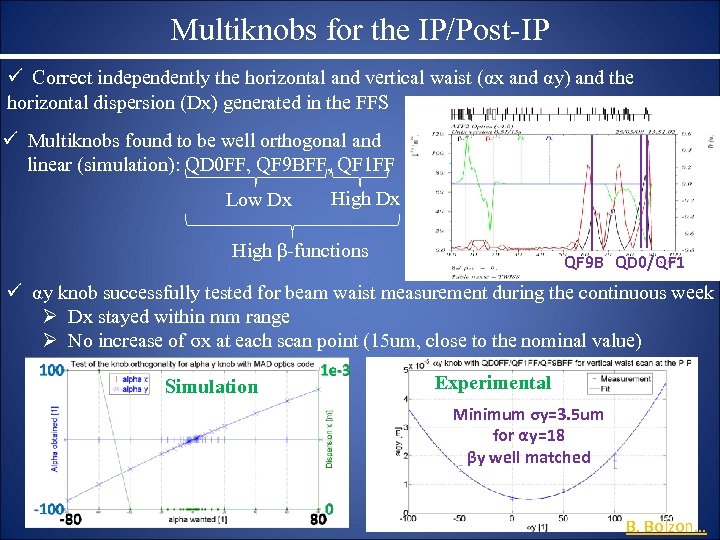
Multiknobs for the IP/Post-IP ü Correct independently the horizontal and vertical waist (αx and αy) and the horizontal dispersion (Dx) generated in the FFS ü Multiknobs found to be well orthogonal and linear (simulation): QD 0 FF, QF 9 BFF, QF 1 FF Low Dx High β-functions QF 9 B QD 0/QF 1 ü αy knob successfully tested for beam waist measurement during the continuous week Ø Dx stayed within mm range Ø No increase of σx at each scan point (15 um, close to the nominal value) Simulation Experimental Minimum σy=3. 5 um for αy=18 βy well matched 14 B. Bolzon…
LLR activity : Background modeling @ ATF 2 15 M. Verderi, H. Guler
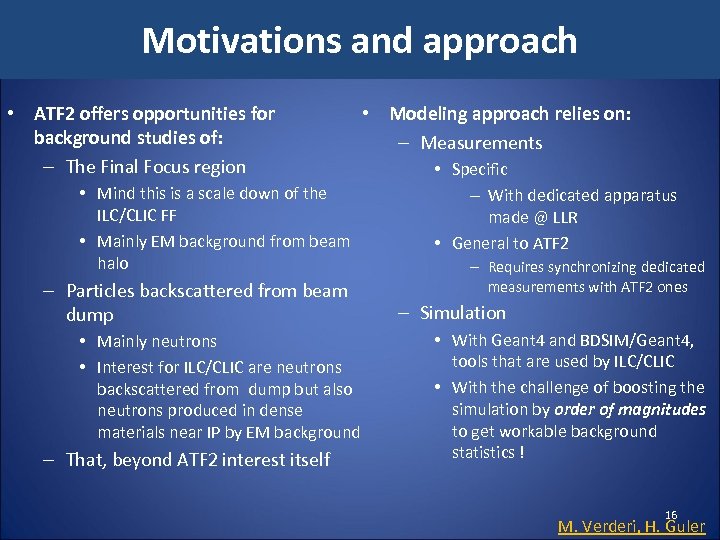
Motivations and approach • ATF 2 offers opportunities for background studies of: – The Final Focus region • Mind this is a scale down of the ILC/CLIC FF • Mainly EM background from beam halo – Particles backscattered from beam dump • Mainly neutrons • Interest for ILC/CLIC are neutrons backscattered from dump but also neutrons produced in dense materials near IP by EM background – That, beyond ATF 2 interest itself • Modeling approach relies on: – Measurements • Specific – With dedicated apparatus made @ LLR • General to ATF 2 – Requires synchronizing dedicated measurements with ATF 2 ones – Simulation • With Geant 4 and BDSIM/Geant 4, tools that are used by ILC/CLIC • With the challenge of boosting the simulation by order of magnitudes to get workable background statistics ! 16 M. Verderi, H. Guler
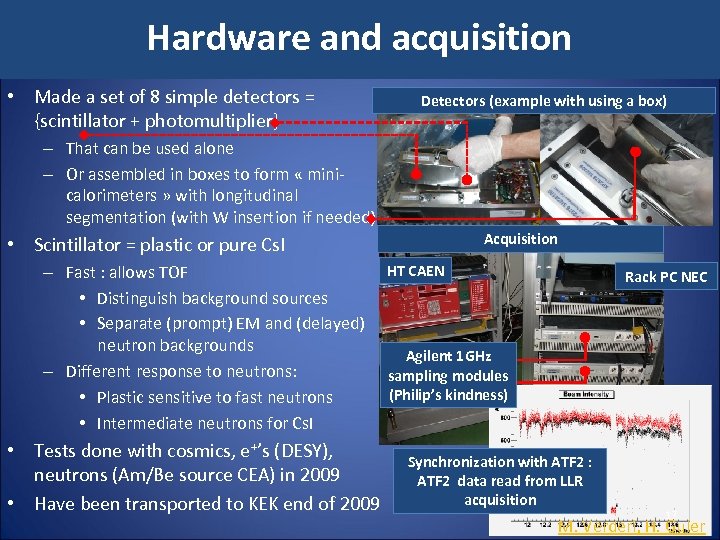
Hardware and acquisition • Made a set of 8 simple detectors = {scintillator + photomultiplier} Detectors (example with using a box) – That can be used alone – Or assembled in boxes to form « minicalorimeters » with longitudinal segmentation (with W insertion if needed) • Scintillator = plastic or pure Cs. I Acquisition HT CAEN – Fast : allows TOF • Distinguish background sources • Separate (prompt) EM and (delayed) neutron backgrounds Agilent 1 GHz – Different response to neutrons: sampling modules (Philip’s kindness) • Plastic sensitive to fast neutrons • Intermediate neutrons for Cs. I • Tests done with cosmics, e+’s (DESY), neutrons (Am/Be source CEA) in 2009 • Have been transported to KEK end of 2009 Rack PC NEC Synchronization with ATF 2 : ATF 2 data read from LLR acquisition 17 M. Verderi, H. Guler
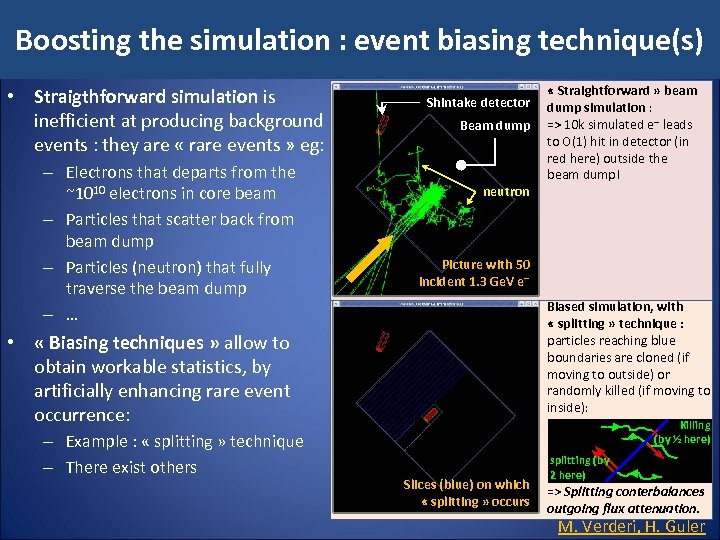
Boosting the simulation : event biasing technique(s) • Straigthforward simulation is inefficient at producing background events : they are « rare events » eg: – Electrons that departs from the ~1010 electrons in core beam – Particles that scatter back from beam dump – Particles (neutron) that fully traverse the beam dump – … Shintake detector Beam dump neutron Picture with 50 incident 1. 3 Ge. V e. Biased simulation, with « splitting » technique : particles reaching blue boundaries are cloned (if moving to outside) or randomly killed (if moving to inside): • « Biasing techniques » allow to obtain workable statistics, by artificially enhancing rare event occurrence: – Example : « splitting » technique – There exist others « Straightforward » beam dump simulation : => 10 k simulated e- leads to O(1) hit in detector (in red here) outside the beam dump! Killing × (by ½ here) Slices (blue) on which « splitting » occurs splitting (by 2 here) => Splitting conterbalances outgoing flux attenuation. 18 M. Verderi, H. Guler
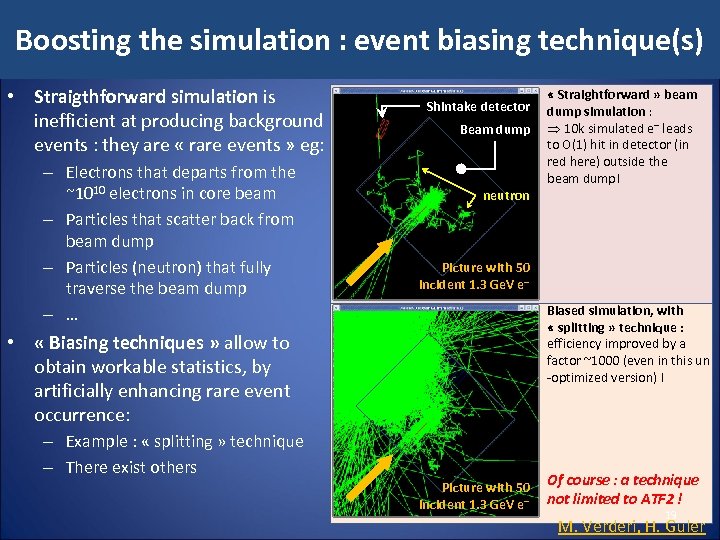
Boosting the simulation : event biasing technique(s) • Straigthforward simulation is inefficient at producing background events : they are « rare events » eg: – Electrons that departs from the ~1010 electrons in core beam – Particles that scatter back from beam dump – Particles (neutron) that fully traverse the beam dump – … Shintake detector Beam dump neutron « Straightforward » beam dump simulation : 10 k simulated e- leads to O(1) hit in detector (in red here) outside the beam dump! Picture with 50 incident 1. 3 Ge. V e. Biased simulation, with « splitting » technique : efficiency improved by a factor ~1000 (even in this un -optimized version) ! • « Biasing techniques » allow to obtain workable statistics, by artificially enhancing rare event occurrence: – Example : « splitting » technique – There exist others Picture with 50 incident 1. 3 Ge. V e- Of course : a technique not limited to ATF 2 ! 19 M. Verderi, H. Guler
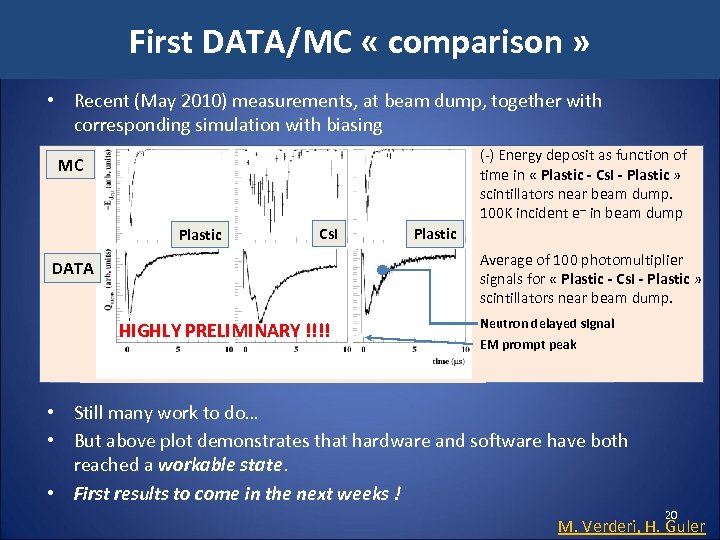
First DATA/MC « comparison » • Recent (May 2010) measurements, at beam dump, together with corresponding simulation with biasing (-) Energy deposit as function of time in « Plastic - Cs. I - Plastic » scintillators near beam dump. 100 K incident e- in beam dump MC Plastic Cs. I Plastic Average of 100 photomultiplier signals for « Plastic - Cs. I - Plastic » scintillators near beam dump. DATA HIGHLY PRELIMINARY !!!! Neutron delayed signal EM prompt peak • Still many work to do… • But above plot demonstrates that hardware and software have both reached a workable state. • First results to come in the next weeks ! 20 M. Verderi, H. Guler
LAL: Beam tuning & control, software tools, computing Commissioning strategy & organization 21
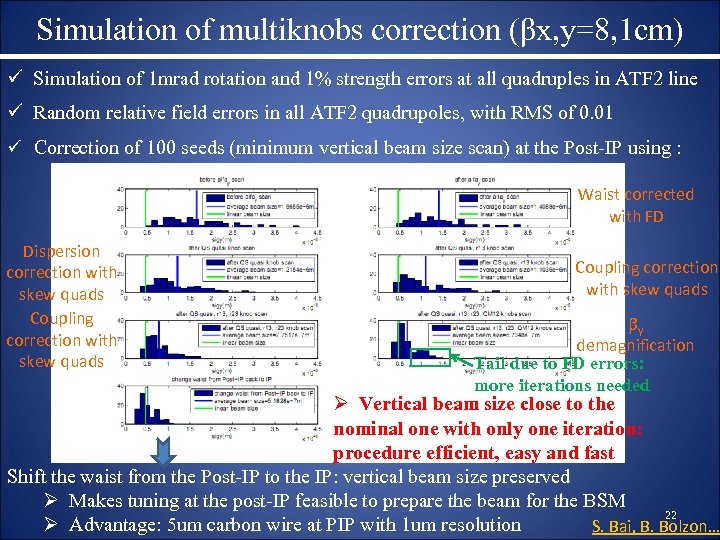
Simulation of multiknobs correction (βx, y=8, 1 cm) ü Simulation of 1 mrad rotation and 1% strength errors at all quadruples in ATF 2 line ü Random relative field errors in all ATF 2 quadrupoles, with RMS of 0. 01 ü Correction of 100 seeds (minimum vertical beam size scan) at the Post-IP using : Waist corrected with FD Dispersion correction with skew quads Coupling correction with skew quads Coupling correction with skew quads y demagnification Tail due to FD errors: more iterations needed Ø Vertical beam size close to the nominal one with only one iteration: procedure efficient, easy and fast Shift the waist from the Post-IP to the IP: vertical beam size preserved Ø Makes tuning at the post-IP feasible to prepare the beam for the BSM 22 Ø Advantage: 5 um carbon wire at PIP with 1 um resolution S. Bai, B. Bolzon…
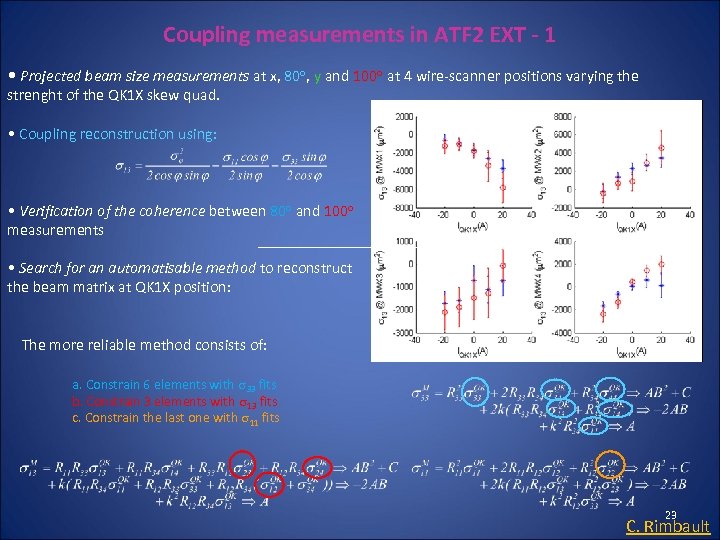
Coupling measurements in ATF 2 EXT - 1 • Projected beam size measurements at x, 80 o, y and 100 o at 4 wire-scanner positions varying the strenght of the QK 1 X skew quad. • Coupling reconstruction using: • Verification of the coherence between 80 o and 100 o measurements • Search for an automatisable method to reconstruct the beam matrix at QK 1 X position: The more reliable method consists of: a. Constrain 6 elements with 33 fits b. Constrain 3 elements with 13 fits c. Constrain the last one with 11 fits 23 C. Rimbault
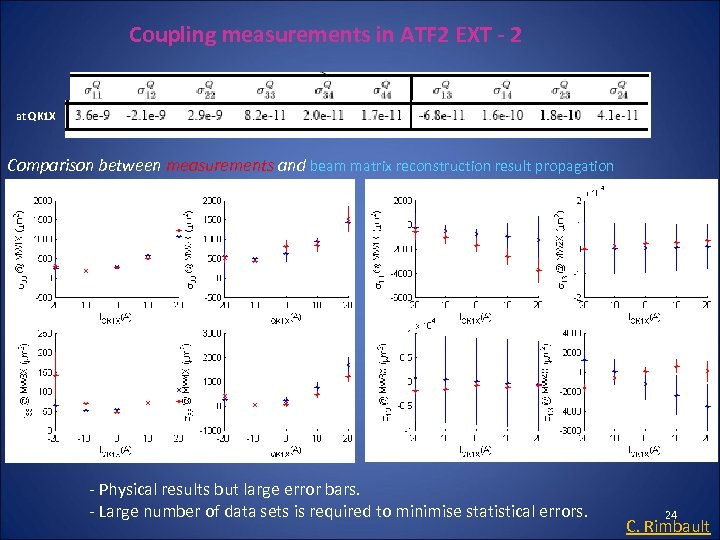
Coupling measurements in ATF 2 EXT - 2 at QK 1 X Comparison between measurements and beam matrix reconstruction result propagation s 33 s 13 - Physical results but large error bars. - Large number of data sets is required to minimise statistical errors. 24 C. Rimbault
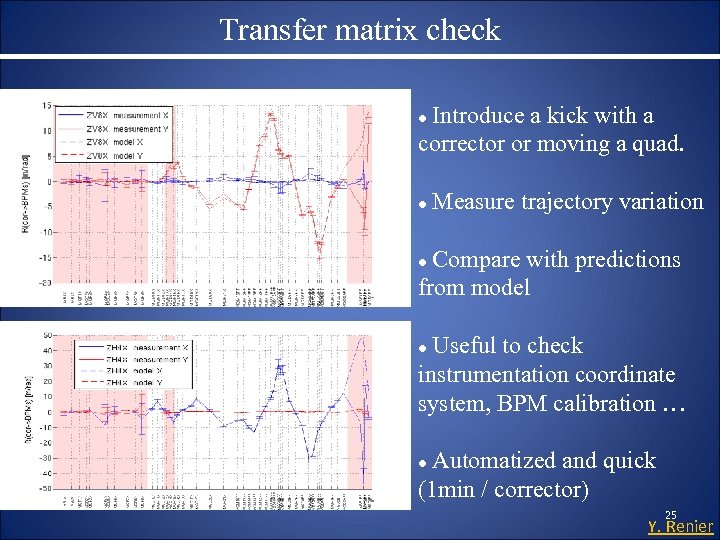
Transfer matrix check Introduce a kick with a corrector or moving a quad. Measure trajectory variation Compare with predictions from model Useful to check instrumentation coordinate system, BPM calibration … Automatized and quick (1 min / corrector) 25 Y. Renier
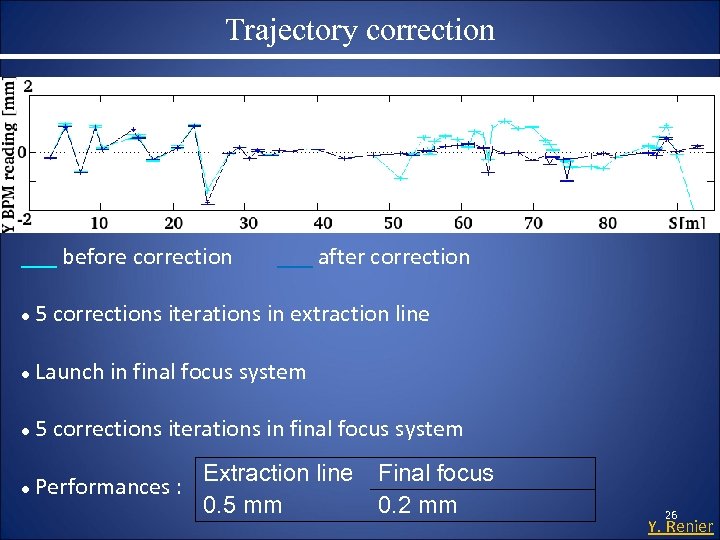
Trajectory correction ___ before correction ___ after correction 5 corrections iterations in extraction line Launch in final focus system 5 corrections iterations in final focus system Performances : Extraction line 0. 5 mm Final focus 0. 2 mm 26 Y. Renier
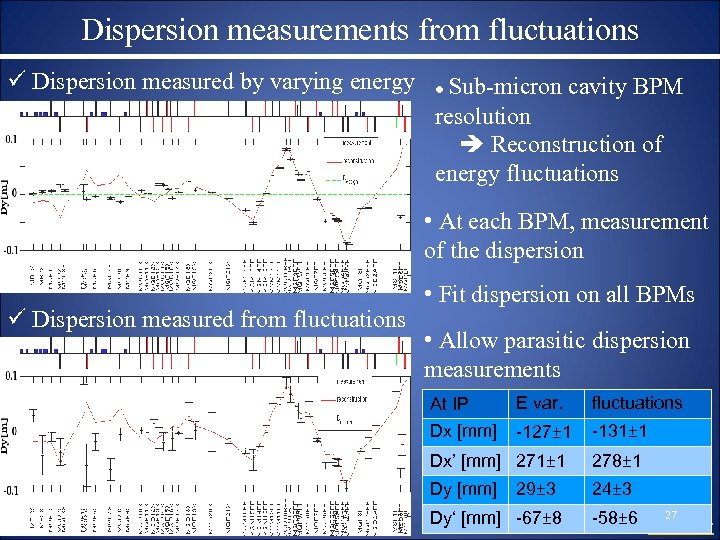
Dispersion measurements from fluctuations ü Dispersion measured by varying energy Sub-micron cavity BPM resolution Reconstruction of energy fluctuations • At each BPM, measurement of the dispersion ü Dispersion measured from fluctuations • Fit dispersion on all BPMs • Allow parasitic dispersion measurements At IP E var. fluctuations Dx [mm] -127± 1 -131± 1 Dx’ [mm] 271± 1 278± 1 Dy [mm] 24± 3 29± 3 Dy‘ [mm] -67± 8 27 -58± 6 Y. Renier
Proceedings, publications and theses at ATF 2 28
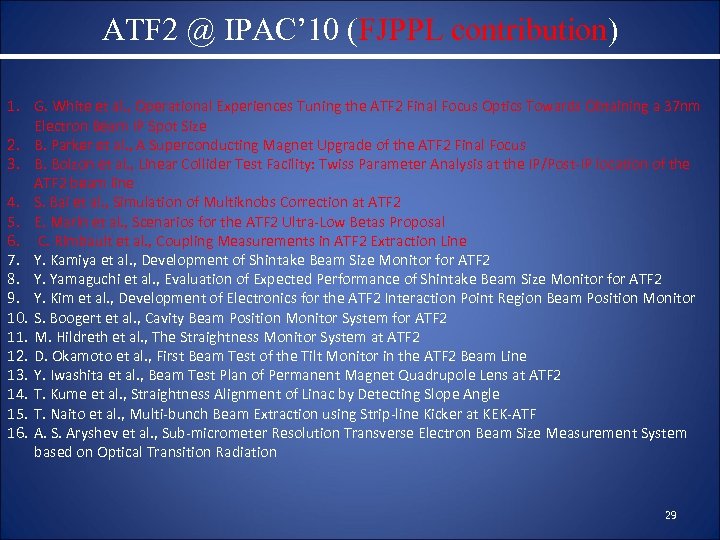
ATF 2 @ IPAC’ 10 (FJPPL contribution) 1. G. White et al. , Operational Experiences Tuning the ATF 2 Final Focus Optics Towards Obtaining a 37 nm Electron Beam IP Spot Size 2. B. Parker et al. , A Superconducting Magnet Upgrade of the ATF 2 Final Focus 3. B. Bolzon et al. , Linear Collider Test Facility: Twiss Parameter Analysis at the IP/Post-IP location of the ATF 2 beam line 4. S. Bai et al. , Simulation of Multiknobs Correction at ATF 2 5. E. Marin et al. , Scenarios for the ATF 2 Ultra-Low Betas Proposal 6. C. Rimbault et al. , Coupling Measurements in ATF 2 Extraction Line 7. Y. Kamiya et al. , Development of Shintake Beam Size Monitor for ATF 2 8. Y. Yamaguchi et al. , Evaluation of Expected Performance of Shintake Beam Size Monitor for ATF 2 9. Y. Kim et al. , Development of Electronics for the ATF 2 Interaction Point Region Beam Position Monitor 10. S. Boogert et al. , Cavity Beam Position Monitor System for ATF 2 11. M. Hildreth et al. , The Straightness Monitor System at ATF 2 12. D. Okamoto et al. , First Beam Test of the Tilt Monitor in the ATF 2 Beam Line 13. Y. Iwashita et al. , Beam Test Plan of Permanent Magnet Quadrupole Lens at ATF 2 14. T. Kume et al. , Straightness Alignment of Linac by Detecting Slope Angle 15. T. Naito et al. , Multi-bunch Beam Extraction using Strip-line Kicker at KEK-ATF 16. A. S. Aryshev et al. , Sub-micrometer Resolution Transverse Electron Beam Size Measurement System based on Optical Transition Radiation 29
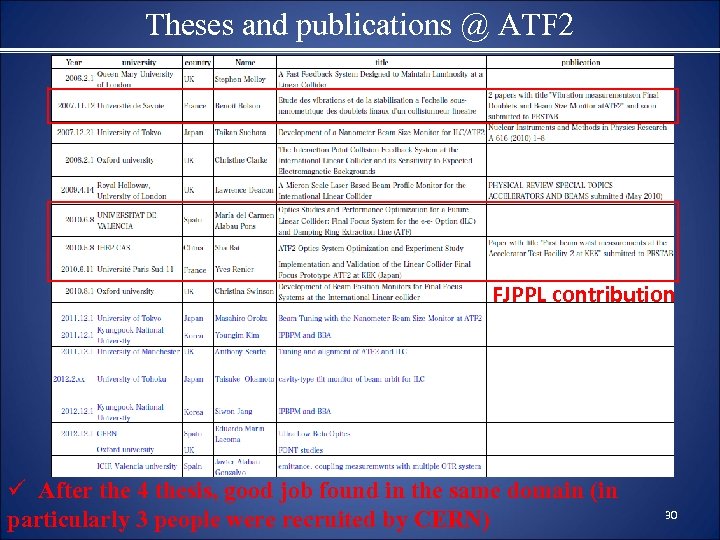
Theses and publications @ ATF 2 FJPPL contribution ü After the 4 thesis, good job found in the same domain (in particularly 3 people were recruited by CERN) 30
ILC Machine Detector Interface: ILD vibration studies 31 H. Yamaoka
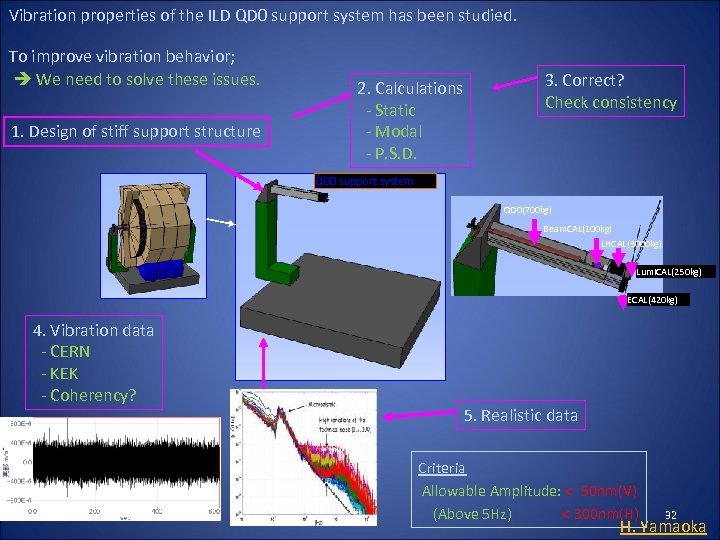
Vibration properties of the ILD QD 0 support system has been studied. To improve vibration behavior; We need to solve these issues. 1. Design of stiff support structure 2. Calculations - Static - Modal - P. S. D. 3. Correct? Check consistency QD 0 support system QD 0(700 kg) Beam. CAL(100 kg) LHCAL(3000 kg) Lumi. CAL(250 kg) ECAL(420 kg) 4. Vibration data - CERN - KEK - Coherency? 5. Realistic data Criteria Allowable Amplitude: < 50 nm(V) (Above 5 Hz) < 300 nm(H) 32 H. Yamaoka
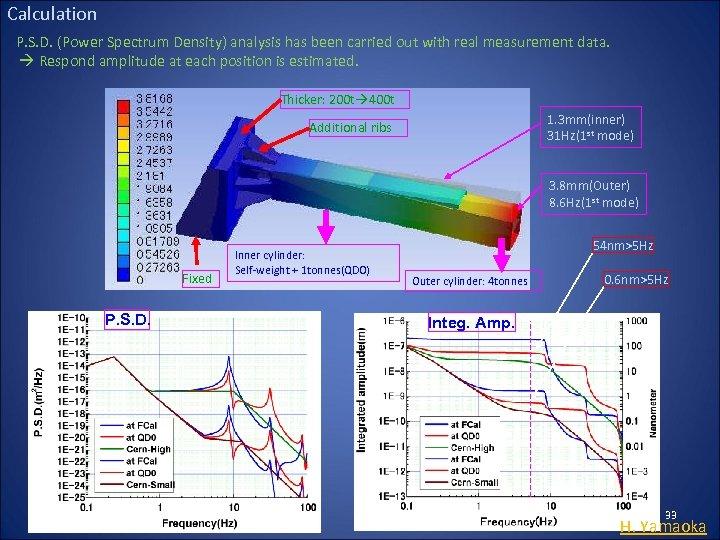
Calculation P. S. D. (Power Spectrum Density) analysis has been carried out with real measurement data. Respond amplitude at each position is estimated. Thicker: 200 t 400 t 1. 3 mm(inner) 31 Hz(1 st mode) Additional ribs 3. 8 mm(Outer) 8. 6 Hz(1 st mode) Fixed P. S. D. Inner cylinder: Self-weight + 1 tonnes(QD 0) 54 nm>5 Hz Outer cylinder: 4 tonnes 0. 6 nm>5 Hz Integ. Amp. 33 H. Yamaoka
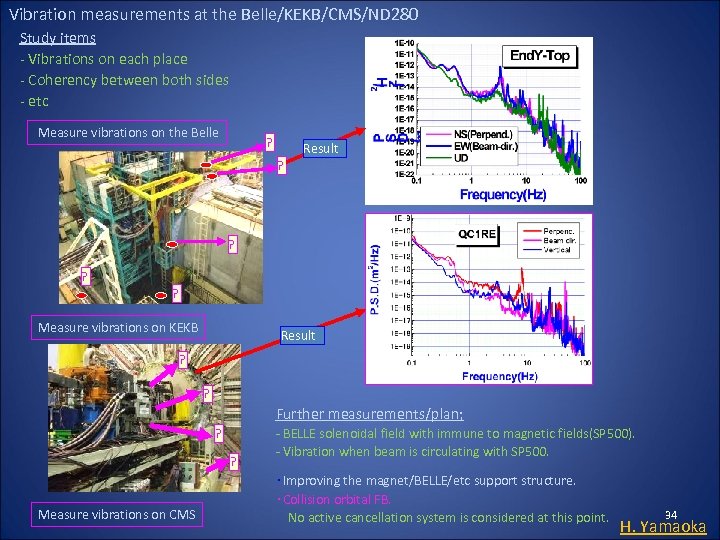
Vibration measurements at the Belle/KEKB/CMS/ND 280 Study items - Vibrations on each place - Coherency between both sides - etc Measure vibrations on the Belle ? ? Result ? ? ? Measure vibrations on KEKB Result ? ? Further measurements/plan; ? ? Measure vibrations on CMS - BELLE solenoidal field with immune to magnetic fields(SP 500). - Vibration when beam is circulating with SP 500. ・Improving the magnet/BELLE/etc support structure. ・Collision orbital FB. No active cancellation system is considered at this point. 34 H. Yamaoka
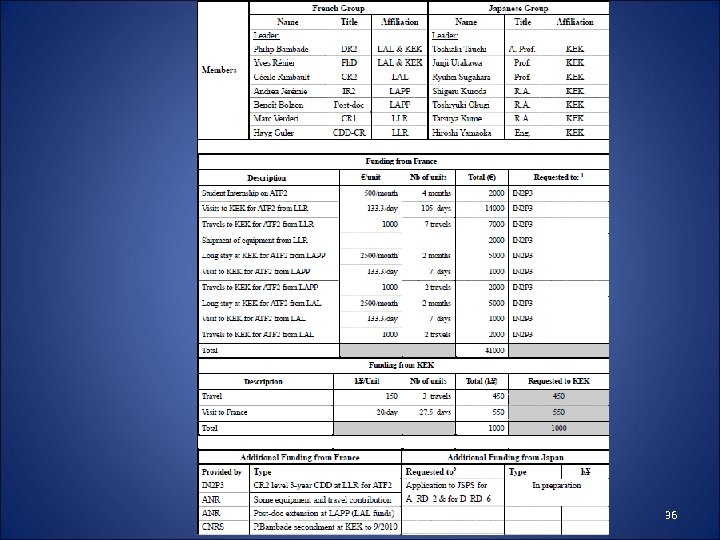
FJPPL A_RD_2 teams & request 35
36
Conclusion 37
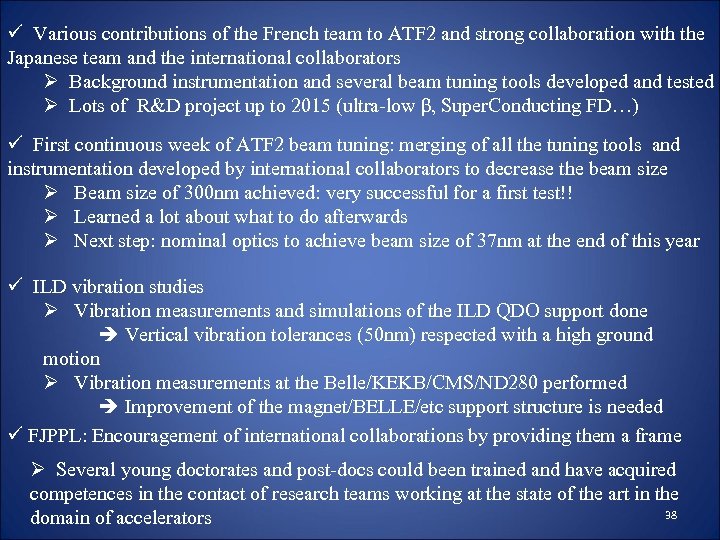
ü Various contributions of the French team to ATF 2 and strong collaboration with the Japanese team and the international collaborators Ø Background instrumentation and several beam tuning tools developed and tested Ø Lots of R&D project up to 2015 (ultra-low β, Super. Conducting FD…) ü First continuous week of ATF 2 beam tuning: merging of all the tuning tools and instrumentation developed by international collaborators to decrease the beam size Ø Beam size of 300 nm achieved: very successful for a first test!! Ø Learned a lot about what to do afterwards Ø Next step: nominal optics to achieve beam size of 37 nm at the end of this year ü ILD vibration studies Ø Vibration measurements and simulations of the ILD QDO support done Vertical vibration tolerances (50 nm) respected with a high ground motion Ø Vibration measurements at the Belle/KEKB/CMS/ND 280 performed Improvement of the magnet/BELLE/etc support structure is needed ü FJPPL: Encouragement of international collaborations by providing them a frame Ø Several young doctorates and post-docs could been trained and have acquired competences in the contact of research teams working at the state of the art in the 38 domain of accelerators
Скачать презентацию A_RD_2 Collaboration on the ATF 2 project at
c52ca3cde0314dd984a8375941dc0236.ppt