 Скачать презентацию A WORLD HISTORY OF THE ARCHITECTURE MEKHRIBANU BEKRIMZHANOVNA
L1.History_of_the_world_architecture_1.pptx
- Количество слайдов: 43



A WORLD HISTORY OF THE ARCHITECTURE MEKHRIBANU BEKRIMZHANOVNA GLAUDINOVA DR ARCH, ASSOCIATE PROFESSOR 555 CAB.
ARCHITECTURE AS A FORM OF CULTURE • The subject of “The History of Architecture” as a science one • Importance of “The History of Architecture” for architect and his work • Connection between the history and theory of architecture • Architecture as unit of utility, constructional, technical and artistic problems • Social importance of architecture • Artistic image of architecture • Main periods of the architectural development Appearance of architecture. The most ancient erections
APPEARANCE OF ARCHITECTURE. THE MOST ANCIENT ERECTIONS Occasional caves and temporary tents • Early humans are often thought of as dwelling in caves, largely because that is where we find traces of them. The flints they used, the bones they gnawed, even their own bones - these lurk for ever in a cave but get scattered or demolished elsewhere. • Caves are winter shelter. Living outside, with the freedom to roam widely for the purposes of hunting and gathering, suggests the need for at least a temporary shelter. And this, even at the simplest level, means the beginning of something approaching architecture.
THE EARLIEST ARTIFICIAL ERECTIONS • Homo habilis – 2 million years ago • Homo erectus – 1 million years ago • But Lucy (skeleton was find in 1976 at Ephyopia) – is dated 3, 6 million years ago • Khaddar and Kubi Fora in Kenya, Oldway Gorge in Tanzania – the most ancient stone paved places – are dated 1 million years ago
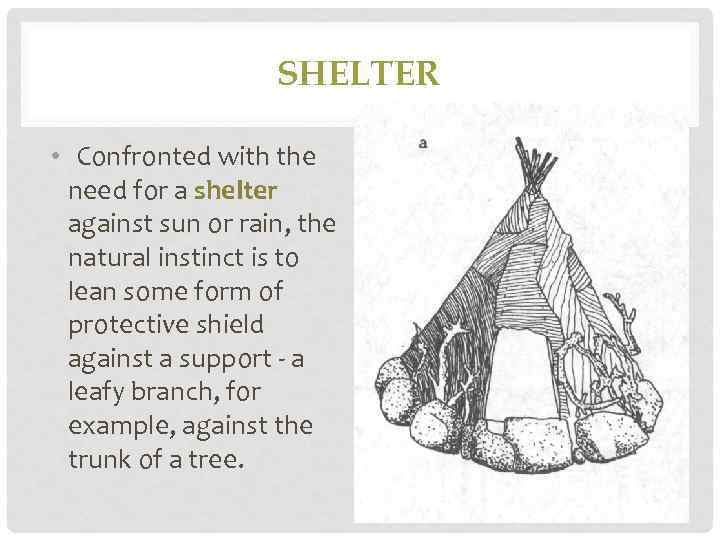
SHELTER • Confronted with the need for a shelter against sun or rain, the natural instinct is to lean some form of protective shield against a support - a leafy branch, for example, against the trunk of a tree.
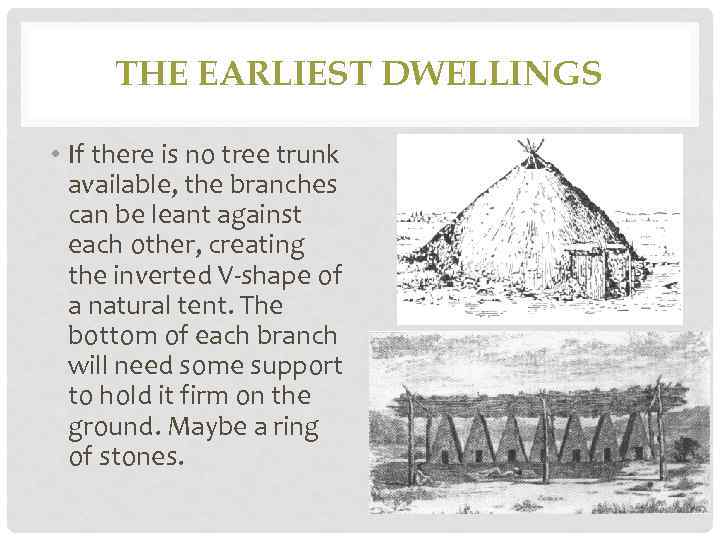
THE EARLIEST DWELLINGS • If there is no tree trunk available, the branches can be leant against each other, creating the inverted V-shape of a natural tent. The bottom of each branch will need some support to hold it firm on the ground. Maybe a ring of stones.
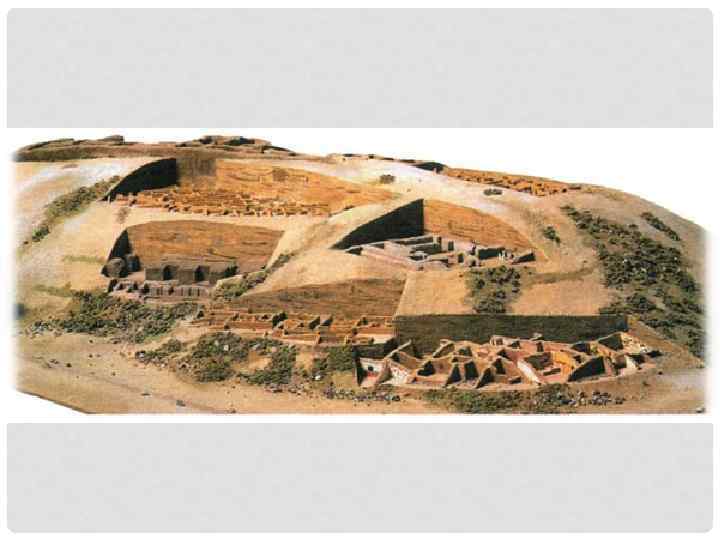
FROM TENTS TO ROUND HOUSES: 10 000 - 8000 BC • Once human beings settle down to the business of agriculture, instead of hunting and gathering, permanent settlements become a factor of life. The story of architecture can begin. • The tent-like structures of earlier times evolve now into round houses. Jericho is usually quoted as the earliest known town. A small settlement here evolves in about 8000 BC into a town covering 10 acres. And the builders of Jericho have a new technology - bricks, shaped from mud and baked hard in the sun. In keeping with a circular tradition, each brick is curved on its outer edge.
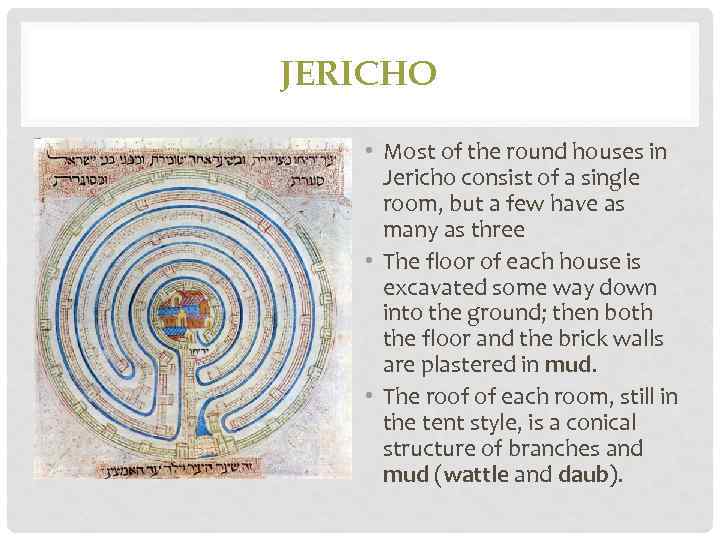
JERICHO • Most of the round houses in Jericho consist of a single room, but a few have as many as three • The floor of each house is excavated some way down into the ground; then both the floor and the brick walls are plastered in mud. • The roof of each room, still in the tent style, is a conical structure of branches and mud (wattle and daub).
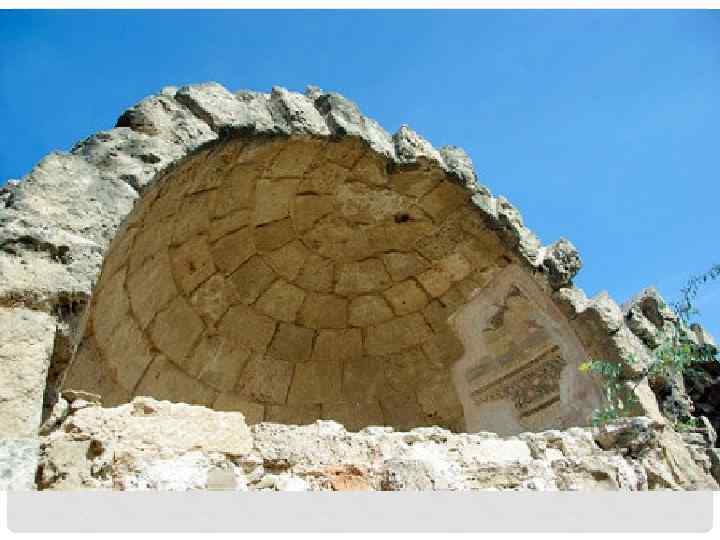
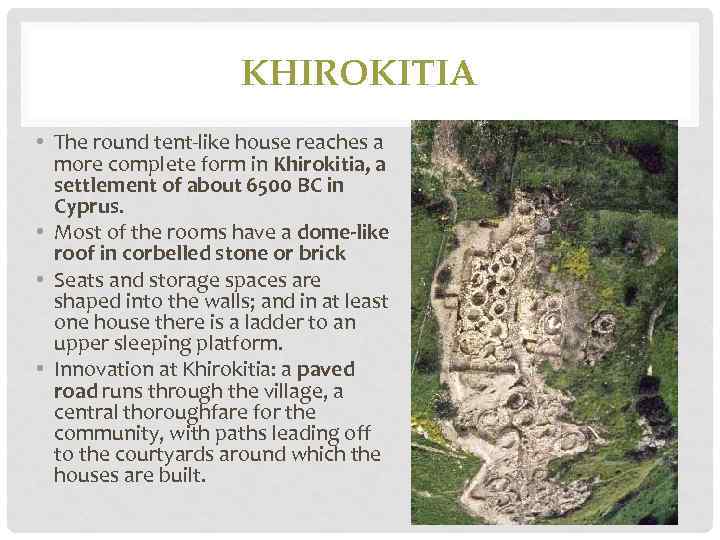
KHIROKITIA • The round tent-like house reaches a more complete form in Khirokitia, a settlement of about 6500 BC in Cyprus. • Most of the rooms have a dome-like roof in corbelled stone or brick • Seats and storage spaces are shaped into the walls; and in at least one house there is a ladder to an upper sleeping platform. • Innovation at Khirokitia: a paved road runs through the village, a central thoroughfare for the community, with paths leading off to the courtyards around which the houses are built.
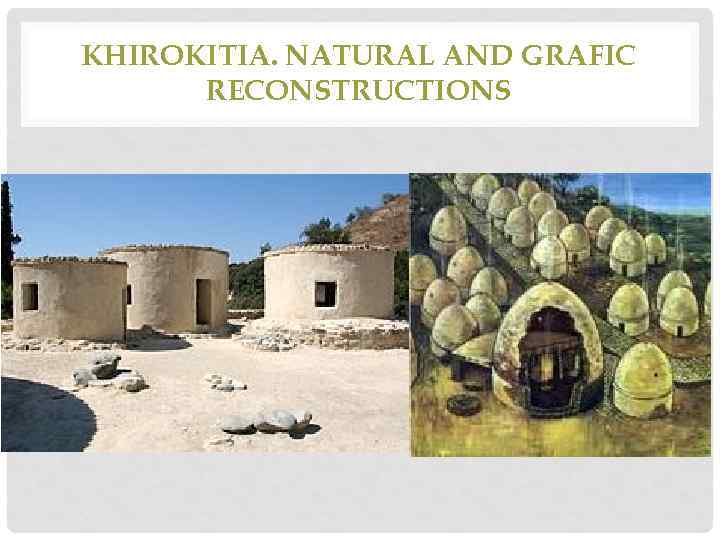
KHIROKITIA. NATURAL AND GRAFIC RECONSTRUCTIONS
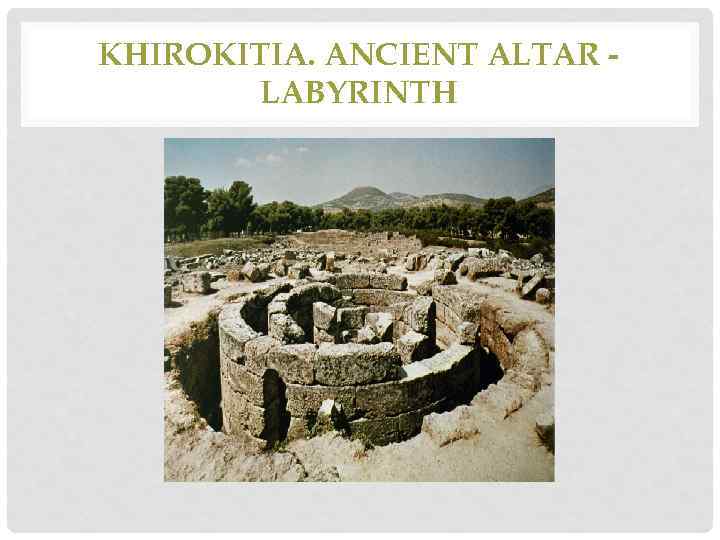
KHIROKITIA. ANCIENT ALTAR LABYRINTH
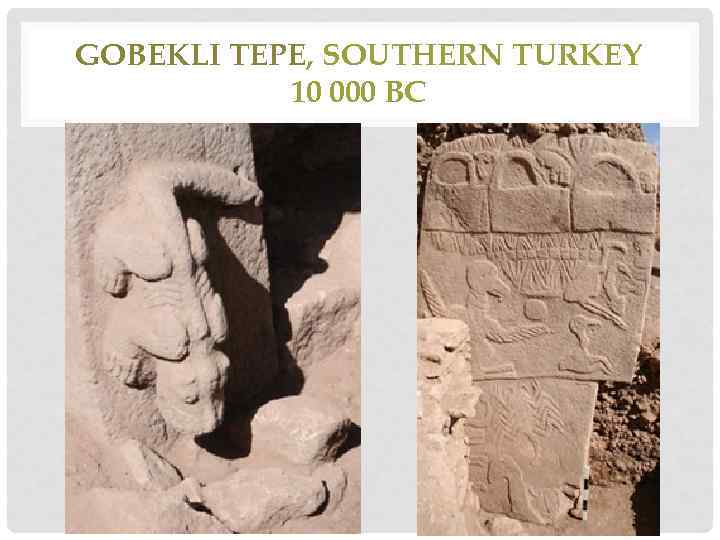
GOBEKLI TEPE, SOUTHERN TURKEY 10 000 BC
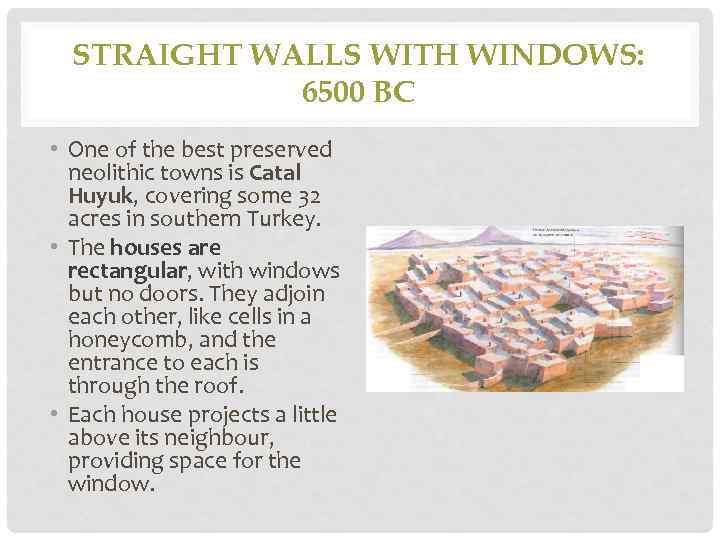
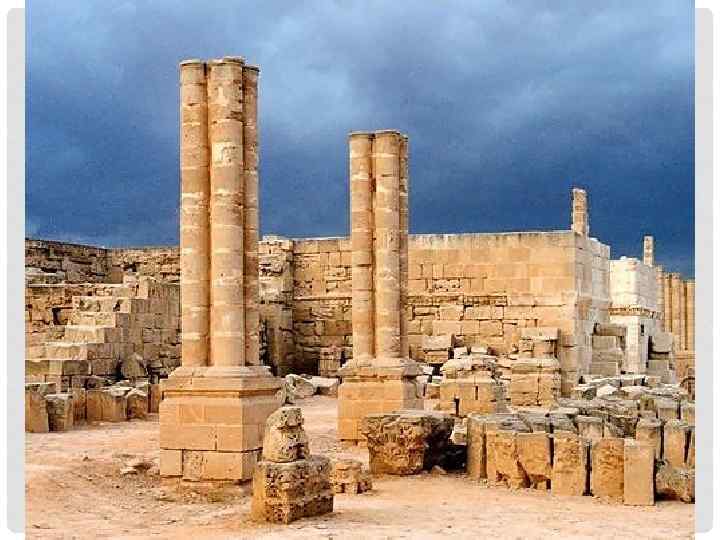
STRAIGHT WALLS WITH WINDOWS: 6500 BC • One of the best preserved neolithic towns is Catal Huyuk, covering some 32 acres in southern Turkey. • The houses are rectangular, with windows but no doors. They adjoin each other, like cells in a honeycomb, and the entrance to each is through the roof. • Each house projects a little above its neighbour, providing space for the window.
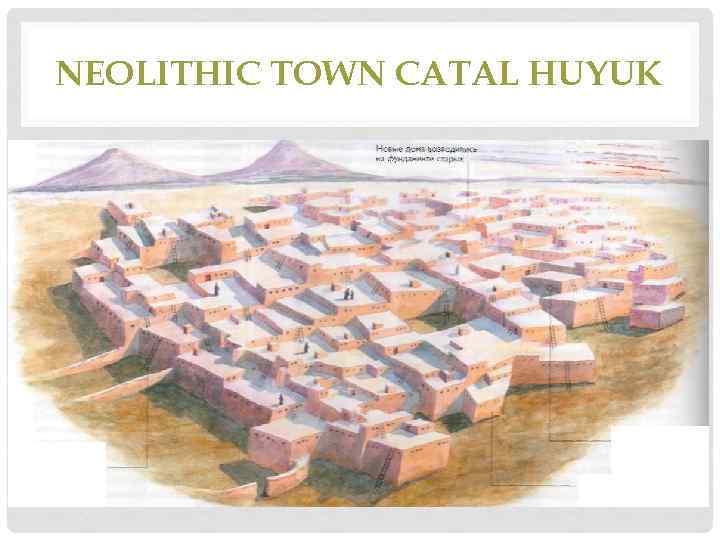
NEOLITHIC TOWN CATAL HUYUK
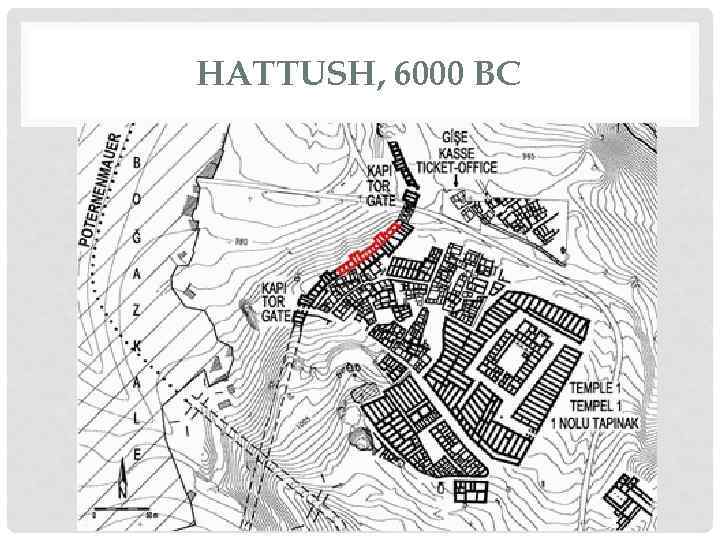
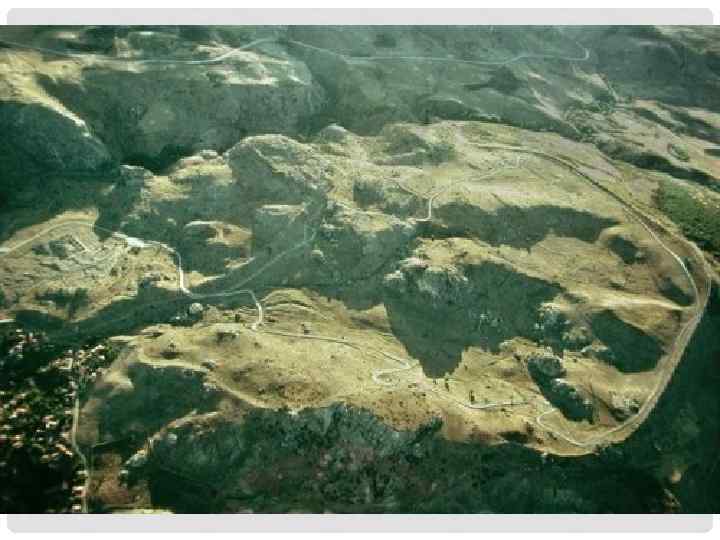
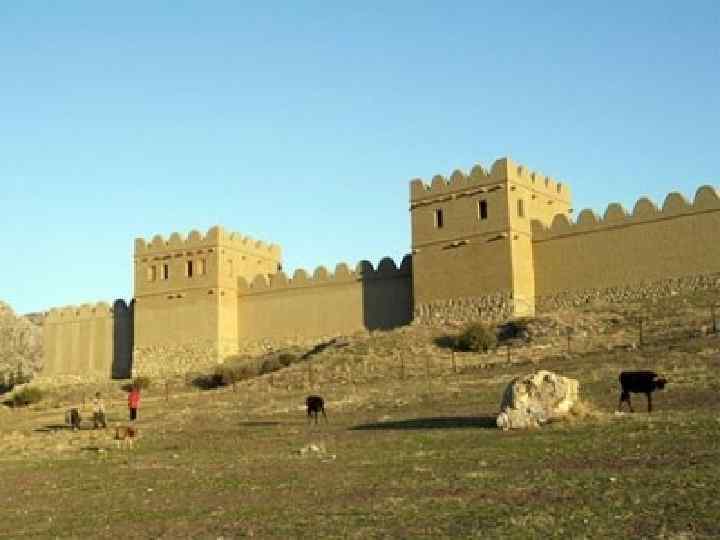
HATTUSH, 6000 BC
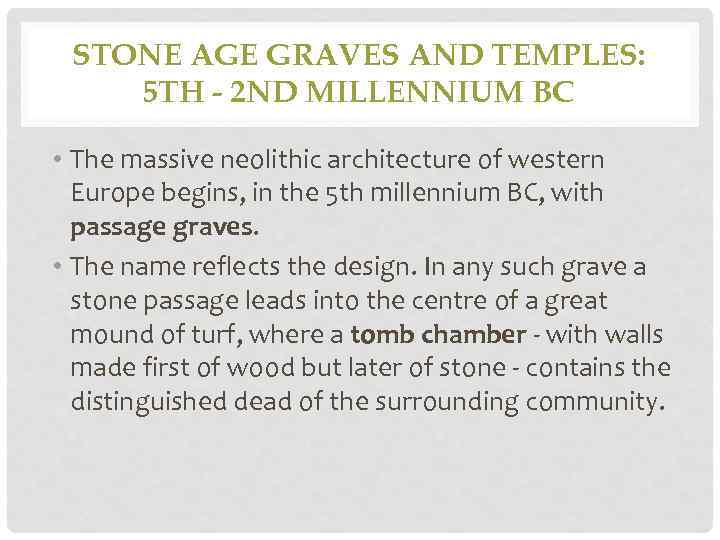
STONE AGE GRAVES AND TEMPLES: 5 TH - 2 ND MILLENNIUM BC • The massive neolithic architecture of western Europe begins, in the 5 th millennium BC, with passage graves. • The name reflects the design. In any such grave a stone passage leads into the centre of a great mound of turf, where a tomb chamber - with walls made first of wood but later of stone - contains the distinguished dead of the surrounding community.
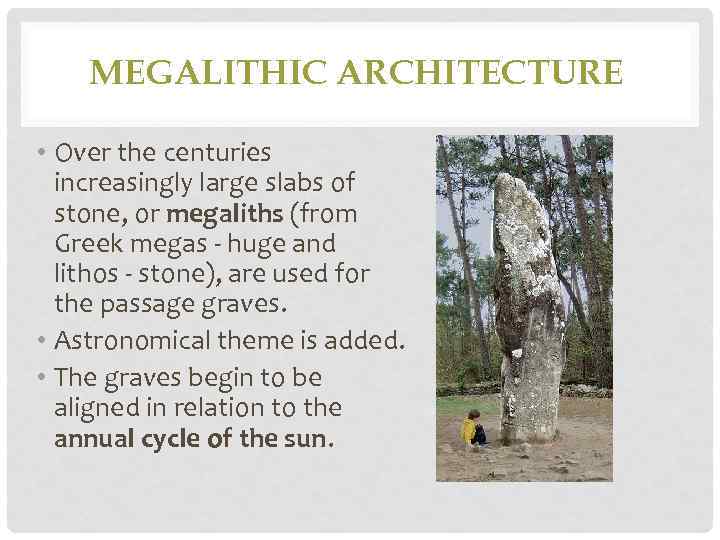
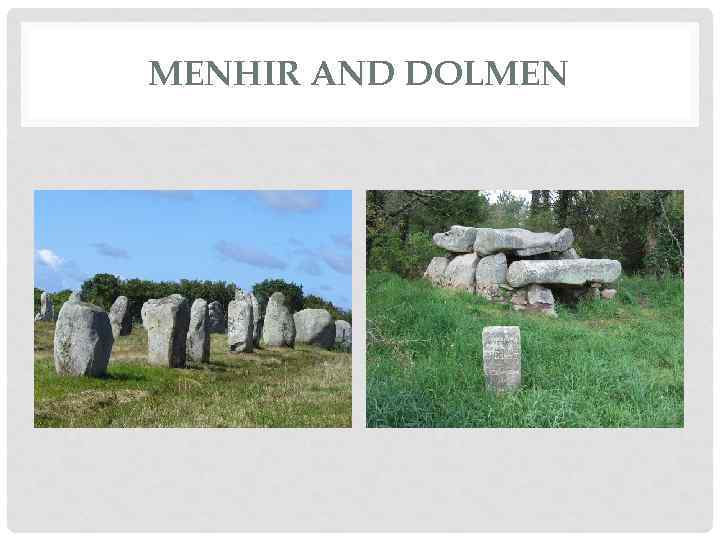
MEGALITHIC ARCHITECTURE • Over the centuries increasingly large slabs of stone, or megaliths (from Greek megas - huge and lithos - stone), are used for the passage graves. • Astronomical theme is added. • The graves begin to be aligned in relation to the annual cycle of the sun.
MENHIR AND DOLMEN
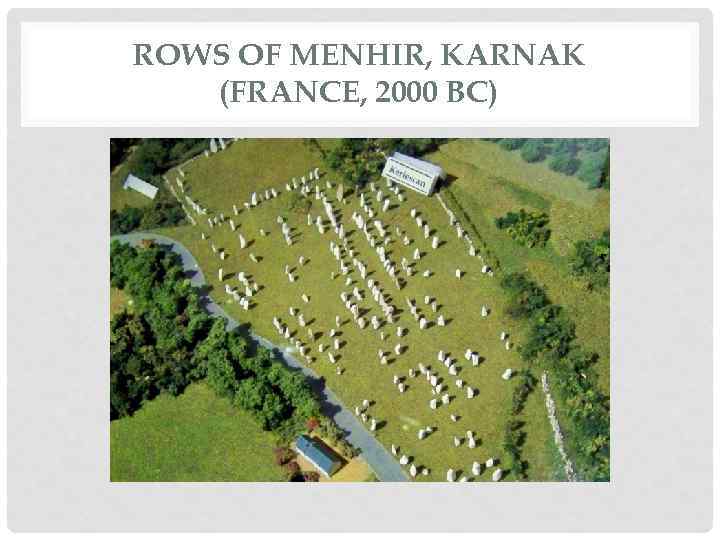
ROWS OF MENHIR, KARNAK (FRANCE, 2000 BC)
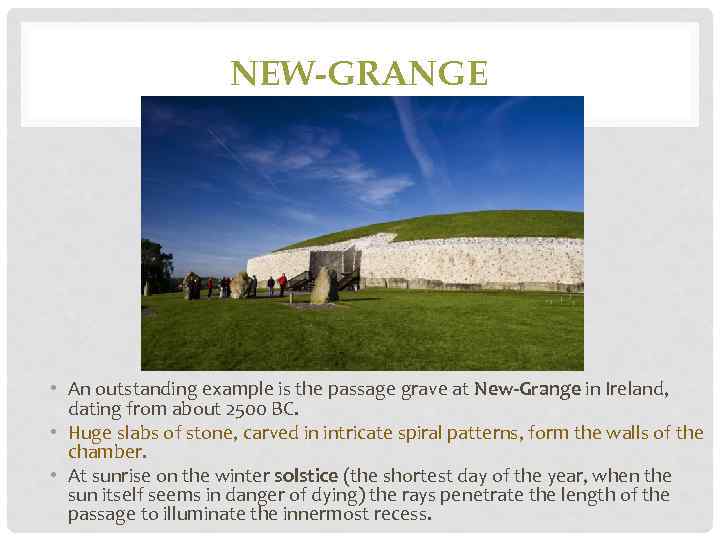
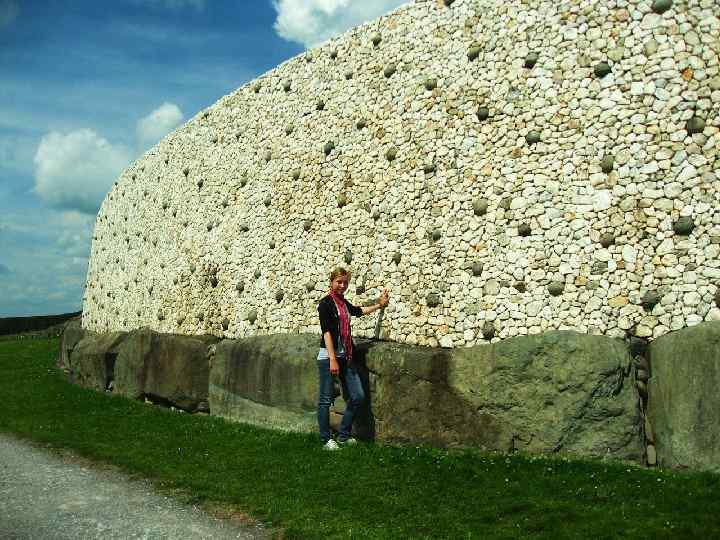
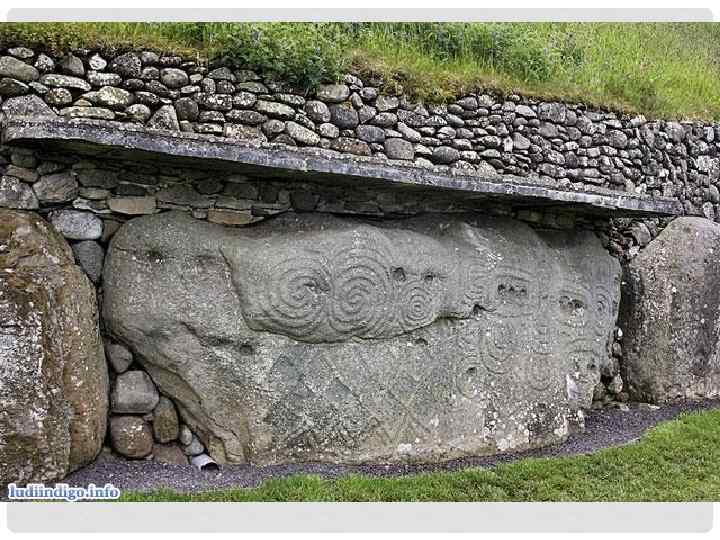
NEW-GRANGE • An outstanding example is the passage grave at New-Grange in Ireland, dating from about 2500 BC. • Huge slabs of stone, carved in intricate spiral patterns, form the walls of the chamber. • At sunrise on the winter solstice (the shortest day of the year, when the sun itself seems in danger of dying) the rays penetrate the length of the passage to illuminate the innermost recess.
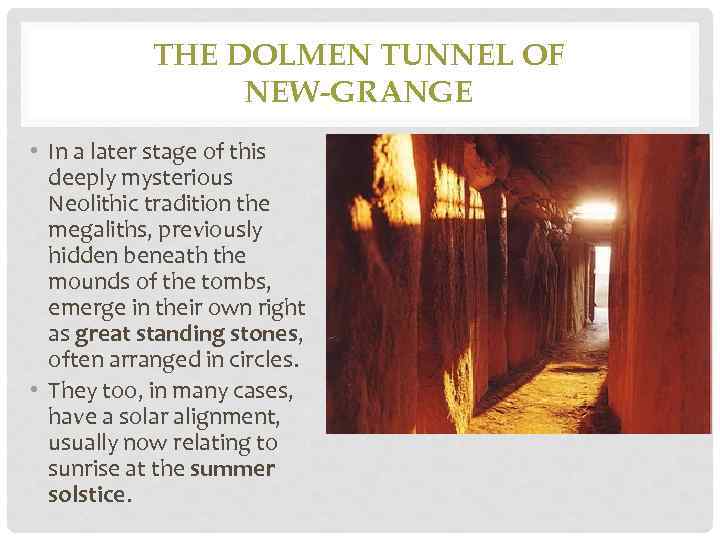
THE DOLMEN TUNNEL OF NEW-GRANGE • In a later stage of this deeply mysterious Neolithic tradition the megaliths, previously hidden beneath the mounds of the tombs, emerge in their own right as great standing stones, often arranged in circles. • They too, in many cases, have a solar alignment, usually now relating to sunrise at the summer solstice.
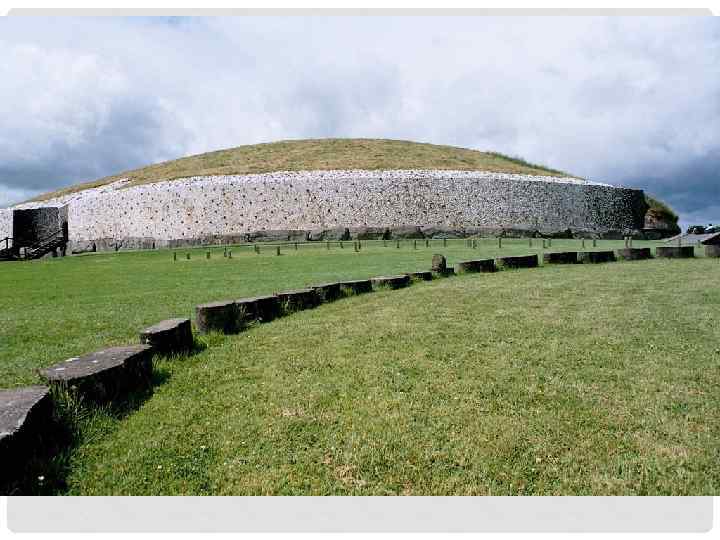
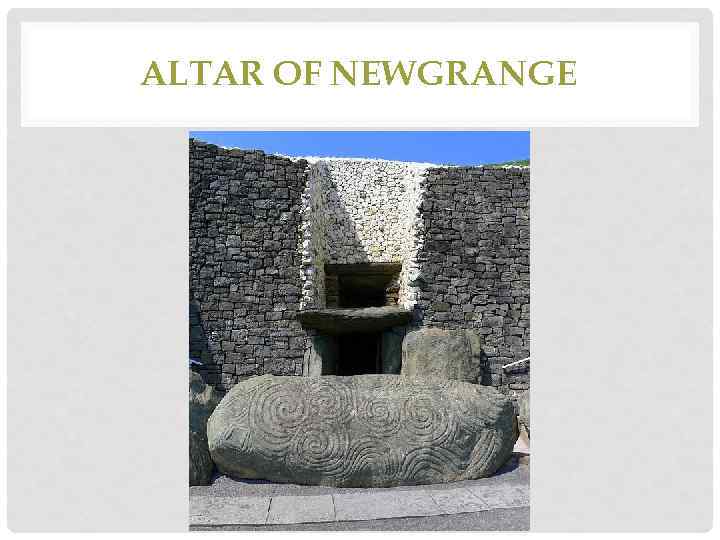
ALTAR OF NEWGRANGE
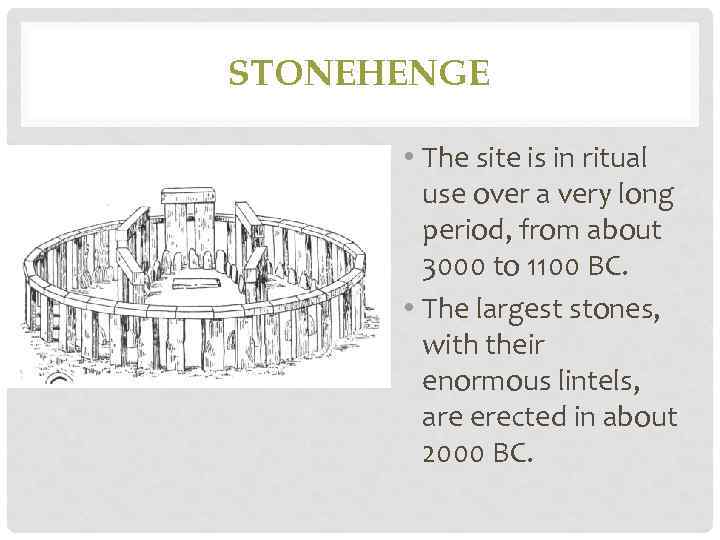
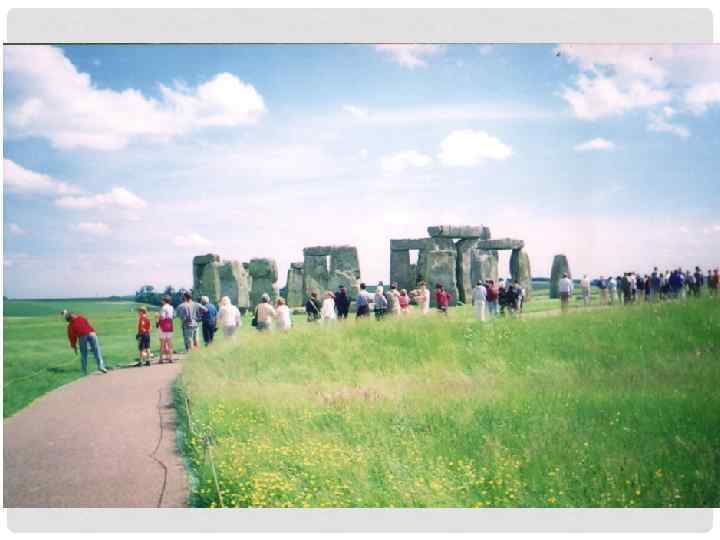
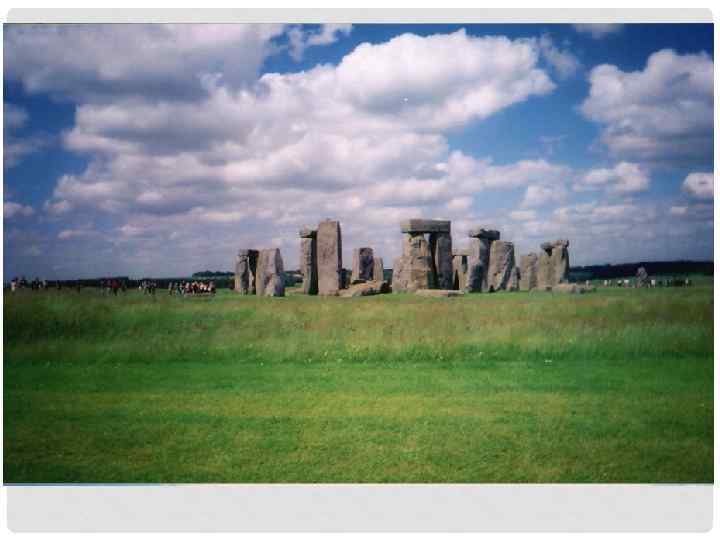
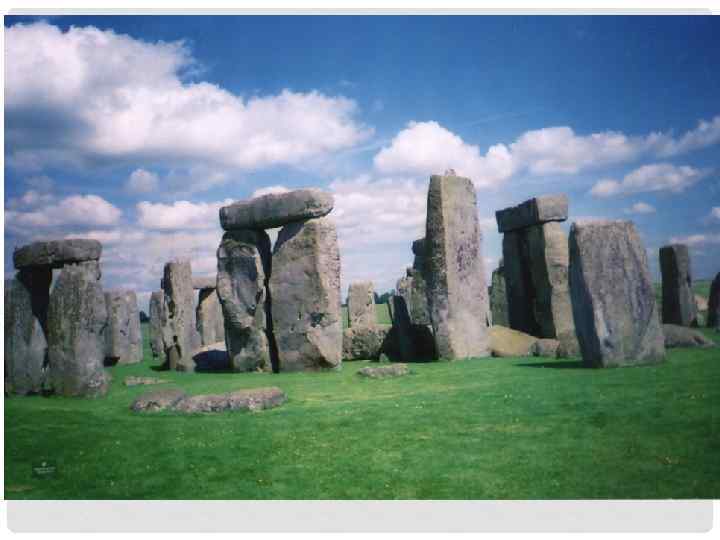
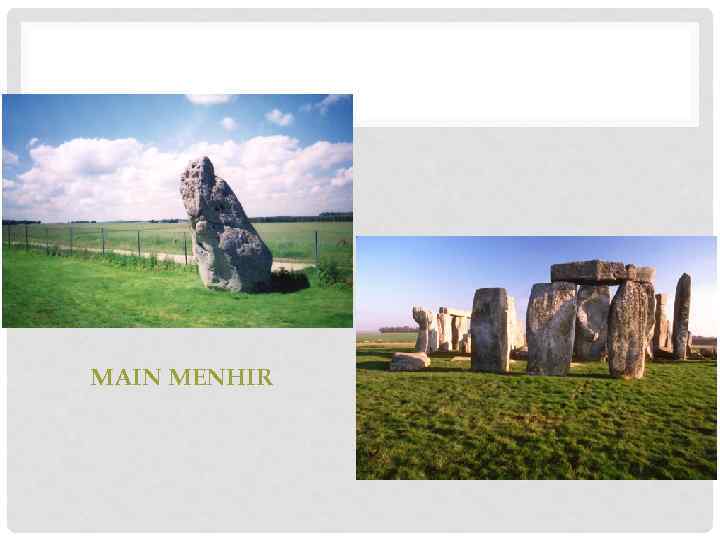
STONEHENGE • The site is in ritual use over a very long period, from about 3000 to 1100 BC. • The largest stones, with their enormous lintels, are erected in about 2000 BC.
MAIN MENHIR
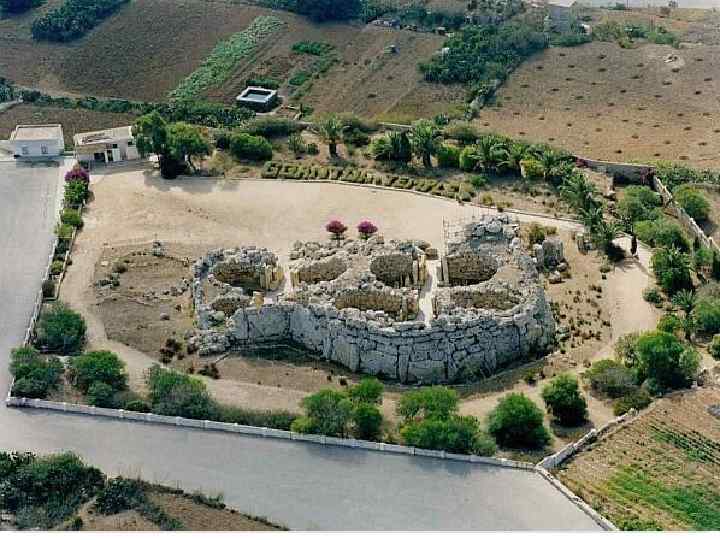
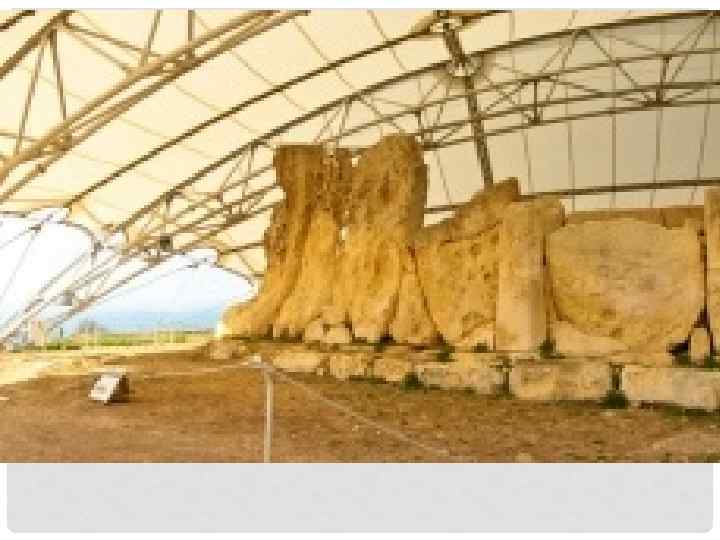
THE WORLD MOST ANCIENT TEMPLES (MALTA, 4000 BC) • 23 stone constructions (Kemmuna, Gozo and Malta islands) • Weight of the wall stones - 15 т • Строители умели вырезать проходы в цельном камне и закладывать огромные глыбы в основание своих построек. They decorated walls by ornaments. • Earliest temple – Njganti erected of large wild stones were хорошо подогнаны друг к другу. Height of the walls now – 4 -5 m.
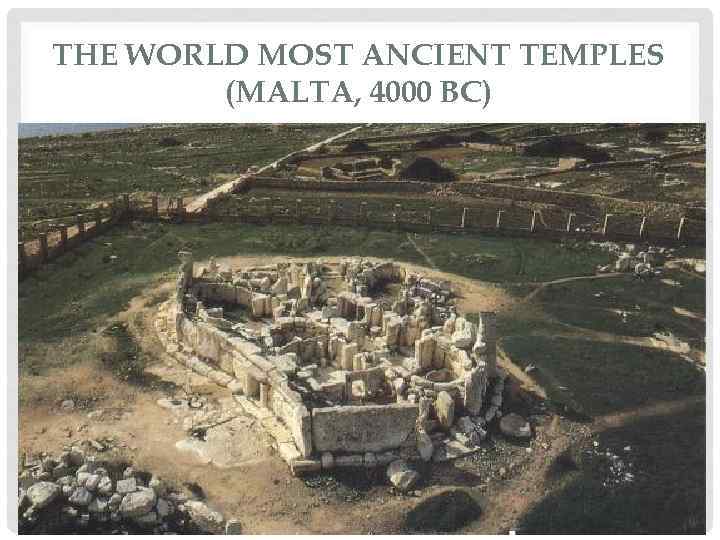
THE WORLD MOST ANCIENT TEMPLES (MALTA, 4000 BC)
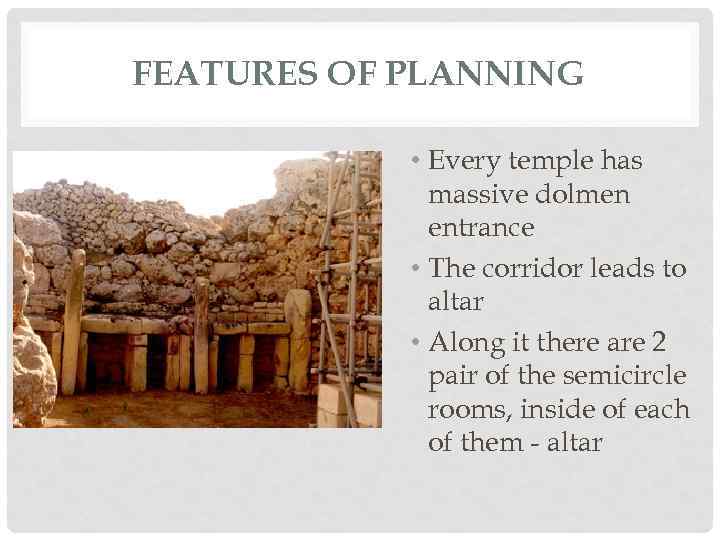
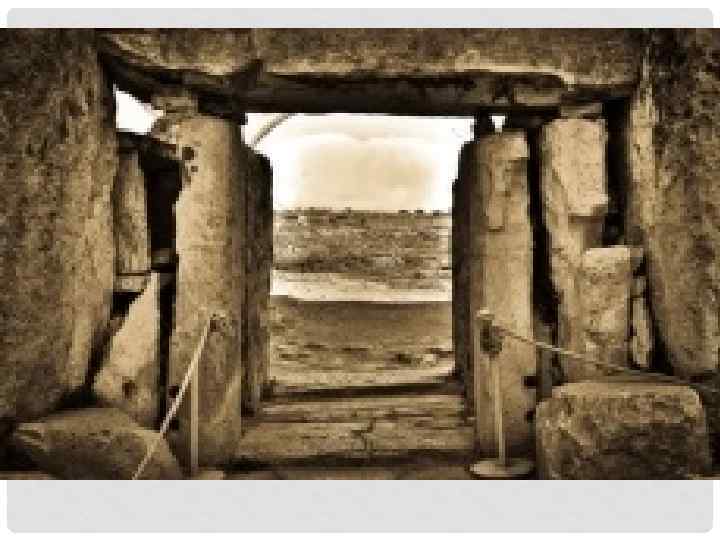
FEATURES OF PLANNING • Every temple has massive dolmen entrance • The corridor leads to altar • Along it there are 2 pair of the semicircle rooms, inside of each of them - altar

MNAJRA TEMPLE
 Скачать презентацию A WORLD HISTORY OF THE ARCHITECTURE MEKHRIBANU BEKRIMZHANOVNA
L1.History_of_the_world_architecture_1.pptx