


 Скачать презентацию A WORKING PEDAGOGICAL MODEL TO SUPPORT INTERCULTURAL ONLINE
fc236b1b363fe6f98411647773e75b48.ppt
- Количество слайдов: 25
 A WORKING PEDAGOGICAL MODEL TO SUPPORT INTERCULTURAL ONLINE LANGUAGE LEARNING ENVIRONMENTS TESL Canada October 13, 2012 Geoff Lawrence, Ph. D. Ryerson University, Toronto
 SESSION OVERVIEW Benefits/limitations of intercultural online language learning collaboration/exchanges A working pedagogical model: Collaborative planning Building identity investment Active intercultural language learning work Some strategies Concluding thoughts, questions & comments
 ASKING YOU. . Experience with online intercultural language learning collaboration or exchanges (telecollaboration)? Benefits and challenges?
 BENEFITS? Authentic learner-centred collaboration with target language speakers/peer language learners (Thorne, 2003) Enhanced learner autonomy, self-paced, multimodal language-and -culture input, negotiation of meaning in a reflective environment (Warschauer, 2005) Opportunities to build intercultural communicative competence (IC ‘self’-awareness and interpreting/relating skills) (Byram, 1997) Learning technologically relevant skills, communication processes Opportunities to develop meaningful relationships and extend language and intercultural learning beyond the class
 THE BENEFITS OF HYBRID LEARNING Face-to-face classroom context provides opportunities for spontaneous communication/interaction, debriefings, community building Asynchronous and synchronous online tools provide selfpaced, multimodal, reflective environments to position identities, detail/share experiences, feelings and to critically analyze intercultural linguistic processes
 LIMITATIONS & CHALLENGES? Potential of intercultural learning in online/blended environments often not realized (O’Dowd, 2007; Kramsch & Thorne, 2002) Telecollaborative exchanges can reinforce, rather than bridge, feelings of difference (Kern, 2000) Individual differences in motivation, communicative expectations and norms – speech acts, stylistic approaches, discursive patterns – message length, response time (often shaped by prior online experiences) (Ware, 2005)
 LIMITATIONS & CHALLENGES? Potential lack of investment with online peers (Lawrence, Compton, Young & Owen, 2009) Lack of pedagogical guidance (O’Dowd & Ritter, 2006; Potts, 2005) …Online collaborative communication is bound within a culturally and contextually framed communicative purpose, expectations of social relations and expressions of individual identity (Kramsch & Thorne, 2002).
 STUDENT COMMENTS FROM A DUBAI-CANADA ELL WIKI-WRITING EXCHANGE “…the WIKI webpage give me a nice opportunity to make friends with foreigners and improve English. This time, I knew a Saudi Arabia (Barbie, I am Emirati, not Saudi. . . just as you are Chinese not Taiwanese) boy whose name is Ahmed Darwish. He is very friendly and sympathetic…. . ” “What I extremely hated is that I have tried to connect my partner but he did not respond. ” “The main problem that I observe…. we don’t have the same expectations, interest in the project. ”
 TEACHER COMMENT FROM DUBAICANADA WIKI-WRITING PROJECT “My final reflection was that we tried to do too much in the time we allotted. Both students and teachers need time to get their head into this online platform. . . and to feel comfortable. 'Buy-in' by all concerned can only be fostered through this break in process. For this project, we should have spent more time up front familiarizing students with the Wiki and allowing time for students to get to know one another online. ” …Emirati EAP Teacher (Lawrence et al. , 2009, p. 206)
 AREAS TO SUPPORT IN COLLABORATIVE ONLINE INTERCULTURAL LANGUAGE LEARNING… Need to build shared investment/motivation in the online collaborative learning process Need to negotiate ‘new’ shared communicative norms and expectations Guidance on how to actively work with the intercultural dimension in online/hybrid language teaching to build intercultural competence (awareness, interpreting/relating strategies)
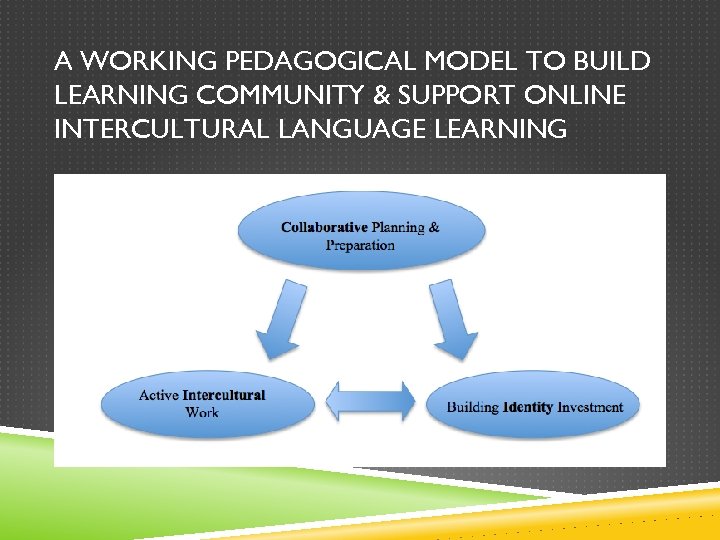 A WORKING PEDAGOGICAL MODEL TO BUILD LEARNING COMMUNITY & SUPPORT ONLINE INTERCULTURAL LANGUAGE LEARNING
 1. COLLABORATIVE PLANNING & PREPARATION If possible, engage learners in the planning, goals/focus, topics of the exchange Conduct pre-exchange briefings, targeted learning and planning sessions and then early-exchange activities: Exploring personal practices, differences in communicative norms/expectations in online interactions and negotiating new, SHARED group norms Explicitly discussing/exploring the ‘implicit’ systems of culturally informed behaviour/expectations Exploring intercultural self-awareness/communication skills and then the intercultural experiences of the group
 CANADA-FRANCE-HAITI E-NEWSLETTER COLLABORATION “I loved his class and this project…. It didn’t feel like French class…” (Turnbull & Lawrence, 2003)
 KEY PREPARATORY WORK: HIGHLIGHTING IMPLICIT ASPECTS OF CULTURE USING CULTURE-GENERAL FRAMEWORKS Language use & non-verbal behaviour Communication styles, discourse patterns Value orientations Focusing on intercultural self-awareness and developing exploratory, critically reflective intercultural learning approaches (Bennett, 2009; Byram & Feng, 2004) …making the familiar, unfamiliar.
 2. THE NEED TO BUILD IDENTITY INVESTMENT The most salient feature of a motivating classroom environment is the relationships between the class members, the ‘we’ feeling of a group (Dörnyei, 2007) …Built on intermember acceptance and shared commitment to task/purpose of the group…
 STRATEGIES TO BUILD IDENTITY INVESTMENT Promote activities where group members learn about each other to build/deepen relationships and investment with each other (actively working with cultural and linguistic capital) Explore learners’ linguistic and intercultural wealth in identity positioning/negotiation Engage promixity, contact and interaction through group work, opportunities for spontaneous interaction to bond learners Use synchronous tools (chat, videoconferencing, Google+, Skype) to develop peer-to-peer relationships, deepen group investment (Kramsch & Thorne, 2002) Use asynchronous tools (discussions, blogs, wikis, twitter) to explore learner-centred topics, share narratives/experiences, position identities and develop linguistic/intercultural learning material for analysis/reflection
 3. ACTIVE INTERCULTURAL WORK BUILDING ON PREPARATORY WORK Proactively work with/debriefing ‘rich points’ (Agar, 2006) – intercultural surprises, questions, miscommunications and successes Actively monitor online interactions, check in with learners, revisit culture general learning principles, introduce relevant intercultural topics, and encourage nonthreatening rich point sharing Establish a supportive teacher presence, modeling desired online behaviour Exploit the hybrid delivery – using class time and synchronous tools to discuss/debrief challenging topics, asynchronous tools to reflect/share Adopt an exploratory, curious approach to intercultural learning using intercultural tools like the D. I. E. & K. (Describe – Interpret – Evaluate & Knowledge) to suspend judgment and seek alternative frames of reference Promote an emic, insider’s approach to intercultural learning to see the ‘complexity’ of cultural behaviour
 …the essential difference between successful and unsuccessful email exchanges was the degree of intercultural competence that could enable partners to develop the interpreting and relating skills necessary to build interculturally rich relationships (O’Dowd, 2003).
 SOME STRATEGIES… 1. 2. 3. 4. 5. Involving students early in the planning stage and throughout the project – building buy-in and promoting ownership/investment (student resources/Q & C pages) Establishing early contact with another institution/group to begin planning (teacher collaboration area) Conducting pre-exchange work with culture, intercultural awareness, playful technology prep and discussing communicative norms/expectations (in f 2 f and online environments), adopting a reflective ‘me’ focus Explicitly teaching online peer feedback strategies Explicitly, explicitly… discussing/posting instructions, schedule/deadlines and actively inviting questions
 SOME STRATEGIES… 6. 7. 8. 9. Using the f 2 f and online environments strategically to complement each other Exploiting synchronous and asynchronous tools (video podcasts/images) to provide multiple modes of communication, expression, reflection and intercultural language input Taking time (group activities) to build community, group norms and investment in peer collaboration and intercultural learning Modeling social presence with a supportive teacher presence (video podcasts) and actively monitoring interactions, follow up directly with students/reminders
 POTENTIAL BENEFITS OF ONLINE INTERCULTURAL COLLABORATION? Rich opportunities to build language acquisition, intercultural knowledge To develop meaningful relationships and build curiosity to extend intercultural and language learning beyond the class Opportunities to build 21 st century communication skills “The project was great. It made me so curious about these people and places. I can’t wait to learn more and hopefully visit some day. ” …. student in the Canada-France-Haiti e-newsletter exchange “The WIKI is so interesting, and I like it a lot. It makes us improve our English, and teaches us how to communicate with others from different countries. ”
 Questions/comments? & give-aways… geoff. lawrence@utoronto. ca
 OTHER INTERCULTURAL ACTIVITY TYPES: Simulations Artifact analysis (e. g. , ads) to elicit/contrast value orientation differences Comparative text response analysis (to highlight differences in cultural experience) Proverb analysis (contrasting value orientations) Deconstructing stereotypes by hearing multiple voices/experiences from “one” cultural background Intercultural assessments – defining individual communication style orientations, etc.
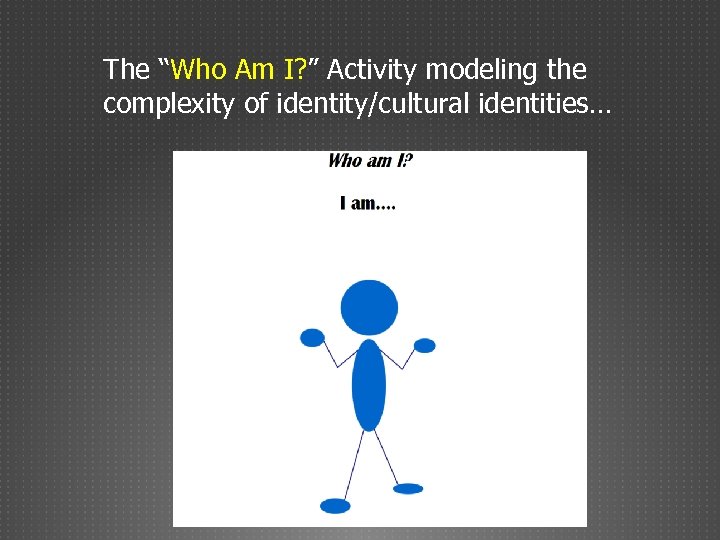 The “Who Am I? ” Activity modeling the complexity of identity/cultural identities…
 The “Who Am I” Identity Dialogue. . . 1. In reviewing the figure, which three identities are the most important to you? 2. Which one identity is shaped by the values of your ethnic/cultural membership? What are yours ethnic/cultural membership values? Do they differ from your personal values? 3. Looking at the figure again, which one identity are you most comfortable with? Why? 4. Which one identity are you least comfortable with? Why? 5. If someone wanted to find out more about who you are, how should they approach you? How should they begin? What are the best ways to get to know you?