 Скачать презентацию A Water Primer 1998 by Peter Berck
5061084d6546b939b95bb93424b122a7.ppt
- Количество слайдов: 32



A Water Primer © 1998 by Peter Berck Copyright 1998 by Peter Berck 1
Water Economics z. Rain yproperty rights z. Reservoirs, Canals, and Treatment y. Efficient Pricing y. Border Prices y. Subsidies for Whom? P. Berck 2
Property Rights z. Limited as to extent yright to use: consumptive use v. total use ytransport: use only here or can transport yhydraulic mine: damaging uses prohibited z. Water flow is Stochastic ysome years a lot, others a little P. Berck 3
The Uncertainty Paradigm z. Distinct states of nature (SON) yrains a little. Say 0 - 10”, 1000 ac ft available y medium amount, say 11 - 20”, 2000 ac ft yrains a high amount, say 20” +, 4000 ac ft. z. Probability of each SON y. PL + Pm + Ph =1 z. Rights give rules by SON P. Berck 4
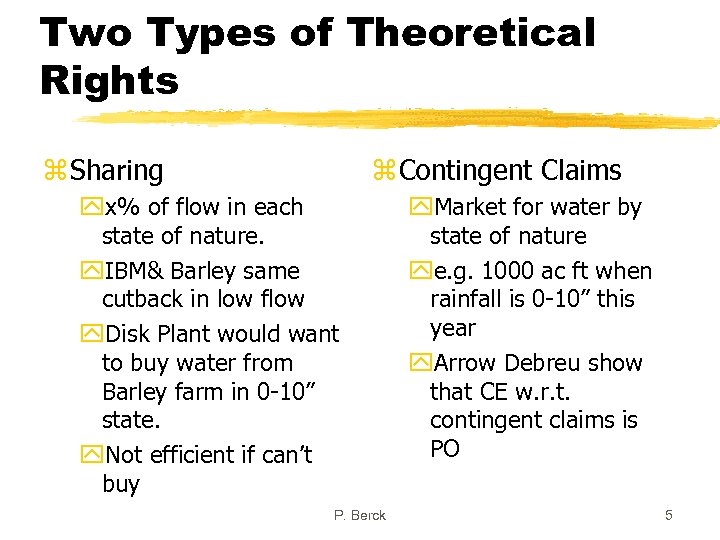
Two Types of Theoretical Rights z Sharing z Contingent Claims yx% of flow in each state of nature. y. IBM& Barley same cutback in low flow y. Disk Plant would want to buy water from Barley farm in 0 -10” state. y. Not efficient if can’t buy P. Berck y. Market for water by state of nature ye. g. 1000 ac ft when rainfall is 0 -10” this year y. Arrow Debreu show that CE w. r. t. contingent claims is PO 5
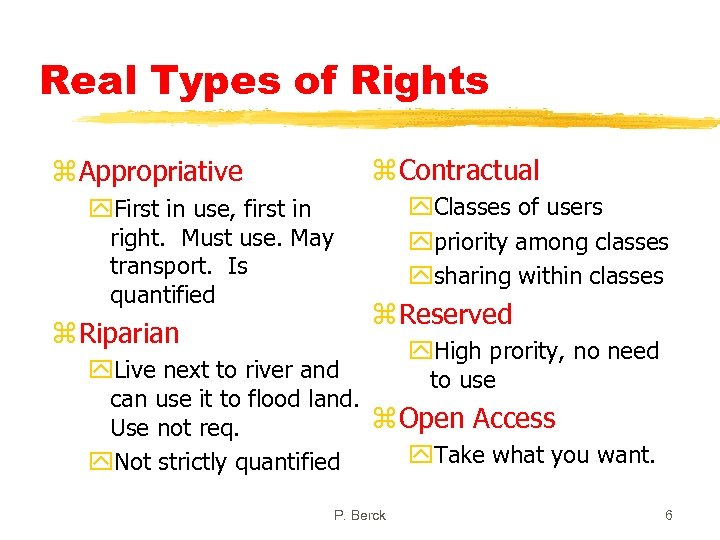
Real Types of Rights z Appropriative y. First in use, first in right. Must use. May transport. Is quantified z Riparian z Contractual y. Classes of users ypriority among classes ysharing within classes z Reserved y. High prority, no need to use y. Live next to river and can use it to flood land. z Open Access Use not req. y. Take what you want. y. Not strictly quantified P. Berck 6
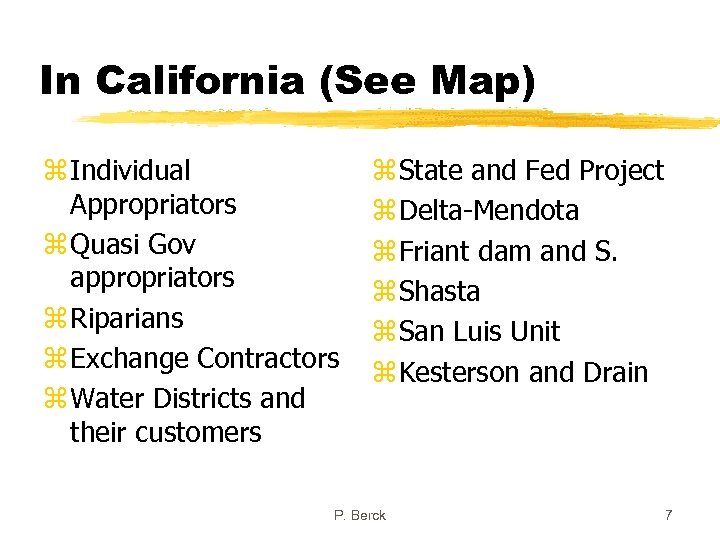
In California (See Map) z Individual Appropriators z Quasi Gov appropriators z Riparians z Exchange Contractors z Water Districts and their customers z State and Fed Project z Delta-Mendota z Friant dam and S. z Shasta z San Luis Unit z Kesterson and Drain P. Berck 7
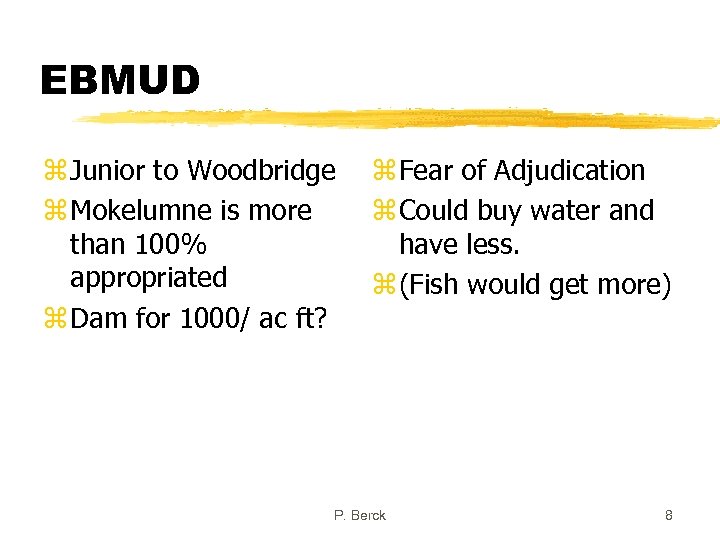
EBMUD z Junior to Woodbridge z Mokelumne is more than 100% appropriated z Dam for 1000/ ac ft? z Fear of Adjudication z Could buy water and have less. z (Fish would get more) P. Berck 8
Rights Issues z. Transferability y. Within Basin? Between Basins y. Security of transferred rights y. Damage to non-participants z. Security y. Use it or lose it. z. Availability yevery two weeks? Little bits daily? P. Berck 9
Claims about Appropriative Rights z. Transferable, Divisible, Appropriative rights are equivalent to contingent claims. By Arrow-Debreu, they are efficient. (Berck and Lipow) z. Every utility maximizer prefers senior to junior appropriative rights. (Burness and Quirk) P. Berck 10
State Contingent Claim z. Expand notion of goods to include things like y. Umbrella when it rains y. Umbrella when it doesn’t rain z. Every state of nature has different goods z. CE w. r. t. contingent goods is PO P. Berck 11
Contingent Claims z. Right to water in ONLY one SON is a contingent claim. z. Treat each contingent claim as a separate good. z. Means can buy and sell “water if there are between 0 and 10” of rainfall” z. First Welfare Theorem says a Competitive Equilibrium is a Pareto Optima. P. Berck 12
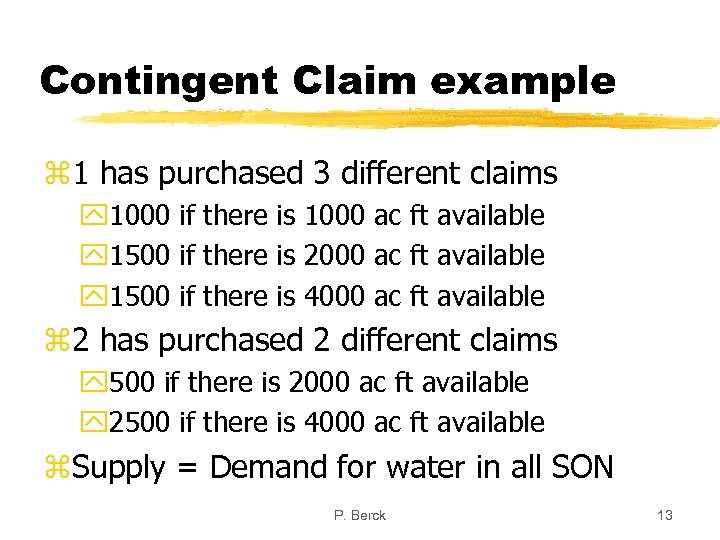
Contingent Claim example z 1 has purchased 3 different claims y 1000 if there is 1000 ac ft available y 1500 if there is 2000 ac ft available y 1500 if there is 4000 ac ft available z 2 has purchased 2 different claims y 500 if there is 2000 ac ft available y 2500 if there is 4000 ac ft available z. Supply = Demand for water in all SON P. Berck 13
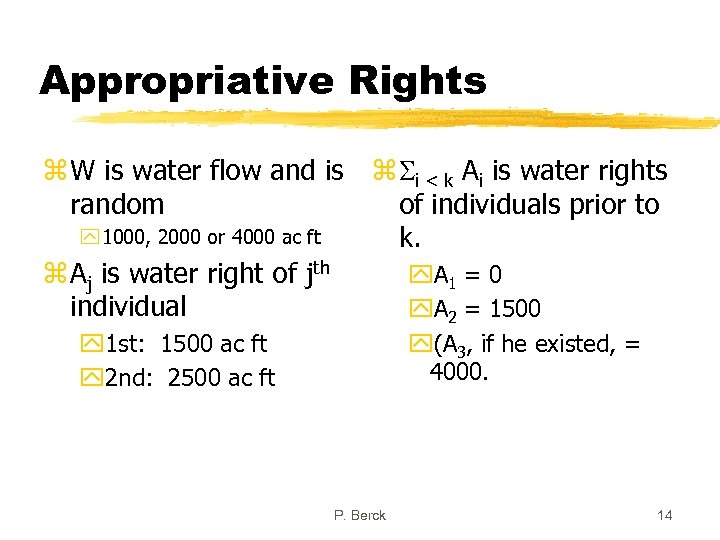
Appropriative Rights z W is water flow and is z Si < k Ai is water rights random of individuals prior to y 1000, 2000 or 4000 ac ft k. y. A 1 = 0 z Aj is water right of jth individual y. A 2 = 1500 y(A 3, if he existed, = 4000. y 1 st: 1500 ac ft y 2 nd: 2500 ac ft P. Berck 14
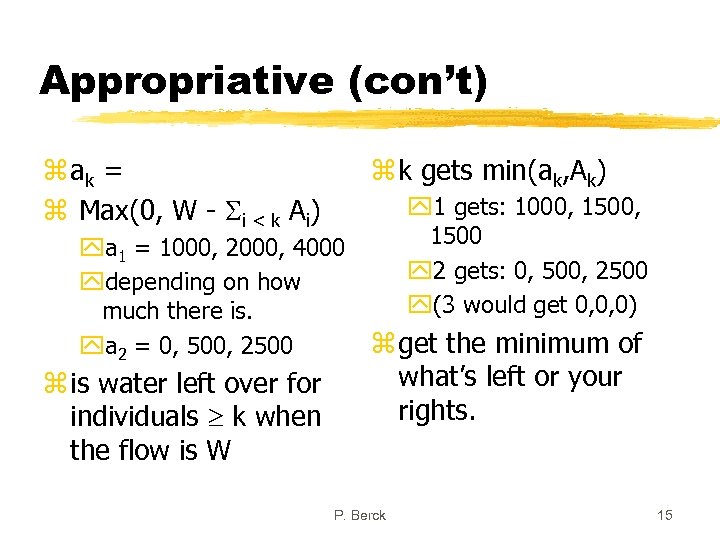
Appropriative (con’t) z ak = z Max(0, W - Si < k Ai) z k gets min(ak, Ak) ya 1 = 1000, 2000, 4000 ydepending on how much there is. ya 2 = 0, 500, 2500 z is water left over for individuals k when the flow is W y 1 gets: 1000, 1500 y 2 gets: 0, 500, 2500 y(3 would get 0, 0, 0) z get the minimum of what’s left or your rights. P. Berck 15
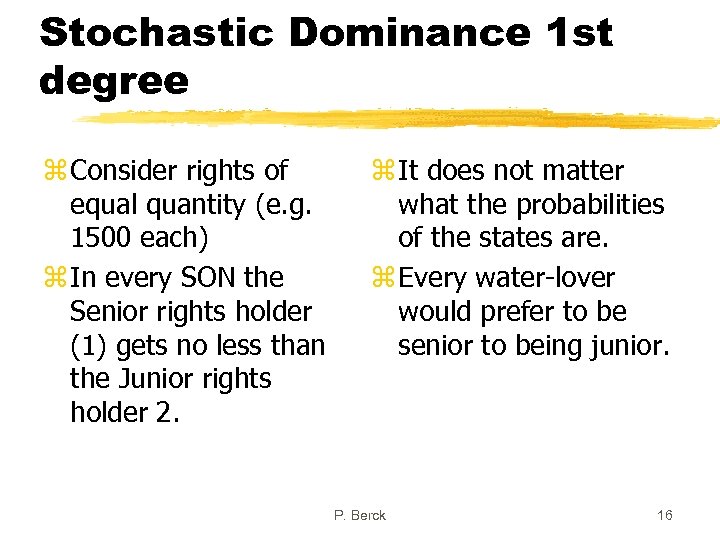
Stochastic Dominance 1 st degree z Consider rights of equal quantity (e. g. 1500 each) z In every SON the Senior rights holder (1) gets no less than the Junior rights holder 2. z It does not matter what the probabilities of the states are. z Every water-lover would prefer to be senior to being junior. P. Berck 16
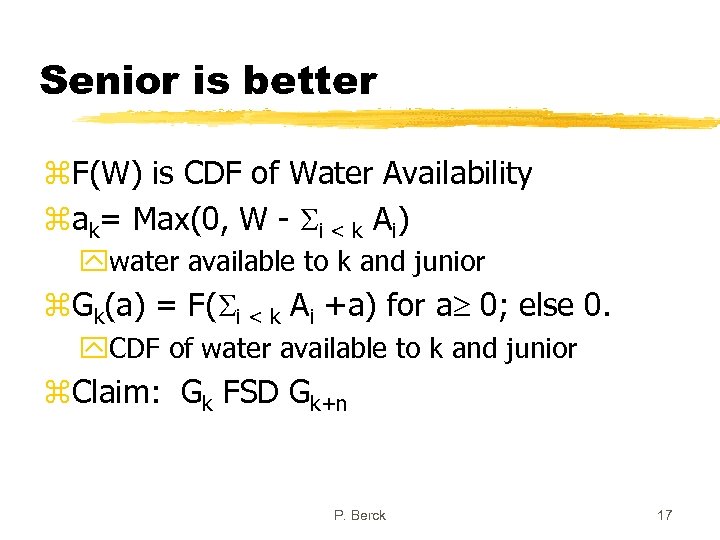
Senior is better z. F(W) is CDF of Water Availability zak= Max(0, W - Si < k Ai) ywater available to k and junior z. Gk(a) = F(Si < k Ai +a) for a 0; else 0. y. CDF of water available to k and junior z. Claim: Gk FSD Gk+n P. Berck 17
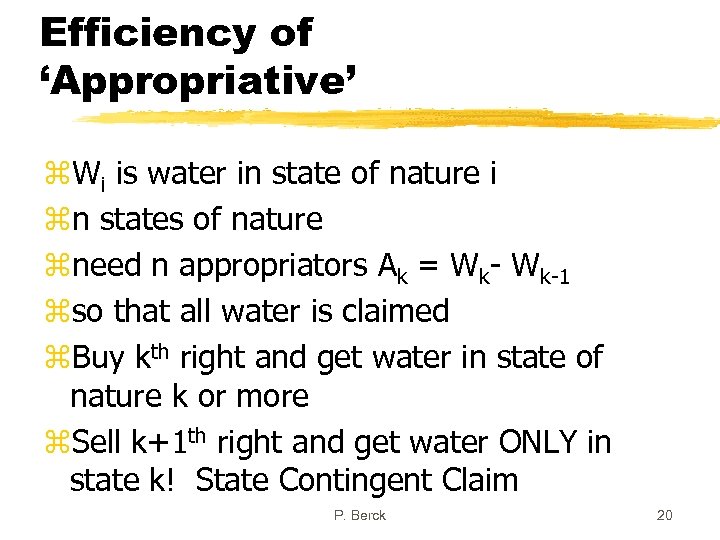
Efficiency of ‘Appropriative’ z. Wi is water in state of nature i zn states of nature zneed n appropriators Ak = Wk-1 zso that all water is claimed z. Buy kth right and get water in state of nature k or more z. Sell k+1 th right and get water ONLY in state k! State Contingent Claim P. Berck 20
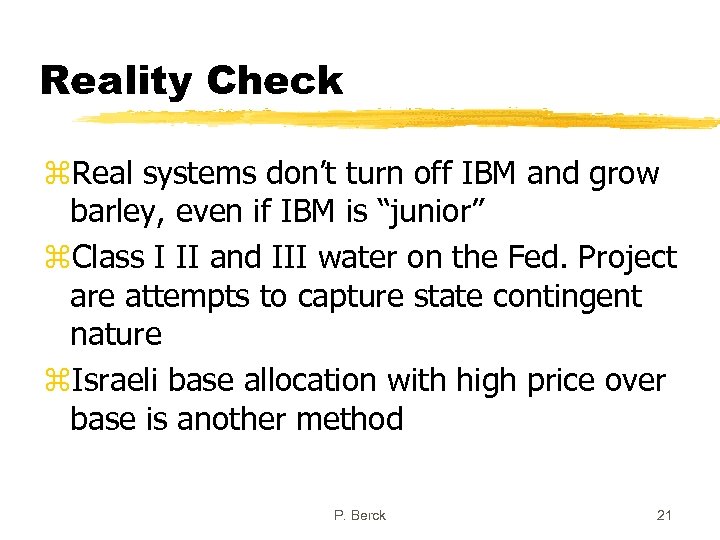
Reality Check z. Real systems don’t turn off IBM and grow barley, even if IBM is “junior” z. Class I II and III water on the Fed. Project are attempts to capture state contingent nature z. Israeli base allocation with high price over base is another method P. Berck 21
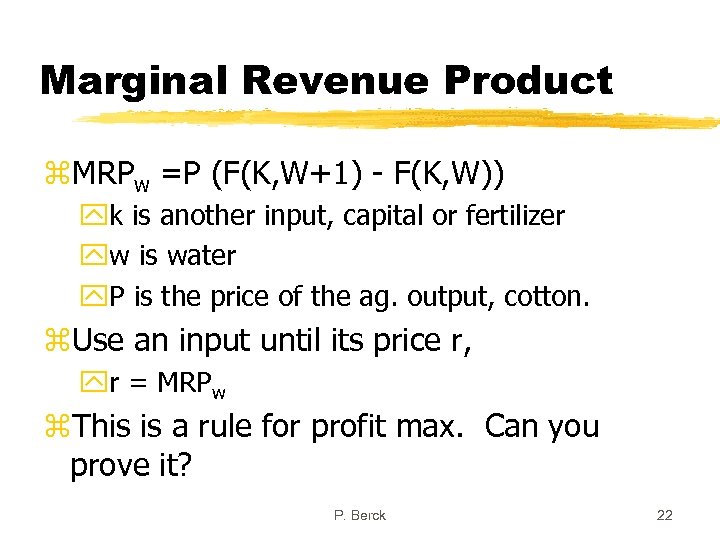
Marginal Revenue Product z. MRPw =P (F(K, W+1) - F(K, W)) yk is another input, capital or fertilizer yw is water y. P is the price of the ag. output, cotton. z. Use an input until its price r, yr = MRPw z. This is a rule for profit max. Can you prove it? P. Berck 22
Economic Efficiency z. Price = MRP y. Price is the (marginal) value of what is produced with the water z. What price? Border Pricing Rule y. Value of tradable is it’s price in trade y. Gifts from government don’t count in price y. Non-tradable goods used to make tradables can also be priced this way P. Berck 23
Water Delivery z. Rain, Reservoirs, Canals, and Treatment z. Should charge y. Value of Raw Water + y. Marginal Cost of Storage+ y. Marginal Cost of Transfer + y. Marginal Cost of Treatment P. Berck 24
Price: An Example z. Cotton is marginal crop y. Acreage adjusts to economic conditions. y. Assume Average Yield y 70 cents per lb for cotton y 12 c is value of cotton from additional m 3 of water. x. Dinar and Ariel; Calif. ‘ 91 x. UC Coop Ext cost data only 8 c /m 3 x. Kislev, Israel Av. 1980 -88. 8. 7 c/m 3 P. Berck 25
MC of Transport z. Israel/Jordan/West Bank y. MC is between 2 and 50 c/m 3 y 2 near the Jordan y 50 in the Negev (Bank, 1990) z. Efficiency: y. On average, grow less cotton in Negev y. Grow more crops near Jordan River P. Berck 26
California Cotton y. Power is priced too low. (Border Price) y. Capital costs are intentionally subsidized (not MC) y. Operating costs are misstated on low side (is MC) y. Cotton is subsidized (Border Price) z. Efficiency? y. Less field crops in dry times in Westlands P. Berck 27
P MC z. In agriculture, Water often can not pay its transport cost, much less storage or treatment z. Underlying value of water (value of rain) is taken as zero. z. Underlying value of water needs to be found P. Berck 28
Value of Water Rights zmarkets give best evidence of value of underlying rights z. CA has limited markets for water rights zmarkets also lead to efficiency in water allocation zthere are many caveats P. Berck 29
Water Sales are Difficult z. Rights weren’t (and in Mid-east aren’t) saleable z. Ag. and Urban not same water z. Downstream users object z. Multiple agencies all end up with veto ysuppose every time you tried to buy a candy bar you had to notify your dentist? P. Berck 30
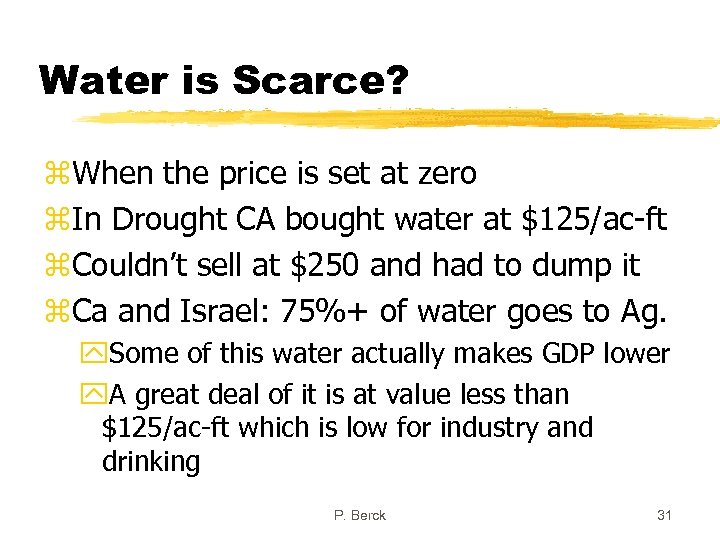
Water is Scarce? z. When the price is set at zero z. In Drought CA bought water at $125/ac-ft z. Couldn’t sell at $250 and had to dump it z. Ca and Israel: 75%+ of water goes to Ag. y. Some of this water actually makes GDP lower y. A great deal of it is at value less than $125/ac-ft which is low for industry and drinking P. Berck 31
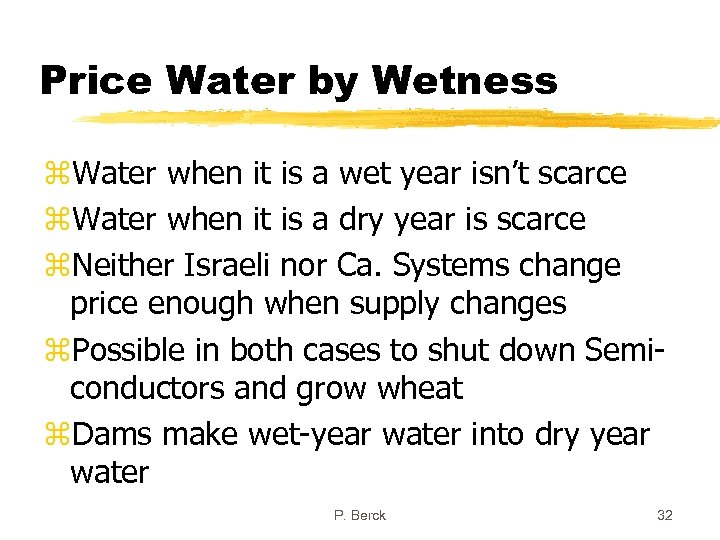
Price Water by Wetness z. Water when it is a wet year isn’t scarce z. Water when it is a dry year is scarce z. Neither Israeli nor Ca. Systems change price enough when supply changes z. Possible in both cases to shut down Semiconductors and grow wheat z. Dams make wet-year water into dry year water P. Berck 32
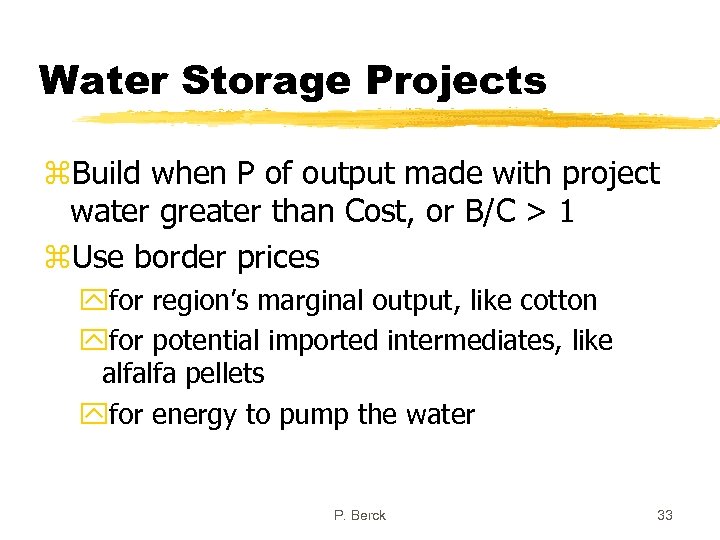
Water Storage Projects z. Build when P of output made with project water greater than Cost, or B/C > 1 z. Use border prices yfor region’s marginal output, like cotton yfor potential imported intermediates, like alfalfa pellets yfor energy to pump the water P. Berck 33
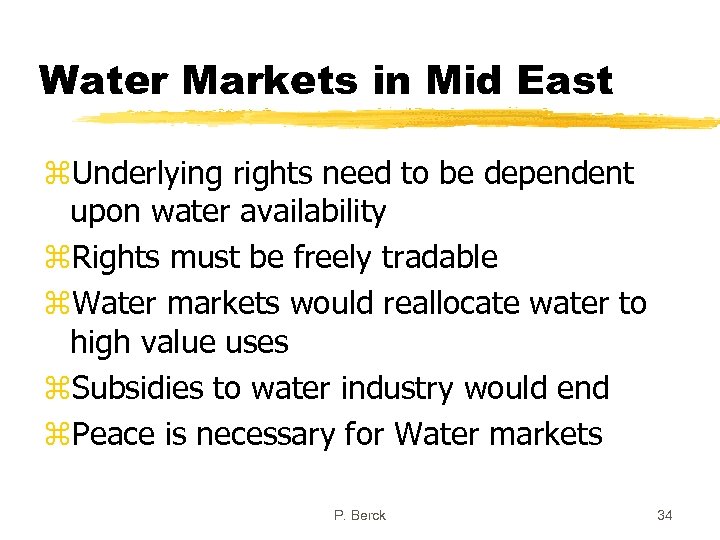
Water Markets in Mid East z. Underlying rights need to be dependent upon water availability z. Rights must be freely tradable z. Water markets would reallocate water to high value uses z. Subsidies to water industry would end z. Peace is necessary for Water markets P. Berck 34
Скачать презентацию A Water Primer 1998 by Peter Berck
5061084d6546b939b95bb93424b122a7.ppt