


 Скачать презентацию A Vision for International Polar Year 2007 -08
3d963e3788af643bd2ea32d09e09eb88.ppt
- Количество слайдов: 29
 A Vision for International Polar Year 2007 -08 Chris Elfring, Director Polar Research Board The National Academies www. us-ipy. org 1 Polar Research Board www. nas. edu/prb
 History of the “International Year” Concept v 1882 -1883: 1 st International Polar Year 11 nations, moving beyond exploration to science, first coordinated international science v 1932 -1933: 2 nd International Polar Year 40 nations, meteorology, magnetism, radio science v 1957 -1958: International Geophysical Year 67 nations, global focus on geosciences and applying WWII technologies v 2007 -2007: 3 rd International Polar Year 2 Broad interdisciplinary focus, with emphasis on environmental change, including human dimensions
 Evolution of IPY 2007 -2008 v Early discussions and PRB Forum - 2002 v USA-UK IPY discussions - early 2003 v ICSU forms IPY Planning Group - March 2003 v Invites nations to participate v Outlines IPY concept v Drafts and circulates outline science plan v Delivers “Framework” report to ICSU v US National Committee - Aug 2003 v Encourages community input at conferences & web v Nurtures agency involvement v Articulates overarching IPY science issues in A Vision for the IPY 2007 -8 (NRC 2004) v Hosts Interagency IPY Implementation Workshop in July 2004 and produces workshop report v Continues role in coordination and communication 3
 IPY Concept v An intense, internationally coordinated campaign of polar observations, research and analysis that will further our understanding of physical and social processes in polar regions, examine their globallyconnected role in the climate system, and establish research infrastructure for the future. v The IPY will galvanize new and innovative observations and research while building on and enhancing existing relevant initiatives. v Timeframe: 4 1 March 2007 – 1 March 2009
 Why International? v The polar regions play key roles in global processes that affect all nations v The science challenges exceed the capability of any one nation v A coordinated approach maximizes outcomes v International collaboration shares the benefits and builds common understanding 5
 Why a “Year”? v Intensive burst of effort will accelerate progress and initiate activities that couldn’t be done otherwise v Intensive investigations will lay groundwork for sustained assessments of environmental change and variability v Provides opportunity for observations at both polar regions over all seasons v Resulting enhanced infrastructure and observing systems will provide improved foundation for ongoing science 6
 Why 2007 -2008? v Pressing need to understand change in the polar regions v Anniversary of past IPYs and IGY provides a firm deadline v Planning horizon is challenging but feasible v New advances in technology and logistics provide ways to address new issues and access new areas 7
 ICSU Leads First International Planning v Open process v 30+ countries involved to date v Over 20 National Committees formed v 450+ research ideas v Individuals v National committees v International organizations v Social Science - Physical Science Dialog v Produces Outline Science Plan and IPY Framework Document 8
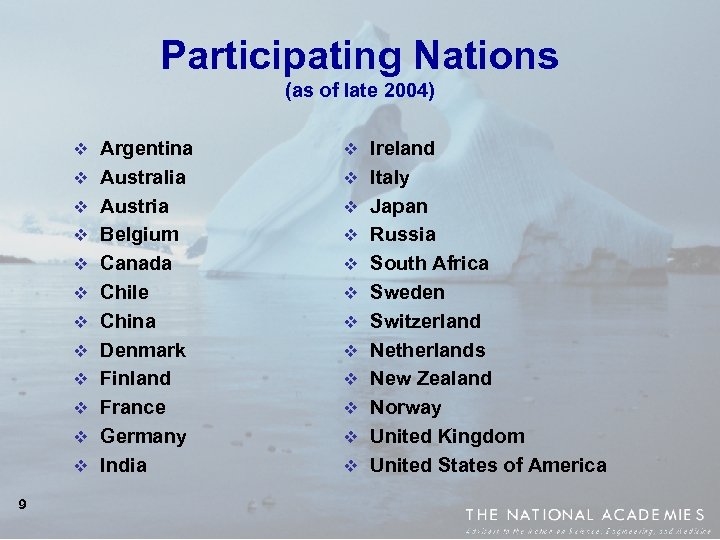 Participating Nations (as of late 2004) v Argentina v Australia v Italy v Austria v Japan v Belgium v Russia v Canada v South Africa v Chile v Sweden v China v Switzerland v Denmark v Netherlands v Finland v New Zealand v France v Norway v Germany v United Kingdom v India 9 v Ireland v United States of America
 ICSU Framework for IPY v ICSU Framework Report includes: v Science themes (6) v Observational initiatives (6) v Data management v Education, outreach and communication v Organizational structure v IPY Criteria v Suggested implementation process v New Joint Committee of ICSU-WMO now formed to continue international planning (March 7 -11, 2005 in Paris) 10
 ICSU IPY Themes 1. 2. 3. 4. 5. 6. 11 Determine environmental status of polar regions by quantifying spatial and temporal variability. Quantify past and present environmental and human change in the polar regions Advance understanding of polar - global teleconnections on all scales and processes controlling these interactions Investigate the unknowns at the frontiers of science in the polar regions. Use the unique vantage point of the polar regions to develop and enhance observations on Earth and beyond (Earth's inner core, magnetic field, the Sun and beyond) Investigate cultural, historical, and social processes that shape the resilience and sustainability of circumpolar human societies and identify their contributions to global cultural diversity and citizenship.
 ICSU Observational Initiatives 1. 2. 3. 4. 5. 6. 12 Produce synoptic set of multidisciplinary observations to establish the status of the polar environment in 2007 -2008 Acquire key data sets necessary to understand factors controlling change in the polar environment Establish a legacy of multidisciplinary observational networks Serve as launch of internationally coordinated, multidisciplinary expeditions into new scientific frontiers Help implement polar observatories to study important facets of Planet Earth and beyond Create datasets on the changing conditions of circumpolar human societies from the First IPY 188283 to the present
 ICSU IPY Criteria 1. 2. 3. 4. 5. 6. 7. 8. 9. 10. 11. 12. 13 Makes significant advances within one or more IPY themes Involves at least one polar region and takes place in timeframe Contributes to international collaboration A viable management plan and organisational structure A viable approach for securing funding A viable plan for securing appropriate logistical support Agrees to the principles of IPY data management and proposes a viable data management plan A viable plan or approach for education, outreach and communication activities Foster the next generation of polar researchers Provides opportunity for a legacy (observation sites, facilities, systems) Builds on existing plans and initiatives or at least does not conflict Has interdisciplinary elements (team, project etc. ) Is “endorsed” by one or more National Committees
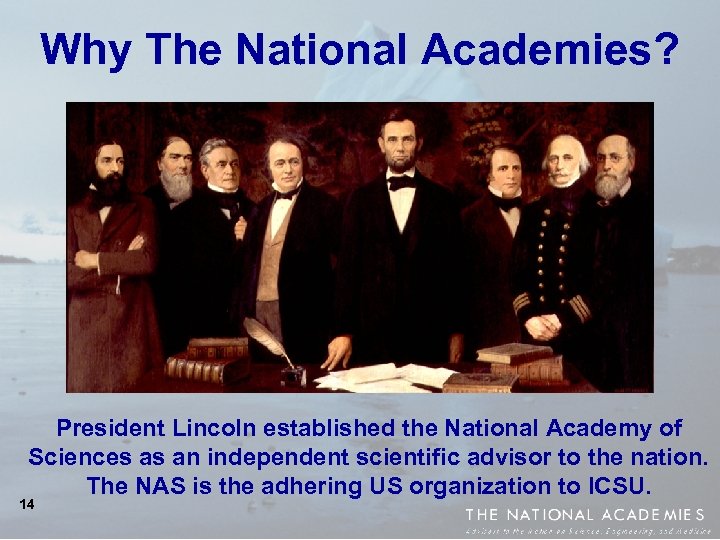 Why The National Academies? President Lincoln established the National Academy of Sciences as an independent scientific advisor to the nation. The NAS is the adhering US organization to ICSU. 14
 US National Committee for IPY 2003 -2005 Mary Albert, Chair, ERDC CRREL Cecilia Bitz, Washington John Kelley, Alaska-Fairbanks Douglas Wiens, Washington at St. Louis Igor Krupnik, Smithsonian Institution Louis Lanzerotti, Bell Labs/Lucent Technologies Philip Smith, Mc. Geary & Smith Jerry Bowen, CBS News Richard Glenn, Arctic Slope Regional Corporation George Somero, Stanford Cristina Takacs-Vesbach, New Mexico 15 Robert Bindschadler, NASA - GSFC David Bromwich, Ohio State Gunter Weller, Alaska-Fairbanks Jacqueline Grebmeier, Tennessee Peter Schlosser, Lamont-Doherty Earth Observatory Chuck Kennicutt (Ex-officio) Texas A&M Terry Wilson (Ex-officio) Ohio State Patrick Webber (Ex-officio) Michigan State Robin Bell (Ex-officio) Lamont-Doherty Earth Observatory
 US National Committee Guides US Planning v Outreach to science communities v Outreach to agencies v Strong influence on international planning v Open and inclusive planning process v Delivery of “Vision Report” v Organization of agency implementation workshop and delivery of workshop report v Continued activities to engage people and ensure that IPY is a success 16
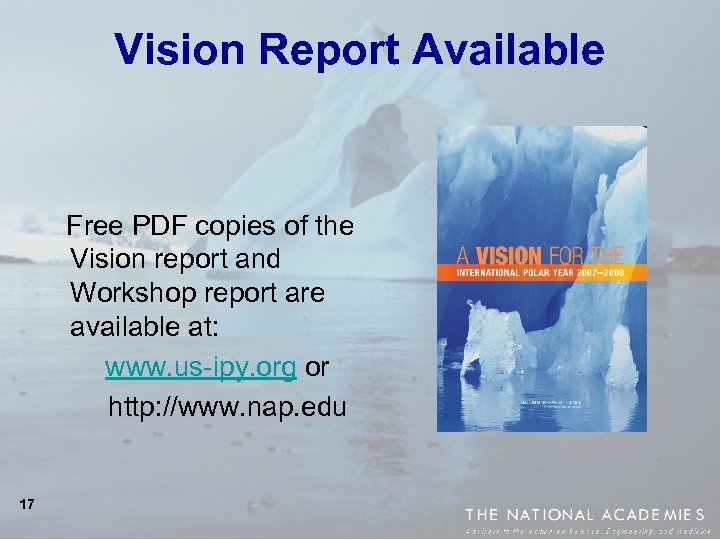 Vision Report Available Free PDF copies of the Vision report and Workshop report are available at: www. us-ipy. org or http: //www. nap. edu 17
 US Goals During IPY From “A Vision for the IPY 2007 -2008” v Assess large-scale environmental change v Explore scientific frontiers in the polar regions v Develop observing networks v Understand human-environment dynamics v Create new connections between science and the public 18
 NRC report recommendation 1: Initiate a sustained effort to assess largescale environmental change and variability in the polar regions v Provide a comprehensive assessment of polar environmental changes v Encourage interdisciplinary studies and the development of models 19
 NRC report recommendation 2: Include studies of coupled human-natural systems critical to societal, economic, and strategic interests v Examine role of the polar regions in globally linked systems v Investigate physical-chemical-biological interactions v Examine the effects of polar environmental change on the human-built environment 20
 NRC report recommendation 3: Explore new scientific frontiers from the molecular to the planetary scale v Involve multidisciplinary studies of biological communities; oceanographic processes; the Earth’s deep interior; and sun-earth connections v Apply new knowledge gained from exploration to questions of societal importance v Invest in new capabilities essential to support interdisciplinary exploration at the poles 21
 NRC report recommendation 4: Design multidisciplinary polar observing networks that provide a long-term perspective v Establish integrated multidisciplinary observing networks that employ new sensing technologies and data assimilation v Conduct an internationally coordinated “snapshot” of the polar regions using all available satellite sensors 22
 NRC report recommendation 5: Invest in critical infrastructure and technology to guarantee enduring benefits v Ensure the long-term availability of assets necessary to support science in the polar regions v Encourage development of innovative technologies (UAVs, AUVs, etc. ) v Develop advanced communications systems v Establish international data standards, policies, and procedures v Train the next generation of scientists, engineers, and leaders 23
 NRC report recommendation 6: Create new connections between science and the public v Develop programs in education and outreach that build on the inherent public interest v Create opportunities for education, training, and outreach for all age groups and build on successful existing models 24
 NRC report recommendation 7: Participate as leaders in International Polar Year 2007 -2008 v Use the IPY to build long-lasting partnerships across national borders v Capitalize on existing agency missions and create new opportunities v Provide mechanisms for individuals, early- career researchers, and small teams to contribute to IPY 25
 The Avalanche Model: Success Requires Broad Participation Early recognition – there is no one “lead” on IPY, but many equally important parts v v v 26 Scientists and Engineers Universities Agencies US National Committee ICSU-WMO Joint Planning Committee v v v Foundations Educators Media Private sector Scouting groups Communities
 NAS Hosts Federal Agency Workshop & Info Sessions …to inform and engage agencies so they find ways for IPY to serve their needs while meeting IPY goals. Participants so far have included: v NSF (designated by the v v v 27 White House as the lead federal agency) NOAA NASA USGS NIH EPA v. Do. D v. Do. I v. Do. E v. State Dept v. OSTP v. Smithsonian v. DHS-USCG
 What Can You Do? v Find ways to get all the necessary “avalanche” participants engaged asap v Work with colleagues in science and agencies to plan activities, increase awareness and move toward implementation v Form international partnerships and help nurture national and international funding sources and logistics coordination v Follow guidance from ICSU-WMO Joint Committee (preliminary Expression of Interest) at www. ipy. org v Check www. us-ipy. org for US IPY information v Commit to making something happen! 28
 For More Information www. us-ipy. org www. national-academies. org/prb Chris Elfring c/o prb@nas. edu Chris Elfring, Polar Research Board The National Academies 500 Fifth Street NW Washington DC 20001 202 334 3479 29