


 Скачать презентацию A View of 20 th and 21 st
57fac8a04c1dbf354df01ab94850cb2f.ppt
- Количество слайдов: 54
 A View of 20 th and 21 st Century Software Engineering Barry Boehm ICSE 2006 Keynote Address
 Outline • Motivation and Context • A 20 th Century View • A 21 st Century View • Conclusions – Timeless principles and aging practices 2
 Motivation and Context • Working definition of “software engineering” • Importance of historical perspective • We are losing our history • Some historical perspectives 3
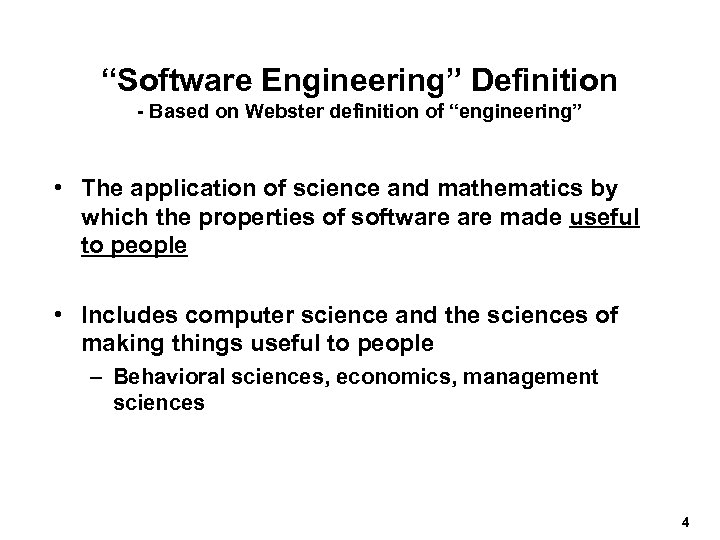 “Software Engineering” Definition - Based on Webster definition of “engineering” • The application of science and mathematics by which the properties of software made useful to people • Includes computer science and the sciences of making things useful to people – Behavioral sciences, economics, management sciences 4
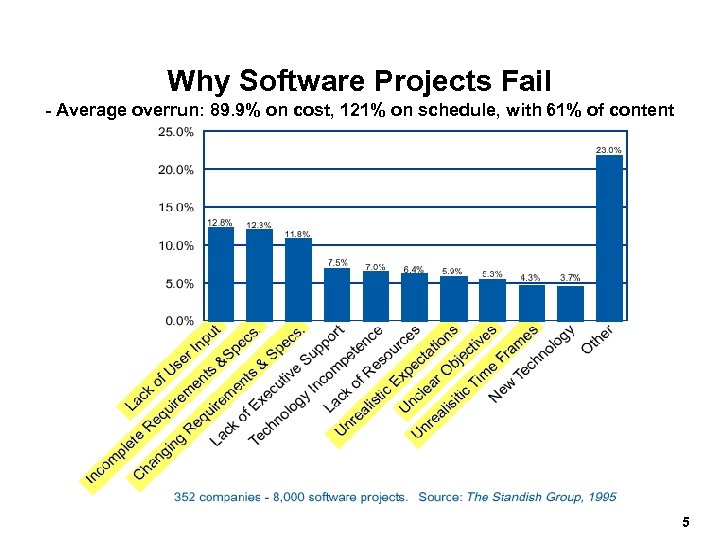 Why Software Projects Fail - Average overrun: 89. 9% on cost, 121% on schedule, with 61% of content 5
 Importance of Historical Perspective • Santayana half-truth: – “Those who cannot remember the past are condemned to repeat it” • Don’t remember failures? – Likely to repeat them • Don’t remember successes? – Not likely to repeat them 6
 We Are Losing Our History • Great people are gone – Hopper, Mills, Royce, Dijkstra, Dahl, Nygaard, Weiser, … • Relative inaccessibility of hardcopy literature – Median ICSE 2005 paper has no reference before 1984 -85 • 77% have no references before 1980 7
 Some Historical Perspectives • 1996 Dagstuhl Workshop – Historians: Aspray, Bergin, Ceruzzi, Mahoney, Tomayko, … – Practitioners: Endres, Parnas, Randell, Ross, Shaw, … – Provided perspectives and insights adapted here • 2001 Software Pioneers conference and book (Broy, Denert; Springer) • NSF/ACM IMPACT Project: impact of research on practice – To date: Configuration Management, Programming Languages – Coming: Reviews, Testing and Analysis, Design, Reuse, Middleware, Resource Estimation • A Hegelian View (drafted at Dagstuhl workshop) – Thesis, Antithesis, Synthesis 8
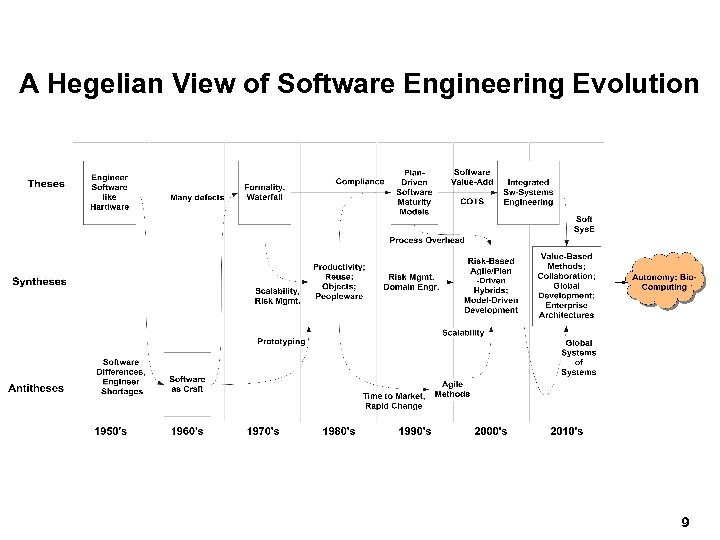 A Hegelian View of Software Engineering Evolution 9
 Outline • Motivation and Context • A 20 th Century View • A 21 st Century View • Conclusions – Timeless principles and aging practices 10
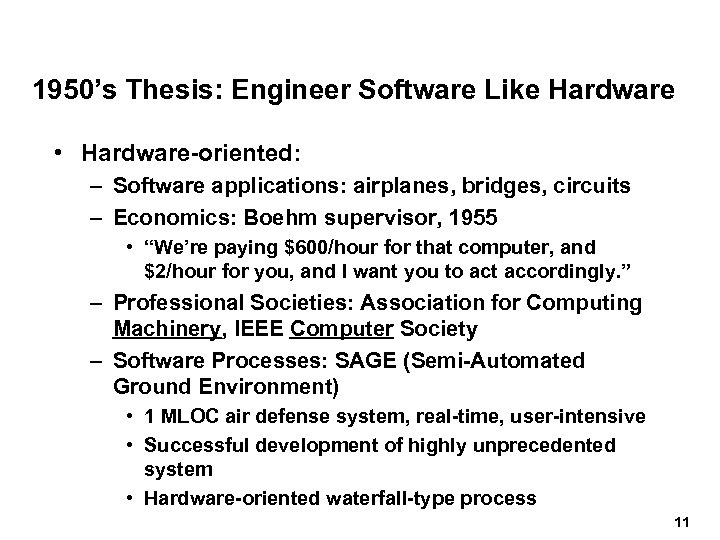 1950’s Thesis: Engineer Software Like Hardware • Hardware-oriented: – Software applications: airplanes, bridges, circuits – Economics: Boehm supervisor, 1955 • “We’re paying $600/hour for that computer, and $2/hour for you, and I want you to act accordingly. ” – Professional Societies: Association for Computing Machinery, IEEE Computer Society – Software Processes: SAGE (Semi-Automated Ground Environment) • 1 MLOC air defense system, real-time, user-intensive • Successful development of highly unprecedented system • Hardware-oriented waterfall-type process 11
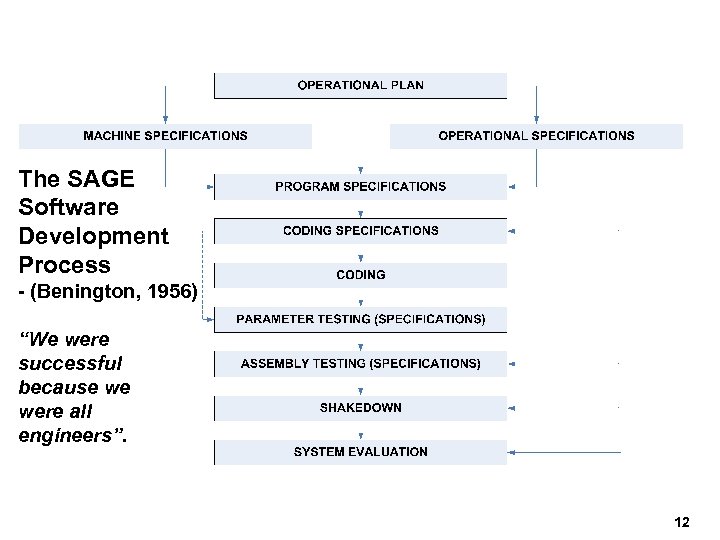 The SAGE Software Development Process - (Benington, 1956) “We were successful because we were all engineers”. 12
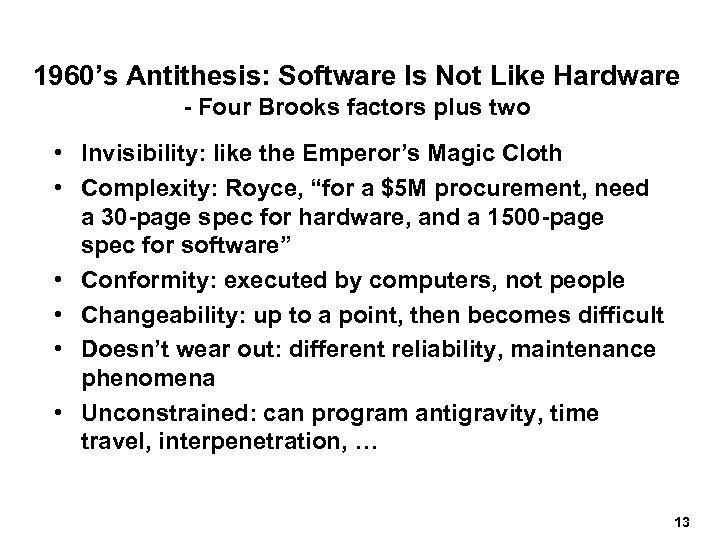 1960’s Antithesis: Software Is Not Like Hardware - Four Brooks factors plus two • Invisibility: like the Emperor’s Magic Cloth • Complexity: Royce, “for a $5 M procurement, need a 30 -page spec for hardware, and a 1500 -page spec for software” • Conformity: executed by computers, not people • Changeability: up to a point, then becomes difficult • Doesn’t wear out: different reliability, maintenance phenomena • Unconstrained: can program antigravity, time travel, interpenetration, … 13
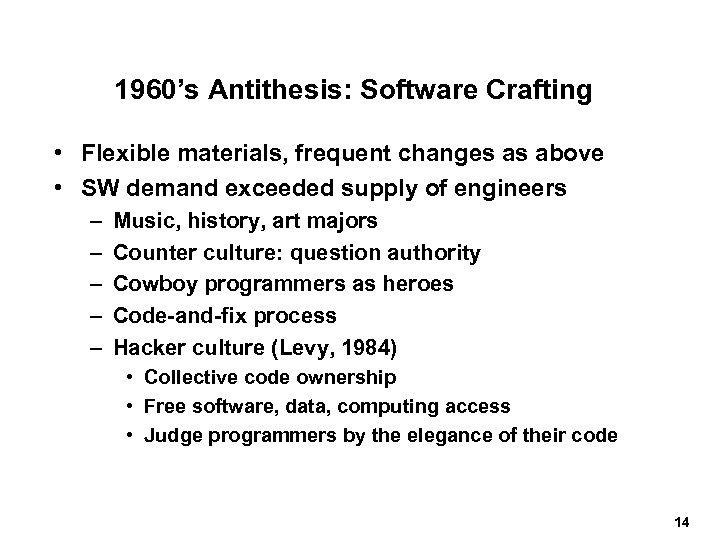 1960’s Antithesis: Software Crafting • Flexible materials, frequent changes as above • SW demand exceeded supply of engineers – – – Music, history, art majors Counter culture: question authority Cowboy programmers as heroes Code-and-fix process Hacker culture (Levy, 1984) • Collective code ownership • Free software, data, computing access • Judge programmers by the elegance of their code 14
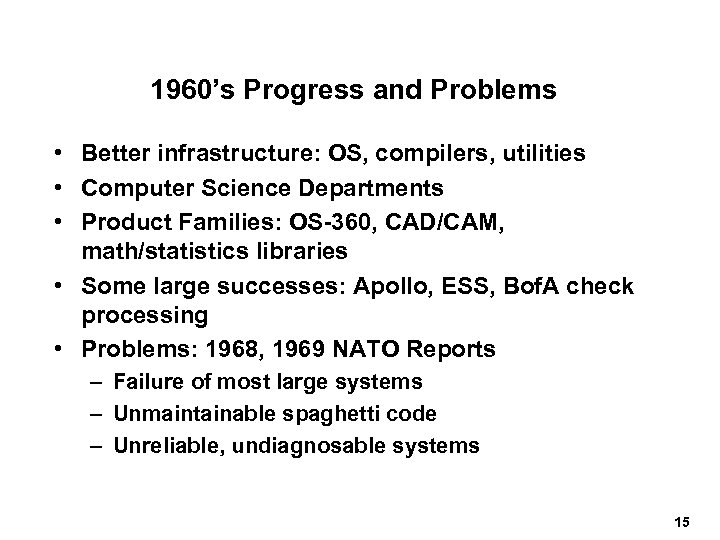 1960’s Progress and Problems • Better infrastructure: OS, compilers, utilities • Computer Science Departments • Product Families: OS-360, CAD/CAM, math/statistics libraries • Some large successes: Apollo, ESS, Bof. A check processing • Problems: 1968, 1969 NATO Reports – Failure of most large systems – Unmaintainable spaghetti code – Unreliable, undiagnosable systems 15
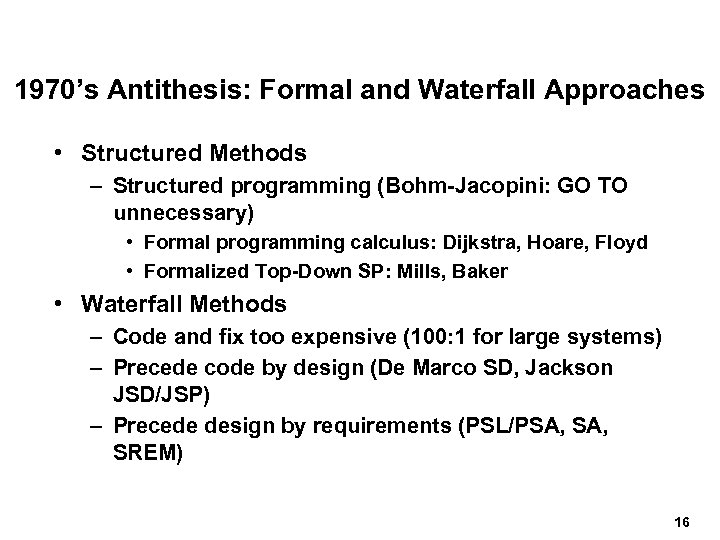 1970’s Antithesis: Formal and Waterfall Approaches • Structured Methods – Structured programming (Bohm-Jacopini: GO TO unnecessary) • Formal programming calculus: Dijkstra, Hoare, Floyd • Formalized Top-Down SP: Mills, Baker • Waterfall Methods – Code and fix too expensive (100: 1 for large systems) – Precede code by design (De Marco SD, Jackson JSD/JSP) – Precede design by requirements (PSL/PSA, SREM) 16
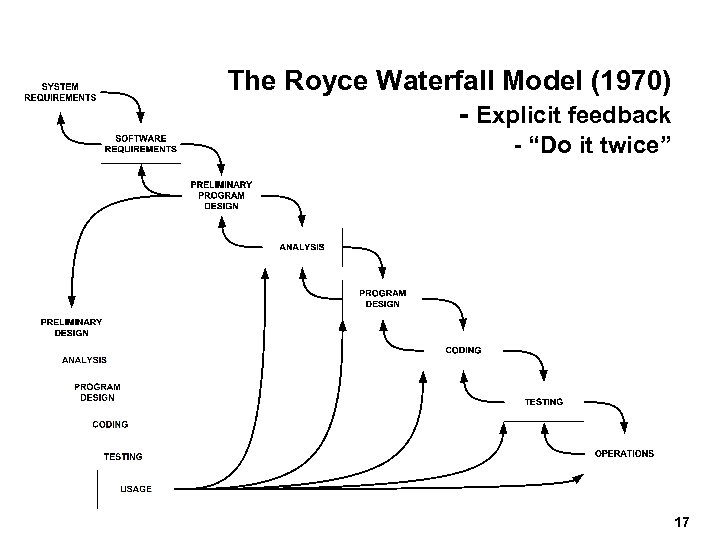 The Royce Waterfall Model (1970) - Explicit feedback - “Do it twice” 17
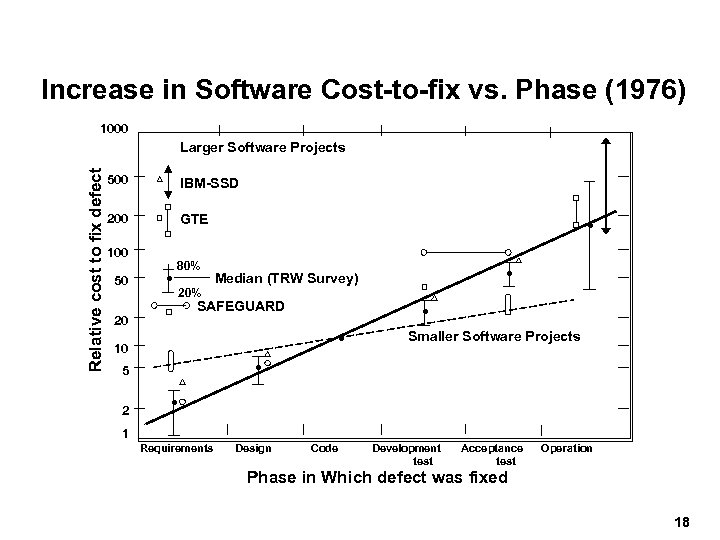 Increase in Software Cost-to-fix vs. Phase (1976) 1000 Relative cost to fix defect Larger Software Projects 500 IBM-SSD 200 GTE 100 50 • 80% 20% • SAFEGUARD 20 • • 10 Smaller Software Projects • 5 2 • Median (TRW Survey) • 1 Requirements Design Code Development test Acceptance test Operation Phase in Which defect was fixed 18
 1970’s: Problems with Formal Methods • Successful for small, critical programs • Largest proven programs around 10 KSLOC • Proofs show presence of defects, not absence – Defects in specification, proofs happen • Scalability of programmer community – Techniques require math expertise, $500/SLOC – Average coder in 1975 survey: • 2 years of college, SW experience • Familiar with 2 languages, applications • Sloppy, inflexible, in over his head, and undermanaged 19
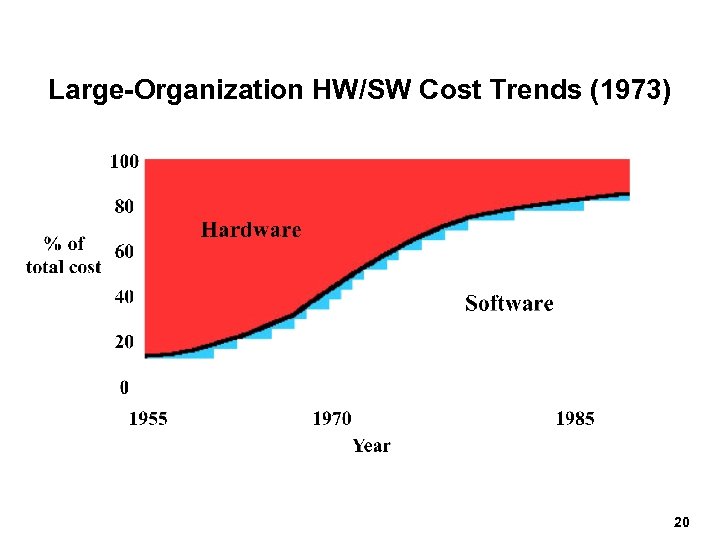 Large-Organization HW/SW Cost Trends (1973) 20
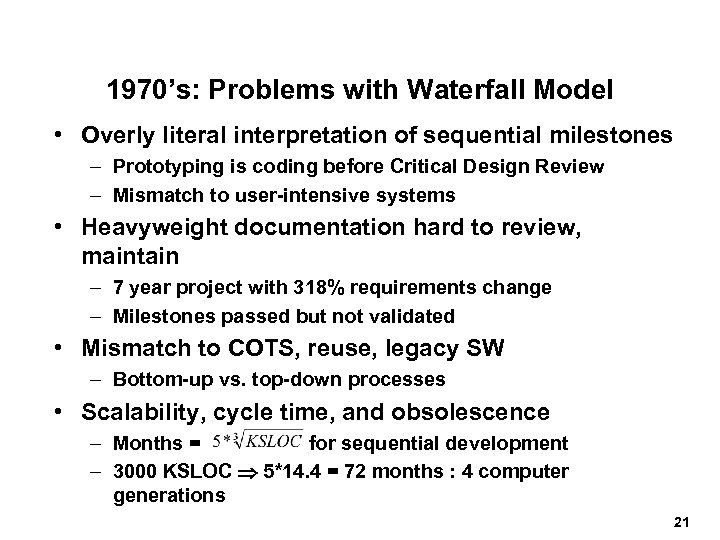 1970’s: Problems with Waterfall Model • Overly literal interpretation of sequential milestones – Prototyping is coding before Critical Design Review – Mismatch to user-intensive systems • Heavyweight documentation hard to review, maintain – 7 year project with 318% requirements change – Milestones passed but not validated • Mismatch to COTS, reuse, legacy SW – Bottom-up vs. top-down processes • Scalability, cycle time, and obsolescence – Months = for sequential development – 3000 KSLOC 5*14. 4 = 72 months : 4 computer generations 21
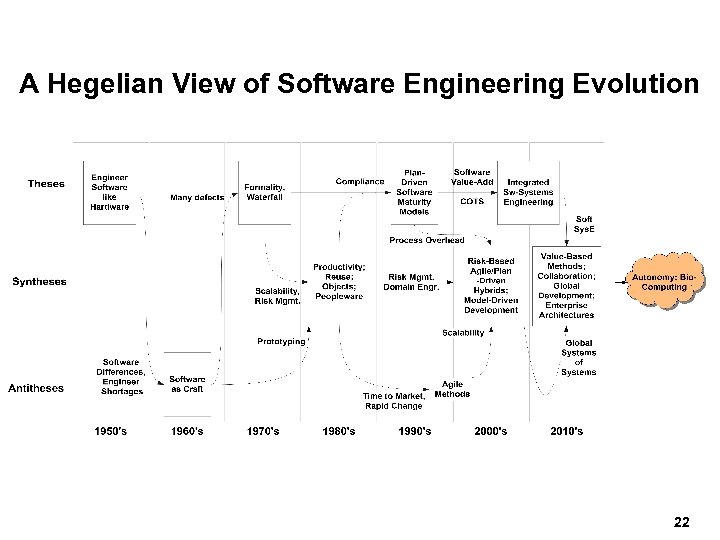 A Hegelian View of Software Engineering Evolution 22
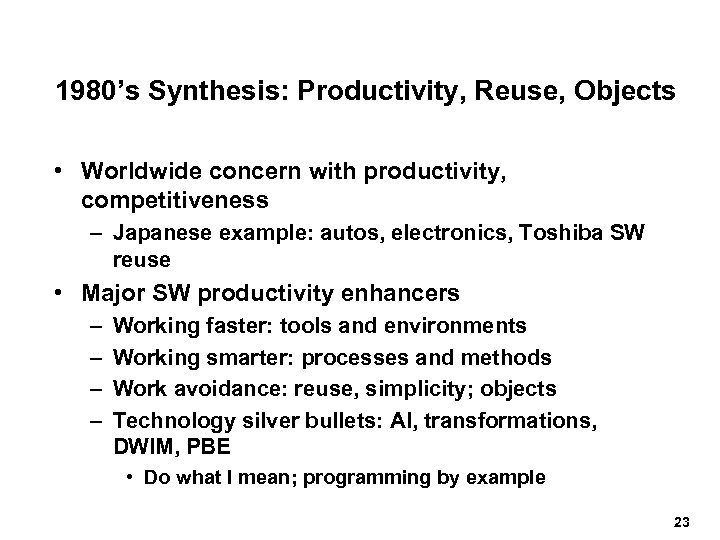 1980’s Synthesis: Productivity, Reuse, Objects • Worldwide concern with productivity, competitiveness – Japanese example: autos, electronics, Toshiba SW reuse • Major SW productivity enhancers – – Working faster: tools and environments Working smarter: processes and methods Work avoidance: reuse, simplicity; objects Technology silver bullets: AI, transformations, DWIM, PBE • Do what I mean; programming by example 23
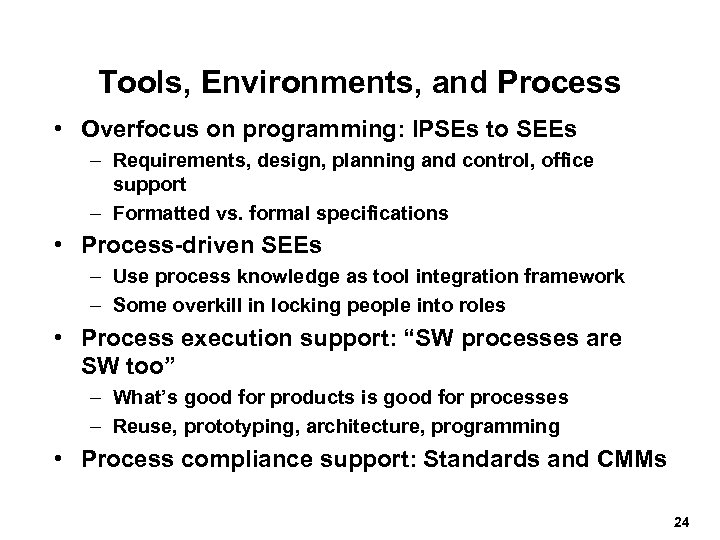 Tools, Environments, and Process • Overfocus on programming: IPSEs to SEEs – Requirements, design, planning and control, office support – Formatted vs. formal specifications • Process-driven SEEs – Use process knowledge as tool integration framework – Some overkill in locking people into roles • Process execution support: “SW processes are SW too” – What’s good for products is good for processes – Reuse, prototyping, architecture, programming • Process compliance support: Standards and CMMs 24
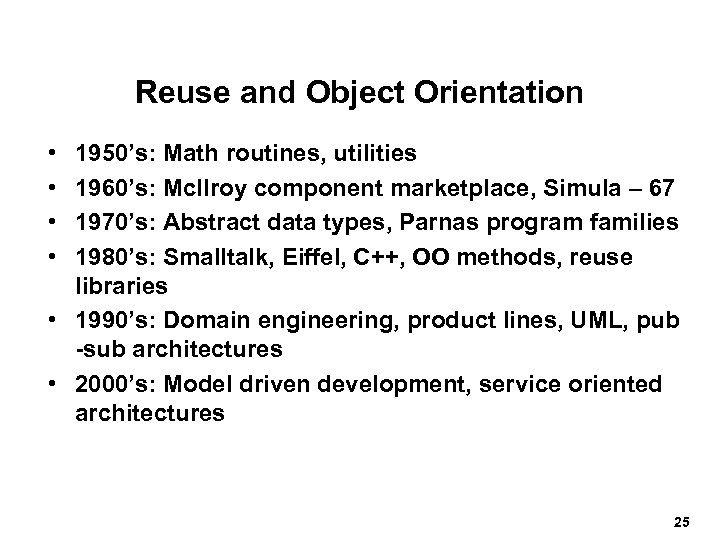 Reuse and Object Orientation • • 1950’s: Math routines, utilities 1960’s: Mc. Ilroy component marketplace, Simula – 67 1970’s: Abstract data types, Parnas program families 1980’s: Smalltalk, Eiffel, C++, OO methods, reuse libraries • 1990’s: Domain engineering, product lines, UML, pub -sub architectures • 2000’s: Model driven development, service oriented architectures 25
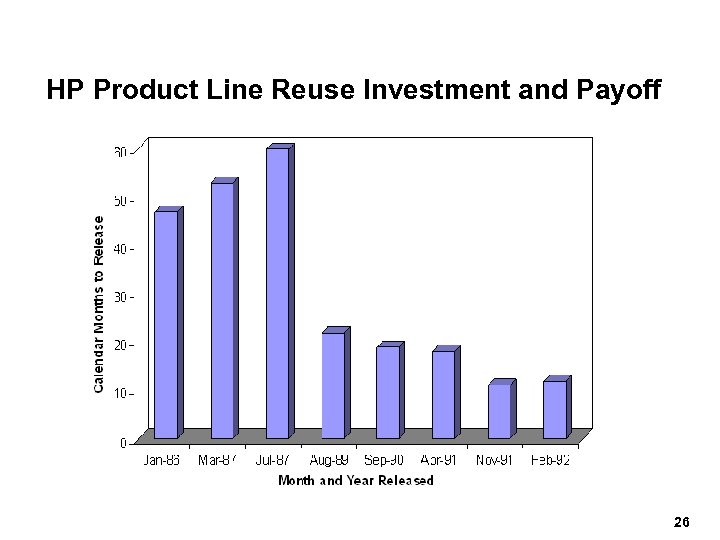 HP Product Line Reuse Investment and Payoff 26
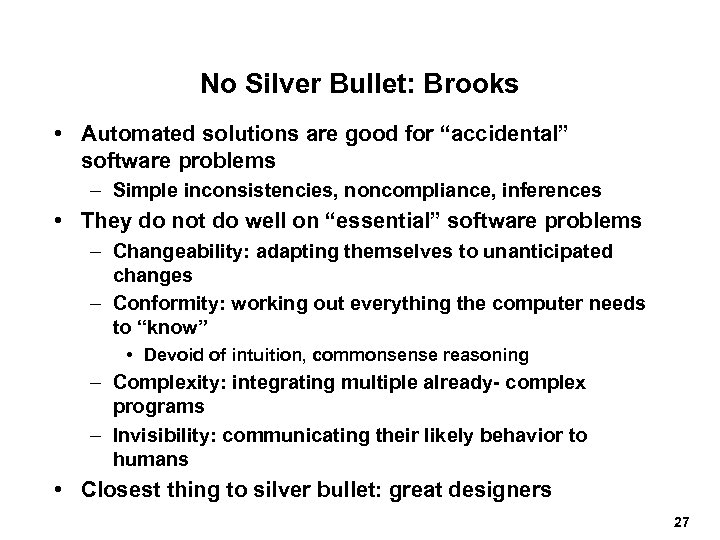 No Silver Bullet: Brooks • Automated solutions are good for “accidental” software problems – Simple inconsistencies, noncompliance, inferences • They do not do well on “essential” software problems – Changeability: adapting themselves to unanticipated changes – Conformity: working out everything the computer needs to “know” • Devoid of intuition, commonsense reasoning – Complexity: integrating multiple already- complex programs – Invisibility: communicating their likely behavior to humans • Closest thing to silver bullet: great designers 27
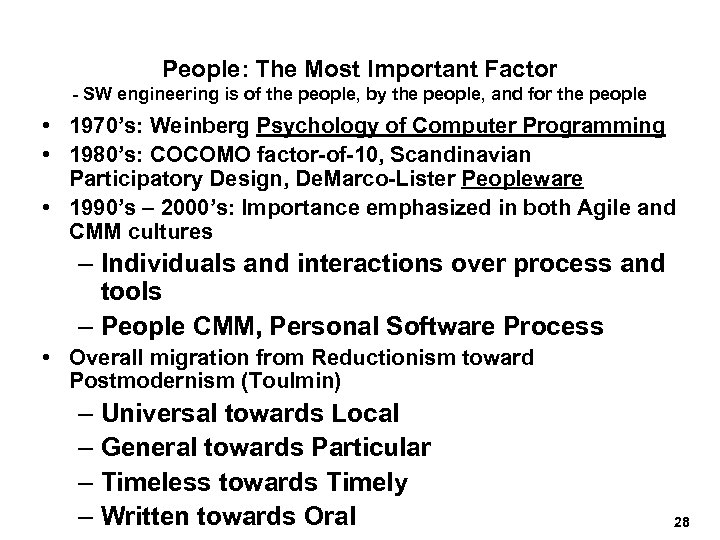 People: The Most Important Factor - SW engineering is of the people, by the people, and for the people • 1970’s: Weinberg Psychology of Computer Programming • 1980’s: COCOMO factor-of-10, Scandinavian Participatory Design, De. Marco-Lister Peopleware • 1990’s – 2000’s: Importance emphasized in both Agile and CMM cultures – Individuals and interactions over process and tools – People CMM, Personal Software Process • Overall migration from Reductionism toward Postmodernism (Toulmin) – Universal towards Local – General towards Particular – Timeless towards Timely – Written towards Oral 28
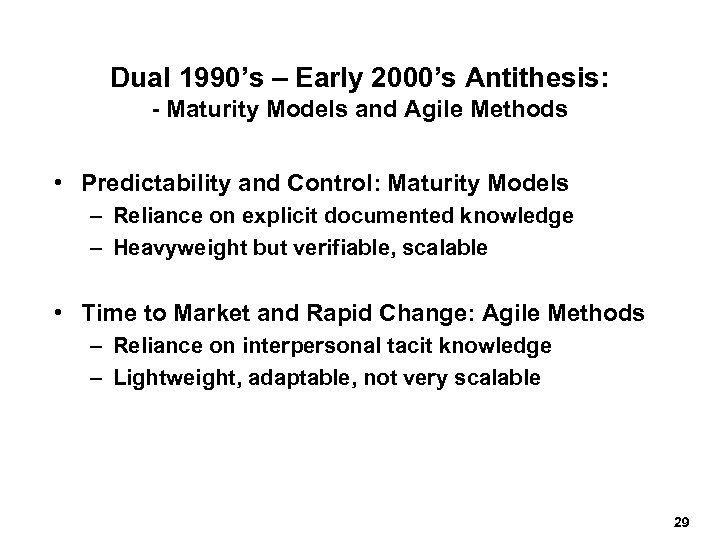 Dual 1990’s – Early 2000’s Antithesis: - Maturity Models and Agile Methods • Predictability and Control: Maturity Models – Reliance on explicit documented knowledge – Heavyweight but verifiable, scalable • Time to Market and Rapid Change: Agile Methods – Reliance on interpersonal tacit knowledge – Lightweight, adaptable, not very scalable 29
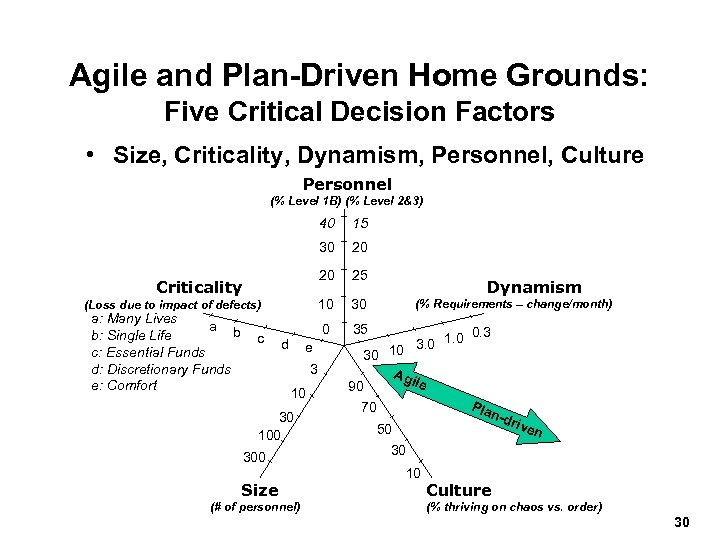 Agile and Plan-Driven Home Grounds: Five Critical Decision Factors • Size, Criticality, Dynamism, Personnel, Culture Personnel (% Level 1 B) (% Level 2&3) 40 30 a: Many Lives a b b: Single Life c: Essential Funds d: Discretionary Funds e: Comfort c 30 0 d 25 10 (Loss due to impact of defects) 20 20 Criticality 15 35 e 3 10 30 100 300 Size (# of personnel) Dynamism (% Requirements – change/month) 0. 3 3. 0 1. 0 30 10 Agi le 90 Pla 70 n-d rive 50 n 30 10 Culture (% thriving on chaos vs. order) 30
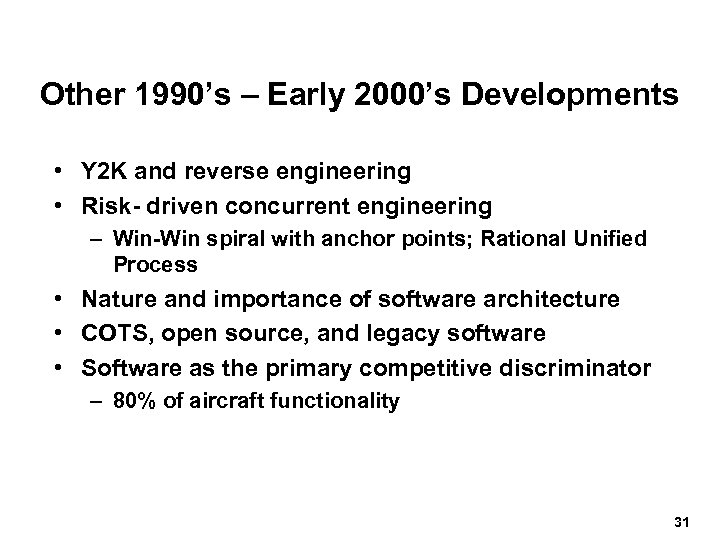 Other 1990’s – Early 2000’s Developments • Y 2 K and reverse engineering • Risk- driven concurrent engineering – Win-Win spiral with anchor points; Rational Unified Process • Nature and importance of software architecture • COTS, open source, and legacy software • Software as the primary competitive discriminator – 80% of aircraft functionality 31
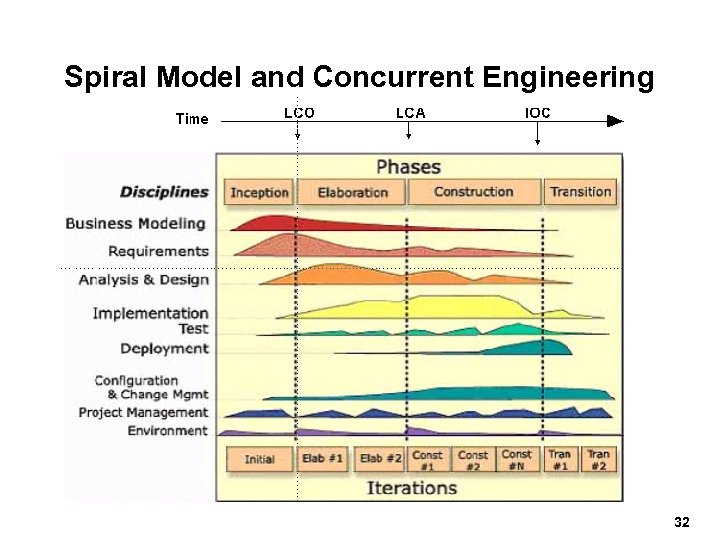 Spiral Model and Concurrent Engineering 32
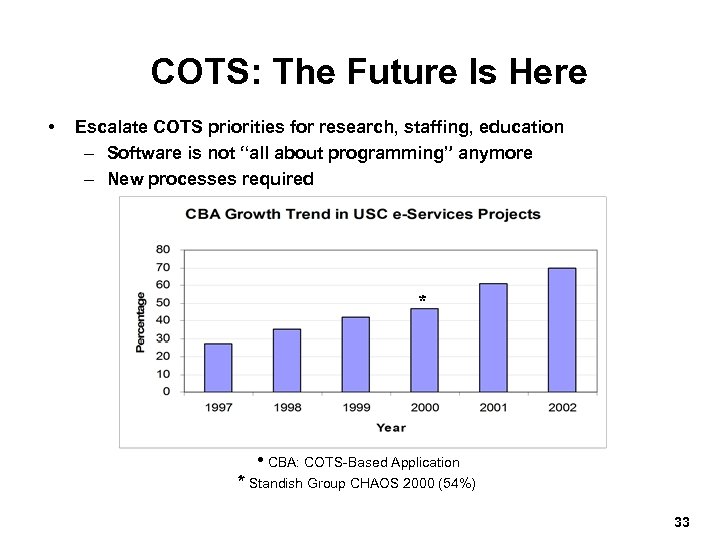 COTS: The Future Is Here • Escalate COTS priorities for research, staffing, education – Software is not “all about programming” anymore – New processes required * • CBA: COTS-Based Application * Standish Group CHAOS 2000 (54%) 33
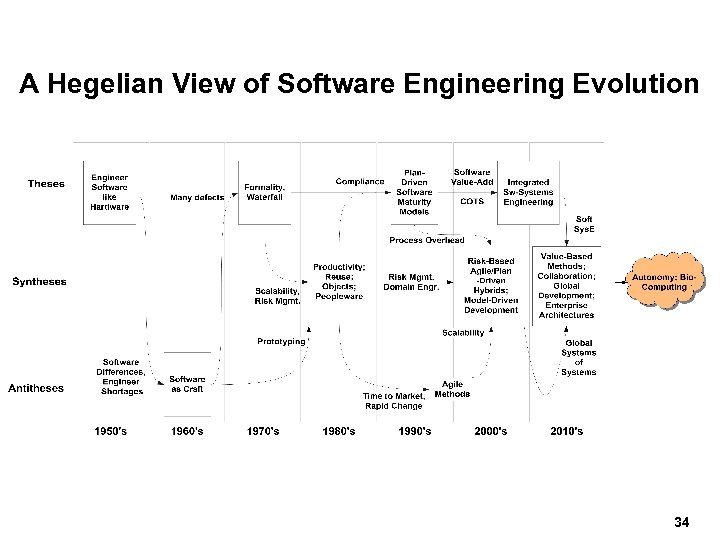 A Hegelian View of Software Engineering Evolution 34
 Mid-2000’s Synthesis: Risk-Driven Hybrid Products and Process • Increasing integration of systems engineering and SW engineering – Increasing trend toward “soft systems engineering” • Increasing focus on usability and value – Fit the software and hardware to the people, not vice versa • Model-driven development and service-oriented architectures • Emergent vs. prespecifiable requirements • Hybrid agile and plan-driven product and process architectures – Encapsulate parts with rapid, unpredictable change – Concurrent build-to-spec, V&V, agile rebaselining 35
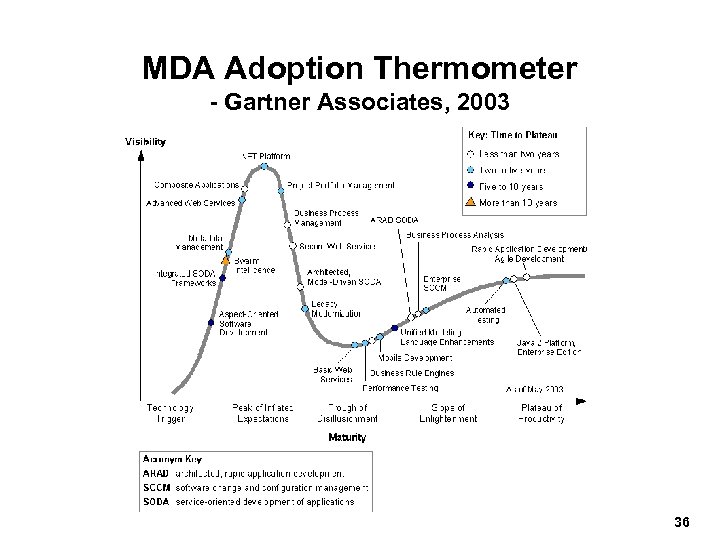 MDA Adoption Thermometer - Gartner Associates, 2003 36
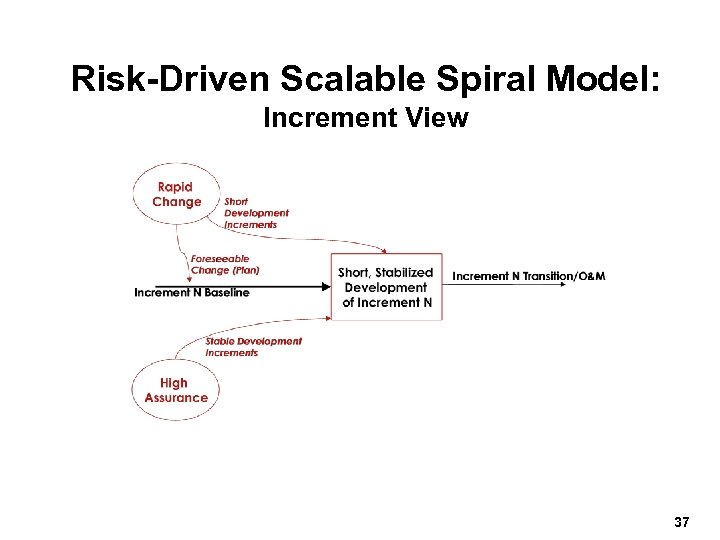 Risk-Driven Scalable Spiral Model: Increment View 37
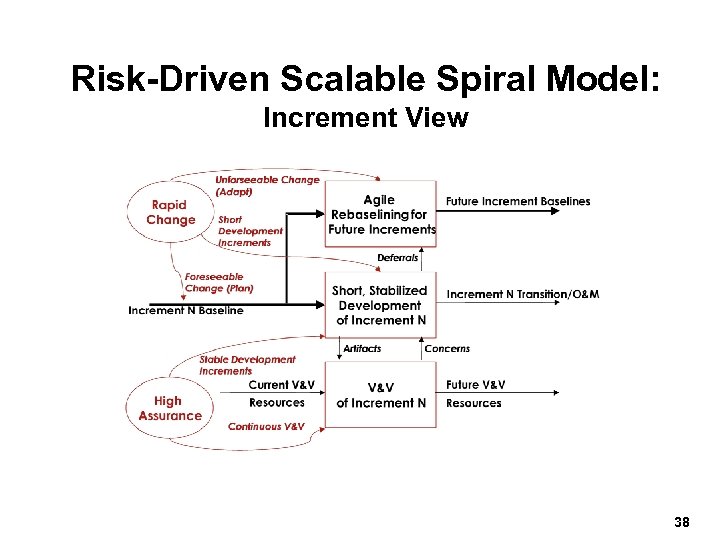 Risk-Driven Scalable Spiral Model: Increment View 38
 Outline • Motivation and Context • A 20 th Century View • A 21 st Century View • Conclusions – Timeless principles and aging practices 39
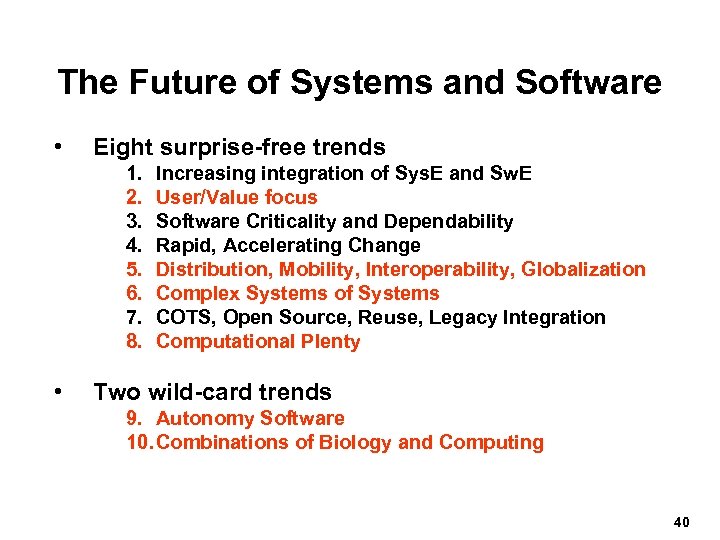 The Future of Systems and Software • Eight surprise-free trends 1. 2. 3. 4. 5. 6. 7. 8. • Increasing integration of Sys. E and Sw. E User/Value focus Software Criticality and Dependability Rapid, Accelerating Change Distribution, Mobility, Interoperability, Globalization Complex Systems of Systems COTS, Open Source, Reuse, Legacy Integration Computational Plenty Two wild-card trends 9. Autonomy Software 10. Combinations of Biology and Computing 40
![Pareto 80 -20 distribution of test case value [Bullock, 2000] Actual business value 100](https://present5.com/presentation/57fac8a04c1dbf354df01ab94850cb2f/image-41.jpg "Pareto 80 -20 distribution of test case value [Bullock, 2000] Actual business value 100") Pareto 80 -20 distribution of test case value [Bullock, 2000] Actual business value 100 80 % of Value for Correct Customer Billing 60 Automated test generation tool - all tests have equal value * 40 20 5 10 15 Customer Type *Usual Sw. E assumption for all requirements, objects, defects, … 41
Pareto 80 -20 distribution of test case value [Bullock, 2000] Actual business value 100 80 % of Value for Correct Customer Billing 60 Automated test generation tool - all tests have equal value * 40 20 5 10 15 Customer Type *Usual Sw. E assumption for all requirements, objects, defects, … 41
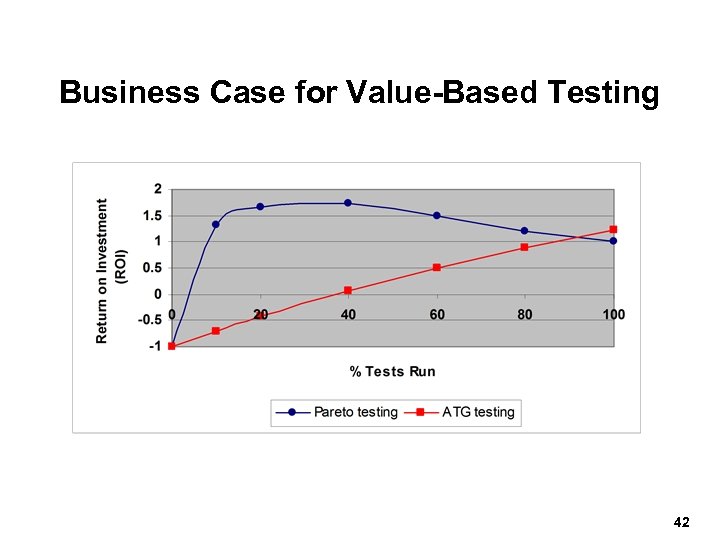 Business Case for Value-Based Testing 42
 Globalization: “The World is Flat” - Friedman, 2005 • Information processing functions can be performed almost anywhere in the world – Low-cost global fiber-optic communications – Overnight global delivery services • Significant advantages in outsourcing to low-cost suppliers – But significant risks also • Competitive success involves pro-actively pursuing advantages – While keeping risks manageable 43
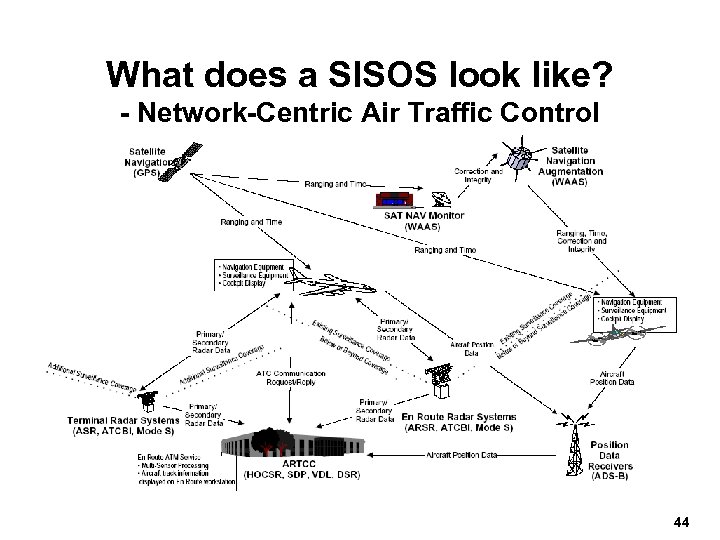 What does a SISOS look like? - Network-Centric Air Traffic Control 44
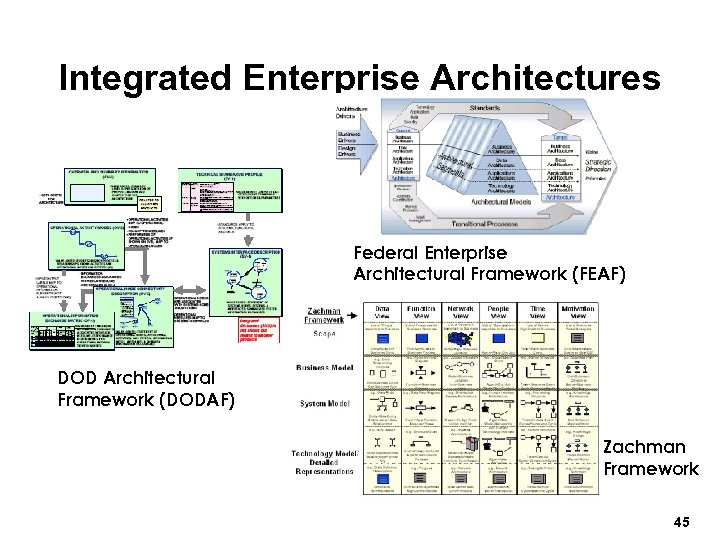 Integrated Enterprise Architectures Federal Enterprise Architectural Framework (FEAF) DOD Architectural Framework (DODAF) Zachman Framework 45
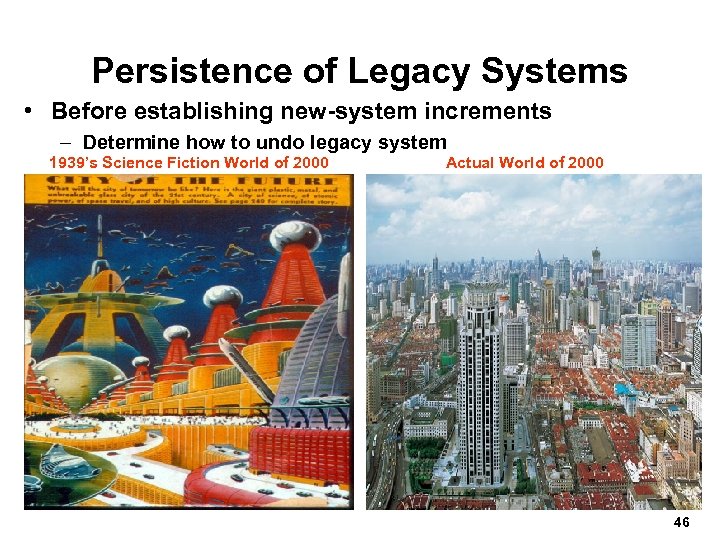 Persistence of Legacy Systems • Before establishing new-system increments – Determine how to undo legacy system 1939’s Science Fiction World of 2000 Actual World of 2000 46
 Computational Plenty: Process Implications • New platforms: smart dust, human prosthetics (physical, mental) – New applications: sensor networks, nanotechnology • Enable powerful self-monitoring software – Assertion checking, trend analysis, intrusion detection, proof-carrying code, perpetual testing • Enable higher levels of abstraction – Pattern programming, programming by example with dialogue – Simpler brute-force solutions: exhaustive case analysis • Enable more powerful software tools – Based on domain, programming, management knowledge – Show-and-tell documentation – Game-oriented software engineering education 47
 Wild Cards: Autonomy and Bio-Computing • Great potential for good – Robot labor; human shortfall compensation • 5 Senses, healing, life span, self-actualization – Adaptive control of the environment – Redesigning the world for higher quality of life • Physically, biologically, informationally • Great potential for harm – Loss of human primacy: computers propose, humans decide – Overempowerment of humans • Accidents, terrorism, Enron California brownouts – New failure modes: adaptive control instability, selfmodifying software, commonsense reasoning, bio-computer mismatches – V&V difficulties: cooperating autonomous agents, biocomputing • Forms and timing of new capabilities still unclear 48
 Outline • Motivation and Context • A 20 th Century View • A 21 st Century View • Conclusions – Timeless principles and aging practices 49
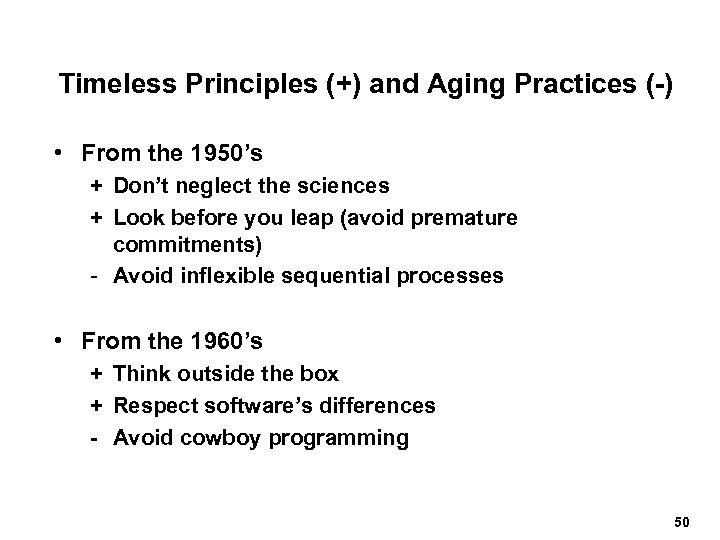 Timeless Principles (+) and Aging Practices (-) • From the 1950’s + Don’t neglect the sciences + Look before you leap (avoid premature commitments) - Avoid inflexible sequential processes • From the 1960’s + Think outside the box + Respect software’s differences - Avoid cowboy programming 50
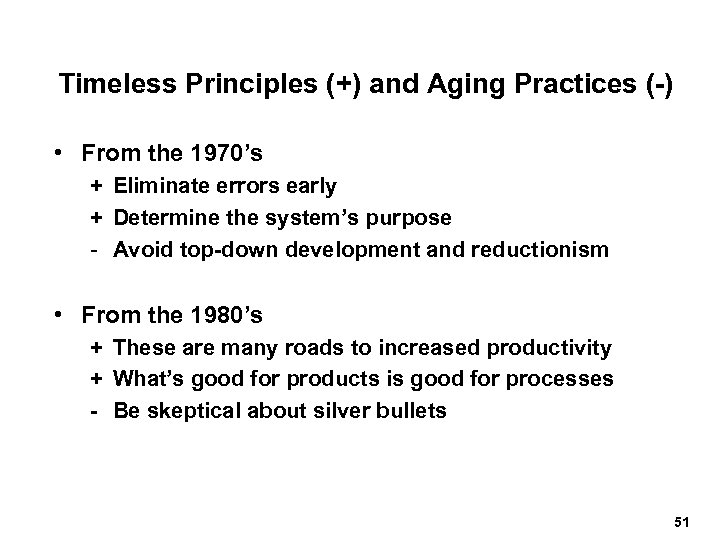 Timeless Principles (+) and Aging Practices (-) • From the 1970’s + Eliminate errors early + Determine the system’s purpose - Avoid top-down development and reductionism • From the 1980’s + These are many roads to increased productivity + What’s good for products is good for processes - Be skeptical about silver bullets 51
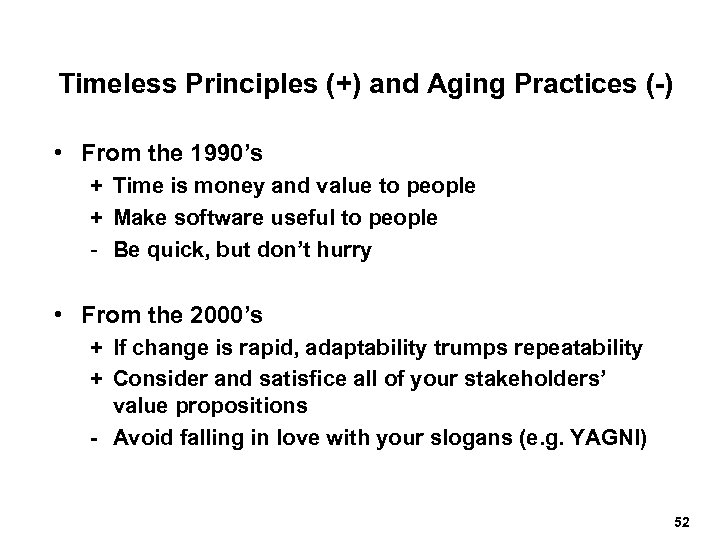 Timeless Principles (+) and Aging Practices (-) • From the 1990’s + Time is money and value to people + Make software useful to people - Be quick, but don’t hurry • From the 2000’s + If change is rapid, adaptability trumps repeatability + Consider and satisfice all of your stakeholders’ value propositions - Avoid falling in love with your slogans (e. g. YAGNI) 52
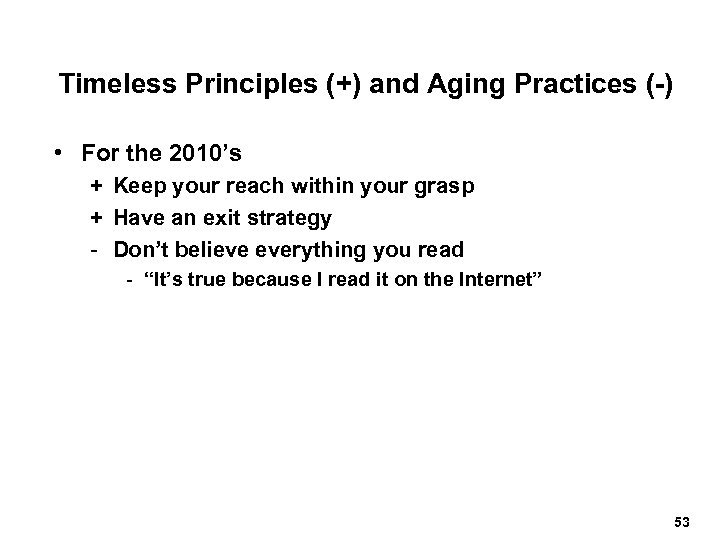 Timeless Principles (+) and Aging Practices (-) • For the 2010’s + Keep your reach within your grasp + Have an exit strategy - Don’t believe everything you read - “It’s true because I read it on the Internet” 53
 Future Challenges for SW Engineering Education - Student careers go through 2050’s • Keeping courseware continually up-to-date • Anticipating future trends and preparing students for them • Separating timeless principles from aging practices • Making small student projects relevant to large industry practices • Participating in research; incorporating results in courses • Helping students learn how to learn • Offering lifelong learning to practitioners 54