


 Скачать презентацию A Very Special 20 A Thanks to Richard
1e23a34d6ea2d2f6ec200c8c12a10747.ppt
- Количество слайдов: 6
 A Very Special 20 A Thanks to Richard D. Evans W 9 GPP And his Dad Oral Evans W 9 OLI-W 0 OLI-W 9 GPJ (SK)
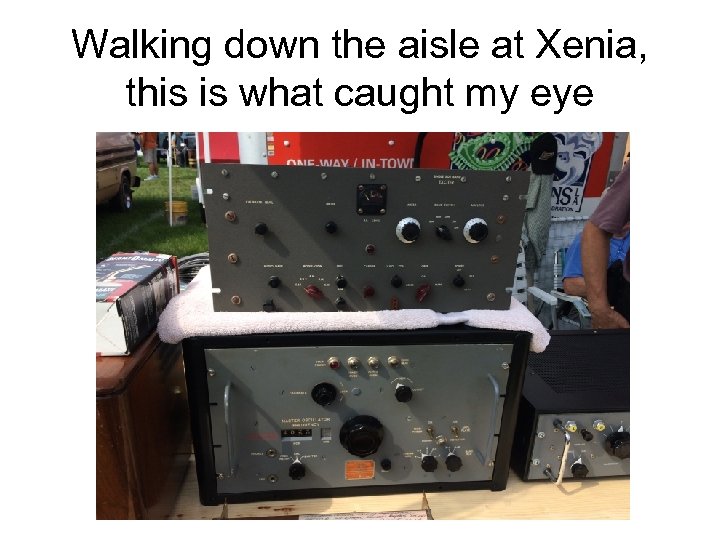 Walking down the aisle at Xenia, this is what caught my eye
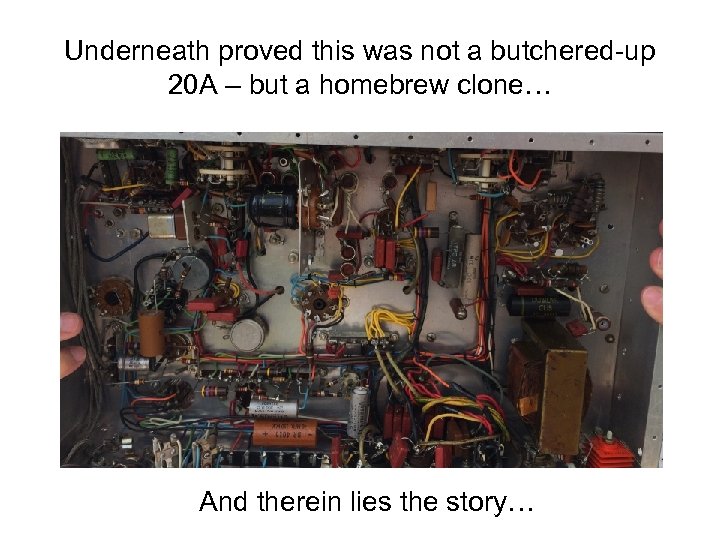 Underneath proved this was not a butchered-up 20 A – but a homebrew clone… And therein lies the story…
 Starting point: • • • The 20 A schematic and other drawings PS-1 phase shift network Telephone type relay A handful of knobs Unknown CTC audio filter from a local ham A 16 year old ham builder who was motivated to get on SSB • And a great mentor/Dad (who held him to high standards!)
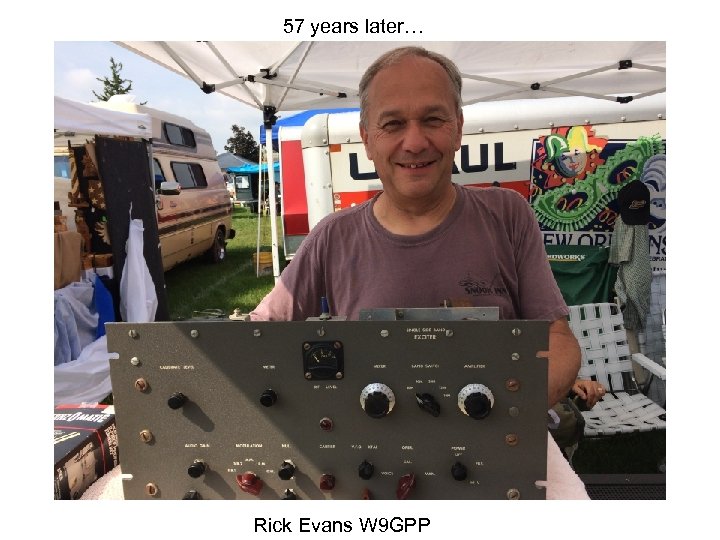 57 years later… Rick Evans W 9 GPP
 My Dad got his Amateur License at age 14 in 1937. He started working for a radio broadcast station during high school and continued after graduation. He went into the Navy at about age 20 and trained as a pilot. About the time he was ready for an overseas assignment, Germany was defeated and Japan’s fate was pretty well determined. Navy flight training was terminated, as no additional pilots would be required to finish things up. He was assigned to the Pentagon for the last year of the war before being discharged. He came back to the job he had left before the Navy. He continued in radio broadcast until he moved to television broadcasting shortly after 1950. While working in this job, he started repairing televisions on a part time basis since there were not too many people that had mastered this yet. A few years later he made the television repair business a full time job, and trained a couple of guys to help him. By 1957 a few other opportunities opened for him. He wound up going to work for IBM and shut down his TV business. He continued helping other TV repairmen fix the sets they were having trouble with. They would bring them over in the evening to get some training and fix the sets at the same time. In about 1960, he was asked to accompany several other IBM people on a trip to Zenith in Chicago. At the time, I was about 14 and had been a ham for about 3 years. I had been through my Novice year, held a Technician license briefly (until the FCC examiners made their twice a year stop in town), and then got my General. I think the real reason he was along on the trip to Zenith was because of his background and history. Someone thought it might be helpful to have him along. I remember him saying he would not normally have been on a trip like this with people from a different division of the company. At that time SSB was gaining ground quickly. We were on AM along with a lot of others, but it was becoming evident where things were going. We had started building a “Cheap and Easy SSB” so we could see what SSB was all about. On that trip to Chicago, he evidentially hit it off well with some people there who knew other people. As a result, he returned home with a bunch of drawings, schematics, and parts. The people he met told him that if we were going to build something, this would be a lot better in the long run than what we had started. We discontinued that project we and went full speed ahead on the 20 A. (I recently found the discontinued “Cheap & Easy” project in a box at my Dad’s house. ) Unfortunately, I do not have any knowledge of the people he talked to in Chicago, or any recollection of other details. So far, I have not been able to find his files with the information he brought back. Some of those items are in a file I have, but have not been able to locate it either. As I mentioned, I am quite sure they both exist and will keep looking. All of the parts he brought back are in the unit you have. Without those files, the rest is just speculation. I’m not sure even if we had them we would know any more that I do now. I don’t remember seeing anything indicating the people that were involved, just the drawings. It has been over 50 years since I remember seeing my Dad’s file. I have seen my file in the last 5 -10 years. I know it is in this house somewhere. I’m not sure there is much more in it than the original schematic and some notes and sketches. Wish I could tell you more. As it was all happening, I never thought there would be a need to know any more later down the road. Glad to hear the phasing adjustment was close. That is one thing I remember doing. I remember calibrating our old scope so the horizontal and vertical deflections were the same, then hooking it up and seeing a not so round pattern. A few twists of the pots made the pattern looked as round as I could get it. That is where I left it. Probably was pure luck. As I told you at Dayton, it was originally built with an external power supply. That is the reason for the second socket on the back of the chassis. The power supply we used was borrowed from a friend. He said to hang on to it and he would let us know if he needed it back. Several years later, he asked for it back. So we looked through the junk box to see what we had and decided to add the power supply to the existing unit. I never really liked the way it turned out and thought maybe we should have stayed with the separate power supply. I remember the voltage being high. In fact, that is how we destroyed the 6 AG 7’s that we had used since startup. The original power supply had close to the correct voltages for the exciter. The higher voltage from the internal supply took the finals out fairly quickly. Since we had only one spare 6 AG 7, I decided to try a 6550 since I had a good supply of them and the 100 V used them. I put together the adapter and gave it a try. I figured the 6550 could handle the voltage. Turned out it worked OK and that is the way we ran it until we retired it somewhere in the 80’s. I do remember the 3 resistors in series you mentioned in the bias circuit. I remember doing something with them. Wouldn’t have remembered that unless you mentioned the 3 resistors. I may have added one or two of them at that time. Just don’t remember. As I mentioned in my last e-mail, check voltages and verify where the finals are really operating. I think if you have the right voltages and are getting output power with the 6 AG 7 s, I would just leave it like that. Switching to choke input was a good move to get the voltage down. I never really considered that at the time since it was working with the 6550 and it could handle the extra voltage. The 6 L 6 that was in it was never used. It may not be any good. I just stuck it in the socket when I stole the 6550. We did not take many pictures in those days. I can’t really remember any with the 20 A. Will keep my eyes open. I took the 20 A to Dayton several times about 7 -8 years ago. I had it on display like this year. Figured I would see if it attracted any attention. It did. Lots. After telling the story, most everyone said "You can't sell something like that, you should keep it for sentimental reasons". So I did for a while. I always figured someday I would find the right person to take over this rig. As it turned out, this was the year. I am happy for you to have it and share with others. That is just how I always hoped it would turn out. Glad to hear it is working. Will be anxious to hear it on the air. 73's Rick W 9 GPP