 Скачать презентацию A versatile MALDI target plate based on polymer-filled
87025c6fe5e2be0133d044eadd5c6d84.ppt
- Количество слайдов: 1



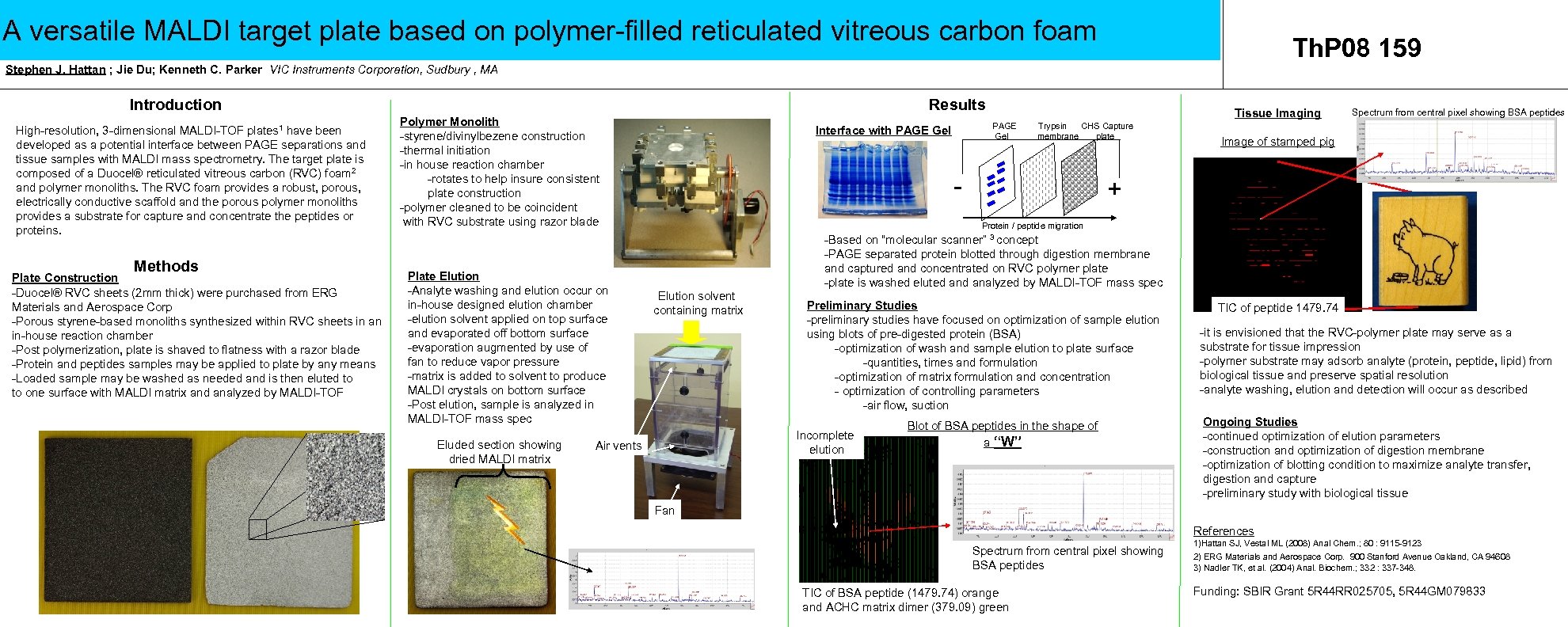
A versatile MALDI target plate based on polymer-filled reticulated vitreous carbon foam Th. P 08 159 Stephen J. Hattan ; Jie Du; Kenneth C. Parker VIC Instruments Corporation, Sudbury , MA Results Introduction High-resolution, 3 -dimensional MALDI-TOF plates 1 have been developed as a potential interface between PAGE separations and tissue samples with MALDI mass spectrometry. The target plate is composed of a Duocel® reticulated vitreous carbon (RVC) foam 2 and polymer monoliths. The RVC foam provides a robust, porous, electrically conductive scaffold and the porous polymer monoliths provides a substrate for capture and concentrate the peptides or proteins. Methods Plate Construction -Duocel® RVC sheets (2 mm thick) were purchased from ERG Materials and Aerospace Corp -Porous styrene-based monoliths synthesized within RVC sheets in an in-house reaction chamber -Post polymerization, plate is shaved to flatness with a razor blade -Protein and peptides samples may be applied to plate by any means -Loaded sample may be washed as needed and is then eluted to to one surface with MALDI matrix and analyzed by MALDI-TOF Polymer Monolith -styrene/divinylbezene construction -thermal initiation -in house reaction chamber -rotates to help insure consistent plate construction -polymer cleaned to be coincident with RVC substrate using razor blade Plate Elution -Analyte washing and elution occur on in-house designed elution chamber -elution solvent applied on top surface and evaporated off bottom surface -evaporation augmented by use of fan to reduce vapor pressure -matrix is added to solvent to produce MALDI crystals on bottom surface -Post elution, sample is analyzed in MALDI-TOF mass spec Eluded section showing dried MALDI matrix Tissue Imaging PAGE Gel Interface with PAGE Gel Trypsin CHS Capture membrane plate - Spectrum from central pixel showing BSA peptides Image of stamped pig + Protein / peptide migration -Based on “molecular scanner” 3 concept -PAGE separated protein blotted through digestion membrane and captured and concentrated on RVC polymer plate -plate is washed eluted analyzed by MALDI-TOF mass spec Elution solvent containing matrix Preliminary Studies -preliminary studies have focused on optimization of sample elution using blots of pre-digested protein (BSA) -optimization of wash and sample elution to plate surface -quantities, times and formulation -optimization of matrix formulation and concentration - optimization of controlling parameters -air flow, suction Incomplete elution Air vents Blot of BSA peptides in the shape of a “W” TIC of peptide 1479. 74 -it is envisioned that the RVC-polymer plate may serve as a substrate for tissue impression -polymer substrate may adsorb analyte (protein, peptide, lipid) from biological tissue and preserve spatial resolution -analyte washing, elution and detection will occur as described Ongoing Studies -continued optimization of elution parameters -construction and optimization of digestion membrane -optimization of blotting condition to maximize analyte transfer, digestion and capture -preliminary study with biological tissue Fan References Spectrum from central pixel showing BSA peptides TIC of BSA peptide (1479. 74) orange and ACHC matrix dimer (379. 09) green 1)Hattan SJ, Vestal ML (2008) Anal Chem. ; 80 : 9115 -9123 2) ERG Materials and Aerospace Corp. 900 Stanford Avenue Oakland, CA 94608 3) Nadler TK, et al. (2004) Anal. Biochem. ; 332 : 337 -348. Funding: SBIR Grant 5 R 44 RR 025705, 5 R 44 GM 079833
Скачать презентацию A versatile MALDI target plate based on polymer-filled
87025c6fe5e2be0133d044eadd5c6d84.ppt