 Скачать презентацию A Verbal Behavior Approach to Teaching Language to
9adf9e1df6aafc7432bf54712f2ab2f3.ppt
- Количество слайдов: 59



A Verbal Behavior Approach to Teaching Language to Children with Autism Presented By: Katie Cole, MS, BCBA and Cassondra M. Gayman, MS, BCBA
• Mariposa School background – Who we are – What we do – How we do it
In the next 90 minutes we hope to: • Provide an overview of ABA • Discuss basic behavioral principles and procedures • Overview of Verbal Behavior • Discuss the main verbal operants • Common components of a VB program • The importance of the mand • Teaching procedures – NET – Intensive Teaching • Q&A
What is Applied Behavior Analysis? • The modern form of the philosophy of behaviorism • Skinner laid the foundation for modern behaviorism in 1938 • ABA is the science from which procedures derived from principles of behavior are systematically applied to improve socially significant behaviors. Cooper, Heron, Heward (1987). – Principles applied to improve socially significant behaviors – Analysis of behavior used to identify variables (causes) for behavior
What is Behavior? • Anything a living organism says or does • Getting an A on a test is an Outcome • Effective studying is a Behavior • Dead man test • Skinner distinguished between operant and reflexive behavior. – Operant = voluntary (affected by reinforcement) – Reflex behavior = involuntary (salivating, knee jerk) • Skinner later (1957) defined language as behavior in his book Verbal Behavior
Who Benefits from ABA? • Troubled teens, typical children, parents, business people, person’s with developmental disabilities, and you and me. • 1965 Lovaas, Schaeffer, & Simmons decreased self-injury in children with Autism. • 1987 Lovaas study to demonstrate efficacy of ABA as treatment with children with Autism.
Why Do We Do What We Do? • All behavior has a function • Identifying the function tells us – the conditions in which the behavior may occur – a possibly effective treatment method / how to respond to the behavior
What are the Functions of Behavior? • Escape/Avoidance – escaping or avoiding a demand situation – Often occur during work type situations • Attention – a behavior to gain the attention of others – This can be positive or negative attention • Access – a behavior to gain access to an object or situation – Food, toys, warmth • Automatic – a behavior that “feels good – Self-Stimulatory or Stereotypy.
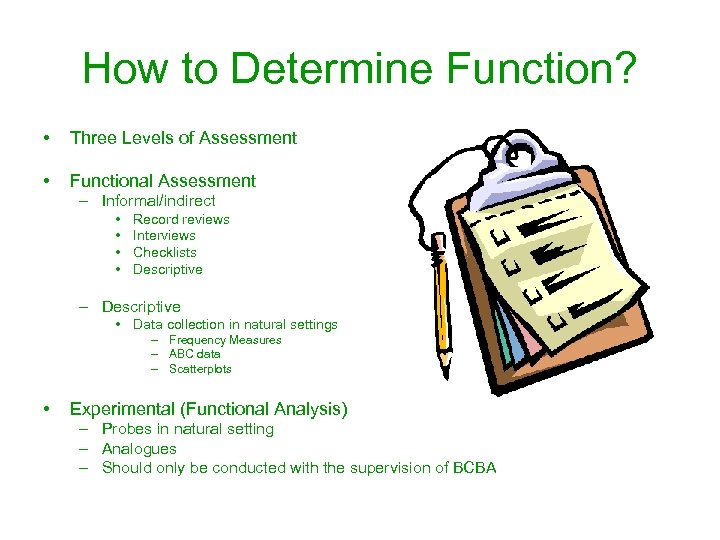
How to Determine Function? • Three Levels of Assessment • Functional Assessment – Informal/indirect • • Record reviews Interviews Checklists Descriptive – Descriptive • Data collection in natural settings – Frequency Measures – ABC data – Scatterplots • Experimental (Functional Analysis) – Probes in natural setting – Analogues – Should only be conducted with the supervision of BCBA
What next? • Treatment should be based on function • Identify behavior targeted for change • Prevention (Antecedent) strategies should also be put into place • Replacement behaviors should always be taught • Treatment plan based on behavior principles
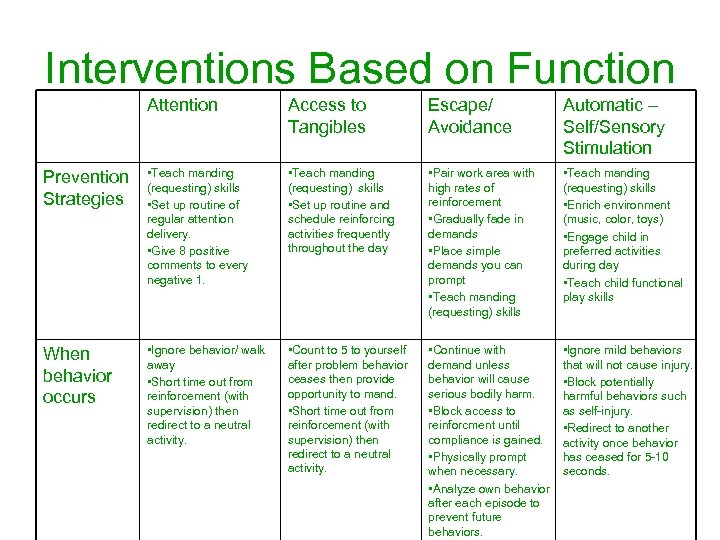
Interventions Based on Function Attention Access to Tangibles Escape/ Avoidance Automatic – Self/Sensory Stimulation Prevention Strategies • Teach manding (requesting) skills • Set up routine of regular attention delivery. • Give 8 positive comments to every negative 1. • Teach manding (requesting) skills • Set up routine and schedule reinforcing activities frequently throughout the day • Pair work area with high rates of reinforcement • Gradually fade in demands • Place simple demands you can prompt • Teach manding (requesting) skills • Enrich environment (music, color, toys) • Engage child in preferred activities during day • Teach child functional play skills When behavior occurs • Ignore behavior/ walk away • Short time out from reinforcement (with supervision) then redirect to a neutral activity. • Count to 5 to yourself after problem behavior ceases then provide opportunity to mand. • Short time out from reinforcement (with supervision) then redirect to a neutral activity. • Continue with demand unless behavior will cause serious bodily harm. • Block access to reinforcment until compliance is gained. • Physically prompt when necessary. • Analyze own behavior after each episode to prevent future behaviors. • Ignore mild behaviors that will not cause injury. • Block potentially harmful behaviors such as self-injury. • Redirect to another activity once behavior has ceased for 5 -10 seconds.
Principles and Procedures: • When we talk about increasing behavior, we’re talking about the procedure called REINFORCEMENT • When we talk about decreasing behavior, we’re talking about the procedure called PUNISHMENT • Reinforcement: Increase as Punishment: Decrease
Principles and Procedures: • Reinforcement (increase the response): – A consequence follows a behavior and increases the future frequency of that behavior under similar circumstances
Principles and Procedures: • Positive vs. Negative Reinforcement – Both INCREASE behavior! • Positive Reinforcement – Giving something a person finds desirable after the behavior occurs • Negative Reinforcement – Removing something that the individual finds aversive.
Principles and Procedures: • Positive Reinforcement Example: • Situation - A child sees a candy bar in the grocery store and wants it. – Child screams “I want candy” and throws a tantrum. Adult hands him the candy. (Reinforcement of inappropriate behavior) – Child signs or says ‘candy’. Adult hands him the candy. (Reinforcement of appropriate behavior) • Discussion: In both examples, the child has learned that his behavior gets him what he wants, so he is likely to repeat this behavior next time.
Principles and Procedures: • Negative Reinforcement Example: • Situation: The radio is playing loudly in the room. • The child comes into the room and begins screaming. Somebody rushes over to turn down the radio. (Reinforcement of inappropriate behavior) • • The child comes in and covers his ears saying “Too loud”. Somebody rushes over to turn down the radio. (Reinforcement of appropriate behavior) Discussion: In both examples, the child has learned that his behavior gets him what he wants, so he is likely to repeat this behavior next time.
Principles and Procedures: • Punishment (decrease the response): – A consequence follows a behavior and decreases the future frequency of that behavior under similar circumstances
Principles and Procedures: • Positive vs. Negative Punishment – Both DECREASE behavior! • Positive Punishment – Applying something the individual finds aversive • Negative Punishment – Taking away something the individual finds pleasurable right after the behavior has occurred.
Principles and Procedures: • Situation: Teenager misses his curfew. • Positive Punishment Example: – Parent states that he has to rake the yard this weekend. (Application of something aversive) • Negative Punishment Example: – Parent states that he cannot attend a planned event. (Removal of a reinforcing or desired activity)
Principles and Procedures: • Problems with punishment: – May elicit aggression or other emotional side effects – May result in escape or avoidance behaviors – May be negatively reinforcing for the person using punishment --- misuse/overuse of punishment – Because of these problems… • Punishment as LAST RESORT
Principles and Procedures: • Extinction: – Removing or withholding the consequence (reinforcement) that maintains behavior. Discontinuing reinforcement of a previously reinforced behavior. – Results in a DECREASE in frequency of the behavior. • Examples: – Soda machine – Candy Isle
Principles and Procedures: • Differential Reinforcement: – 2 separate forms of behavior • One is reinforced (increased) • One is extinguished (decreased) • Examples: – Request for candy
Principles and Procedures: • Shaping: – A process through which we gradually modify existing behavior into what we want it to be. Successive approximation toward terminal behavior. Uses differential reinforcement. • Examples – Swing sign example – Banana vocal example
Principles and Procedures: • Prompting: – Assistance provided to promote correct responding. • Full physical, partial physical, model… • Full echoic, phonemic… • Fading: – Systematic removal of the prompt
Principles and Procedures: • All of the above mentioned principles and procedures have a solid and extensive foundation of empirical research. There have been over 1500 published studies within the past 60 years establishing these principles of behavior.
Verbal Behavior • Language is learned behavior, acquired and maintained by the same principles of behavior responsible for non-language behavior (Cooper, Heron, Heward, 2007). • In 1957, Skinner published Verbal Behavior. • Verbal behavior is defined by function rather than form
Verbal Behavior • Function vs. Form – Formal properties of language: • Topography = Form of language can be measured by phonemes, morphemes, lexicon, syntax, grammar, and semantics. • Also can be classified as nouns, verbs, pronouns, adjectives… – Functional properties of language: • Involve the causes of the response. – We need to look at BOTH!
Skinner’s Classification of Language • Skinner’s classification of language different from linguists, who classify words as parts of speech (noun, pronoun, verb, adjective etc…) • “This is an apple. ” = APPLE classified as noun. • What does that tell us?
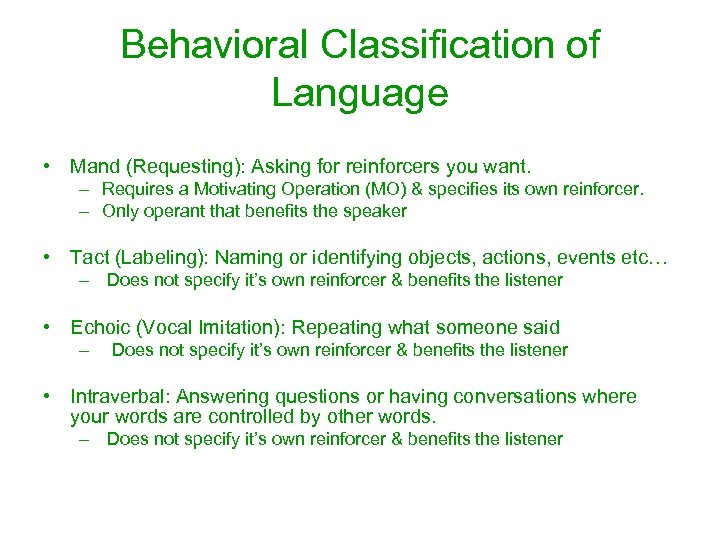
Behavioral Classification of Language • Mand (Requesting): Asking for reinforcers you want. – Requires a Motivating Operation (MO) & specifies its own reinforcer. – Only operant that benefits the speaker • Tact (Labeling): Naming or identifying objects, actions, events etc… – Does not specify it’s own reinforcer & benefits the listener • Echoic (Vocal Imitation): Repeating what someone said – Does not specify it’s own reinforcer & benefits the listener • Intraverbal: Answering questions or having conversations where your words are controlled by other words. – Does not specify it’s own reinforcer & benefits the listener
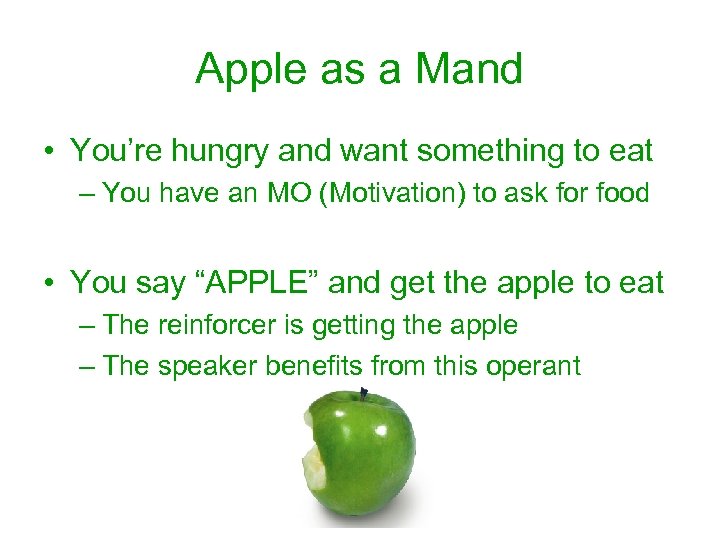
Apple as a Mand • You’re hungry and want something to eat – You have an MO (Motivation) to ask for food • You say “APPLE” and get the apple to eat – The reinforcer is getting the apple – The speaker benefits from this operant
APPLE AS A TACT • Someone shows you a pictures of an apple and asks you what it is. You say “APPLE” you have given a Tact for the apple. – LABEL, NAME • The source of reinforcement is praise or approval, not the apple
Apple as an Echoic • In an echoic, the person “Echoes” the same sounds that were heard • Someone says “APPLE” and you repeat “APPLE” • The reinforcement for doing so may be praise or approval
Apple as an Intraverbal • Someone says “What is the fruit that’s red and grows on trees”. You say “Apple” • The item is not present • The answer does not specify the reinforcer
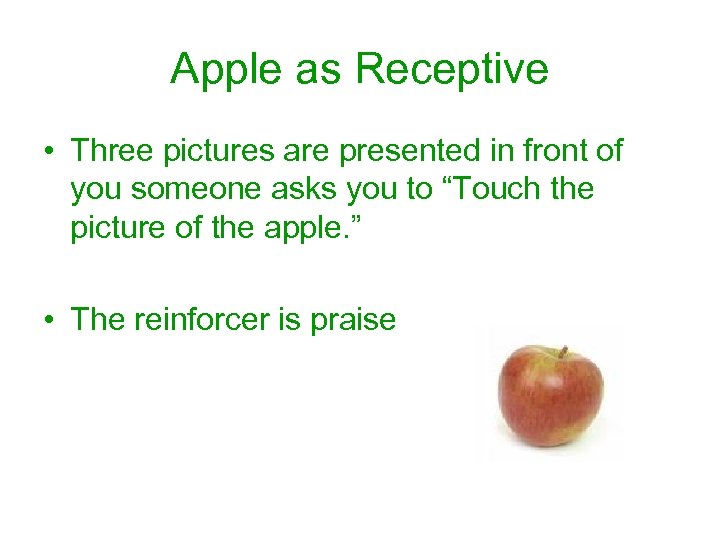
Apple as Receptive • Three pictures are presented in front of you someone asks you to “Touch the picture of the apple. ” • The reinforcer is praise
Why Do We Say What We Say? • All language has a function • The same word (apple) has many meanings • Many children with Autism do not generalize a word across operants. • Just because a child can label an apple doesn’t mean they can mand for an apple.
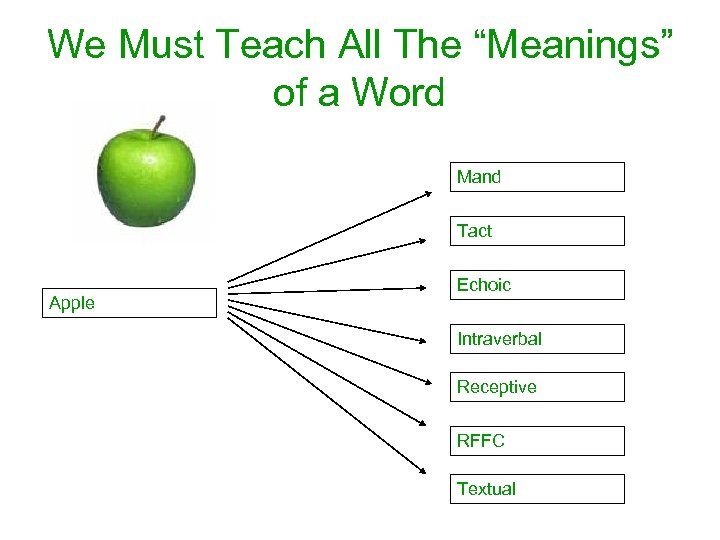
We Must Teach All The “Meanings” of a Word Mand Tact Apple Echoic Intraverbal Receptive RFFC Textual
Receptive Versus Expressive • Many other philosophies classify language as either expressive or receptive. • Problems arise when we talk about all the functions of expressive language
“VB vs ABA? ” • “What is the difference between VB and ABA? ” • VB IS ABA!! • Verbal behavior involves the same behavioral principles that make up the analysis of nonverbal behavior. No new principles are required. The principles implemented in a VB program are the same ones that have the solid and extensive empirical research foundation discussed earlier.
Verbal Behavior • When people ask the question, “What’s the difference between “VB and ABA? ” what they likely mean is, “What is the difference between a ‘traditional ABA’ program and an ABA program using VB methodology? ”
ABA and Autism Treatment • Ivar Lovaas (1987) – Significant advancements in the field of ABA, specifically related to teaching children with autism. – Research suggesting ABA is an effective treatment for autism – This “method” uses principles of reinforcement, shaping, chaining, prompting/fading, extinction… to teach vocal language as well as a variety of other behaviors, including imitation, matching-to-sample, and following commands behaviors. The main method in which these behaviors are taught is through Discrete Trial Training (DTT)
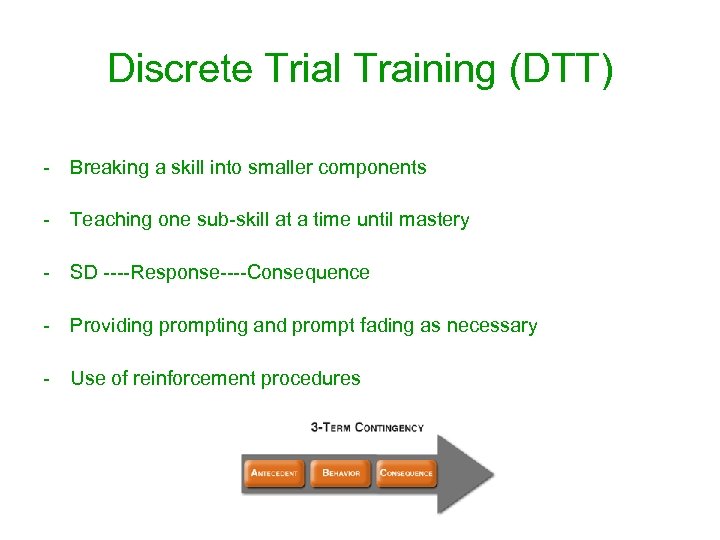
Discrete Trial Training (DTT) - Breaking a skill into smaller components - Teaching one sub-skill at a time until mastery - SD ----Response----Consequence - Providing prompting and prompt fading as necessary - Use of reinforcement procedures
What about VB? • Does VB use DTT to teach skills? – YES! – A solid VB program will also use reinforcement, shaping, chaining, prompting/fading, extinction… to teach a variety of vocal and nonvocal behaviors to children with autism.
Verbal Behavior • What does a VB program have that a “traditional ABA” program tends not to have? – A functional analysis of language!
Verbal Behavior • A VB program is based on a functional analysis of language, rather than a structural one. • Traditional linguistics receptive/expressive distinction, which focuses on form rather than function, dominates assessment and intervention programs for kids with autism.
Verbal Behavior • Recall 3 of the operants discussed earlier. The mand, tact, and intraverbal would all be classified as “expressive language”. This structural classification system will mask important distinctions. – Different sources of antecedent control – Failure to emerge across operants without training.
Other differences… • Other differences between a “traditional ABA” program and a VB program: – – – – Pairing Balance of NET and DTT Data Methods – cold probe Mix and Vary across operants Errorless teaching Error correction Transfer Procedures Focus on the mand
Importance of the Mand • Specifies what speaker is motivated by • Allows us to establishing rapport with the learner • Essential in teaching other skills • First operant learned by typical children
Importance of the Mand • Key to replacing problem behaviors • Only operant that benefits the speaker • Essential for advanced social interactions • Doesn’t necessary emerge by training the other verbal operants
Teaching Manding in the Natural Environment
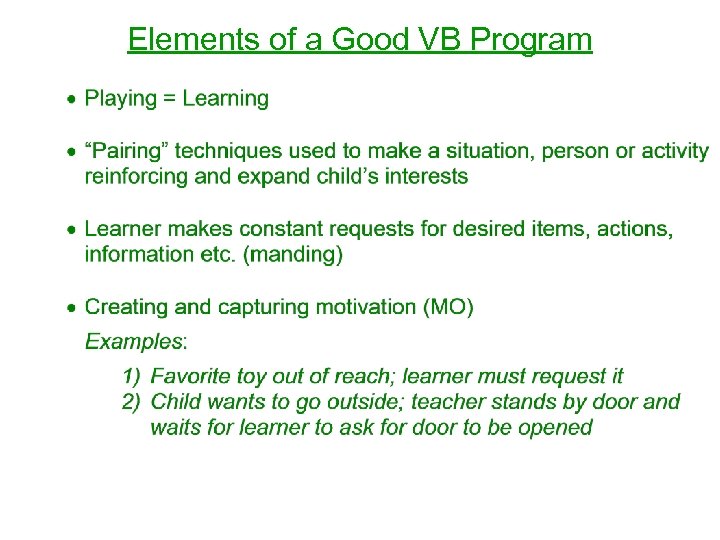
Elements of a Good VB Program
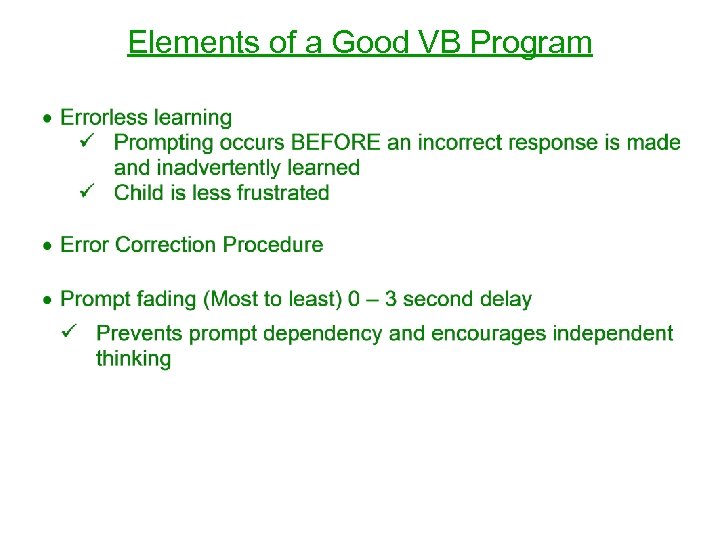
Elements of a Good VB Program
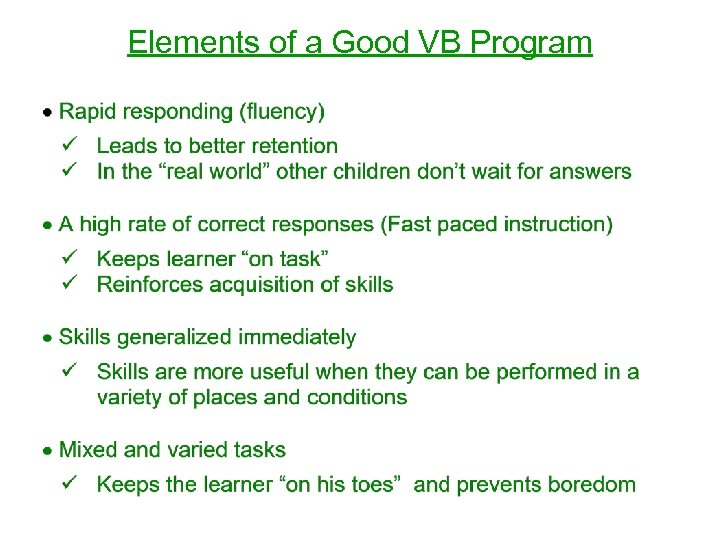
Elements of a Good VB Program
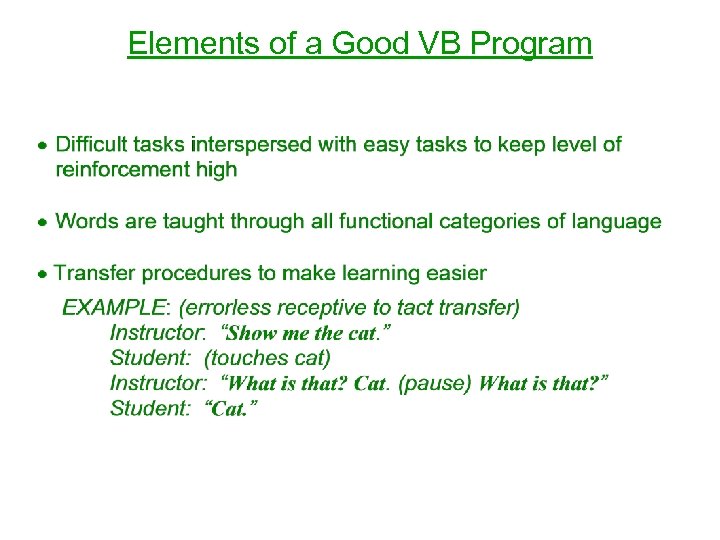
Elements of a Good VB Program
Elements of a Good VB Program: Video Examples
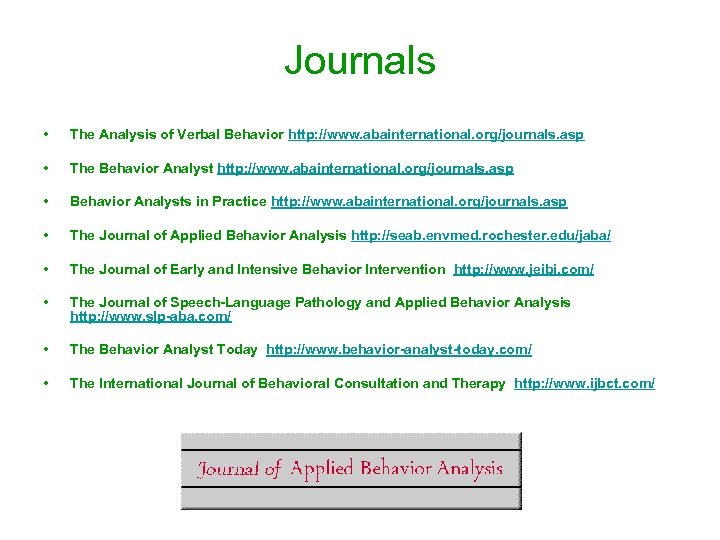
Journals • The Analysis of Verbal Behavior http: //www. abainternational. org/journals. asp • The Behavior Analyst http: //www. abainternational. org/journals. asp • Behavior Analysts in Practice http: //www. abainternational. org/journals. asp • The Journal of Applied Behavior Analysis http: //seab. envmed. rochester. edu/jaba/ • The Journal of Early and Intensive Behavior Intervention http: //www. jeibi. com/ • The Journal of Speech-Language Pathology and Applied Behavior Analysis http: //www. slp-aba. com/ • The Behavior Analyst Today http: //www. behavior-analyst-today. com/ • The International Journal of Behavioral Consultation and Therapy http: //www. ijbct. com/
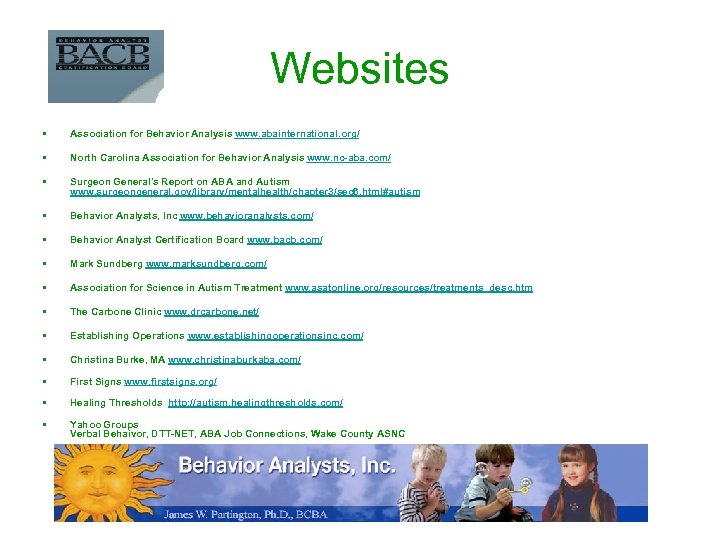
Websites • Association for Behavior Analysis www. abainternational. org/ • North Carolina Association for Behavior Analysis www. nc-aba. com/ • Surgeon General's Report on ABA and Autism www. surgeongeneral. gov/library/mentalhealth/chapter 3/sec 6. html#autism • Behavior Analysts, Inc www. behavioranalysts. com/ • Behavior Analyst Certification Board www. bacb. com/ • Mark Sundberg www. marksundberg. com/ • Association for Science in Autism Treatment www. asatonline. org/resources/treatments_desc. htm • The Carbone Clinic www. drcarbone. net/ • Establishing Operations www. establishingoperationsinc. com/ • Christina Burke, MA www. christinaburkaba. com/ • First Signs www. firstsigns. org/ • Healing Thresholds http: //autism. healingthresholds. com/ • Yahoo Groups Verbal Behaivor, DTT-NET, ABA Job Connections, Wake County ASNC
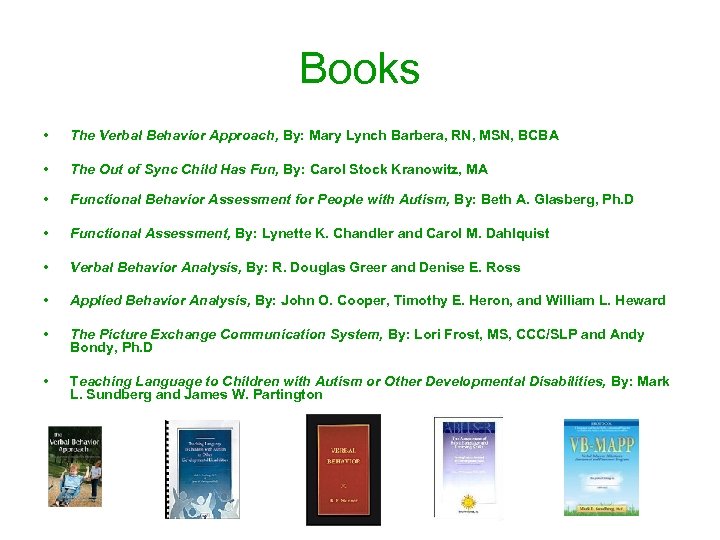
Books • The Verbal Behavior Approach, By: Mary Lynch Barbera, RN, MSN, BCBA • The Out of Sync Child Has Fun, By: Carol Stock Kranowitz, MA • Functional Behavior Assessment for People with Autism, By: Beth A. Glasberg, Ph. D • Functional Assessment, By: Lynette K. Chandler and Carol M. Dahlquist • Verbal Behavior Analysis, By: R. Douglas Greer and Denise E. Ross • Applied Behavior Analysis, By: John O. Cooper, Timothy E. Heron, and William L. Heward • The Picture Exchange Communication System, By: Lori Frost, MS, CCC/SLP and Andy Bondy, Ph. D • Teaching Language to Children with Autism or Other Developmental Disabilities, By: Mark L. Sundberg and James W. Partington
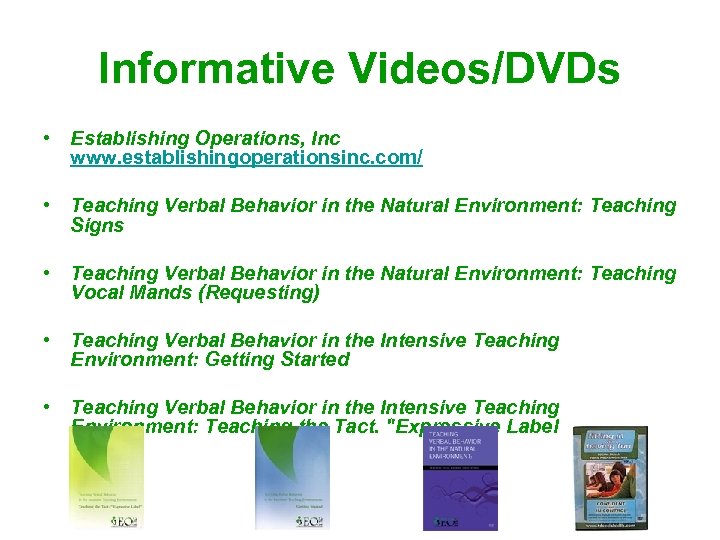
Informative Videos/DVDs • Establishing Operations, Inc www. establishingoperationsinc. com/ • Teaching Verbal Behavior in the Natural Environment: Teaching Signs • Teaching Verbal Behavior in the Natural Environment: Teaching Vocal Mands (Requesting) • Teaching Verbal Behavior in the Intensive Teaching Environment: Getting Started • Teaching Verbal Behavior in the Intensive Teaching Environment: Teaching the Tact. "Expressive Label
Thank You For Attending www. mariposaschool. org
Скачать презентацию A Verbal Behavior Approach to Teaching Language to
9adf9e1df6aafc7432bf54712f2ab2f3.ppt