 Скачать презентацию A Transaction Cost Approach to Make-or-Buy Decisions Walker
f4032a13d4b60955a248f29550bb31c9.ppt
- Количество слайдов: 9



A Transaction Cost Approach to Make-or-Buy Decisions Walker & Weber (1984) Anand RV 9/14/2017
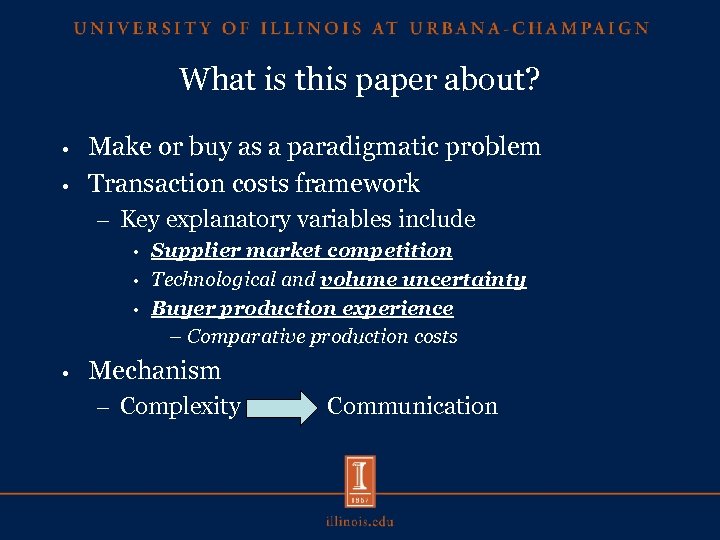
What is this paper about? Make or buy as a paradigmatic problem • Transaction costs framework • – Key explanatory variables include Supplier market competition • Technological and volume uncertainty • Buyer production experience – Comparative production costs • • Mechanism – Complexity Communication
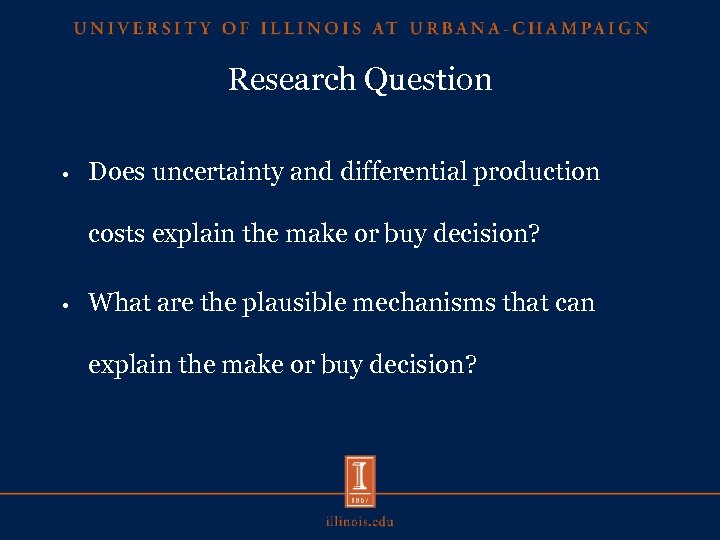
Research Question • Does uncertainty and differential production costs explain the make or buy decision? • What are the plausible mechanisms that can explain the make or buy decision?
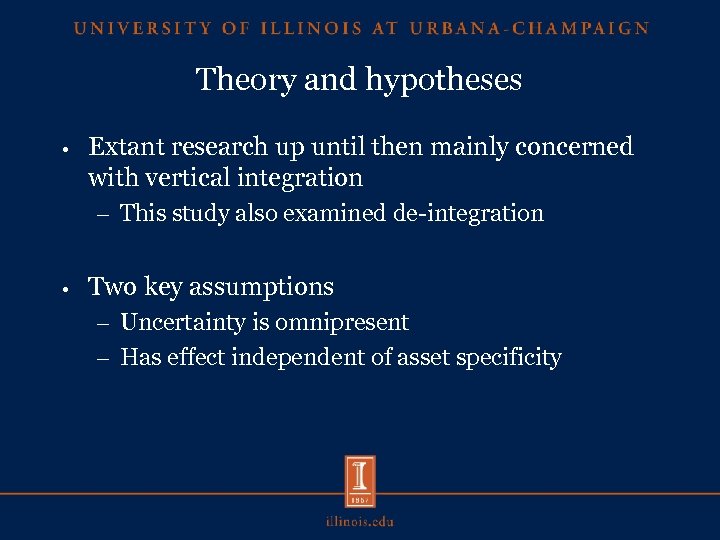
Theory and hypotheses • Extant research up until then mainly concerned with vertical integration – This study also examined de-integration • Two key assumptions – Uncertainty is omnipresent – Has effect independent of asset specificity
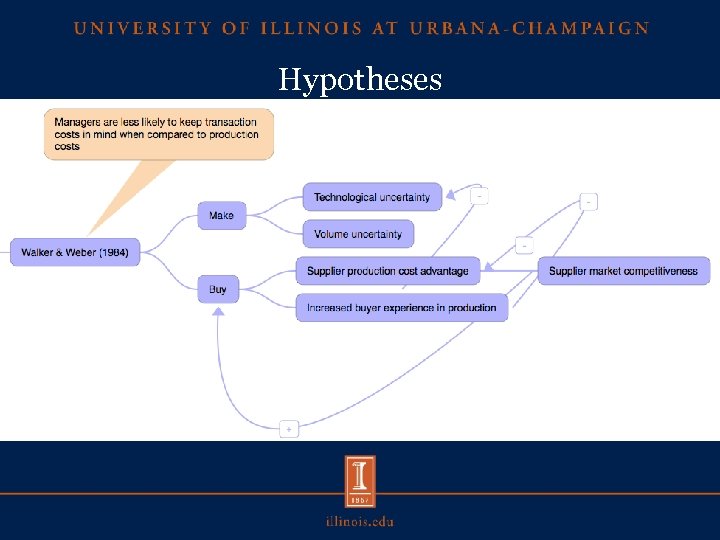
Hypotheses
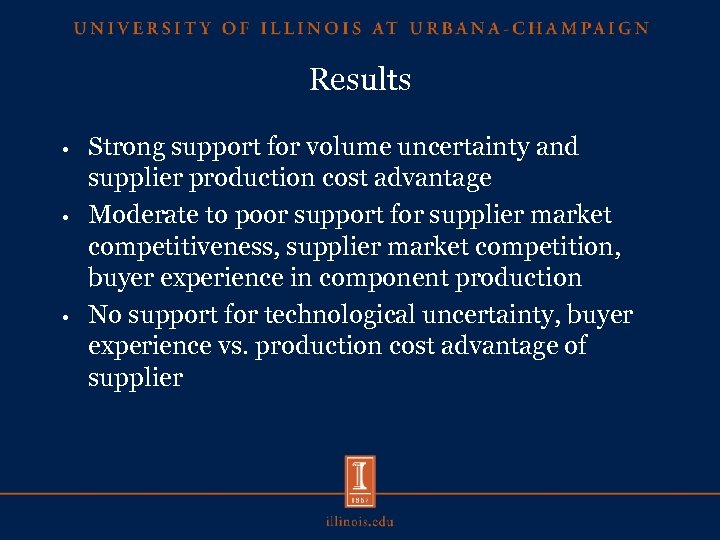
Results Strong support for volume uncertainty and supplier production cost advantage • Moderate to poor support for supplier market competitiveness, supplier market competition, buyer experience in component production • No support for technological uncertainty, buyer experience vs. production cost advantage of supplier •
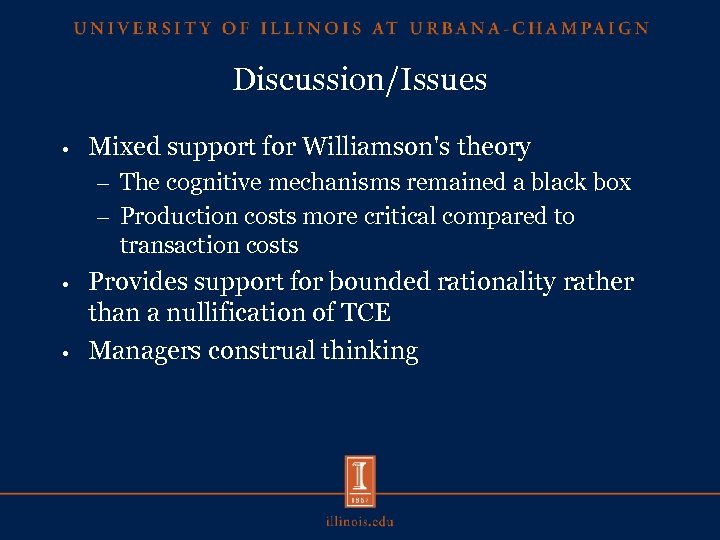
Discussion/Issues • Mixed support for Williamson's theory – The cognitive mechanisms remained a black box – Production costs more critical compared to transaction costs Provides support for bounded rationality rather than a nullification of TCE • Managers construal thinking •
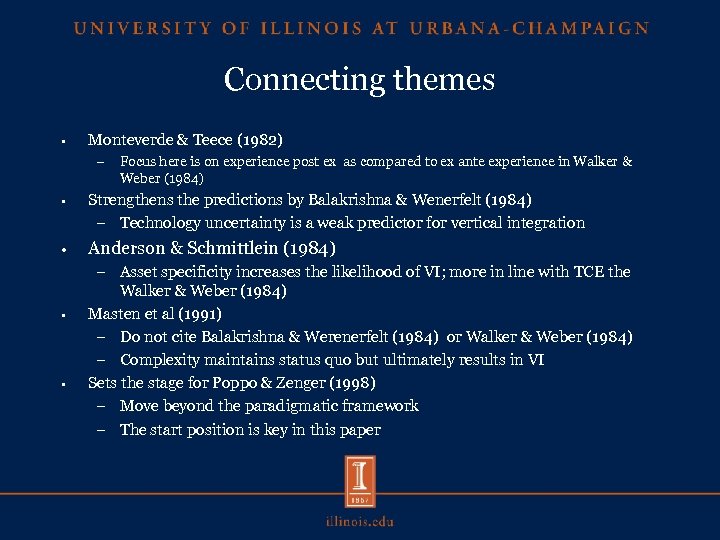
Connecting themes • Monteverde & Teece (1982) – Focus here is on experience post ex as compared to ex ante experience in Walker & Weber (1984) • Strengthens the predictions by Balakrishna & Wenerfelt (1984) – Technology uncertainty is a weak predictor for vertical integration • Anderson & Schmittlein (1984) • • – Asset specificity increases the likelihood of VI; more in line with TCE the Walker & Weber (1984) Masten et al (1991) – Do not cite Balakrishna & Werenerfelt (1984) or Walker & Weber (1984) – Complexity maintains status quo but ultimately results in VI Sets the stage for Poppo & Zenger (1998) – Move beyond the paradigmatic framework – The start position is key in this paper
Discussion questions How can TCE be applied to make or buy decisions while considering the degree of product modularity? What are the plausible managerial challenges then to appreciate TCE? • What are the merits and demerits of binary vs. non-binary measures of the make or buy decision? • What are the suggestions to improve Walker & Weber’s (1984) analytical model? • Is TCE too academic? •
Скачать презентацию A Transaction Cost Approach to Make-or-Buy Decisions Walker
f4032a13d4b60955a248f29550bb31c9.ppt