


 Скачать презентацию A Three-Tiered Model early intervention for students atrisk
c7335114f6dbf3c5de301a5a1837191b.ppt
- Количество слайдов: 18
 A Three-Tiered Model: early intervention for students “atrisk” for learning difficulties CASP Convention 2004 Allan Lloyd-Jones Special Education Consultant California Department of Education alloydjo@cde. ca. gov
 Background n n n IDEA 1997 LD Summit – August 2001 No Child Left Behind Act of 2001 President’s Commission on Special Education Robert Pasternack’s Statements on Reform Reauthorization of IDEA (HR 1350, SB 1248)
 LD Summit (August 2001) n n Criticized wait to fail model Criticized disconnect between current assessment practices and marker variables Criticized ability-achievement discrepancy approach Pointed to response to instruction as alternative evaluation procedure
 PRESIDENT’S COMMISION ON EXCELLENCE IN SPECIAL EDUCATION: FINDINGS n n n n n Current system – process above results Current system – wait to fail model Dual system- general and special Inadequate parent options and recourse Culture of compliance Identification methods lack validity Better teacher preparation needed Rigorous research and evidence-based practice Focus on compliance and bureaucratic imperatives not academic achievement
 PRESIDENT’S COMMISION ON EXCELLENCE IN SPECIAL EDUCATION: RECOMMENDATIONS n Embrace a model of prevention not failure n Change the way we assess for LD n n Eliminate the necessity for IQ-achievement discrepancy Shift to academically relevant assessments.
 PRESIDENT’S COMMISION ON EXCELLENCE IN SPECIAL EDUCATION: RECOMMENDATIONS (cont. ) n n n Change focus from eligibility determination to successful interventions Use response to instruction as a key measure Apply scientifically based instruction before referring for evaluation.
 Robert Pasternack’s Testimony to the House Committee… Statement by Robert Pasternack, Assistant Secretary for Special Education and Rehabilitative Services On Learning Disabilities before the House of Representatives Education and the Workforce Committee, Subcommittee on Education Reform
 Dr. Pasternack’s Statements n n n Half of the students receiving special education are LD. 80% to 90% of students with LD have reading disabilities. Most students can learn to read with scientifically based instruction.
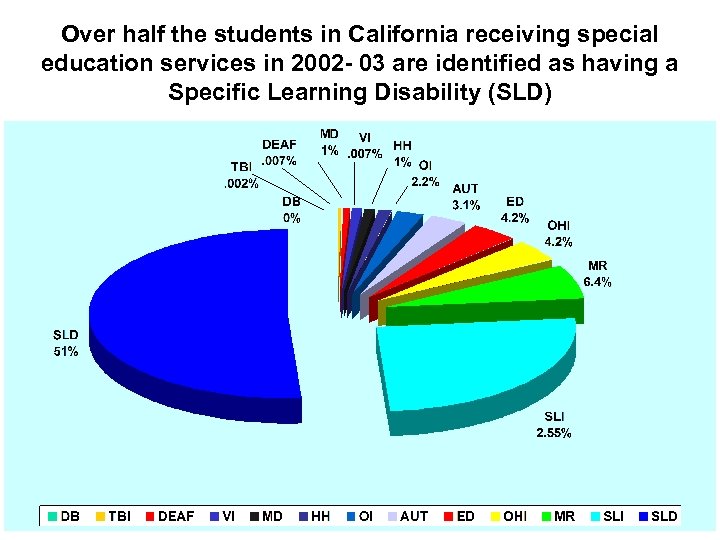 Over half the students in California receiving special education services in 2002 - 03 are identified as having a Specific Learning Disability (SLD)
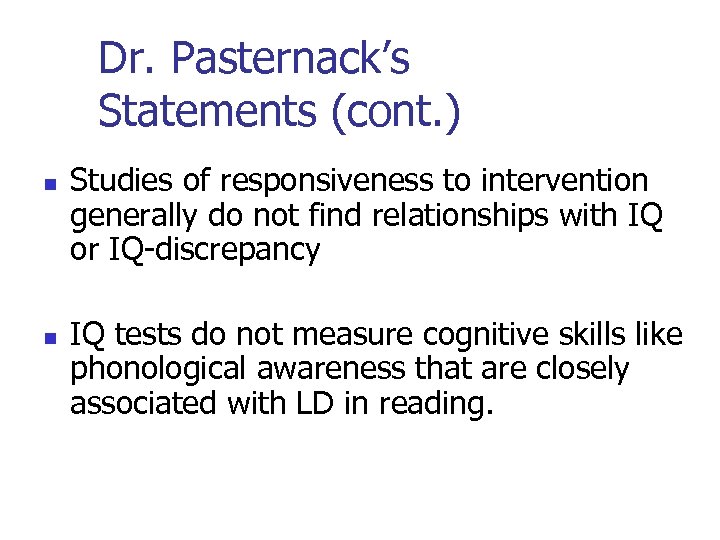 Dr. Pasternack’s Statements (cont. ) n n Studies of responsiveness to intervention generally do not find relationships with IQ or IQ-discrepancy IQ tests do not measure cognitive skills like phonological awareness that are closely associated with LD in reading.
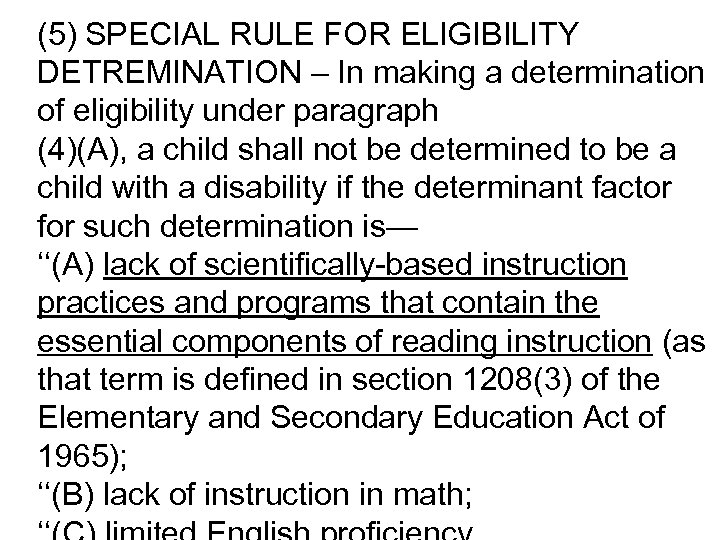 (5) SPECIAL RULE FOR ELIGIBILITY DETREMINATION – In making a determination of eligibility under paragraph (4)(A), a child shall not be determined to be a child with a disability if the determinant factor for such determination is— ‘‘(A) lack of scientifically-based instruction practices and programs that contain the essential components of reading instruction (as that term is defined in section 1208(3) of the Elementary and Secondary Education Act of 1965); ‘‘(B) lack of instruction in math;
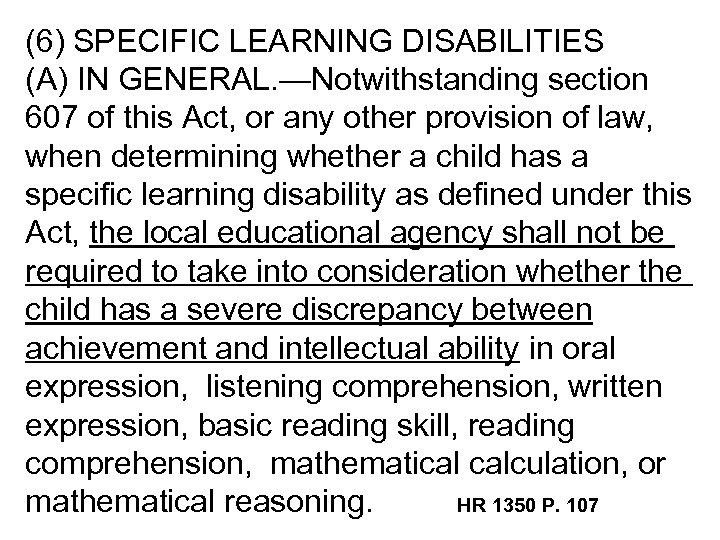 (6) SPECIFIC LEARNING DISABILITIES (A) IN GENERAL. —Notwithstanding section 607 of this Act, or any other provision of law, when determining whether a child has a specific learning disability as defined under this Act, the local educational agency shall not be required to take into consideration whether the child has a severe discrepancy between achievement and intellectual ability in oral expression, listening comprehension, written expression, basic reading skill, reading comprehension, mathematical calculation, or mathematical reasoning. HR 1350 P. 107
 ‘‘(B) ADDITIONAL AUTHORITY. — In determining whether a child has a specific learning disability, a local educational agency may use a process which determines if a child responds to scientific, research-based intervention HR 1350 P. 108.
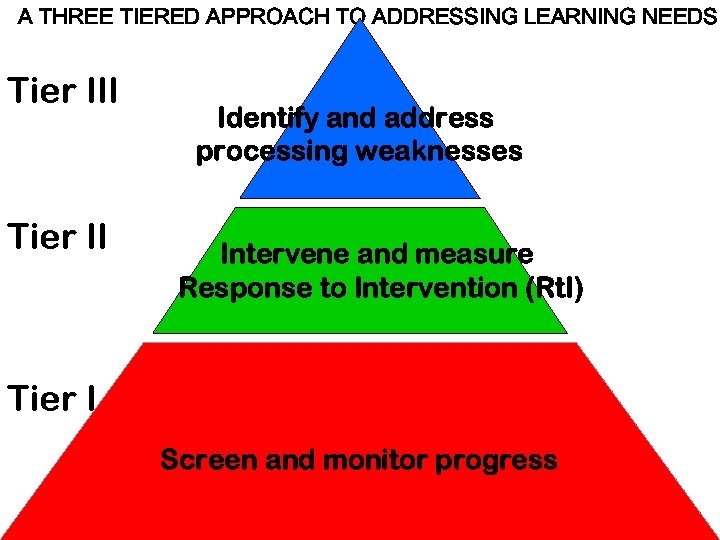 A THREE TIERED APPROACH TO ADDRESSING LEARNING NEEDS Tier III Tier II Identify and address processing weaknesses Intervene and measure Response to Intervention (Rt. I) Tier I Screen and monitor progress
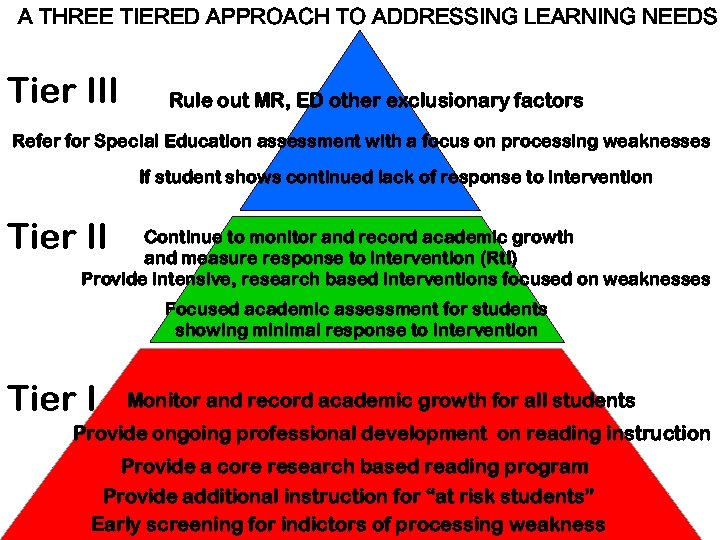 A THREE TIERED APPROACH TO ADDRESSING LEARNING NEEDS Tier III Rule out MR, ED other exclusionary factors Refer for Special Education assessment with a focus on processing weaknesses If student shows continued lack of response to intervention Tier II Continue to monitor and record academic growth and measure response to intervention (Rt. I) Provide intensive, research based interventions focused on weaknesses Focused academic assessment for students showing minimal response to intervention Tier I Monitor and record academic growth for all students Provide ongoing professional development on reading instruction Provide a core research based reading program Provide additional instruction for “at risk students” Early screening for indictors of processing weakness
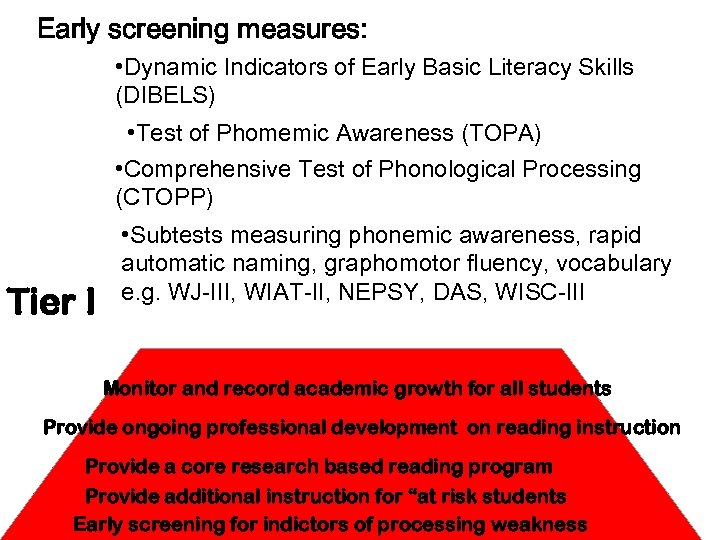 Early screening measures: • Dynamic Indicators of Early Basic Literacy Skills (DIBELS) • Test of Phomemic Awareness (TOPA) • Comprehensive Test of Phonological Processing (CTOPP) Tier I • Subtests measuring phonemic awareness, rapid automatic naming, graphomotor fluency, vocabulary e. g. WJ-III, WIAT-II, NEPSY, DAS, WISC-III Monitor and record academic growth for all students Provide ongoing professional development on reading instruction Provide a core research based reading program Provide additional instruction for “at risk students Early screening for indictors of processing weakness
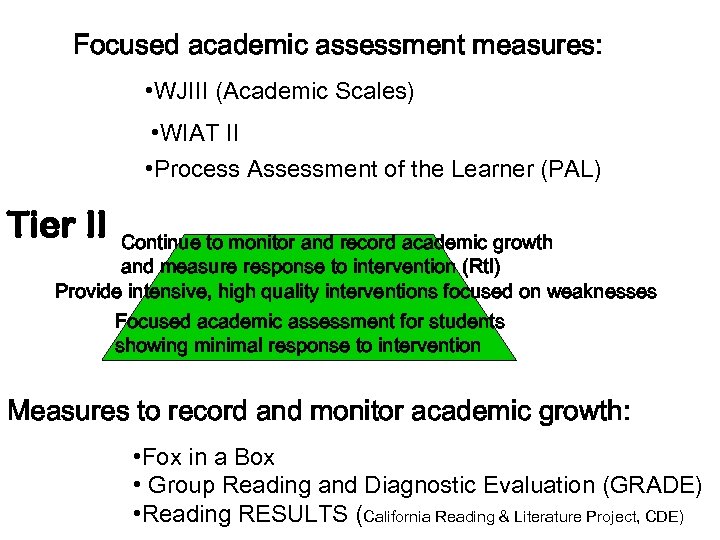 Focused academic assessment measures: • WJIII (Academic Scales) • WIAT II • Process Assessment of the Learner (PAL) Tier II Continue to monitor and record academic growth and measure response to intervention (Rt. I) Provide intensive, high quality interventions focused on weaknesses Focused academic assessment for students showing minimal response to intervention Measures to record and monitor academic growth: • Fox in a Box • Group Reading and Diagnostic Evaluation (GRADE) • Reading RESULTS (California Reading & Literature Project, CDE)
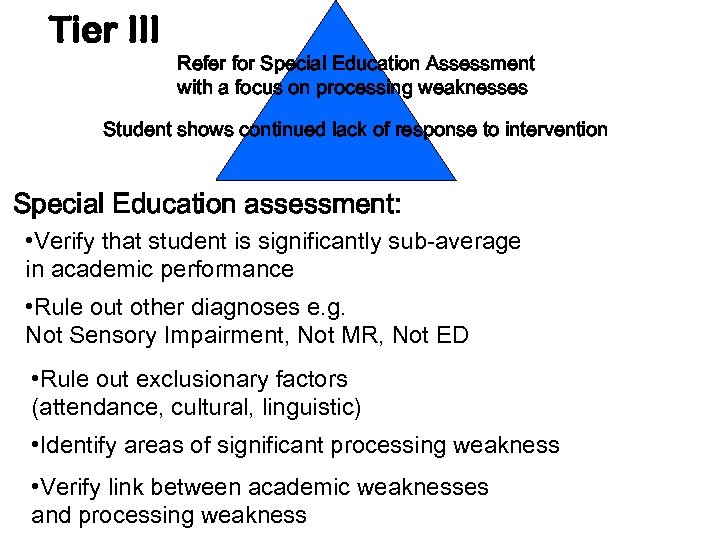 Tier III Refer for Special Education Assessment with a focus on processing weaknesses Student shows continued lack of response to intervention Special Education assessment: • Verify that student is significantly sub-average in academic performance • Rule out other diagnoses e. g. Not Sensory Impairment, Not MR, Not ED • Rule out exclusionary factors (attendance, cultural, linguistic) • Identify areas of significant processing weakness • Verify link between academic weaknesses and processing weakness