


 Скачать презентацию A Thermo Electron Corporation új XSeries II ICP
70dd6770cd164f2524974d675b103327.ppt
- Количество слайдов: 60
 A Thermo Electron Corporation új XSeries. II ICP -MS készülékének és környezetvédelmi alkalmazásainak bemutatása Száraz Sándor Unicam Magyarország Kft. 1144 Budapest, Kőszeg u. 29. unicam@unicam. hu
 XSeries. II ICP-MS Brief introduction to ICP-MS
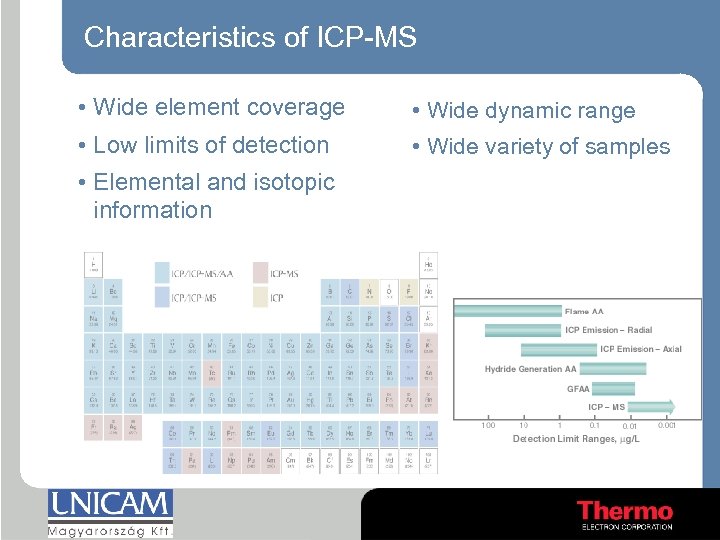 Characteristics of ICP-MS • Wide element coverage • Wide dynamic range • Low limits of detection • Wide variety of samples • Elemental and isotopic information
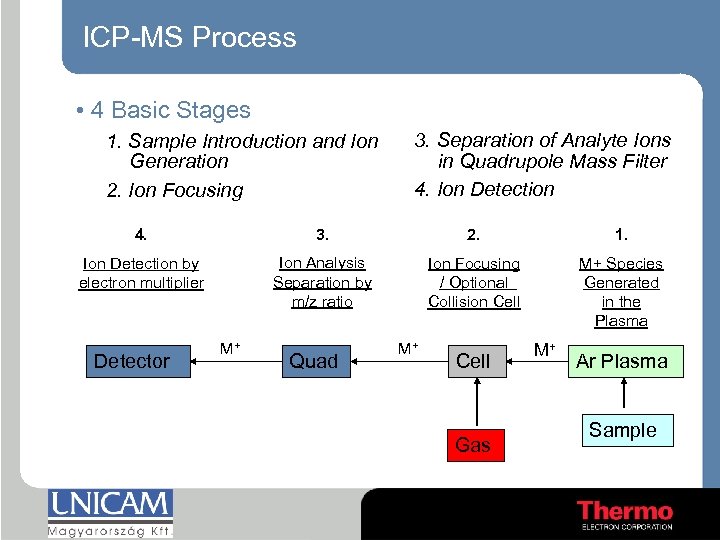 ICP-MS Process • 4 Basic Stages 1. Sample Introduction and Ion Generation 2. Ion Focusing 3. Separation of Analyte Ions in Quadrupole Mass Filter 4. Ion Detection 4. 3. 2. 1. Ion Detection by electron multiplier Ion Analysis Separation by m/z ratio Ion Focusing / Optional Collision Cell M+ Species Generated in the Plasma Detector M+ Quad M+ Cell Gas M+ Ar Plasma Sample
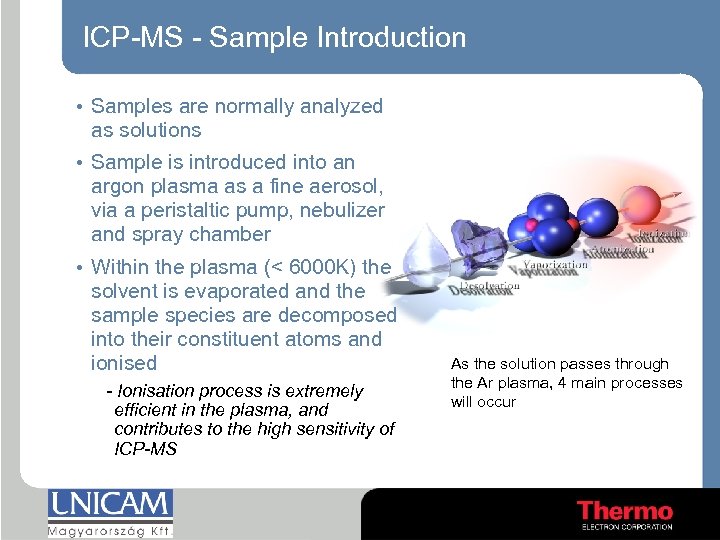 ICP-MS - Sample Introduction • Samples are normally analyzed as solutions • Sample is introduced into an argon plasma as a fine aerosol, via a peristaltic pump, nebulizer and spray chamber • Within the plasma (< 6000 K) the solvent is evaporated and the sample species are decomposed into their constituent atoms and ionised - Ionisation process is extremely efficient in the plasma, and contributes to the high sensitivity of ICP-MS As the solution passes through the Ar plasma, 4 main processes will occur
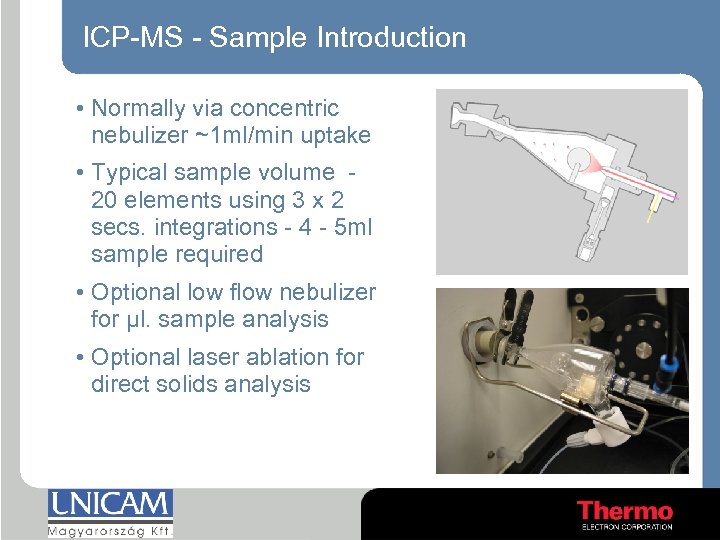 ICP-MS - Sample Introduction • Normally via concentric nebulizer ~1 ml/min uptake • Typical sample volume 20 elements using 3 x 2 secs. integrations - 4 - 5 ml sample required • Optional low flow nebulizer for μl. sample analysis • Optional laser ablation for direct solids analysis
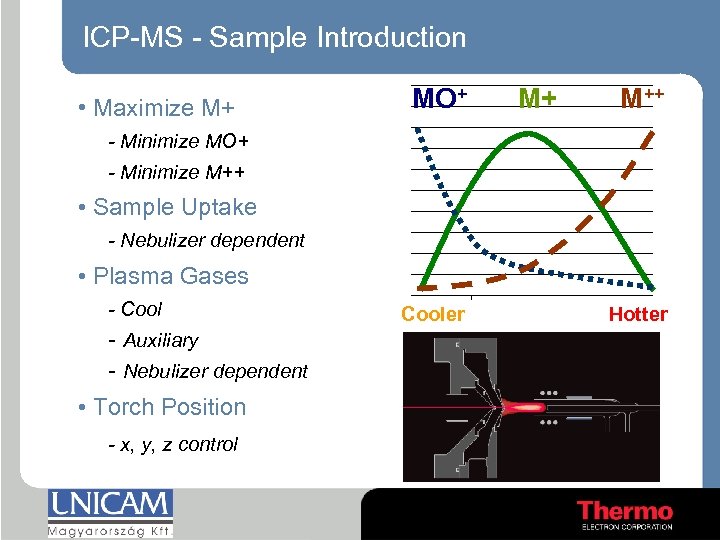 ICP-MS - Sample Introduction • Maximize M+ MO+ M+ M++ - Minimize MO+ - Minimize M++ • Sample Uptake - Nebulizer dependent • Plasma Gases - Cool - Auxiliary - Nebulizer dependent • Torch Position - x, y, z control Cooler Hotter
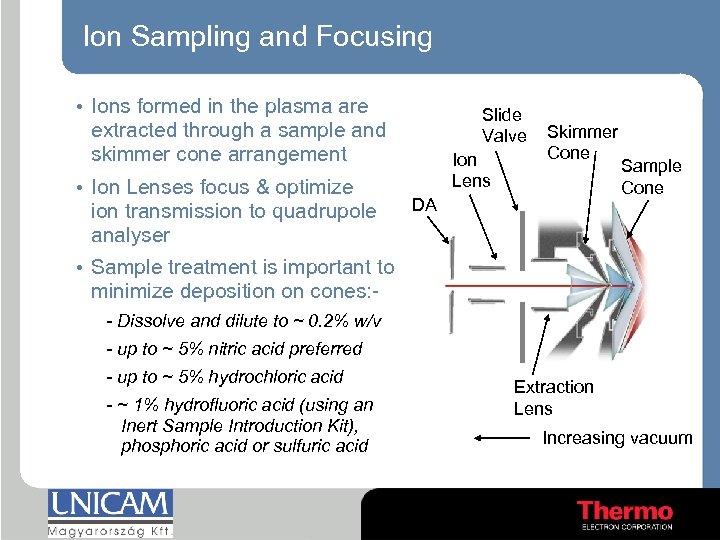 Ion Sampling and Focusing • Ions formed in the plasma are extracted through a sample and skimmer cone arrangement • Ion Lenses focus & optimize ion transmission to quadrupole analyser Slide Valve Ion Lens Skimmer Cone DA Sample Cone • Sample treatment is important to minimize deposition on cones: - Dissolve and dilute to ~ 0. 2% w/v - up to ~ 5% nitric acid preferred - up to ~ 5% hydrochloric acid - ~ 1% hydrofluoric acid (using an Inert Sample Introduction Kit), phosphoric acid or sulfuric acid Extraction Lens Increasing vacuum
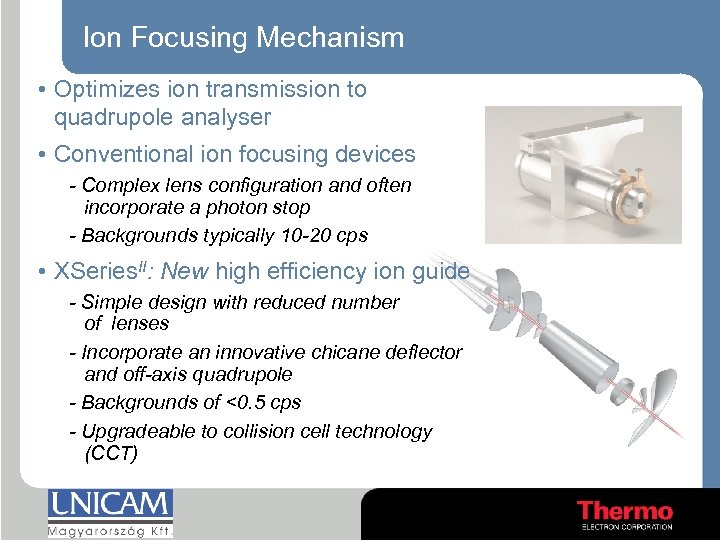 Ion Focusing Mechanism • Optimizes ion transmission to quadrupole analyser • Conventional ion focusing devices - Complex lens configuration and often incorporate a photon stop - Backgrounds typically 10 -20 cps • XSeries. II: New high efficiency ion guide - Simple design with reduced number of lenses - Incorporate an innovative chicane deflector and off-axis quadrupole - Backgrounds of <0. 5 cps - Upgradeable to collision cell technology (CCT)
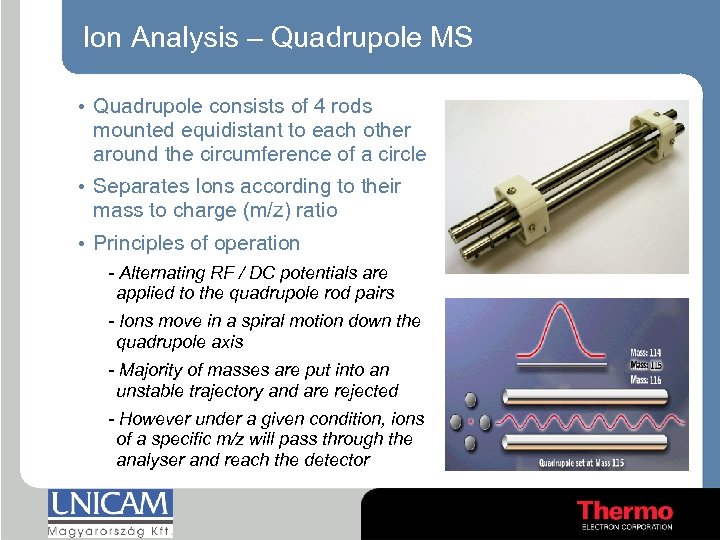 Ion Analysis – Quadrupole MS • Quadrupole consists of 4 rods mounted equidistant to each other around the circumference of a circle • Separates Ions according to their mass to charge (m/z) ratio • Principles of operation - Alternating RF / DC potentials are applied to the quadrupole rod pairs - Ions move in a spiral motion down the quadrupole axis - Majority of masses are put into an unstable trajectory and are rejected - However under a given condition, ions of a specific m/z will pass through the analyser and reach the detector
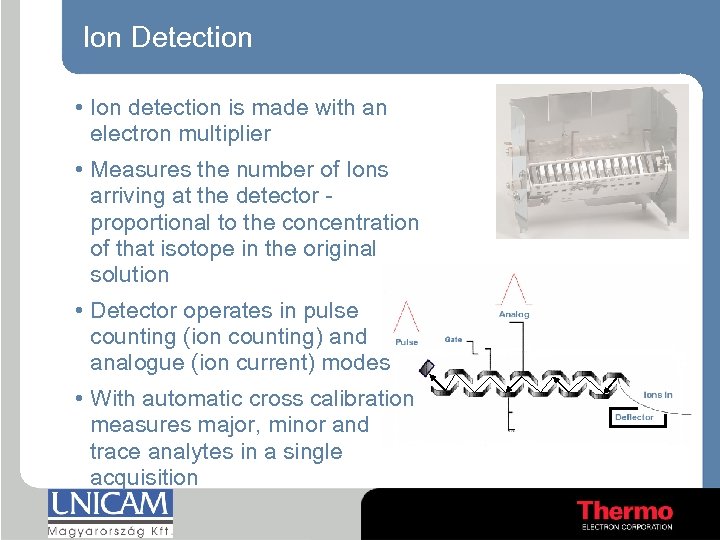 Ion Detection • Ion detection is made with an electron multiplier • Measures the number of Ions arriving at the detector proportional to the concentration of that isotope in the original -2 Kv solution • Detector operates in pulse counting (ion counting) and analogue (ion current) modes • With automatic cross calibration measures major, minor and trace analytes in a single acquisition
 Data Acquisition Modes • Scanning - Qualitative analysis and Quantitative analysis - Semi. Quantitative analysis: Post run data retrieval on uncalibrated elements • Peak Jumping - Selected isotopes - Optimized dwell times - Improved detection limits • Time Resolved Analysis - Transient signal analysis - Applicable to laser ablation ICP-MS and chromatographic studies
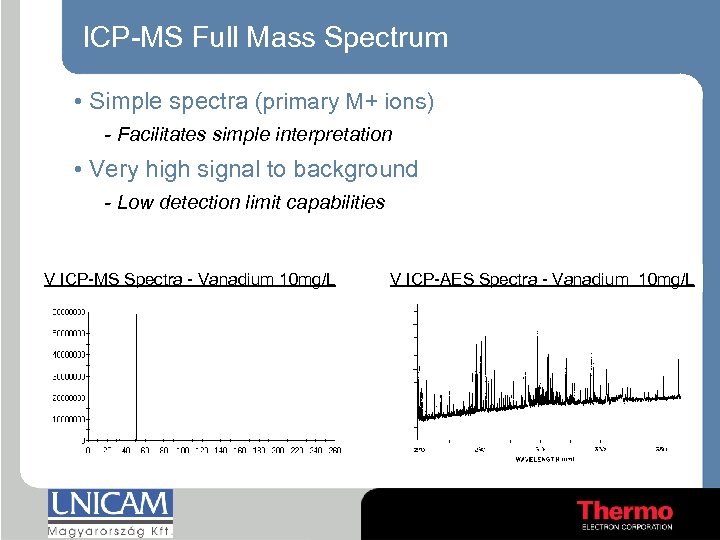 ICP-MS Full Mass Spectrum • Simple spectra (primary M+ ions) - Facilitates simple interpretation • Very high signal to background - Low detection limit capabilities V ICP-MS Spectra - Vanadium 10 mg/L V ICP-AES Spectra - Vanadium 10 mg/L
 Calibration Techniques • Semi Quantitative - Analyte sensitivity can be determined from the instrument response built from the response to other known analytes. - Relative Sensitivity Factors (RSF) apply corrections for ionization and sample processing effects, these can be pre-determined for a given matrix to improve accuracy • Full Quantitative - Multi element external calibration standards - Standard additions calibration - Isotope ratio determination (for isotope dilution measurement)
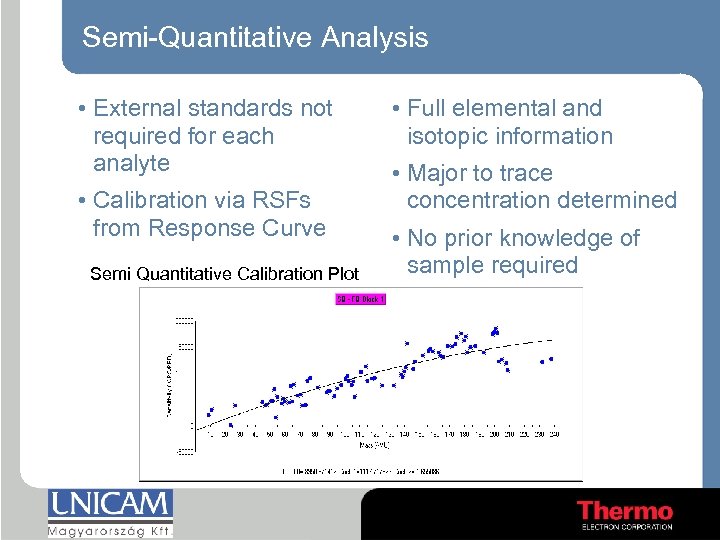 Semi-Quantitative Analysis • External standards not required for each analyte • Calibration via RSFs from Response Curve Semi Quantitative Calibration Plot • Full elemental and isotopic information • Major to trace concentration determined • No prior knowledge of sample required
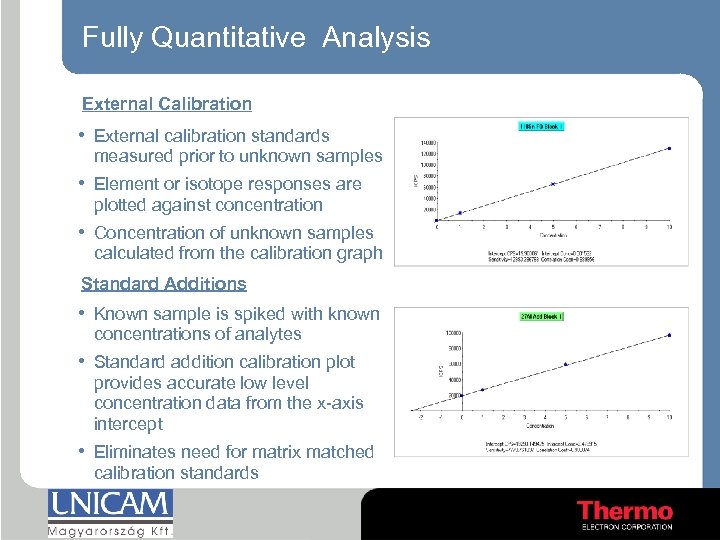 Fully Quantitative Analysis External Calibration • External calibration standards measured prior to unknown samples • Element or isotope responses are plotted against concentration • Concentration of unknown samples calculated from the calibration graph Standard Additions • Known sample is spiked with known concentrations of analytes • Standard addition calibration plot provides accurate low level concentration data from the x-axis intercept • Eliminates need for matrix matched calibration standards
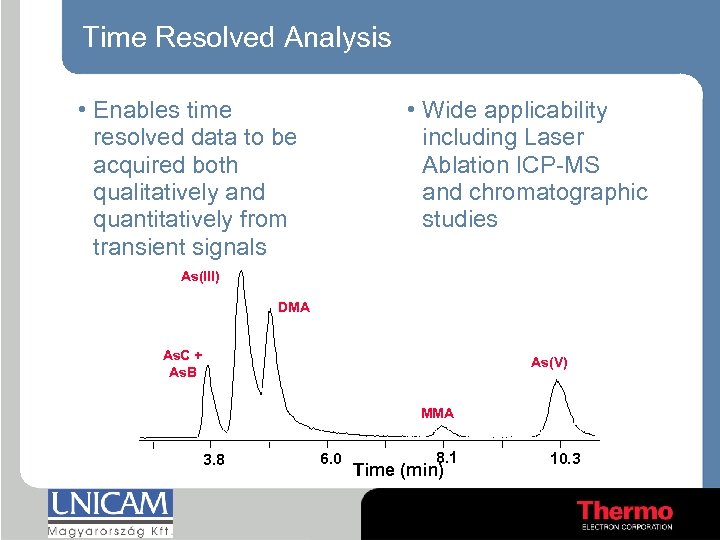 Time Resolved Analysis • Enables time resolved data to be acquired both qualitatively and quantitatively from transient signals • Wide applicability including Laser Ablation ICP-MS and chromatographic studies As(III) DMA As. C + As. B As(V) MMA 3. 8 6. 0 8. 1 Time (min) 10. 3
 XSeries. II ICP-MS Routine Environmental Applications
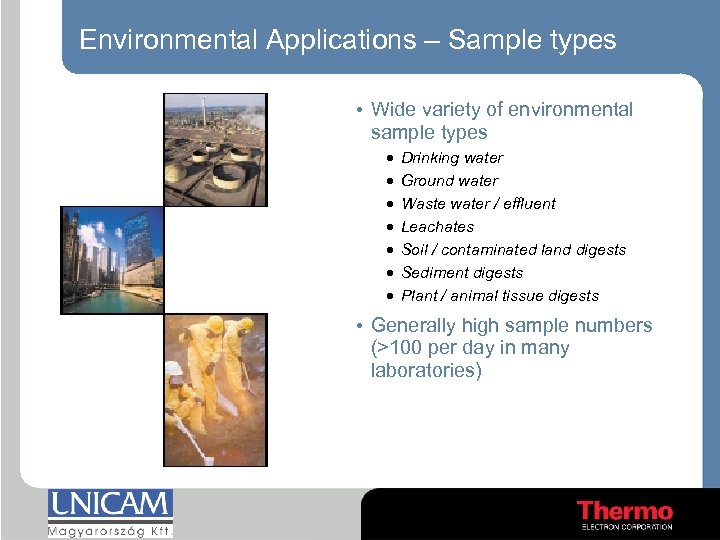 Environmental Applications – Sample types • Wide variety of environmental sample types · · · · Drinking water Ground water Waste water / effluent Leachates Soil / contaminated land digests Sediment digests Plant / animal tissue digests • Generally high sample numbers (>100 per day in many laboratories)
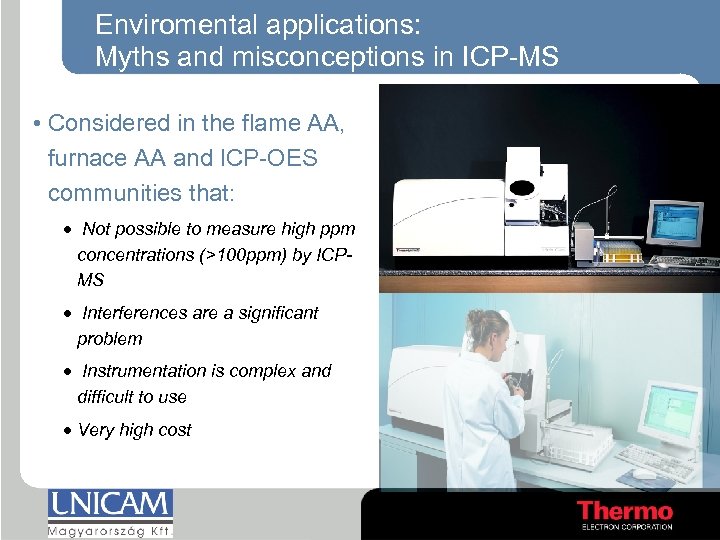 Enviromental applications: Myths and misconceptions in ICP-MS • Considered in the flame AA, furnace AA and ICP-OES communities that: · Not possible to measure high ppm concentrations (>100 ppm) by ICPMS · Interferences are a significant problem · Instrumentation is complex and difficult to use · Very high cost
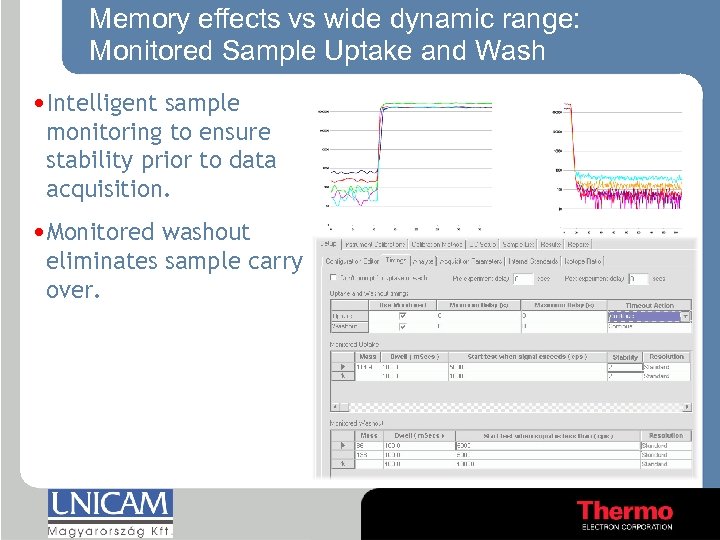 Memory effects vs wide dynamic range: Monitored Sample Uptake and Wash • Intelligent sample monitoring to ensure stability prior to data acquisition. • Monitored washout eliminates sample carry over.
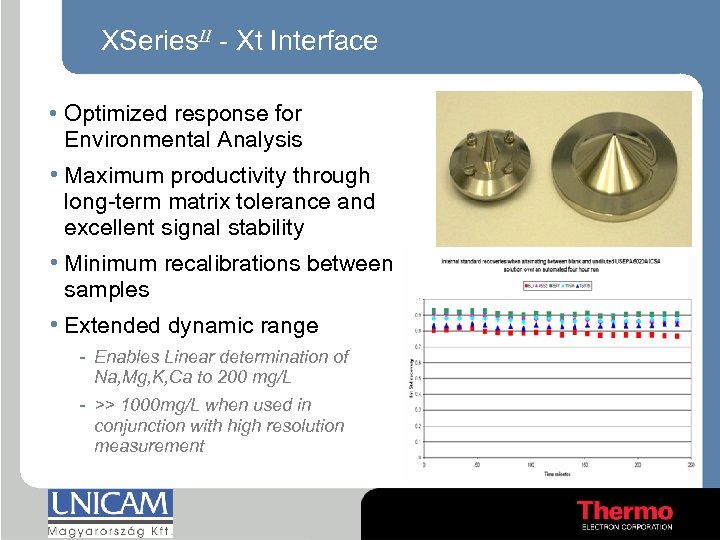 XSeries. II - Xt Interface • Optimized response for Environmental Analysis • Maximum productivity through long-term matrix tolerance and excellent signal stability • Minimum recalibrations between samples • Extended dynamic range - Enables Linear determination of Na, Mg, K, Ca to 200 mg/L - >> 1000 mg/L when used in conjunction with high resolution measurement
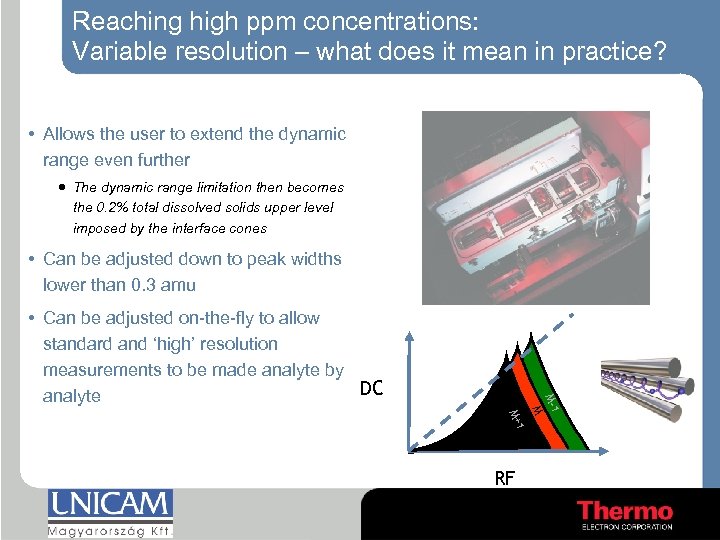 Reaching high ppm concentrations: Variable resolution – what does it mean in practice? • Allows the user to extend the dynamic range even further · The dynamic range limitation then becomes the 0. 2% total dissolved solids upper level imposed by the interface cones • Can be adjusted down to peak widths lower than 0. 3 amu 1 M+ RF M-1 M • Can be adjusted on-the-fly to allow standard and ‘high’ resolution measurements to be made analyte by DC analyte
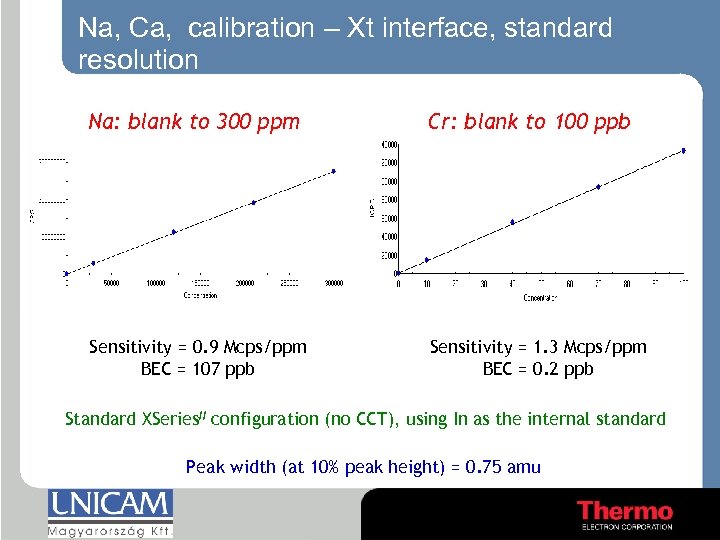 Na, Ca, calibration – Xt interface, standard resolution Na: blank to 300 ppm Cr: blank to 100 ppb Sensitivity = 0. 9 Mcps/ppm BEC = 107 ppb Sensitivity = 1. 3 Mcps/ppm BEC = 0. 2 ppb Standard XSeries. II configuration (no CCT), using In as the internal standard Peak width (at 10% peak height) = 0. 75 amu
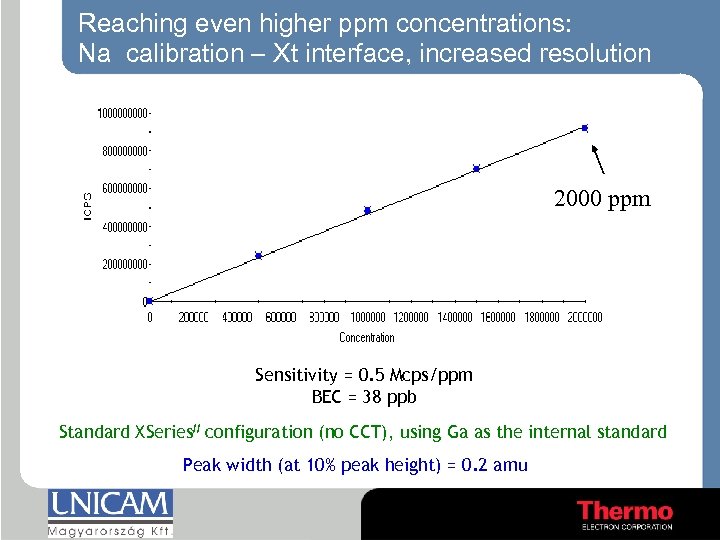 Reaching even higher ppm concentrations: Na calibration – Xt interface, increased resolution Na: blank to 2000 ppm Sensitivity = 0. 5 Mcps/ppm BEC = 38 ppb Standard XSeries. II configuration (no CCT), using Ga as the internal standard Peak width (at 10% peak height) = 0. 2 amu
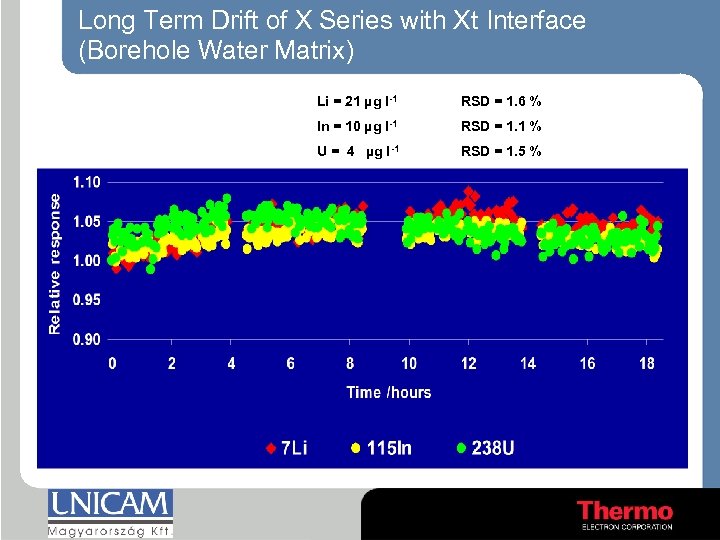 Long Term Drift of X Series with Xt Interface (Borehole Water Matrix) Li = 21 µg l-1 RSD = 1. 6 % In = 10 µg l-1 RSD = 1. 1 % U = 4 µg l-1 RSD = 1. 5 %
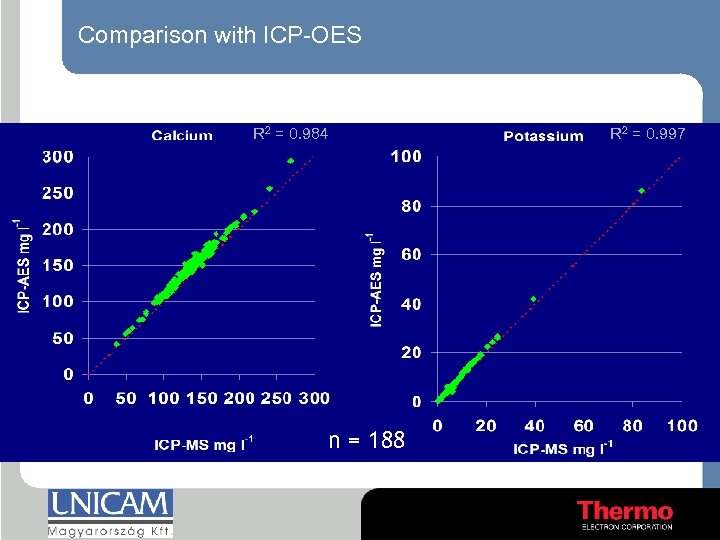 Comparison with ICP-OES R 2 = 0. 984 n = 188 R 2 = 0. 997
 Conclusions for XSeries. II standard with environmental work • Hardware and software advancements of the XSeries. II ICP-MS allow rapid, accurate analyses of environmental samples with turnkey operation. • Great improvement in sample throughput. • Linear range extended and matrix tolerance improved with Xt interface. • Protocol compliance even without CCT.
 XSeries. II ICP-MS Performance Options for Environmental Research Applications
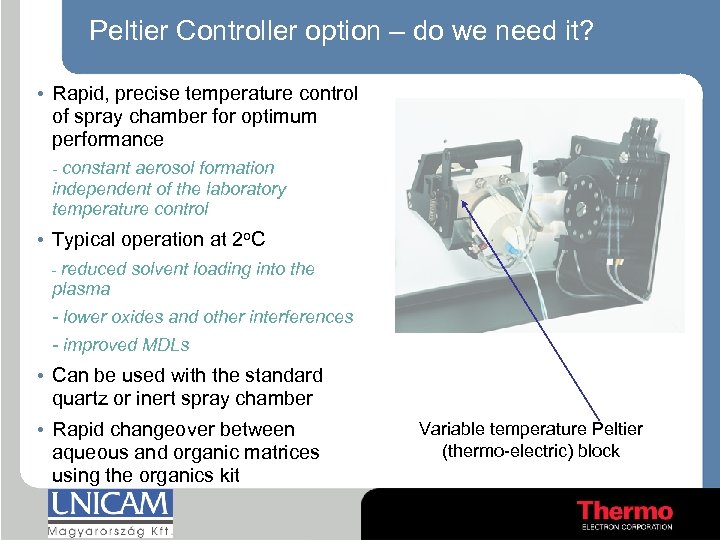 Peltier Controller option – do we need it? • Rapid, precise temperature control of spray chamber for optimum performance - constant aerosol formation independent of the laboratory temperature control • Typical operation at 2 o. C - reduced solvent loading into the plasma - lower oxides and other interferences - improved MDLs • Can be used with the standard quartz or inert spray chamber • Rapid changeover between aqueous and organic matrices using the organics kit Variable temperature Peltier (thermo-electric) block
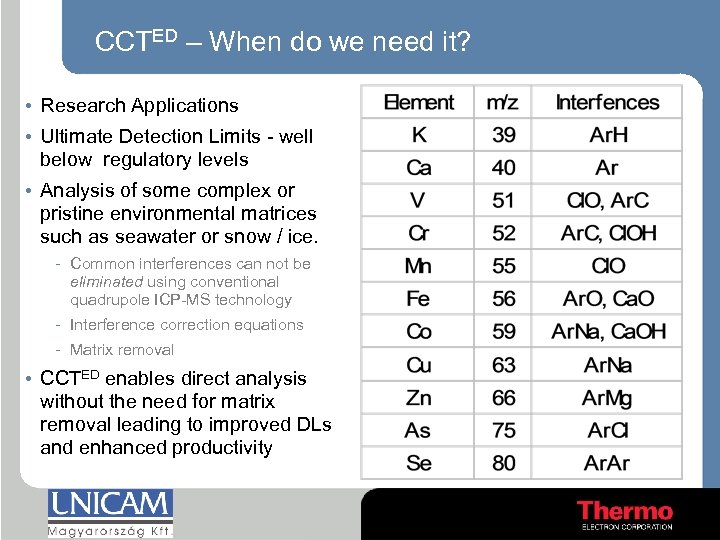 CCTED – When do we need it? • Research Applications • Ultimate Detection Limits - well below regulatory levels • Analysis of some complex or pristine environmental matrices such as seawater or snow / ice. - Common interferences can not be eliminated using conventional quadrupole ICP-MS technology - Interference correction equations - Matrix removal • CCTED enables direct analysis without the need for matrix removal leading to improved DLs and enhanced productivity
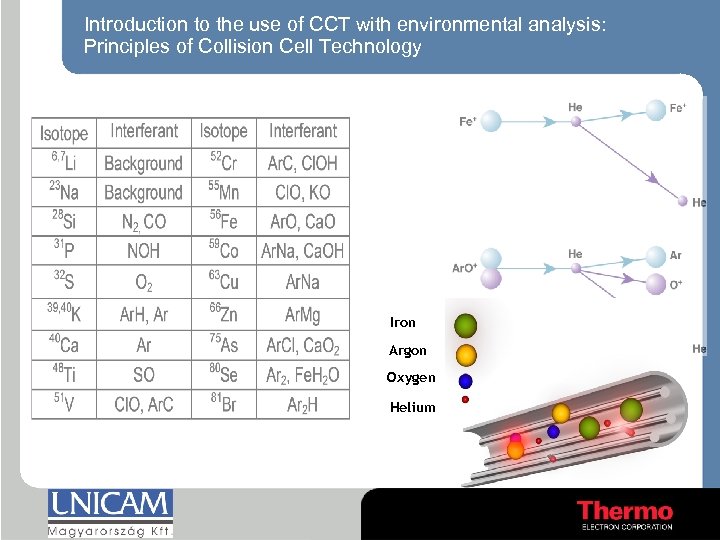 Introduction to the use of CCT with environmental analysis: Principles of Collision Cell Technology Iron Argon Oxygen Helium
 Introduction to the use of CCT with environmental analysis • Some analytes have few interference problems and perform best with the cell unpressurised, i. e. standard ICP-MS mode, e. g. Pb • The ideal multi-element analysis would result in several analyses under different conditions, e. g. · Standard mode · H 2 mode · NH 3 mode • A more efficient method is to switch modes “in-sample” · is this viable in terms of speed, stability and accuracy?
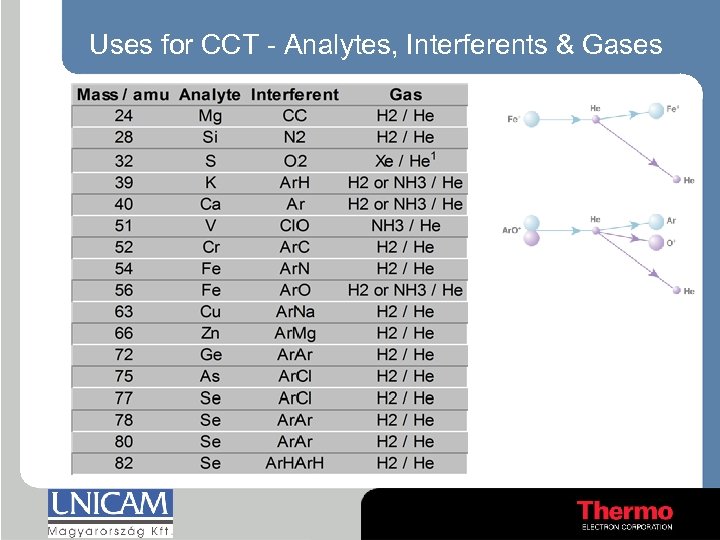 Uses for CCT - Analytes, Interferents & Gases
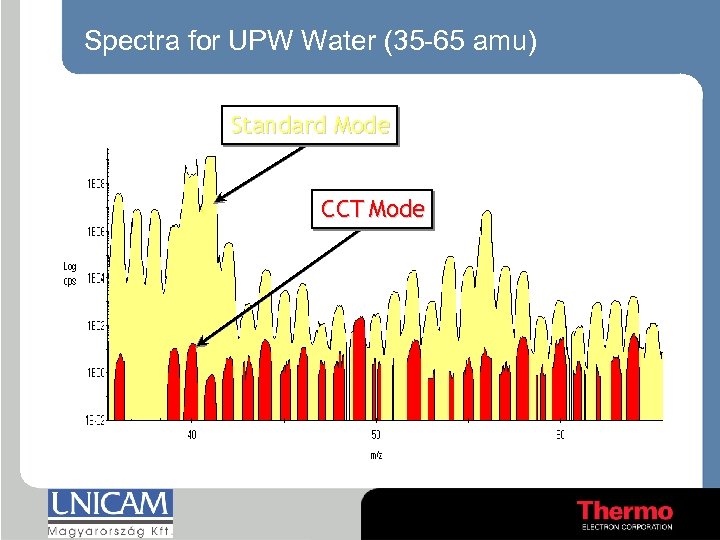 Spectra for UPW Water (35 -65 amu) Standard Mode CCT Mode
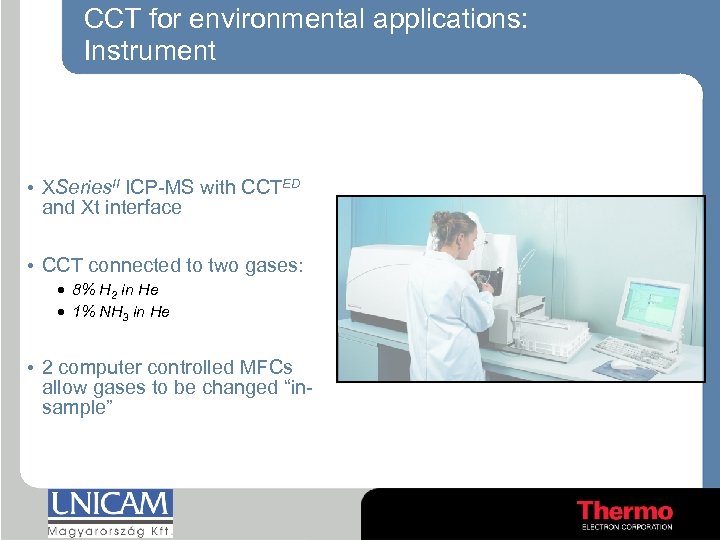 CCT for environmental applications: Instrument • XSeries. II ICP-MS with CCTED and Xt interface • CCT connected to two gases: · 8% H 2 in He · 1% NH 3 in He • 2 computer controlled MFCs allow gases to be changed “insample”
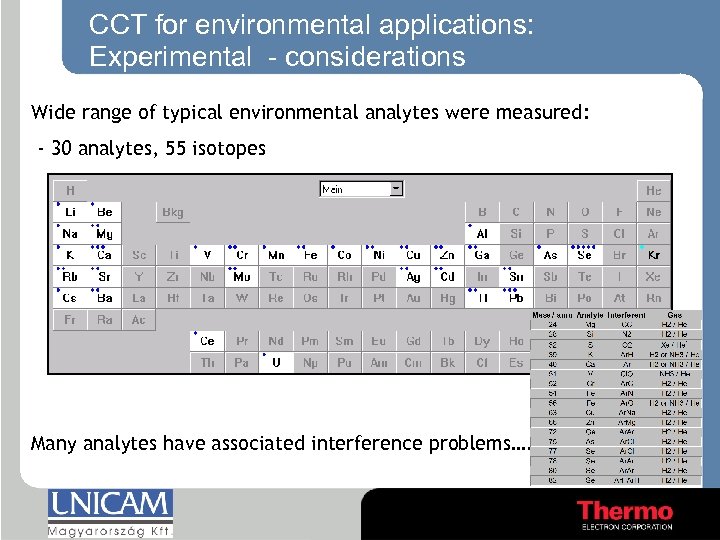 CCT for environmental applications: Experimental - considerations Wide range of typical environmental analytes were measured: - 30 analytes, 55 isotopes Many analytes have associated interference problems….
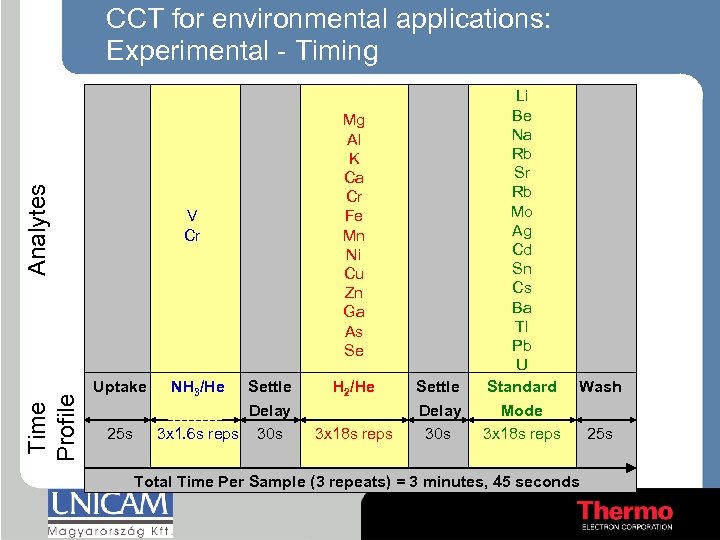 Time Profile Analytes CCT for environmental applications: Experimental - Timing V Cr Uptake 25 s NH 3/He Settle Delay 3 x 1. 6 s reps 30 s Mg Al K Ca Cr Fe Mn Ni Cu Zn Ga As Se H 2/He 3 x 18 s reps Settle Delay 30 s Li Be Na Rb Sr Rb Mo Ag Cd Sn Cs Ba Tl Pb U Standard Mode 3 x 18 s reps Wash Total Time Per Sample (3 repeats) = 3 minutes, 45 seconds 25 s
 CCT for environmental applications: Results - detection limits (mg/L) Based on 3 s on 12 x 10 replicates of blank, each from a new calibration
 CCT for environmental applications: Results – stability of real sample in different modes Sample diluted 1+9 and spiked to 2% HCl
 CCT for environmental applications: Conclusions • The XSeries. II allows rapid settings changes, allowing two different cell gases and normal ICP-MS mode to be used in a single sample analysis · 3¾ minutes per sample, 55 isotopes, 3 measurements/isotope, • Excellent stability is retained in each mode · RSDs of typically <1% over a 12 hour duration for a signal of ~50, 000 cps • Mode switching allows the optimum conditions for each analyte to be utilised, resulting in ultimate performance: · DLs in the ppt or sub-ppt range for almost all elements • The technique results in freedom from many interferences · Accuracy of within ± 5% for the vast majority of analytes, even after spiking to 700 ppm chloride
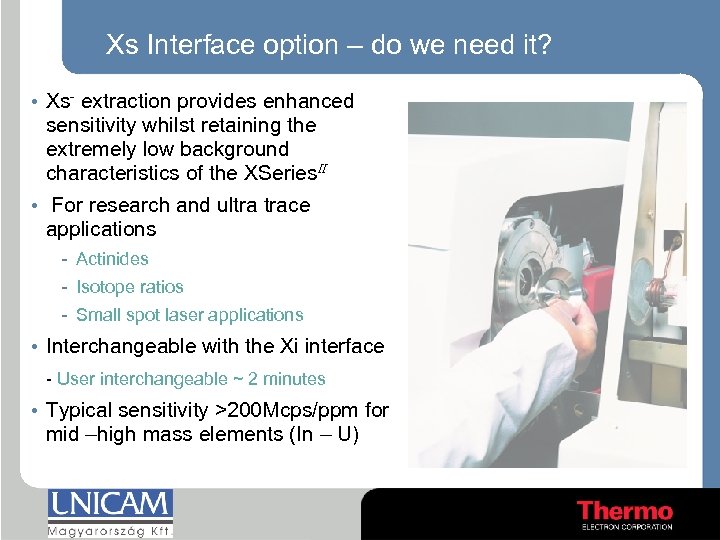 Xs Interface option – do we need it? • Xs- extraction provides enhanced sensitivity whilst retaining the extremely low background characteristics of the XSeries. II • For research and ultra trace applications - Actinides - Isotope ratios - Small spot laser applications • Interchangeable with the Xi interface - User interchangeable ~ 2 minutes • Typical sensitivity >200 Mcps/ppm for mid –high mass elements (In – U)
 X Series Environmental Methods ICP-MS Productivity Pack • Supplied to customers on instrument delivery: · Plasma. Lab Productivity Method Template · Detailed instructions on instrument set-up, solution preparation and sample analysis · A Productivity Method Template that can be modified to a laboratory’s own working method · All calibration and quality control solutions required to run each protocol · A printed file containing the Productivity Method Template
 Environmental Protocols • US EPA has developed a series of methods for the analysis of drinking water, waste water and other environmental samples: · OW 200. 8 drinking water 1991 · OSW 6020 waters, wastes, soils, etc 1994 · OSW 6020 A waters, wastes, soils, etc 1998 · CLP ILM 05. 2 D waters, wastes, soils, etc 2001 These are challenging, QC intensive, multiple analyte, multiple concentration methods with tough specifications for accuracy, precision and DLs
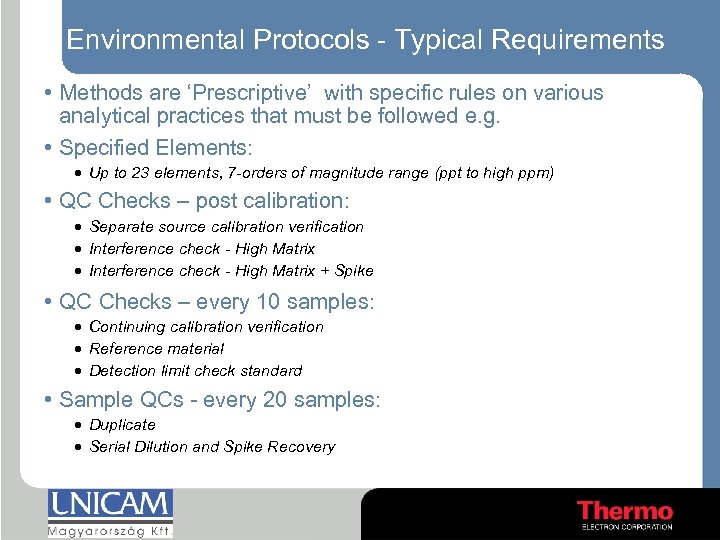 Environmental Protocols - Typical Requirements • Methods are ‘Prescriptive’ with specific rules on various analytical practices that must be followed e. g. • Specified Elements: · Up to 23 elements, 7 -orders of magnitude range (ppt to high ppm) • QC Checks – post calibration: · Separate source calibration verification · Interference check - High Matrix + Spike • QC Checks – every 10 samples: · Continuing calibration verification · Reference material · Detection limit check standard • Sample QCs - every 20 samples: · Duplicate · Serial Dilution and Spike Recovery
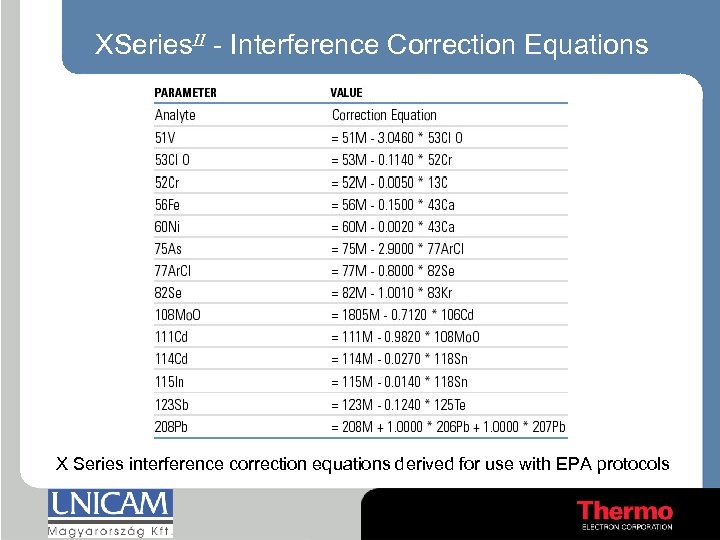 XSeries. II - Interference Correction Equations X Series interference correction equations derived for use with EPA protocols
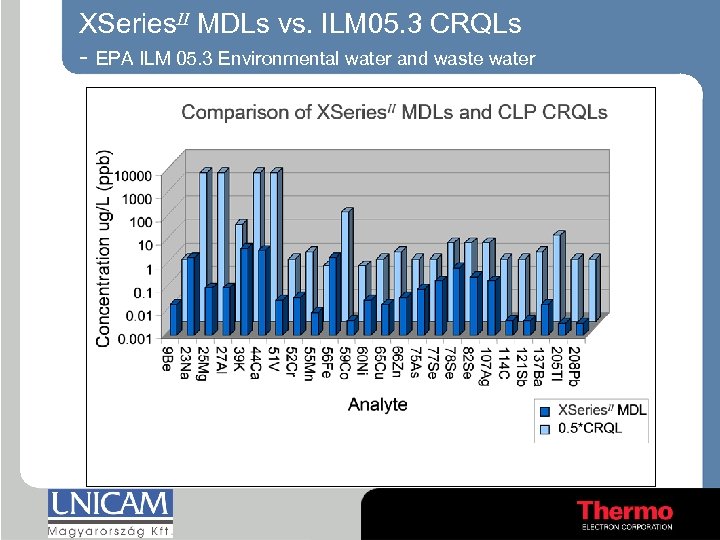 XSeries. II MDLs vs. ILM 05. 3 CRQLs - EPA ILM 05. 3 Environmental water and waste water
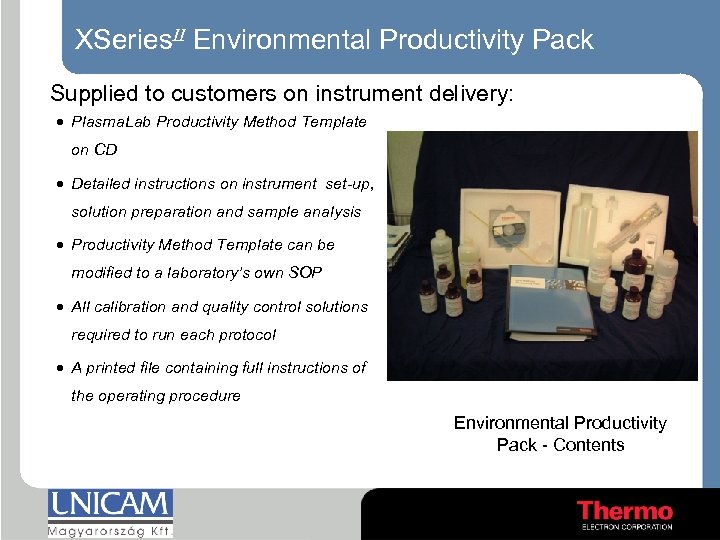 XSeries. II Environmental Productivity Pack Supplied to customers on instrument delivery: · Plasma. Lab Productivity Method Template on CD · Detailed instructions on instrument set-up, solution preparation and sample analysis · Productivity Method Template can be modified to a laboratory’s own SOP · All calibration and quality control solutions required to run each protocol · A printed file containing full instructions of the operating procedure Environmental Productivity Pack - Contents
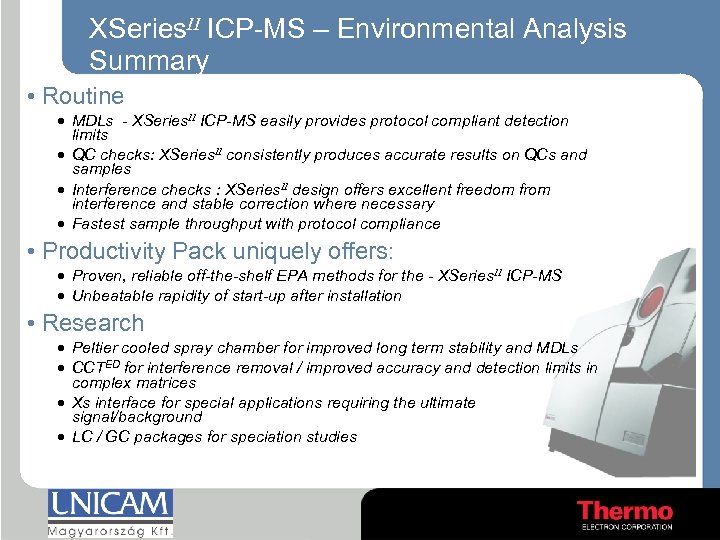 XSeries. II ICP-MS – Environmental Analysis Summary • Routine · MDLs - XSeries. II ICP-MS easily provides protocol compliant detection limits · QC checks: XSeries. II consistently produces accurate results on QCs and samples · Interference checks : XSeries. II design offers excellent freedom from interference and stable correction where necessary · Fastest sample throughput with protocol compliance • Productivity Pack uniquely offers: · Proven, reliable off-the-shelf EPA methods for the - XSeries. II ICP-MS · Unbeatable rapidity of start-up after installation • Research · Peltier cooled spray chamber for improved long term stability and MDLs · CCTED for interference removal / improved accuracy and detection limits in complex matrices · Xs interface for special applications requiring the ultimate signal/background · LC / GC packages for speciation studies
 XSeries. II ICP-MS Speciation analysis
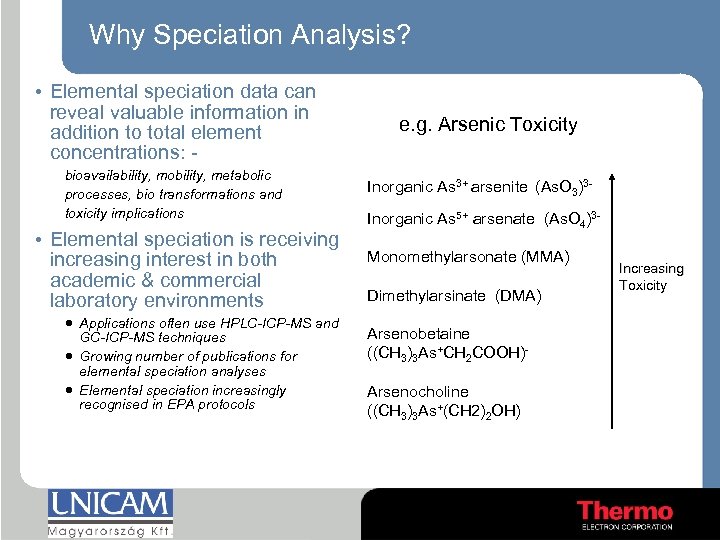 Why Speciation Analysis? • Elemental speciation data can reveal valuable information in addition to total element concentrations: bioavailability, mobility, metabolic processes, bio transformations and toxicity implications • Elemental speciation is receiving increasing interest in both academic & commercial laboratory environments · Applications often use HPLC-ICP-MS and GC-ICP-MS techniques · Growing number of publications for elemental speciation analyses · Elemental speciation increasingly recognised in EPA protocols e. g. Arsenic Toxicity Inorganic As 3+ arsenite (As. O 3)3 Inorganic As 5+ arsenate (As. O 4)3 Monomethylarsonate (MMA) Dimethylarsinate (DMA) Arsenobetaine ((CH 3)3 As+CH 2 COOH)Arsenocholine ((CH 3)3 As+(CH 2)2 OH) Increasing Toxicity
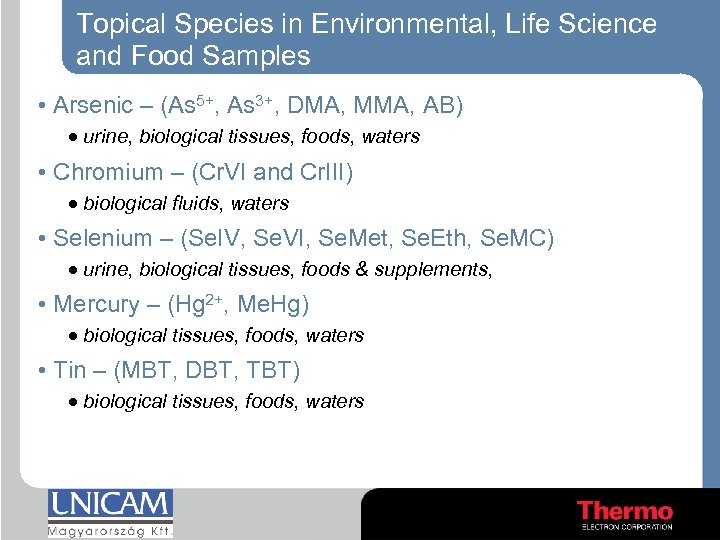 Topical Species in Environmental, Life Science and Food Samples • Arsenic – (As 5+, As 3+, DMA, MMA, AB) · urine, biological tissues, foods, waters • Chromium – (Cr. VI and Cr. III) · biological fluids, waters • Selenium – (Se. IV, Se. VI, Se. Met, Se. Eth, Se. MC) · urine, biological tissues, foods & supplements, • Mercury – (Hg 2+, Me. Hg) · biological tissues, foods, waters • Tin – (MBT, DBT, TBT) · biological tissues, foods, waters
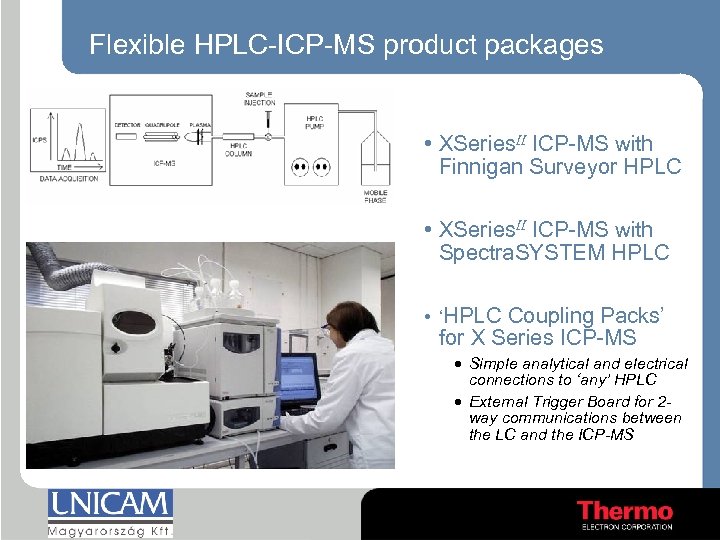 Flexible HPLC-ICP-MS product packages • XSeries. II ICP-MS with Finnigan Surveyor HPLC • XSeries. II ICP-MS with Spectra. SYSTEM HPLC • ‘HPLC Coupling Packs’ for X Series ICP-MS · Simple analytical and electrical connections to ‘any’ HPLC · External Trigger Board for 2 way communications between the LC and the ICP-MS
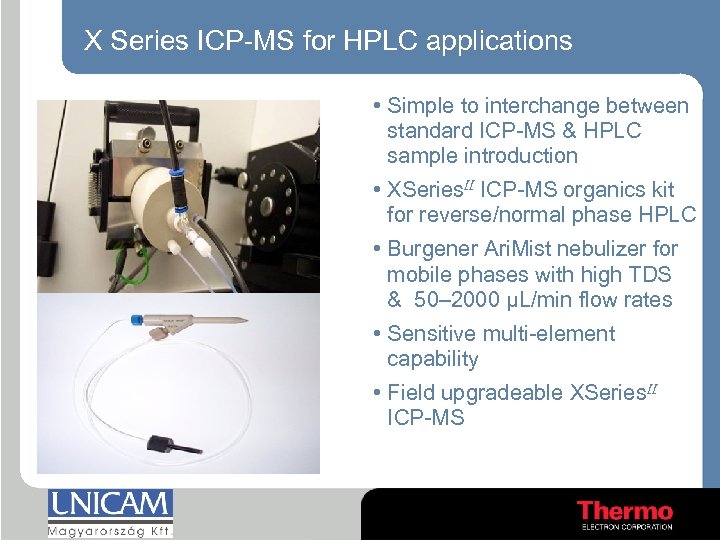 X Series ICP-MS for HPLC applications • Simple to interchange between standard ICP-MS & HPLC sample introduction • XSeries. II ICP-MS organics kit for reverse/normal phase HPLC • Burgener Ari. Mist nebulizer for mobile phases with high TDS & 50– 2000 μL/min flow rates • Sensitive multi-element capability • Field upgradeable XSeries. II ICP-MS
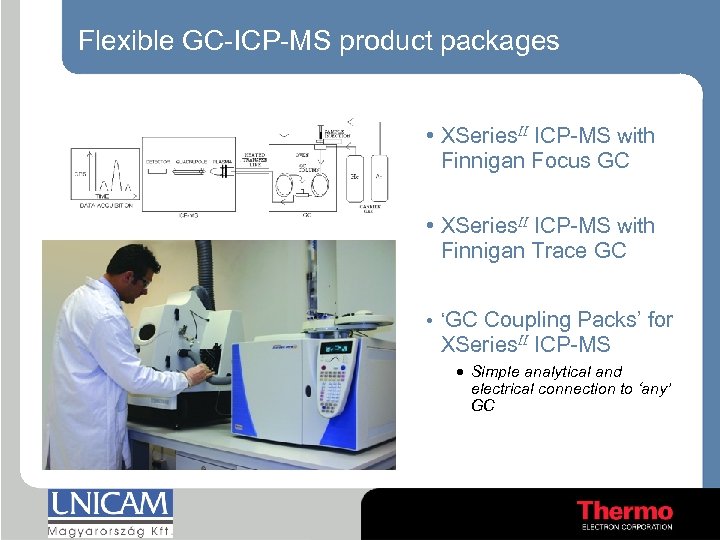 Flexible GC-ICP-MS product packages • XSeries. II ICP-MS with Finnigan Focus GC • XSeries. II ICP-MS with Finnigan Trace GC • ‘GC Coupling Packs’ for XSeries. II ICP-MS · Simple analytical and electrical connection to ‘any’ GC
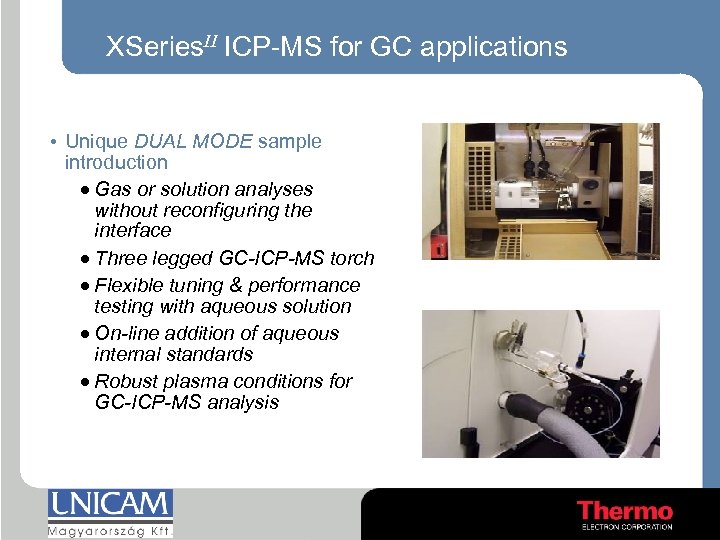 XSeries. II ICP-MS for GC applications • Unique DUAL MODE sample introduction · Gas or solution analyses without reconfiguring the interface · Three legged GC-ICP-MS torch · Flexible tuning & performance testing with aqueous solution · On-line addition of aqueous internal standards · Robust plasma conditions for GC-ICP-MS analysis
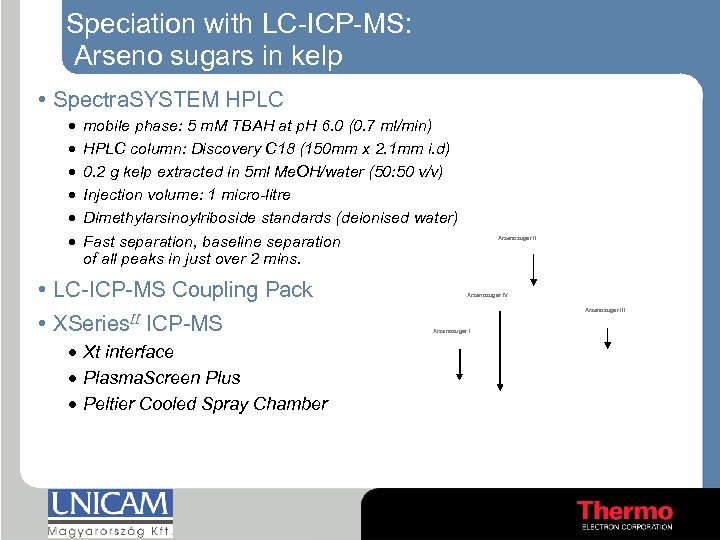 Speciation with LC-ICP-MS: Arseno sugars in kelp • Spectra. SYSTEM HPLC · · · mobile phase: 5 m. M TBAH at p. H 6. 0 (0. 7 ml/min) HPLC column: Discovery C 18 (150 mm x 2. 1 mm i. d) 0. 2 g kelp extracted in 5 ml Me. OH/water (50: 50 v/v) Injection volume: 1 micro-litre Dimethylarsinoylriboside standards (deionised water) Fast separation, baseline separation of all peaks in just over 2 mins. • LC-ICP-MS Coupling Pack • XSeries. II ICP-MS · Xt interface · Plasma. Screen Plus · Peltier Cooled Spray Chamber Arsenosugar II Arsenosugar IV Arsenosugar III Arsenosugar I
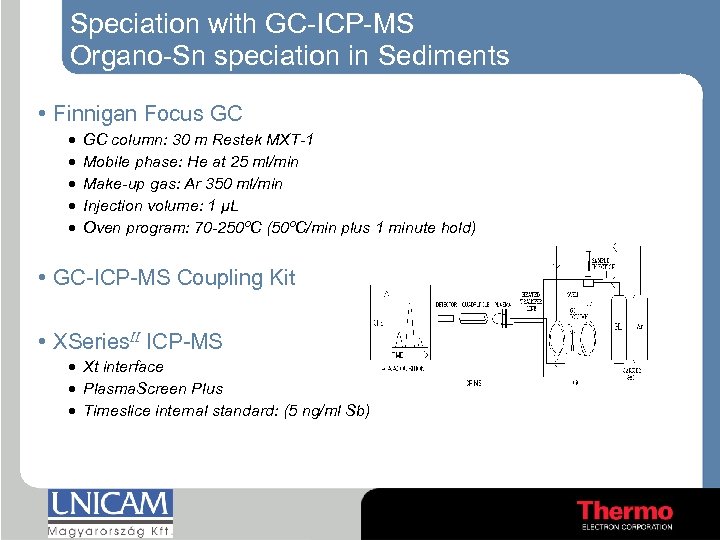 Speciation with GC-ICP-MS Organo-Sn speciation in Sediments • Finnigan Focus GC · · · GC column: 30 m Restek MXT-1 Mobile phase: He at 25 ml/min Make-up gas: Ar 350 ml/min Injection volume: 1 μL Oven program: 70 -250ºC (50ºC/min plus 1 minute hold) • GC-ICP-MS Coupling Kit • XSeries. II ICP-MS · Xt interface · Plasma. Screen Plus · Timeslice internal standard: (5 ng/ml Sb)
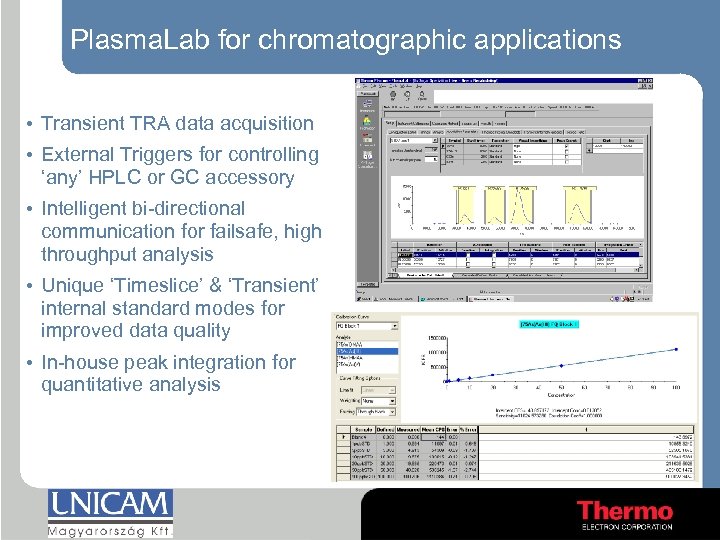 Plasma. Lab for chromatographic applications • Transient TRA data acquisition • External Triggers for controlling ‘any’ HPLC or GC accessory • Intelligent bi-directional communication for failsafe, high throughput analysis • Unique ‘Timeslice’ & ‘Transient’ internal standard modes for improved data quality • In-house peak integration for quantitative analysis
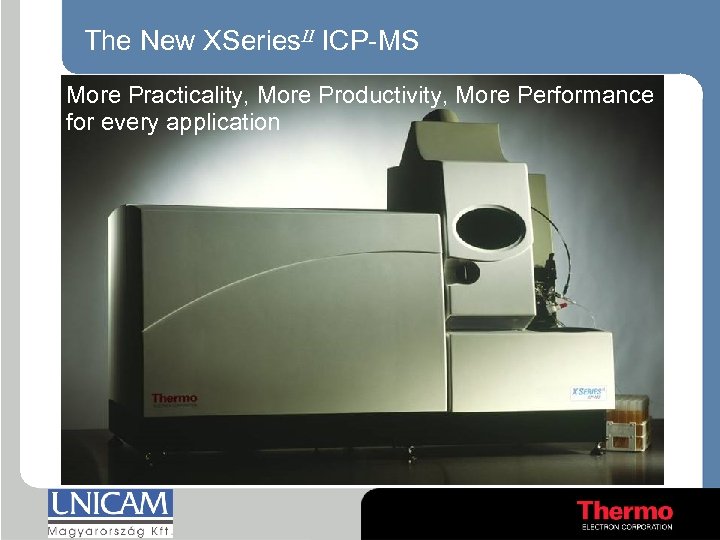 The New XSeries. II ICP-MS More Practicality, More Productivity, More Performance for every application