 Скачать презентацию A technological capability story behind exports of fish
c2c295add939c727d14983cb9ef0d044.ppt
- Количество слайдов: 18



A technological capability story behind exports of fish fillet and i. Pods Vandana Chandra (Joint work with Jessica Boccardo, and Israel Osorio)[1])) [1] October 15, 2007 [1] The views and interpretations in this document are those of the authors and should not be attributed to the World Bank, or to any individual acting on its behalf.
Outline § Background – uneven growth across regions § Relationship between income differentials and trade and technology – raises many questions… § What explains these income differentials? Export mix. ? § Technology definition – deterministic § Other explanations – Natural Resource Curse? Is SSA special? – also deterministic § These explanations do not explain the link between technology, trade and income - need an alternative approach § What determines it? § What can it explain? § Policy implications § Lessons
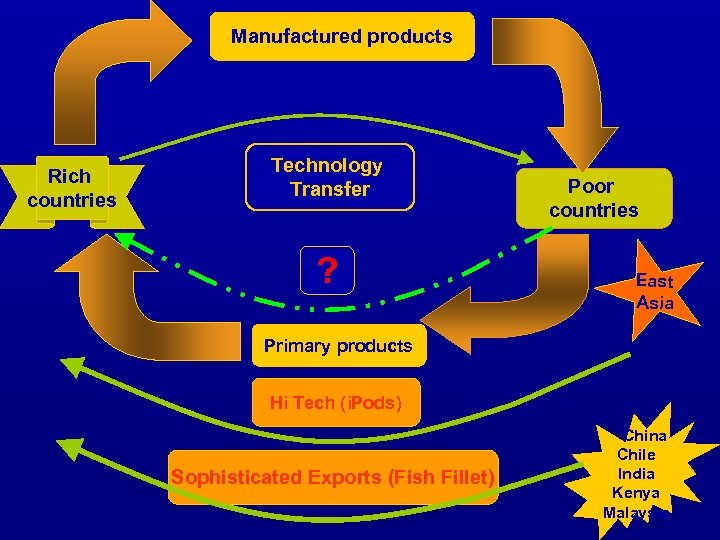
Manufactured products Rich countries Technology Transfer ? Poor countries E ast Asia Primary products Hi Tech (i. Pods) Sophisticated Exports (Fish Fillet) China Chile India Kenya Malaysia
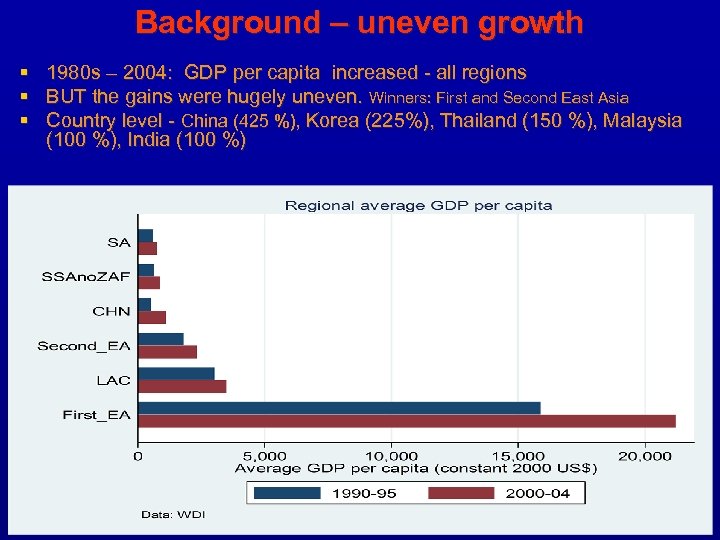
Background – uneven growth § 1980 s – 2004: GDP per capita increased - all regions § BUT the gains were hugely uneven. Winners: First and Second East Asia § Country level - China (425 %), Korea (225%), Thailand (150 %), Malaysia (100 %), India (100 %)
3 Questions In a world where comparative advantage determines the pattern of trade: § How can a country become richer? Export more of the same. § Why did some developing countries become richer and others not? § Among other things, do trade and technology explain this?
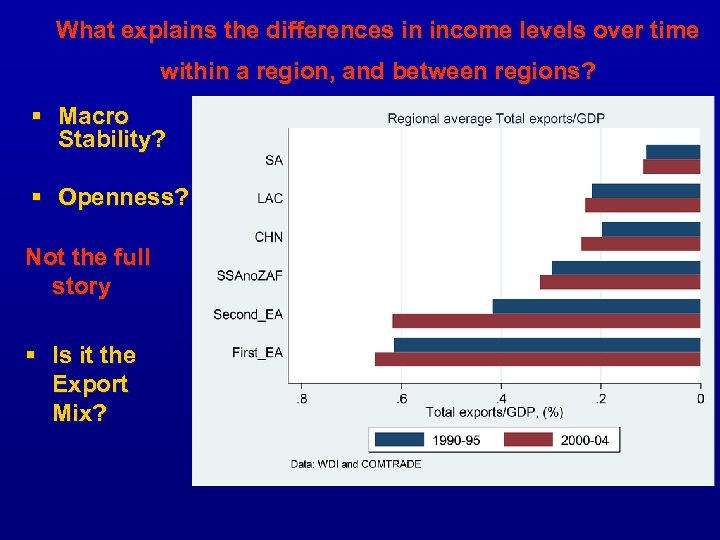
What explains the differences in income levels over time within a region, and between regions? § Macro Stability? § Openness? Not the full story § Is it the Export Mix?
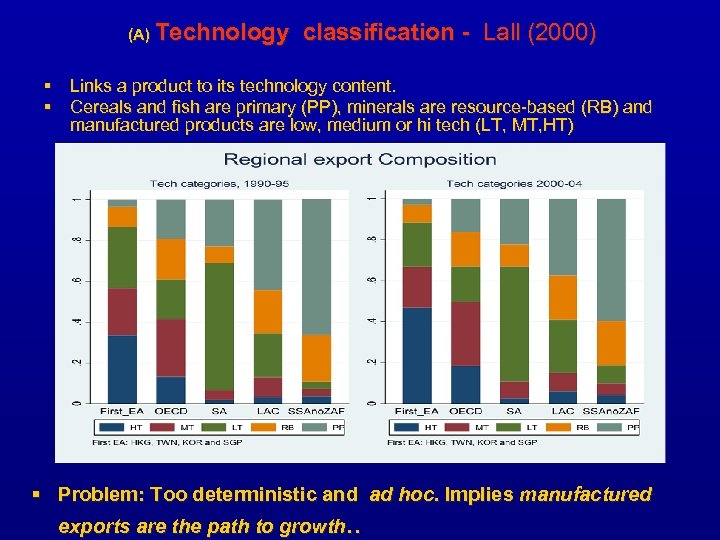
(A) Technology classification - Lall (2000) § Links a product to its technology content. § Cereals and fish are primary (PP), minerals are resource-based (RB) and manufactured products are low, medium or hi tech (LT, MT, HT) § Problem: Too deterministic and ad hoc. Implies manufactured exports are the path to growth. .
Other explanations for differences in the export mix (B) Country characteristics constrain diversification and growth 1. Is there a natural resource curse? Prebisch and Singer in 50 s and 60 s and Sachs and Warner ’ 90 s). In reality, ‘neither curse nor destiny” - Lederman and Maloney , 2007; Bonaglia and Fukasaku, 2003. 2. Is Sub-Saharan Africa special? Transactions costs, and risks of manufactured exports (Collier, 1998, 1999), low skills, land abundance (Mayer and Woods, 2001) and low Net TFP (Eifert, Gelb and Ramachandran, 2005); infrastructure (Habiyaremya and Ziesemer, 2006) Main implication of this research: § Deterministic - In poor countries, manufactured exports are the PATH to growth
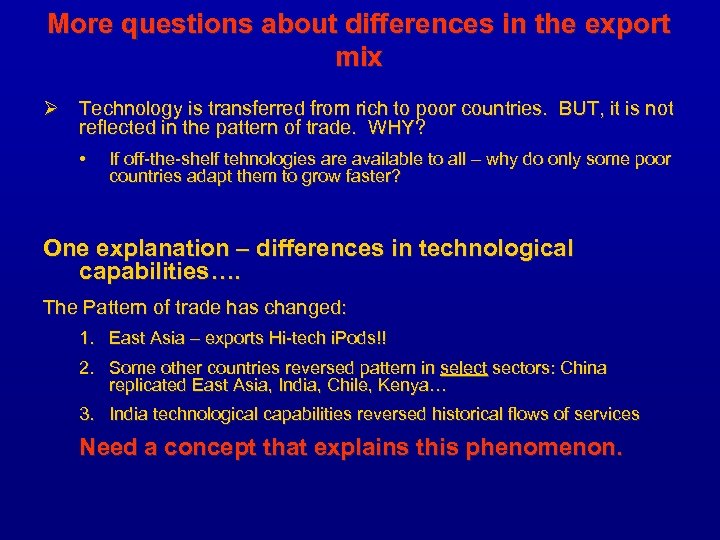
More questions about differences in the export mix Ø Technology is transferred from rich to poor countries. BUT, it is not reflected in the pattern of trade. WHY? • If off-the-shelf tehnologies are available to all – why do only some poor countries adapt them to grow faster? One explanation – differences in technological capabilities…. The Pattern of trade has changed: 1. East Asia – exports Hi-tech i. Pods!! 2. Some other countries reversed pattern in select sectors: China replicated East Asia, India, Chile, Kenya… 3. India technological capabilities reversed historical flows of services Need a concept that explains this phenomenon.
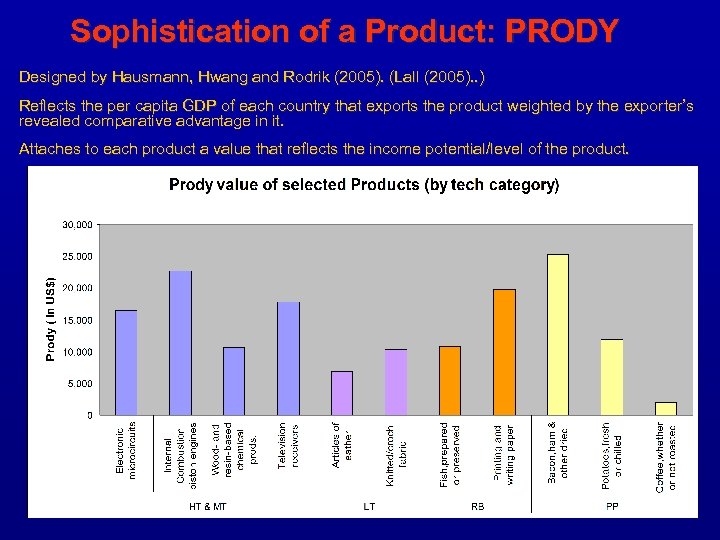
Sophistication of a Product: PRODY Designed by Hausmann, Hwang and Rodrik (2005). (Lall (2005). . ) Reflects the per capita GDP of each country that exports the product weighted by the exporter’s revealed comparative advantage in it. Attaches to each product a value that reflects the income potential/level of the product.
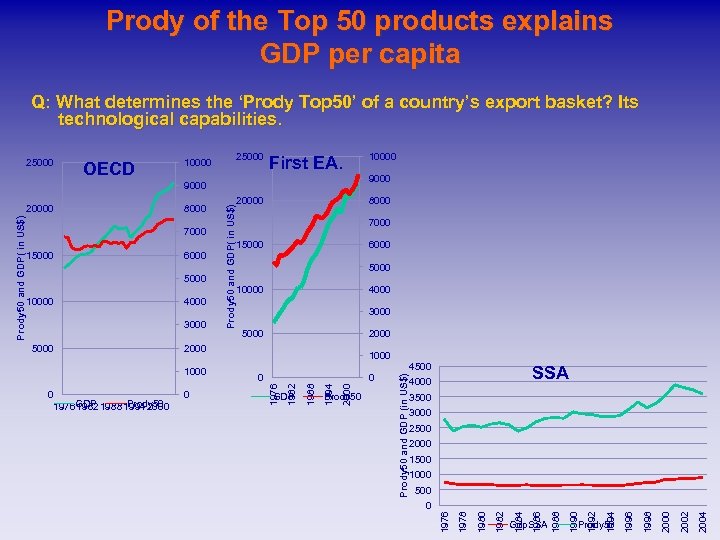
Prody of the Top 50 products explains GDP per capita Q: What determines the ‘Prody Top 50’ of a country’s export basket? Its technological capabilities. First EA. 9000 2000 SSA 4000 3500 3000 2500 2000 1500 1000 2004 2002 Prody 50 2000 Gdp. SSA 1998 0 1996 500 1994 Prody 50 4500 1992 GDP 0 1990 0 2000 0 1000 1988 5000 2000 1000 0 Prody 50 1976 GDP 1988 1994 2000 1982 3000 1994 5000 4000 1986 3000 10000 1984 4000 5000 1988 10000 6000 1982 5000 1980 6000 7000 1982 15000 8000 1978 7000 20000 1976 Prody 50 and GDP( in US$) 8000 Prody 50 and GDP( in US$) 9000 20000 1976 OECD 25000 10000 Prody 50 and GDP (in US$) 25000
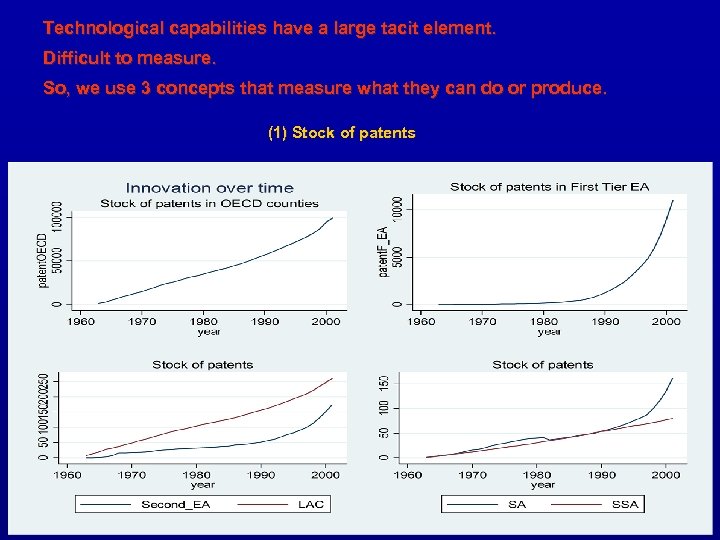
Technological capabilities have a large tacit element. Difficult to measure. So, we use 3 concepts that measure what they can do or produce. (1) Stock of patents
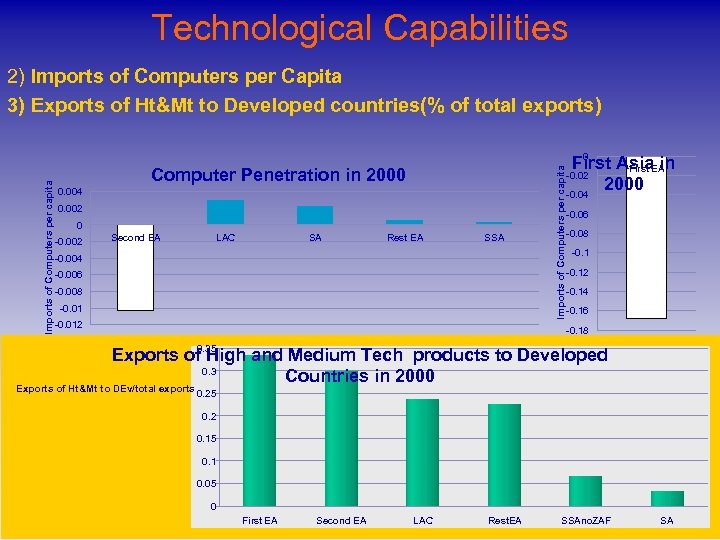
Technological Capabilities Computer Penetration in 2000 0. 004 0. 002 0 -0. 002 Second EA LAC SA Rest EA SSA -0. 004 -0. 006 -0. 008 -0. 012 Imports of Computers per capita 2) Imports of Computers per Capita 3) Exports of Ht&Mt to Developed countries(% of total exports) 0 First Asia. EA First in -0. 02 2000 -0. 04 -0. 06 -0. 08 -0. 12 -0. 14 -0. 16 -0. 18 0. 35 Exports of High and Medium Tech products to Developed 0. 3 Countries in 2000 Exports of Ht&Mt to DEv/total exports 0. 25 0. 2 0. 15 0. 1 0. 05 0 First EA Second EA LAC Rest. EA SSAno. ZAF SA
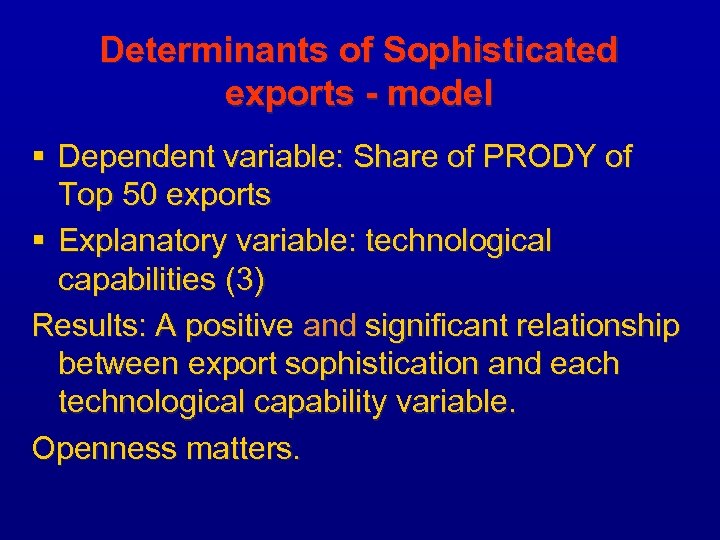
Determinants of Sophisticated exports - model § Dependent variable: Share of PRODY of Top 50 exports § Explanatory variable: technological capabilities (3) Results: A positive and significant relationship between export sophistication and each technological capability variable. Openness matters.
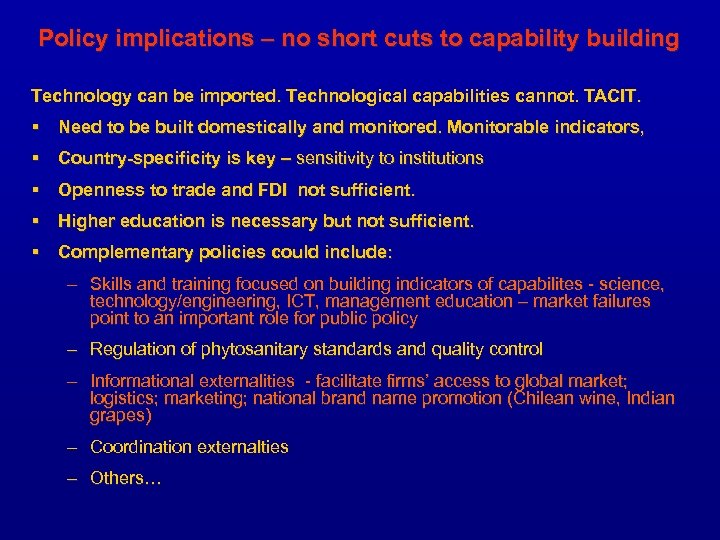
Policy implications – no short cuts to capability building Technology can be imported. Technological capabilities cannot. TACIT. § Need to be built domestically and monitored. Monitorable indicators, § Country-specificity is key – sensitivity to institutions § Openness to trade and FDI not sufficient. § Higher education is necessary but not sufficient. § Complementary policies could include: – Skills and training focused on building indicators of capabilites - science, technology/engineering, ICT, management education – market failures point to an important role for public policy – Regulation of phytosanitary standards and quality control – Informational externalities - facilitate firms’ access to global market; logistics; marketing; national brand name promotion (Chilean wine, Indian grapes) – Coordination externalties – Others…
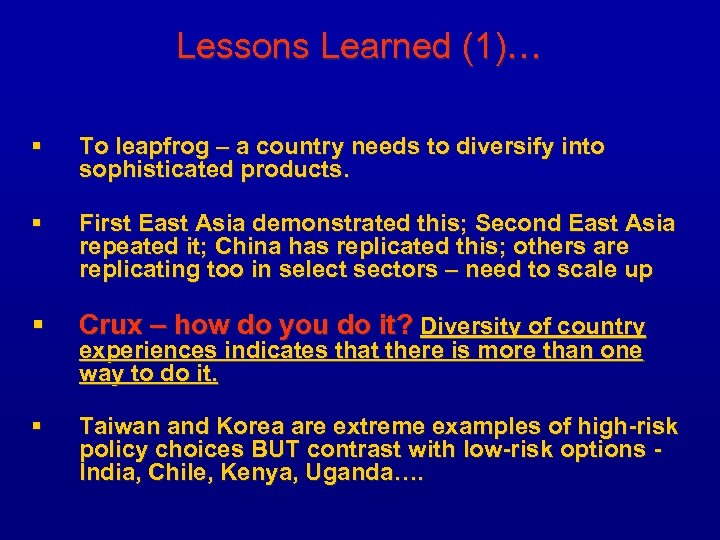
Lessons Learned (1)… § To leapfrog – a country needs to diversify into sophisticated products. § First East Asia demonstrated this; Second East Asia repeated it; China has replicated this; others are replicating too in select sectors – need to scale up § Crux – how do you do it? Diversity of country § Taiwan and Korea are extreme examples of high-risk policy choices BUT contrast with low-risk options India, Chile, Kenya, Uganda…. experiences indicates that there is more than one way to do it.
Lessons (2) – from more trade openness to more tech capability building… § Empirical evidence – imported technology is slow to deliver technological skills § FDI does not flow easily to countries with weak technological capabilities § Technological capabilities can be acquired and can change what you export § Technology and trade – even more critical for developing countries today
Hi-Tech is not the ONLY path to growth § Today, trade patterns are indeterminate § There are multiple paths to leapfrogging for natural resource and primary product exporters § Exports of manufactured prodcuts – low, medium and hi tech – are only ONE path § For Sub-Saharan Africa – large range of opportunities – evidence? § Uganda – Nile Perch -30% of total exports; Kenya – cut flowers – 3 rd. Largest in world.
Скачать презентацию A technological capability story behind exports of fish
c2c295add939c727d14983cb9ef0d044.ppt