


 Скачать презентацию A Technical Framework for Designing Wireless Sensor Networks
2144a934a0f8831cde9d74d8913e63ac.ppt
- Количество слайдов: 17
 A Technical Framework for Designing Wireless Sensor Networks for Agricultural Monitoring in Developing Regions Prepared by: Amar kabashi (a. h. kabashi@leeds. ac. uk) && Presented by: Hamada Alshaer (h. alshaer@leeds. ac. uk)
 Outline • • Motivations Objective Monitoring System Characteristics Agricultural application-specific characteristics Monitoring Framework Design Challenges Technical Monitoring Framework Contributions under investigation – Zone-based joint topology control and power scheduling – Multi-Sink Architecture and Back-link/Storage aware complementary routing – Network self buffering and Back-link/Storage aware complementary routing – Parameter-Energy-Environment aware Task Scheduling • VESEL System • System Testing www. veselproject. net
 Motivations • Developing the underdeveloped countries through information and communication technologies deployment. • Improving the quality of life in the least developed poor environments. • Ubiquitous wireless sensor networks and context-aware applications. • Wireless sensing for agricultural applications development: – Maximizing the productivity of irrigation and farming resources while maintaining the quality and integrity of land environment. – Optimizing natural resource utilization to maximize production and minimize environmental and economic risks. www. veselproject. net
 Objective Design and implementing an efficient and optimal field monitoring system that: 1. provides valuable data about land conditions, water usage and climate variability 2. back-supported by a capable data processing platform for analysis and interpretation which leads to eventual proper dissemination of the learned outcomes. www. veselproject. net
 Monitoring System Characteristics • It should be continuous, fairly accurate, automated and able to cover wide fields, while being affordable by the resource-limited communities and tolerant to technical faults and environmental conditions. • The system’s life time should be typically long; covering at least a whole cropping season of 4 -6 months, without maintenance. • It should be remotely accessible and controllable to enable distant analysis and decision making by centralized expertise, typically in distant urban areas, or by foreign expertise. • It should enable long term nationwide research/modelling/planning as well as short term, quasi-real-time, local response. www. veselproject. net
 Monitoring Framework Design Challenges • Scarce deployment of nodes in relatively large fields. • Unreliable, intermittent upload links. • Informatics gap; Lack of proper IS infrastructure for data analysis, modelling, interpretation and dissemination. www. veselproject. net
 Agricultural application-specific characteristics • It is highly preferable to have a fairly good idea about the field conditions for long time than having a high precision field mapping over a short period. With a relaxed accuracy requirement, many power conservation strategies could be adopted at the physical layer, e. g. signal conditioning and data conversion. • Spatial homogeneity (field zoning) could be used to optimize the WSN topology and deployment of the scarce nodes. This has a direct impact on the power consumption and network life. • Real time and accuracy requirements are fairly relaxed. Closed-loop real time sensing-and-control solutions are generally not feasible to be deployed in such a highly resource-limited environment. Such a tolerance for delay enables better optimization of the network resources and relaxes the burden on the communication protocols. www. veselproject. net
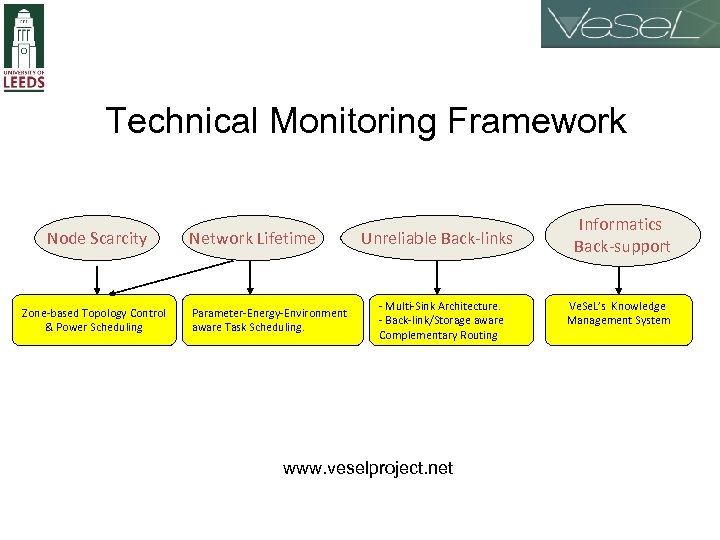 Technical Monitoring Framework Node Scarcity Zone-based Topology Control & Power Scheduling Network Lifetime Parameter-Energy-Environment aware Task Scheduling. Unreliable Back-links - Multi-Sink Architecture. - Back-link/Storage aware Complementary Routing www. veselproject. net Informatics Back-support Ve. Se. L’s Knowledge Management System
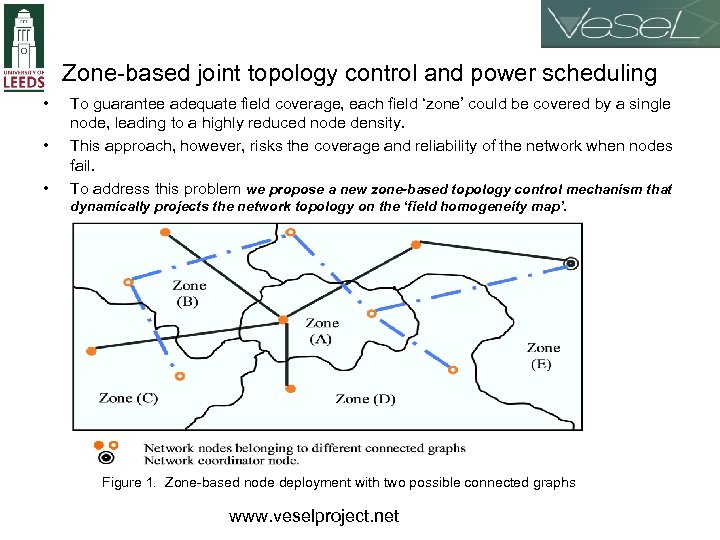 Zone-based joint topology control and power scheduling • • • To guarantee adequate field coverage, each field ‘zone’ could be covered by a single node, leading to a highly reduced node density. This approach, however, risks the coverage and reliability of the network when nodes fail. To address this problem we propose a new zone-based topology control mechanism that dynamically projects the network topology on the ‘field homogeneity map’. Figure 1. Zone-based node deployment with two possible connected graphs www. veselproject. net
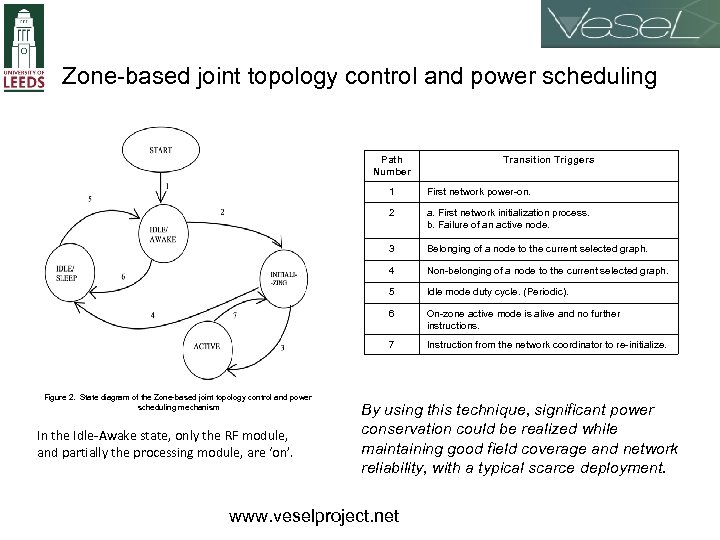 Zone-based joint topology control and power scheduling Path Number Transition Triggers 1 2 Belonging of a node to the current selected graph. 4 Non-belonging of a node to the current selected graph. 5 Idle mode duty cycle. (Periodic). 6 On-zone active mode is alive and no further instructions. 7 In the Idle-Awake state, only the RF module, and partially the processing module, are ‘on’. a. First network initialization process. b. Failure of an active node. 3 Figure 2. State diagram of the Zone-based joint topology control and power scheduling mechanism First network power-on. Instruction from the network coordinator to re-initialize. By using this technique, significant power conservation could be realized while maintaining good field coverage and network reliability, with a typical scarce deployment. www. veselproject. net
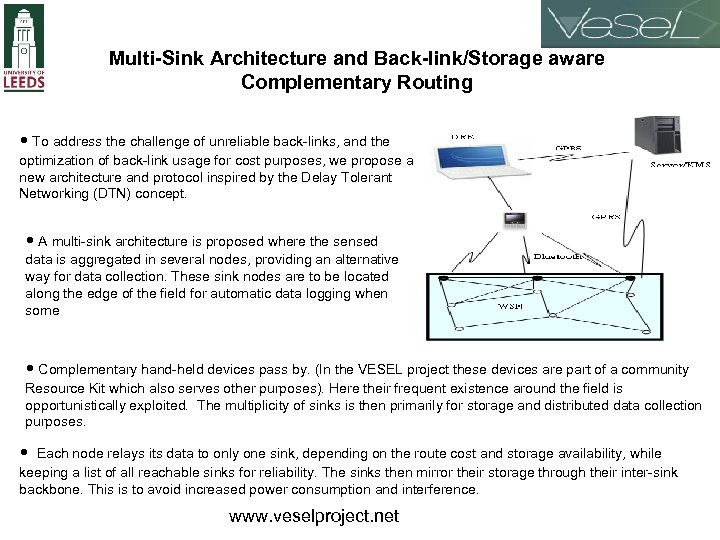 Multi-Sink Architecture and Back-link/Storage aware Complementary Routing • To address the challenge of unreliable back-links, and the optimization of back-link usage for cost purposes, we propose a new architecture and protocol inspired by the Delay Tolerant Networking (DTN) concept. • A multi-sink architecture is proposed where the sensed data is aggregated in several nodes, providing an alternative way for data collection. These sink nodes are to be located along the edge of the field for automatic data logging when some • Complementary hand-held devices pass by. (In the VESEL project these devices are part of a community Resource Kit which also serves other purposes). Here their frequent existence around the field is opportunistically exploited. The multiplicity of sinks is then primarily for storage and distributed data collection purposes. • Each node relays its data to only one sink, depending on the route cost and storage availability, while keeping a list of all reachable sinks for reliability. The sinks then mirror their storage through their inter-sink backbone. This is to avoid increased power consumption and interference. www. veselproject. net
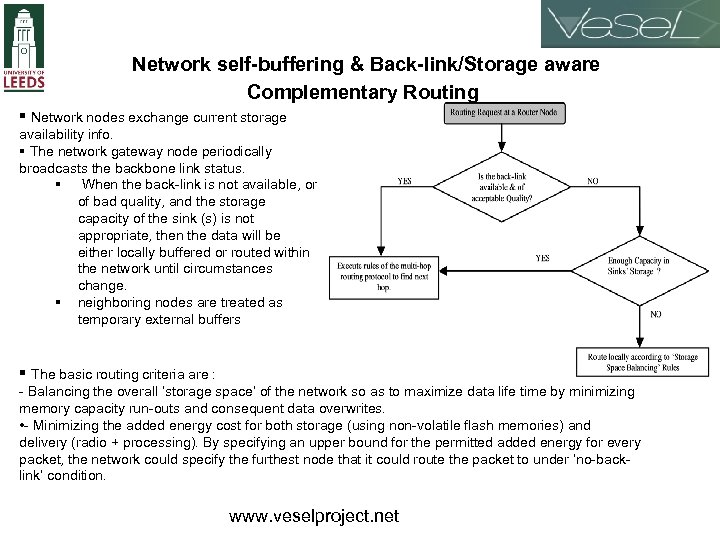 Network self-buffering & Back-link/Storage aware Complementary Routing § Network nodes exchange current storage availability info. § The network gateway node periodically broadcasts the backbone link status. § When the back-link is not available, or of bad quality, and the storage capacity of the sink (s) is not appropriate, then the data will be either locally buffered or routed within the network until circumstances change. § neighboring nodes are treated as temporary external buffers § The basic routing criteria are : - Balancing the overall ‘storage space’ of the network so as to maximize data life time by minimizing memory capacity run-outs and consequent data overwrites. • - Minimizing the added energy cost for both storage (using non-volatile flash memories) and delivery (radio + processing). By specifying an upper bound for the permitted added energy for every packet, the network could specify the furthest node that it could route the packet to under ‘no-backlink’ condition. www. veselproject. net
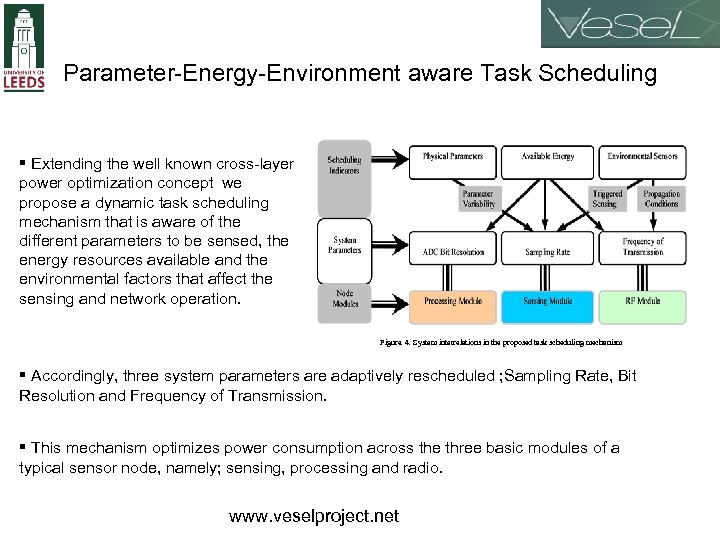 Parameter-Energy-Environment aware Task Scheduling § Extending the well known cross-layer power optimization concept we propose a dynamic task scheduling mechanism that is aware of the different parameters to be sensed, the energy resources available and the environmental factors that affect the sensing and network operation. Figure. 4. System interrelations in the proposed task scheduling mechanism § Accordingly, three system parameters are adaptively rescheduled ; Sampling Rate, Bit Resolution and Frequency of Transmission. § This mechanism optimizes power consumption across the three basic modules of a typical sensor node, namely; sensing, processing and radio. www. veselproject. net
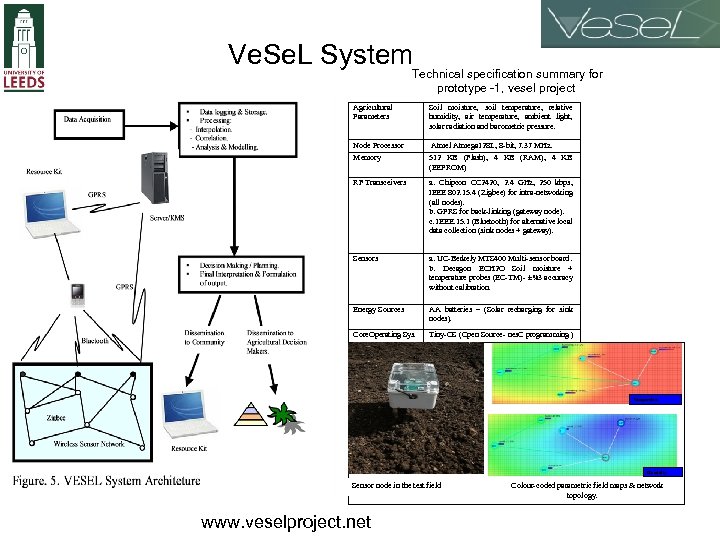 Ve. Se. L System. Technical specification summary for prototype -1, vesel project Agricultural Parameters Soil moisture, soil temperature, relative humidity, air temperature, ambient light, solar radiation and barometric pressure. Node Processor Atmel Atmega 128 L, 8 -bit, 7. 37 MHz. Memory 512 KB (Flash), 4 KB (RAM), 4 KB (EEPROM) RF Transceivers a. Chipcon CC 2420, 2. 4 GHz, 250 kbps, IEEE 802. 15. 4 (Zigbee) for intra-networking (all nodes). b. GPRS for back-linking (gateway node). c. IEEE. 15. 1 (Bluetooth) for alternative local data collection (sink nodes + gateway). Sensors a. UC-Berkely MTS 400 Multi-sensor board. b. Decagon ECH 2 O Soil moisture + temperature probes (EC-TM)- ±%3 accuracy without calibration. Energy Sources AA batteries – (Solar recharging for sink nodes). Core. Operating Sys. Tiny-OS (Open Source- nes. C programming ) Temperature Humidity Sensor node in the test field www. veselproject. net Colour-coded parametric field maps & network topology.
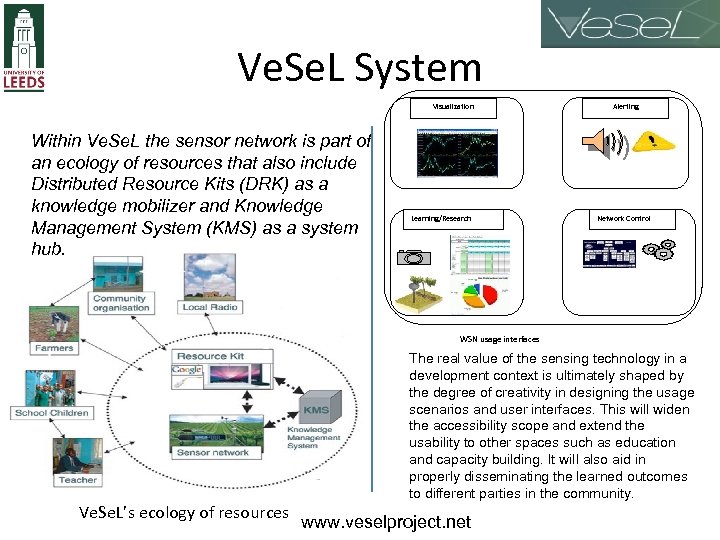 Ve. Se. L System Visualization Within Ve. Se. L the sensor network is part of an ecology of resources that also include Distributed Resource Kits (DRK) as a knowledge mobilizer and Knowledge Management System (KMS) as a system hub. Learning/Research Alerting Network Control WSN usage interfaces The real value of the sensing technology in a development context is ultimately shaped by the degree of creativity in designing the usage scenarios and user interfaces. This will widen the accessibility scope and extend the usability to other spaces such as education and capacity building. It will also aid in properly disseminating the learned outcomes to different parties in the community. Ve. Se. L’s ecology of resources www. veselproject. net
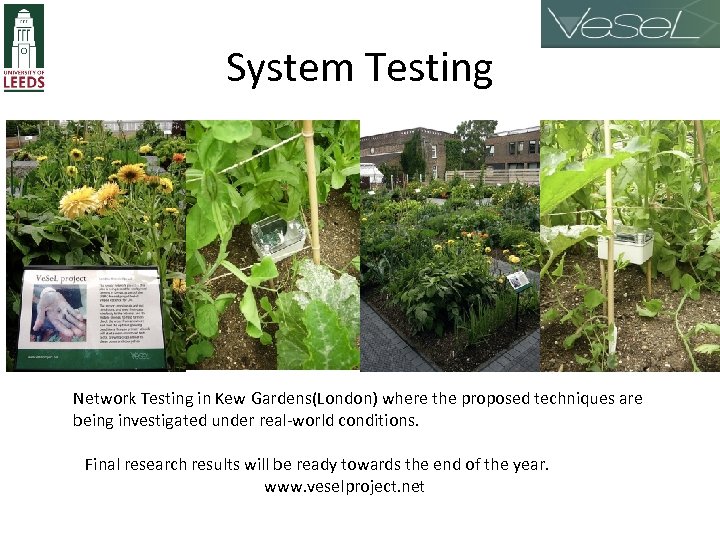 System Testing Network Testing in Kew Gardens(London) where the proposed techniques are being investigated under real-world conditions. Final research results will be ready towards the end of the year. www. veselproject. net
 Thank You!