


 Скачать презентацию A teaching hospital of Harvard Medical School Enhancing
167a0a88873b692ba094df3f0e182835.ppt
- Количество слайдов: 21
 A teaching hospital of Harvard Medical School Enhancing Thinking & Learning via Mechanism Maps Richard M. Schwartzstein, MD David H. Roberts, MD Shapiro Institute for Education and Research Beth Israel Deaconess Medical Center HMS Academy Education is at the heart of patient care.
 After this session, you will be able: • To describe the underlying cognitive theory behind the use of concept maps and mechanism maps • To use mechanism maps to foster linkage of basic and clinical science concepts • To enhance teaching of analytical reasoning in the approach to clinical problems A teaching hospital of Harvard Medical School
 How do we facilitate deep learning? Modified from Harasym et al. 2008 Surface Learning -- New info not linked to previous knowledge -- Knowledge abundant but disorganized -- Focus on memorization and recall -- Learn concepts and facts without reflection Deep Learning -- Relates new knowledge to previous knowledge -- Content organized into coherent whole -- Focus on problem-solving; synthesis, application, transfer -- Link concepts/principles to everyday experience A teaching hospital of Harvard Medical School
 Encoding and Retrieval of Information Influences Learning Karpicke and Blunt, Science Express, 2011 • “Activities that promote effective encoding, known as elaborative study tasks, are important for learning” • “Because each act of retrieval changes memory, the act of reconstructing knowledge must be considered essential to the process of learning” A teaching hospital of Harvard Medical School
 Problem Solving and Neural Networks Adapted from Jung-Beeman et al. , PLo. S Biology, 2004 Problem solving relies on cortical networks for access to and use of information Problems without obvious/immediate solutions require engagement of distinct neural and cognitive processes These processes allow solvers to see connections that may have previously eluded them A teaching hospital of Harvard Medical School
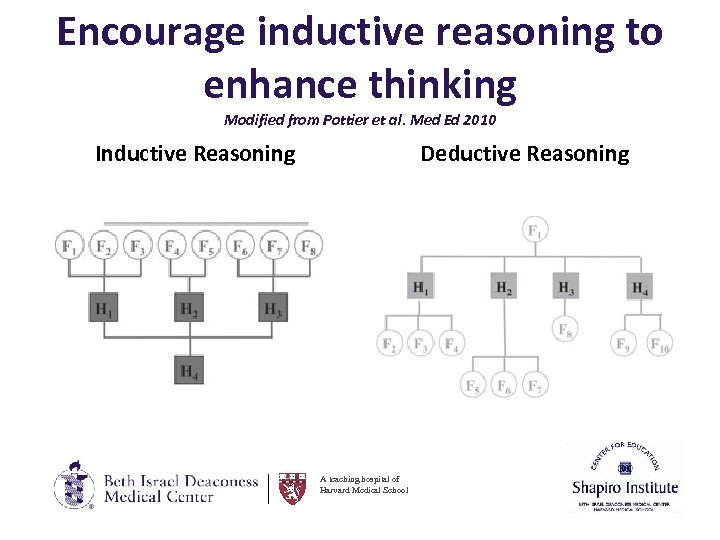 Encourage inductive reasoning to enhance thinking Modified from Pottier et al. Med Ed 2010 Inductive Reasoning Deductive Reasoning A teaching hospital of Harvard Medical School
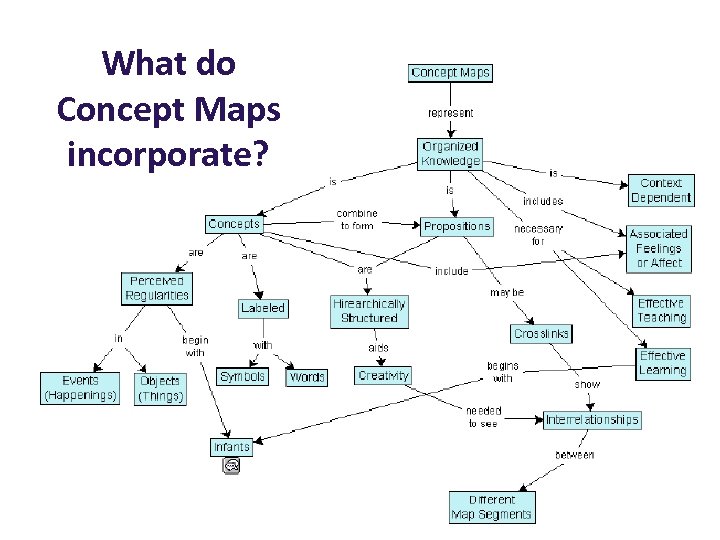 What do Concept Maps incorporate? A teaching hospital of Harvard Medical School
 Mechanistic Mapping “The mechanistic case diagram is a student constructed tool whose objective is to trace, in stepwise form, the pathophysiologic mechanisms leading from underlying causes of disease (including genetic, microbiologic, and social) to the clinical signs and symptoms and psychosocial consequences described in a PBL case. ” Guerrero APS, Acad. Med. 2001; 76: 385– 389 A teaching hospital of Harvard Medical School
 …and now, let’s try one! A teaching hospital of Harvard Medical School
 Chief Complaint PJ is a 51 year old woman with a one year history of intermittent abdominal pain who now presents with nausea, vomiting, and worsening abdominal pain. A teaching hospital of Harvard Medical School
 History PMH - Type II Diabetes - Hypertension - Rheumatoid Arthritis - Obesity - NO history of gallstones, hypertriglyceridemia or prior pancreatitis PSH - Low-transverse abdominal scar c/w possible gynecologic surgery Medications - Hydroclorothiazide - Metoprolol - Amlodipine - Cyclobenzaprine - Nabumetone - Fluticasone FH - HTN - No FH GI malignancy/disease SH - Tob: 1 ppd, duration uncertain - Et. OH: 2 -3 beers/day - Illicits: unknown A teaching hospital of Harvard Medical School
 Initial Presentation • Vital signs notable for tachycardia to 110’s What does this tell you? Is it specific? Sensitive? – Increased sympathetic activity • • Compensatory (hypovolemia) Pathologic (Axis dysregulation) Parallel (Pain) Pharmacologic – Decreased parasympathetic activity • Neurologic dysregulation • Pharmacologic A teaching hospital of Harvard Medical School
 Initial Presentation Continued • CT abdomen revealed acute pancreatitis – extensive peripancreatic inflamation – distended GB with no evidence of stones, – diverticulosis • RUQ ultrasound – No stones or biliary duct dilation. • Amylase 183 • Lipase 157 • She was admitted to their medical service, made NPO, and started on IV fluids for presumed mild pancreatitis A teaching hospital of Harvard Medical School
 Deterioration at Outside Hospital • Overnight, developed hypotension, acidemia, hyperglycemia, and extreme fever/hyperthermia • Transferred to the OSH ICU for mechanical ventilation, central line placement, vasopressor support, and insulin and bicarbonate drips A teaching hospital of Harvard Medical School
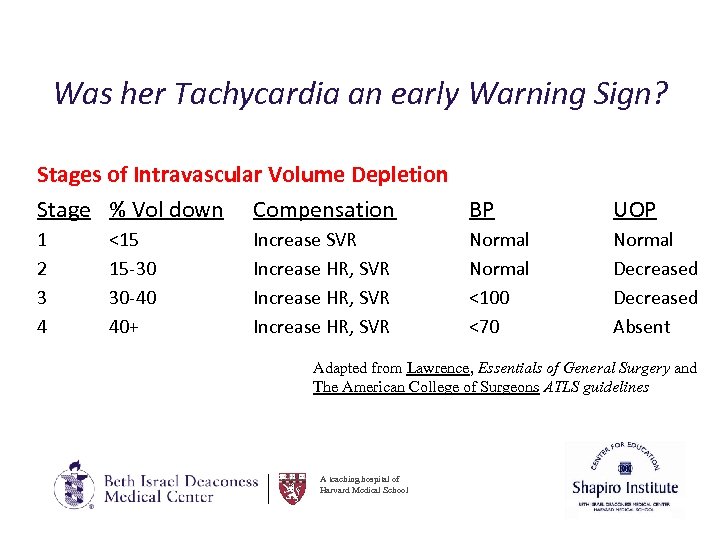 Was her Tachycardia an early Warning Sign? Stages of Intravascular Volume Depletion Stage % Vol down Compensation BP UOP 1 2 3 4 Normal Decreased Absent <15 15 -30 30 -40 40+ Increase SVR Increase HR, SVR Normal <100 <70 Adapted from Lawrence, Essentials of General Surgery and The American College of Surgeons ATLS guidelines A teaching hospital of Harvard Medical School
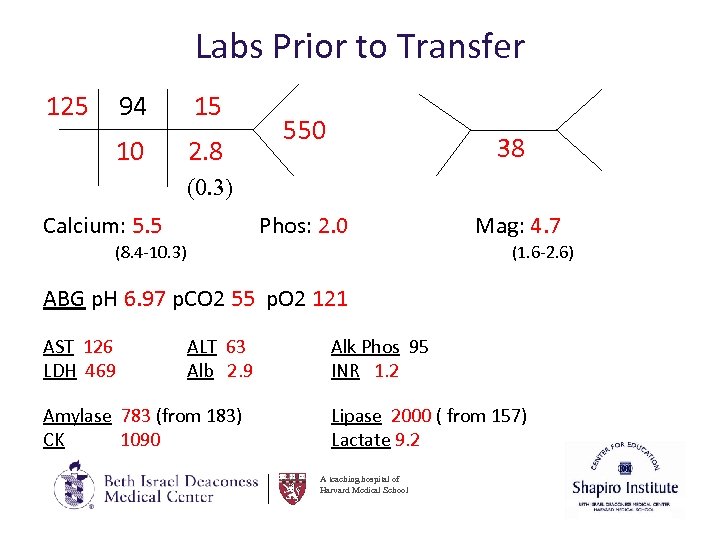 Labs Prior to Transfer 125 94 15 10 2. 8 550 38 (0. 3) Calcium: 5. 5 Phos: 2. 0 (8. 4 -10. 3) Mag: 4. 7 (1. 6 -2. 6) ABG p. H 6. 97 p. CO 2 55 p. O 2 121 AST 126 LDH 469 ALT 63 Alb 2. 9 Amylase 783 (from 183) CK 1090 Alk Phos 95 INR 1. 2 Lipase 2000 ( from 157) Lactate 9. 2 A teaching hospital of Harvard Medical School
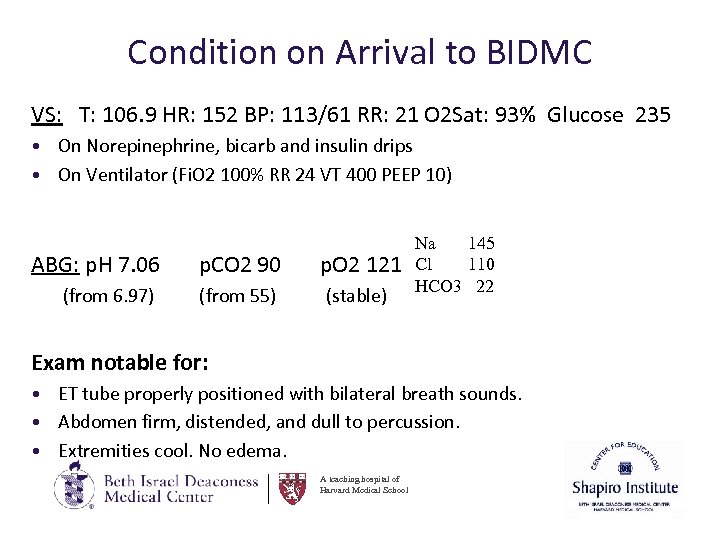 Condition on Arrival to BIDMC VS: T: 106. 9 HR: 152 BP: 113/61 RR: 21 O 2 Sat: 93% Glucose 235 • On Norepinephrine, bicarb and insulin drips • On Ventilator (Fi. O 2 100% RR 24 VT 400 PEEP 10) ABG: p. H 7. 06 p. CO 2 90 p. O 2 121 (from 6. 97) (from 55) (stable) Na 145 Cl 110 HCO 3 22 Exam notable for: • ET tube properly positioned with bilateral breath sounds. • Abdomen firm, distended, and dull to percussion. • Extremities cool. No edema. A teaching hospital of Harvard Medical School
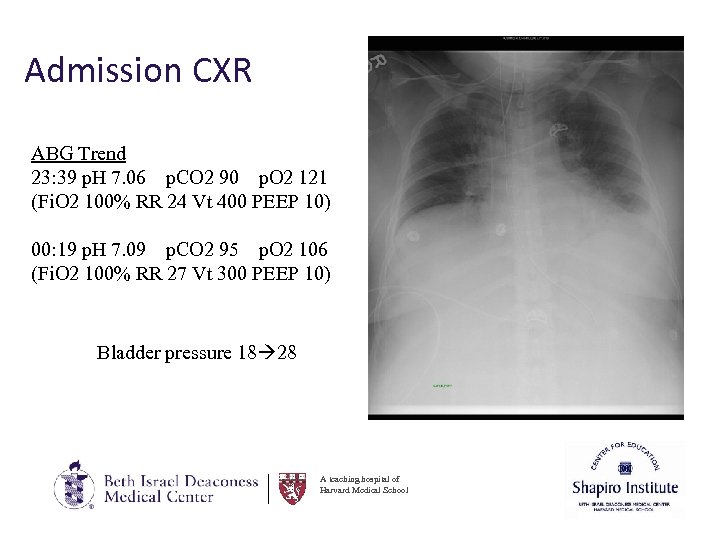 Admission CXR ABG Trend 23: 39 p. H 7. 06 p. CO 2 90 p. O 2 121 (Fi. O 2 100% RR 24 Vt 400 PEEP 10) 00: 19 p. H 7. 09 p. CO 2 95 p. O 2 106 (Fi. O 2 100% RR 27 Vt 300 PEEP 10) Bladder pressure 18 28 A teaching hospital of Harvard Medical School
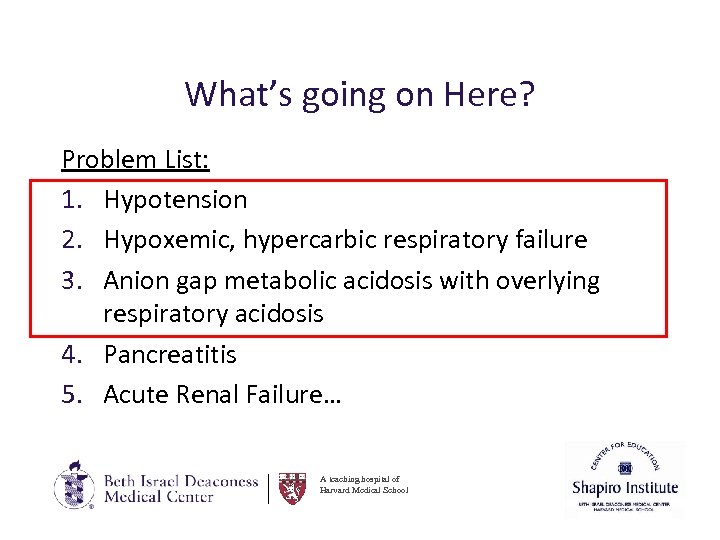 What’s going on Here? Problem List: 1. Hypotension 2. Hypoxemic, hypercarbic respiratory failure 3. Anion gap metabolic acidosis with overlying respiratory acidosis 4. Pancreatitis 5. Acute Renal Failure… A teaching hospital of Harvard Medical School
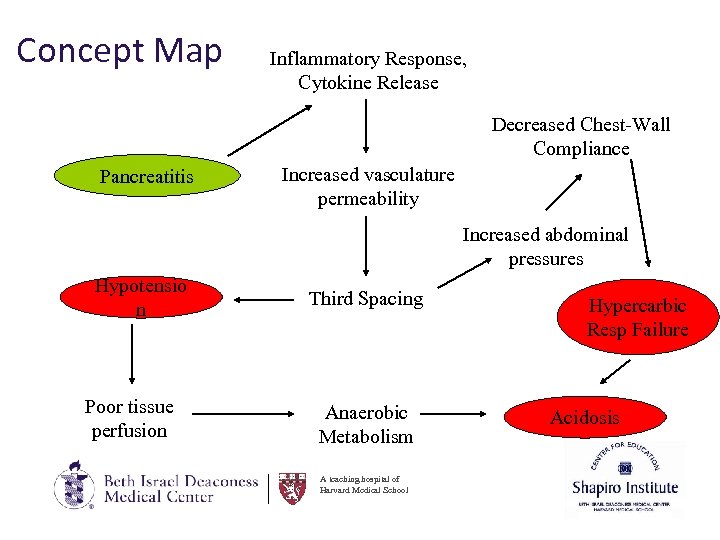 Concept Map Inflammatory Response, Cytokine Release Decreased Chest-Wall Compliance Pancreatitis Increased vasculature permeability Increased abdominal pressures Hypotensio n Poor tissue perfusion Third Spacing Anaerobic Metabolism A teaching hospital of Harvard Medical School Hypercarbic Resp Failure Acidosis
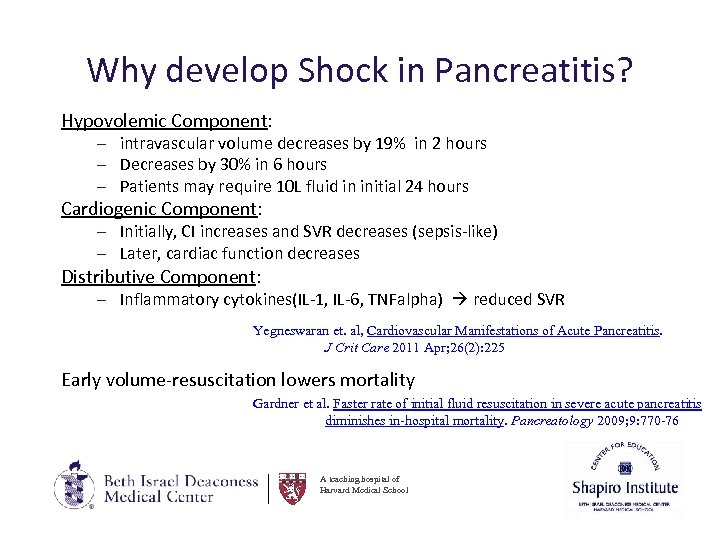 Why develop Shock in Pancreatitis? Hypovolemic Component: – intravascular volume decreases by 19% in 2 hours – Decreases by 30% in 6 hours – Patients may require 10 L fluid in initial 24 hours Cardiogenic Component: – Initially, CI increases and SVR decreases (sepsis-like) – Later, cardiac function decreases Distributive Component: – Inflammatory cytokines(IL-1, IL-6, TNFalpha) reduced SVR Yegneswaran et. al, Cardiovascular Manifestations of Acute Pancreatitis. J Crit Care 2011 Apr; 26(2): 225 Early volume-resuscitation lowers mortality Gardner et al. Faster rate of initial fluid resuscitation in severe acute pancreatitis diminishes in-hospital mortality. Pancreatology 2009; 9: 770 -76 A teaching hospital of Harvard Medical School