


 Скачать презентацию A Taste of American Food Served up for
b3d4f5a69a9c89cb90128e53844e0cb1.ppt
- Количество слайдов: 22
 A Taste of American Food Served up for you by Brea Barthel RPI Advising & Learning Assistance Center Rev 10/2012
 What is “American” food? That’s hard to answer! n America is a nation of immigrants n Many different cooking styles n Regional specialties n Eating habits change through time (low-carbohydrate; vegetarian; etc. )
 So what is “American” food? Dinners for white, working-class, traditional Euro-American families often include: n Meat (usually in large pieces) n Potatoes n A vegetable (perhaps canned) n A salad of lettuce & tomato n Dessert (ice cream, pie, cookies)
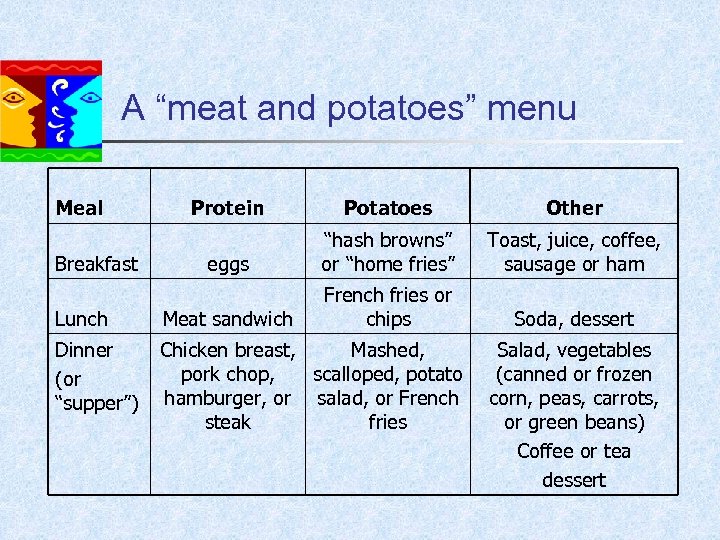 A “meat and potatoes” menu Meal Protein Potatoes Other eggs “hash browns” or “home fries” Toast, juice, coffee, sausage or ham Lunch Meat sandwich French fries or chips Soda, dessert Dinner (or “supper”) Chicken breast, Mashed, pork chop, scalloped, potato hamburger, or salad, or French steak fries Breakfast Salad, vegetables (canned or frozen corn, peas, carrots, or green beans) Coffee or tea dessert
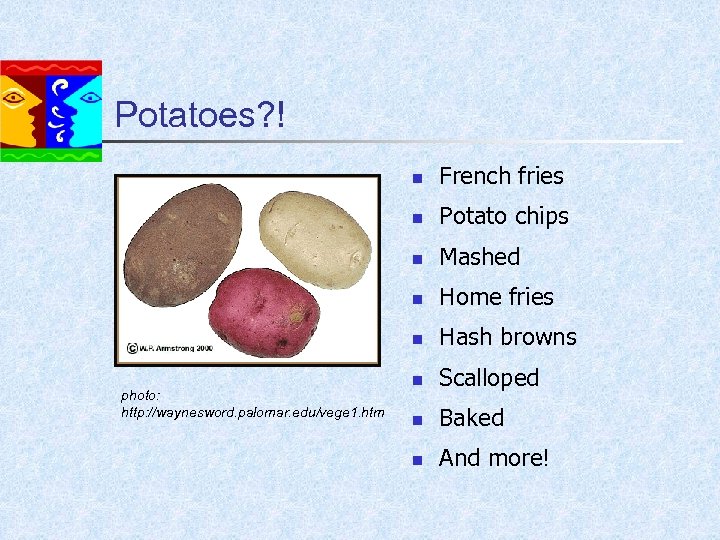 Potatoes? ! n n Potato chips n Mashed n Home fries n photo: http: //waynesword. palomar. edu/vege 1. htm French fries Hash browns n Scalloped n Baked n And more!
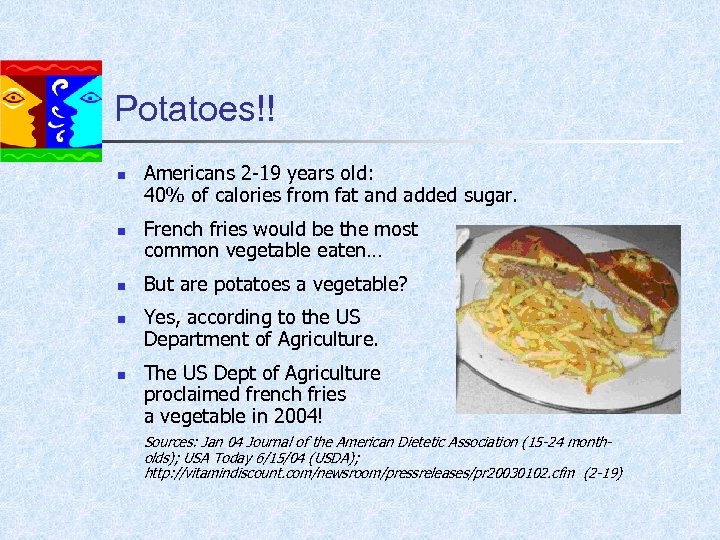 Potatoes!! n n n Americans 2 -19 years old: 40% of calories from fat and added sugar. French fries would be the most common vegetable eaten… But are potatoes a vegetable? Yes, according to the US Department of Agriculture. The US Dept of Agriculture proclaimed french fries a vegetable in 2004! Sources: Jan 04 Journal of the American Dietetic Association (15 -24 montholds); USA Today 6/15/04 (USDA); http: //vitamindiscount. com/newsroom/pressreleases/pr 20030102. cfm (2 -19)
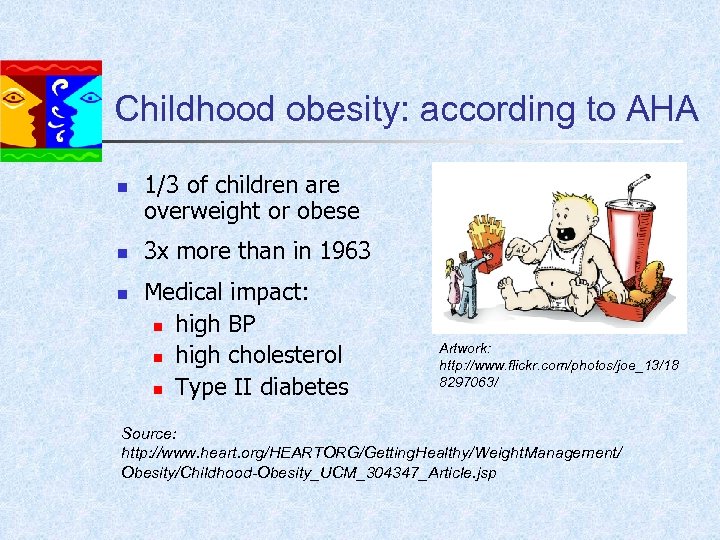 Childhood obesity: according to AHA n n n 1/3 of children are overweight or obese 3 x more than in 1963 Medical impact: n high BP n high cholesterol n Type II diabetes Artwork: http: //www. flickr. com/photos/joe_13/18 8297063/ Source: http: //www. heart. org/HEARTORG/Getting. Healthy/Weight. Management/ Obesity/Childhood-Obesity_UCM_304347_Article. jsp
 Some responses to “obesity epidemic” n n Emphasis on nutritional education In NYC, as of 9/2012: sales of drinks larger than 16 oz. are banned in restaurants, food service, other eating sources n Revision of federal school lunch program guidelines n Limitations on sales of sweets in schools n Backlash to all the rules!
 Related issues/responses n “Food deserts” n “Food insecurity” n Community Gardens n Buy-local movement
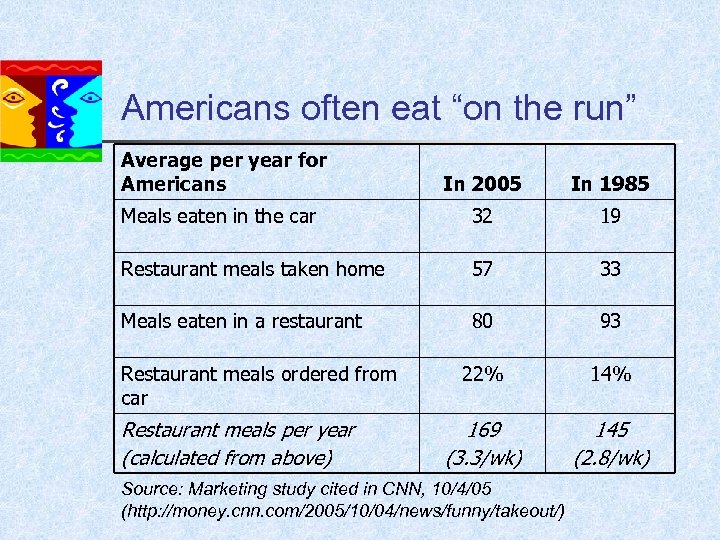 Americans often eat “on the run” Average per year for Americans In 2005 In 1985 Meals eaten in the car 32 19 Restaurant meals taken home 57 33 Meals eaten in a restaurant 80 93 22% 14% 169 (3. 3/wk) 145 (2. 8/wk) Restaurant meals ordered from car Restaurant meals per year (calculated from above) Source: Marketing study cited in CNN, 10/4/05 (http: //money. cnn. com/2005/10/04/news/funny/takeout/)
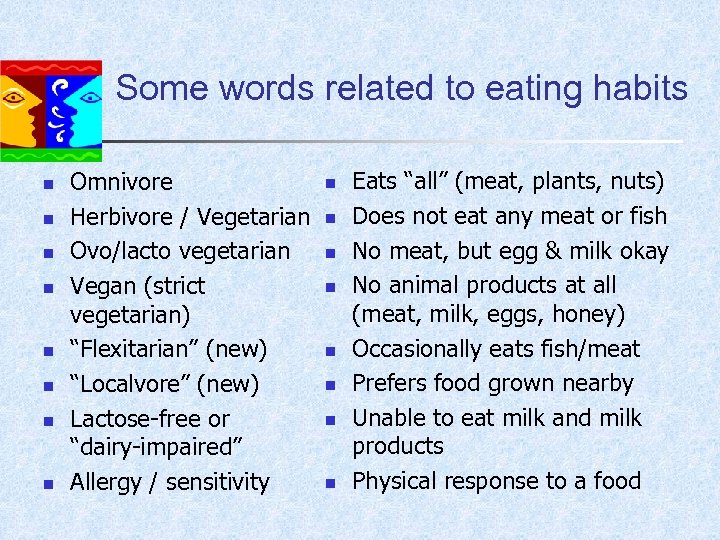 Some words related to eating habits n n n n Omnivore Herbivore / Vegetarian Ovo/lacto vegetarian Vegan (strict vegetarian) “Flexitarian” (new) “Localvore” (new) Lactose-free or “dairy-impaired” Allergy / sensitivity n n n n Eats “all” (meat, plants, nuts) Does not eat any meat or fish No meat, but egg & milk okay No animal products at all (meat, milk, eggs, honey) Occasionally eats fish/meat Prefers food grown nearby Unable to eat milk and milk products Physical response to a food
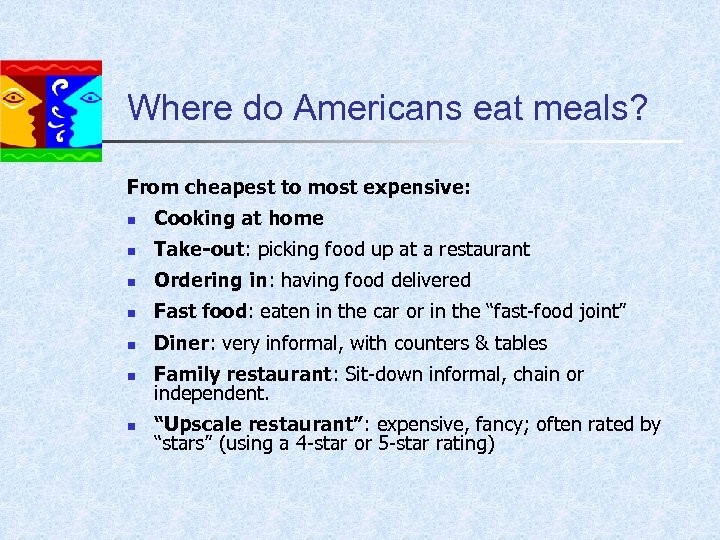 Where do Americans eat meals? From cheapest to most expensive: n Cooking at home n Take-out: picking food up at a restaurant n Ordering in: having food delivered n Fast food: eaten in the car or in the “fast-food joint” n Diner: very informal, with counters & tables n Family restaurant: Sit-down informal, chain or independent. n “Upscale restaurant”: expensive, fancy; often rated by “stars” (using a 4 -star or 5 -star rating)
 Other meal-related terms n n n n Banquet: fanciest type of sit-down meal Sit-down meal: Food is served ahead of time on the plate, and delivered to your table Buffet: Food is in bowls on a side table, and you help yourself Family Style: Food is in bowls that you “pass around, ” usually clockwise Picnic: Outdoor informal meal, often with hot dogs or hamburgers “Pot Luck”: a buffet meal or party where the guests each bring a “dish” to share Brunch: late breakfast/early lunch
 So how do you order in an American restaurant? n n That depends on the type of restaurant Let’s assume you are going out to a nice sit-down restaurant n Your dinner may have a few “courses” n Here are some things to consider…
 “Courses” of a dinner n Appetizer: small “nibbles” to eat while you wait for the main meal n Soup n Salad, often with a “dressing” n “Entrée” (main dish, usually meat or fish) n “Side dishes” (potatoes, vegetables) n Dessert
 Some cost considerations n n Entrée price may include salad &/or “sides” If “a la carte, ” each item is an additional cost “Prix Fixe” means one price for everything (usually only upscale places) Drinks, especially alcoholic ones, are usually “extra”
 Lots of choices! n n Soup? Cup or bowl? Entrée? How prepared? (rare, medium, or welldone; baked or broiled) Salad? Which “salad dressing”? (French, Italian, Russian, Blue Cheese, Honey Mustard, or others) Potatoes? What kind? (French fries, baked, mashed) n Baked potato? With or without “sour cream”? n Coffee? Regular or decaf? Black, cream, or sugar? n Pie? Plain or “a la mode” (with ice cream)?
 Examples In a fancy restaurant: n “I’d like the London Broil [a cut of beef] with a baked potato, no sour cream and Italian dressing for the salad. ” Or, the more likely meal out: n “Give me a Whopper with medium fries & a Coke. ”
 Tipping in a restaurant n Most servers (waiters/waitresses) get most of their income from tips. n The tip is usually left on the table, but may be given to server or left at “register” n The usual tip is 15% of the entire bill, rounded up. BUT n Tip on the tax portion? Some people do, some don’t. n Leave a higher % for great service or extra help. n At serve-yourself “buffets” with less service, 10% is okay. n No tipping is done in fast food restaurants. n Some restaurants include “gratuity” (tip) in the price, especially for large groups. Don’t pay twice!
 Dining “etiquette” (expected behavior) n Place your napkin on your lap before you start to eat; put it on the table when you’re done. n Keep your mouth closed when you chew n Swallow before you speak n n Usually keep your fork in the left hand to cut, but the right hand to eat The knife usually rests across the top of your plate after the first time you use it. n Always say thank you to your host n Always tip your waiter after a sit-down meal
 Some common phrases n n n “Bon appetit” = French for “good appetite”) “A toast” = a few words to thank the host, honor the occasion, or celebrate the “guest of honor. ” Everyone holds a glass up during the toast, and drinks at the end. “Grace” = A prayer of thanks before (and sometimes after) a meal. “Set the table” = put out the glasses, plates, silverware, etc. “Clear the table” = remove all the food, dishes, etc. after a meal.
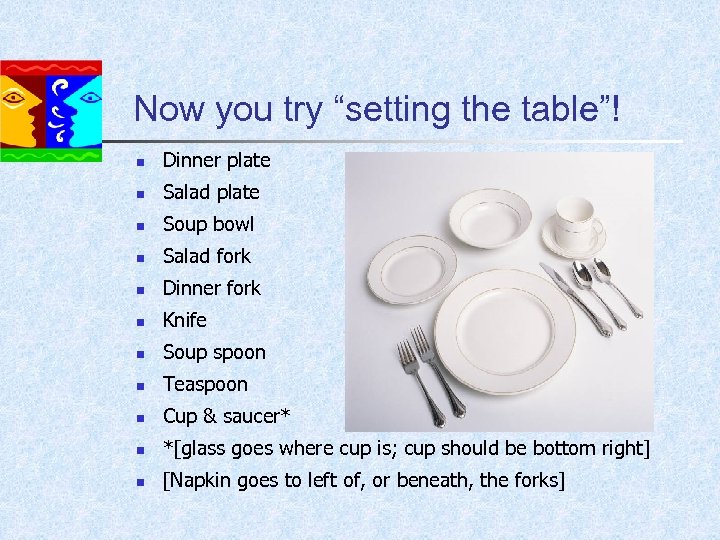 Now you try “setting the table”! n Dinner plate n Salad plate n Soup bowl n Salad fork n Dinner fork n Knife n Soup spoon n Teaspoon n Cup & saucer* n *[glass goes where cup is; cup should be bottom right] n [Napkin goes to left of, or beneath, the forks]