 Скачать презентацию A survey of underground laboratory space Dave Wark
a18cea53d65dba992e56a7309af4518f.ppt
- Количество слайдов: 7



A survey of underground laboratory space Dave Wark University of Sussex/ Rutherford Lab Journées du n, LPNHE Paris Nov. 27, 2003
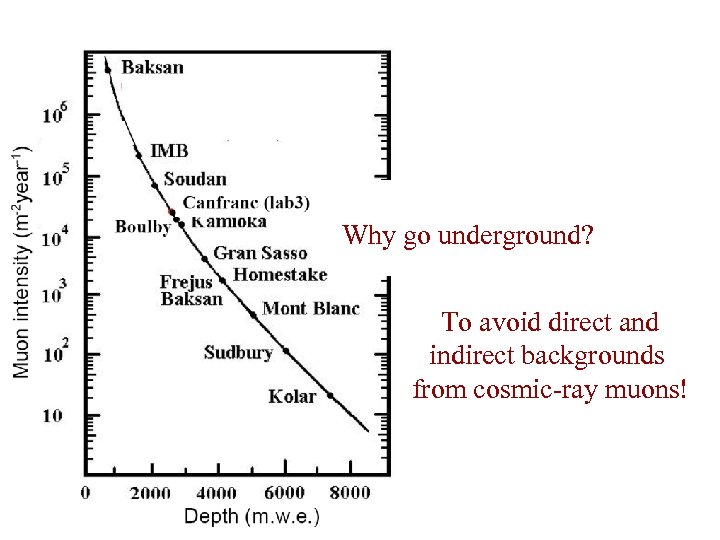
Why go underground? To avoid direct and indirect backgrounds from cosmic-ray muons!
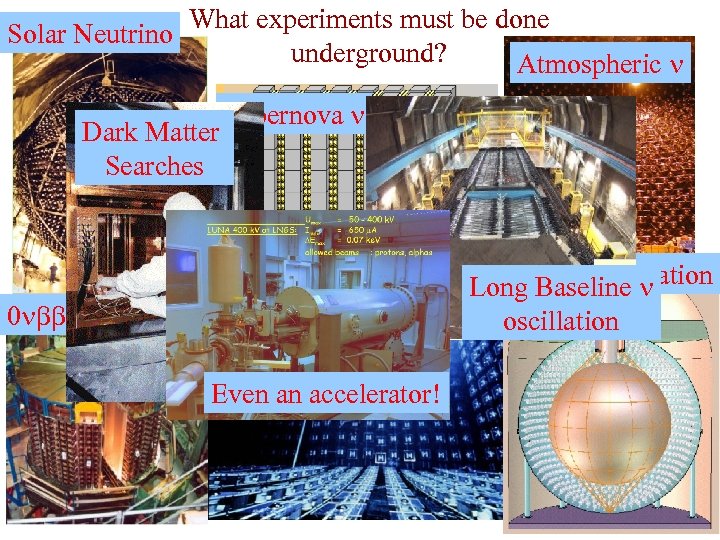
Solar Neutrino What experiments must be done underground? Atmospheric n Dark Matter Searches 0 nbb decay Supernova n proton decay Even an accelerator! Reactor n oscillation Long Baseline n oscillation
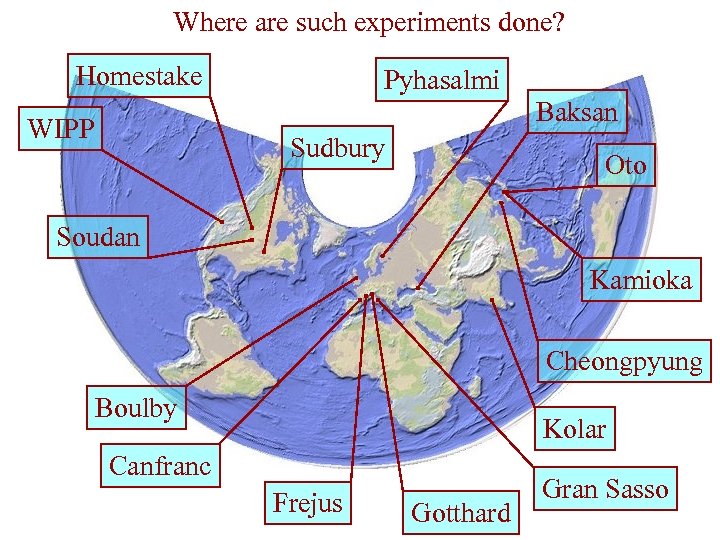
Where are such experiments done? Homestake Pyhasalmi Baksan WIPP Sudbury Oto Soudan Kamioka Cheongpyung Boulby Kolar Canfranc Frejus Gotthard Gran Sasso
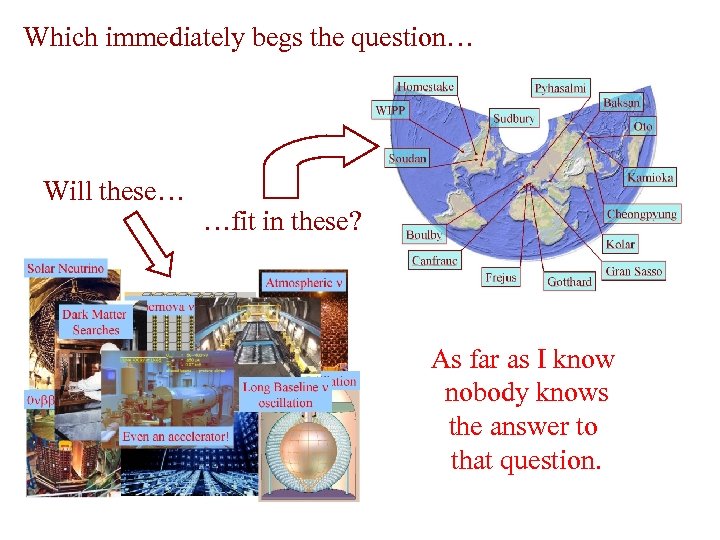
Which immediately begs the question… Will these… …fit in these? As far as I know nobody knows the answer to that question.
Possible Responses… • It will be all right on the night… – Pro: These experiments are mostly small, as each one is available it can look around and find somewhere to go, and after all, we haven’t run into any trouble yet. – Con: These experiments are not all small, and if several large ones become ready simultaneously we could face long delays. • Let’s all build more labs! – Pro: A little healthy competition is good for the field, there are enough highquality projects that everyone is likely to get at least one, and the funding isn’t a zero-sum game. – Con: This doesn’t guarantee that we will have space when we need it, and conversely money that could be spent building experiments may get used digging holes in the ground that won’t be used. • Somebody should make reasoned estimates and see if it looks like we will have sufficient space, or if we are in trouble, or if we are in real trouble. – Note that this is an information gathering exercise only.
A survey of underground lab space – need and availability • I have been charged by Ap. PEC with producing estimates of likely future need and availability of underground lab space. • The exact nature of this review is not yet finalized. • I propose that a panel of experts from around the world meet at a workshop and, building on the work that has gone before, produce estimates for review by the community. • Much of the information already exists in the form of conference proceedings (such as NESS 2002) and reports prepared for other facilities – what is needed is for the information to be brought together in one place and evaluated. • What is it really reasonable that we will build? How many experiments (and how big) do we really need? How many experiments could a reasonable extrapolation of the size of the community support? How many experiments would a reasonable enhancement of our budgets buy? The most important output would be a range of numbers for need and availability under clearly stated assumptions, and a flagging of any problems revealed. • All comments/advice are welcome – email to d. l. wark@rl. ac. uk
Скачать презентацию A survey of underground laboratory space Dave Wark
a18cea53d65dba992e56a7309af4518f.ppt