


 Скачать презентацию A survey of Internet Topology Discovery 1
d1c6a0ba04b3c6758b7a57cea7aba363.ppt
- Количество слайдов: 39
 A survey of Internet Topology Discovery 1
 Outline n n Motivations Internet topology n IP Interface Level n Router Level n AS Level n Po. P Level 2
 Motivations n The topology data collected can form the basis for a formal graph of the internet. The properties derived from the internet graph can be used as input to simulations. Networking management. n Design and evaluation protocol. n n 3
 Internet topology n n First level: IP interface level Second level: Router level Third level: Point of presence (Po. P) level Fourth level: Autonomous system (AS) level 4
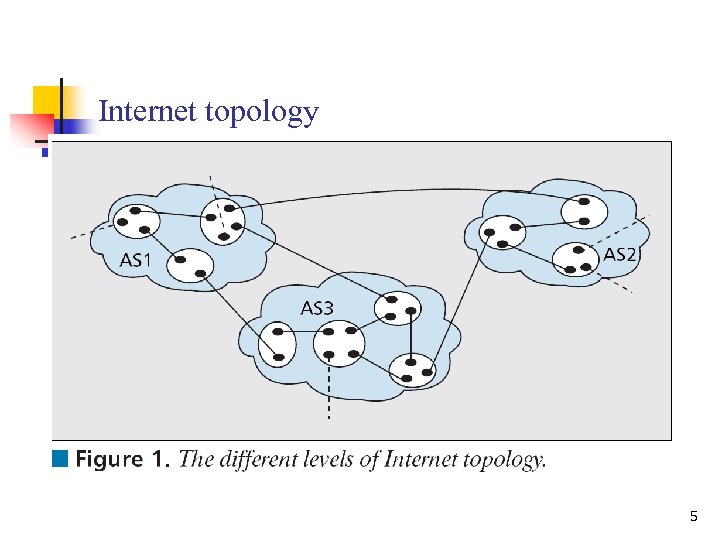 Internet topology 5
 IP interface level n n It’s composed of the IP interfaces of routers and end-hosts. All routers and some hosts have multiple interfaces, and each interface appears as a separate node in this topology. 6
 IP interface level n Four algorithm to discover topology n n Based on SNMP Based on the broadcast ping and the DNS transfer zone Based on DNS transfer zone and traceroute Based only on traceroute 7
 Algorithm based on SNMP n n For each router, one finds neighboring routers from that router’s ip. Route. Table entry. Hosts are obtained from the router’s Address Resolution Protocol (ARP) table entries. ARP is a protocol used to map IP network addresses to the hardware addresses used by a data link protocol. All entries are obtained through SNMP. Each router is pinged to be sure it is alive. But this algorithm can only be used on networks where SNMP is enabled on all routers. 8
 Algorithm based on the broadcast ping and the DNS transfer zone n n n First, get the list of all hosts in a domain, using the DNS transfer zone Second, check the validity of this list with a broadcast ping. this algorithm heavily depends on DNS transfer zone and broadcast ping, which both may be unavailable for security reasons. Ex firewall 9
 Algorithm based on traceroute and the DNS transfer zone n The basic idea of the algorithm is to get a list of all routers and hosts in the domain with DNS transfer zone and then initiate a traceroute to each member of this list. 10
 Algorithm based only on traceroute n n The difference between this algorithm and the previous one is the way which the IP addresses are obtained. Here, a heuristic is used to discover the address space to probe. 11
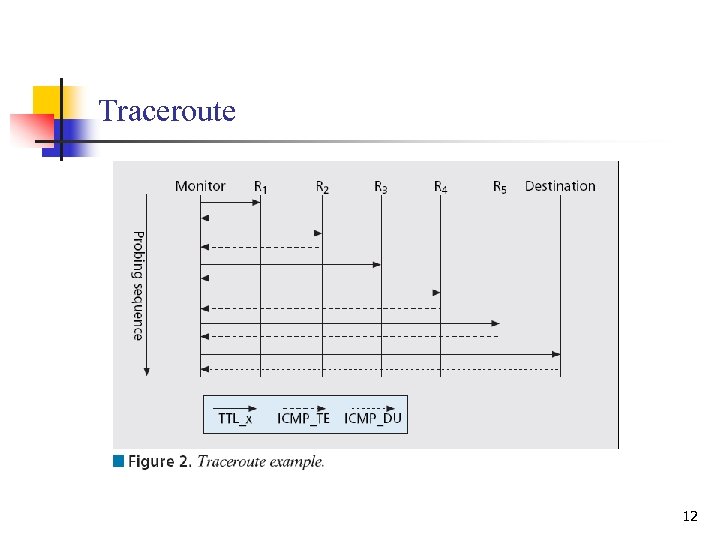 Traceroute 12
 Traceroute n Problems will occur n ICMP not enable or ICMP rate limiting. n Destination not respond. Ex firewall etc. 13
 Router Level n An aggregation of the IP interface level, i. e. the summary of all the IP addresses of a router into a single identifier, called alias resolution 14
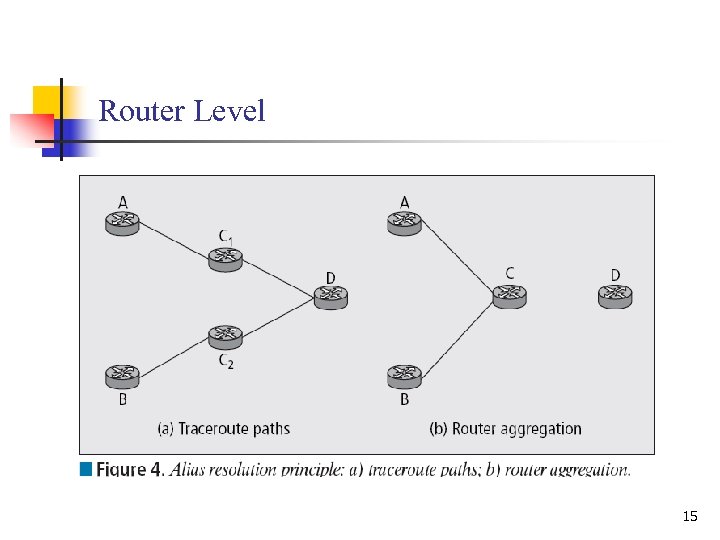 Router Level 15
 Router Level n The existing approaches for alias resolution n Address based method: RFC 1122[64] n IP identification based method n DNS based method n Graph based method n The Analytical Alias Resolver (AAR) n TTL-limited with record route option method n IPv 6 based method 16
 Address based method n n The source sends a UDP probe with a high port number to the router’s interface X. If the source address of the resulting “Port Unreachable” ICMP message is Y, then X and Y are aliases for the same router. The drawback of this solution is that some routers do not generate ICMP messages, making alias resolution impossible. 17
 IP identification based method n n Send a UDP probe packet with a high port number to the two potential aliases. The “Port Unreachable” ICMP responses are encapsulated within IP packets and, so each one includes an IP identifier (x and y). Then, one sends a third packet to the address that responded first. Assume that z is the IP identifier of the third response and x was the IP identifier of the first response. If x < y < z and z – x is small, the addresses are likely aliases. This method, in like the address based method, works only if a router responds to probes 18
 DNS based method n n n This method considers similarities in router host names and works when an AS uses a systematic naming scheme for assigning IP addresses to router interfaces. This method is especially interesting as it can work even if a router does not respond to probes directed to itself. Ally uses this technique against unresponsive routers with the help of the Rocketfuel’s name DNS decoder 19
 Graph based method n n This method extracts from traceroute outputs a graph of linked IP addresses in order to infer likely and unlikely aliases. It is based on two assumptions: n If two IP addresses precede a common successor IP address, then they are likely to be alias. n Two addresses found in a same traceroute are unlikely to be aliases 20
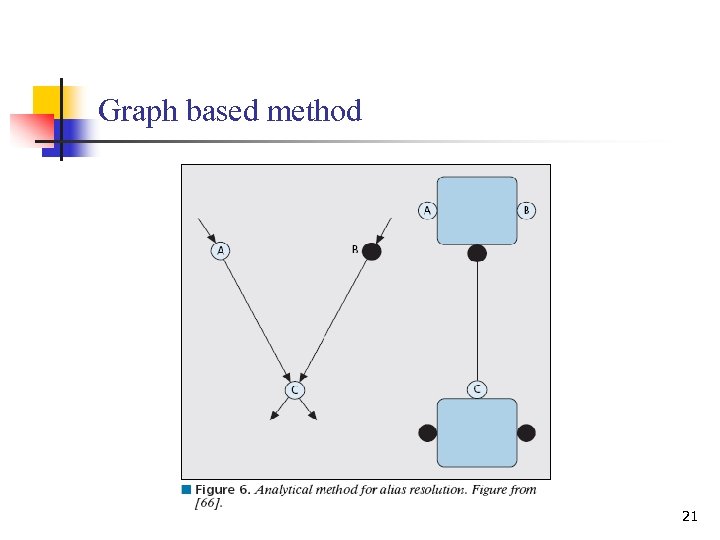 Graph based method 21
 The Analytical Alias Resolver n They propose a graph theoretic formulation of the alias resolution problem and developed the AAR algorithm to solve it. Given a set of path traces, AAR utilizes the common IP address assignment scheme to infer IP aliases within the collected path traces. 22
 TTL-limited with record route option method n n The idea is to perform a standard traceroute with the Record Route (RR) IP option enabled. This option is supposed to force an intermediate router to record its IP address in the IP packet that traverses it. Size constraints, an IP packet cannot contain more than nine IP addresses of intermediate routers 23
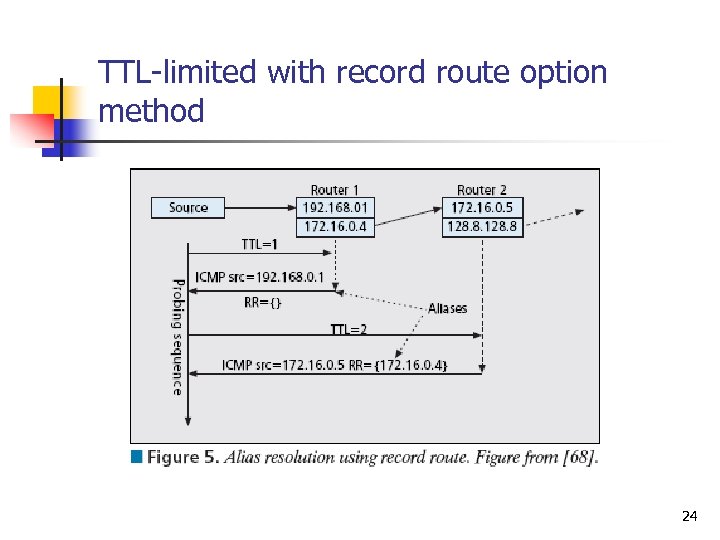 TTL-limited with record route option method 24
 IPv 6 based method n n Atlas tries to find addresses belonging to the same router relying on the assumption that routing header processing in IPv 6 routers is separate from delivering packets to the TCP/UDP layers. To elicit the equivalence of two addresses X and Y, Atlas performs a traceroute to Y via X. When the first probe reaches router X, at a distance h, the first swaps the address X in the destination field with final address Y contained in the routing header. 25
 n n Next, the hop limit is checked. If we assume that the value is 1, an ICMPv 6 hop limit exceeded in transit message response is triggered. Because the destination address field of the probe packet is now Y, the source address of the ICMPv 6 response also becomes Y. The next probe packet, with hop limit h 1, is delivered to the UDP layer, causing a port unreachable response. Thus, if X and Y belong to the same router, the trace XY will report Y-Y and the trace Y-X will report XX. 26
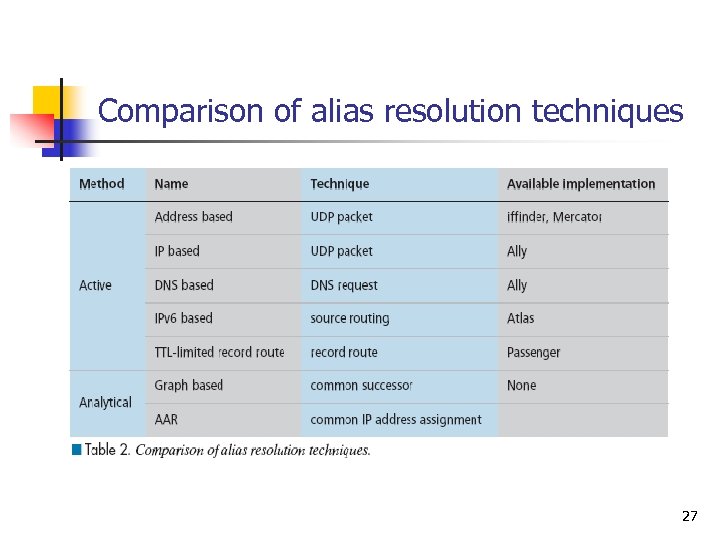 Comparison of alias resolution techniques 27
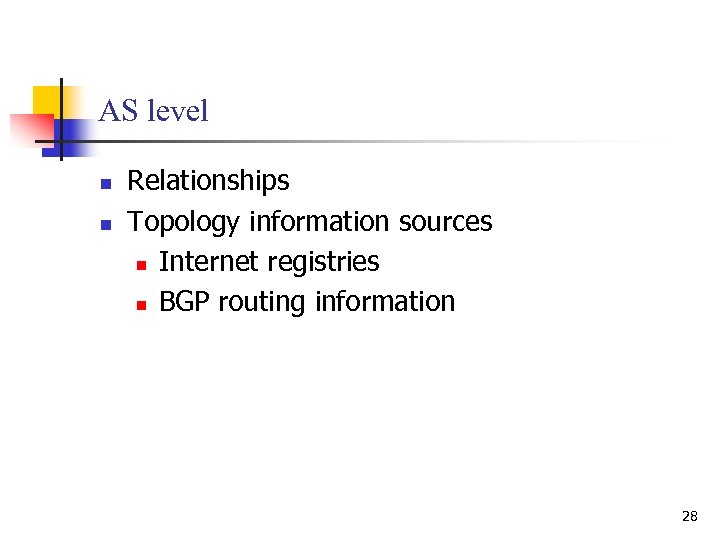 AS level n n Relationships Topology information sources n Internet registries n BGP routing information 28
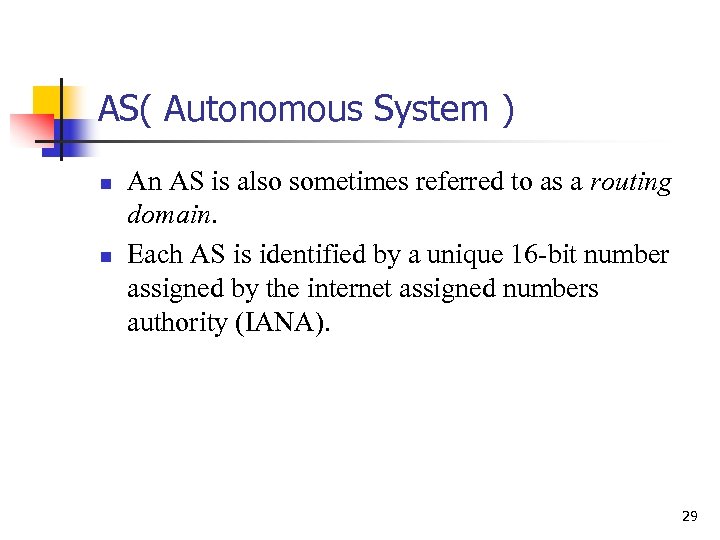 AS( Autonomous System ) n n An AS is also sometimes referred to as a routing domain. Each AS is identified by a unique 16 -bit number assigned by the internet assigned numbers authority (IANA). 29
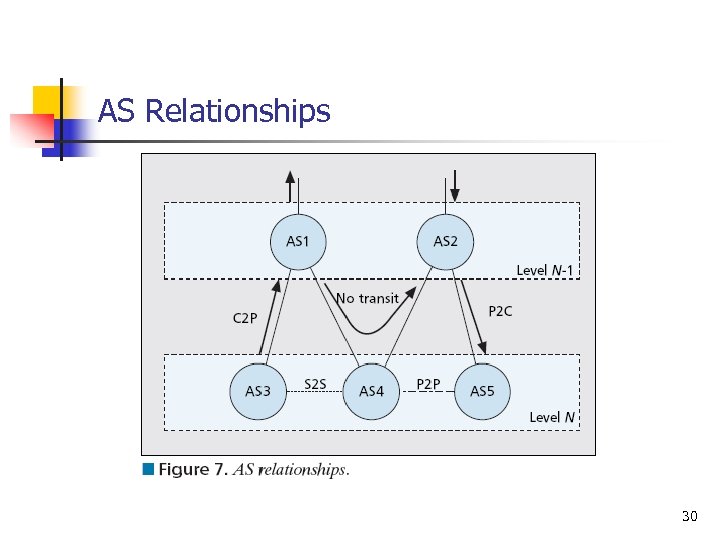 AS Relationships 30
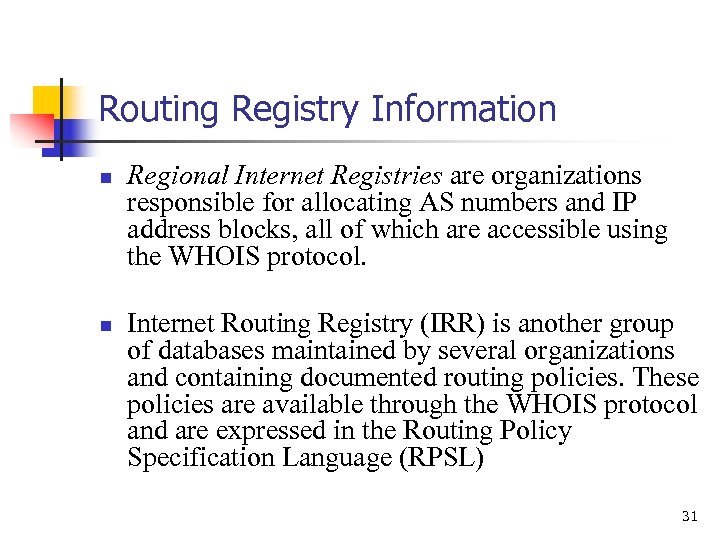 Routing Registry Information n n Regional Internet Registries are organizations responsible for allocating AS numbers and IP address blocks, all of which are accessible using the WHOIS protocol. Internet Routing Registry (IRR) is another group of databases maintained by several organizations and containing documented routing policies. These policies are available through the WHOIS protocol and are expressed in the Routing Policy Specification Language (RPSL) 31
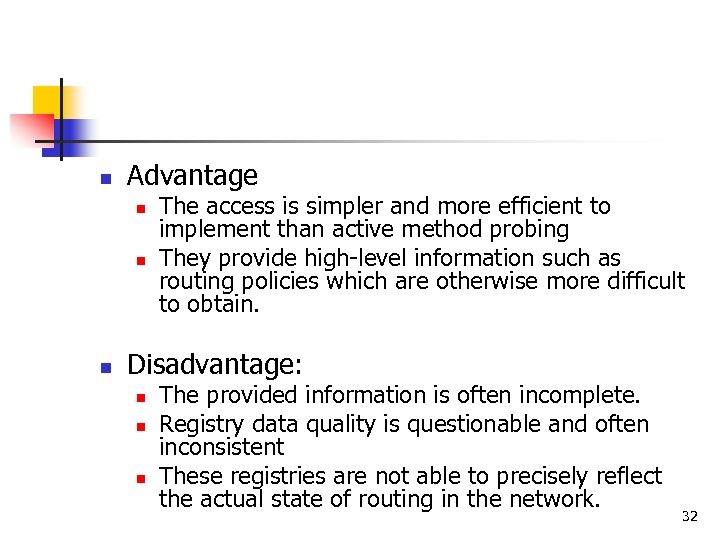 n Advantage n n n The access is simpler and more efficient to implement than active method probing They provide high-level information such as routing policies which are otherwise more difficult to obtain. Disadvantage: n n n The provided information is often incomplete. Registry data quality is questionable and often inconsistent These registries are not able to precisely reflect the actual state of routing in the network. 32
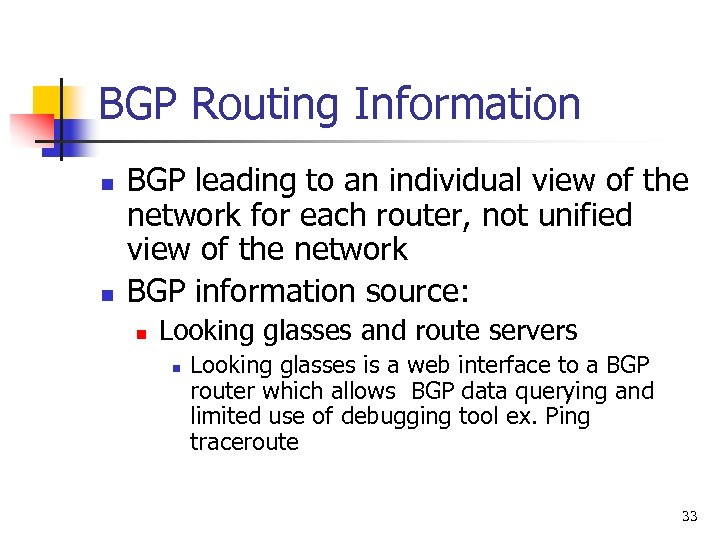 BGP Routing Information n n BGP leading to an individual view of the network for each router, not unified view of the network BGP information source: n Looking glasses and route servers n Looking glasses is a web interface to a BGP router which allows BGP data querying and limited use of debugging tool ex. Ping traceroute 33
 n BGP dumps n Provide collected information form BGP routers around the world. n Ex. Route. Views, RIPE NCC 34
 n Advantage: n n n No need to deploy an infrastructure for exploring the network Provide actual state of the network Disadvantage: n BGP doesn’t provide complete information due to missing AS relationships that include both p 2 c and p 2 p type relationships. 35
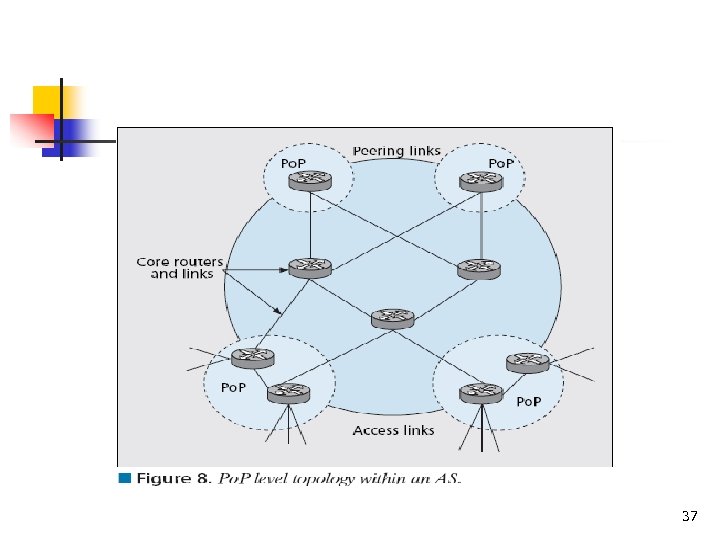
 POP level n A point of presence is a collection of routers owned by an AS in specific location 36
 37
37
 Reference n Donnet. B, Friedman. T, “INTERNET TOPOLOGY DISCOVERY: A SURVEY” IEEE, Communications Surveys & Tutorials, Fourth Quarter. 2007 38
 n END 39