 Скачать презентацию A Survey and Evaluation of Open-Source Electronic Publishing
3b681a567895ff2e06eba40d57edb6a4.ppt
- Количество слайдов: 23



A Survey and Evaluation of Open-Source Electronic Publishing Systems Mark Cyzyk Library Digital Programs Group The Sheridan Libraries Johns Hopkins University

Scan of the Environment


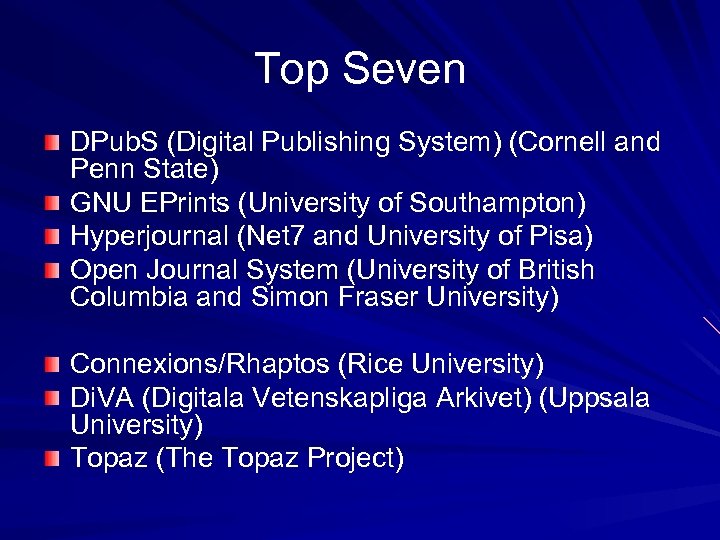
Top Seven DPub. S (Digital Publishing System) (Cornell and Penn State) GNU EPrints (University of Southampton) Hyperjournal (Net 7 and University of Pisa) Open Journal System (University of British Columbia and Simon Fraser University) Connexions/Rhaptos (Rice University) Di. VA (Digitala Vetenskapliga Arkivet) (Uppsala University) Topaz (The Topaz Project)
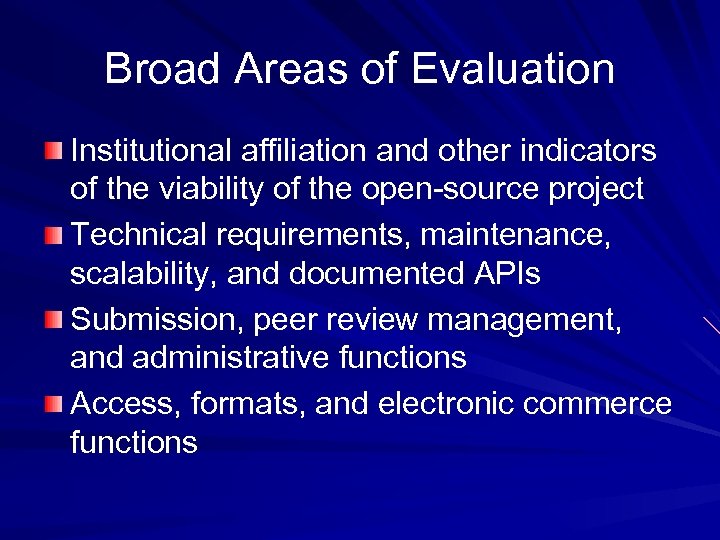
Broad Areas of Evaluation Institutional affiliation and other indicators of the viability of the open-source project Technical requirements, maintenance, scalability, and documented APIs Submission, peer review management, and administrative functions Access, formats, and electronic commerce functions
Institutional affiliation and other indicators of the viability of the open -source project

Technical requirements, maintenance, scalability, and documented APIs

Submission, peer review management, and administrative functions


Access, formats, and electronic commerce functions

Three Worthy Mentions Connexions/Rhaptos Di. VA Topaz
DPub. S (2. 0) Strengths: – Very well architected – Highly customizable – custom metadata schemas, UI configurations, file formats – Provision of subscription services Weaknesses: – – Difficult to install Primitive Perl scripts for backend administration Incomplete documentation Publications must be in final form. No modeling of peer review process.
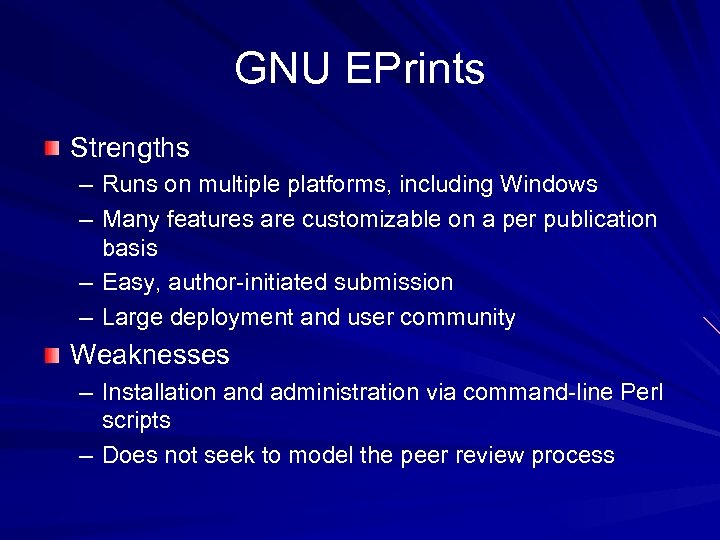
GNU EPrints Strengths – Runs on multiple platforms, including Windows – Many features are customizable on a per publication basis – Easy, author-initiated submission – Large deployment and user community Weaknesses – Installation and administration via command-line Perl scripts – Does not seek to model the peer review process
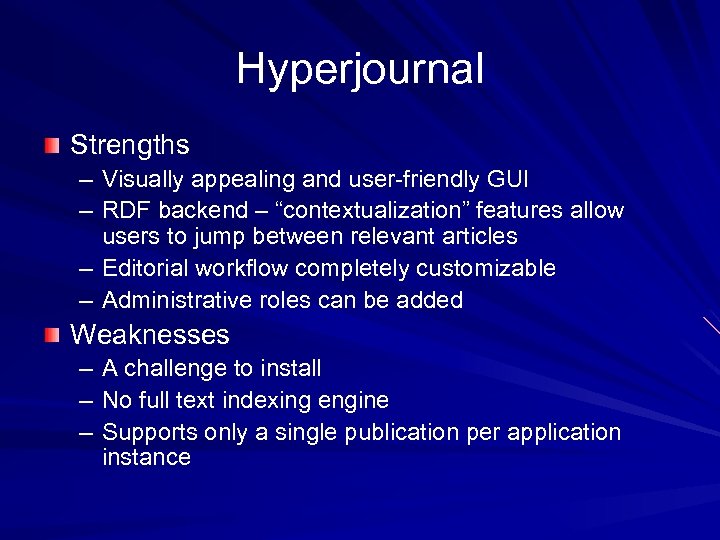
Hyperjournal Strengths – Visually appealing and user-friendly GUI – RDF backend – “contextualization” features allow users to jump between relevant articles – Editorial workflow completely customizable – Administrative roles can be added Weaknesses – – – A challenge to install No full text indexing engine Supports only a single publication per application instance
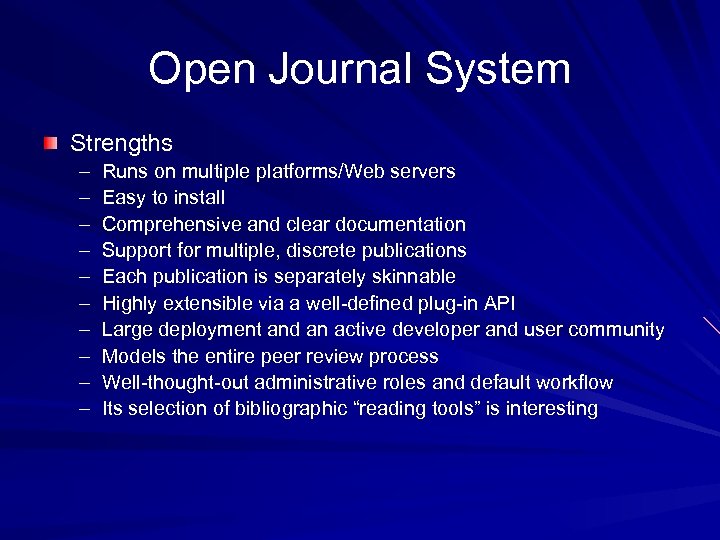
Open Journal System Strengths – – – – – Runs on multiple platforms/Web servers Easy to install Comprehensive and clear documentation Support for multiple, discrete publications Each publication is separately skinnable Highly extensible via a well-defined plug-in API Large deployment and an active developer and user community Models the entire peer review process Well-thought-out administrative roles and default workflow Its selection of bibliographic “reading tools” is interesting
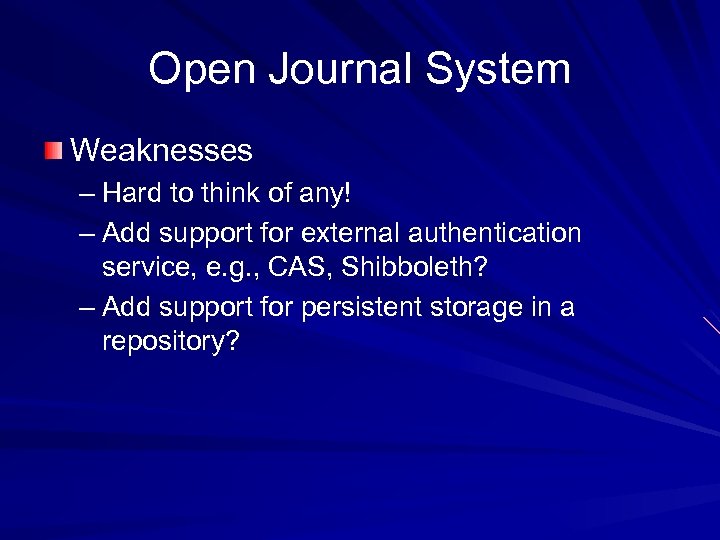
Open Journal System Weaknesses – Hard to think of any! – Add support for external authentication service, e. g. , CAS, Shibboleth? – Add support for persistent storage in a repository?
Conclusions
(Personal Lessons Learned) Platform independence should not be neglected. One inherits the flaws of external libraries and frameworks. Choose with care. Installation procedures must be simple and flawless. Don’t wake the Sys. Admin: “Slap a GUI on that XML!” -- and push application administration out, as much as possible, to select users. Documentation must be concise, complete, and comprehensive. “I can’t guess what you’re thinking. ”

Mark Cyzyk mcyzyk@jhu. edu
Скачать презентацию A Survey and Evaluation of Open-Source Electronic Publishing
3b681a567895ff2e06eba40d57edb6a4.ppt