 Скачать презентацию A Summary of Guidelines for Managing the Diabetic
ebcd4af60e9aece35e22fce533ca8aec.ppt
- Количество слайдов: 19



A Summary of Guidelines for Managing the Diabetic Foot Robert G. Frykberg, DPM, MPH, FAPWCA • Chief • Podiatry Section • Carl T. Hayden VA Medical Center • Phoenix, AZ Advances in skin & wound care 2005. 05 謝宜蓁 1
PURPOSE To familiarize the physician and registered professional nurse with an overview of updated guidelines for the prevention and/or management of pressure ulcers, diabetic foot ulcers, and surgical site infections. 2
TARGET AUDIENCE • This continuing education activity is intended for physicians and nurses with an interest in learning about evidence-based prevention and management of wounds. 3
OBJECTIVES • After reading the article and taking the test, the participant should be able to: 1. Discuss the origins and use of the updated guidelines presented. 2. Describe patients at risk for incurring wounds and state preventive measures as identified in the guidelines. 3. Identify techniques used to prevent and treat chronic or infected wounds as described in the guidelines. 4
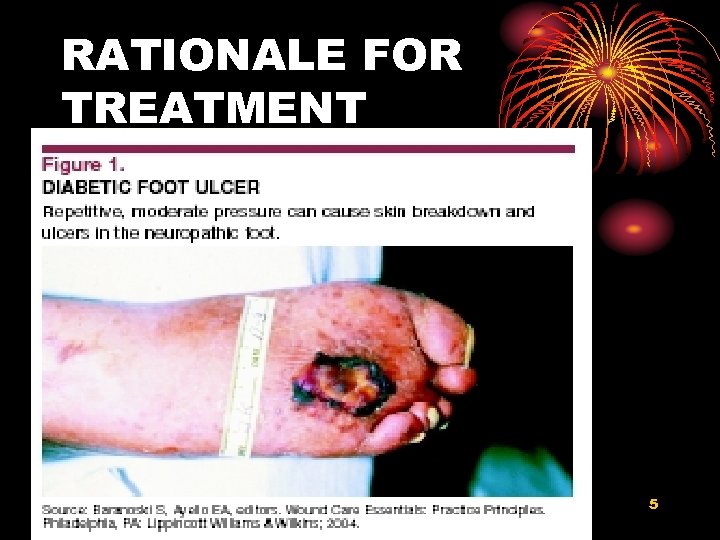
RATIONALE FOR TREATMENT 5
RATIONALE FOR TREATMENT • Perhaps the best reason to aggressively treat a diabetic foot ulcer is because it is the leading risk factor for lowerextremity amputation. 6
RISK FACTORS • • • Minor trauma Neuropathy Previous ulcer Infection Hypoxia Protein glycosylation 7
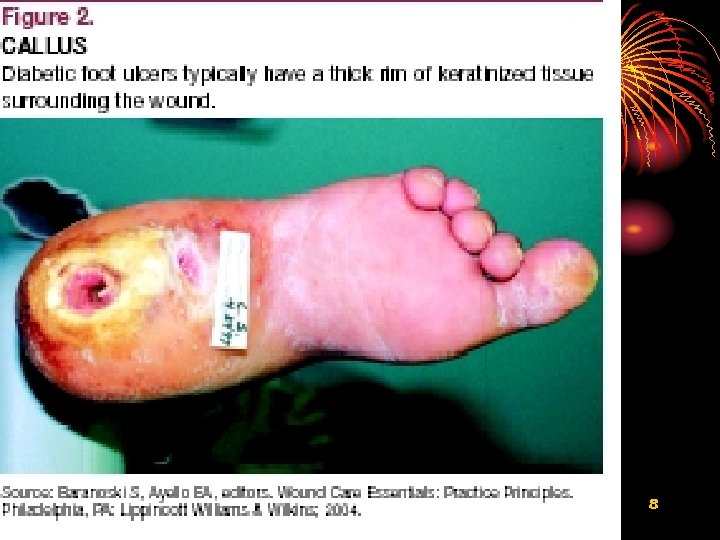
8

WOUND ASSESSMENT AND CLASSIFICATION • • • Laboratory parameters Wound assessment Neurologic examination Vascular examination Infection 9
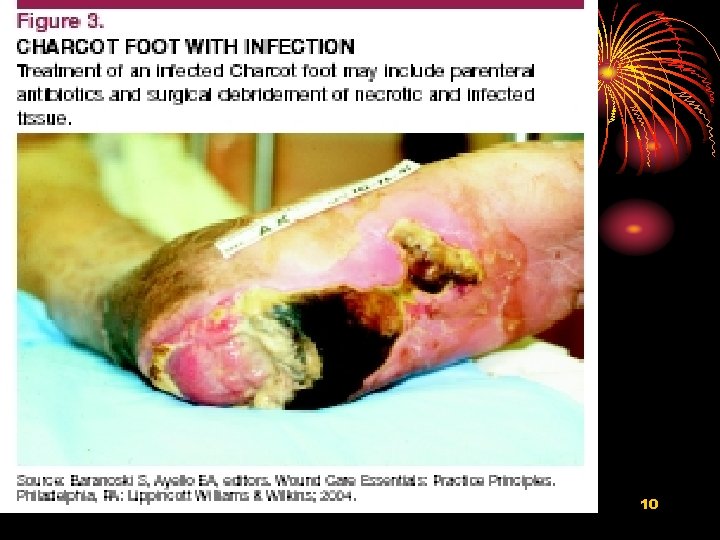
10
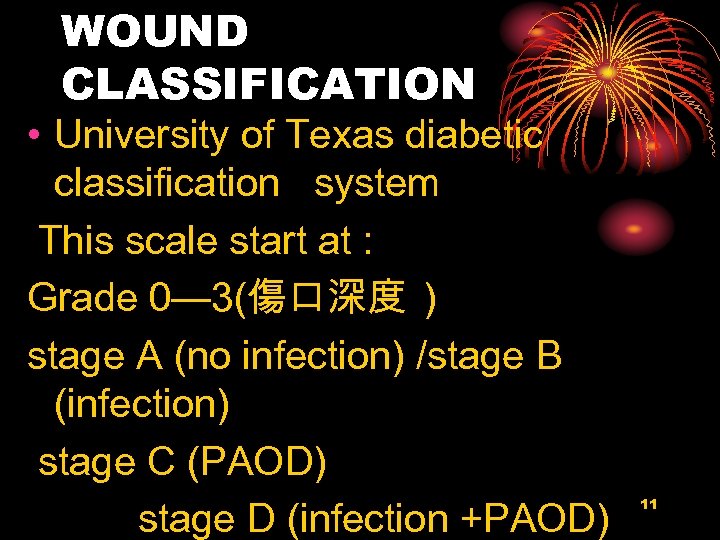
WOUND CLASSIFICATION • University of Texas diabetic classification system This scale start at : Grade 0— 3(傷口深度 ) stage A (no infection) /stage B (infection) stage C (PAOD) stage D (infection +PAOD) 11

ADA的文獻醫治建議 一個有 系統的評估 , 如下列問題 ︰ 病患有潰瘍經驗嗎? 潰瘍是因穿刺傷 ? 鈍傷 ? 燙傷? 傷口持續多久? 急性 ? 慢性 ? 局部或系統症狀有無擴散? 傷口正改善 ? 穩定的 ? 還是正惡化? 病患之前做過傷口處理嗎?做過哪些處 置? • 何種治療有效 ? 何種失敗?失敗原因 ? • • • 12
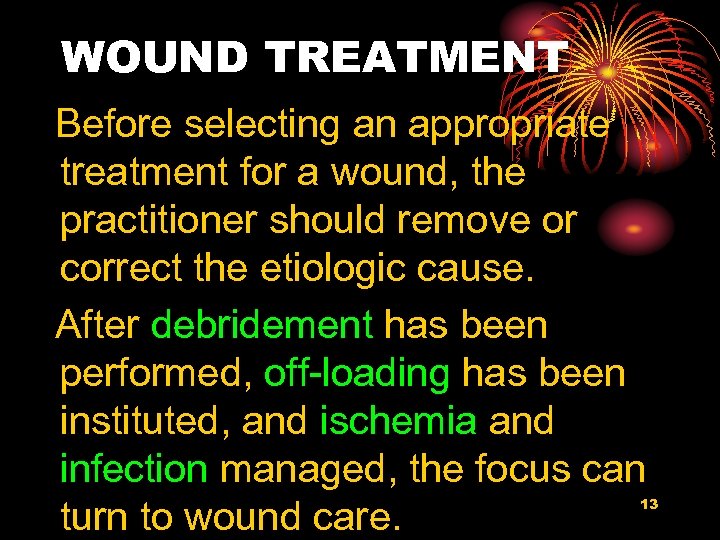
WOUND TREATMENT Before selecting an appropriate treatment for a wound, the practitioner should remove or correct the etiologic cause. After debridement has been performed, off-loading has been instituted, and ischemia and infection managed, the focus can turn to wound care. 13

Treatment • Sharp debridement , ultrasound , enzyme…/Maggots … • 減壓 : TCC, Itcc • Medical management • 敷料 : gels, creams, solutions, anti…. 14
PREVENTION The basic parameter for prevention is education. • Patients are not the only ones who need to be educated, however ; providers need education as well. • Not every health care practitioner is cognizant of current standards of wound care. • With the rapid advances in this area of practice, even wound care practitioners need to ensure that they 15 are consistently updating their •

SELECTED REFERENCES • • • • • • American Diabetes Association. Consensus development conference on diabetic foot wound care. Diabetes Care 1999; 22: 1354 -60. American Diabetes Association. Peripheral arterial disease in people with diabetes. Diabetes Care 2203; 26: 3333 -41. Armstrong DG, Boulton AJ, Banwell P. Negative pressure wound therapy in treatment of diabetic foot wounds: a marriage of modalities. Ostomy Wound Manage 2004; 50(4 A Suppl): 9 -12. Armstrong DG, Lavery LA, Harkless LB. Validation of a diabetic wound classification system. The contribution of depth, infection, and ischemia to risk of amputation. Diabetes Care 1998; 21: 855 -9. Armstrong DG, Lavery LA, Nixon BP, Boulton AJ. It’s not what you put on, but what you take off: techniques for debriding and off-loading the diabetic foot wound. Clin Infect Dis 2004; 39(Suppl 2): S 92 -S 9. Bartus CL, Margolis DJ. Reducing the incidence of foot ulceration and amputation in diabetes. Curr Diab Rep 2004; 4: 413 -8. Eldor R, Raz I, Ben Yehuda A, Boulton AJ. New and experimental approaches to treatment of diabetic foot ulcers: a comprehensive review of emerging treatment strategies. Diabet Med 2004; 21: 1161 -73. Frykberg RG. Diabetic foot ulcers: pathogenesis and management. Am Fam Physician 2002; 66: 1655 -62. Frykberg RG. The team approach in diabetic foot management. Adv Wound Care 1998; 11(2): 71 -7. 16
• • • • • Frykberg RG, Lavery LA, Pham H, Harvey C, Harkless L, Veves A. Role of neuropathy and high foot pressures in diabetic foot ulceration. Diabetes Care 1998; 21: 1714 -9. Frykberg RG, Armstrong DG, Giurini J, et al. Diabetic foot disorders; a clinical practice guideline. J Foot Ankle Surg. 2000; 39(5 Suppl): S 1 -60. Grayson ML, Gibbons GW, Balogh K, Levin E, Karchmer AW. Probing to bone in infected pedal ulcers. A clinical sign of underlying osteomyelitis in diabetic patients. JAMA 1995; 273: 721 -3. Lavery LA, Vela SA, Fleischli JG, Armstrong DG, Lavery DC. Reducing plantar pressure in the neuropathic foot: a comparison of footwear. Diabetes Care 1997; 20: 1706 -10. Meggitt B. Surgical management of the diabetic foot. Br J Hosp Med 1976; 227 -32. Murabito JM, Evans JC, Nieto K, Larson MG, Levy D, Wilson PW. Prevalence and clinical correlates of peripheral arterial disease in the Framingham Offspring Study. Am Heart J 2002; 143: 961 -5. Peters EJ, Lavery LA. Effectiveness of the diabetic foot risk classification system of the International Working Group on the Diabetic Foot. Diabetes Care 2001; 24: 1442 -7. Reiber GE, Vileikyte L, Boyko EJ, et al. Causal pathways for incident lower-extremity ulcers in patients with diabetes from two settings. Diabetes Care 1999; 22: 157 -62. Saltzman CL, Zimmerman MB, Holdsworth RL, Beck S, Hartsell HD, Frantz RA. Effect of initial weight-bearing in a total contact cast on healing of diabetic foot ulcers. J Bone Joint Surg Am 2004; 86 -A(12): 2714 -9. 17
• • • • Singh N, Armstrong DG, Lipsky BA. Preventing foot ulcers in patients with diabetes. JAMA 2005; 293: 217 -28. Steed DL, Donohue D, Webster MW, Lindsley L. Effect of extensive debridement and treatment on the healing of diabetic foot ulcers. Diabetic Ulcer Study Group. J Am Coll Surg 1996; 183: 61 -4. Vileikyte L. Diabetic foot ulcers: a quality of life issue. Diabetes Metab Res Rev 2001; 17: 246 -9. Van Gils CC, Wheeler LA, Mellstrom M, Brinton EA, Mason S, Wheeler CG. Amputation prevention by vascular surgery and podiatry collaboration in high-risk diabetic and nondiabetic patients. The Operation Desert Foot experience. Diabetes Care 1999; 22: 678 -83. Wagner FW Jr. The dysvascular foot: a system for diagnosis and treatment. Foot Ankle 1981; 2(2): 64 -122. Wunderlich RP, Peters EJ, Lavery LA. Systemic hyperbaric oxygen therapy: lower-extremity wound healing and the diabetic foot. Diabetes Care 2000; 23(10): 1551 -5. WCF 349_209_214 4/5/05 9: 05 PM Page 214 18

19
Скачать презентацию A Summary of Guidelines for Managing the Diabetic
ebcd4af60e9aece35e22fce533ca8aec.ppt