


 Скачать презентацию A Study of Employee Stock Option Pricing in
64f197e834839af5b5191c004ab15d2b.ppt
- Количество слайдов: 37
 A Study of Employee Stock Option Pricing in Taiwan by Ling-Chu Lee, Ming-Chun Wang and Chia-ying Chan* 2008/4 -25 Seminars on Financial Mathematics and Financial Statistics
 Objectives • What are Employee Stock Options (ESOs)? • ESOs in Taiwan • Pricing ESOs: With and Without Restricted Exercise Price • Factors that Determine the Imposition of Restricted Exercise Price on ESOs 2008/4 -25 Seminars on Financial Mathematics and Financial Statistics
 What are the Employee Stock Options (ESOs)? • A right to buy underlying shares at a certain price during a certain interval • • To Firm Employees: 1) Salary Compensation/Remuneration 2) Incentive/Motivation 3) Employee=Shareholder 2008/4 -25 Seminars on Financial Mathematics and Financial Statistics
 Practice of various incentive schemes In Taiwan Cash bonus Share bonus Employee Stock Options Treasury Shares Interest from Shareholder Trust 2008/4 -25 Seminars on Financial Mathematics and Financial Statistics
 What are the ESOs • To Corporate finance perspective: • Share Bonus Vs. Employee Share Options The Former: • 1) Short Term /Long Term Incentive Scheme • 2) Depends Upon Past Performance • The Latter: • 1) Long Term Incentive Scheme • 2) Depends Upon Post Performance 2008/4 -25 Seminars on Financial Mathematics and Financial Statistics
 The Issue of ESOs • Furthermore, the issue of the ESOs implies the potential change of company ownership[1] and capital structure[2], which brings a large impact on the firm. • [1] The exercise of ESOs means an increase and diversification of the number of firm shareholders. • [2] The exercise of the ESOs may bring so-called dilution effects to the firm inducing the change of capital structure. 2008/4 -25 Seminars on Financial Mathematics and Financial Statistics
 The Impact of Issuing of ESOs in Taiwan • Merits • Better than share bonus from reporting prospective • Incentive scheme 2008/4 -25 • Demerits • Dilution of the revenue • Income tax to the employees by exercising the options • Possible manipulation effect Seminars on Financial Mathematics and Financial Statistics
 The History of ESOs • US: The first inception happened around 1990 s’. The ESOs is considered as “ Incentive Scheme”. • Japan: 1997. Both managers and employees are eligible for the incentive scheme. • Germany: 1996. Likewise. • Taiwan: 2000. ESOs are allowed to set restricted exercise. Generally follow the FASB 123 reporting. Most of ESOs have lack up period. 2008/4 -25 Seminars on Financial Mathematics and Financial Statistics
 The Issue of ESOs In Taiwan 2000: Listed firms were allowed to issue employee stock options. 2007: The adoption of the ESOs schemes should follow Fair price valuation and report as expenses. 1. Total amount should not exceed 15% of total outstanding shares. 2. Effective after the application of issuing ESOs to Financial Supervisory Commission being approved. 2008/4 -25 Seminars on Financial Mathematics and Financial Statistics
 The Issue of ESOs In Taiwan Company Act (公司法) No. 167 -2 Securities and Exchange Act (證交法) No. 28 -3 Business Accounting Act ( 商業會計法) No. 64 Regulations Governing the Offering and Issuance of Securities by Securities Issuers (發行人募集與發行 有價證券處理準則) No. 39 Paper (第 39號公報) 2008/4 -25 Seminars on Financial Mathematics and Financial Statistics
 Motivation of the paper • With a similar origin to corporate equity warrants, (Eberhart (2005)), ESOs are also important as part of a firm’s stage financing. • However, since the fist inception of the ESOs around 1990 s’, literature on this instrument has been scarce. The notable absence of the literature on the ESOs hence gives original motivation of this paper. 2008/4 -25 Seminars on Financial Mathematics and Financial Statistics
 Motivation of the paper • The imposition of Restricted exercise provision on ESOs in Taiwan is a unique phenomenon. There is no study focused on this issue. • In year 2007, more than 90 listed firms had issued employee stock options. (Economics Daily) 2008/4 -25 Seminars on Financial Mathematics and Financial Statistics
 Contribution of the paper • First attempt to adopt forward-pricing model in pricing ESOs. • First attempt to adopt Reset pricing model to examine the restricted exercise price provision. • First attempt to examine factors determine the decision of imposing restricted exercise price. 2008/4 -25 Seminars on Financial Mathematics and Financial Statistics
 Studies on the Incentive Schemes • Design of the Schemes • Jenkins and Seiler (1990), Galbraith and Merrill (1991), Smith and Watts (1992), Gaver and Gaver (1995), Lawrence (2001)). • Performance post the Schemes • Jensen and Murphy (1990), Yermack (1995), Hall and Leibman (1998), Ding and Sun (2001), Kato (2005) • Pricing and accounting of the scheme • Yermack (1997), Aboody and Kasznik (2000), Brenner et al. (2000), Chance et al. (2000), Aboody et al. (2006)) 2008/4 -25 Seminars on Financial Mathematics and Financial Statistics
 Studies on the ESOs • Studies in Taiwan • Han (2003), Guo et al. (2006), Fan and Chen (2006), Lin and Hu (2006), Han and Shen (2007) • Hemmer et al. (1996) indicate that the valuation of employee stock options (ESO) has received significant attention from academics and practitioners. Nevertheless, most of the studies examined the implementations of Executive Manager Options Scheme, with a relatively short history, ESOs studies were neglected. 2008/4 -25 Seminars on Financial Mathematics and Financial Statistics
 Pricing ESOs • Executive ESOs: • Murphy (1985), Yermack (1995), and Boschen and Smith (1995) use the Black-Scholes model to measure the fair value of the ESO. Hall and Murphy (2002) apply Certainty Equivalence Evaluation derived from Binominal model. All use the US market data. • ESOs: • Abbody (1996) Binominal Pricing model, US. 2008/4 -25 Seminars on Financial Mathematics and Financial Statistics
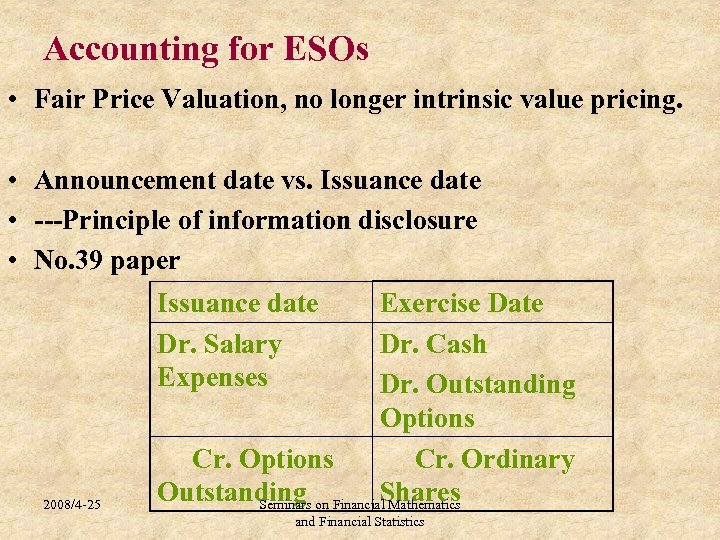 Accounting for ESOs • Fair Price Valuation, no longer intrinsic value pricing. • Announcement date vs. Issuance date • ---Principle of information disclosure • No. 39 paper Issuance date Dr. Salary Expenses 2008/4 -25 Exercise Date Dr. Cash Dr. Outstanding Options Cr. Ordinary Outstanding Shares Seminars on Financial Mathematics and Financial Statistics
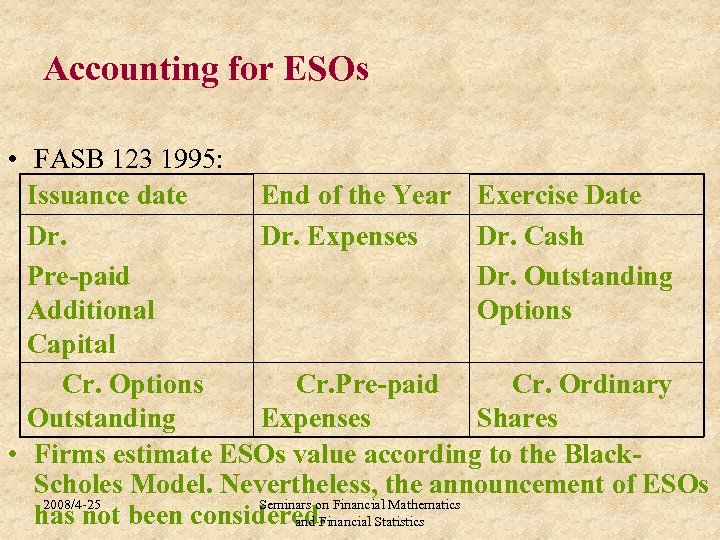 Accounting for ESOs • FASB 123 1995: Issuance date End of the Year Exercise Date Dr. Expenses Dr. Cash Pre-paid Dr. Outstanding Additional Options Capital Cr. Options Cr. Pre-paid Cr. Ordinary Outstanding Expenses Shares • Firms estimate ESOs value according to the Black. Scholes Model. Nevertheless, the announcement of ESOs 2008/4 -25 Seminars on Financial Mathematics has not been considered. and Financial Statistics
 In this study, we claim …… • To report the cost of the issue of the ESO, the “prepaid” capital should be taken into account on the announcement date, rather than the Issue date. Since the issue of ESO is considered as an “Obligation” after its announcement. The Time Gap between the announcement and issuance of the ESOs should be taken in to account when pricing the fair value of the ESOs. • Regulations Governing the Offering and Issuance of Securities by Securities Issuers N 0. 56 -1 • ----Forward Pricing model (Robinstain (1991)) 2008/4 -25 Seminars on Financial Mathematics and Financial Statistics
 In this study, we claim …… • ESOs with restricted exercise price should be adjusted while applying pricing model. The payoff of ESOs exercised on the basis of two different strike prices should be taken into account. One is while the strike price above par, the other is while the strike price at par (restricted exercise price) ----Reset Pricing Model (Gray and Whaley (1997)) 2008/4 -25 Seminars on Financial Mathematics and Financial Statistics
 Pricing ESOs: With and Without Restricted Exercise Price • ESOs without restricted exercise price: Normal ESOs, Exercise Price = Share Price on the Issuance Date. • ESOs with restricted exercise price: Exercise Price = Par Value (TW$10) if the Share Price Goes Below Par. We claim: The ESO Expenses = Exercise Price Discounted back to the Announcement Date. 2008/4 -25 Seminars on Financial Mathematics and Financial Statistics
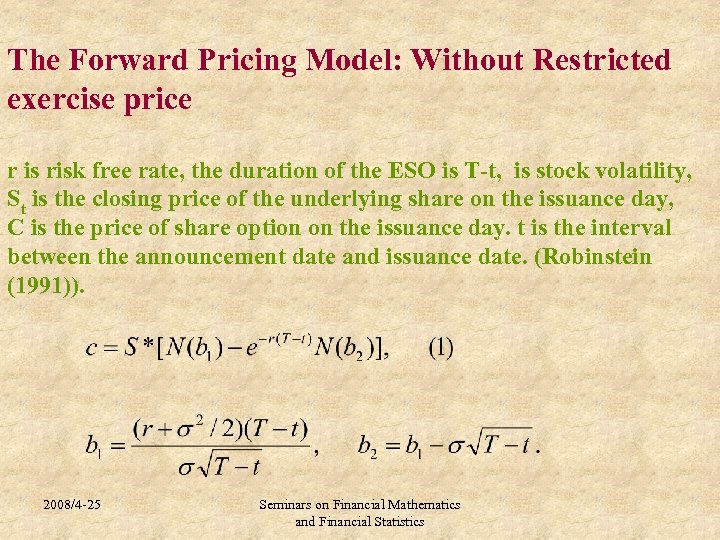 The Forward Pricing Model: Without Restricted exercise price r is risk free rate, the duration of the ESO is T-t, is stock volatility, St is the closing price of the underlying share on the issuance day, C is the price of share option on the issuance day. t is the interval between the announcement date and issuance date. (Robinstein (1991)). 2008/4 -25 Seminars on Financial Mathematics and Financial Statistics
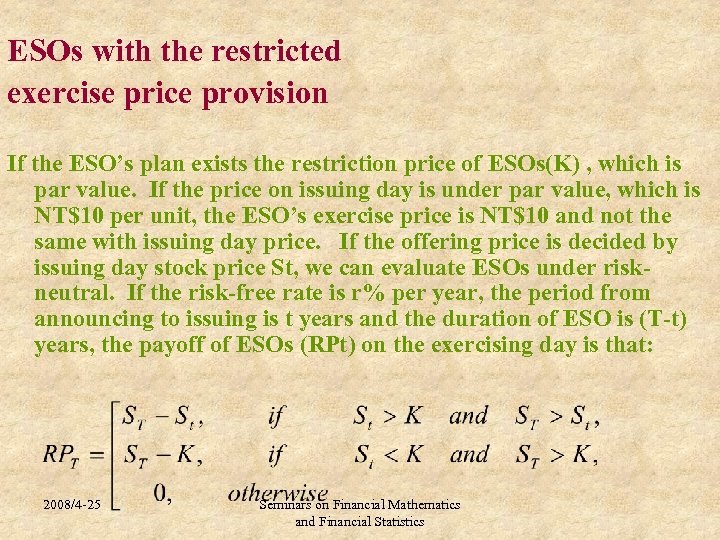 ESOs with the restricted exercise price provision If the ESO’s plan exists the restriction price of ESOs(K) , which is par value. If the price on issuing day is under par value, which is NT$10 per unit, the ESO’s exercise price is NT$10 and not the same with issuing day price. If the offering price is decided by issuing day stock price St, we can evaluate ESOs under riskneutral. If the risk-free rate is r% per year, the period from announcing to issuing is t years and the duration of ESO is (T-t) years, the payoff of ESOs (RPt) on the exercising day is that: 2008/4 -25 Seminars on Financial Mathematics and Financial Statistics
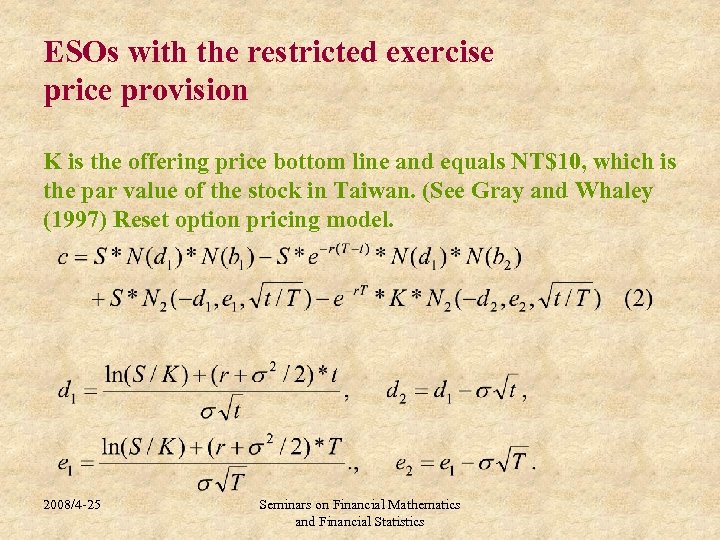 ESOs with the restricted exercise price provision K is the offering price bottom line and equals NT$10, which is the par value of the stock in Taiwan. (See Gray and Whaley (1997) Reset option pricing model. 2008/4 -25 Seminars on Financial Mathematics and Financial Statistics
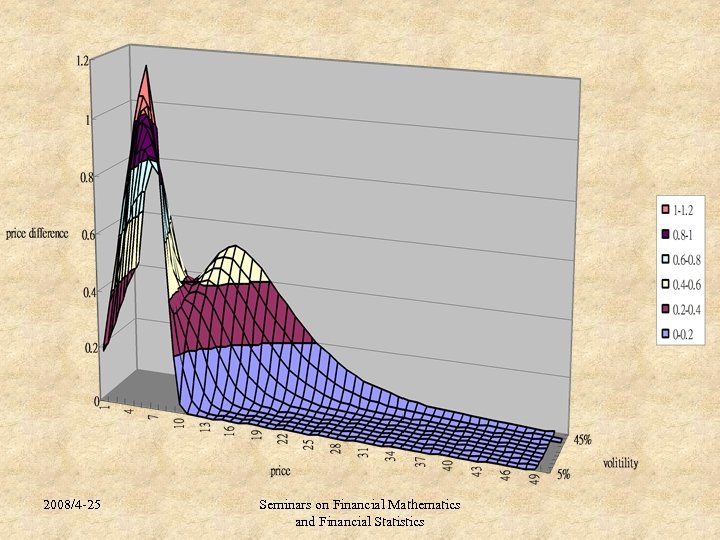
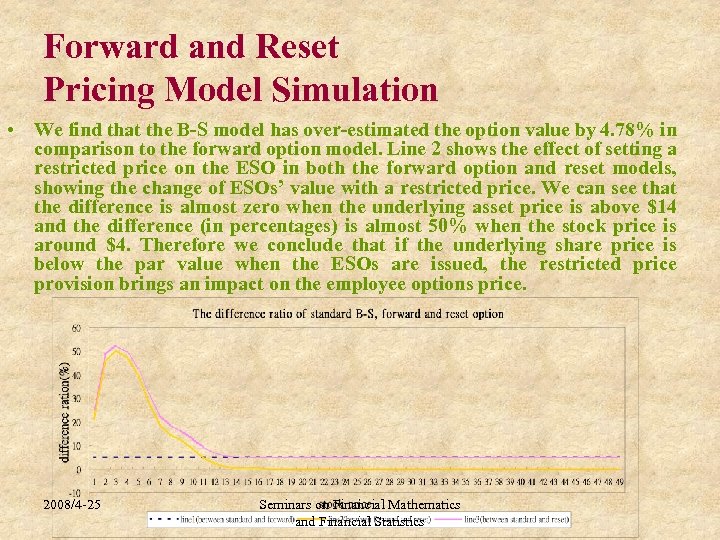 Forward and Reset Pricing Model Simulation • We find that the B-S model has over-estimated the option value by 4. 78% in comparison to the forward option model. Line 2 shows the effect of setting a restricted price on the ESO in both the forward option and reset models, showing the change of ESOs’ value with a restricted price. We can see that the difference is almost zero when the underlying asset price is above $14 and the difference (in percentages) is almost 50% when the stock price is around $4. Therefore we conclude that if the underlying share price is below the par value when the ESOs are issued, the restricted price provision brings an impact on the employee options price. 2008/4 -25 Seminars on Financial Mathematics and Financial Statistics
 2008/4 -25 Seminars on Financial Mathematics and Financial Statistics
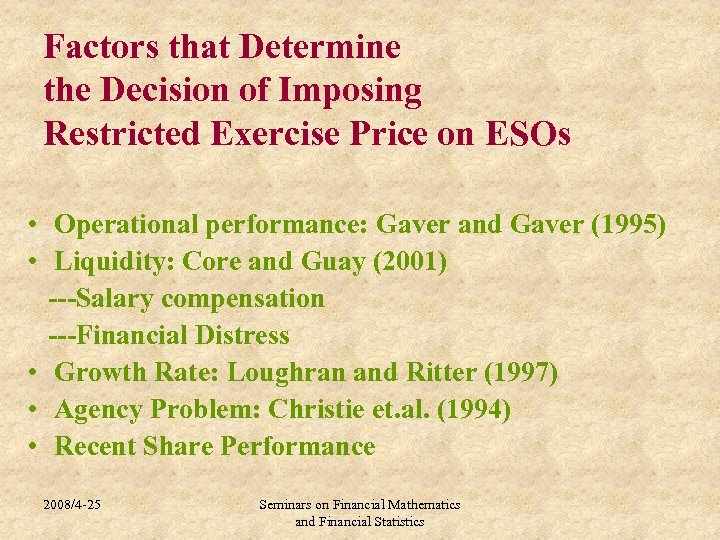 Factors that Determine the Decision of Imposing Restricted Exercise Price on ESOs • Operational performance: Gaver and Gaver (1995) • Liquidity: Core and Guay (2001) ---Salary compensation ---Financial Distress • Growth Rate: Loughran and Ritter (1997) • Agency Problem: Christie et. al. (1994) • Recent Share Performance 2008/4 -25 Seminars on Financial Mathematics and Financial Statistics
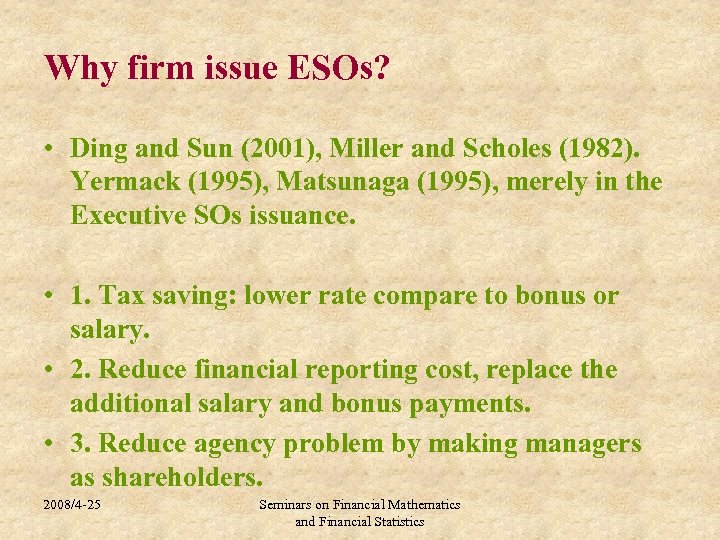 Why firm issue ESOs? • Ding and Sun (2001), Miller and Scholes (1982). Yermack (1995), Matsunaga (1995), merely in the Executive SOs issuance. • 1. Tax saving: lower rate compare to bonus or salary. • 2. Reduce financial reporting cost, replace the additional salary and bonus payments. • 3. Reduce agency problem by making managers as shareholders. 2008/4 -25 Seminars on Financial Mathematics and Financial Statistics
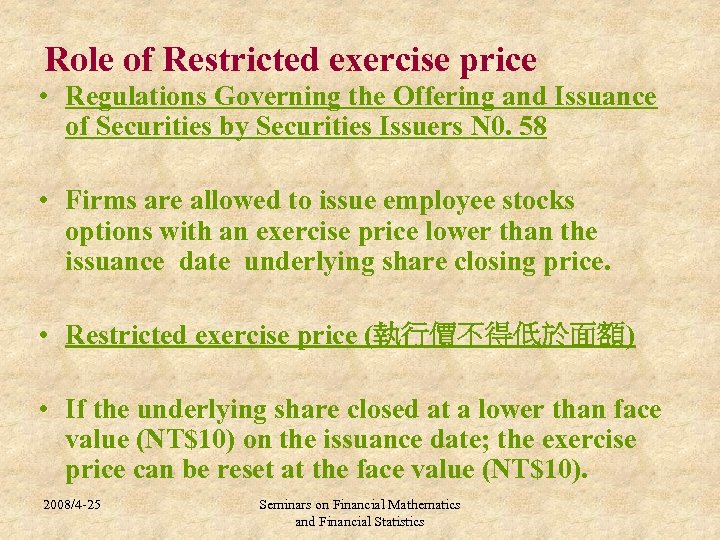 Role of Restricted exercise price • Regulations Governing the Offering and Issuance of Securities by Securities Issuers N 0. 58 • Firms are allowed to issue employee stocks options with an exercise price lower than the issuance date underlying share closing price. • Restricted exercise price (執行價不得低於面額) • If the underlying share closed at a lower than face value (NT$10) on the issuance date; the exercise price can be reset at the face value (NT$10). 2008/4 -25 Seminars on Financial Mathematics and Financial Statistics
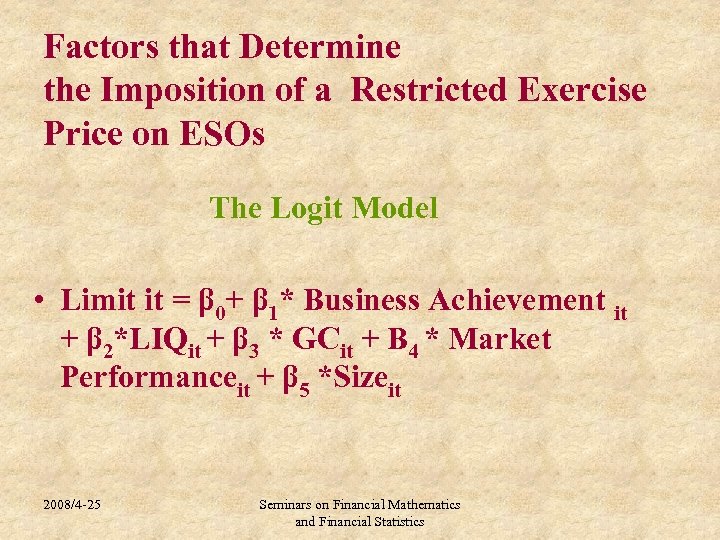 Factors that Determine the Imposition of a Restricted Exercise Price on ESOs The Logit Model • Limit it = β 0+ β 1* Business Achievement it + β 2*LIQit + β 3 * GCit + Β 4 * Market Performanceit + β 5 *Sizeit 2008/4 -25 Seminars on Financial Mathematics and Financial Statistics
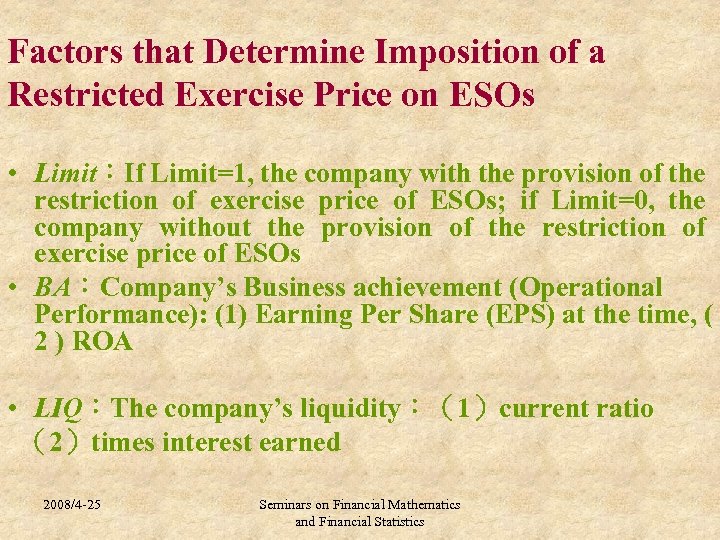 Factors that Determine Imposition of a Restricted Exercise Price on ESOs • Limit:If Limit=1, the company with the provision of the restriction of exercise price of ESOs; if Limit=0, the company without the provision of the restriction of exercise price of ESOs • BA:Company’s Business achievement (Operational Performance): (1) Earning Per Share (EPS) at the time, ( 2 ) ROA • LIQ:The company’s liquidity:(1)current ratio (2)times interest earned 2008/4 -25 Seminars on Financial Mathematics and Financial Statistics
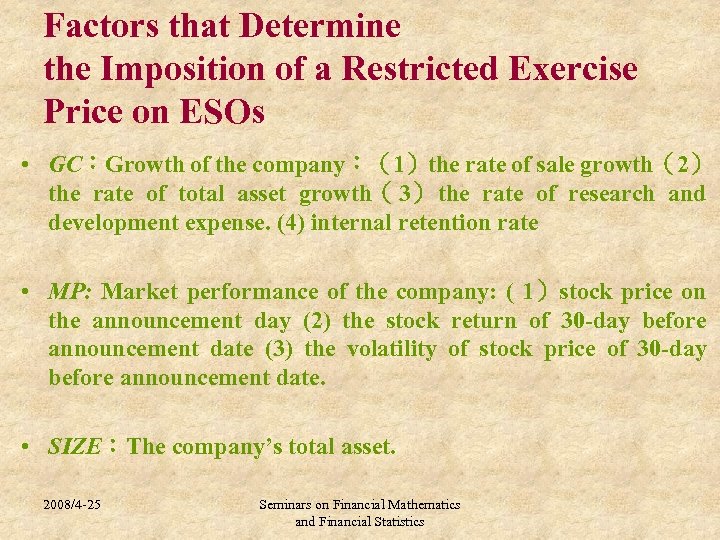 Factors that Determine the Imposition of a Restricted Exercise Price on ESOs • GC:Growth of the company:(1)the rate of sale growth(2) the rate of total asset growth( 3) the rate of research and development expense. (4) internal retention rate • MP: Market performance of the company: ( 1)stock price on the announcement day (2) the stock return of 30 -day before announcement date (3) the volatility of stock price of 30 -day before announcement date. • SIZE:The company’s total asset. 2008/4 -25 Seminars on Financial Mathematics and Financial Statistics
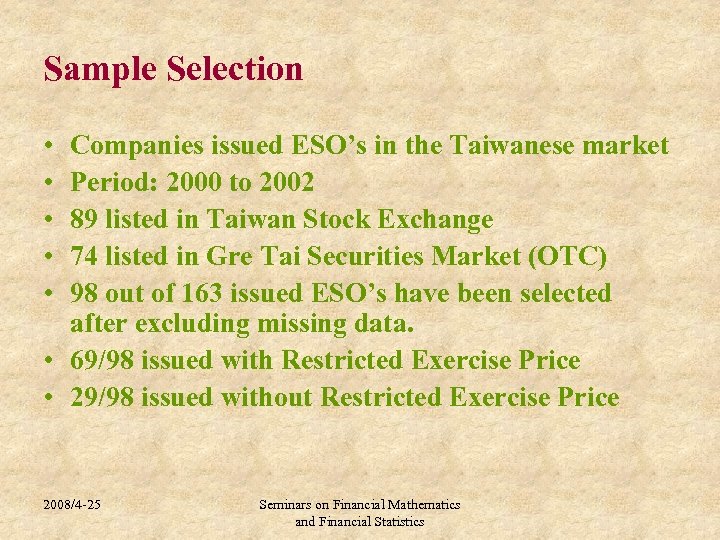 Sample Selection • • • Companies issued ESO’s in the Taiwanese market Period: 2000 to 2002 89 listed in Taiwan Stock Exchange 74 listed in Gre Tai Securities Market (OTC) 98 out of 163 issued ESO’s have been selected after excluding missing data. • 69/98 issued with Restricted Exercise Price • 29/98 issued without Restricted Exercise Price 2008/4 -25 Seminars on Financial Mathematics and Financial Statistics
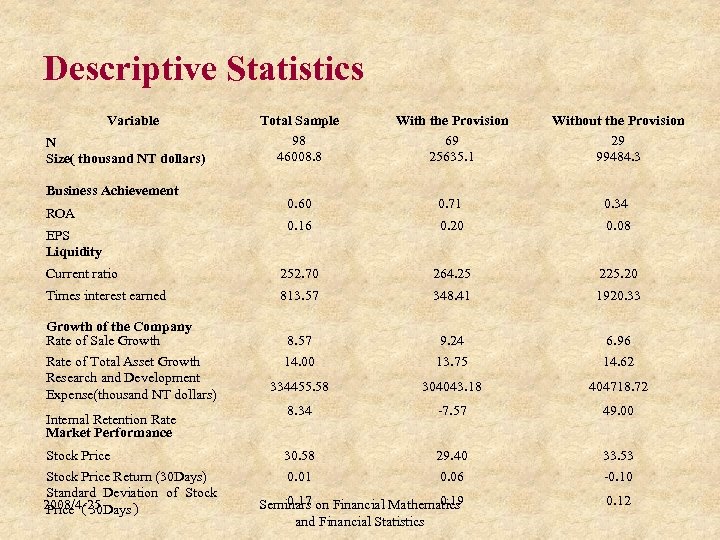 Descriptive Statistics Variable N Size( thousand NT dollars) Business Achievement Total Sample 98 46008. 8 With the Provision 69 25635. 1 Without the Provision 29 99484. 3 0. 60 0. 71 0. 34 0. 16 0. 20 0. 08 Current ratio 252. 70 264. 25 225. 20 Times interest earned 813. 57 348. 41 1920. 33 8. 57 9. 24 6. 96 14. 00 13. 75 14. 62 334455. 58 304043. 18 404718. 72 8. 34 -7. 57 49. 00 Stock Price 30. 58 29. 40 33. 53 Stock Price Return (30 Days) Standard Deviation of Stock 2008/4 -25 Price(30 Days) 0. 01 0. 06 -0. 10 0. 17 0. 19 Seminars on Financial Mathematics and Financial Statistics 0. 12 ROA EPS Liquidity Growth of the Company Rate of Sale Growth Rate of Total Asset Growth Research and Development Expense(thousand NT dollars) Internal Retention Rate Market Performance
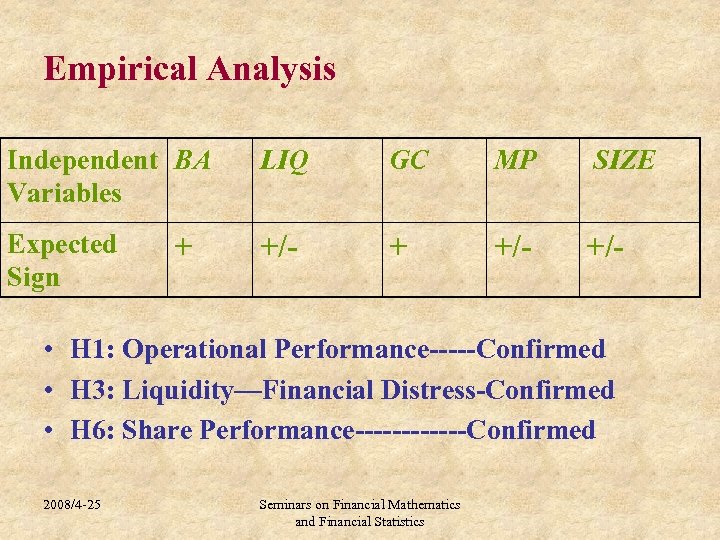 Empirical Analysis Independent BA Variables LIQ GC MP SIZE Expected Sign +/- +/- + • H 1: Operational Performance-----Confirmed • H 3: Liquidity—Financial Distress-Confirmed • H 6: Share Performance------Confirmed 2008/4 -25 Seminars on Financial Mathematics and Financial Statistics
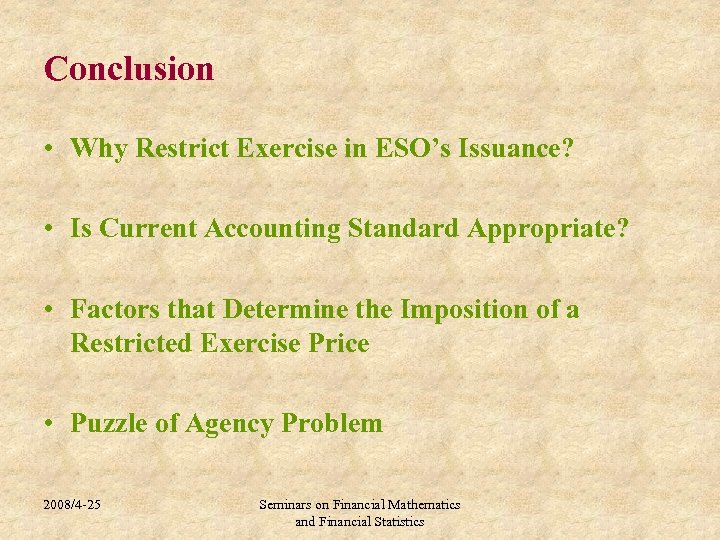 Conclusion • Why Restrict Exercise in ESO’s Issuance? • Is Current Accounting Standard Appropriate? • Factors that Determine the Imposition of a Restricted Exercise Price • Puzzle of Agency Problem 2008/4 -25 Seminars on Financial Mathematics and Financial Statistics
 Finally…………. • All suggestions are truly appreciated. THANK YOU ! ! 2008/4 -25 Seminars on Financial Mathematics and Financial Statistics