


 Скачать презентацию A strategic contextual overview of university modern languages
2eb45dcf7c61f3572eca844713722a55.ppt
- Количество слайдов: 19
 A strategic contextual overview of university modern languages Jim Coleman, The Open University
 Schools: Primary (England) • Compulsory in KS 2 from 2014 • List of languages dropped • Major concerns about contact time; teacher competence; teacher ITT and CPD; emphasis on achievement in L 2 not language awareness; uncoordinated choice of languages; no coordination of transition to secondary • Existing research not promising > repeat of 1974 Nuffield experiment? • No impact on universities until 2025 2
 Secondary (England) • KS 3 (ages 11 -14) foreign language mandatory but timetable reducing; only 70% of secondaries subject to National Curriculum • EBacc introduced 2010; one-off impact on GCSE numbers, up 15. 8% 2013 (F +15. 5%, G + 9. 4%, S +25. 8%, Oth +5. 1%). • Confusion EBacc (‘soft’ performance measure) and EBacc Certificate (abandoned) • Accountability > ‘best eight’ (Eng, Maths, 3 EBacc, 3 others) • Heads fear school rankings are jeopardised by lower grades in languages than other subjects • Languages not in first wave of new GCSEs (6 Sep: not alone) 3
 Secondary (England) • Correlation between privilege and language study • Move from French and German to Spanish • Spanish now represents over a quarter of GCSE entries (25. 2%), taking one percentage point each from German (17. 3%) and other languages (8. 6%), while French retains just under half of total entries (48. 9%). 4
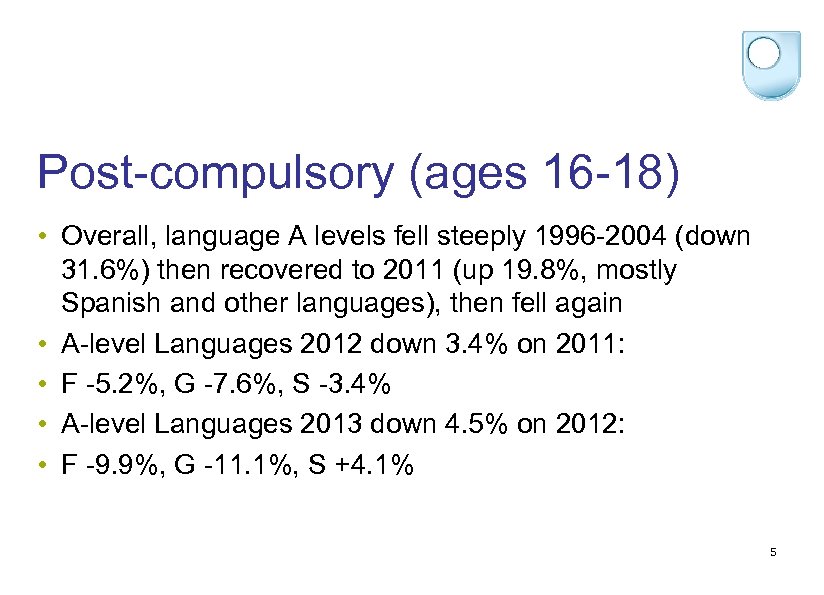 Post-compulsory (ages 16 -18) • Overall, language A levels fell steeply 1996 -2004 (down 31. 6%) then recovered to 2011 (up 19. 8%, mostly Spanish and other languages), then fell again • A-level Languages 2012 down 3. 4% on 2011: • F -5. 2%, G -7. 6%, S -3. 4% • A-level Languages 2013 down 4. 5% on 2012: • F -9. 9%, G -11. 1%, S +4. 1% 5
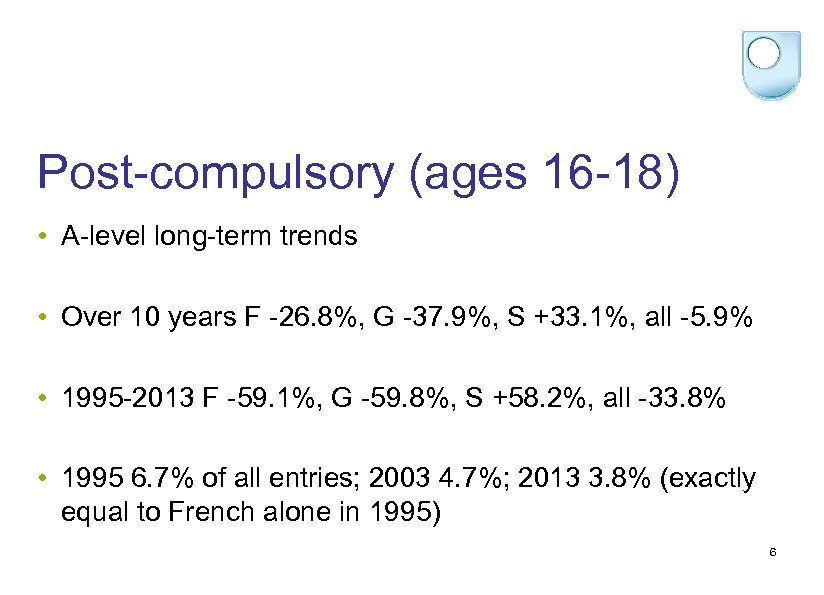 Post-compulsory (ages 16 -18) • A-level long-term trends • Over 10 years F -26. 8%, G -37. 9%, S +33. 1%, all -5. 9% • 1995 -2013 F -59. 1%, G -59. 8%, S +58. 2%, all -33. 8% • 1995 6. 7% of all entries; 2003 4. 7%; 2013 3. 8% (exactly equal to French alone in 1995) 6
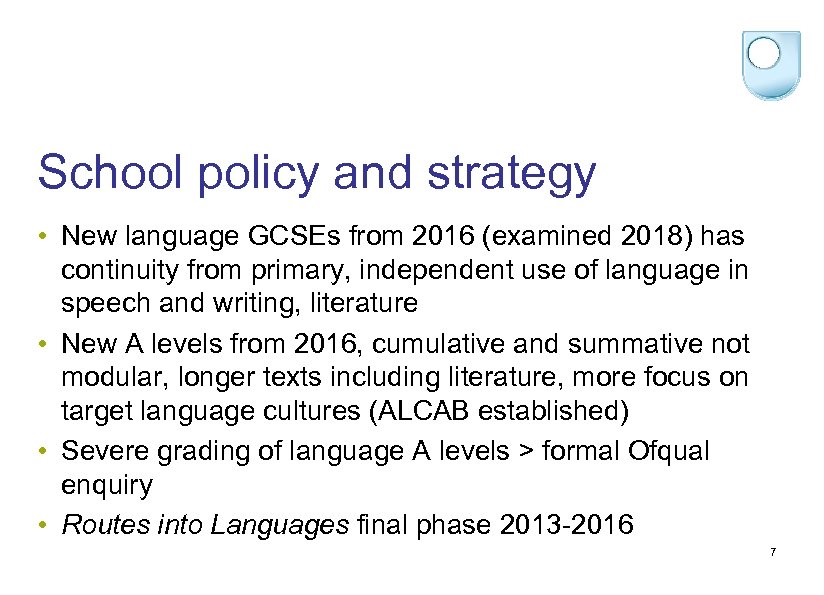 School policy and strategy • New language GCSEs from 2016 (examined 2018) has continuity from primary, independent use of language in speech and writing, literature • New A levels from 2016, cumulative and summative not modular, longer texts including literature, more focus on target language cultures (ALCAB established) • Severe grading of language A levels > formal Ofqual enquiry • Routes into Languages final phase 2013 -2016 7
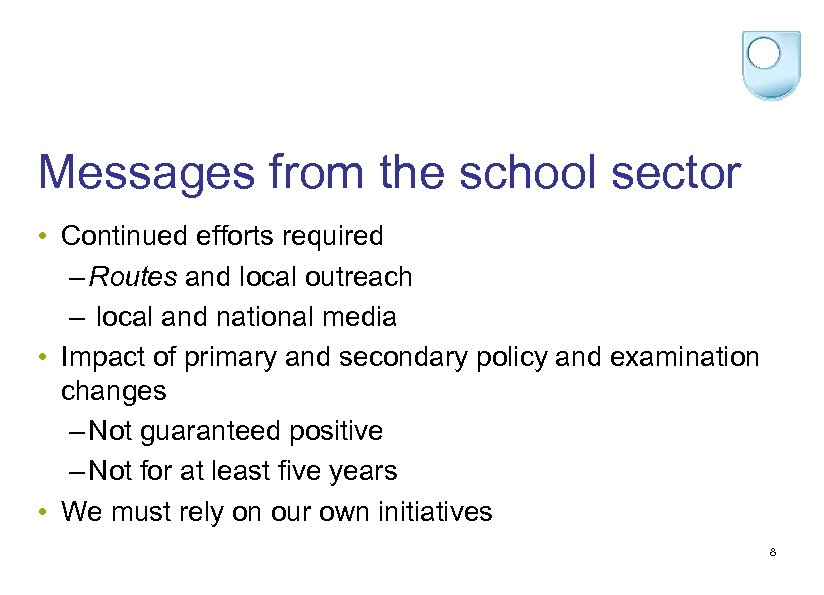 Messages from the school sector • Continued efforts required – Routes and local outreach – local and national media • Impact of primary and secondary policy and examination changes – Not guaranteed positive – Not for at least five years • We must rely on our own initiatives 8
 A comparison… • Classics A levels: – 2003 2. 5 French entries for each Classics entry – 2013 0. 7 French entries for each Classics entry – 2003 -2013 Classics up 171% 9
 University specialist linguists • Peak recruitment 1992 • Decade of falling enrolments, departmental closures • 2004 -2011 small but consistent increase in numbers of students on specialist language degrees • Likely impact of Routes into Languages and other initiatives (SIVS 2005 -2012) • But departments still closing: increasing concentration in research-elite Russell Group universities 10
 University specialist linguists • Language specialists 2001 -2011 up 11% in pre-1992, down 24% in post-1992 HEIs • 2010 -11 78% of European and 95% of non-European specialist language students were in pre-1992 universities • Modern language degrees at 105 HEIs in 2000, 62 in 2013 (MHK) • 14% fall in recruitment 2012 entry, but fall of below 1% in 2013 11
 Lessons from Salford • Factors forcing closure (Salford VC Martin Hall): – removal of compulsory language GCSE (2004) – drop in language GCSEs and A levels – socio-economic factors at school: compulsory KS 4 languages 82% in independent schools, 23% across state schools, 19% in comprehensives – Salford 45% WP background, 50% non-standard qualifications 12
 Lessons from Salford • Factors forcing closure (Salford VC Martin Hall): – Languages less popular nationally: 2001 -2011 total student numbers +5. 6%, languages -4. 5% – Courses in 6 main languages reduced from 503 in 2001 to 271 in 2011 – Tripling of fees for 2012 entry hit languages and humanities disproportionately – ‘Core and margin’ policy stripped student numbers for allocation to low-tariff, low-fee HEIs, while high-tariff HEIs poached AAB+s > ‘squeezed middle’ 13
 Lessons from Salford • Factors forcing closure (Salford VC Martin Hall): – wrong to blame loss of compulsory GCSE: dates do not coincide – more significant factors: insularity of public opinion, poor progression to A-level, perceived irrelevance of languages to non-academic vocations Alliance Universities February proposal to HEFCE declined (single mission group) but fed into UCML-led cooperation on possible Catalyst Fund bid 14
 Catalyst Bid proposal strands • • A national network offering practical language skills, relevant to general and specific purposes including business contexts, in a wide and expanded range of languages and at many levels to students at English HEIs, combining face-to-face teaching with online and mobile learning and Open Educational Resources. A new national scheme of certification/kitemarking of language learning for students, linked to the Common European Framework of Reference for Languages. 15
 Catalyst Bid proposal strands • New support for outward mobility, both physical and virtual, involving a new framework for online intercultural exchange with students in target language countries. • A small over-arching hub with legal entity status to provide more secure, cross-institutional support for those departments, language centres and individual teachers providing language learning. 16
 Catalyst Bid proposal • One of at least three planned Catalyst Fund bids in languages • Nine pre- and post-1992 HEIs currently in discussion with UCML • Transferable strategic elements – Pro-active – Address students not currently applying to selective universities – Innovative use of technologies – Viability built on critical mass 17
 Other UCML actions • Lobbying based on – Accurate data, understanding of contexts – Developing relationships with other agencies (Df. E, BIS, British Council, British Academy, AHRC, HEFCE and other national funding agencies, etc. ) – Involvement of subject community – Speaking with one voice – Using new media – Working with other advocates: ALL, Speak to the Future, British Academy, APPG 18
 Acting strategically • Stay informed – UCML, ALL – and disseminate helpful messages, e. g. varied international careers • Help reframe languages as a cross-curriculum skill for all abilities, levels and disciplines • Engage with campaigns – Routes into Languages – Speak to the Future 1000 Words – Born Global (launch 23 Sept. ) 19