


 Скачать презентацию A Stochastic Model of Platoon Formation in Traffic
a76d01b931c3617a25fbf373289994ed.ppt
- Количество слайдов: 15
 A Stochastic Model of Platoon Formation in Traffic Flow USC/Information Sciences Institute K. Lerman and A. Galstyan USC M. Mataric and D. Goldberg TASK PI Meeting, Santa Fe, NM April 17 -19 2001
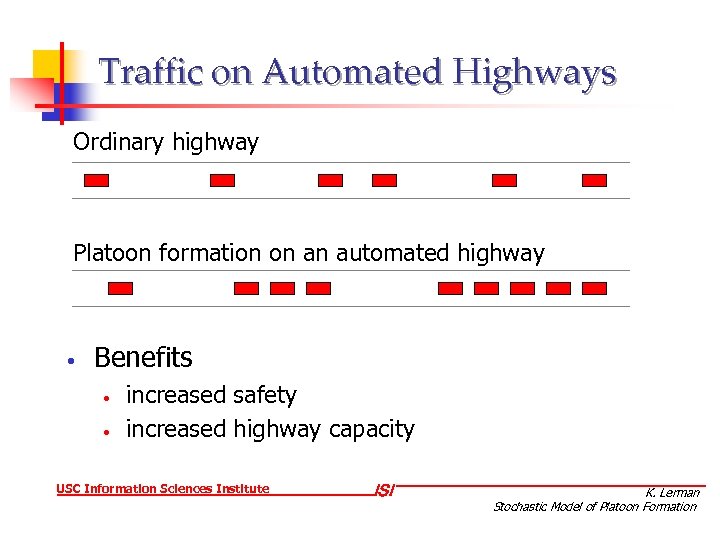 Traffic on Automated Highways Ordinary highway Platoon formation on an automated highway • Benefits • • increased safety increased highway capacity USC Information Sciences Institute ISI K. Lerman Stochastic Model of Platoon Formation
 Our Approach • Traffic as a MAS • • each car is an agent with its own velocity simple passing rules based on agent preference distributed mechanism for platoon formation MAS is a stochastic system • • stochastic Master Equation describes the dynamics of platoons study the solutions USC Information Sciences Institute ISI K. Lerman Stochastic Model of Platoon Formation
 Traffic as a MAS • Car = agent • • velocity vi drawn from a velocity distribution P 0(v) risk factor Ri : agent’s aversion to passing • • • desire for safety (no passing) desire to minimize travel time (passing) Traffic = MAS • • • heterogeneous system (velocity distribution) on- and off-ramps distributed control – platoons arise from local interactions among cars USC Information Sciences Institute ISI K. Lerman Stochastic Model of Platoon Formation
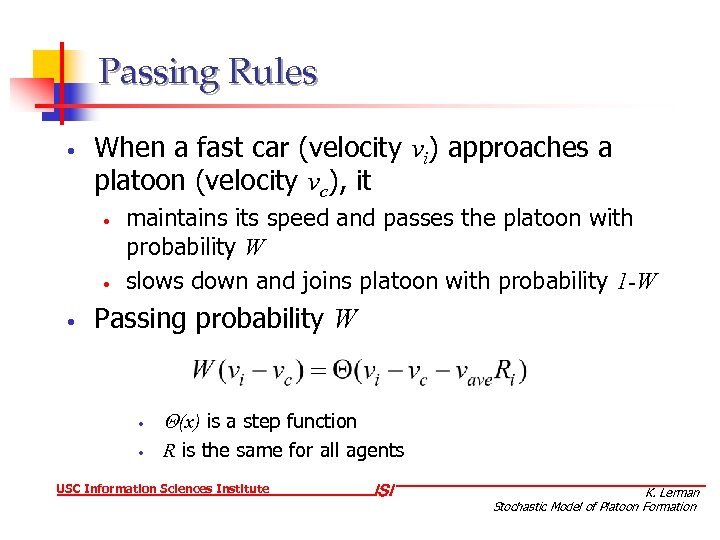 Passing Rules • When a fast car (velocity vi) approaches a platoon (velocity vc), it • • • maintains its speed and passes the platoon with probability W slows down and joins platoon with probability 1 -W Passing probability W • Q(x) is a step function • R is the same for all agents USC Information Sciences Institute ISI K. Lerman Stochastic Model of Platoon Formation
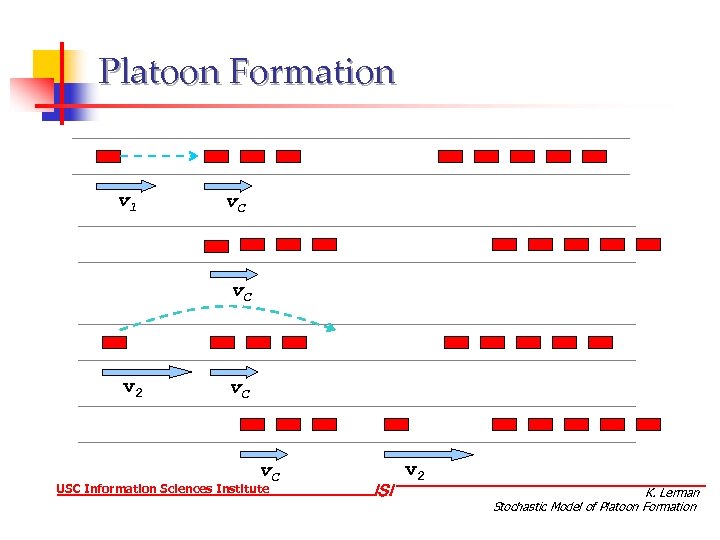 Platoon Formation v 1 v. C v 2 v. C USC Information Sciences Institute ISI v 2 K. Lerman Stochastic Model of Platoon Formation
 MAS as a Stochastic System Behavior of an individual agent in a MAS is very complex and has many influences: • • external forces – may not be anticipated noise – fluctuations and random events other agents – with complex trajectories probabilistic behavior – e. g. passing probability While the behavior of each agent is very complex, the collective behavior of a MAS is described very simply as a stochastic system. USC Information Sciences Institute ISI K. Lerman Stochastic Model of Platoon Formation
 Physics-Based Models of Traffic Flow • Gas kinetics models • • • similarities between behavior of cars in traffic and molecules in dilute gases state of the system given by distribution funct P(v, x, t) Hydrodynamic models • • • can be derived from the gas kinetic approach computationally more efficient reproduce many of the observed traffic phenomena free flow, synchronous flow, stop & go traffic • valid at higher traffic densities USC Information Sciences Institute ISI K. Lerman Stochastic Model of Platoon Formation
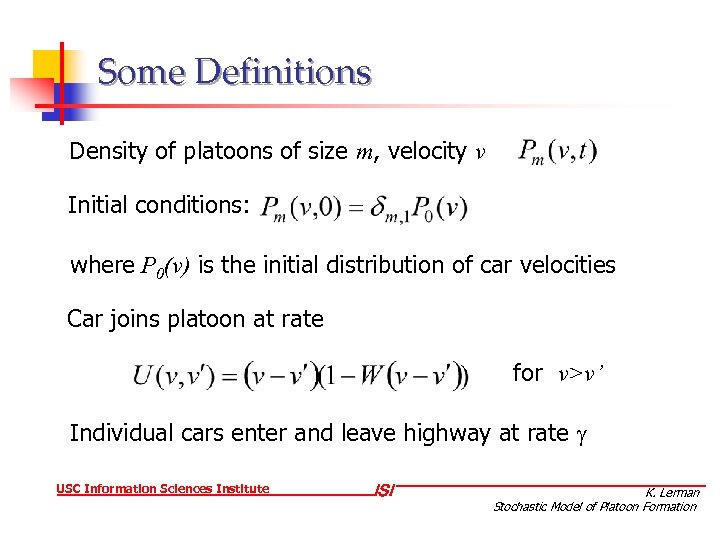 Some Definitions Density of platoons of size m, velocity v Initial conditions: where P 0(v) is the initial distribution of car velocities Car joins platoon at rate for v>v’ Individual cars enter and leave highway at rate g USC Information Sciences Institute ISI K. Lerman Stochastic Model of Platoon Formation
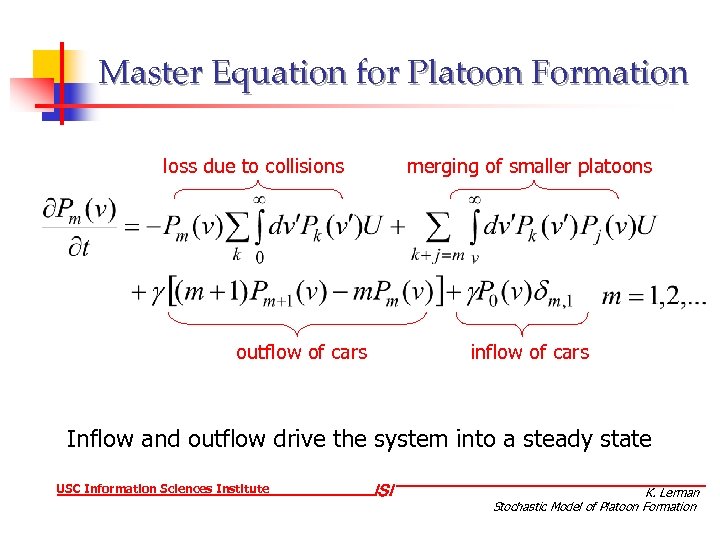 Master Equation for Platoon Formation loss due to collisions merging of smaller platoons outflow of cars inflow of cars Inflow and outflow drive the system into a steady state USC Information Sciences Institute ISI K. Lerman Stochastic Model of Platoon Formation
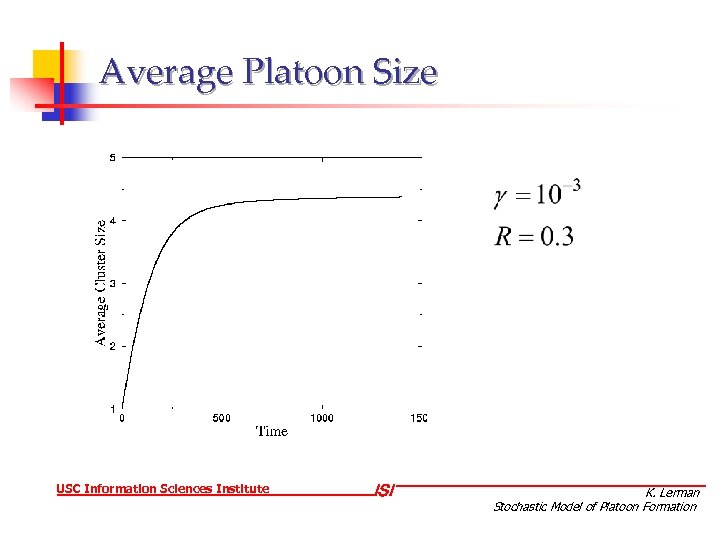 Average Platoon Size USC Information Sciences Institute ISI K. Lerman Stochastic Model of Platoon Formation
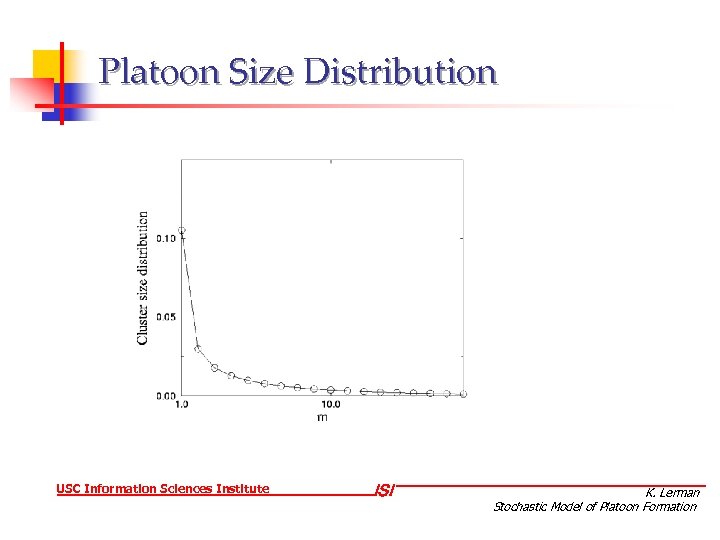 Platoon Size Distribution USC Information Sciences Institute ISI K. Lerman Stochastic Model of Platoon Formation
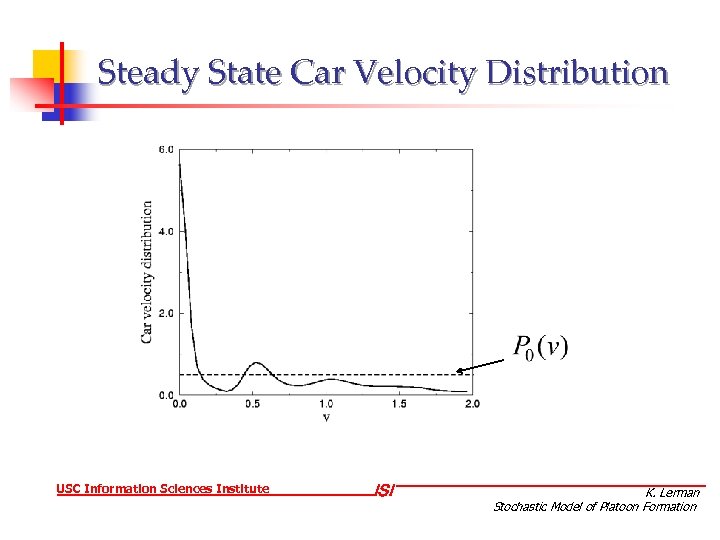 Steady State Car Velocity Distribution USC Information Sciences Institute ISI K. Lerman Stochastic Model of Platoon Formation
 Conclusion Platoons form through simple local interactions • Stochastic Master Equation describes the time evolution of the platoon distribution function • Study platoon formation mathematically But, • Does not take into account spatial inhomogeneities • Need a more realistic passing mechanism • • effect of the passing lane USC Information Sciences Institute ISI K. Lerman Stochastic Model of Platoon Formation
 Future work • Multi-lane model • • • for each lane i, Pmi(v, t) Passing probability depends on density of cars in the other lane, and on platoon size Microscopic simulations of the system • • Particle hopping (stochastic cellular automata) What are the parameters that optimize • • average travel time total flow USC Information Sciences Institute ISI K. Lerman Stochastic Model of Platoon Formation