


 Скачать презентацию A STEP Antarctica Search for Transiting Extrasolar Planets
da57373025edf706b4a9f3ce776bb90c.ppt
- Количество слайдов: 30
 A STEP Antarctica Search for Transiting Extrasolar Planets F. Fressin, T. Guillot Y. Rabbia, A. Blazit, JP. Rivet, J. Gay, D. Albanese, V. Morello, N. Crouzer (OCA - Nice), F. X Schmider, K. Agabi, J-B. Daban, E. Fossat, L. Abe, C. Combier, F. Janneaux, Y. Fantei (LUAN – Nice) C. Moutou, F. Bouchy, M. Deleuil, M. Ferrari, A. Llebaria, M. Boer, H. Le Corroler, A. Klotz, A. Le van Suu, J. Eysseric, C Carol (OAMP - Marseille), A. Erikson, H. Rauer (DLR - Berlin), F. Pont (Obs. Genève)
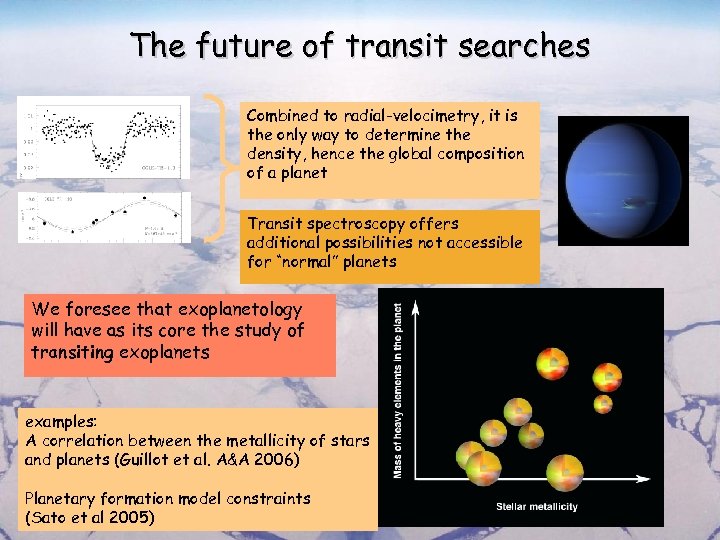 The future of transit searches Combined to radial-velocimetry, it is the only way to determine the density, hence the global composition of a planet Transit spectroscopy offers additional possibilities not accessible for “normal” planets We foresee that exoplanetology will have as its core the study of transiting exoplanets examples: A correlation between the metallicity of stars and planets (Guillot et al. A&A 2006) Planetary formation model constraints (Sato et al 2005)
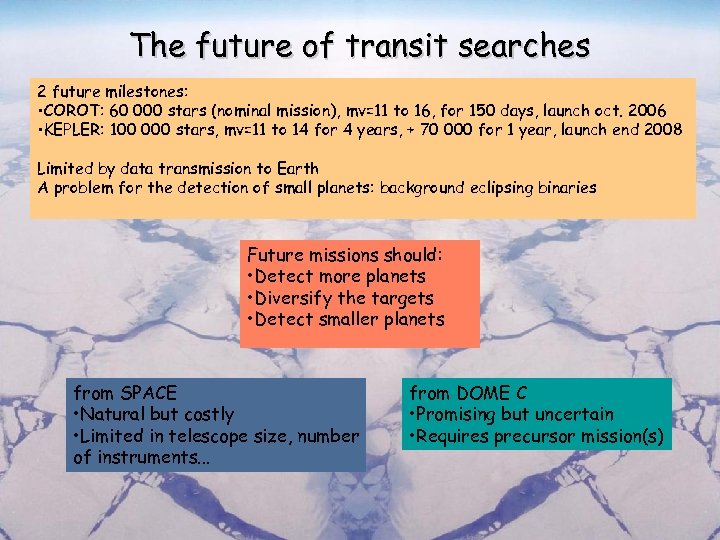 The future of transit searches 2 future milestones: • COROT: 60 000 stars (nominal mission), mv=11 to 16, for 150 days, launch oct. 2006 • KEPLER: 100 000 stars, mv=11 to 14 for 4 years, + 70 000 for 1 year, launch end 2008 Limited by data transmission to Earth A problem for the detection of small planets: background eclipsing binaries Future missions should: • Detect more planets • Diversify the targets • Detect smaller planets from SPACE • Natural but costly • Limited in telescope size, number of instruments. . . from DOME C • Promising but uncertain • Requires precursor mission(s)
 Why transit searches at Dome C? • Continuous night for 3 months • Excellent weather Questions: We don’t know how the following factors will affect transit surveys: • Sky brightness & fluctuations • Presence of the moon • Generally, systematics effect due to the combination of astrophysical, atmospheric and instrumental noises Technical problems • Autonomous operations in cold (-50°C to -80°C) conditions • Temperature fluctuations • Icing • Electrical discharges
 A STEP Objectives 1. Determine the limits of Dome C for precise wide field photometry (Scintillation and photon noise … or other noise sources ? ) 2. If the site is competitive with space and transit search limits are well understood, establish the bases of a midterm massive detection project (large Schmidt telescope or network of small ones) 3. Search for transiting exo-planets and characterization of these planets – Detection of bright stars oscillations.
 A STEP: the philosophy behind • Prepare future photometric projects for planetary transit detection at Dome C • Use available equipment, minimize development work for a fast implementation of the project • Use experience acquired from the site testing experiment Concordiastro • Semi-automated operation • Directly compare survey efficiency at Dome C with BEST 2 in Chile for the same target field
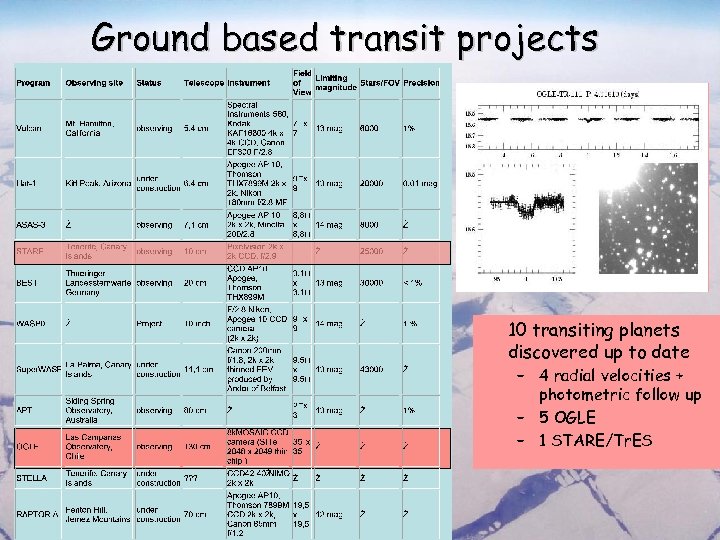 Ground based transit projects 10 transiting planets discovered up to date – 4 radial velocities + photometric follow up – 5 OGLE – 1 STARE/Tr. ES
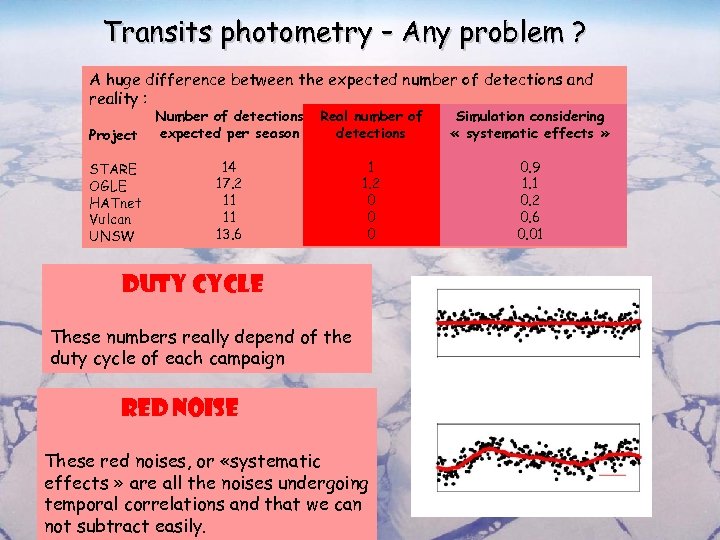 Transits photometry – Any problem ? A huge difference between the expected number of detections and reality : Project Number of detections expected per season Real number of detections Simulation considering « systematic effects » STARE OGLE HATnet Vulcan UNSW 14 17. 2 11 11 13. 6 1 1. 2 0 0. 9 1. 1 0. 2 0. 6 0. 01 DUTY CYCLE These numbers really depend of the duty cycle of each campaign Red Noise These red noises, or «systematic effects » are all the noises undergoing temporal correlations and that we can not subtract easily.
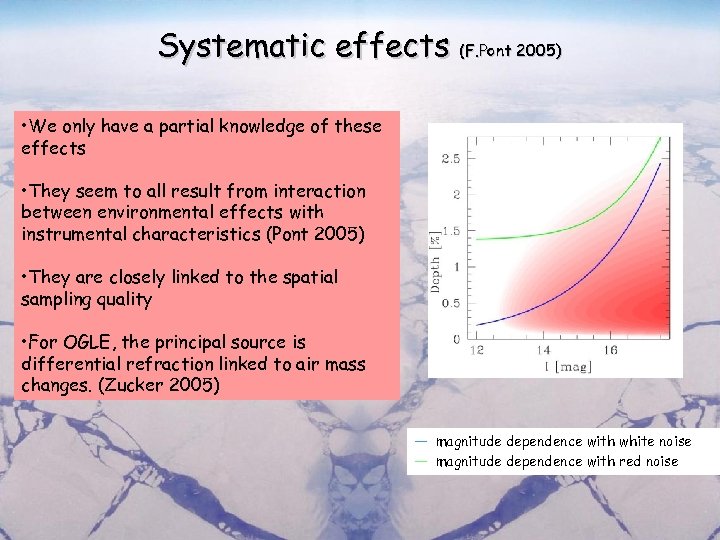 Systematic effects (F. Pont 2005) • We only have a partial knowledge of these effects • They seem to all result from interaction between environmental effects with instrumental characteristics (Pont 2005) • They are closely linked to the spatial sampling quality • For OGLE, the principal source is differential refraction linked to air mass changes. (Zucker 2005) — magnitude dependence with white noise — magnitude dependence with red noise
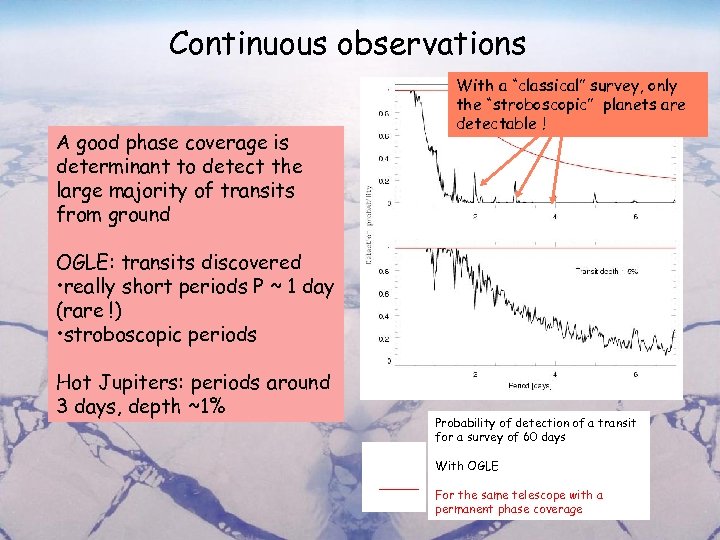 Continuous observations A good phase coverage is determinant to detect the large majority of transits from ground With a “classical” survey, only the “stroboscopic” planets are detectable ! OGLE: transits discovered • really short periods P ~ 1 day (rare !) • stroboscopic periods Hot Jupiters: periods around 3 days, depth ~1% Probability of detection of a transit for a survey of 60 days With OGLE For the same telescope with a permanent phase coverage
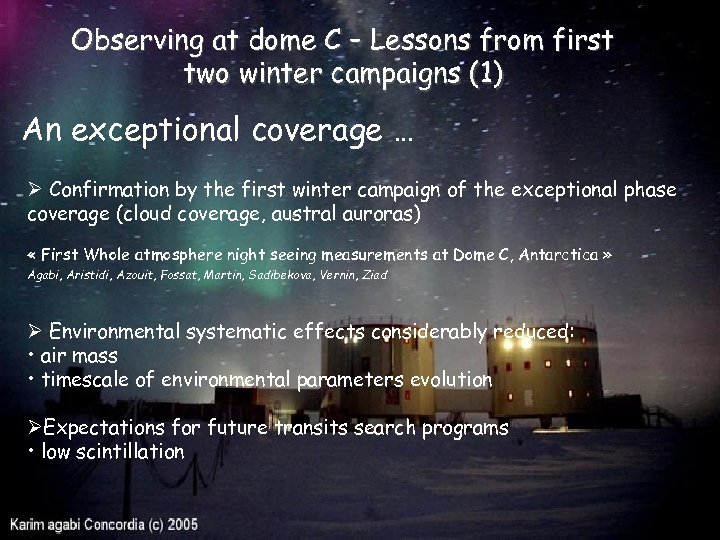 Observing at dome C – Lessons from first two winter campaigns (1) An exceptional coverage … Ø Confirmation by the first winter campaign of the exceptional phase coverage (cloud coverage, austral auroras) « First Whole atmosphere night seeing measurements at Dome C, Antarctica » Agabi, Aristidi, Azouit, Fossat, Martin, Sadibekova, Vernin, Ziad Ø Environmental systematic effects considerably reduced: • air mass • timescale of environmental parameters evolution ØExpectations for future transits search programs • low scintillation
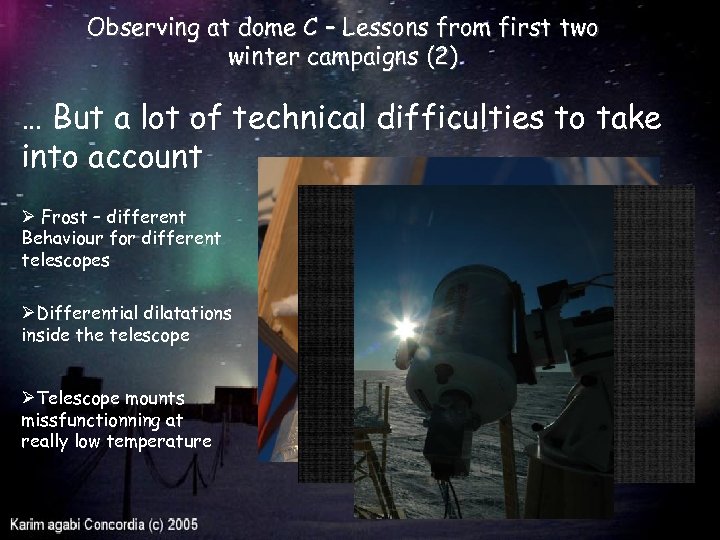 Observing at dome C – Lessons from first two winter campaigns (2) … But a lot of technical difficulties to take into account Ø Frost – different Behaviour for different telescopes ØDifferential dilatations inside the telescope ØTelescope mounts missfunctionning at really low temperature
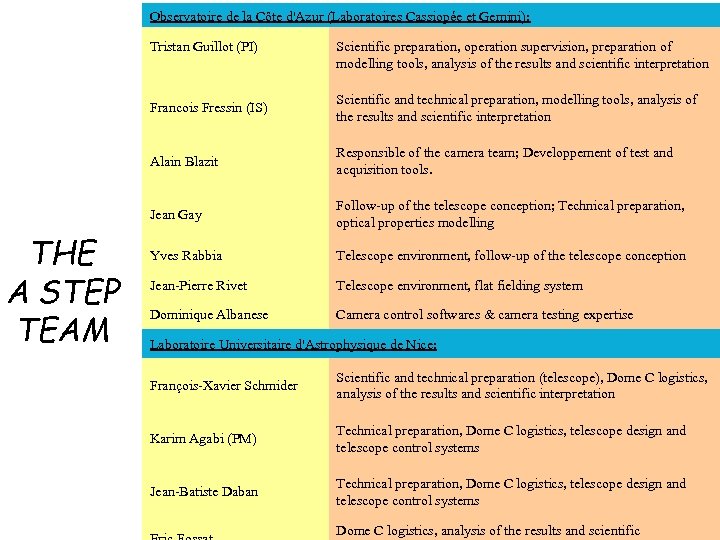 Observatoire de la Côte d'Azur (Laboratoires Cassiopée et Gemini): Tristan Guillot (PI) Scientific preparation, operation supervision, preparation of modelling tools, analysis of the results and scientific interpretation Francois Fressin (IS) Alain Blazit Responsible of the camera team; Developpement of test and acquisition tools. Jean Gay THE A STEP TEAM Scientific and technical preparation, modelling tools, analysis of the results and scientific interpretation Follow-up of the telescope conception; Technical preparation, optical properties modelling Yves Rabbia Telescope environment, follow-up of the telescope conception Jean-Pierre Rivet Telescope environment, flat fielding system Dominique Albanese Camera control softwares & camera testing expertise Laboratoire Universitaire d'Astrophysique de Nice: François-Xavier Schmider Scientific and technical preparation (telescope), Dome C logistics, analysis of the results and scientific interpretation Karim Agabi (PM) Technical preparation, Dome C logistics, telescope design and telescope control systems Jean-Batiste Daban Technical preparation, Dome C logistics, telescope design and telescope control systems Dome C logistics, analysis of the results and scientific
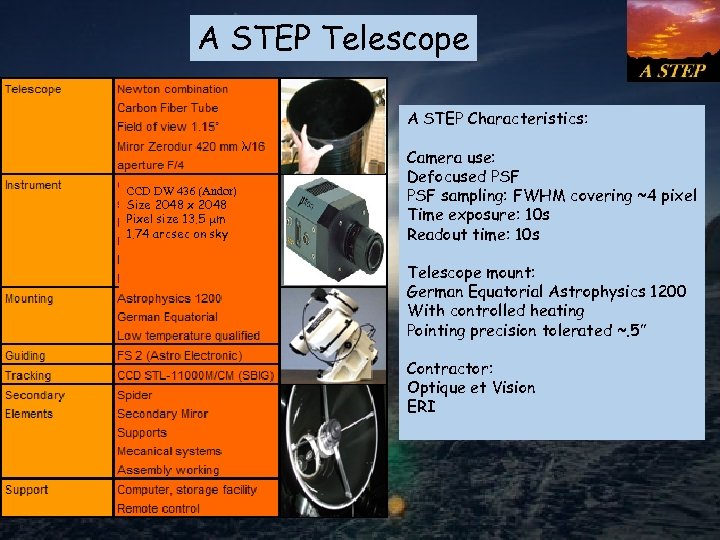 A STEP Telescope A STEP Characteristics: CCD DW 436 (Andor) Size 2048 x 2048 Pixel size 13. 5 mm 1. 74 arcsec on sky Camera use: Defocused PSF sampling: FWHM covering ~4 pixel Time exposure: 10 s Readout time: 10 s Telescope mount: German Equatorial Astrophysics 1200 With controlled heating Pointing precision tolerated ~. 5” Contractor: Optique et Vision ERI
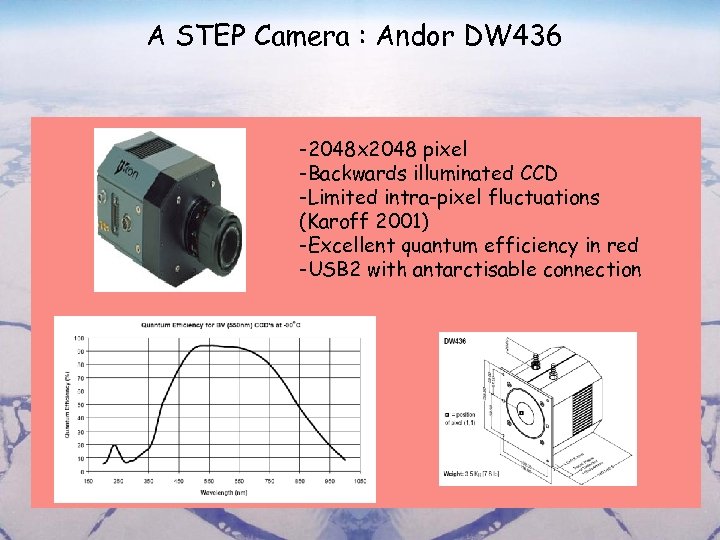 A STEP Camera : Andor DW 436 -2048 x 2048 pixel -Backwards illuminated CCD -Limited intra-pixel fluctuations (Karoff 2001) -Excellent quantum efficiency in red -USB 2 with antarctisable connection
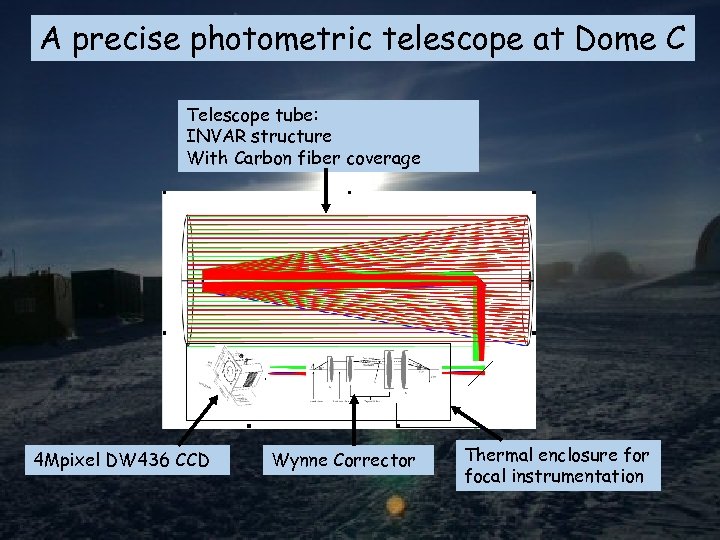 A precise photometric telescope at Dome C Telescope tube: INVAR structure With Carbon fiber coverage 4 Mpixel DW 436 CCD Wynne Corrector Thermal enclosure for focal instrumentation
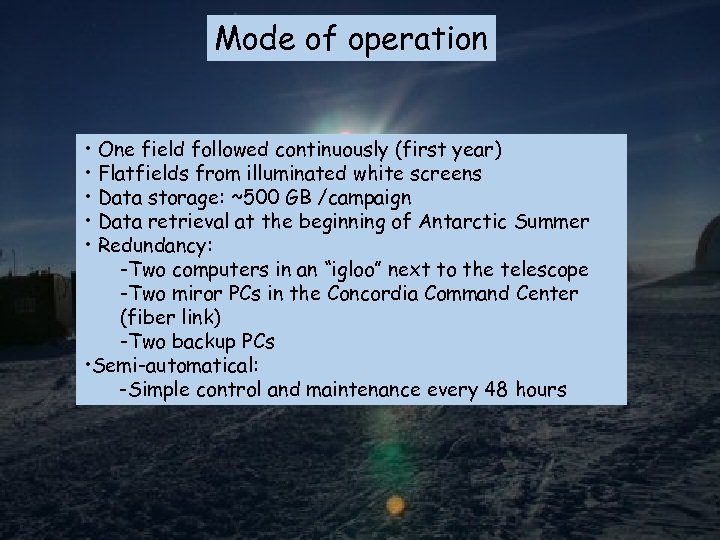 Mode of operation • One field followed continuously (first year) • Flatfields from illuminated white screens • Data storage: ~500 GB /campaign • Data retrieval at the beginning of Antarctic Summer • Redundancy: -Two computers in an “igloo” next to the telescope -Two miror PCs in the Concordia Command Center (fiber link) -Two backup PCs • Semi-automatical: -Simple control and maintenance every 48 hours
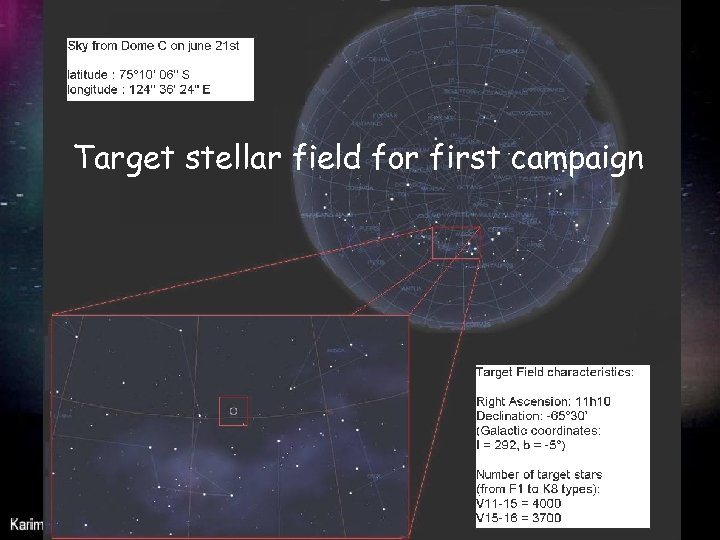 Target stellar field for first campaign
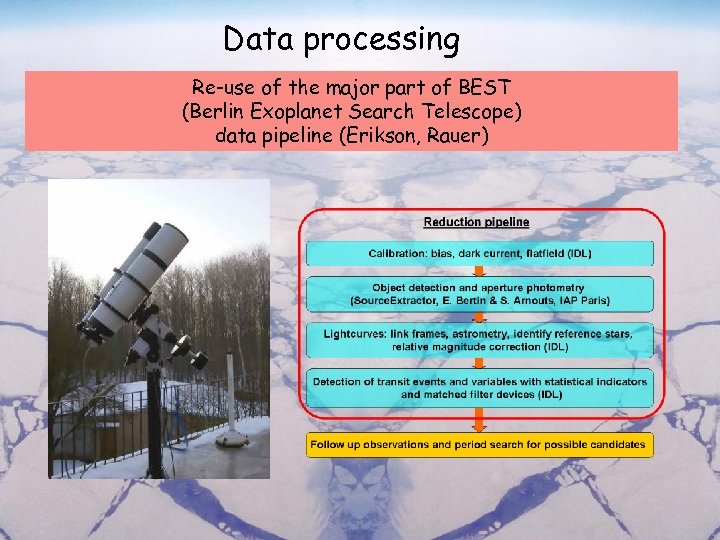 Data processing Re-use of the major part of BEST (Berlin Exoplanet Search Telescope) data pipeline (Erikson, Rauer)
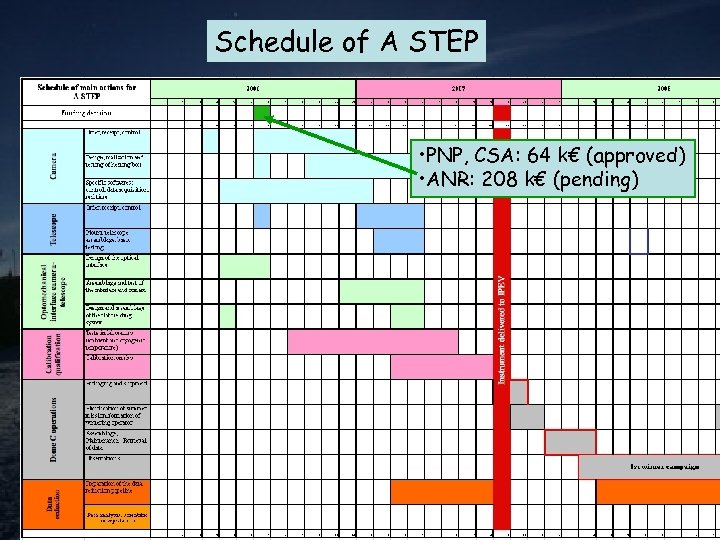 Schedule of A STEP • PNP, CSA: 64 k€ (approved) • ANR: 208 k€ (pending)
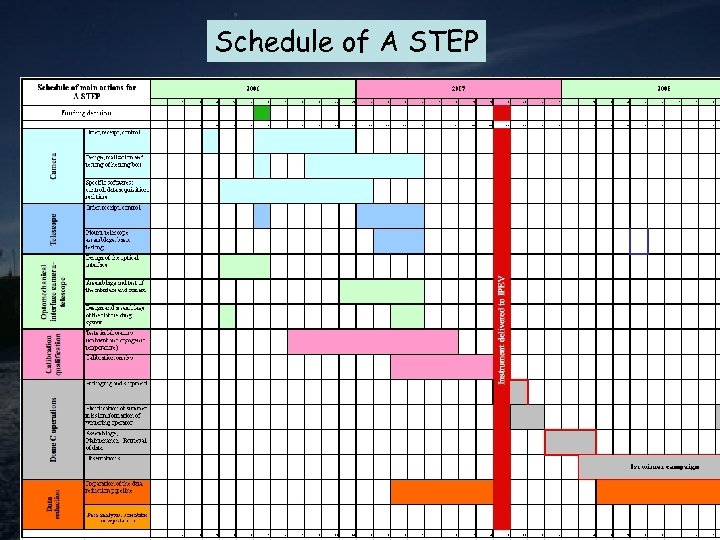 Schedule of A STEP
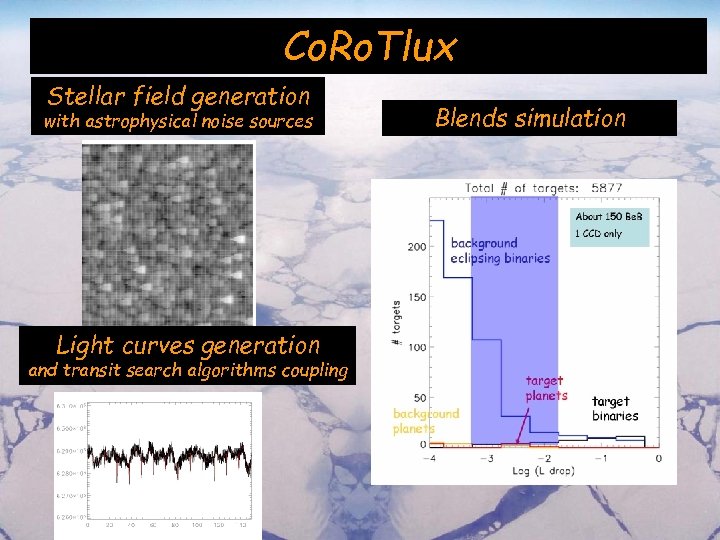 Co. Ro. Tlux Stellar field generation with astrophysical noise sources Light curves generation and transit search algorithms coupling Blends simulation
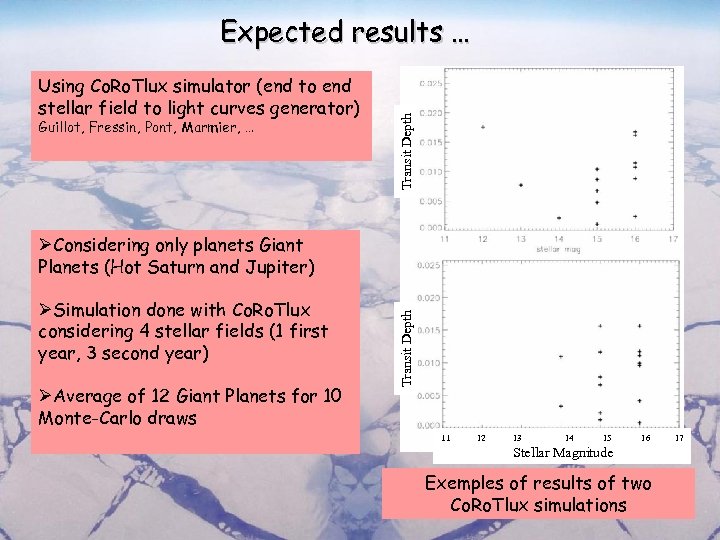 Using Co. Ro. Tlux simulator (end to end stellar field to light curves generator) Guillot, Fressin, Pont, Marmier, … Transit Depth Expected results … ØSimulation done with Co. Ro. Tlux considering 4 stellar fields (1 first year, 3 second year) ØAverage of 12 Giant Planets for 10 Monte-Carlo draws Transit Depth ØConsidering only planets Giant Planets (Hot Saturn and Jupiter) 11 12 13 14 15 16 17 Stellar Magnitude Exemples of results of two Co. Ro. Tlux simulations
 False Transit Discrimination
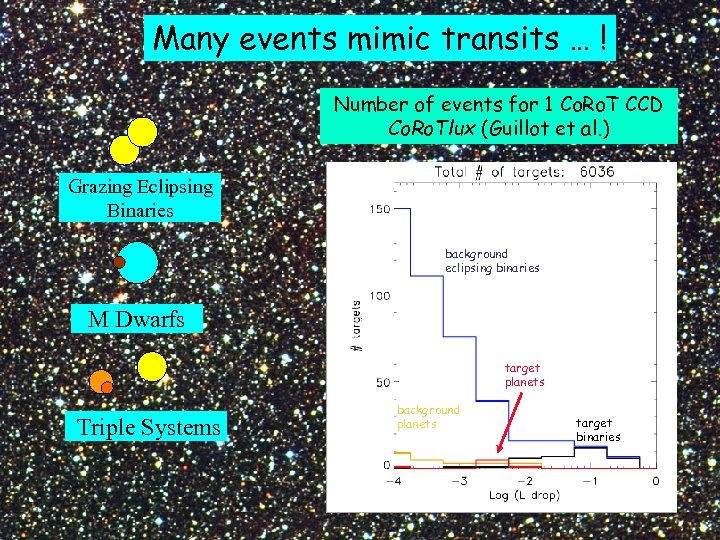 Many events mimic transits … ! Number of events for 1 Co. Ro. T CCD Co. Ro. Tlux (Guillot et al. ) Grazing Eclipsing Binaries background eclipsing binaries M Dwarfs target planets Triple Systems background planets target binaries
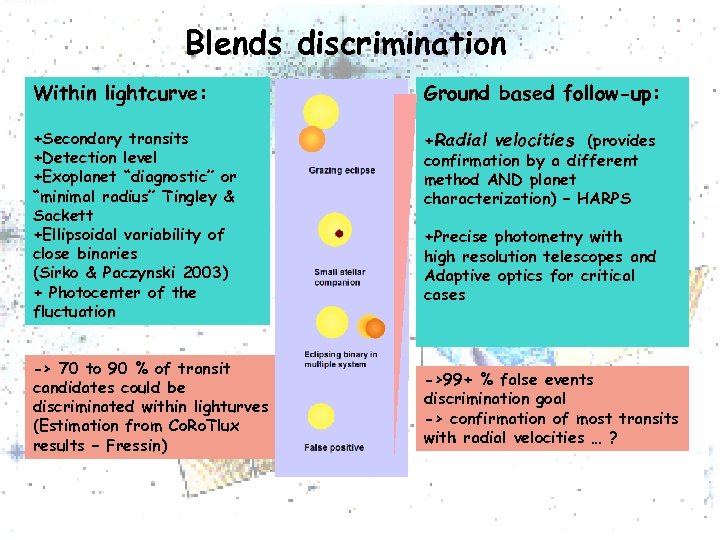 Blends discrimination Within lightcurve: Ground based follow-up: +Secondary transits +Detection level +Exoplanet “diagnostic” or “minimal radius” Tingley & Sackett +Ellipsoidal variability of close binaries (Sirko & Paczynski 2003) + Photocenter of the fluctuation +Radial velocities (provides confirmation by a different method AND planet characterization) – HARPS -> 70 to 90 % of transit candidates could be discriminated within lighturves (Estimation from Co. Ro. Tlux results – Fressin) +Precise photometry with high resolution telescopes and Adaptive optics for critical cases ->99+ % false events discrimination goal -> confirmation of most transits with radial velocities … ?
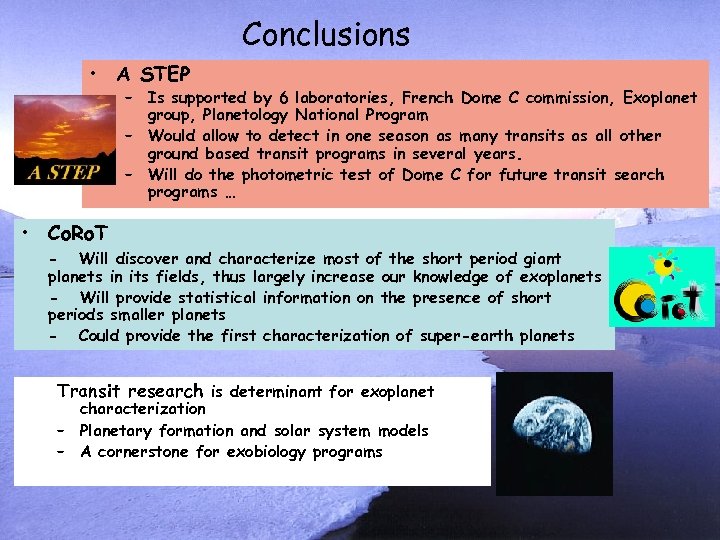 Conclusions • A STEP – Is supported by 6 laboratories, French Dome C commission, Exoplanet group, Planetology National Program – Would allow to detect in one season as many transits as all other ground based transit programs in several years. – Will do the photometric test of Dome C for future transit search programs … • Co. Ro. T - Will discover and characterize most of the short period giant planets in its fields, thus largely increase our knowledge of exoplanets - Will provide statistical information on the presence of short periods smaller planets - Could provide the first characterization of super-earth planets Transit research is determinant for exoplanet characterization – Planetary formation and solar system models – A cornerstone for exobiology programs
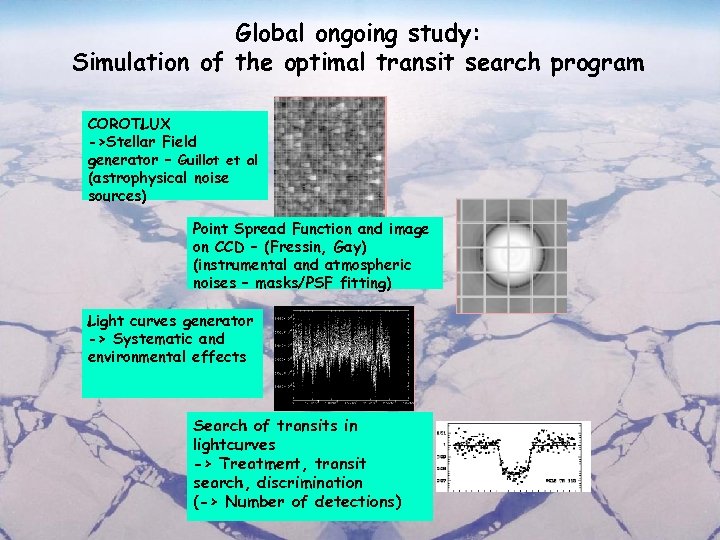 Global ongoing study: Simulation of the optimal transit search program COROTLUX ->Stellar Field generator – Guillot et al (astrophysical noise sources) Point Spread Function and image on CCD – (Fressin, Gay) (instrumental and atmospheric noises – masks/PSF fitting) Light curves generator -> Systematic and environmental effects Search of transits in lightcurves -> Treatment, transit search, discrimination (-> Number of detections)
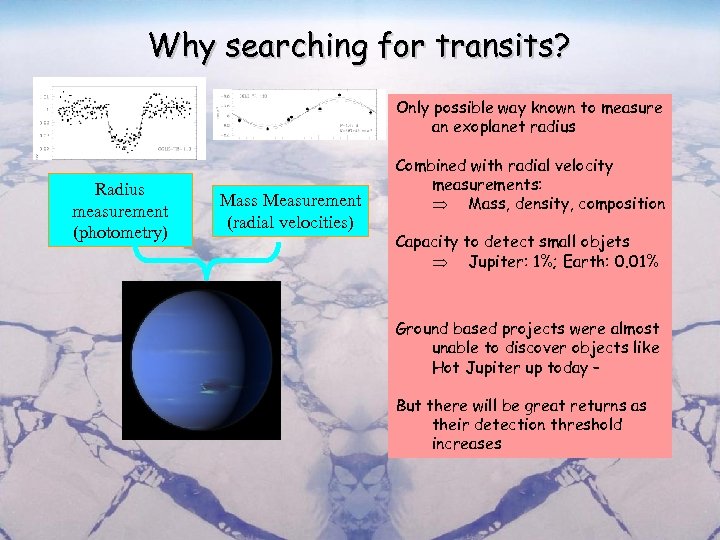 Why searching for transits? Only possible way known to measure an exoplanet radius Radius measurement (photometry) Mass Measurement (radial velocities) Combined with radial velocity measurements: Þ Mass, density, composition Capacity to detect small objets Þ Jupiter: 1%; Earth: 0. 01% Ground based projects were almost unable to discover objects like Hot Jupiter up today – But there will be great returns as their detection threshold increases