


 Скачать презентацию A Silicon Vertex Tracker Upgrade for the PHENIX
d6dd1b61ededa372b4c58a53e8a0044a.ppt
- Количество слайдов: 16
 A Silicon Vertex Tracker Upgrade for the PHENIX Experiment at RHIC - RHIC and PHENIX in Brief - Physics Goals & Detector Upgrades - Silicon Vertex Tracker: Concept and Status of Preparations Johann M. Heuser, RIKEN for the PHENIX Collaboration International Workshop on Radiation Imaging Detectors, Glasgow, July 25 -29, 2004
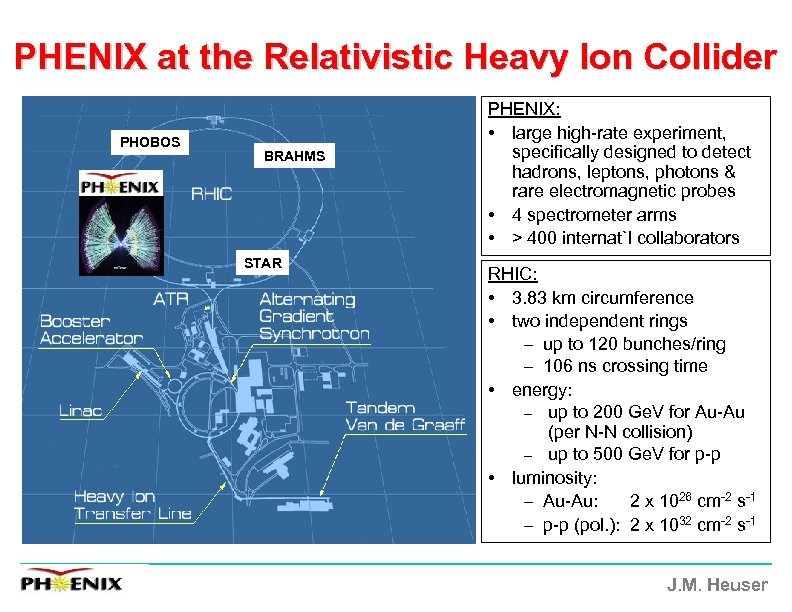 PHENIX at the Relativistic Heavy Ion Collider PHOBOS BRAHMS STAR PHENIX: • large high-rate experiment, specifically designed to detect hadrons, leptons, photons & rare electromagnetic probes • 4 spectrometer arms • > 400 internat`l collaborators RHIC: • 3. 83 km circumference • two independent rings – up to 120 bunches/ring – 106 ns crossing time • energy: – up to 200 Ge. V for Au-Au (per N-N collision) – up to 500 Ge. V for p-p • luminosity: – Au-Au: 2 x 1026 cm-2 s-1 – p-p (pol. ): 2 x 1032 cm-2 s-1 J. M. Heuser
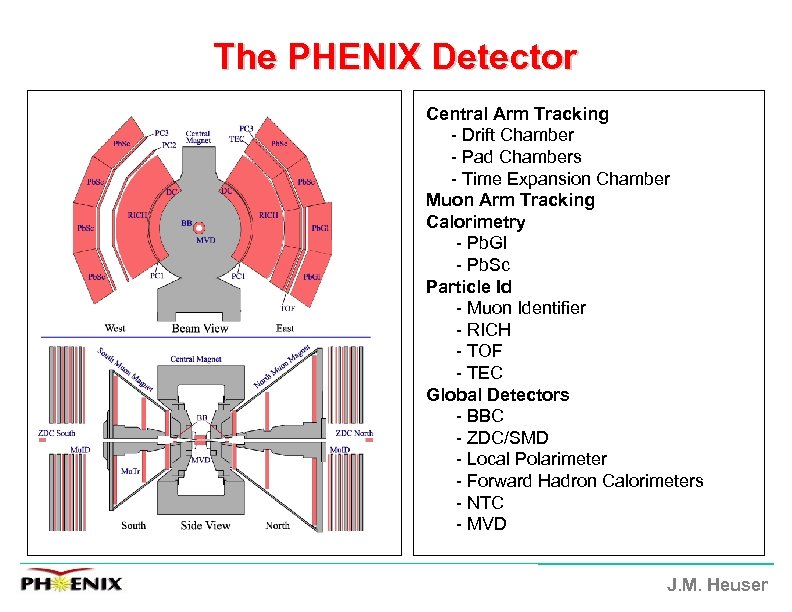 The PHENIX Detector Central Arm Tracking - Drift Chamber - Pad Chambers - Time Expansion Chamber Muon Arm Tracking Calorimetry - Pb. Gl - Pb. Sc Particle Id - Muon Identifier - RICH - TOF - TEC Global Detectors - BBC - ZDC/SMD - Local Polarimeter - Forward Hadron Calorimeters - NTC - MVD J. M. Heuser
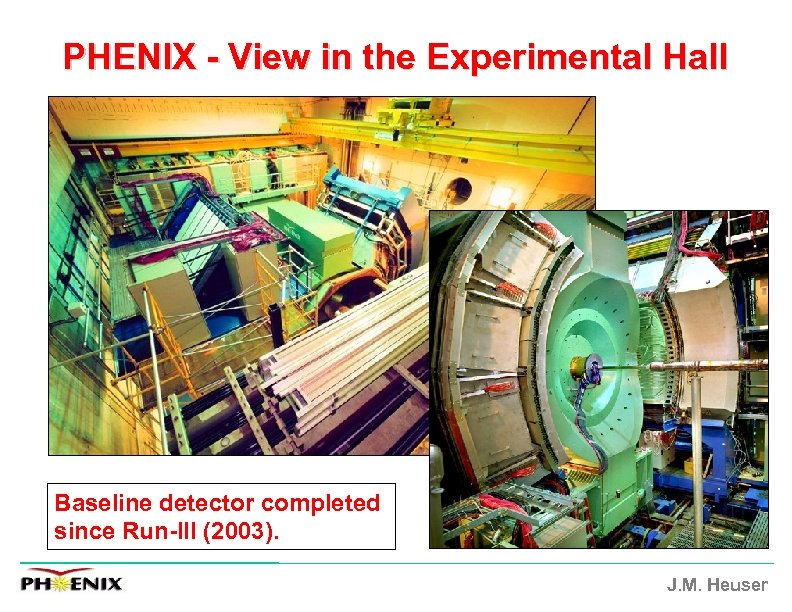 PHENIX - View in the Experimental Hall Baseline detector completed since Run-III (2003). J. M. Heuser
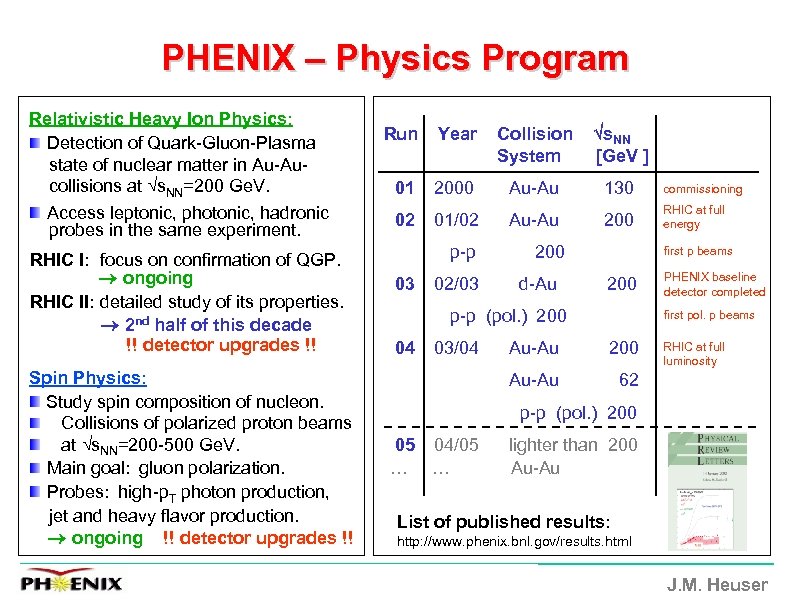 PHENIX – Physics Program Relativistic Heavy Ion Physics: Detection of Quark-Gluon-Plasma state of nuclear matter in Au-Au collisions at s. NN=200 Ge. V. Access leptonic, photonic, hadronic probes in the same experiment. Run Year Collision System s. NN [Ge. V ] commissioning 01 2000 Au-Au 130 02 01/02 Au-Au 200 RHIC I: focus on confirmation of QGP. p-p 200 ongoing 03 02/03 d-Au 200 RHIC II: detailed study of its properties. p-p (pol. ) 200 2 nd half of this decade !! detector upgrades !! 04 03/04 Au-Au 200 Spin Physics: Au-Au 62 Study spin composition of nucleon. p-p (pol. ) 200 Collisions of polarized proton beams 05 04/05 lighter than 200 at s. NN=200 -500 Ge. V. … … Au-Au Main goal: gluon polarization. Probes: high-p. T photon production, jet and heavy flavor production. List of published results: ongoing !! detector upgrades !! http: //www. phenix. bnl. gov/results. html RHIC at full energy first p beams PHENIX baseline detector completed first pol. p beams RHIC at full luminosity J. M. Heuser
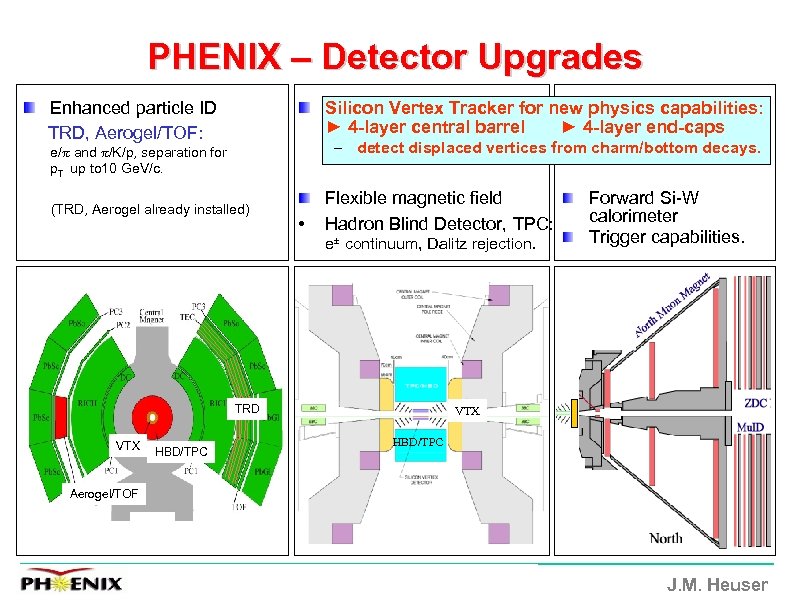 PHENIX – Detector Upgrades Silicon Vertex Tracker for new physics capabilities: ► 4 -layer central barrel ► 4 -layer end-caps Enhanced particle ID TRD, Aerogel/TOF: – detect displaced vertices from charm/bottom decays. e/ and /K/p, separation for p. T up to 10 Ge. V/c. (TRD, Aerogel already installed) • Flexible magnetic field Hadron Blind Detector, TPC: e± continuum, Dalitz rejection. TRD VTX HBD/TPC Forward Si-W calorimeter Trigger capabilities. VTX HBD/TPC Aerogel/TOF J. M. Heuser
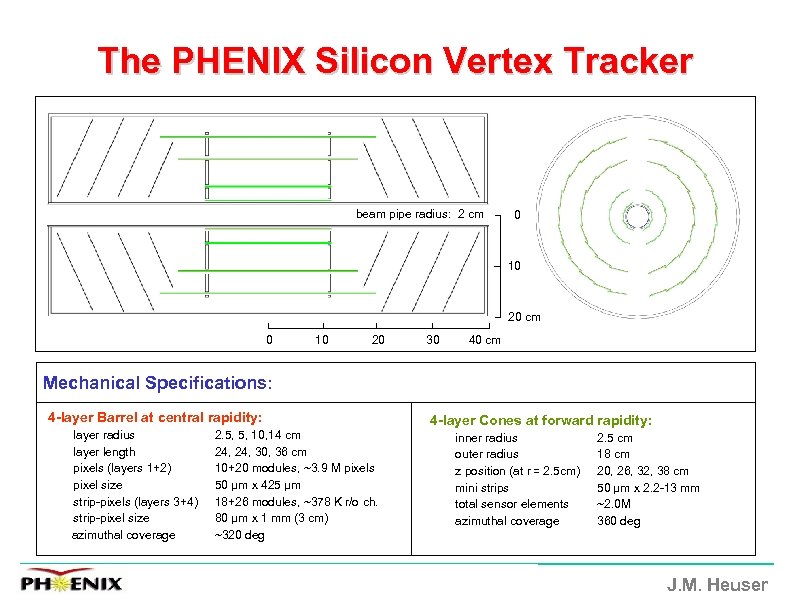 The PHENIX Silicon Vertex Tracker beam pipe radius: 2 cm 0 10 20 30 40 cm Mechanical Specifications: 4 -layer Barrel at central rapidity: layer radius layer length pixels (layers 1+2) pixel size strip-pixels (layers 3+4) strip-pixel size azimuthal coverage 2. 5, 5, 10, 14 cm 24, 30, 36 cm 10+20 modules, ~3. 9 M pixels 50 µm x 425 µm 18+26 modules, ~378 K r/o ch. 80 µm x 1 mm (3 cm) ~320 deg 4 -layer Cones at forward rapidity: inner radius outer radius z position (at r = 2. 5 cm) mini strips total sensor elements azimuthal coverage 2. 5 cm 18 cm 20, 26, 32, 38 cm 50 µm x 2. 2 -13 mm ~2. 0 M 360 deg J. M. Heuser
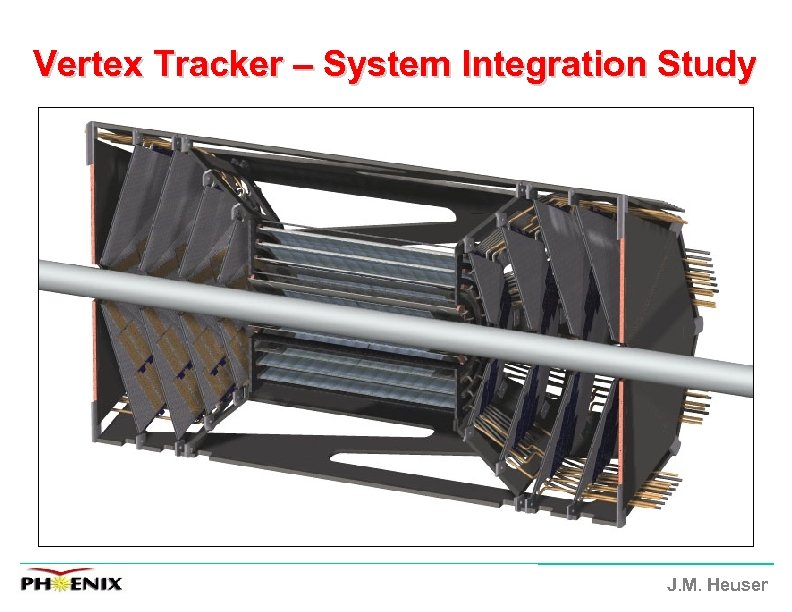 Vertex Tracker – System Integration Study J. M. Heuser
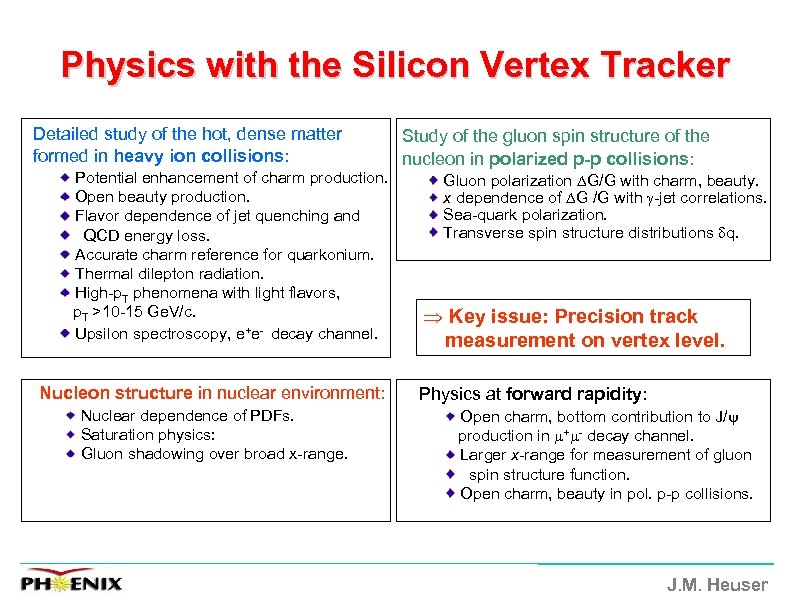 Physics with the Silicon Vertex Tracker Detailed study of the hot, dense matter formed in heavy ion collisions: Potential enhancement of charm production. Open beauty production. Flavor dependence of jet quenching and QCD energy loss. Accurate charm reference for quarkonium. Thermal dilepton radiation. High-p. T phenomena with light flavors, p. T >10 -15 Ge. V/c. Upsilon spectroscopy, e+e- decay channel. Nucleon structure in nuclear environment: Nuclear dependence of PDFs. Saturation physics: Gluon shadowing over broad x-range. Study of the gluon spin structure of the nucleon in polarized p-p collisions: Gluon polarization G/G with charm, beauty. x dependence of G /G with -jet correlations. Sea-quark polarization. Transverse spin structure distributions q. Key issue: Precision track measurement on vertex level. Physics at forward rapidity: Open charm, bottom contribution to J/ production in + - decay channel. Larger x-range for measurement of gluon spin structure function. Open charm, beauty in pol. p-p collisions. J. M. Heuser
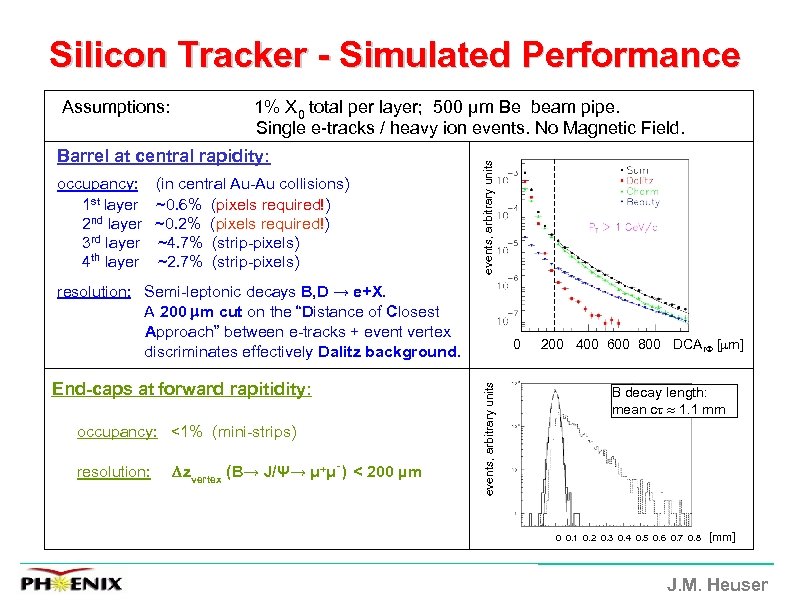 Silicon Tracker - Simulated Performance Barrel at central rapidity: occupancy: (in central Au-Au collisions) 1 st layer ~0. 6% (pixels required!) 2 nd layer ~0. 2% (pixels required!) 3 rd layer ~4. 7% (strip-pixels) 4 th layer ~2. 7% (strip-pixels) events, arbitrary units Assumptions: 1% X 0 total per layer; 500 μm Be beam pipe. Single e-tracks / heavy ion events. No Magnetic Field. resolution: Semi-leptonic decays B, D → e+X. A 200 m cut on the “Distance of Closest Approach” between e-tracks + event vertex discriminates effectively Dalitz background. occupancy: <1% (mini-strips) resolution: zvertex (B→ J/Ψ→ μ+μ- ) < 200 µm events, arbitrary units End-caps at forward rapitidity: 0 200 400 600 800 DCAr [ m] B decay length: mean c 1. 1 mm zvertex 0 0. 1 0. 2 0. 3 0. 4 0. 5 0. 6 0. 7 0. 8 [mm] J. M. Heuser
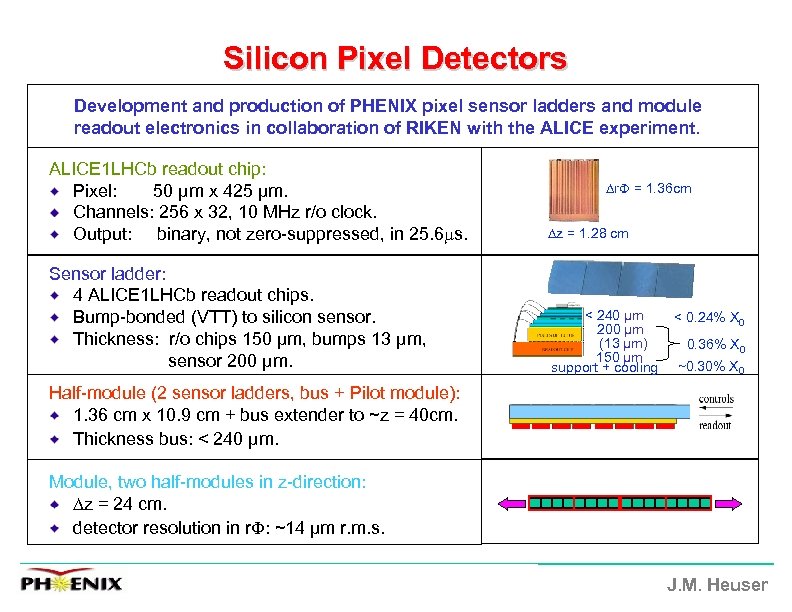 Silicon Pixel Detectors Development and production of PHENIX pixel sensor ladders and module readout electronics in collaboration of RIKEN with the ALICE experiment. ALICE 1 LHCb readout chip: Pixel: 50 µm x 425 µm. Channels: 256 x 32, 10 MHz r/o clock. Output: binary, not zero-suppressed, in 25. 6 s. Sensor ladder: 4 ALICE 1 LHCb readout chips. Bump-bonded (VTT) to silicon sensor. Thickness: r/o chips 150 µm, bumps 13 µm, sensor 200 µm. r = 1. 36 cm z = 1. 28 cm < 240 µm 200 µm (13 µm) 150 µm support + cooling < 0. 24% X 0 0. 36% X 0 ~0. 30% X 0 Half-module (2 sensor ladders, bus + Pilot module): 1. 36 cm x 10. 9 cm + bus extender to ~z = 40 cm. Thickness bus: < 240 µm. Module, two half-modules in z-direction: z = 24 cm. detector resolution in r : ~14 µm r. m. s. J. M. Heuser
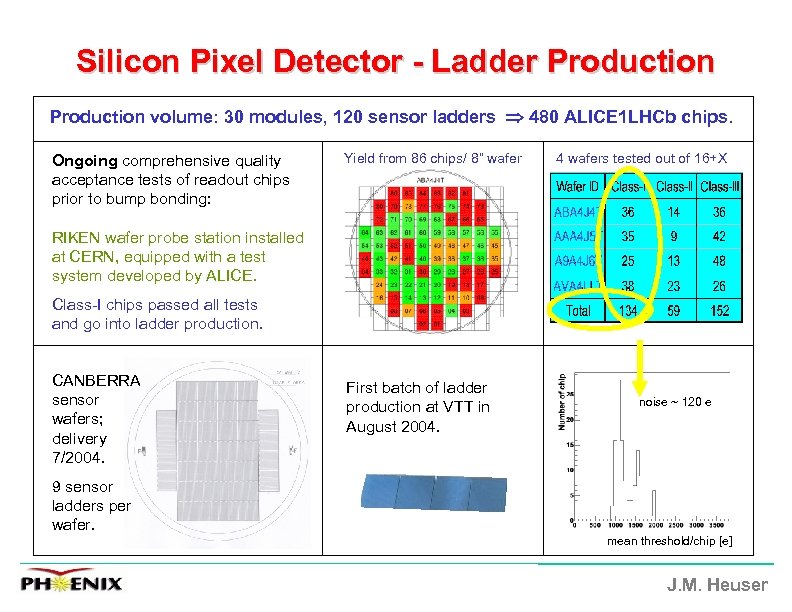 Silicon Pixel Detector - Ladder Production volume: 30 modules, 120 sensor ladders 480 ALICE 1 LHCb chips. Ongoing comprehensive quality acceptance tests of readout chips prior to bump bonding: Yield from 86 chips/ 8“ wafer 4 wafers tested out of 16+X RIKEN wafer probe station installed at CERN, equipped with a test system developed by ALICE. Class-I chips passed all tests and go into ladder production. CANBERRA sensor wafers; delivery 7/2004. First batch of ladder production at VTT in August 2004. noise ~ 120 e 9 sensor ladders per wafer. mean threshold/chip [e] J. M. Heuser
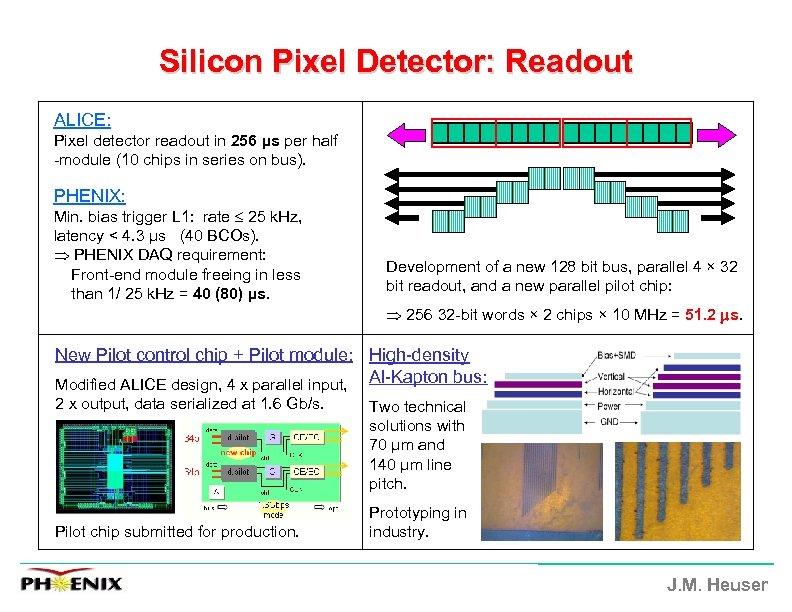 Silicon Pixel Detector: Readout ALICE: Pixel detector readout in 256 µs per half -module (10 chips in series on bus). PHENIX: Min. bias trigger L 1: rate 25 k. Hz, latency < 4. 3 µs (40 BCOs). PHENIX DAQ requirement: Front-end module freeing in less than 1/ 25 k. Hz = 40 (80) µs. Development of a new 128 bit bus, parallel 4 × 32 bit readout, and a new parallel pilot chip: 256 32 -bit words × 2 chips × 10 MHz = 51. 2 s. New Pilot control chip + Pilot module: High-density Modified ALICE design, 4 x parallel input, Al-Kapton bus: 2 x output, data serialized at 1. 6 Gb/s. Pilot chip submitted for production. Two technical solutions with 70 µm and 140 µm line pitch. Prototyping in industry. J. M. Heuser
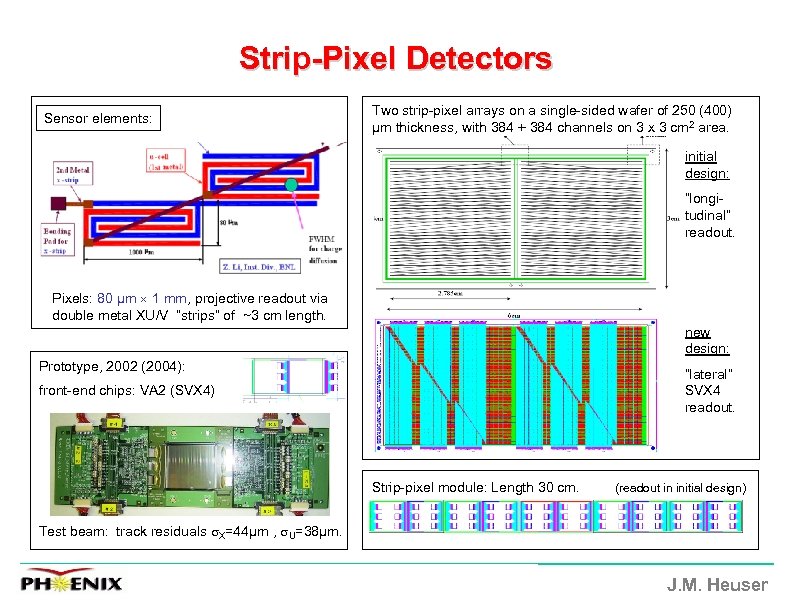 Strip-Pixel Detectors Sensor elements: Two strip-pixel arrays on a single-sided wafer of 250 (400) µm thickness, with 384 + 384 channels on 3 x 3 cm 2 area. initial design: “longitudinal” readout. Pixels: 80 µm 1 mm, projective readout via double metal XU/V “strips” of ~3 cm length. new design: Prototype, 2002 (2004): front-end chips: VA 2 (SVX 4) “lateral” SVX 4 readout. Strip-pixel module: Length 30 cm. (readout in initial design) Test beam: track residuals X=44µm , U=38µm. J. M. Heuser
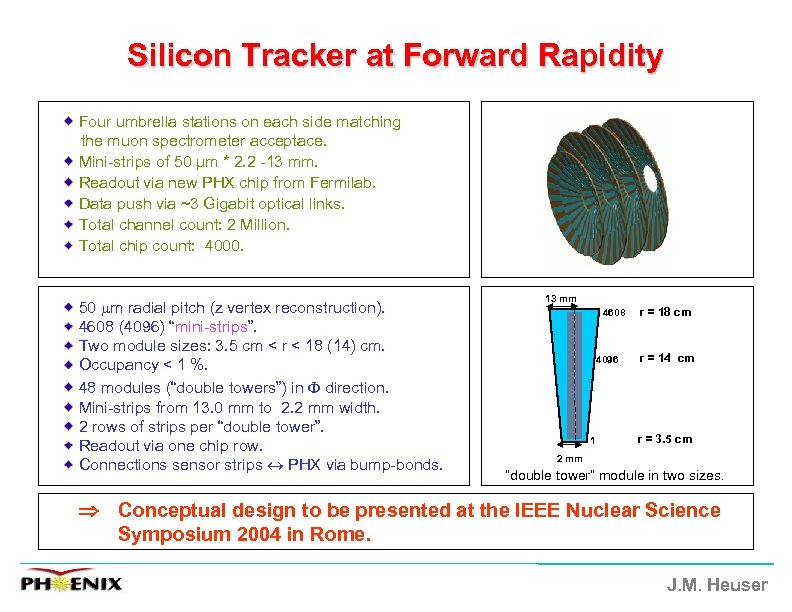 Silicon Tracker at Forward Rapidity Four umbrella stations on each side matching the muon spectrometer acceptace. Mini-strips of 50 µm * 2. 2 -13 mm. Readout via new PHX chip from Fermilab. Data push via ~3 Gigabit optical links. Total channel count: 2 Million. Total chip count: 4000. 50 m radial pitch (z vertex reconstruction). 4608 (4096) “mini-strips”. Two module sizes: 3. 5 cm < r < 18 (14) cm. Occupancy < 1 %. 48 modules (“double towers”) in direction. Mini-strips from 13. 0 mm to 2. 2 mm width. 2 rows of strips per “double tower”. Readout via one chip row. Connections sensor strips PHX via bump-bonds. 13 mm 4608 4096 1 r = 18 cm r = 14 cm r = 3. 5 cm 2 mm “double tower” module in two sizes. Conceptual design to be presented at the IEEE Nuclear Science Symposium 2004 in Rome. J. M. Heuser
 Summary Physics motivation, technical concept and beginning construction of the PHENIX Silicon Vertex Tracker was outlined. The Silicon Vertex Tracker is an important upgrade of the PHENIX detector and will extend its physics capabilities to new observables for the physics program at RHIC II and the polarized proton physics program. The technical proposal document for the barrel detector layers at central rapidity has been submitted. The prototyping and production of its detector components have started. The full detector in PHENIX is aimed at for the year 2007/8 (Run 8). Pixel detectors: are essential in the inner two layers to achieve the spatial resolution for secondary vertex measurement. Due to short time scale until they are needed: Focus on the application of up-to-date established technology. Utilization of CERN-ALICE hybrid pixel detectors as the building block for PHENIX specific pixel detector modules. Novel “Strip-pixel” detectors in the outer layers are essential for the track reconstruction and help with linking the tracks to the central spectrometers. A proposal for the end-cap vertex tracker at forward rapidity will be presented soon. The application of this device is aimed at for around the year 2008/9. J. M. Heuser