 Скачать презентацию A Silicon Analog of the Carbon Based Laboratory
fa9911849883892f8474d051a081e0b5.ppt
- Количество слайдов: 40



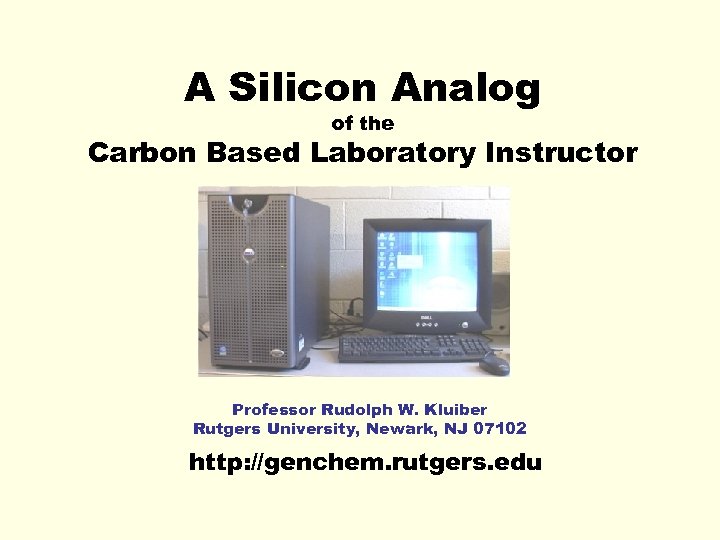
A Silicon Analog of the Carbon Based Laboratory Instructor Professor Rudolph W. Kluiber Rutgers University, Newark, NJ 07102 http: //genchem. rutgers. edu
General Chemistry Laboratory Talking to the Molecules 1. Philosophy • Teach General Chemistry • Teach Other Skills 2. Students • First college chemistry course • Varied Interests • Varied Ability 3. Teacher • Communication Skills • Interest • Ability
PHILOSOPHIES 1. Cook Book or Verification • • Students are given specific instructions. Learn laboratory techniques and logic. Comfortable and convenient. Correlate with lecture to form a “community”. 2. Guided Inquiry or Discovery • • Students are given general instructions. Students work out the details. Teach the student to think. Make them think they figured it out 3. Others • Research Projects • Collaboration
SUPPORTING Classic Cook Book Chemistry It’s EASY, COMFORTABLE and ROUTINE STUDENTS • Almost all are not chem majors • Varied background (skill, ethic and temperament) • First college chemistry laboratory course • Most are foreign born; majority are women INSTRUCTORS • All are foreign born • Many initially have language problems • Familiarity brings comfort PHILOSOPHY • Laboratory supports lecture
Classic Cook Book Chemistry…IT’S EASY DRAWBACKS • Copying and cheating can be prevalent • Pre. Labs • Experiments: section to section, year to year • Learning can be minimal • Laboratory should be fun • Laboratory is a joke • Labs are labor intensive • Junior faculty are hired to carry out research • Laboratory used to increase contact hours • Return on teaching investment • Good, cheap help is hard to get • May create conflicts of interest • Lack scientific sophistication (undergraduates? )
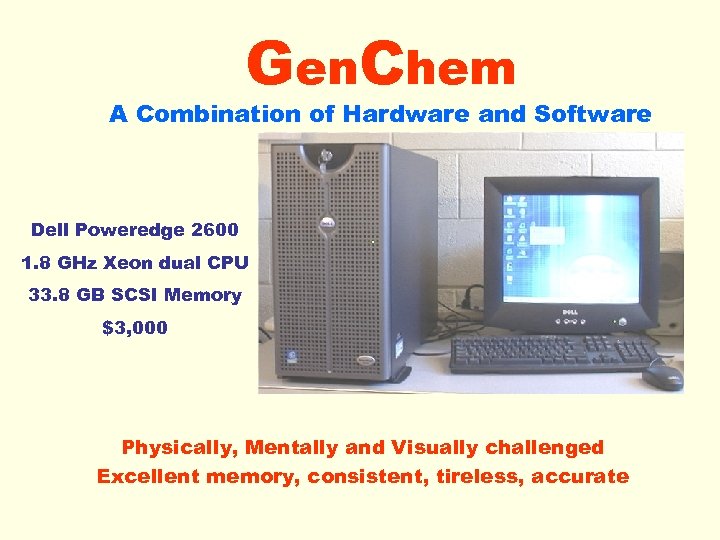
Gen. Chem A Combination of Hardware and Software Dell Poweredge 2600 1. 8 GHz Xeon dual CPU 33. 8 GB SCSI Memory $3, 000 Physically, Mentally and Visually challenged Excellent memory, consistent, tireless, accurate
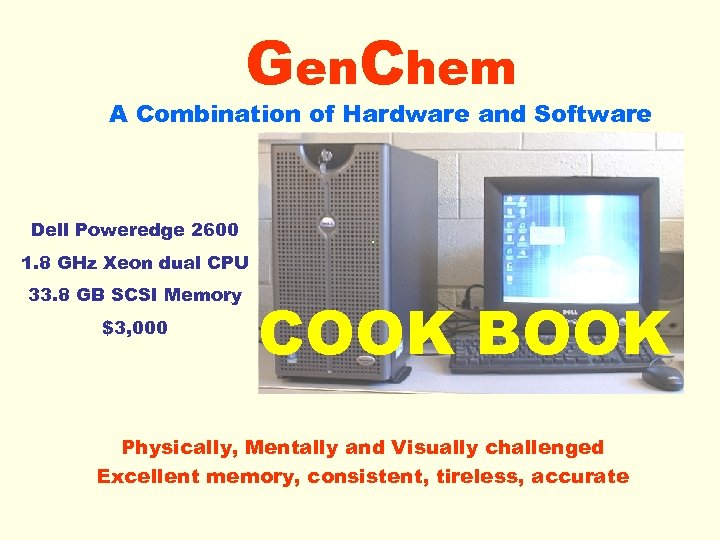
Gen. Chem A Combination of Hardware and Software Dell Poweredge 2600 1. 8 GHz Xeon dual CPU 33. 8 GB SCSI Memory $3, 000 COOK BOOK Physically, Mentally and Visually challenged Excellent memory, consistent, tireless, accurate
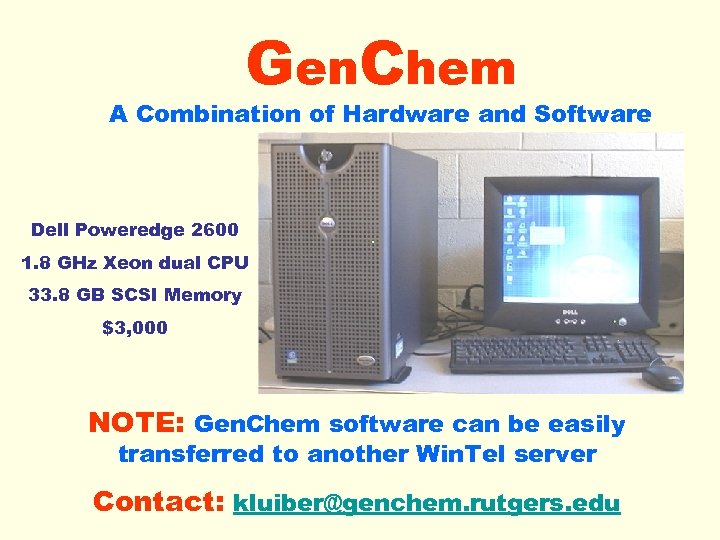
Gen. Chem A Combination of Hardware and Software Dell Poweredge 2600 1. 8 GHz Xeon dual CPU 33. 8 GB SCSI Memory $3, 000 NOTE: Gen. Chem software can be easily transferred to another Win. Tel server Contact: kluiber@genchem. rutgers. edu
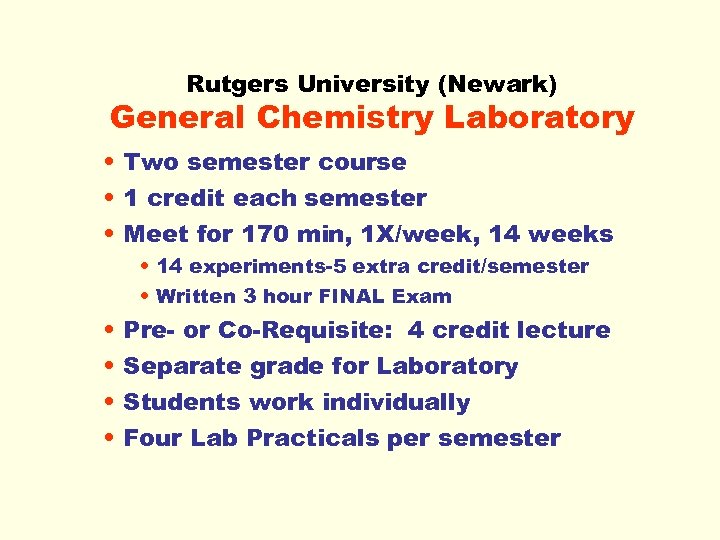
Rutgers University (Newark) General Chemistry Laboratory • Two semester course • 1 credit each semester • Meet for 170 min, 1 X/week, 14 weeks • 14 experiments-5 extra credit/semester • Written 3 hour FINAL Exam • • Pre- or Co-Requisite: 4 credit lecture Separate grade for Laboratory Students work individually Four Lab Practicals per semester
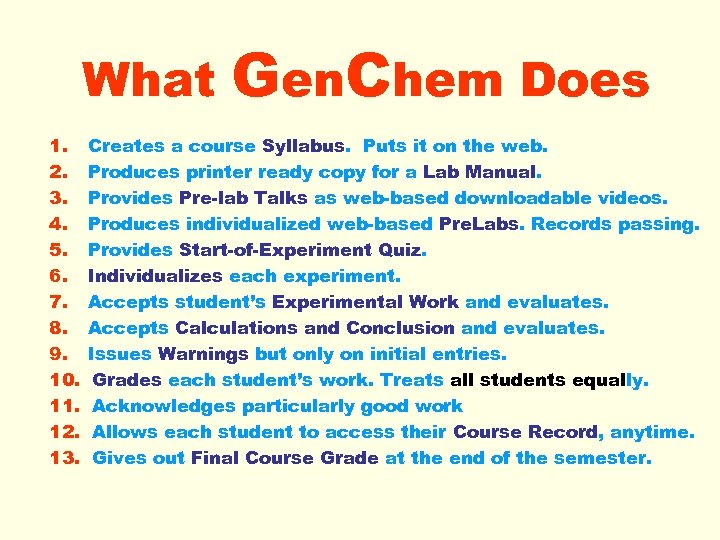
What 1. 2. 3. 4. 5. 6. 7. 8. 9. 10. 11. 12. 13. Gen. Chem Does Creates a course Syllabus. Puts it on the web. Produces printer ready copy for a Lab Manual. Provides Pre-lab Talks as web-based downloadable videos. Produces individualized web-based Pre. Labs. Records passing. Provides Start-of-Experiment Quiz. Individualizes each experiment. Accepts student’s Experimental Work and evaluates. Accepts Calculations and Conclusion and evaluates. Issues Warnings but only on initial entries. Grades each student’s work. Treats all students equally. Acknowledges particularly good work Allows each student to access their Course Record, anytime. Gives out Final Course Grade at the end of the semester.
SYLLABUS http: //genchem. rutgers. edu
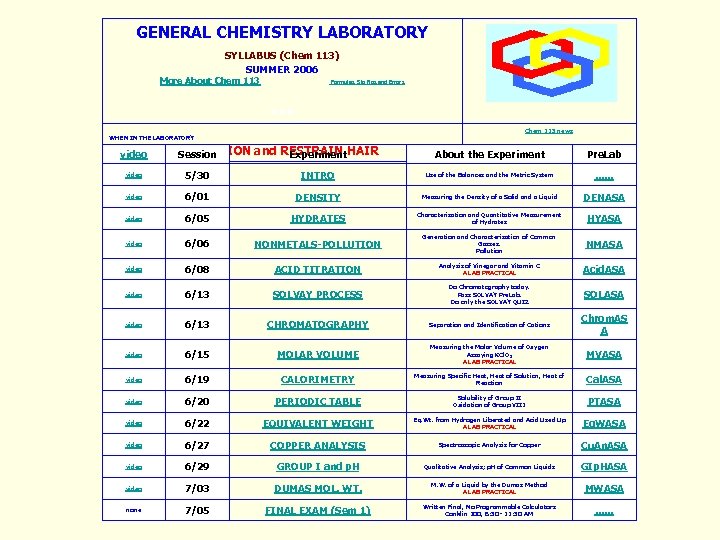
GENERAL CHEMISTRY LABORATORY SYLLABUS (Chem 113) SUMMER 2006 More About Chem 113 Formulas, Sig Figs and Errors . . . WHEN IN THE LABORATORY Chem 113 news Wear EYE PROTECTION and RESTRAIN HAIR video Session Experiment About the Experiment Pre. Lab video 5/30 INTRO Use of the Balances and the Metric System . . . video 6/01 DENSITY Measuring the Density of a Solid and a Liquid DENASA video 6/05 HYDRATES Characterization and Quantitative Measurement of Hydrates HYASA video 6/06 NONMETALS-POLLUTION Generation and Characterization of Common Gasses. Pollution NMASA video 6/08 ACID TITRATION Analysis of Vinegar and Vitamin C A LAB PRACTICAL Acid. ASA video 6/13 SOLVAY PROCESS Do Chromatography today. Pass SOLVAY Pre. Lab. Do only the SOLVAY QUIZ SOLASA video 6/13 CHROMATOGRAPHY Separation and Identification of Cations Chrom. AS A video 6/15 MOLAR VOLUME Measuring the Molar Volume of Oxygen Assaying KCl. O 3 A LAB PRACTICAL MVASA video 6/19 CALORIMETRY Measuring Specific Heat, Heat of Solution, Heat of Reaction Cal. ASA video 6/20 PERIODIC TABLE Solubility of Group II Oxidation of Group VII 1 PTASA video 6/22 EQUIVALENT WEIGHT Eq. Wt. from Hydrogen Liberated and Acid Used Up A LAB PRACTICAL Eq. WASA video 6/27 COPPER ANALYSIS Spectroscopic Analysis for Copper Cu. An. ASA video 6/29 GROUP I and p. H Qualitative Analysis; p. H of Common Liquids GIp. HASA video 7/03 DUMAS MOL. WT. M. W. of a Liquid by the Dumas Method A LAB PRACTICAL MWASA none 7/05 FINAL EXAM (Sem 1) Written Final, No Programmable Calculators Conklin 100, 8: 30 - 11: 30 AM . . .
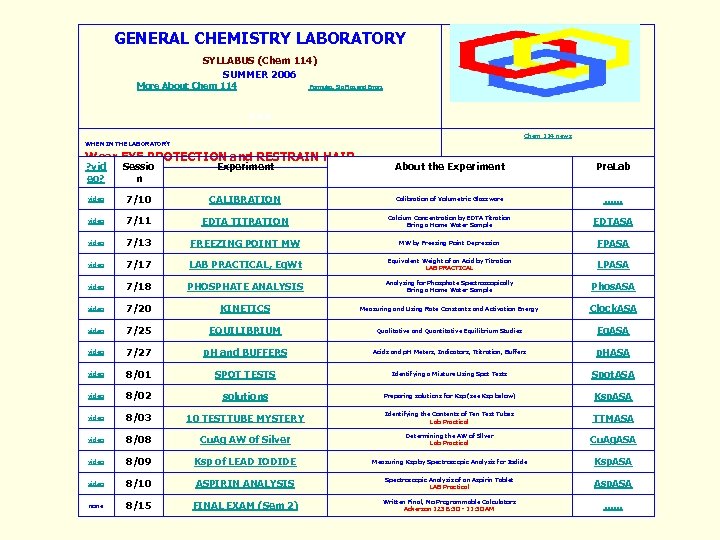
GENERAL CHEMISTRY LABORATORY SYLLABUS (Chem 114) SUMMER 2006 More About Chem 114 Formulas, Sig Figs and Errors . . . WHEN IN THE LABORATORY Chem 114 news Wear EYE PROTECTION and RESTRAIN HAIR ? vid eo? Sessio n Experiment About the Experiment Pre. Lab video 7/10 CALIBRATION Calibration of Volumetric Glassware . . . video 7/11 EDTA TITRATION Calcium Concentration by EDTA Titration Bring a Home Water Sample EDTASA video 7/13 FREEZING POINT MW by Freezing Point Depression FPASA video 7/17 LAB PRACTICAL, Eq. Wt Equivalent Weight of an Acid by Titration LAB PRACTICAL LPASA video 7/18 PHOSPHATE ANALYSIS Analyzing for Phosphate Spectroscopically Bring a Home Water Sample Phos. ASA video 7/20 KINETICS Measuring and Using Rate Constants and Activation Energy Clock. ASA video 7/25 EQUILIBRIUM Qualitative and Quantitative Equilibrium Studies Eq. ASA video 7/27 p. H and BUFFERS Acids and p. H Meters, Indicators, Ttitration, Buffers p. HASA video 8/01 SPOT TESTS Identifying a Mixture Using Spot Tests Spot. ASA video 8/02 solutions Preparing solutions for Ksp (see Ksp below) Ksp. ASA video 8/03 10 TESTTUBE MYSTERY Identifying the Contents of Ten Test Tubes Lab Practical TTMASA video 8/08 Cu. Ag AW of Silver Determining the AW of Silver Lab Practical Cu. Ag. ASA video 8/09 Ksp of LEAD IODIDE Measuring Ksp by Spectroscopic Analysis for Iodide Ksp. ASA video 8/10 ASPIRIN ANALYSIS Spectroscopic Analysis of an Aspirin Tablet LAB Practical Asp. ASA none 8/15 FINAL EXAM (Sem 2) Written Final, No Programmable Calculators Ackerson 123 8: 30 - 11: 30 AM . . .
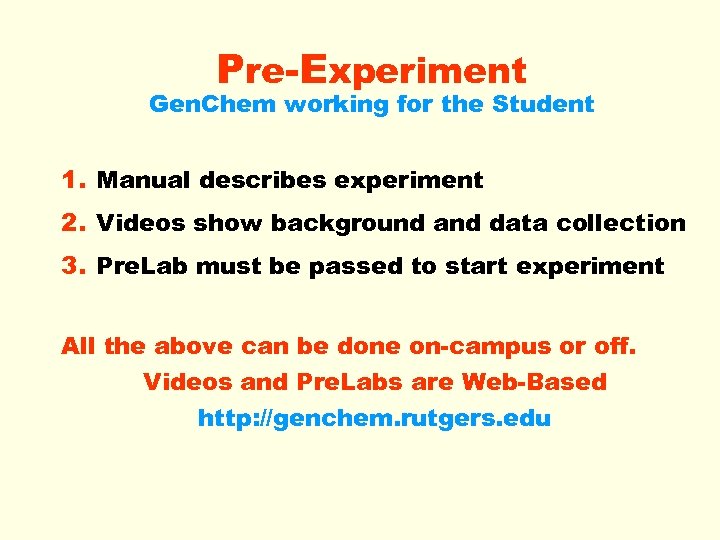
Pre-Experiment Gen. Chem working for the Student 1. Manual describes experiment 2. Videos show background and data collection 3. Pre. Lab must be passed to start experiment All the above can be done on-campus or off. Videos and Pre. Labs are Web-Based http: //genchem. rutgers. edu
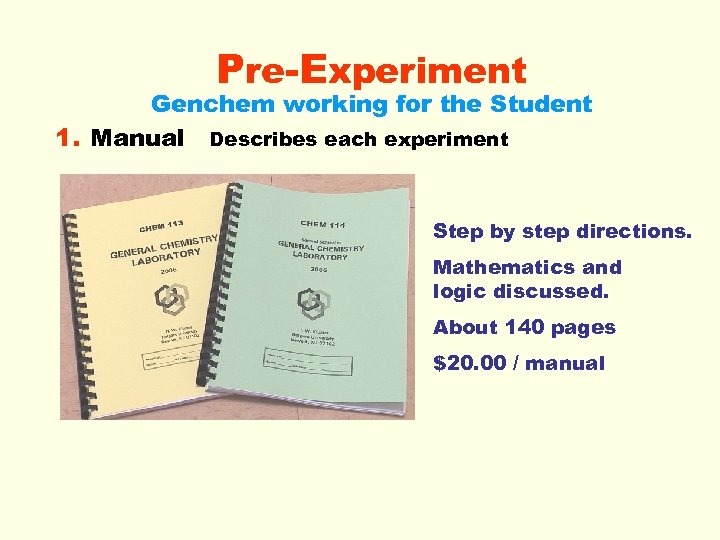
Pre-Experiment Genchem working for the Student 1. Manual Describes each experiment Step by step directions. Mathematics and logic discussed. About 140 pages $20. 00 / manual
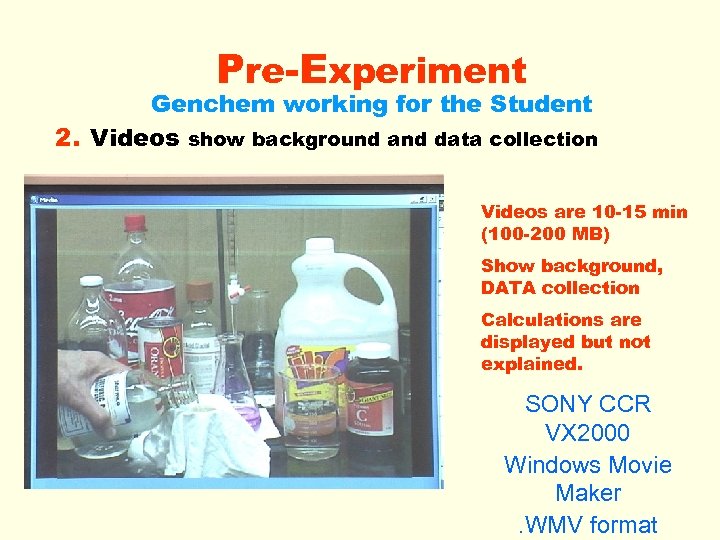
Pre-Experiment Genchem working for the Student 2. Videos show background and data collection Videos are 10 -15 min (100 -200 MB) Show background, DATA collection Calculations are displayed but not explained. SONY CCR VX 2000 Windows Movie Maker. WMV format
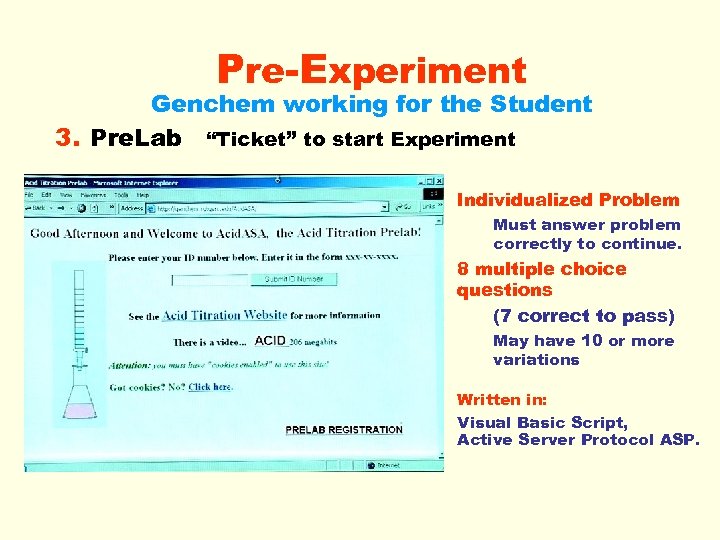
Pre-Experiment Genchem working for the Student 3. Pre. Lab “Ticket” to start Experiment Individualized Problem Must answer problem correctly to continue. 8 multiple choice questions (7 correct to pass) May have 10 or more variations Written in: Visual Basic Script, Active Server Protocol ASP.
The Experiment and Gen. Chem 1. Asks an initial Question. 2. Individualizes Experiments. 3. Accepts experimental data. 4. May warn of bad data on first entry. 5. Accepts calculations and conclusions. 6. Warns of poor calculations on first entry. 7. Grades and gives printout to student. 8. Grading includes “Late” and “Sig Figs”. 9. Records grades automatically. 10. Poor Experiments can be repeated. 11. All the above must be done in the Lab.
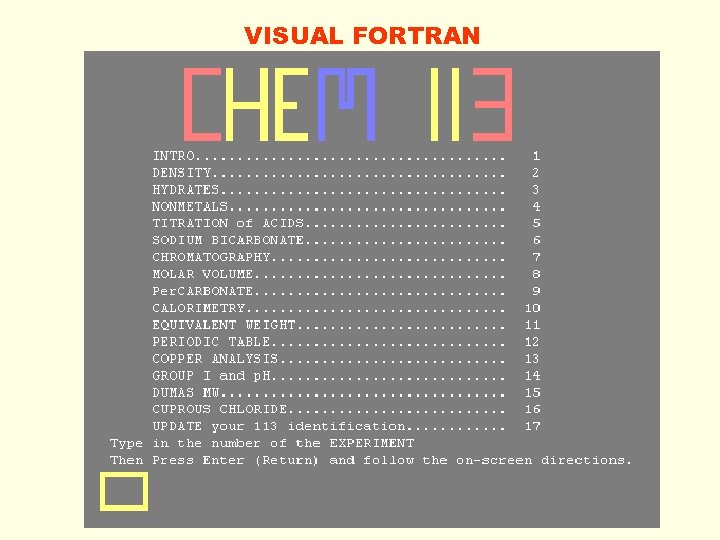
VISUAL FORTRAN
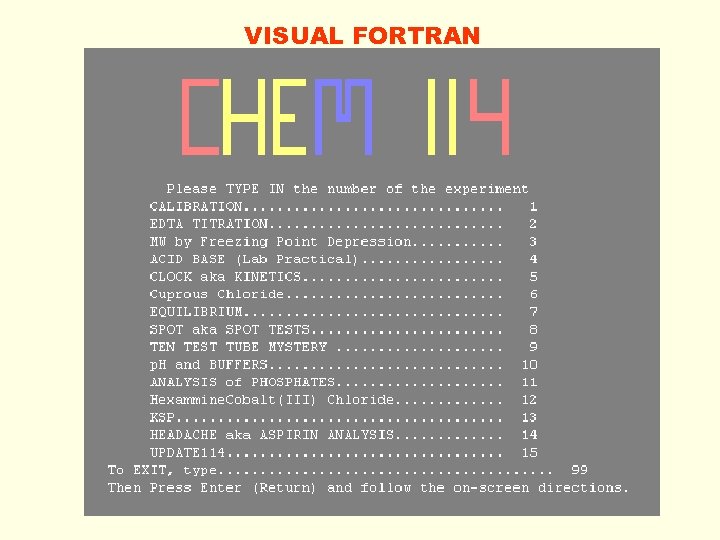
VISUAL FORTRAN
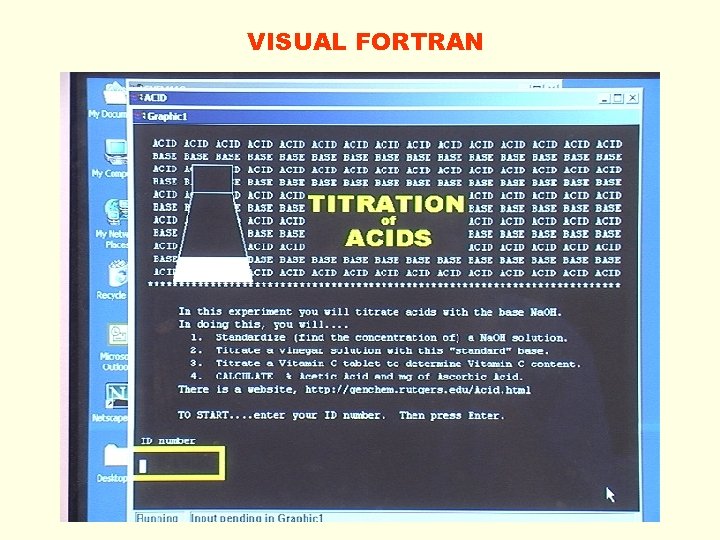
VISUAL FORTRAN
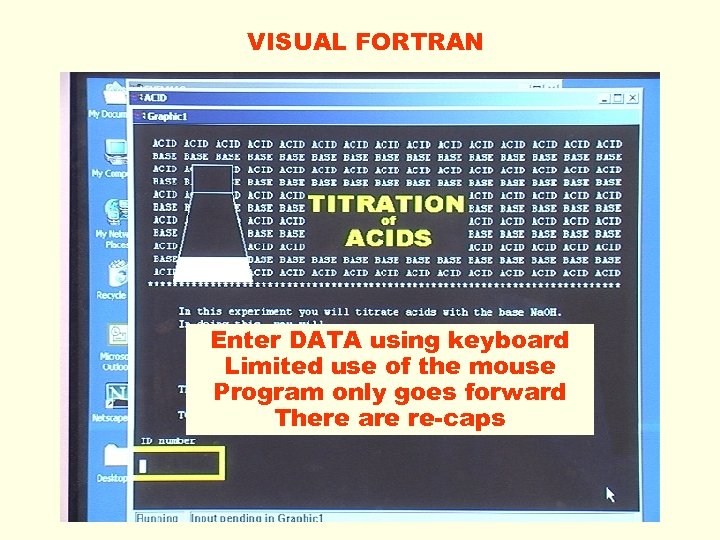
VISUAL FORTRAN Enter DATA using keyboard Limited use of the mouse Program only goes forward There are re-caps
The Experiment and Gen. Chem 1. Asks an initial Question. 2. Individualizes Experiments. 3. Accepts experimental data. 4. May warn of bad data on first entry. 5. Accepts calculations and conclusions. 6. Warns of poor calculations on first entry. 7. Grades and gives printout to student. 8. Grading includes “Late” and “Sig Figs”. 9. Records grades automatically. 10. Poor Experiments can be repeated. 11. All the above must be done in the Lab.
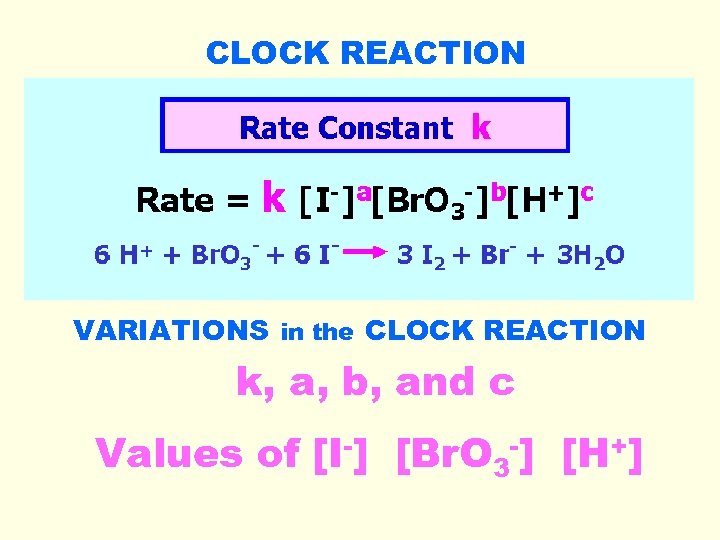
CLOCK REACTION VARIATIONS in the CLOCK REACTION k, a, b, and c Values of [I-] [Br. O 3 -] [H+]
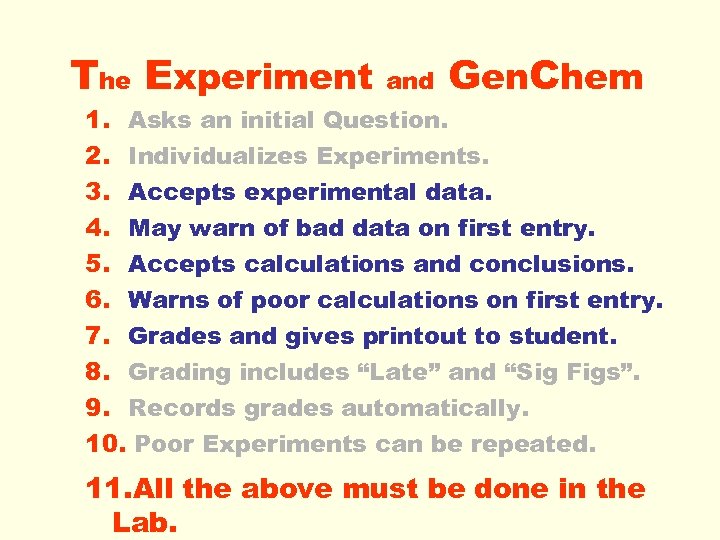
The Experiment and Gen. Chem 1. Asks an initial Question. 2. Individualizes Experiments. 3. Accepts experimental data. 4. May warn of bad data on first entry. 5. Accepts calculations and conclusions. 6. Warns of poor calculations on first entry. 7. Grades and gives printout to student. 8. Grading includes “Late” and “Sig Figs”. 9. Records grades automatically. 10. Poor Experiments can be repeated. 11. All the above must be done in the Lab.
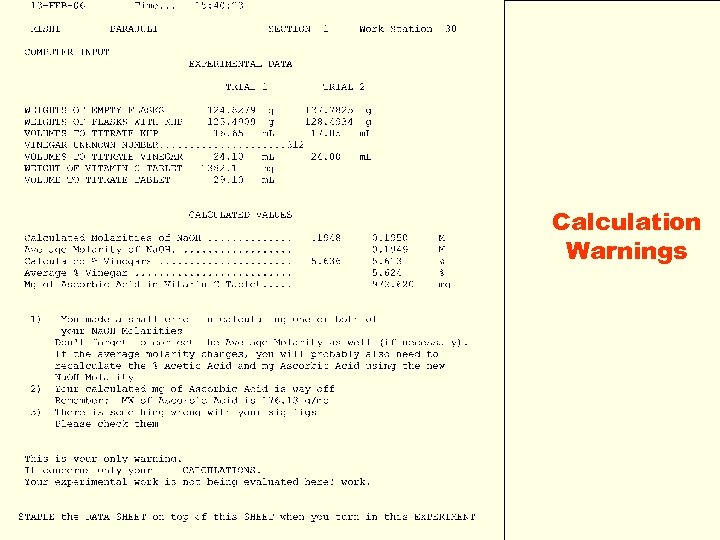
Calculation Warnings
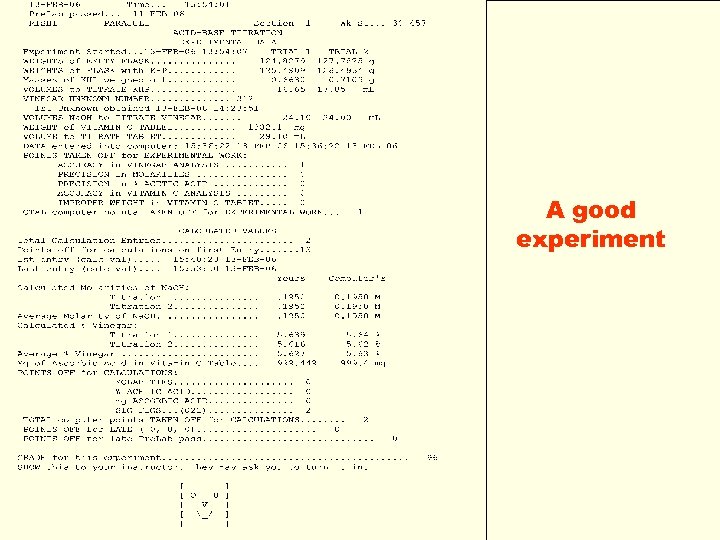
A good experiment
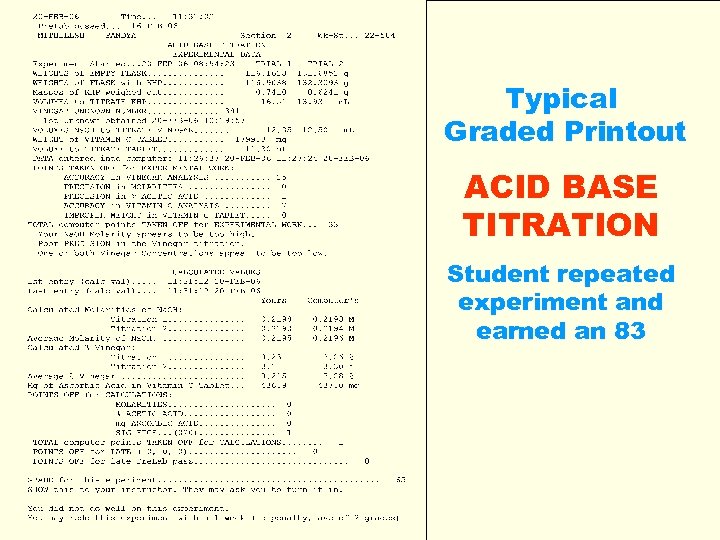
Typical Graded Printout ACID BASE TITRATION Student repeated experiment and earned an 83
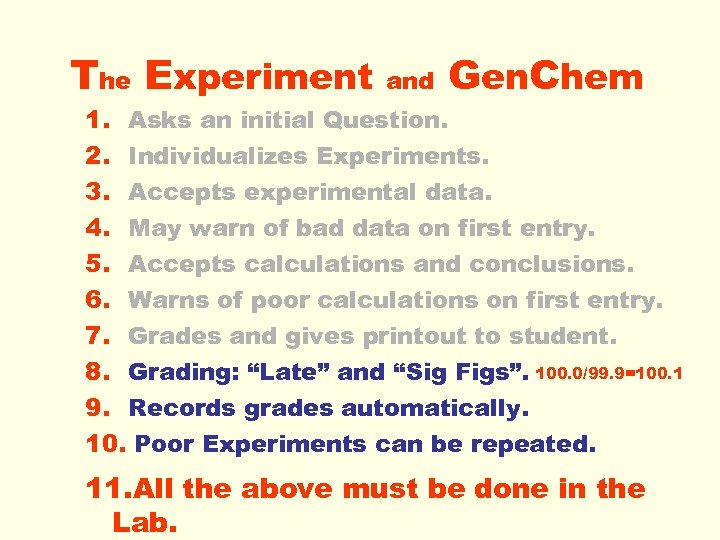
The Experiment and Gen. Chem 1. Asks an initial Question. 2. Individualizes Experiments. 3. Accepts experimental data. 4. May warn of bad data on first entry. 5. Accepts calculations and conclusions. 6. Warns of poor calculations on first entry. 7. Grades and gives printout to student. 8. Grading: “Late” and “Sig Figs”. 100. 0/99. 9=100. 1 9. Records grades automatically. 10. Poor Experiments can be repeated. 11. All the above must be done in the Lab.
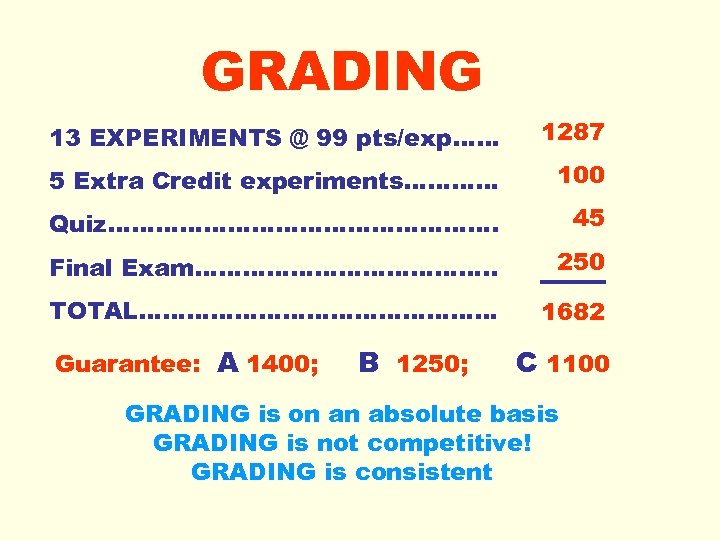
GRADING 13 EXPERIMENTS @ 99 pts/exp…… 1287 5 Extra Credit experiments………… 100 Quiz……………………. 45 Final Exam………………. . 250 TOTAL…………………… 1682 Guarantee: A 1400; B 1250; C 1100 GRADING is on an absolute basis GRADING is not competitive! GRADING is consistent
PLAYCHEM a series of EXTRA CREDIT Experiments Short Simple Significant http: //genchem. rutgers. edu/Play. Chem. html
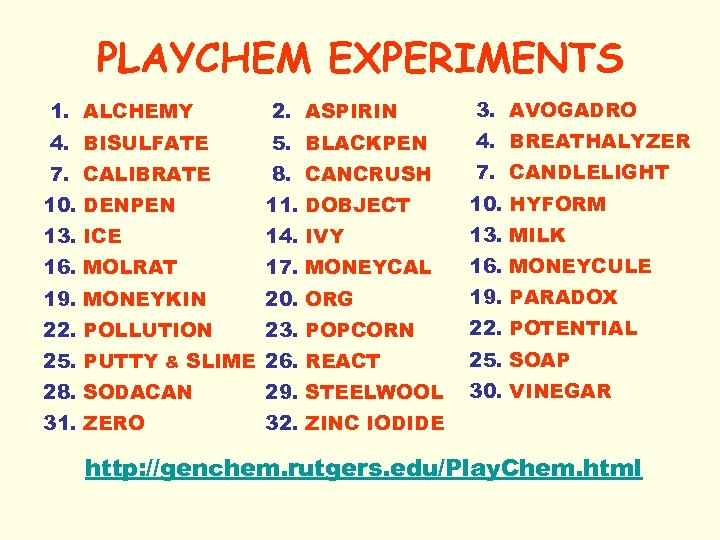
PLAYCHEM EXPERIMENTS 1. ALCHEMY 2. ASPIRIN 3. AVOGADRO 4. BISULFATE 5. BLACKPEN 4. BREATHALYZER 7. CALIBRATE 8. CANCRUSH 7. CANDLELIGHT 10. DENPEN 11. DOBJECT 10. HYFORM 13. ICE 14. IVY 13. MILK 16. MOLRAT 17. MONEYCAL 16. MONEYCULE 19. MONEYKIN 20. ORG 19. PARADOX 22. POLLUTION 23. POPCORN 22. POTENTIAL 25. PUTTY & SLIME 26. REACT 28. SODACAN 29. STEELWOOL 31. ZERO 25. SOAP 30. VINEGAR 32. ZINC IODIDE http: //genchem. rutgers. edu/Play. Chem. html
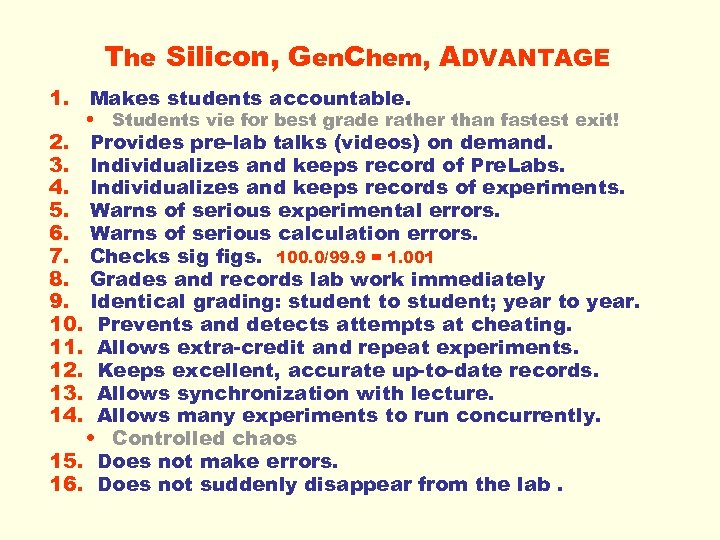
The Silicon, Gen. Chem, ADVANTAGE 1. Makes students accountable. 2. 3. 4. 5. 6. 7. 8. 9. 10. 11. 12. 13. 14. • Students vie for best grade rather than fastest exit! Provides pre-lab talks (videos) on demand. Individualizes and keeps record of Pre. Labs. Individualizes and keeps records of experiments. Warns of serious experimental errors. Warns of serious calculation errors. Checks sig figs. 100. 0/99. 9 = 1. 001 Grades and records lab work immediately Identical grading: student to student; year to year. Prevents and detects attempts at cheating. Allows extra-credit and repeat experiments. Keeps excellent, accurate up-to-date records. Allows synchronization with lecture. Allows many experiments to run concurrently. • Controlled chaos 15. Does not make errors. 16. Does not suddenly disappear from the lab.
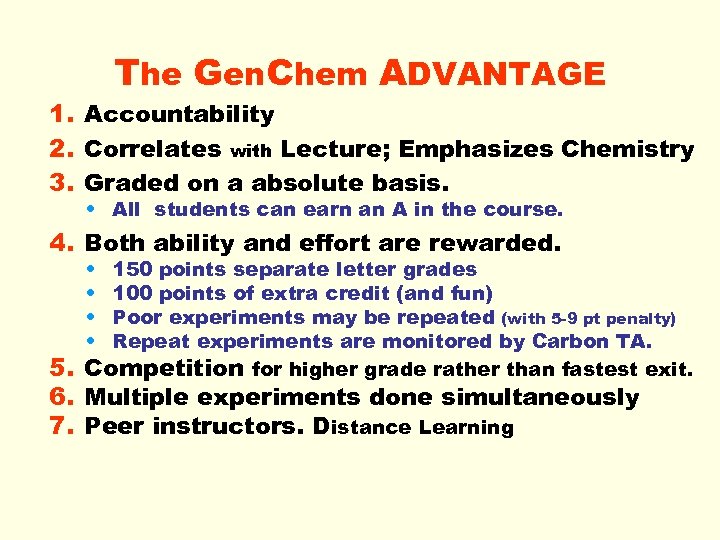
The Gen. Chem ADVANTAGE 1. Accountability 2. Correlates with Lecture; Emphasizes Chemistry 3. Graded on a absolute basis. • All students can earn an A in the course. 4. Both ability and effort are rewarded. • • 150 points separate letter grades 100 points of extra credit (and fun) Poor experiments may be repeated (with 5 -9 pt penalty) Repeat experiments are monitored by Carbon TA. Competition for higher grade rather than fastest exit. 5. 6. Multiple experiments done simultaneously 7. Peer instructors. Distance Learning
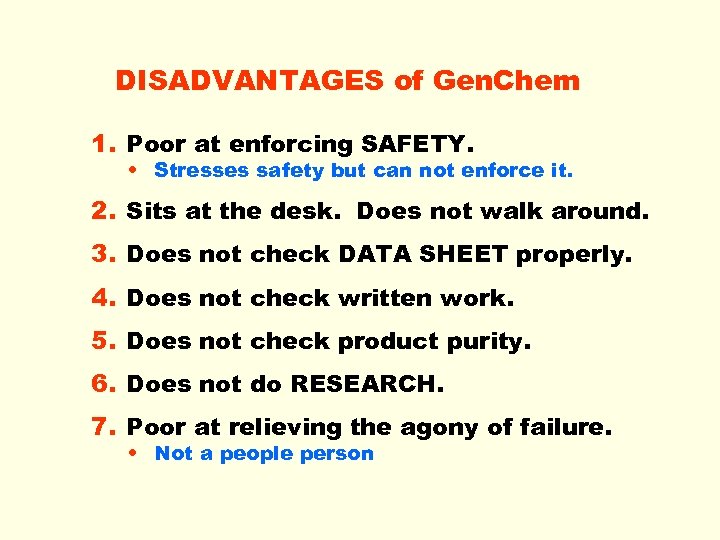
DISADVANTAGES of Gen. Chem 1. Poor at enforcing SAFETY. • Stresses safety but can not enforce it. 2. Sits at the desk. Does not walk around. 3. Does not check DATA SHEET properly. 4. Does not check written work. 5. Does not check product purity. 6. Does not do RESEARCH. 7. Poor at relieving the agony of failure. • Not a people person
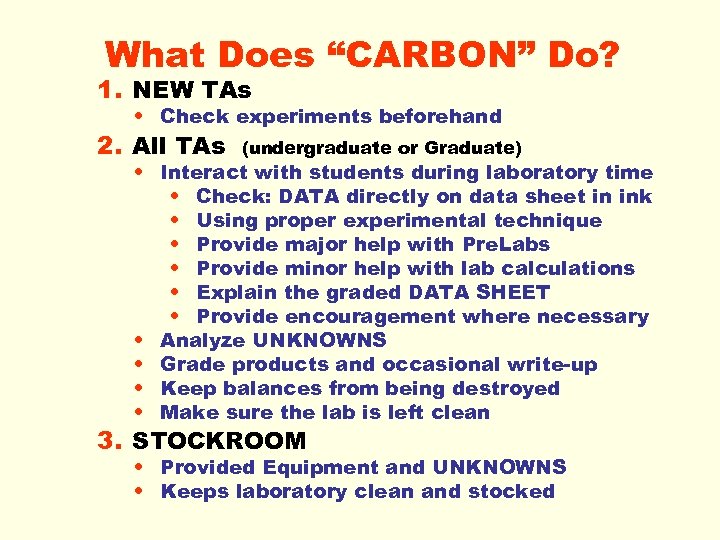
What Does “CARBON” Do? 1. NEW TAs • Check experiments beforehand 2. All TAs (undergraduate or Graduate) • Interact with students during laboratory time • Check: DATA directly on data sheet in ink • Using proper experimental technique • Provide major help with Pre. Labs • Provide minor help with lab calculations • Explain the graded DATA SHEET • Provide encouragement where necessary • Analyze UNKNOWNS • Grade products and occasional write-up • Keep balances from being destroyed • Make sure the lab is left clean 3. STOCKROOM • Provided Equipment and UNKNOWNS • Keeps laboratory clean and stocked
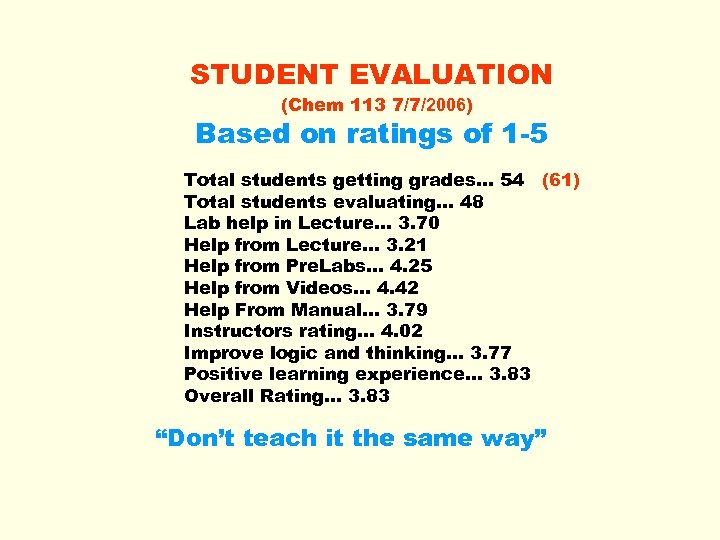
STUDENT EVALUATION (Chem 113 7/7/2006) Based on ratings of 1 -5 Total students getting grades. . . 54 (61) Total students evaluating. . . 48 Lab help in Lecture. . . 3. 70 Help from Lecture. . . 3. 21 Help from Pre. Labs. . . 4. 25 Help from Videos. . . 4. 42 Help From Manual. . . 3. 79 Instructors rating. . . 4. 02 Improve logic and thinking. . . 3. 77 Positive learning experience. . . 3. 83 Overall Rating. . . 3. 83 “Don’t teach it the same way”
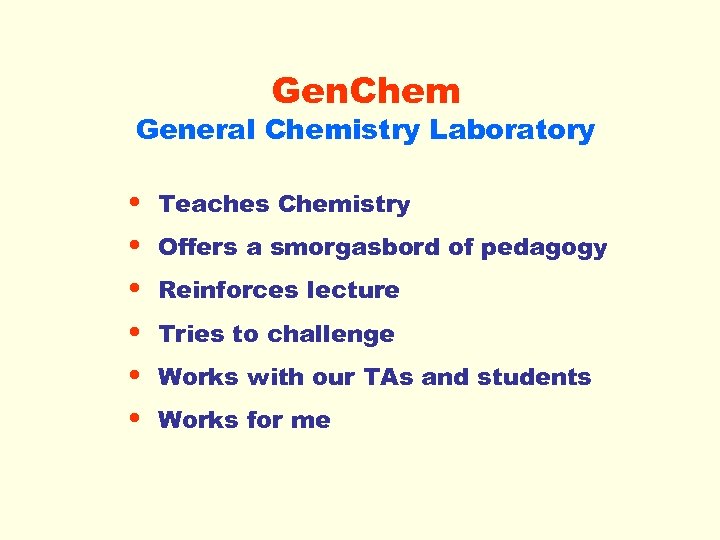
Gen. Chem General Chemistry Laboratory • • • Teaches Chemistry Offers a smorgasbord of pedagogy Reinforces lecture Tries to challenge Works with our TAs and students Works for me
GROUP IV C Si Ge Sn Pb A Silicon Analog of the Carbon Based Laboratory Instructor a TA called Gen. Chem http: //genchem. rutgers. edu
TALK TO THE MOLECULES GROUP IV C Si Ge Sn Pb 100. 0/99. 9 = 100. 1 http: //genchem. rutgers. edu
Скачать презентацию A Silicon Analog of the Carbon Based Laboratory
fa9911849883892f8474d051a081e0b5.ppt