 Скачать презентацию A Search for Strongly-Lensed High-z LBGs around SDSS
621bf2e0331b89ea283de2fc716cb078.ppt
- Количество слайдов: 25



A Search for Strongly-Lensed, High-z LBGs around SDSS LRGs Elizabeth Buckley-Geer Experimental Astrophysics Group Fermilab Center for Particle Astrophysics July 5 2007 23 rd IAP Colloquium 1
Collaborators u Fermilab: H. Lin, D. Kubik, H. T. Diehl, S. Allam, D. Tucker, E. Buckley-Geer, J. Kubo, J. Annis, J. Frieman, D. Finley, J. Estrada, D. Mc. Ginnis, V. Scarpine, … Fermilab Cosmology Analysis Group u D. Schneider, M. Oguri, A. Shapley, A. Baker, D. Lutz, J. A. Smith, J. Brinchmann, M. Strauss, M. -S. Shin, C. Kochanek, C. Tremonti, … July 5 2007 23 rd IAP Colloquium 2
Outline u u u Motivation SDSS Arc Search Follow-up Observations Sample Properties Lens Modeling Plans July 5 2007 23 rd IAP Colloquium 3
Motivation u c. B 58 (Yee et al. 1996) – Discovered serendipitously in CNOC 1 cluster redshift survey – z = 2. 72 Lyman break galaxy (LBG) lensed by z = 0. 37 brightest cluster galaxy (BCG) – Bright, blue object (r = 20. 4), 6” away from BCG – Bright enough to be easily seen in SDSS and to have an SDSS spectroscopic redshift! u 8 o’clock arc (Allam et al. 2007) – Discovered serendipitously in inspection of SDSS DR 4 interacting galaxy pairs sample – z = 2. 73 LBG lensed by z = 0. 38 SDSS luminous red galaxy (LRG) – Bright, blue arc (total r = 19), ~4” away from LRG – Easy absorption line redshift in 20 min DIS spectrum on APO 3. 5 m u Start systematic search for more systems like c. B 58 and the 8 o’clock arc in the SDSS July 5 2007 23 rd IAP Colloquium 4
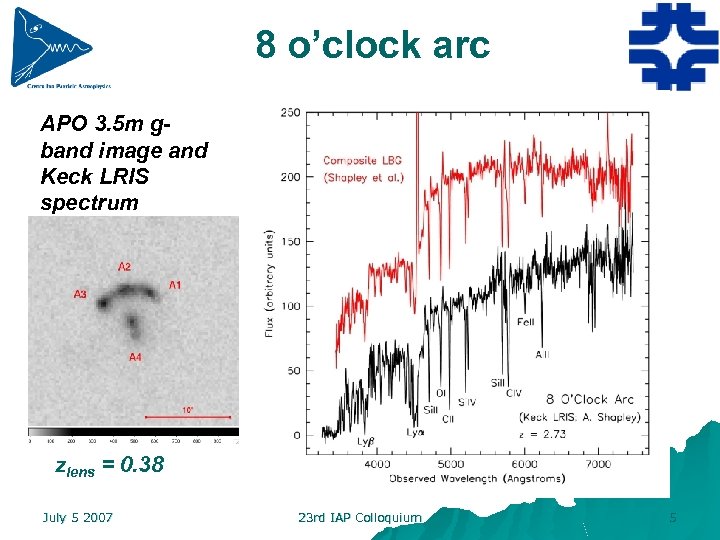
8 o’clock arc APO 3. 5 m gband image and Keck LRIS spectrum zlens = 0. 38 July 5 2007 23 rd IAP Colloquium 5
SDSS Arc Search u Potential red galaxy lenses from SDSS DR 5 (8000 deg 2) – 221, 000 luminous red galaxies (LRGs) – 29, 000 brightest cluster galaxies (BCGs) from max. BCG cluster sample (J. Annis) u SDSS DR 5 CAS database query (D. Kubik) – – u Blue galaxies (g-r and r-i color cuts) < 10” from LRG or BCG 57, 000 systems returned with n=1 or more blue objects Rank systems by number of blue objects n Visual inspections – – – Inspect all systems (1081) with n ≥ 3 blue objects 4 separate inspectors looked at SDSS CAS gri color jpeg images Look for arc-like morphology Reject HII regions, spiral arms, merging galaxies, etc. Follow up 14 candidate systems flagged by 2 or more inspectors Plus 1 more (“clone”) from single-inspector eye scan of n=2 LRG list July 5 2007 23 rd IAP Colloquium 6
Follow-up Observations u Follow-up observing program (Fermilab group) on Apache Point Observatory (APO) 3. 5 m telescope – Arcs are bright (r ~ 20 -22) and high SB ( r ~ 23 -24 mag/arcsec 2) – SPIcam gri imaging (15 min exposures per filter) for deeper images (SDSS discovery images are only 54 seconds on a 2. 5 m telescope) – DIS spectroscopy (45 min exposures) of brighter targets for source and lens redshifts u Additional Hobby-Eberly Telescope (HET) spectroscopic follow-up program (PI D. Schneider) of fainter targets u Subaru FOCAS imaging and spectroscopy (M. Oguri) of “Clone” system u APO and HET programs are ongoing July 5 2007 23 rd IAP Colloquium 7
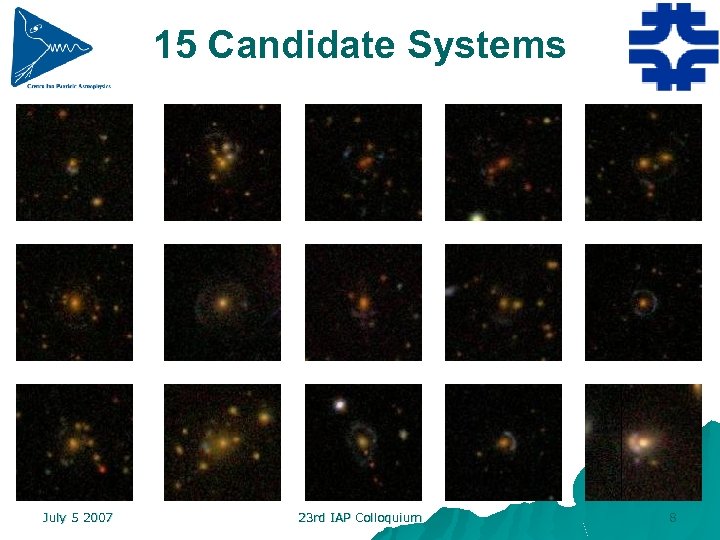
15 Candidate Systems July 5 2007 23 rd IAP Colloquium 8
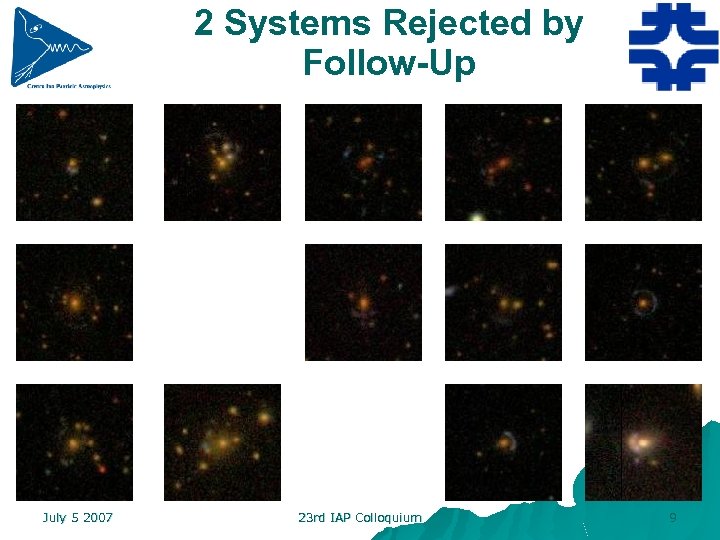
2 Systems Rejected by Follow-Up July 5 2007 23 rd IAP Colloquium 9
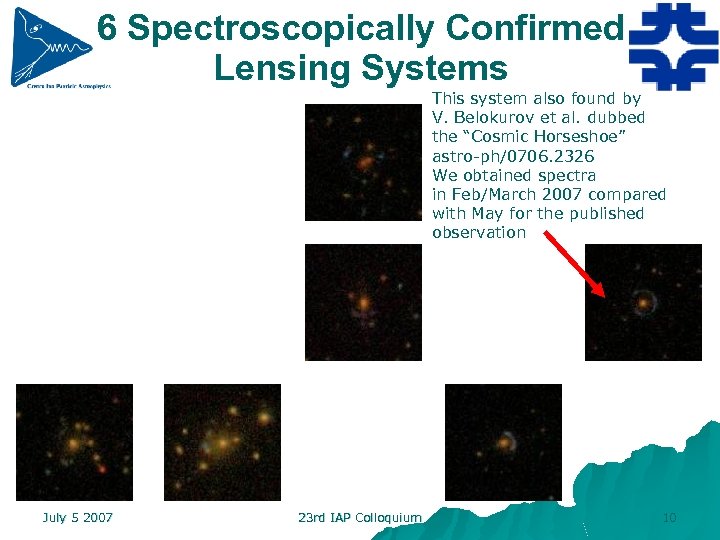
6 Spectroscopically Confirmed Lensing Systems This system also found by V. Belokurov et al. dubbed the “Cosmic Horseshoe” astro-ph/0706. 2326 We obtained spectra in Feb/March 2007 compared with May for the published observation July 5 2007 23 rd IAP Colloquium 10
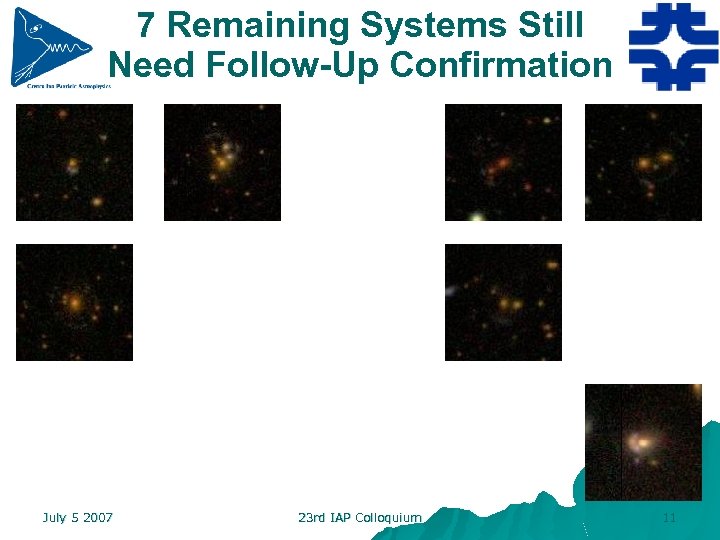
7 Remaining Systems Still Need Follow-Up Confirmation July 5 2007 23 rd IAP Colloquium 11
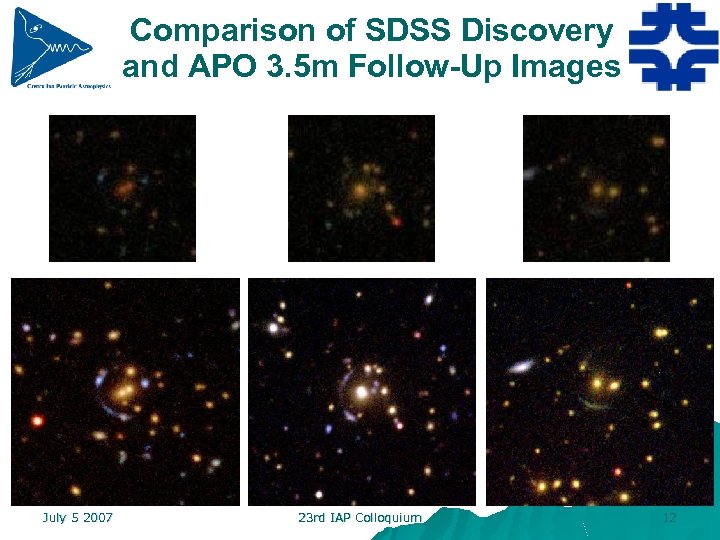
Comparison of SDSS Discovery and APO 3. 5 m Follow-Up Images July 5 2007 23 rd IAP Colloquium 12
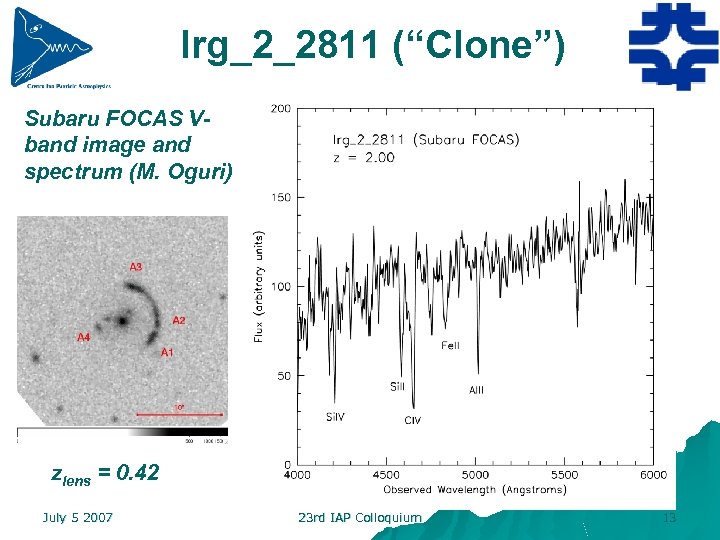
lrg_2_2811 (“Clone”) Subaru FOCAS Vband image and spectrum (M. Oguri) zlens = 0. 42 July 5 2007 23 rd IAP Colloquium 13
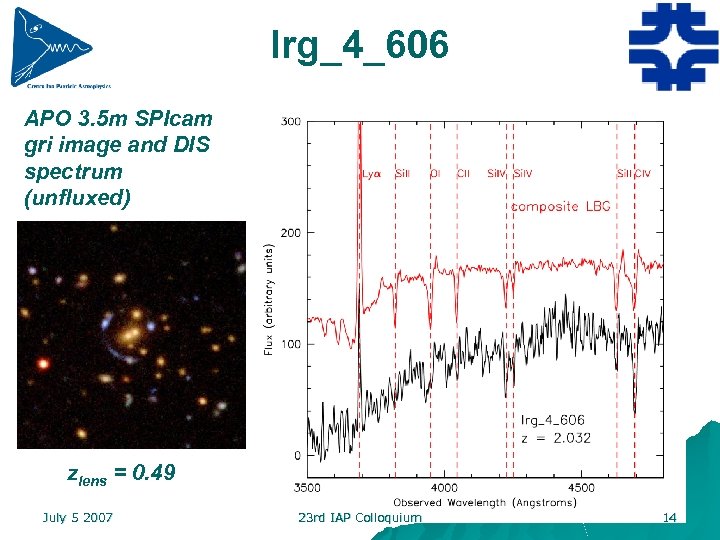
lrg_4_606 APO 3. 5 m SPIcam gri image and DIS spectrum (unfluxed) zlens = 0. 49 July 5 2007 23 rd IAP Colloquium 14
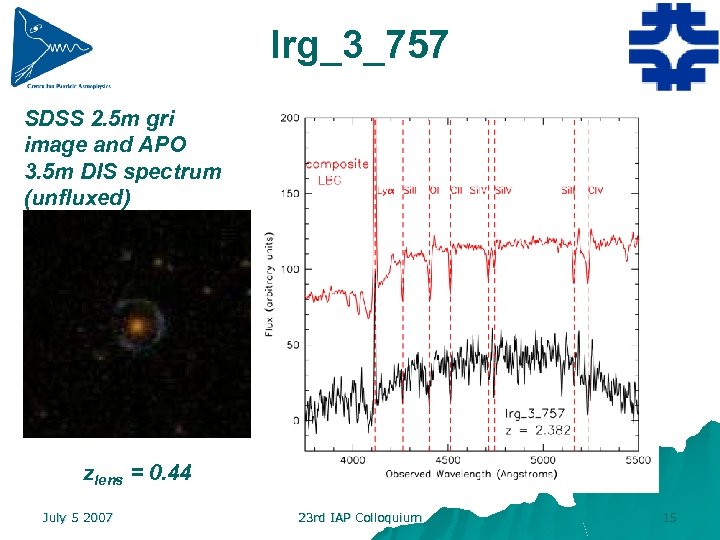
lrg_3_757 SDSS 2. 5 m gri image and APO 3. 5 m DIS spectrum (unfluxed) zlens = 0. 44 July 5 2007 23 rd IAP Colloquium 15
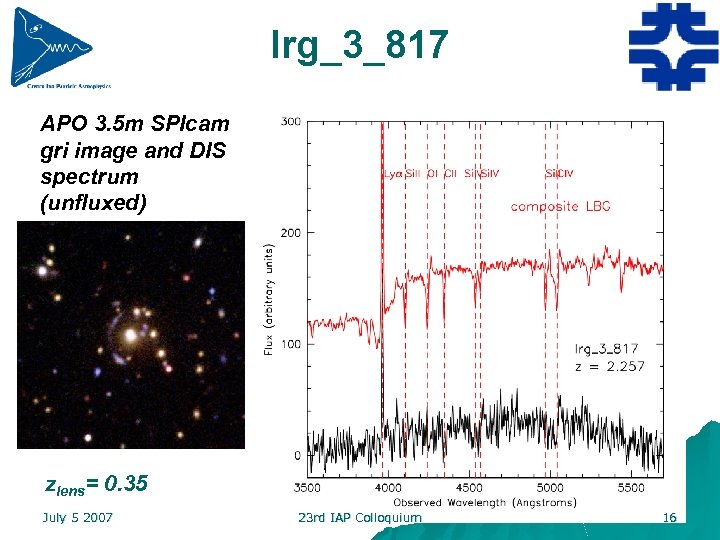
lrg_3_817 APO 3. 5 m SPIcam gri image and DIS spectrum (unfluxed) zlens= 0. 35 July 5 2007 23 rd IAP Colloquium 16
Sample Properties u Current follow-up results for 15 candidate systems – 6 spectroscopically confirmed u u 4 with z = 2. 0 -2. 4: “BX” galaxies (z~2 Lyman break galaxies) 2 have z = 1. 0 and z = 0. 4 – 2 rejected, remaining 7 still need follow-up confirmation u Lensed images are bright (r ~ 20 -22) and high SB ( r ~ 23 -24 mag/arcsec 2) Lens galaxies in z ~ 0. 2 -0. 5 range, but most have z ~ 0. 4 u Einstein radius, mass, and M/L analysis (D. Kubik master’s thesis) u – – – Estimate Einstein radius by circle fit to lensed images Einstein radii 3 -10”, or 10 -40 h-1 kpc Masses within Einstein radii of 1012 - 1013 h-1 M “Intermediate” regime: lensing by groups and centers of clusters M/L (g-band rest frame) of 10 -140 h (M/L) on scales of 10 -40 h-1 kpc u u July 5 2007 Consistent with trends from dynamical and X-ray M/L measurements for ellipticals on similar scales Complementary to other strong lensing results on smaller scales, and weak lensing results on larger scales 23 rd IAP Colloquium 17
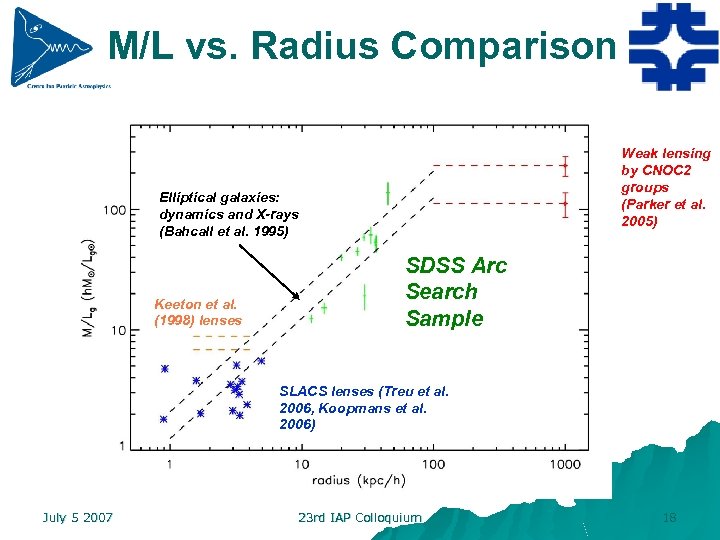
M/L vs. Radius Comparison Weak lensing by CNOC 2 groups (Parker et al. 2005) Elliptical galaxies: dynamics and X-rays (Bahcall et al. 1995) Keeton et al. (1998) lenses SDSS Arc Search Sample SLACS lenses (Treu et al. 2006, Koopmans et al. 2006) July 5 2007 23 rd IAP Colloquium 18
u u u u u Lens Modeling Use lensmodel/gravlens (C. Keeton, astro-ph/0102340) Image positions from SExtractor Assume a SIE mass profile Flat cosmology, Wm=0. 3, WL=0. 7, H 0=100 h km s-1 Mpc-1 Fit for the Einstein radius θEIN Determine velocity dispersion and mass contained within θEIN Have modeled the “ 8 o’clock arc” and the “Clone” so far Used the SPIcam image for the 8 o’clock arc and both the SDSS and Subaru images for the clone. Get consistent results from the two images of the clone. Show results from fit to Subaru data. Also have started to use LENSVIEW (R. Wayth & R. L. Webster, MNRAS 372 (2006) 1187 -1207). Have a preliminary fit for “The Clone” that qualitatively agrees with the lensmodel results. July 5 2007 23 rd IAP Colloquium 19
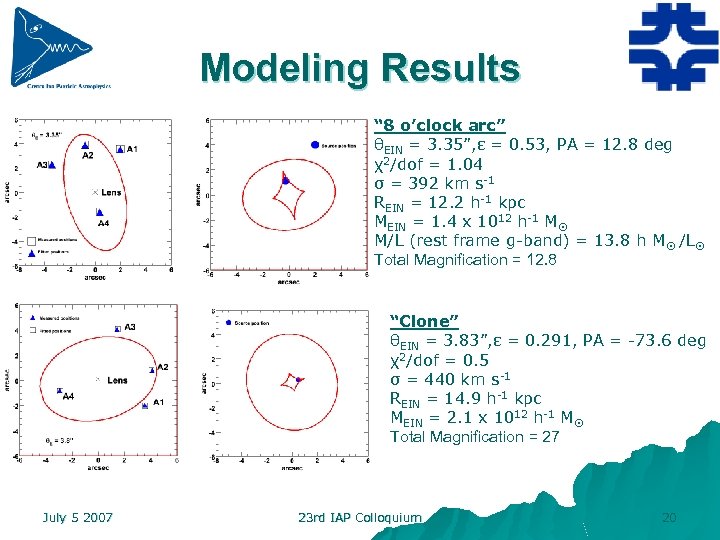
Modeling Results “ 8 o’clock arc” θEIN = 3. 35”, ε = 0. 53, PA = 12. 8 deg χ2/dof = 1. 04 σ = 392 km s-1 REIN = 12. 2 h-1 kpc MEIN = 1. 4 x 10¹² h-1 M M/L (rest frame g-band) = 13. 8 h M /L Total Magnification = 12. 8 “Clone” θEIN = 3. 83”, ε = 0. 291, PA = -73. 6 deg χ2/dof = 0. 5 σ = 440 km s-1 REIN = 14. 9 h-1 kpc MEIN = 2. 1 x 10¹² h-1 M Total Magnification = 27 July 5 2007 23 rd IAP Colloquium 20
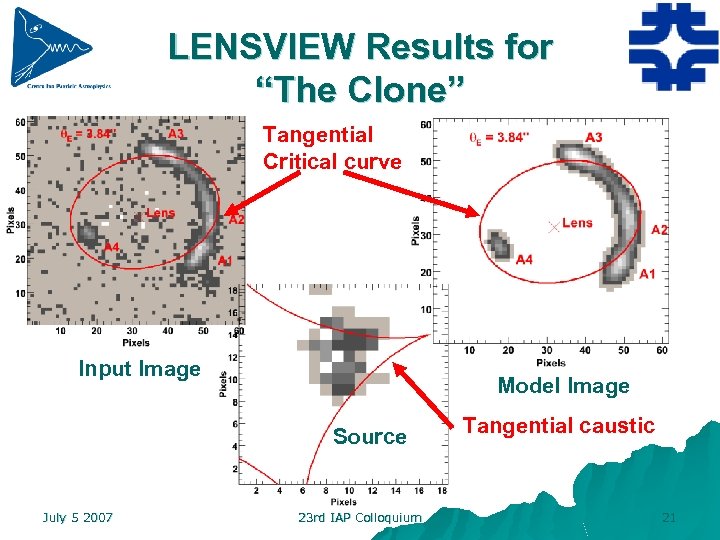
LENSVIEW Results for “The Clone” Tangential Critical curve Input Image Model Image Source July 5 2007 23 rd IAP Colloquium Tangential caustic 21
Plans u Observations – – – u Complete follow-up confirmation programs at APO and HET HST Cycle 16 and Spitzer Cycle 4: 8 o’clock arc and clone Gemini NIRI spectroscopy of 3 confirmed z > 2 systems (2007 B) IRAM mm CO and continuum observations of z > 2 systems Will propose for IRTF near-IR imaging follow-up Analyses – More detailed lens models u Constrain lens mass profiles in group/cluster core environments – Simulations to determine selection effects – Understand source and lens redshift distributions u More SDSS arc searches – – Inspect existing n ≤ 2 query search systems Search around fainter, higher-z red galaxies, including Stripe 82 coadds Increase search radius to get cluster-scale lensing systems Implement automated search methods July 5 2007 23 rd IAP Colloquium 22
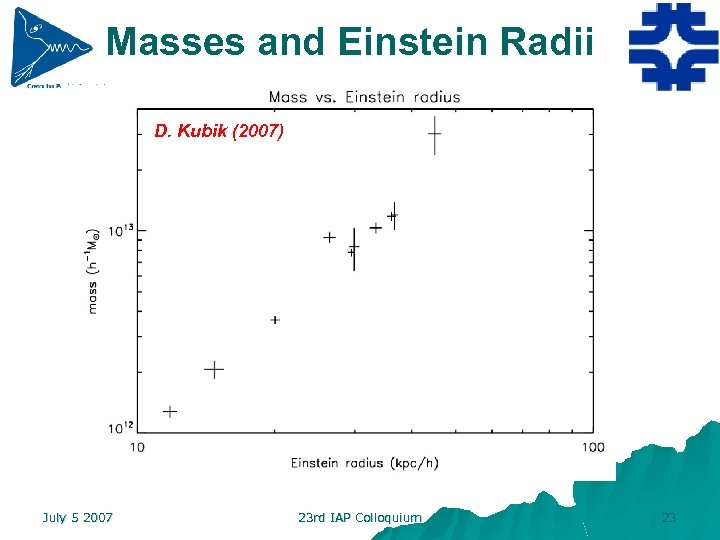
Masses and Einstein Radii D. Kubik (2007) July 5 2007 23 rd IAP Colloquium 23
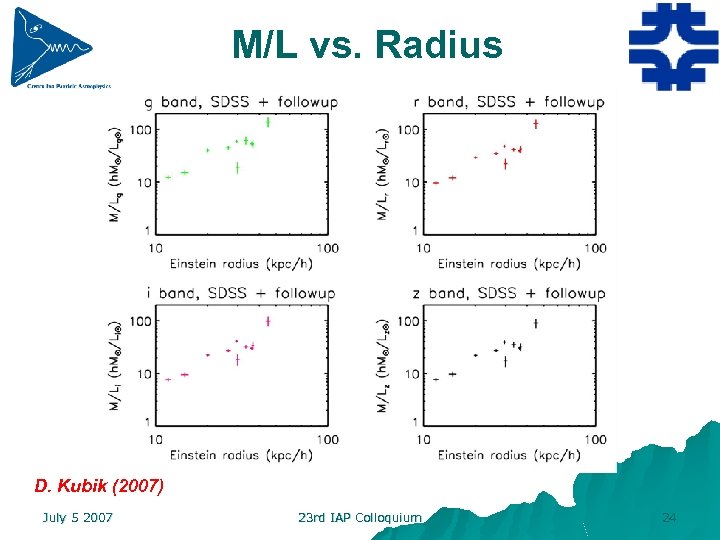
M/L vs. Radius D. Kubik (2007) July 5 2007 23 rd IAP Colloquium 24
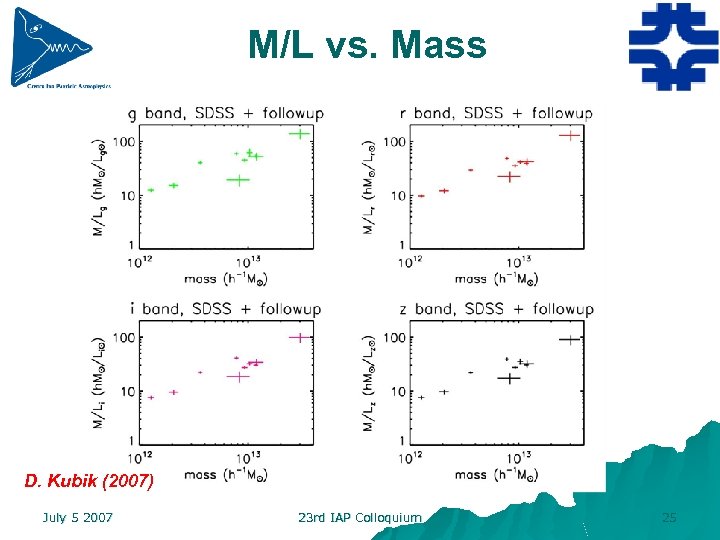
M/L vs. Mass D. Kubik (2007) July 5 2007 23 rd IAP Colloquium 25
Скачать презентацию A Search for Strongly-Lensed High-z LBGs around SDSS
621bf2e0331b89ea283de2fc716cb078.ppt