


 Скачать презентацию -A Satellite Workshop at IPAC-2010 — Superconducting RF
b9d53d90e1aebea3db02f58aece53501.ppt
- Количество слайдов: 30
 -A Satellite Workshop at IPAC-2010 - Superconducting RF Cavity Technology and Industrialization Study with Japanese Industries Eiji Kako (KEK) in cooperation with Japanese Industries IPAC-2010 Satellite Workshop, Kyoto, May 23, 2010 1
 Outline • Introduction – Industrial models assumed for the ILC SCRF cavities • Industrialization Study in cooperation with Japanese Industries – Manufacturing process and facilities required – Industrial engineering examples 2
 A Model for Industrialization • A model for 9 -cell cavity productions – 15, 764 + spare + production back-up (~ 10%) – ~ 18, 000 cavities / 4~5 years • Possible models for manufacturing – Single consortium/vendor – Three regional consortiums/vendors – Six (or more) consortiums/vendors • < 3, 000 > cavities / vendor • < 3 > cavities / day / vendor (assuming 5 years and 200 days/year) 3
 Industrialization Study in Japan • KEK started the ILC industrialization study in cooperation with Japanese Industries • KEK: – Provides process models and required times • Industries: – Study manufacturing model and facilities required, and – Report examples of industrialization experiences as references for further studies 4
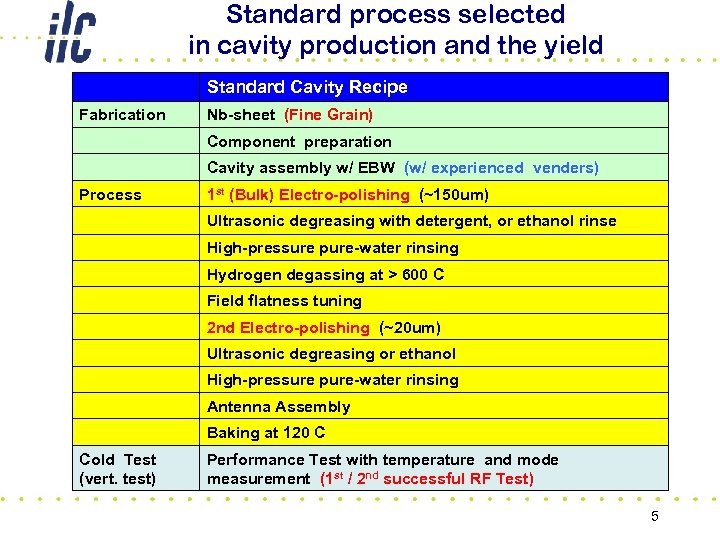 Standard process selected in cavity production and the yield Standard Cavity Recipe Fabrication Nb-sheet (Fine Grain) Component preparation Cavity assembly w/ EBW (w/ experienced venders) Process 1 st (Bulk) Electro-polishing (~150 um) Ultrasonic degreasing with detergent, or ethanol rinse High-pressure pure-water rinsing Hydrogen degassing at > 600 C Field flatness tuning 2 nd Electro-polishing (~20 um) Ultrasonic degreasing or ethanol High-pressure pure-water rinsing Antenna Assembly Baking at 120 C Cold Test (vert. test) Performance Test with temperature and mode measurement (1 st / 2 nd successful RF Test) 5
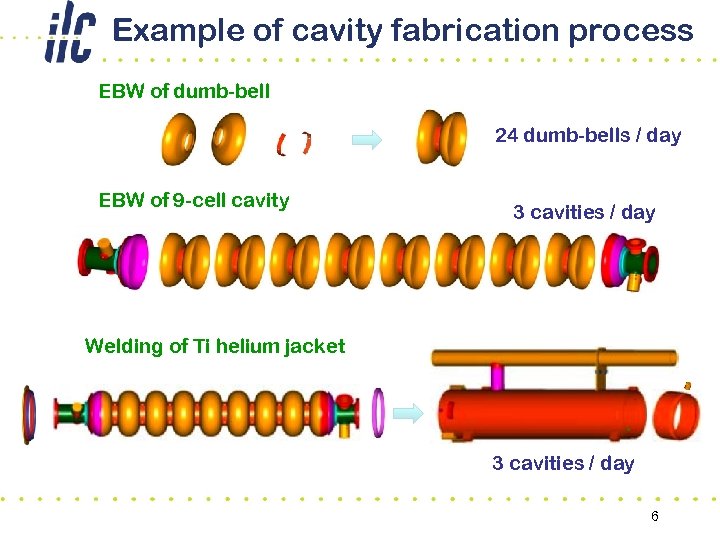 Example of cavity fabrication process EBW of dumb-bell 24 dumb-bells / day EBW of 9 -cell cavity 3 cavities / day Welding of Ti helium jacket 3 cavities / day 6
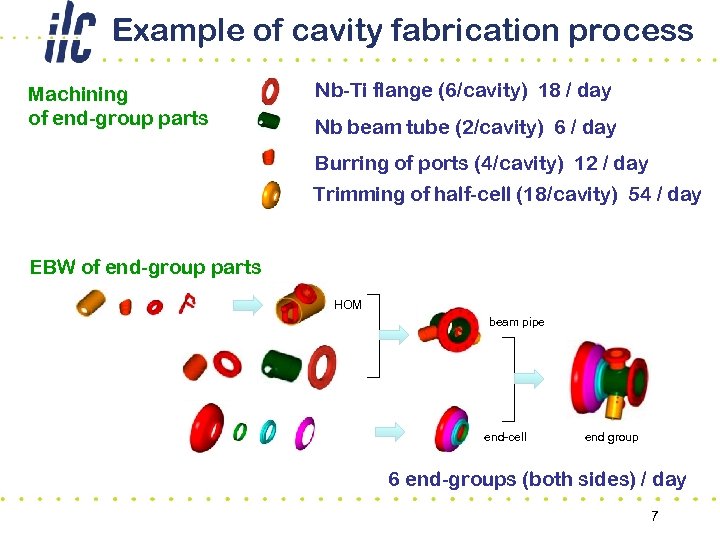 Example of cavity fabrication process Machining of end-group parts Nb-Ti flange (6/cavity) 18 / day Nb beam tube (2/cavity) 6 / day Burring of ports (4/cavity) 12 / day Trimming of half-cell (18/cavity) 54 / day EBW of end-group parts HOM beam pipe end-cell end group 6 end-groups (both sides) / day 7
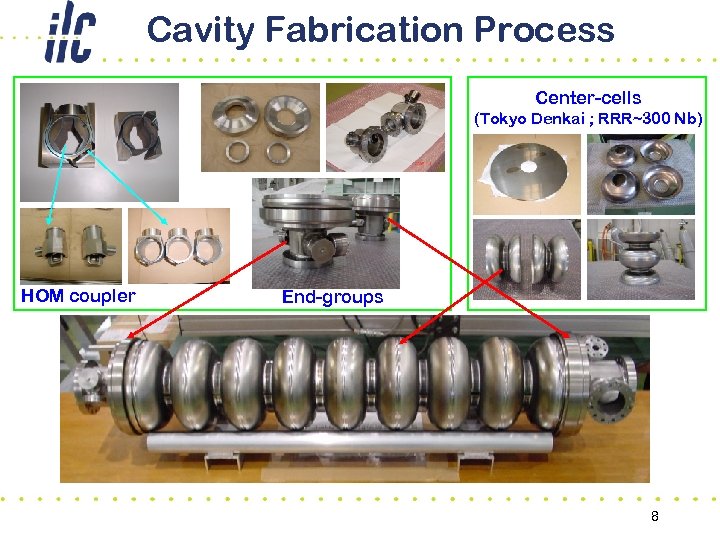 Cavity Fabrication Process Center-cells (Tokyo Denkai ; RRR~300 Nb) HOM coupler End-groups 8
 Cavity Processing for Vertical Tests
 Outline • Introduction – Industrial models assumed for the ILC SCRF cavities • Industrialization Study in cooperation with Japanese Industries – Manufacturing process and facilities required – Industrial engineering examples 10
 Boundary Conditions + We evaluate an ideal production facility from cavity fabrication to cryomodule assembly to produce 600 cavities per year by using a factory production simulation analysis. [ assumption ] • Consider only process time including preparing time to machining, welding, vertical test, surface treatment and cryomodule assembly excluding conveying time of parts and assemblies and costs of labors. • Assumed cavity yield at 35 MV/m = 80% through first cavity processing and 50% after repairing and second cavity processing. • Based on 16 hours of actual run time (2 shifts) per day for each machining and process. • • Evaluate the number of machines and apparatus to satisfy the production rate by use of production simulation code. Machining, welding and other process would use special jigs to handle multiple subassemblies for a given process cycle. 11
 Mass Production Models • Case 1 – Laboratory R&D scheme – 1 seam / one welding cycle • Case 2 – Current production scheme at some industries – Dumb-bell: 8 seams / one welding cycle – 8 dumb-bell + 2 end-group (= 9 -cell cavity) EBW /one welding cycle • Case 3 – Simple mass production model – 8 end-group / one welding cycle – 8 dumb-bell + 2 end-group (= 9 -cell cavity) EBW /one welding cycle • Case 4, (in Preparation) – 8 end-group / one welding cycle – 8 x 9 -cell cavity EBW / one welding cycle 12
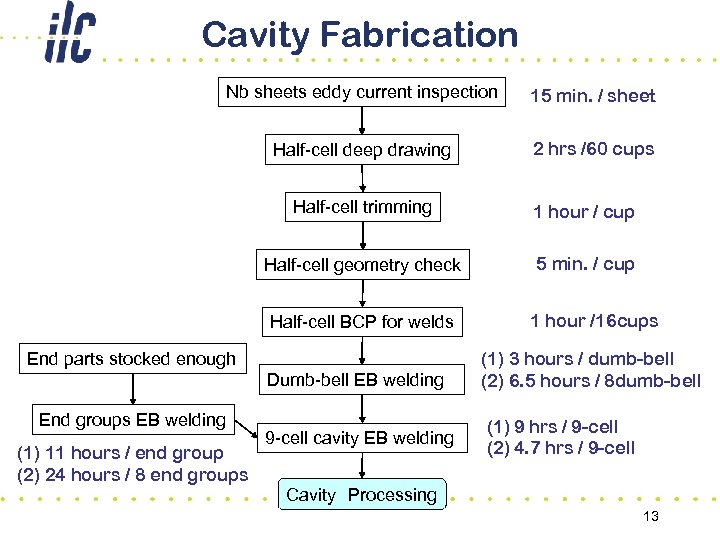 Cavity Fabrication Nb sheets eddy current inspection 15 min. / sheet Half-cell deep drawing 2 hrs /60 cups Half-cell trimming 1 hour / cup Half-cell geometry check 5 min. / cup Half-cell BCP for welds End parts stocked enough Dumb-bell EB welding End groups EB welding (1) 11 hours / end group (2) 24 hours / 8 end groups 9 -cell cavity EB welding 1 hour /16 cups (1) 3 hours / dumb-bell (2) 6. 5 hours / 8 dumb-bell (1) 9 hrs / 9 -cell (2) 4. 7 hrs / 9 -cell Cavity Processing 13
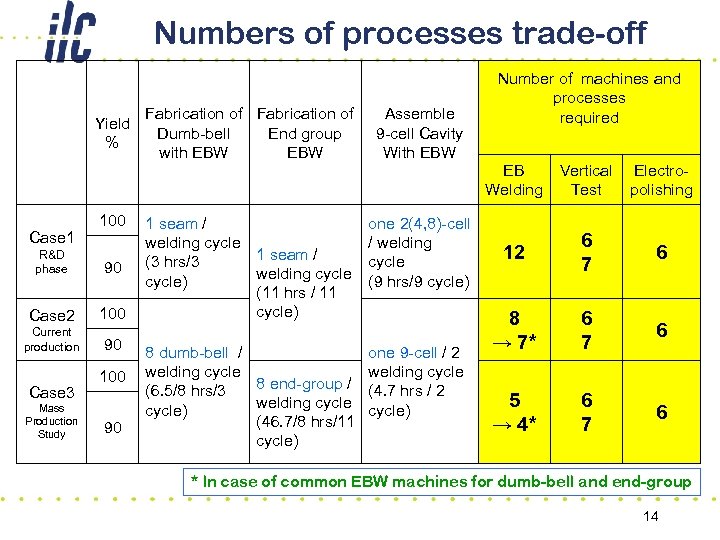 Numbers of processes trade-off Yield % Fabrication of Dumb-bell End group with EBW Assemble 9 -cell Cavity With EBW Number of machines and processes required EB Welding Case 1 100 R&D phase 90 Case 2 100 Current production 90 Case 3 Mass Production Study 100 90 1 seam / welding cycle 1 seam / (3 hrs/3 welding cycle) (11 hrs / 11 cycle) one 2(4, 8)-cell / welding cycle (9 hrs/9 cycle) 8 dumb-bell / welding cycle 8 end-group / (6. 5/8 hrs/3 welding cycle) (46. 7/8 hrs/11 cycle) one 9 -cell / 2 welding cycle (4. 7 hrs / 2 cycle) Vertical Test Electropolishing 12 6 7 6 8 → 7* 6 7 6 5 → 4* 6 7 6 * In case of common EBW machines for dumb-bell and end-group 14
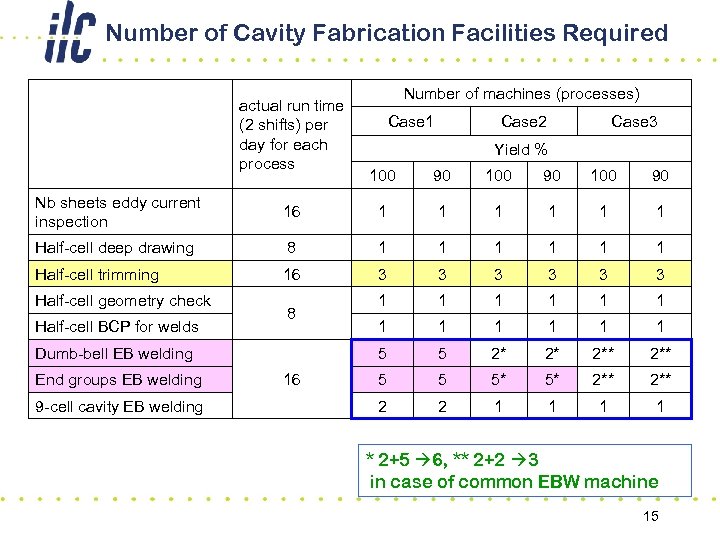 Number of Cavity Fabrication Facilities Required actual run time (2 shifts) per day for each process Number of machines (processes) Case 1 Case 2 Case 3 Yield % 100 90 Nb sheets eddy current inspection 16 1 1 1 Half-cell deep drawing 8 1 1 1 Half-cell trimming 16 3 3 3 1 1 1 5 5 2* 2* 2** 5 5 5* 5* 2** 2 2 1 1 Half-cell geometry check Half-cell BCP for welds 8 Dumb-bell EB welding End groups EB welding 9 -cell cavity EB welding 16 * 2+5 6, ** 2+2 3 in case of common EBW machine 15
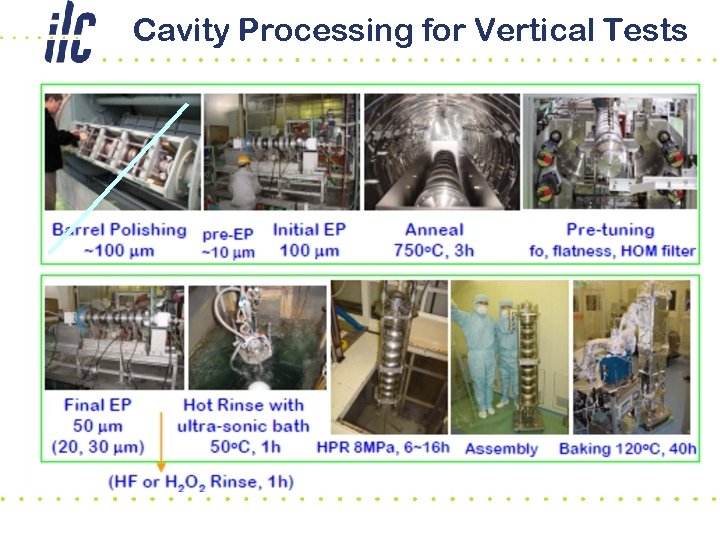
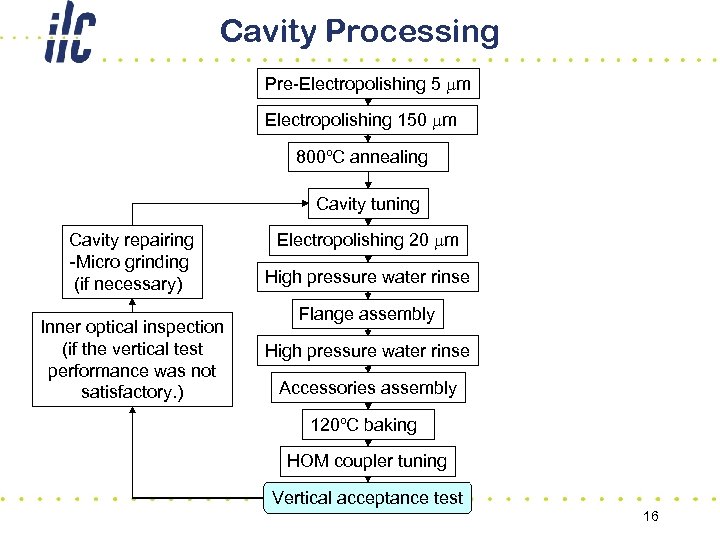 Cavity Processing Pre-Electropolishing 5 mm Electropolishing 150 mm 800ºC annealing Cavity tuning Cavity repairing -Micro grinding (if necessary) Inner optical inspection (if the vertical test performance was not satisfactory. ) Electropolishing 20 mm High pressure water rinse Flange assembly High pressure water rinse Accessories assembly 120ºC baking HOM coupler tuning Vertical acceptance test 16
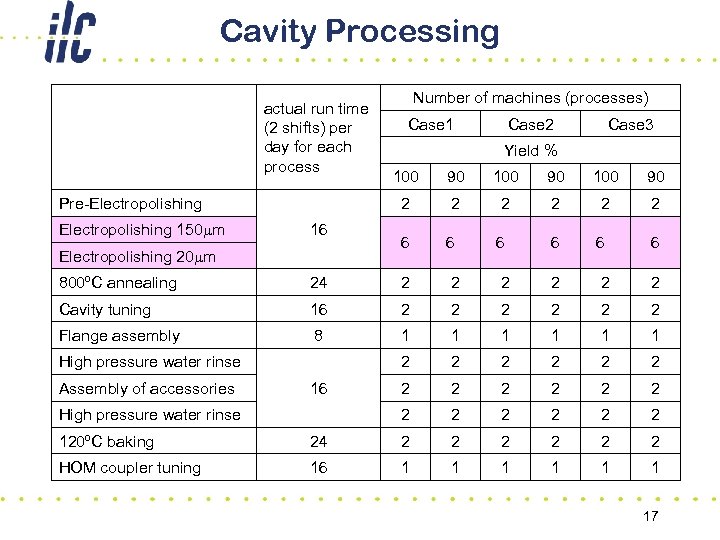 Cavity Processing actual run time (2 shifts) per day for each process Case 1 Case 2 Case 3 Yield % 16 Electropolishing 20 mm 100 90 2 Pre-Electropolishing 150 mm Number of machines (processes) 2 2 2 6 6 6 6 800ºC annealing 24 2 2 2 Cavity tuning 16 2 2 2 Flange assembly 8 1 1 1 2 2 2 2 2 High pressure water rinse Assembly of accessories 16 High pressure water rinse 120ºC baking 24 2 2 2 HOM coupler tuning 16 1 1 1 17
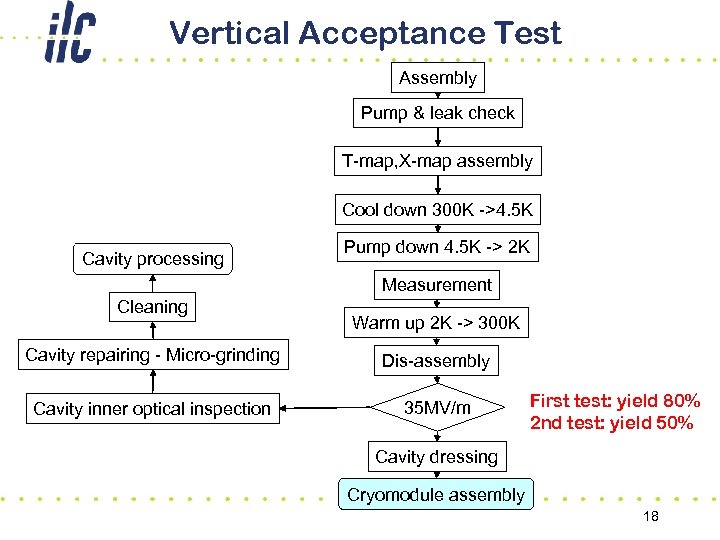 Vertical Acceptance Test Assembly Pump & leak check T-map, X-map assembly Cool down 300 K ->4. 5 K Cavity processing Pump down 4. 5 K -> 2 K Measurement Cleaning Warm up 2 K -> 300 K Cavity repairing - Micro-grinding Dis-assembly Cavity inner optical inspection 35 MV/m First test: yield 80% 2 nd test: yield 50% Cavity dressing Cryomodule assembly 18
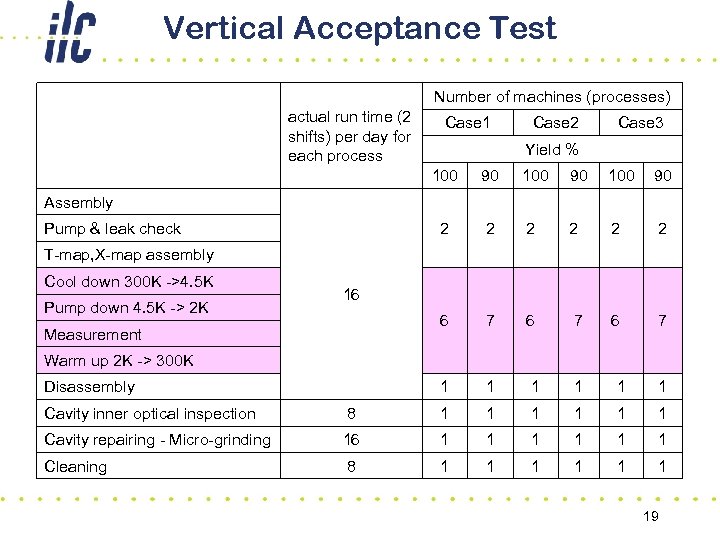 Vertical Acceptance Test Number of machines (processes) actual run time (2 shifts) per day for each process Case 1 Case 2 Case 3 Yield % 100 90 2 2 2 2 6 7 6 7 1 1 1 Assembly Pump & leak check T-map, X-map assembly Cool down 300 K ->4. 5 K Pump down 4. 5 K -> 2 K 16 Measurement Warm up 2 K -> 300 K Disassembly Cavity inner optical inspection 8 1 1 1 Cavity repairing - Micro-grinding 16 1 1 1 Cleaning 8 1 1 1 19
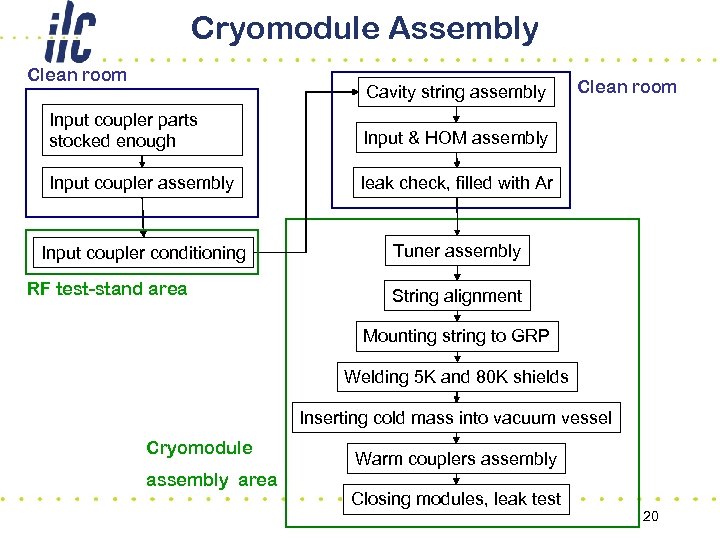 Cryomodule Assembly Clean room Cavity string assembly Input coupler parts stocked enough Input & HOM assembly Input coupler assembly leak check, filled with Ar Input coupler conditioning Clean room Tuner assembly RF test-stand area String alignment Mounting string to GRP Welding 5 K and 80 K shields Inserting cold mass into vacuum vessel Cryomodule assembly area Warm couplers assembly Closing modules, leak test 20
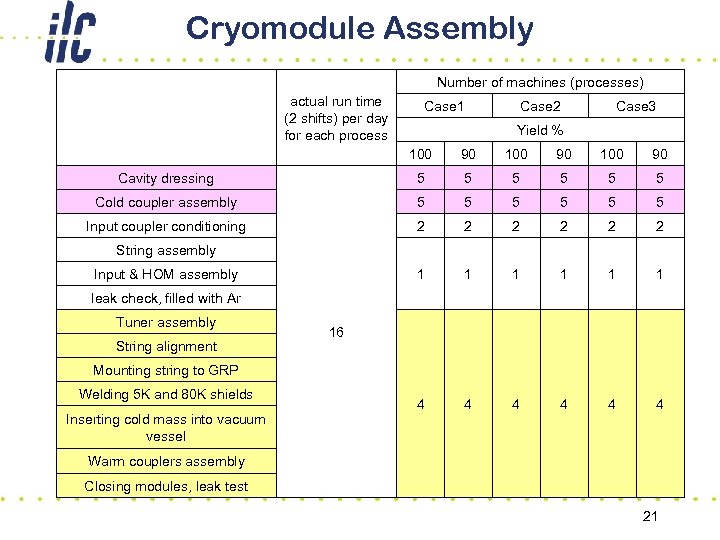 Cryomodule Assembly Number of machines (processes) actual run time (2 shifts) per day for each process Case 1 Case 2 Case 3 Yield % 100 90 Cavity dressing 5 5 5 Cold coupler assembly 5 5 5 Input coupler conditioning 2 2 2 1 1 1 4 4 4 String assembly Input & HOM assembly leak check, filled with Ar Tuner assembly String alignment 16 Mounting string to GRP Welding 5 K and 80 K shields Inserting cold mass into vacuum vessel Warm couplers assembly Closing modules, leak test 21
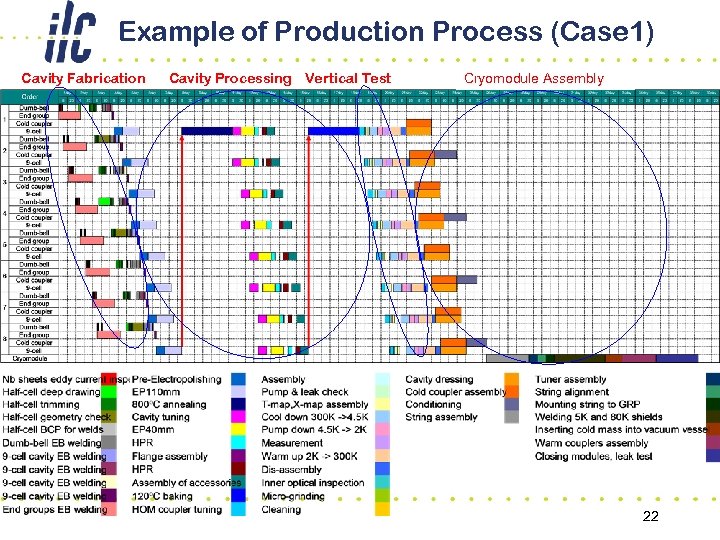 Example of Production Process (Case 1) Cavity Fabrication Cavity Processing Vertical Test Cryomodule Assembly 22
 Outline • Introduction – Industrial models assumed for the ILC SCRF cavities • Industrialization Study in cooperation with Japanese Industries – Manufacturing process and facilities required – Industrial engineering examples 23
 Mass Production Engineering Experience 1. Basic method for Mass Production line design 2. Example Mass Production line design like ILC 3. Consortium Experience with SELETE 24
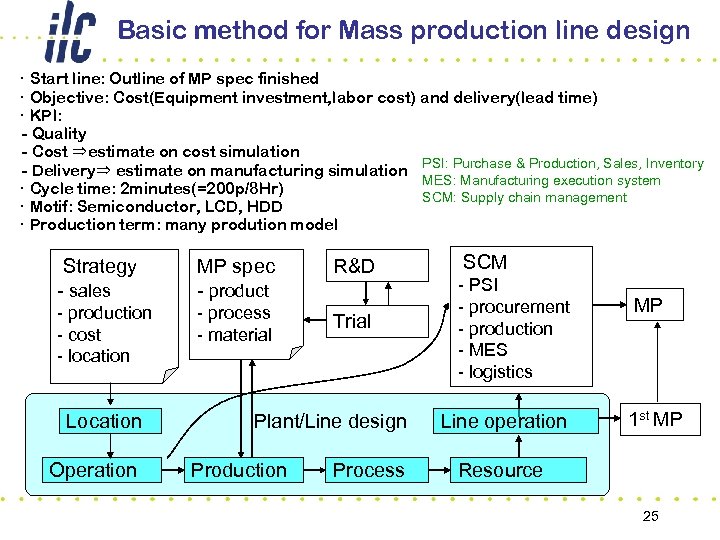 Basic method for Mass production line design ・ Start line: Outline of MP spec finished ・ Objective: Cost(Equipment investment, labor cost) and delivery(lead time) ・ KPI: - Quality - Cost ⇒estimate on cost simulation - Delivery⇒ estimate on manufacturing simulation PSI: Purchase & Production, Sales, Inventory MES: Manufacturing execution system ・ Cycle time: 2 minutes(=200 p/8 Hr) SCM: Supply chain management ・ Motif: Semiconductor, LCD, HDD ・ Production term: many prodution model Strategy - sales MP spec - product R&D - production - cost - location - process - material Trial Location Operation Plant/Line design Production Process SCM - PSI - procurement - production - MES - logistics Line operation MP 1 st MP Resource 25
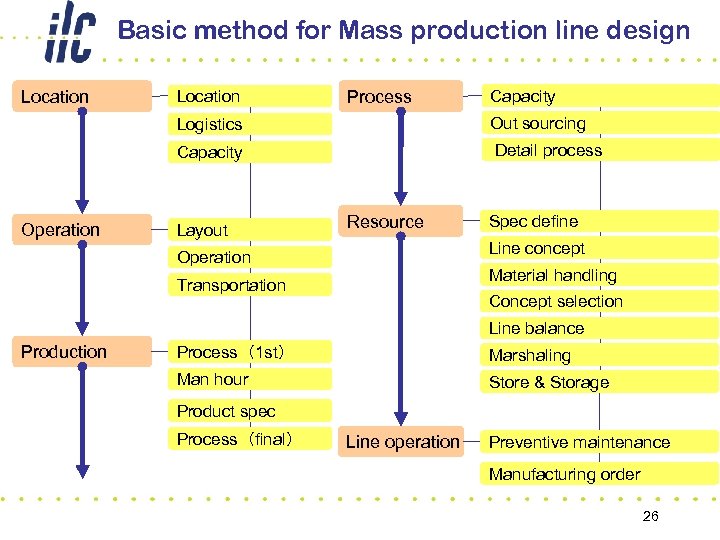 Basic method for Mass production line design Location Process Capacity Logistics Capacity Operation Out sourcing Detail process Layout Resource Spec define Line concept Operation Material handling Transportation Concept selection Line balance Production Process(1 st) Marshaling Man hour Store & Storage Product spec Process(final) Line operation Preventive maintenance Manufacturing order 26
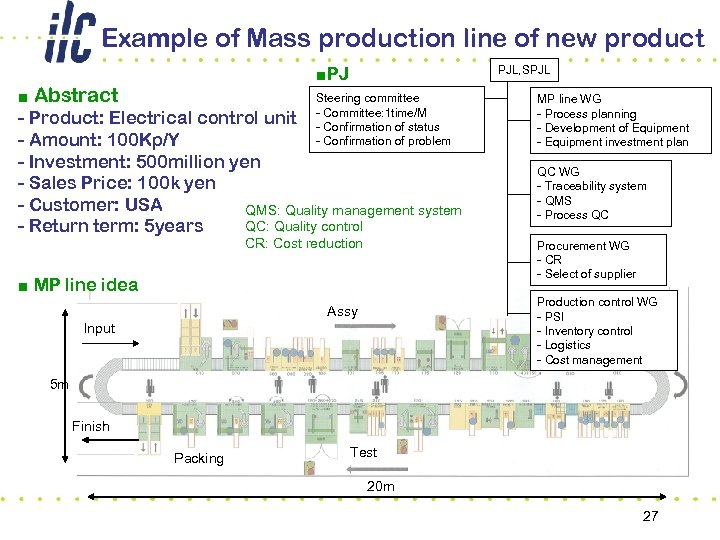 Example of Mass production line of new product PJL, SPJL ■PJ Steering committee ■ Abstract - Product: Electrical control unit - Committee: 1 time/M - Confirmation of status - Confirmation of problem - Amount: 100 Kp/Y - Investment: 500 million yen - Sales Price: 100 k yen - Customer: USA QMS: Quality management system QC: Quality control - Return term: 5 years CR: Cost reduction MP line WG - Process planning - Development of Equipment - Equipment investment plan QC WG - Traceability system - QMS - Process QC Procurement WG - CR - Select of supplier ■ MP line idea Production control WG - PSI - Inventory control - Logistics - Cost management Assy Input 5 m Finish Packing Test 20 m 27
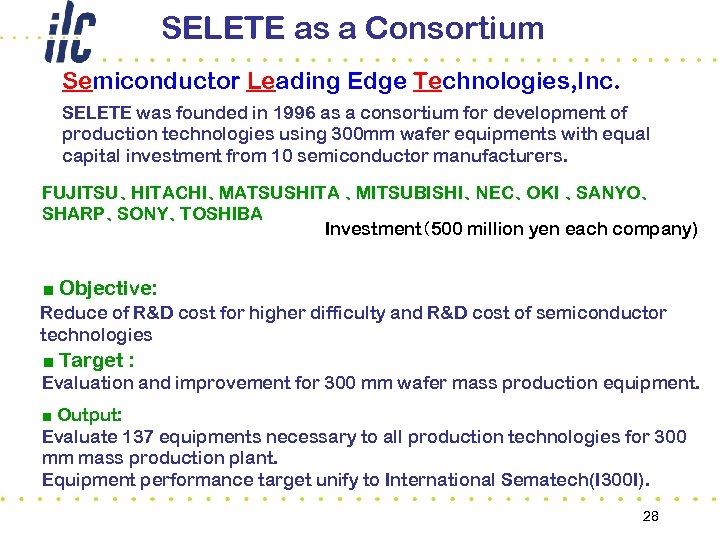 SELETE as a Consortium Semiconductor Leading Edge Technologies, Inc. SELETE was founded in 1996 as a consortium for development of production technologies using 300 mm wafer equipments with equal capital investment from 10 semiconductor manufacturers. FUJITSU、HITACHI、MATSUSHITA 、MITSUBISHI、NEC、OKI 、SANYO、 SHARP、SONY、TOSHIBA Investment(500 million yen each company) ■ Objective: Reduce of R&D cost for higher difficulty and R&D cost of semiconductor technologies ■ Target : Evaluation and improvement for 300 mm wafer mass production equipment. ■ Output: Evaluate 137 equipments necessary to all production technologies for 300 mm mass production plant. Equipment performance target unify to International Sematech(I 300 I). 28
 SUMMARY • ILC cavity industrialization models have been investigated in cooperation with Japanese Industries, – A production model: 3 cavities/day for 5 years • Based on each process time determined by KEK, the required industrial facilities have been investigated, • Dumb-bell process may be a critical pass to determine number of EBW facilities, and multiple seams per one welding cycle may help to reduce the number of EBW facilities, • Full production model in preparation to be studied, • Workshop layout and number of workers are to be further studied, as well as the cost-effective fabrication is to be investigated. 29
 Acknowledgements • We would thank – Japanese industries (MHI, Toshiba, and Hitachi) manufacturing SCRF cavities for their kindest cooperation for the industrialization studies. 30