 Скачать презентацию A Santoro B UERJ -BRAZIL DD-Members please update
247c5bd8d759cfca148aee4f6c1a77c4.ppt
- Количество слайдов: 70



A. Santoro B. UERJ -BRAZIL DD-Members: (please update) David O. Williams –David. O. Williams@cern. ch; Slava Illyin – Ilyin@theory. sinp. msu. ru; Yukio Karita – yulkio. karita@kek. ip; Marcel Kunze - Marcel. Kunze@hik. fzk. de; V. White – white@fnal. gov; Julio Ibarra - <julio@fiu. edu> ; Heidi Alvarez – heidi@fiu. edu; M. H. Zaidi - drzaidi@niit. edu. pk ; Alberto Santoro (Chair) – santoro@uerj. br, Welcome to Digital Divide CREW, Heidi, Julio from FIU, Zaidi from Pakistan and Vicky from Fermilab • • I - Introduction II - Maps: Topologies-Bandwidths III - Questionnaire / Responses IV - Conclusion - Suggested Solutions December 12 -13, 2002 A. Santoro 1
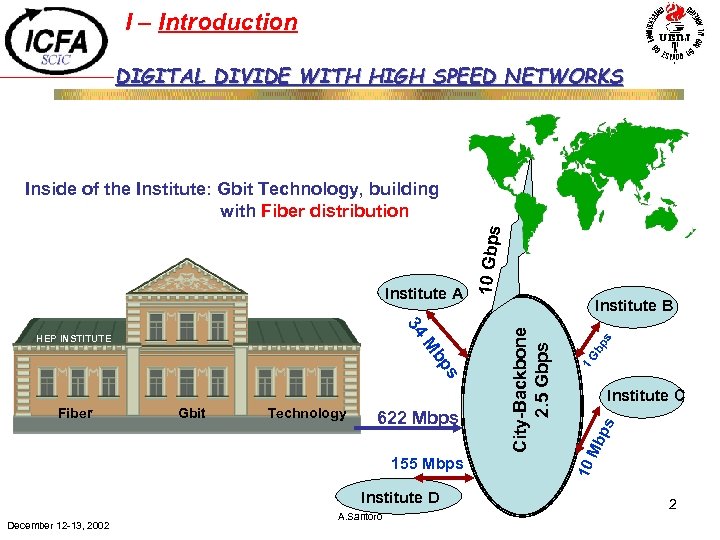
I – Introduction DIGITAL DIVIDE WITH HIGH SPEED NETWORKS 155 Mbps Institute D December 12 -13, 2002 A. Santoro ps Gb 1 ps 622 Mbps Mb s bp M Fiber Gbit Technology Institute C 10 34 HEP INSTITUTE Institute B City-Backbone 2. 5 Gbps Institute A 10 Gbps Inside of the Institute: Gbit Technology, building with Fiber distribution 2
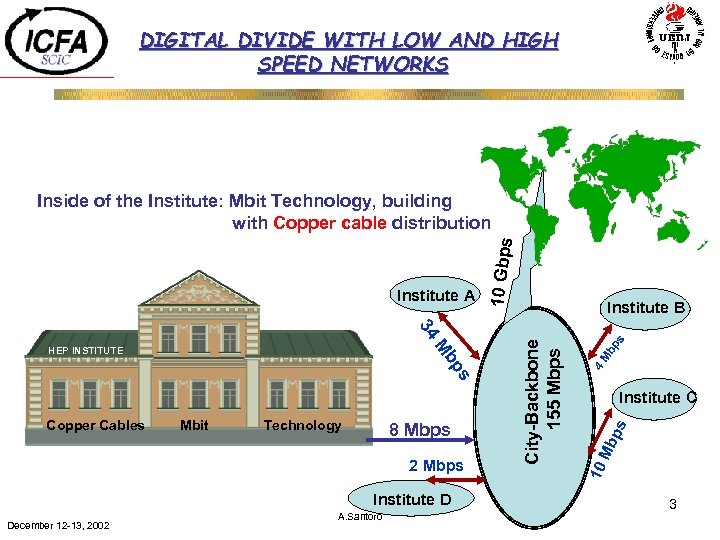
DIGITAL DIVIDE WITH LOW AND HIGH SPEED NETWORKS 2 Mbps Institute D December 12 -13, 2002 A. Santoro s bp M 4 ps s bp 8 Mbps Mb M Copper Cables Mbit Technology Institute C 10 34 HEP INSTITUTE Institute B City-Backbone 155 Mbps Institute A 10 Gbps Inside of the Institute: Mbit Technology, building with Copper cable distribution 3
I - Introduction DIGITAL DIVIDE • In September 28, Last Meeting, we have shown the problem of Digital Divide and due to the first sample of data recollected we understood how serious can be this problem for our LHC Experiments with GRID projects. • We have progress with data and have recollected a better sample of data now. • The Questionnaire presented in September was a bit upgraded and sent to ALICE, ATLAS, LHCb and CMS collaborations to get more information about connection in the institutes. December 12 -13, 2002 A. Santoro 4
DIGITAL DIVIDE • There is now a good data sample but not enough. • Perhaps we need to improve our Questionnaire changing the style to YES – NO – COMMENTS only. But this is a discussion of Methodology. • In fact we made some progress in our knowledge about Digital Divide. December 12 -13, 2002 A. Santoro 5
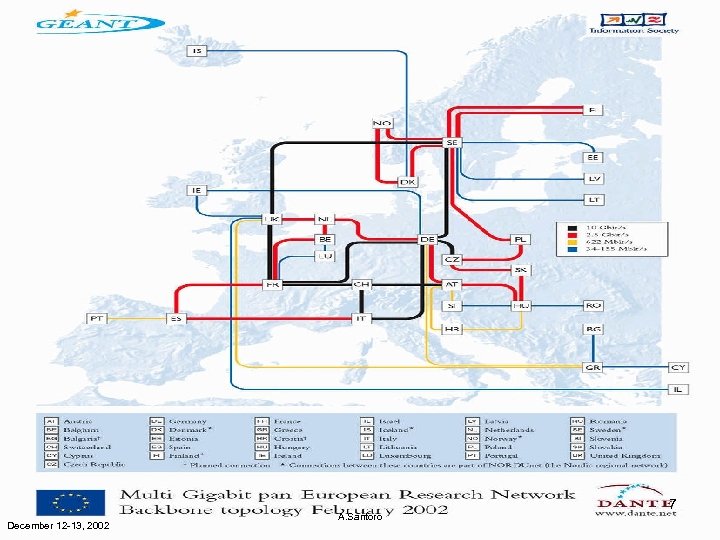
II - Maps: Topologies-Bandwidths DIGITAL DIVIDE • We have shown a lot of Maps last time. Now we will show some Maps representing Regions of the World and a small number of Country Maps. I found some maps in the address http: //cybergeography. org I will first show the European Region and one of the main Network December 12 -13, 2002 A. Santoro 6
December 12 -13, 2002 A. Santoro 7
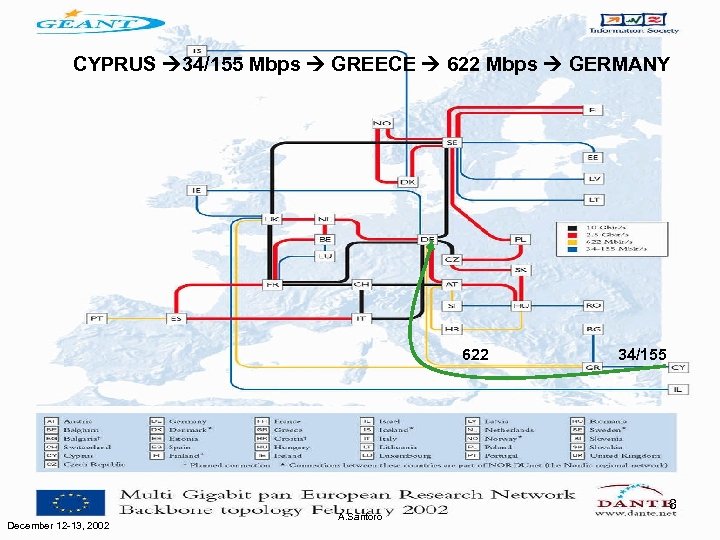
CYPRUS 34/155 Mbps GREECE 622 Mbps GERMANY 622 December 12 -13, 2002 A. Santoro 34/155 8
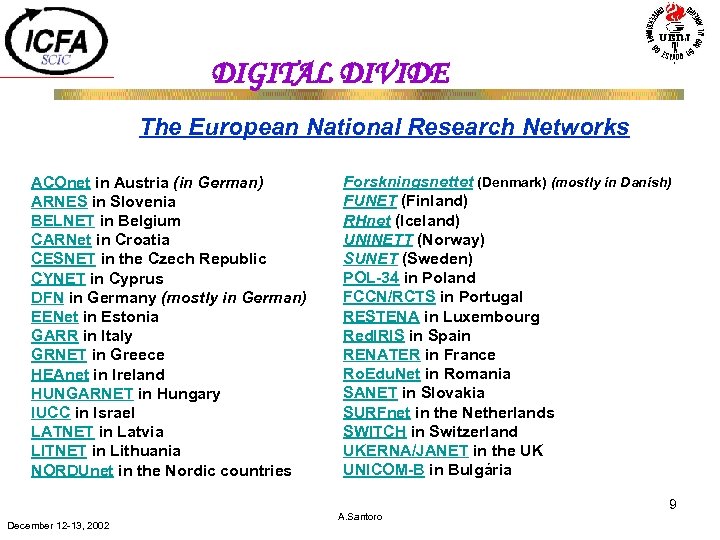
DIGITAL DIVIDE The European National Research Networks ACOnet in Austria (in German) ARNES in Slovenia BELNET in Belgium CARNet in Croatia CESNET in the Czech Republic CYNET in Cyprus DFN in Germany (mostly in German) EENet in Estonia GARR in Italy GRNET in Greece HEAnet in Ireland HUNGARNET in Hungary IUCC in Israel LATNET in Latvia LITNET in Lithuania NORDUnet in the Nordic countries December 12 -13, 2002 Forskningsnettet (Denmark) (mostly in Danish) FUNET (Finland) RHnet (Iceland) UNINETT (Norway) SUNET (Sweden) POL-34 in Poland FCCN/RCTS in Portugal RESTENA in Luxembourg Red. IRIS in Spain RENATER in France Ro. Edu. Net in Romania SANET in Slovakia SURFnet in the Netherlands SWITCH in Switzerland UKERNA/JANET in the UK UNICOM-B in Bulgária A. Santoro 9
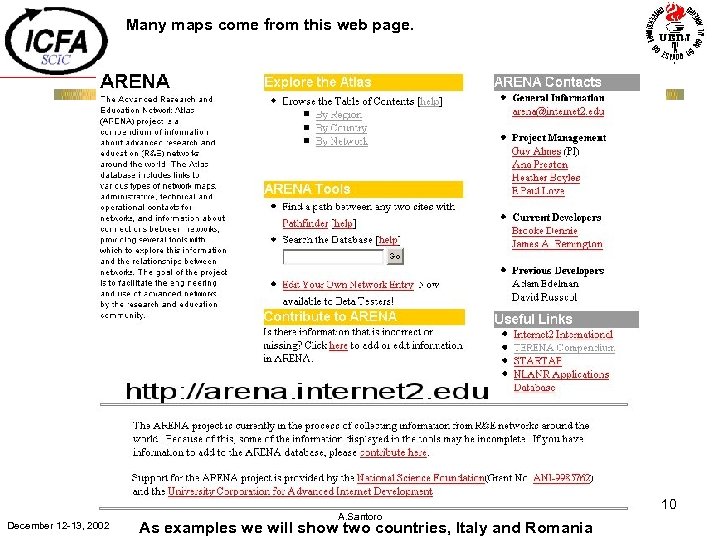
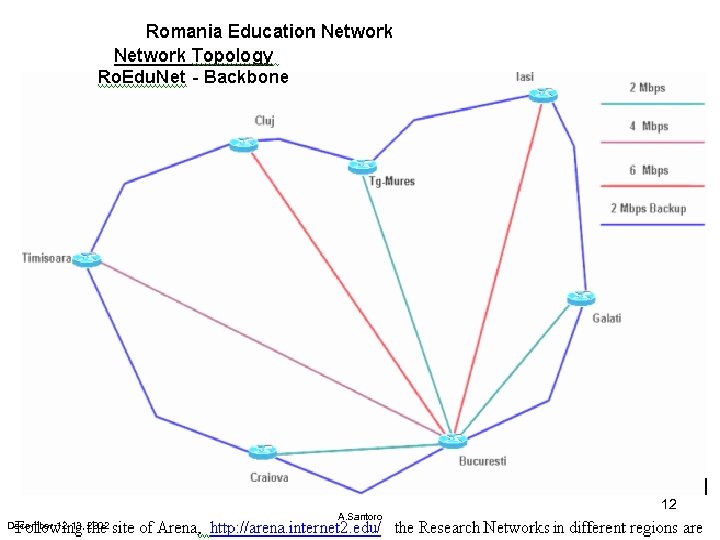
Many maps come from this web page. December 12 -13, 2002 A. Santoro As examples we will show two countries, Italy and Romania 10
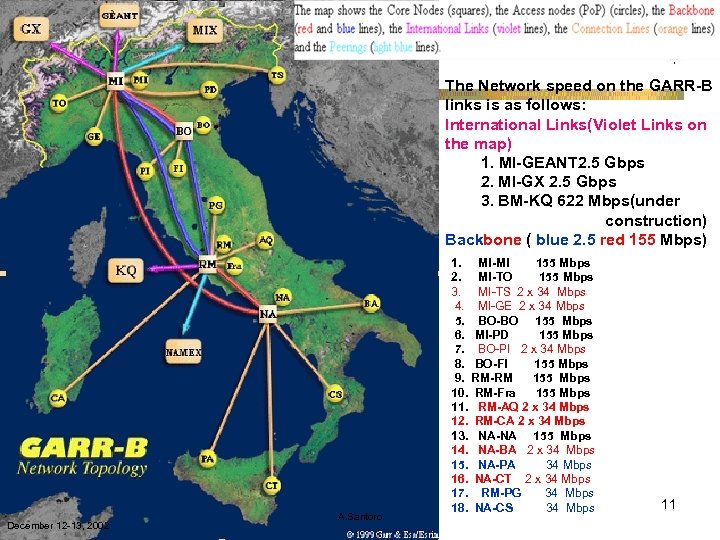
The Network speed on the GARR-B links is as follows: International Links(Violet Links on the map) 1. MI-GEANT 2. 5 Gbps 2. MI-GX 2. 5 Gbps 3. BM-KQ 622 Mbps(under construction) Backbone ( blue 2. 5 red 155 Mbps) December 12 -13, 2002 A. Santoro 1. MI-MI 155 Mbps 2. MI-TO 155 Mbps 3. MI-TS 2 x 34 Mbps 4. MI-GE 2 x 34 Mbps 5. BO-BO 155 Mbps 6. MI-PD 155 Mbps 7. BO-PI 2 x 34 Mbps 8. BO-FI 155 Mbps 9. RM-RM 155 Mbps 10. RM-Fra 155 Mbps 11. RM-AQ 2 x 34 Mbps 12. RM-CA 2 x 34 Mbps 13. NA-NA 155 Mbps 14. NA-BA 2 x 34 Mbps 15. NA-PA 34 Mbps 16. NA-CT 2 x 34 Mbps 17. RM-PG 34 Mbps 18. NA-CS 34 Mbps 11
December 12 -13, 2002 A. Santoro 12
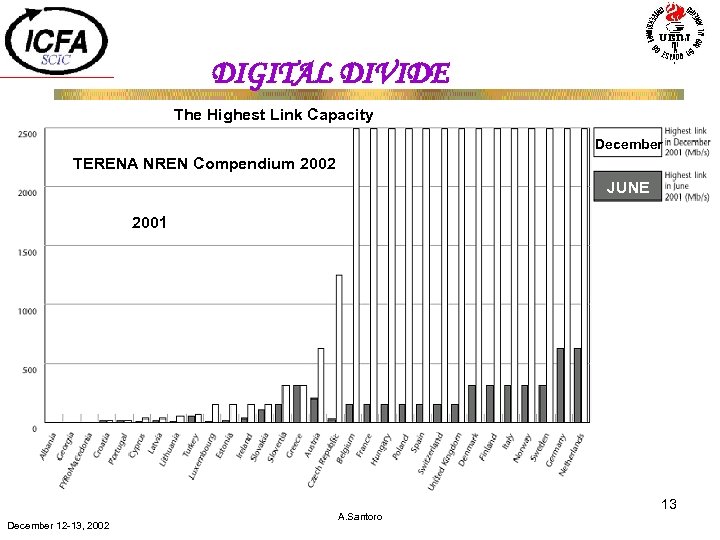
DIGITAL DIVIDE The Highest Link Capacity December TERENA NREN Compendium 2002 JUNE 2001 December 12 -13, 2002 A. Santoro 13
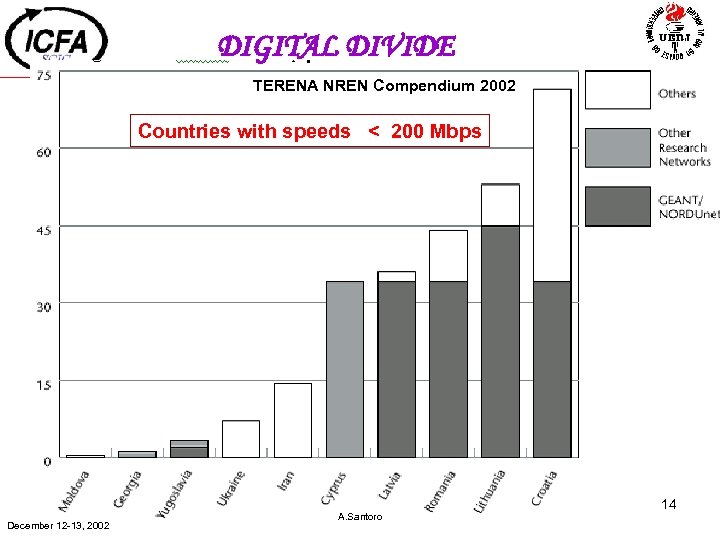
DIGITAL DIVIDE TERENA NREN Compendium 2002 Countries with speeds < 200 Mbps December 12 -13, 2002 A. Santoro 14
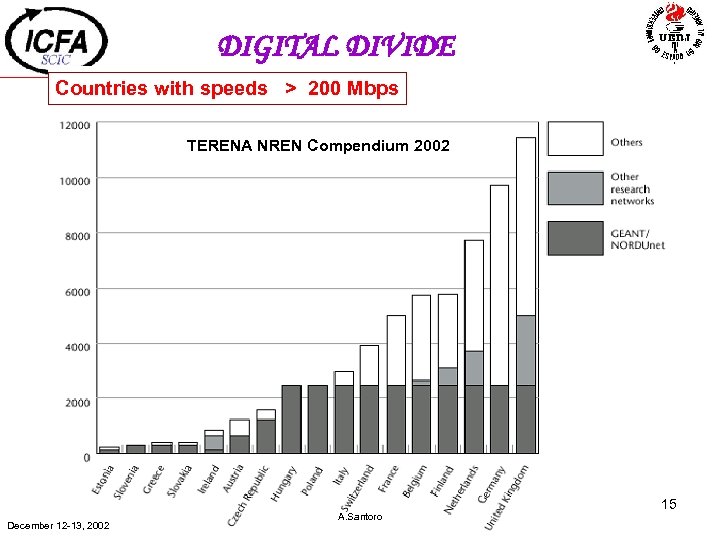
DIGITAL DIVIDE Countries with speeds > 200 Mbps TERENA NREN Compendium 2002 December 12 -13, 2002 A. Santoro 15
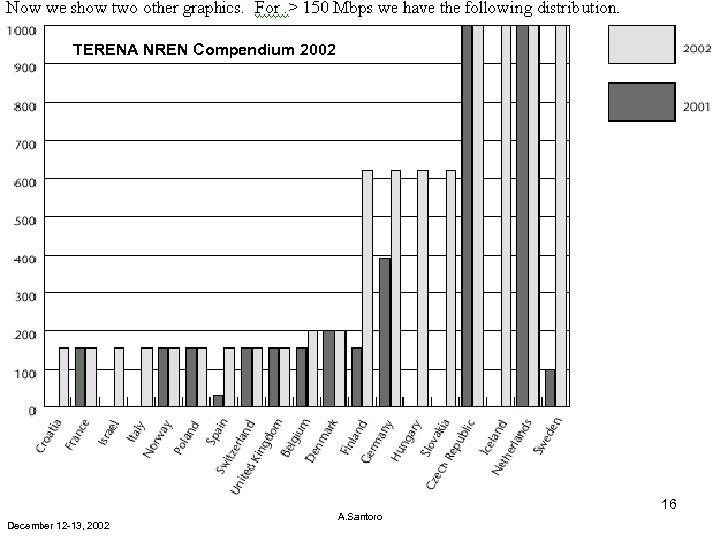
TERENA NREN Compendium 2002 December 12 -13, 2002 A. Santoro 16
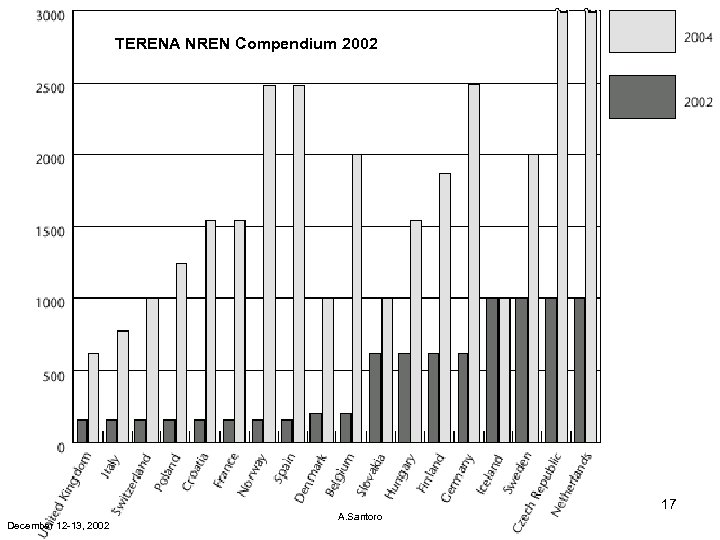
TERENA NREN Compendium 2002 December 12 -13, 2002 A. Santoro 17
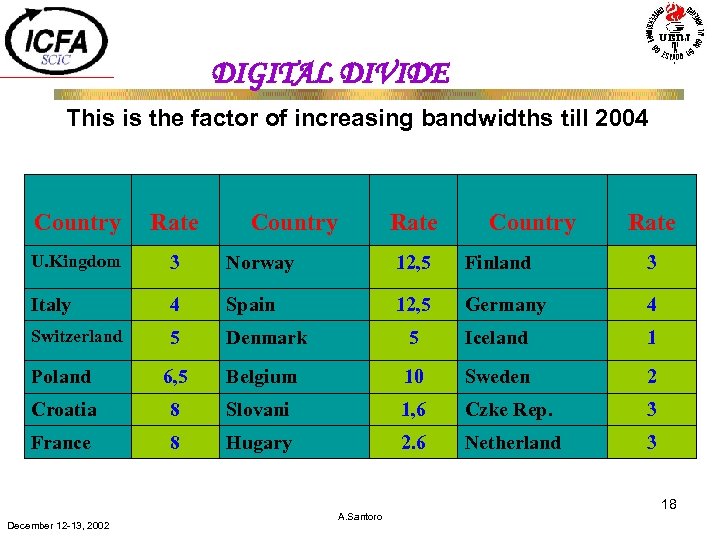
DIGITAL DIVIDE This is the factor of increasing bandwidths till 2004 Country Rate U. Kingdom 3 Norway 12, 5 Finland 3 Italy 4 Spain 12, 5 Germany 4 Switzerland 5 Denmark 5 Iceland 1 Poland 6, 5 Belgium 10 Sweden 2 Croatia 8 Slovani 1, 6 Czke Rep. 3 France 8 Hugary 2. 6 Netherland 3 December 12 -13, 2002 Country Rate A. Santoro Country Rate 18
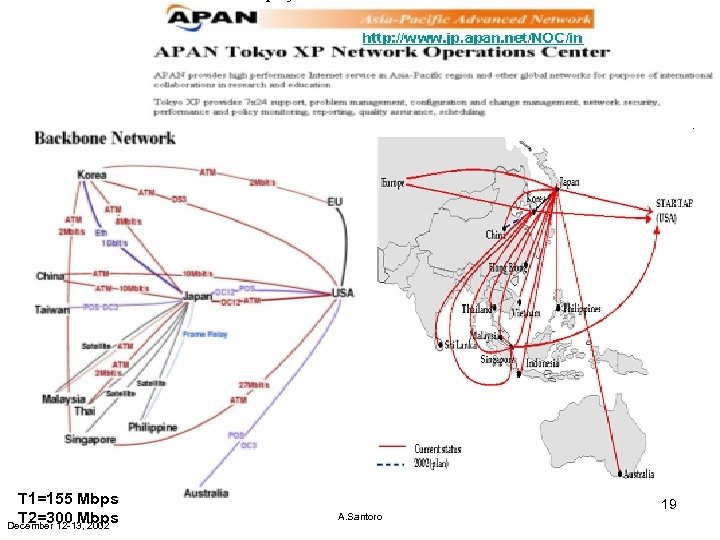
T 1=155 Mbps T 2=300 Mbps December 12 -13, 2002 A. Santoro 19
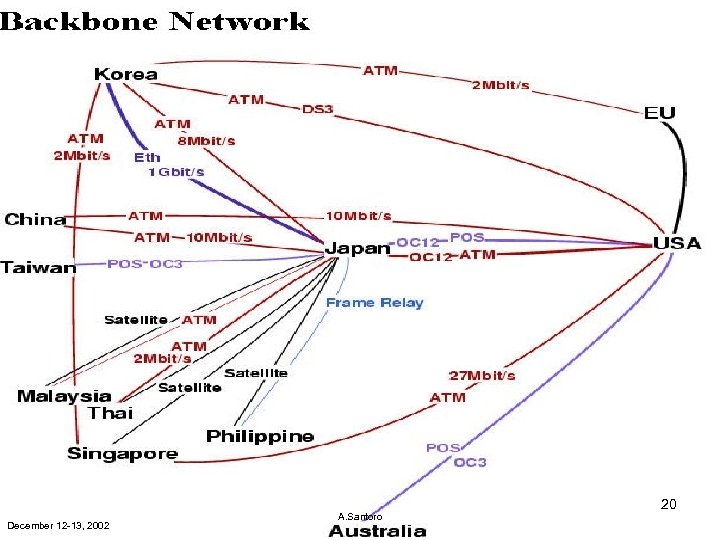
December 12 -13, 2002 A. Santoro 20
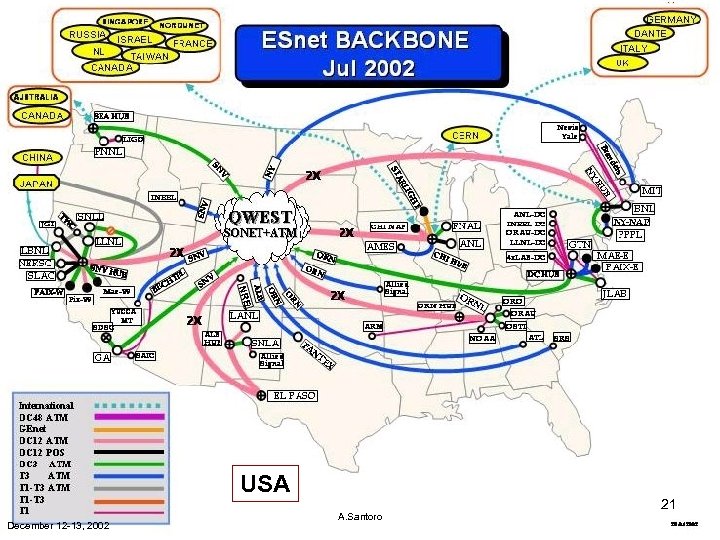
USA December 12 -13, 2002 A. Santoro 21
DIGITAL DIVIDE Mexico - Corporacion Universitaria para el Desarollo del Internet (CUDI) – Internet 2 in Mexico. URL: http: //www. cudi. edu. mx Ø CUDI is comprised of nearly 50 member institutions Ø During XX Mexican School of Particle and Fields (Playa del Carmen), Mexico, October 2002 ) a number of representative physicists from Latin American discussed the upgrading of the existing Links and their future collaboration with CERN and FERMILAB - ALICE and Dzero Ø They are discussing the possibilities to build a GRID station too. Ø As it is available lots of information about Mexico Let us show some good information with maps 22 December 12 -13, 2002 A. Santoro
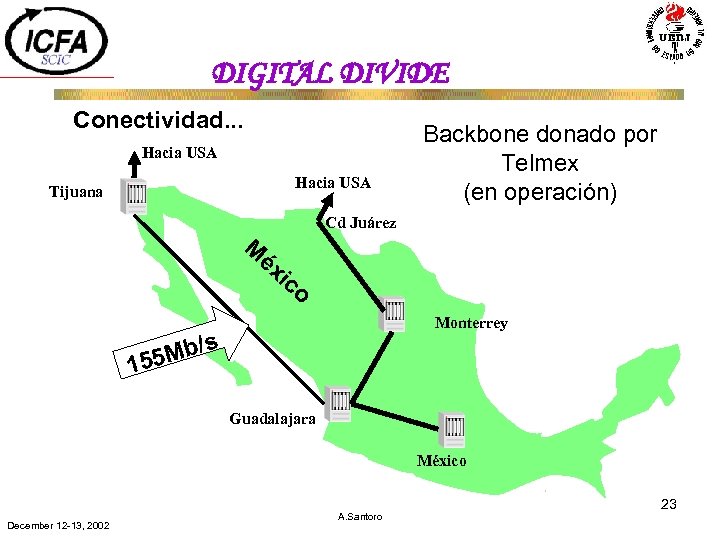
DIGITAL DIVIDE Conectividad. . . Hacia USA Tijuana Backbone donado por Telmex (en operación) Cd Juárez M éx ic o Monterrey s Mb/ 155 Guadalajara México December 12 -13, 2002 A. Santoro 23
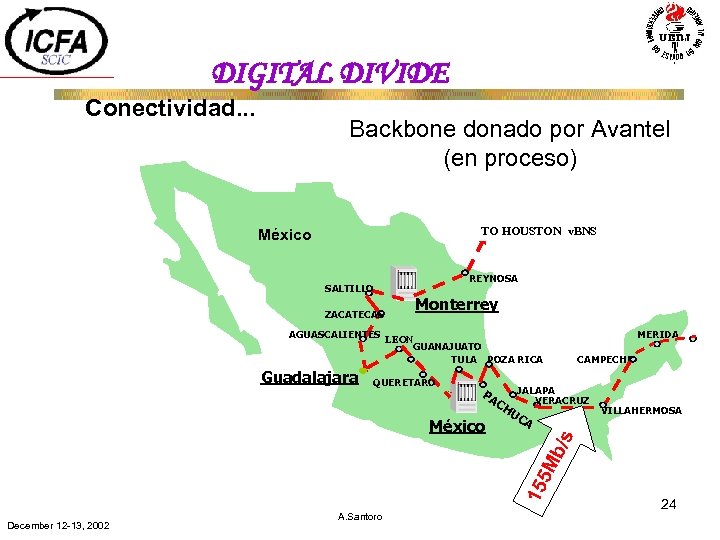
DIGITAL DIVIDE Conectividad. . . Backbone donado por Avantel (en proceso) TO HOUSTON v. BNS México ZACATECAS AGUASCALIENTES Guadalajara REYNOSA Monterrey MERIDA LEON GUANAJUATO TULA POZA RICA QUERETARO PA JALAPA VERACRUZ CH VILLAHERMOSA UC A 15 5 Mb México CAMPECHE /s SALTILLO December 12 -13, 2002 A. Santoro 24
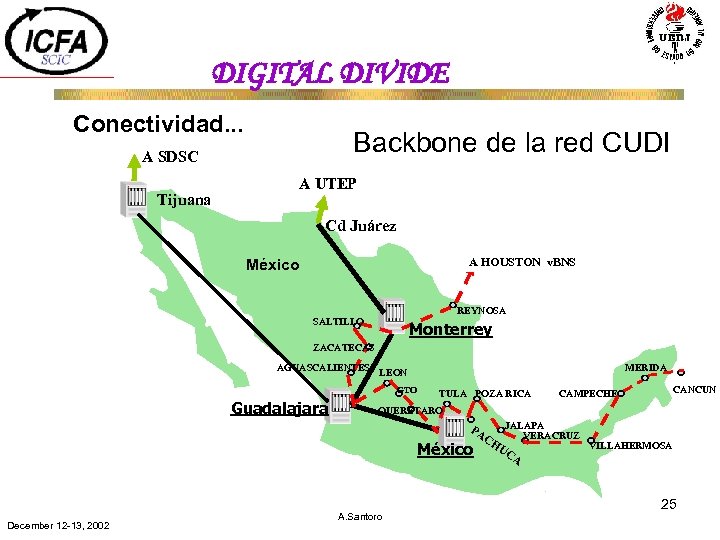
DIGITAL DIVIDE Conectividad. . . Backbone de la red CUDI A SDSC Tijuana A UTEP Cd Juárez A HOUSTON v. BNS México REYNOSA SALTILLO Monterrey ZACATECAS AGUASCALIENTES MERIDA LEON GTO Guadalajara TULA POZA RICA QUERETARO PA México December 12 -13, 2002 CANCUN CAMPECHE A. Santoro CH JALAPA VERACRUZ UC A VILLAHERMOSA 25
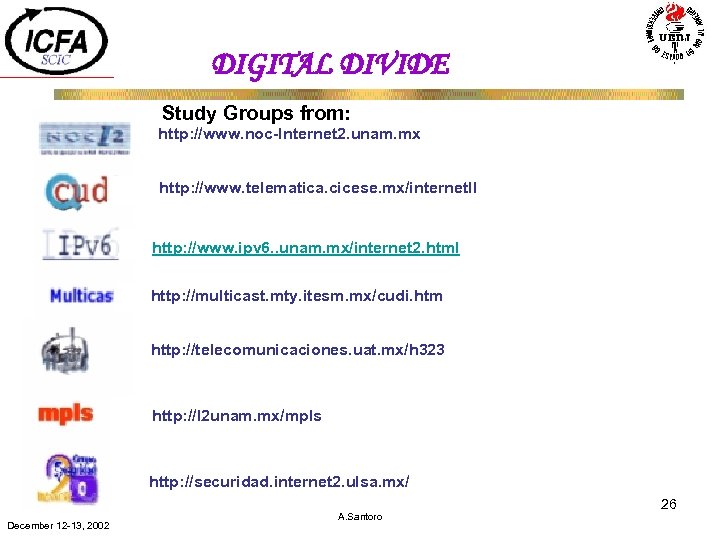
DIGITAL DIVIDE Study Groups from: http: //www. noc-Internet 2. unam. mx http: //www. telematica. cicese. mx/internet. II http: //www. ipv 6. . unam. mx/internet 2. html http: //multicast. mty. itesm. mx/cudi. htm http: //telecomunicaciones. uat. mx/h 323 http: //I 2 unam. mx/mpls http: //securidad. internet 2. ulsa. mx/ December 12 -13, 2002 A. Santoro 26
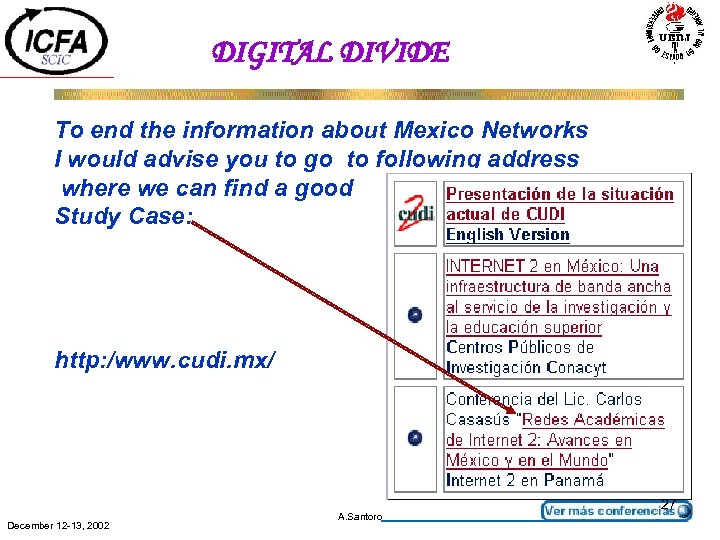
DIGITAL DIVIDE To end the information about Mexico Networks I would advise you to go to following address where we can find a good Study Case: http: /www. cudi. mx/ December 12 -13, 2002 A. Santoro 27
December 12 -13, 2002 A. Santoro 28
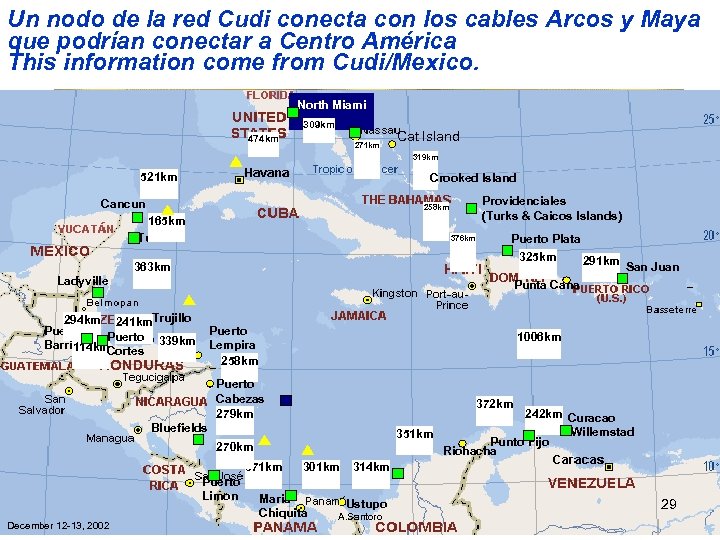
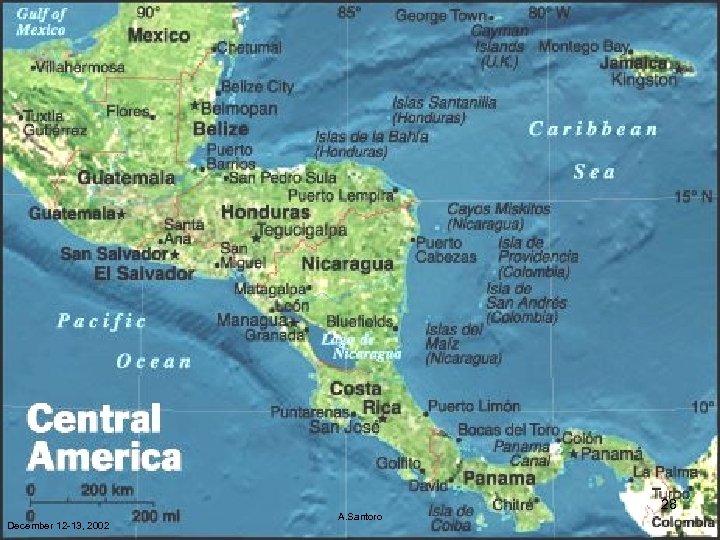
Un nodo de la red Cudi conecta con los cables Arcos y Maya que podrían conectar a Centro América This information come from Cudi/Mexico. North Miami 309 km 474 km 271 km Cat Island 319 km 521 km Crooked Island Cancun Providenciales (Turks & Caicos Islands) 258 km 165 km Tulum 376 km Puerto Plata 325 km 363 km Ladyville San Juan Punta Cana 294 km 241 km. Trujillo Puerto 339 km Barrios 114 km Cortes Puerto Lempira 258 km 1006 km Puerto Cabezas 279 km 372 km 242 km Curacao Willemstad 351 km Punto Fijo Riohacha Bluefields 270 km 371 km Puerto Limon December 12 -13, 2002 291 km 301 km Maria Chiquita 314 km Ustupo A. Santoro 29
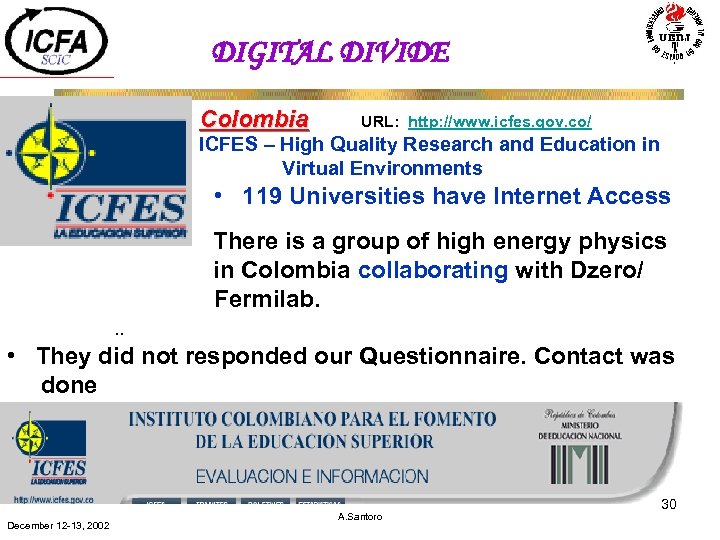
DIGITAL DIVIDE Colombia URL: http: //www. icfes. gov. co/ ICFES – High Quality Research and Education in Virtual Environments • 119 Universities have Internet Access There is a group of high energy physics in Colombia collaborating with Dzero/ Fermilab. . . • They did not responded our Questionnaire. Contact was done December 12 -13, 2002 A. Santoro 30
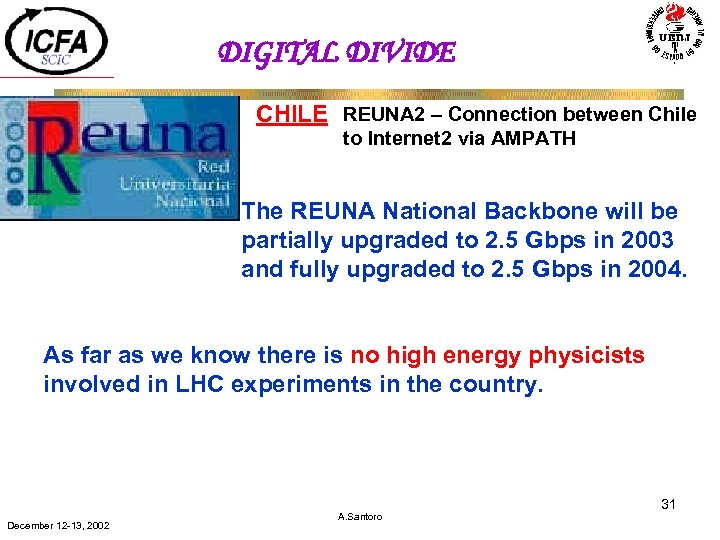
DIGITAL DIVIDE CHILE REUNA 2 – Connection between Chile to Internet 2 via AMPATH The REUNA National Backbone will be partially upgraded to 2. 5 Gbps in 2003 and fully upgraded to 2. 5 Gbps in 2004. As far as we know there is no high energy physicists involved in LHC experiments in the country. December 12 -13, 2002 A. Santoro 31
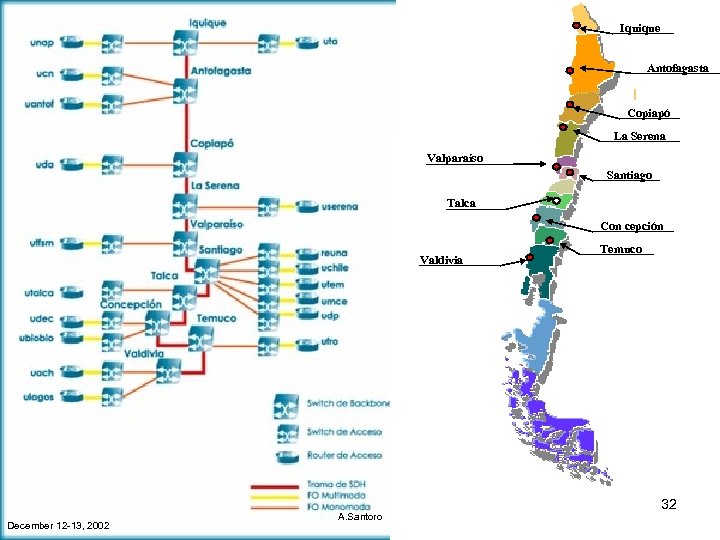
Iquique Antofagasta Copiapó La Serena Valparaíso Santiago Talca Con cepción Valdivia December 12 -13, 2002 A. Santoro Temuco 32
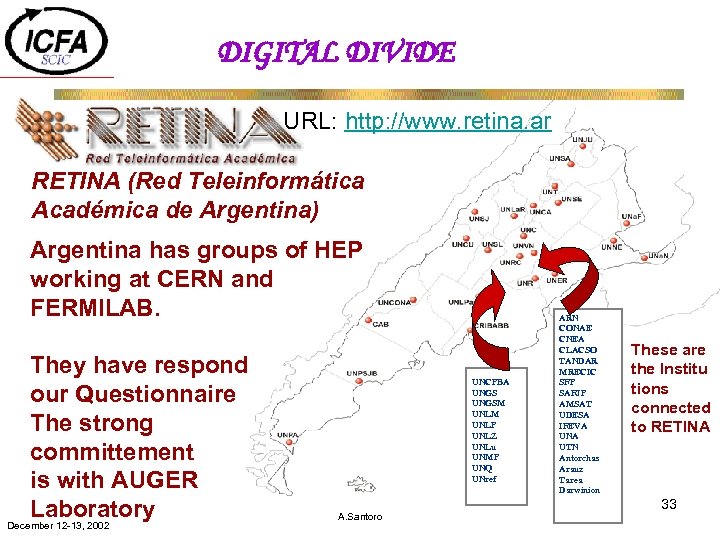
DIGITAL DIVIDE URL: http: //www. retina. ar RETINA (Red Teleinformática Académica de Argentina) Argentina has groups of HEP working at CERN and FERMILAB. They have respond our Questionnaire The strong committement is with AUGER Laboratory December 12 -13, 2002 UNCPBA UNGSM UNLP UNLZ UNLu UNMP UNQ UNref A. Santoro ARN CONAE CNEA CLACSO TANDAR MRECIC SFP SAFJP AMSAT UDESA IFEVA UNA UTN Antorchas Arauz Tarea Darwinion These are the Institu tions connected to RETINA 33
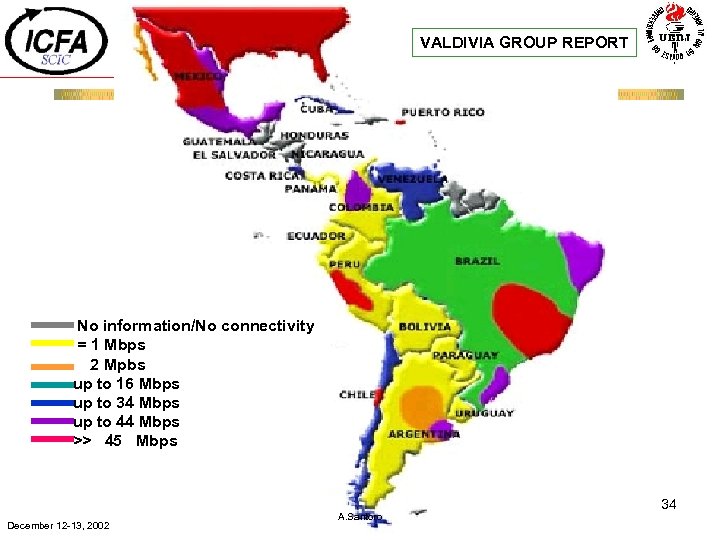
VALDIVIA GROUP REPORT No information/No connectivity = 1 Mbps 2 Mpbs up to 16 Mbps up to 34 Mbps up to 44 Mbps >> 45 Mbps December 12 -13, 2002 A. Santoro 34
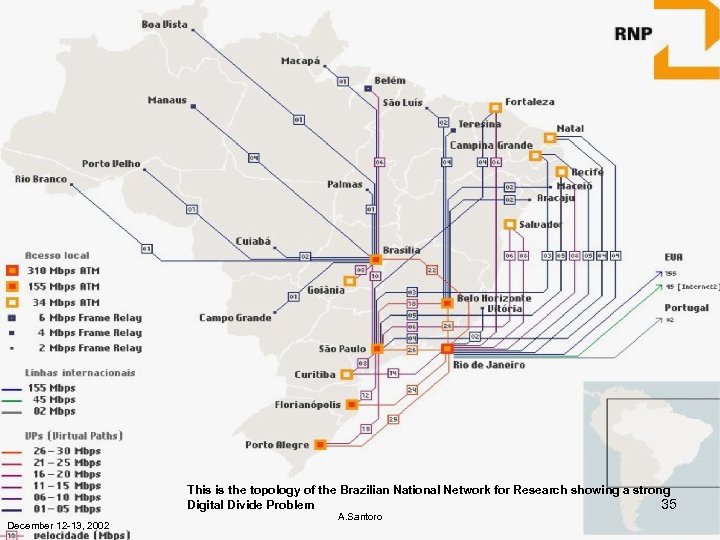
This is the topology of the Brazilian National Network for Research showing a strong Digital Divide Problem 35 December 12 -13, 2002 A. Santoro
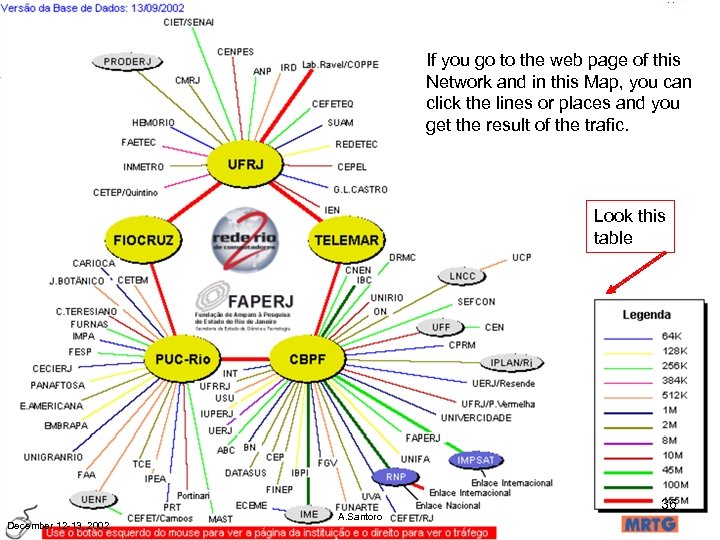
If you go to the web page of this Network and in this Map, you can click the lines or places and you get the result of the trafic. Look this table December 12 -13, 2002 A. Santoro 36
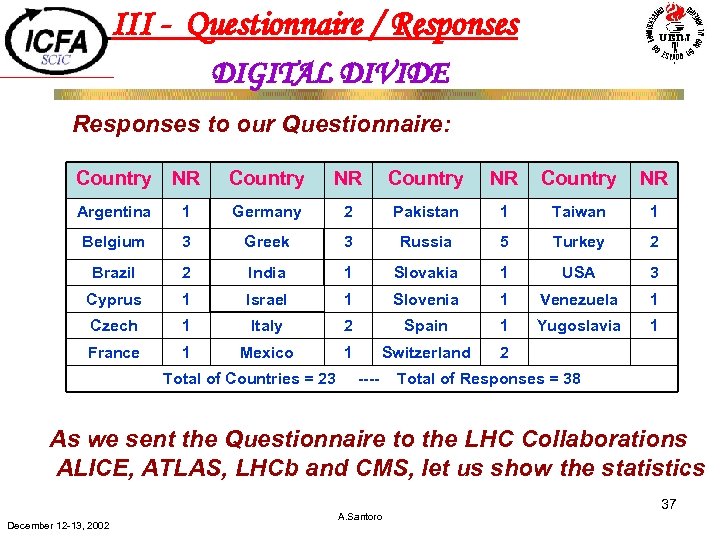
III - Questionnaire / Responses DIGITAL DIVIDE Responses to our Questionnaire: Country NR Argentina 1 Germany 2 Pakistan 1 Taiwan 1 Belgium 3 Greek 3 Russia 5 Turkey 2 Brazil 2 India 1 Slovakia 1 USA 3 Cyprus 1 Israel 1 Slovenia 1 Venezuela 1 Czech 1 Italy 2 Spain 1 Yugoslavia 1 France 1 Mexico 1 Switzerland 2 Total of Countries = 23 ---- Total of Responses = 38 As we sent the Questionnaire to the LHC Collaborations ALICE, ATLAS, LHCb and CMS, let us show the statistics December 12 -13, 2002 A. Santoro 37
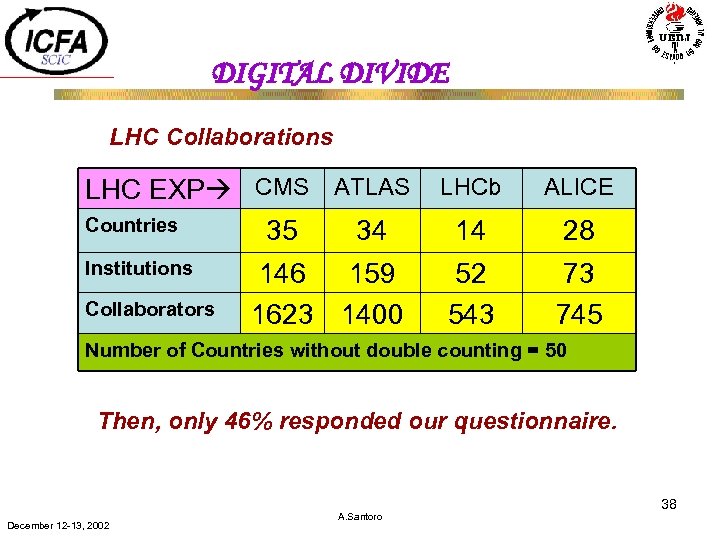
DIGITAL DIVIDE LHC Collaborations LHC EXP CMS ATLAS Countries 35 34 Institutions Collaborators 146 159 1623 1400 LHCb ALICE 14 28 52 543 73 745 Number of Countries without double counting = 50 Then, only 46% responded our questionnaire. December 12 -13, 2002 A. Santoro 38
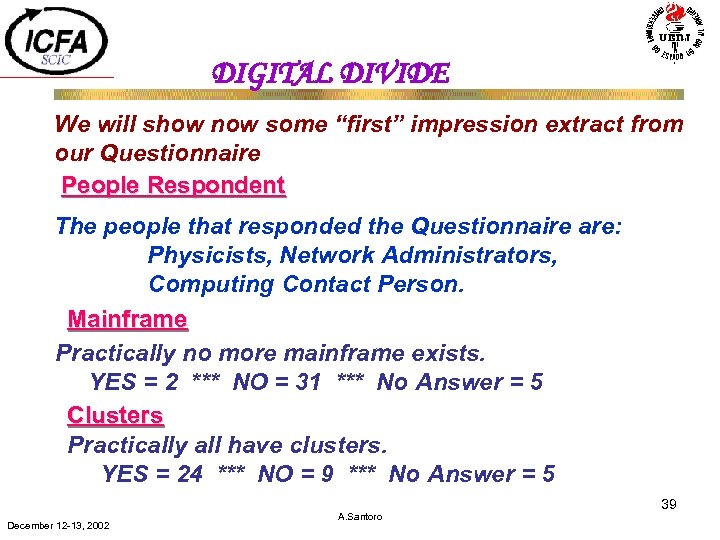
DIGITAL DIVIDE We will show now some “first” impression extract from our Questionnaire People Respondent The people that responded the Questionnaire are: Physicists, Network Administrators, Computing Contact Person. Mainframe Practically no more mainframe exists. YES = 2 *** NO = 31 *** No Answer = 5 Clusters Practically all have clusters. YES = 24 *** NO = 9 *** No Answer = 5 December 12 -13, 2002 A. Santoro 39
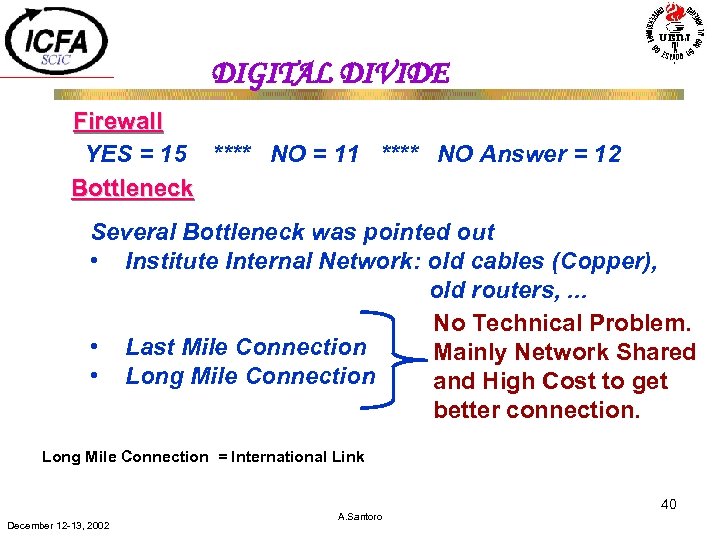
DIGITAL DIVIDE Firewall YES = 15 **** NO = 11 **** NO Answer = 12 Bottleneck Several Bottleneck was pointed out • Institute Internal Network: old cables (Copper), old routers, . . . No Technical Problem. • Last Mile Connection Mainly Network Shared • Long Mile Connection and High Cost to get better connection. Long Mile Connection = International Link December 12 -13, 2002 A. Santoro 40
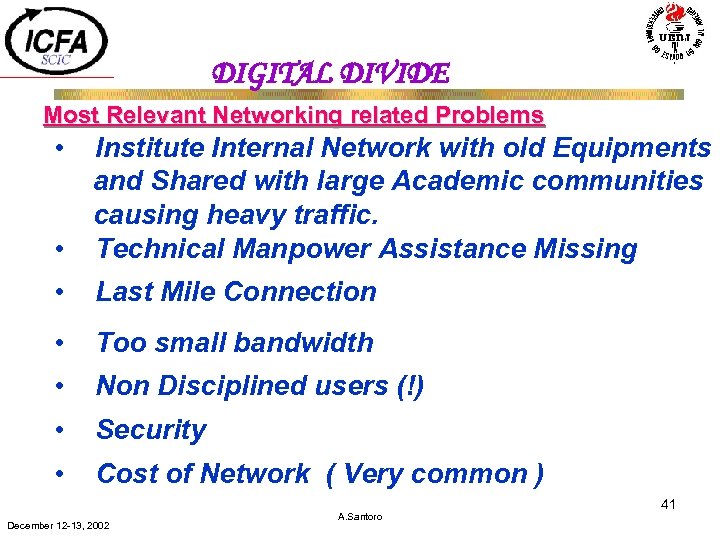
DIGITAL DIVIDE Most Relevant Networking related Problems • • Institute Internal Network with old Equipments and Shared with large Academic communities causing heavy traffic. Technical Manpower Assistance Missing • Last Mile Connection • Too small bandwidth • Non Disciplined users (!) • Security • Cost of Network ( Very common ) December 12 -13, 2002 A. Santoro 41
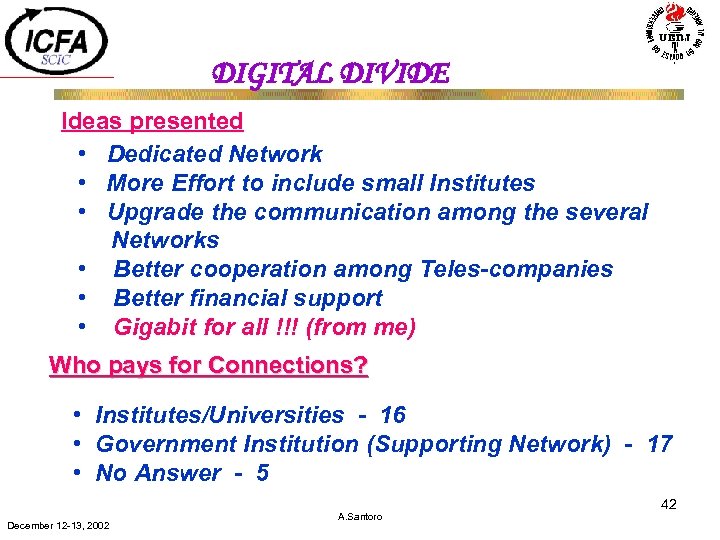
DIGITAL DIVIDE Ideas presented • Dedicated Network • More Effort to include small Institutes • Upgrade the communication among the several Networks • Better cooperation among Teles-companies • Better financial support • Gigabit for all !!! (from me) Who pays for Connections? • Institutes/Universities - 16 • Government Institution (Supporting Network) - 17 • No Answer - 5 December 12 -13, 2002 A. Santoro 42
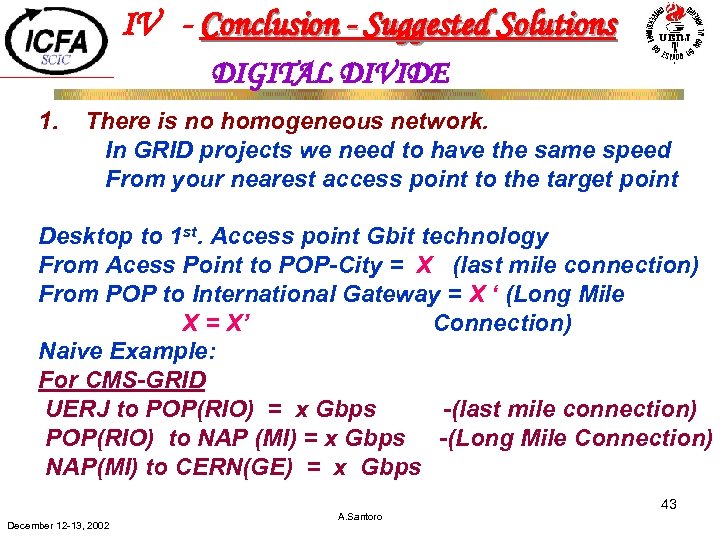
IV - Conclusion - Suggested Solutions DIGITAL DIVIDE 1. There is no homogeneous network. In GRID projects we need to have the same speed From your nearest access point to the target point Desktop to 1 st. Access point Gbit technology From Acess Point to POP-City = X (last mile connection) From POP to International Gateway = X ‘ (Long Mile X = X’ Connection) Naive Example: For CMS-GRID UERJ to POP(RIO) = x Gbps -(last mile connection) POP(RIO) to NAP (MI) = x Gbps -(Long Mile Connection) NAP(MI) to CERN(GE) = x Gbps December 12 -13, 2002 A. Santoro 43
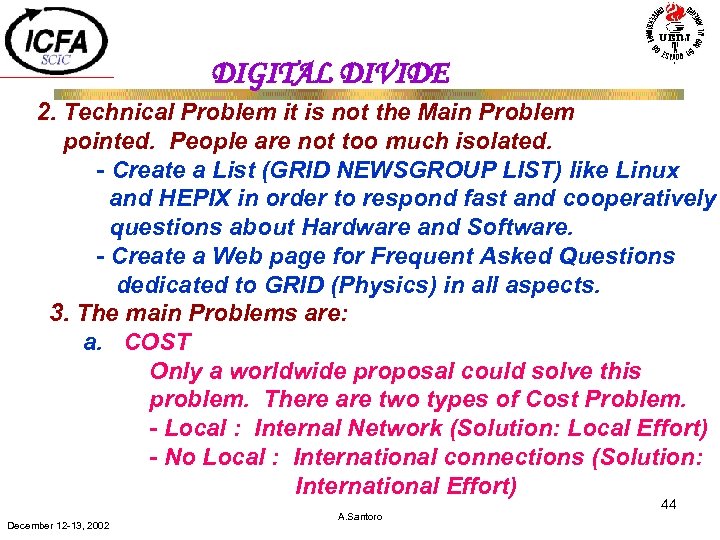
DIGITAL DIVIDE 2. Technical Problem it is not the Main Problem pointed. People are not too much isolated. - Create a List (GRID NEWSGROUP LIST) like Linux and HEPIX in order to respond fast and cooperatively questions about Hardware and Software. - Create a Web page for Frequent Asked Questions dedicated to GRID (Physics) in all aspects. 3. The main Problems are: a. COST Only a worldwide proposal could solve this problem. There are two types of Cost Problem. - Local : Internal Network (Solution: Local Effort) - No Local : International connections (Solution: International Effort) December 12 -13, 2002 A. Santoro 44
DIGITAL DIVIDE b. Shared Network Many people complain about the user competition in their own institute. There is no possibility to create a dedicated line to HEP. Cost involved again. c. GLOBAL PHYSICS NETWORK ? A solution? - This could be a solution for (a) and (b) above. - This is a Luxury or a NEED? Comment: We can do an exercise, even without numbers, and imagine in five-ten years, Medicine Projects Long Distance Education, Astroparticle, Biology, Genoma Project, Weather, Video Conferences in general, and so on, sharing 45 the same network as HEP-GRID? A. Santoro December 12 -13, 2002
DIGITAL DIVIDE d. Perhaps we have to say now, as a principle: “ Technologies for Inclusion and not for Exclusion” The consequence of adopting this, are: - More Cooperative - To build a proposal including all HEP collaborations for a good network. TOO AMBITIOUS? IS IT FORBIDEM TO DREAM? - IEEAF would be the only Solution? - United Nations? - OEA? December 12 -13, 2002 A. Santoro 46
DIGITAL DIVIDE e. Digital Divide can be solved by a joint effort among: - Local Institutions, National Networks Administrations, Financial Support Agencies, and so on. Comments: These Institutions have to be aware for Digital Divide mainly for HEP and Similar projects. . International Effort creating Specific Workshops Organizing Meetings with Network and Government Responsible. Information Society Summit WILL BE an Opportunity for that ! 47 December 12 -13, 2002 A. Santoro

DIGITAL DIVIDE Extra Slides December 12 -13, 2002 A. Santoro 48
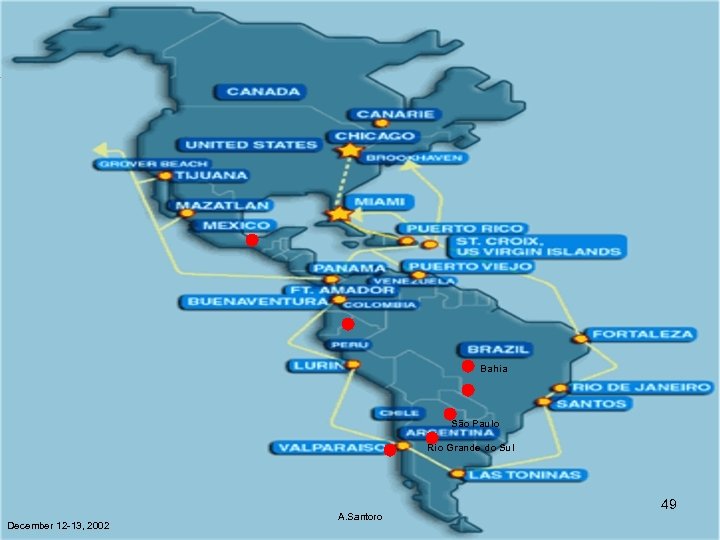
Bahia São Paulo Rio Grande do Sul December 12 -13, 2002 A. Santoro 49
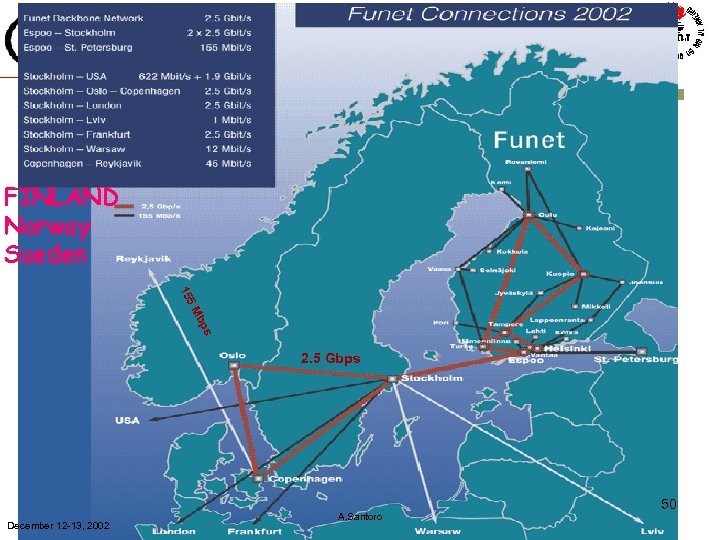
FINLAND Norway Sueden s bp 5 M 15 2. 5 Gbps December 12 -13, 2002 A. Santoro 50
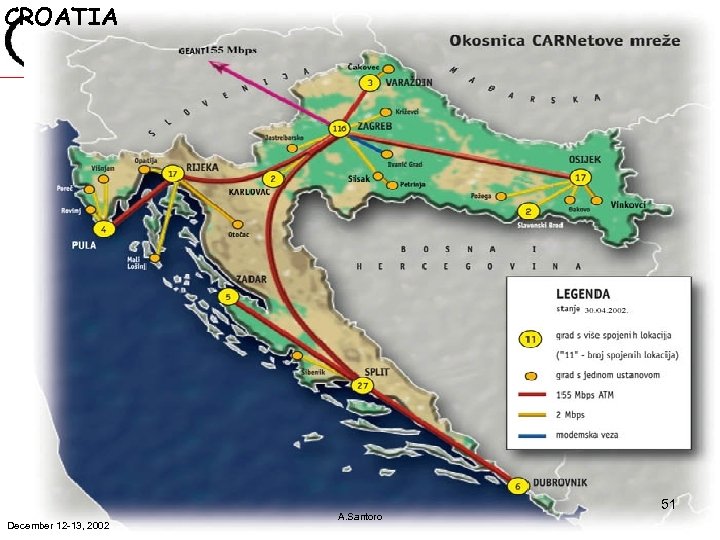
CROATIA December 12 -13, 2002 A. Santoro 51
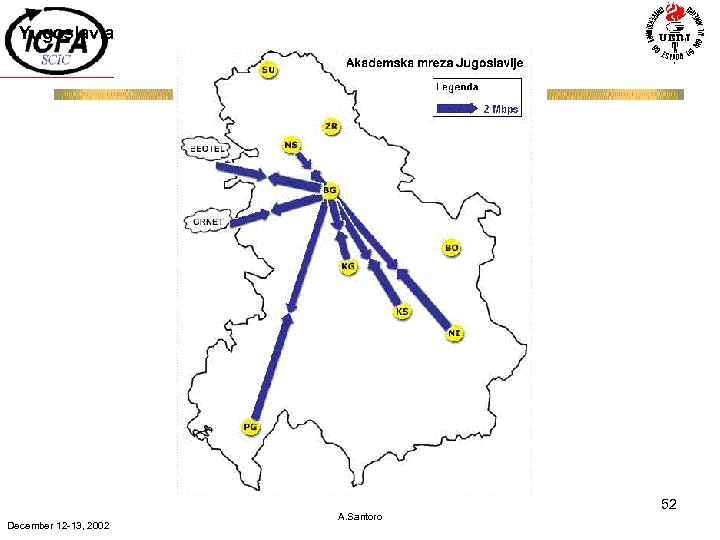
Yugoslavia December 12 -13, 2002 A. Santoro 52
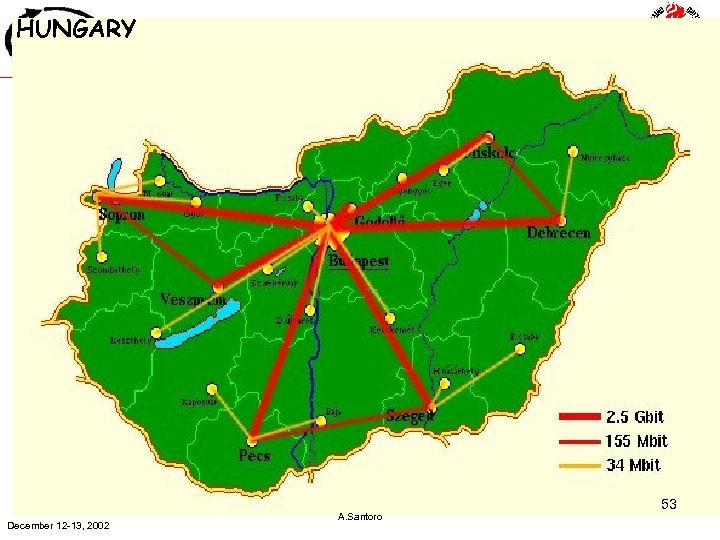
HUNGARY December 12 -13, 2002 A. Santoro 53
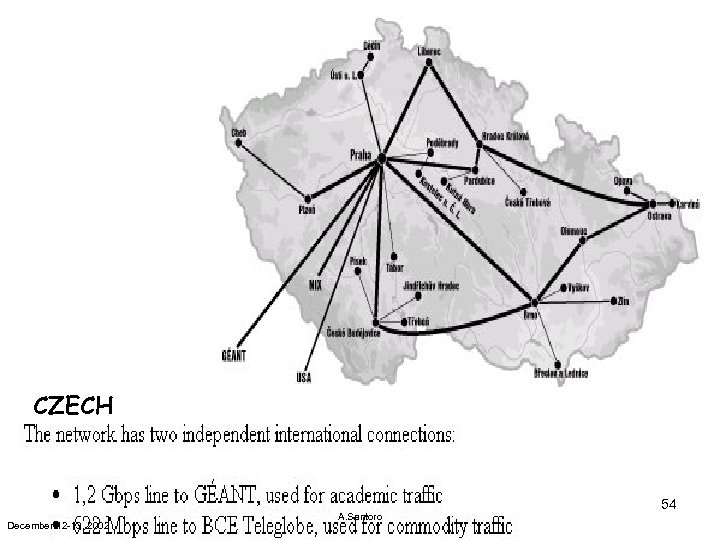
CZECH December 12 -13, 2002 A. Santoro 54
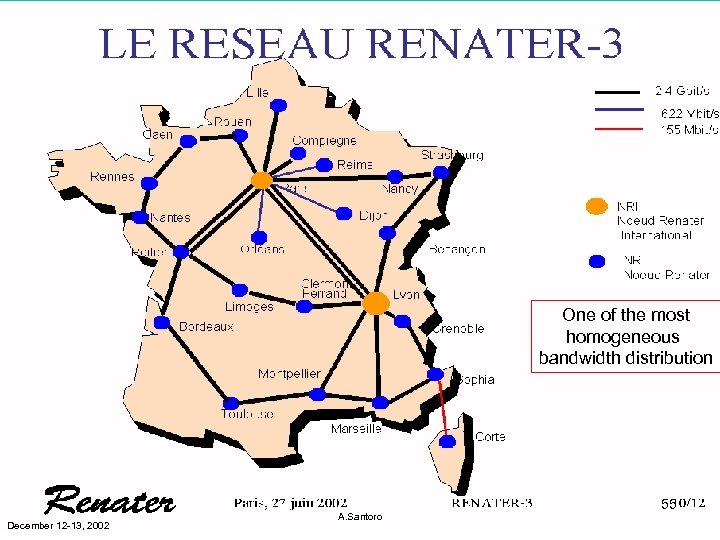
One of the most homogeneous bandwidth distribution December 12 -13, 2002 A. Santoro 55
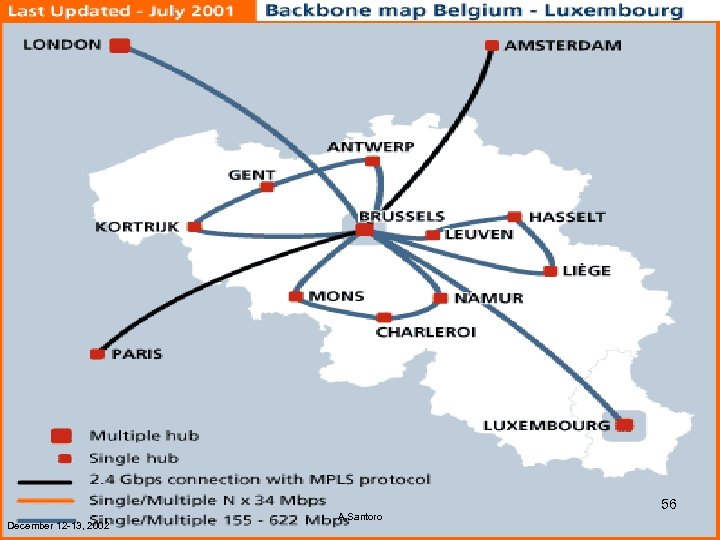
December 12 -13, 2002 A. Santoro 56
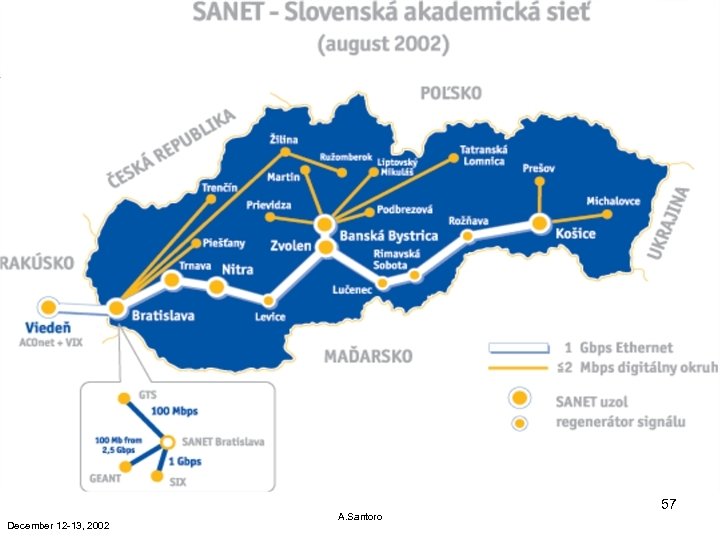
December 12 -13, 2002 A. Santoro 57
![Capacity of the Highest European Link of NRENs Connection to TEN-155 Backbone Rates [Mbps]](https://present5.com/presentation/247c5bd8d759cfca148aee4f6c1a77c4/image-58.jpg "Capacity of the Highest European Link of NRENs Connection to TEN-155 Backbone Rates [Mbps]")
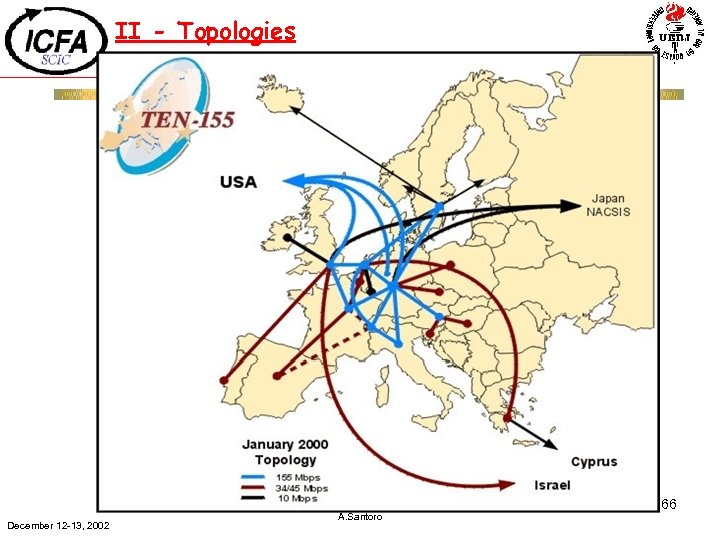
Capacity of the Highest European Link of NRENs Connection to TEN-155 Backbone Rates [Mbps] Connection to GEANT Backbone Countries Rates [Mbps] Countries ≥ 600 Germany, Netherland 5000 Denmark, Finland, Sueden, Norway ≥ 300 Denmark, Greece, Italy, Finland, Suden Norway 2500 Belgium, Germany, Spain, France, Italy, Netherland, United Kingdom, Hungary, Poland, Switzerland ≥ 155 Belgium, Spain, France, Austria, United Kingdom, Hungary, Poland, Slovenia, Switzerland ≥ 1000 Czech Republic ≤ 50 Ireland, Luxembourg, Portugal, Croatia, Cyprus, Albania, Czech Republic, Estonia, Georgia, Latvia, Lithuania, Fyro. Macedonia, Turkey, Slovakia ≥ 500 Austria ≤ 250 Greece, Ireland, Luxembourg, Portugal, Albania, Croatia, Cyprus, Estonia, Geórgia, Latvia, Lithuania, Fyro. Macedonia, Slovenia, Slovakia, Turkey December 12 -13, 2002 A. Santoro 58
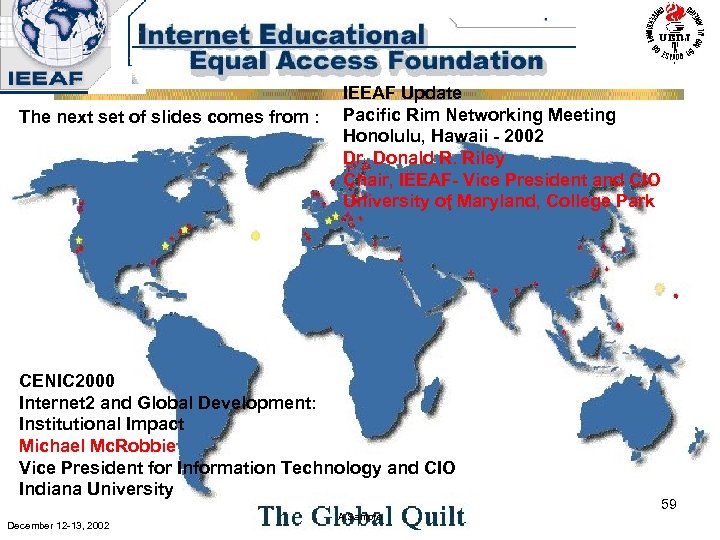
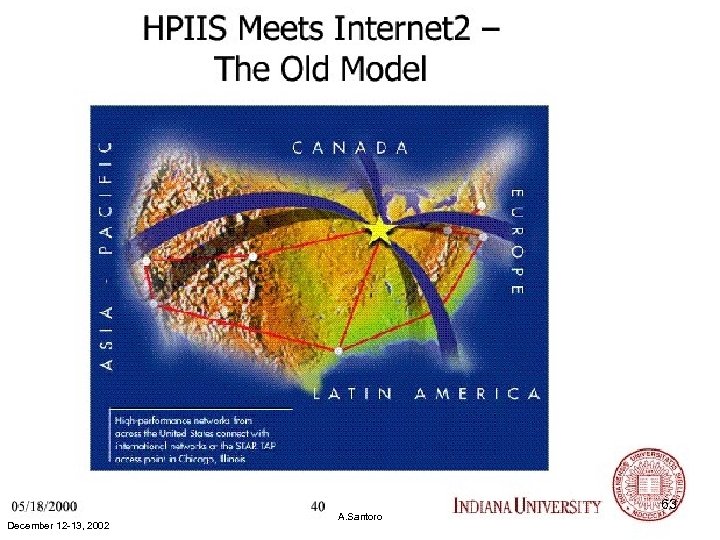
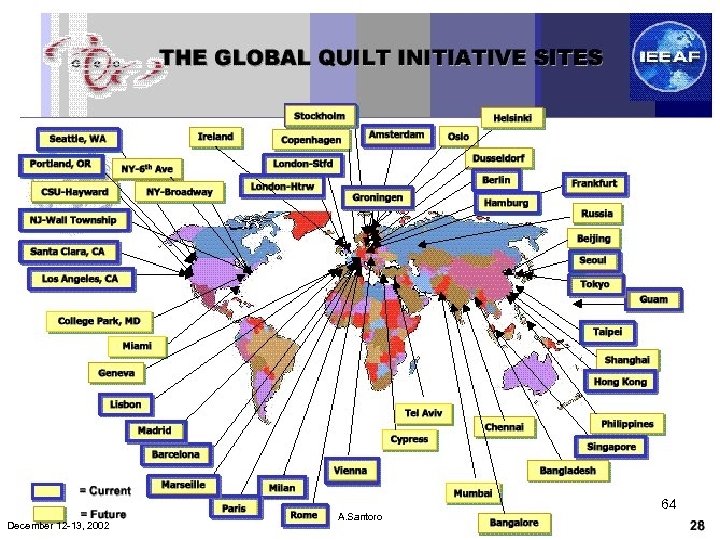
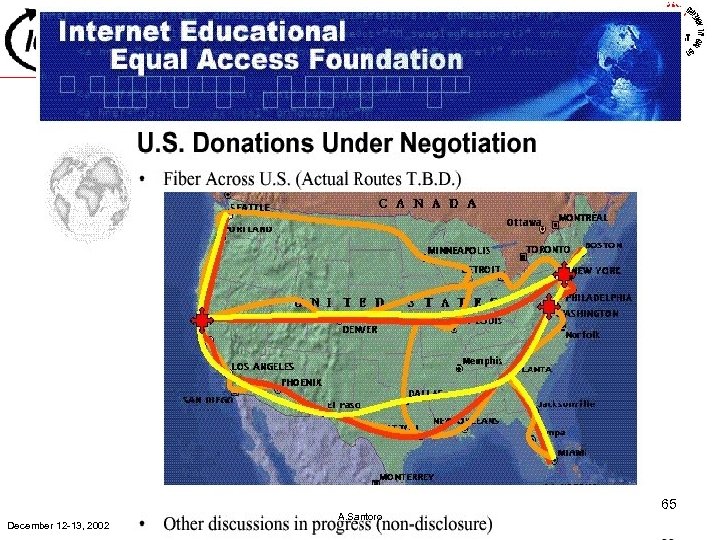
The next set of slides comes from : IEEAF Update Pacific Rim Networking Meeting Honolulu, Hawaii - 2002 Dr. Donald R. Riley Chair, IEEAF- Vice President and CIO University of Maryland, College Park CENIC 2000 Internet 2 and Global Development: Institutional Impact Michael Mc. Robbie Vice President for Information Technology and CIO Indiana University December 12 -13, 2002 A. Santoro 59
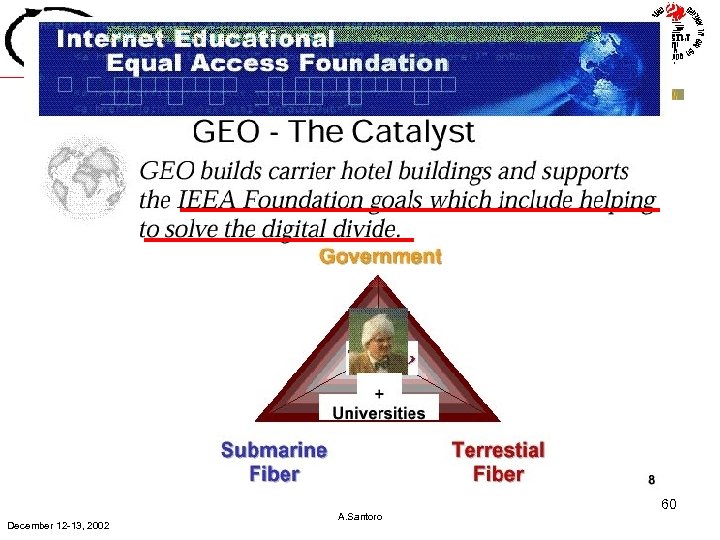
December 12 -13, 2002 A. Santoro 60
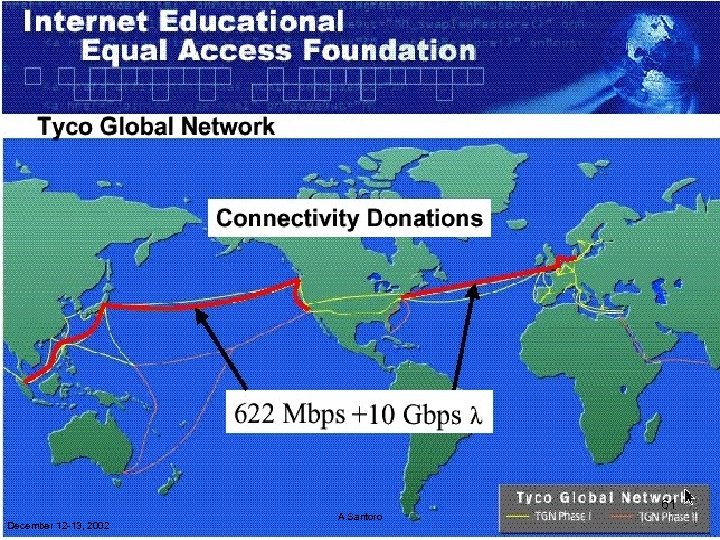
December 12 -13, 2002 A. Santoro 61
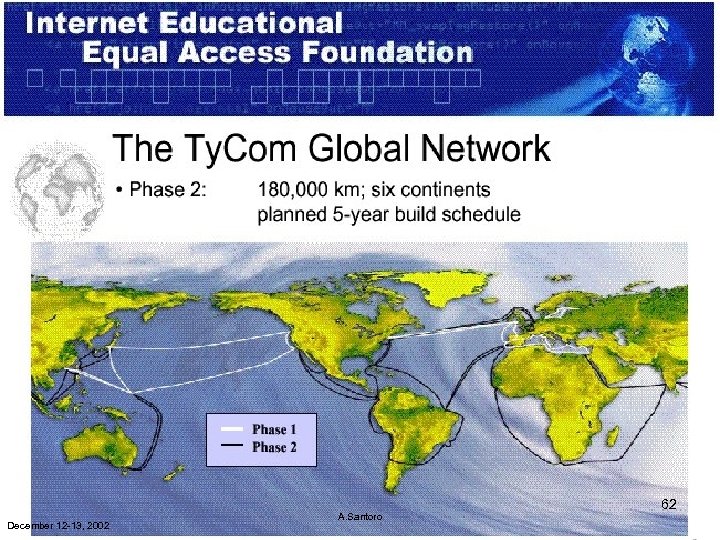
December 12 -13, 2002 A. Santoro 62
December 12 -13, 2002 A. Santoro 63
December 12 -13, 2002 A. Santoro 64
December 12 -13, 2002 A. Santoro 65
II - Topologies December 12 -13, 2002 A. Santoro 66
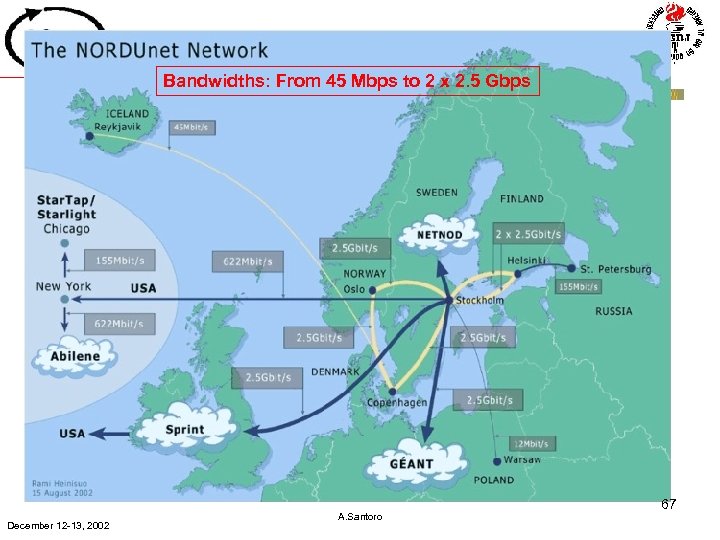
Bandwidths: From 45 Mbps to 2 x 2. 5 Gbps December 12 -13, 2002 A. Santoro 67
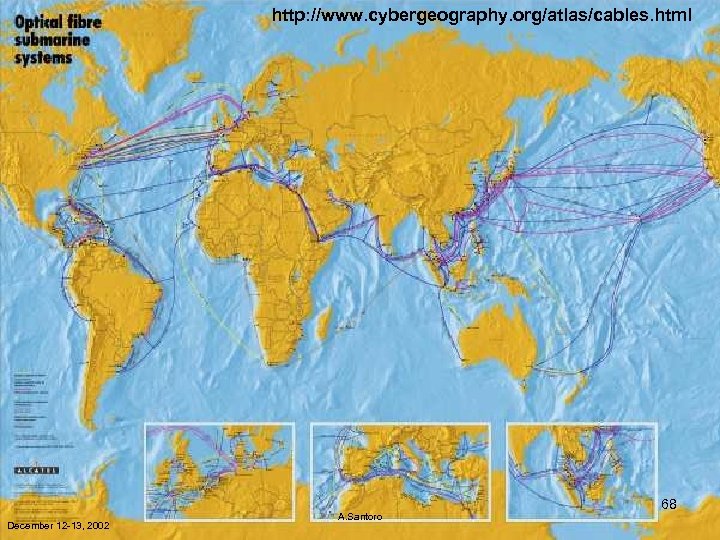
http: //www. cybergeography. org/atlas/cables. html December 12 -13, 2002 A. Santoro 68
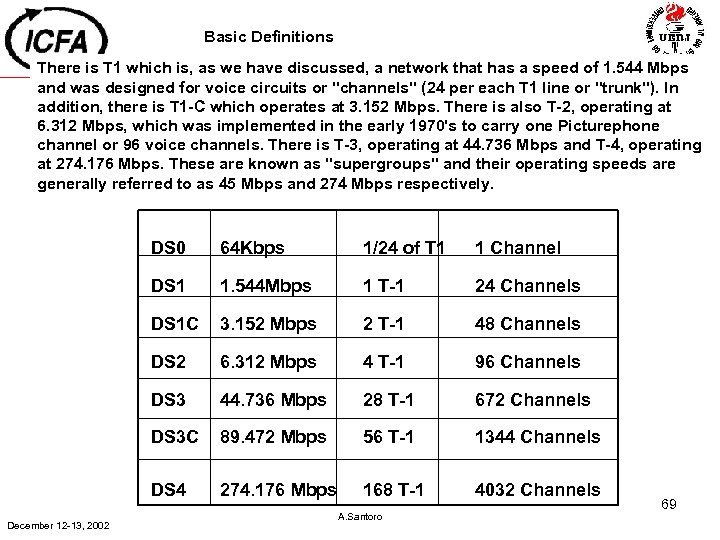
Basic Definitions There is T 1 which is, as we have discussed, a network that has a speed of 1. 544 Mbps and was designed for voice circuits or "channels" (24 per each T 1 line or "trunk"). In addition, there is T 1 -C which operates at 3. 152 Mbps. There is also T-2, operating at 6. 312 Mbps, which was implemented in the early 1970's to carry one Picturephone channel or 96 voice channels. There is T-3, operating at 44. 736 Mbps and T-4, operating at 274. 176 Mbps. These are known as "supergroups" and their operating speeds are generally referred to as 45 Mbps and 274 Mbps respectively. DS 0 1/24 of T 1 1 Channel DS 1 1. 544 Mbps 1 T-1 24 Channels DS 1 C 3. 152 Mbps 2 T-1 48 Channels DS 2 6. 312 Mbps 4 T-1 96 Channels DS 3 44. 736 Mbps 28 T-1 672 Channels DS 3 C 89. 472 Mbps 56 T-1 1344 Channels DS 4 December 12 -13, 2002 64 Kbps 274. 176 Mbps 168 T-1 4032 Channels A. Santoro 69
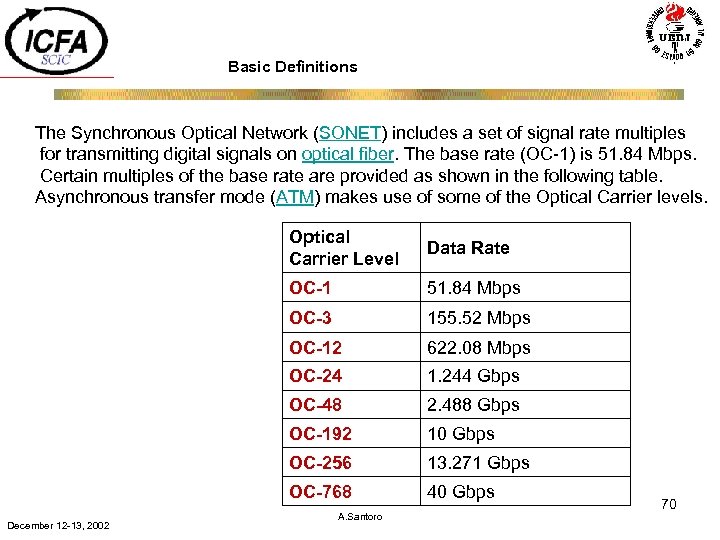
Basic Definitions The Synchronous Optical Network (SONET) includes a set of signal rate multiples for transmitting digital signals on optical fiber. The base rate (OC-1) is 51. 84 Mbps. Certain multiples of the base rate are provided as shown in the following table. Asynchronous transfer mode (ATM) makes use of some of the Optical Carrier levels. Optical Carrier Level OC-1 51. 84 Mbps OC-3 155. 52 Mbps OC-12 622. 08 Mbps OC-24 1. 244 Gbps OC-48 2. 488 Gbps OC-192 10 Gbps OC-256 13. 271 Gbps OC-768 December 12 -13, 2002 Data Rate 40 Gbps A. Santoro 70
Скачать презентацию A Santoro B UERJ -BRAZIL DD-Members please update
247c5bd8d759cfca148aee4f6c1a77c4.ppt