 Скачать презентацию A Robot for Automated Motion Scaling in Robotic
4bcf7a120282f1ce932ba94d9356a5f7.ppt
- Количество слайдов: 33




A Robot for Automated Motion Scaling in Robotic Microsurgery Group 2 Keshav Chintamani Lavie Golenberg Prashanth Mathihalli
Problem Statement • • Different surgical tasks require varying motion scales (MS) between the surgeon and the end-effector – E. g. Suturing vs. gross translation have different scale requirements Surgeons currently keep the MS constant due to – Inconvenience and interruptions during procedures – Higher mental workload – Failures in selecting correct scales might lead to fatal errors – May require an additional technician
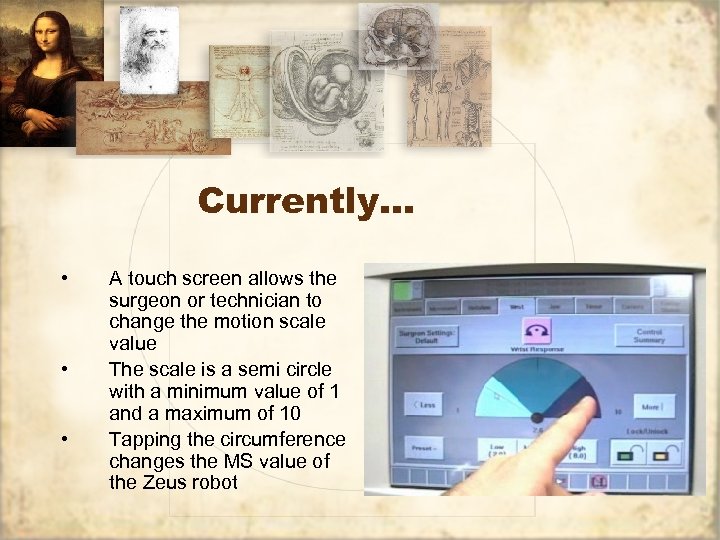
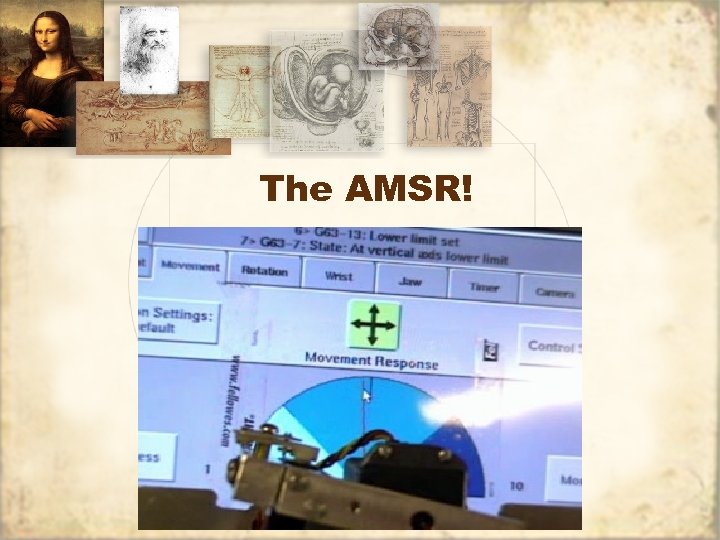
Currently… • • • A touch screen allows the surgeon or technician to change the motion scale value The scale is a semi circle with a minimum value of 1 and a maximum of 10 Tapping the circumference changes the MS value of the Zeus robot
Specific Aims • Design and construct an Automated Motion Scaling Robot (AMSR) – – • • Hardware Software Integrate the AMSR with zeus robot system Analysis and validation of the AMSR through an objective human factors study

The Hypotheses The AMSR will: • Eliminate the need for a technician • Remove pauses during operations • Be capable of changing the MS more frequently • Deliver MS changes more accurately than a human • Not be susceptible to fatigue • Create a more responsive system

Hardware
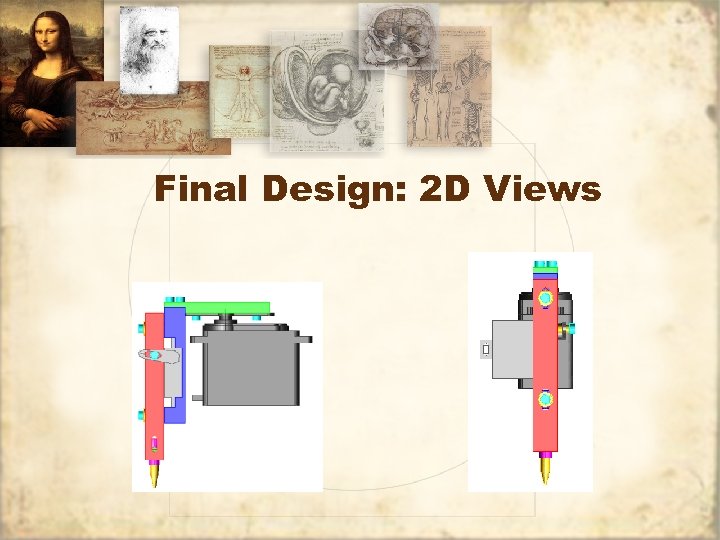
Design Requirements • A two degree-of-freedom (DOF) RP robot arm – – – One rotational and one prismatic joint Damping mechanism to prevent damage to the touch screen Rapid input/output response Provide accurate responses to inputs from the surgeon Provide ease of removal during maintenance and repair
Design Requirements, Contd. . • Designing the Robot Mount to provide – A high center-center accuracy between the AMSR and the Motion Scale – Variable chassis geometry settings for the AMSR for calibration
Design Hurdles • • Providing motors with sufficient torque Providing a unique design that is – Replaceable – Reliable – Sensitive to pressure

Preliminary Concepts for the Prismatic Joint
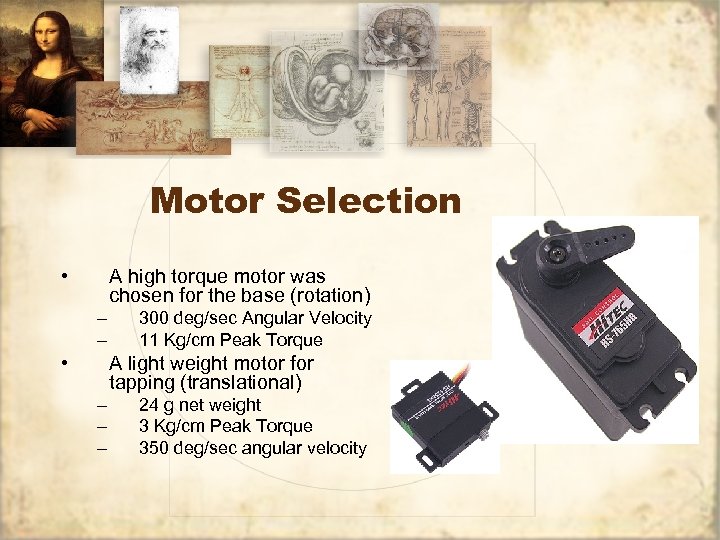
Motor Selection • A high torque motor was chosen for the base (rotation) – – • 300 deg/sec Angular Velocity 11 Kg/cm Peak Torque A light weight motor for tapping (translational) – – – 24 g net weight 3 Kg/cm Peak Torque 350 deg/sec angular velocity

Software
Electronics • • Robix RCS-6 Controller provides support for – 6 servos with 6 sensor inputs – Parallel port data transmission • The programming was done in Microsoft Visual C++ 6. 0
Robot Control Software • Fully integrated control functions for – Speed, acceleration and deceleration of servos – Positional feedback – Additional sensor data acquisition capabilities

Final Design
Final Design: 2 D Views

Final Design: 3 D View

A Descriptive Video
The AMSR!

Evaluation
Methodology • • Obtain preliminary data for 3 humans and the AMS Robot performing a tapping task Compare performance between the robot and the subjects
Preliminary Human Factors Test • • Participants were provided with 5 minutes for practice on the MS display They were asked to input 99 values based on verbal prompts from the experimenter Participants were asked to tap values with and without a stylus Values displayed on screen were recorded
Analysis • • • A within-subjects factorial design was used The experiment was balanced using a Latin square The data was analyzed for input error

Results, Discussion & Conclusion
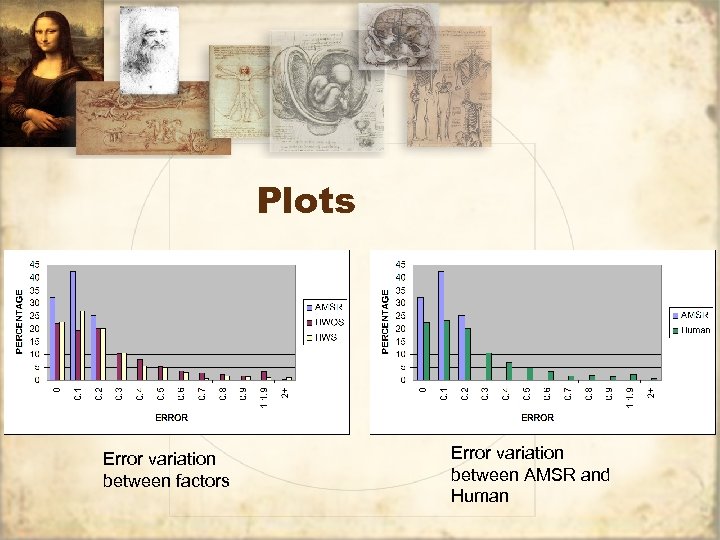
Plots Error variation between factors Error variation between AMSR and Human
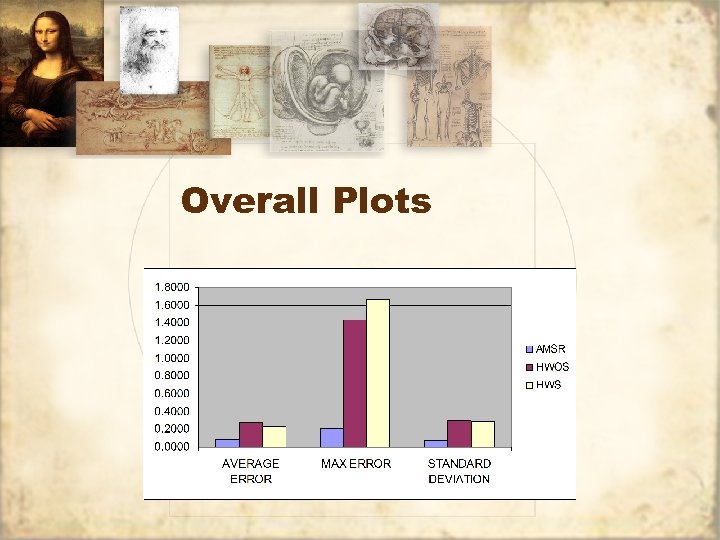
Overall Plots
Conclusion • • Human beings are incapable of the level of dexterity that robots possess Hand movements with a stylus improved human performance The AMSR can provide more rapid and accurate cyclic responses than a human These responses are repeatable
Conclusion, contd… • • • With the AMSR, surgeon performance can immensely be enhanced Surgeon fatigue and workload can be reduced Can result in efficient surgeries with reduced time durations

Future Work
Future Work • • • Creating a closed loop system Increase the accuracy of the robot Continue subject testing Analyze performance of linear scales over semi-circular scales Provide various forms of input methods
Future Work, contd… • • • Combine AMSR with Automatic Motion Scaling This study can lead to further research into human hand tracking performance Develop display methods/cues for enhancing performance

Thank you
References • • S. M. P. M. Sunil M. Prasad MD*, Hersh S. Maniar MD†, Celeste Chu MD*, Richard B. Schuessler Ph. D* and Ralph J. Damiano, Jr. MD*, Corresponding Author Contact Information, FACS, "Surgical robotics: Impact of motion scaling on task performance, " 2004. R. D. Ellis, A. Cao, A. Pandya, A. Composto, M. D. Klein, and G. Auner, "Minimizing Movement Time In Surgical Telerobotic Tasks, " presented at 49 th Annual meeting of the Human Factors and Ergonomics Society Orlando, Florida, 2005. J. Accot and S. Zhai, "Scale effects in steering law tasks, " CHI, vol. No. 3, pp. 1 -8, 2001. P. M. Fitts, "The Information Capacity of the Human Motor System in Controlling the Amplitude of Movement, " Journal of Experimental Psychology, vol. Vol. 121, pp. 262 -269, 1954.
Скачать презентацию A Robot for Automated Motion Scaling in Robotic
4bcf7a120282f1ce932ba94d9356a5f7.ppt