A Roadmap for East Asian Monetary Integration 2006. 10 • Kyungtae Lee and Deokryong Yoon
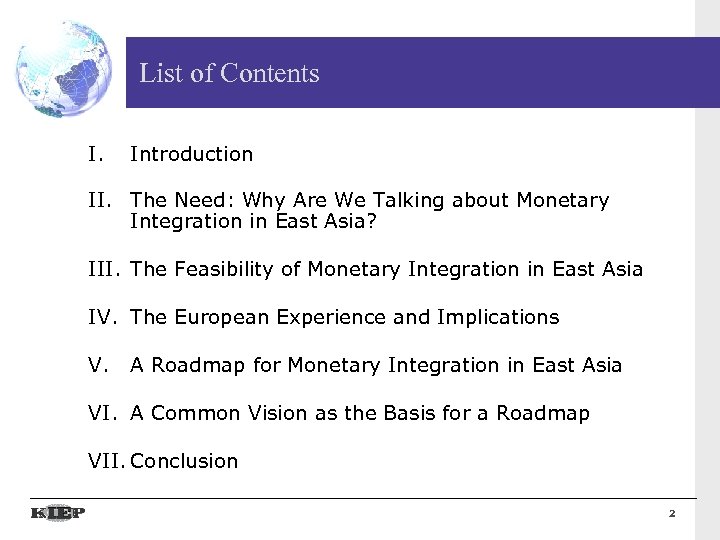
List of Contents I. Introduction II. The Need: Why Are We Talking about Monetary Integration in East Asia? III. The Feasibility of Monetary Integration in East Asia IV. The European Experience and Implications V. A Roadmap for Monetary Integration in East Asia VI. A Common Vision as the Basis for a Roadmap VII. Conclusion 2
II. The Need 1. To stabilize the exchange rate - High proportion of trade in GDP - Avoid competitive devaluation 2. Contagion Effect - High intra-regional trade: 16. 1%→ 23. 7% (China, Japan, Korea, 1993~2003) - High intra-regional investment: 8. 1%→ 18. 7%n(China, Japan, Korea, 1993~2003) 3. Speculative Attack - Small sized currency is easier to attack. 4. Efficient use of regional resources - East Asia is the largest capital exporter and importer 5. New engine of economic growth - Asia accounted for over half of the world’s growth since 2001(in ppp) 3
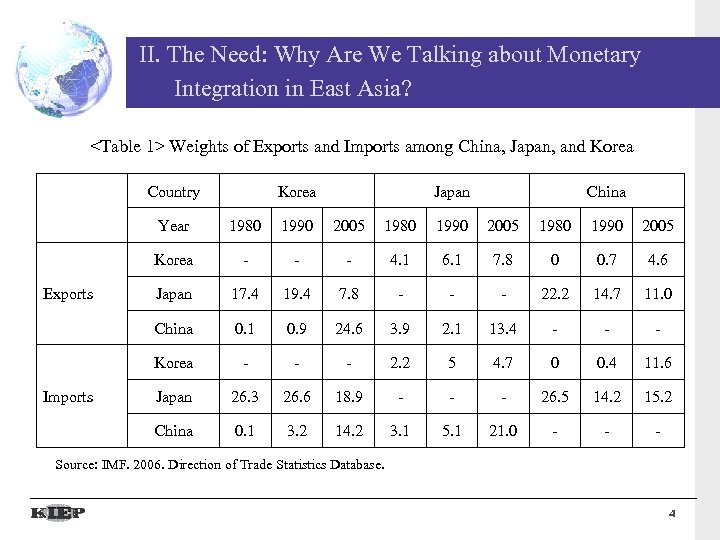
II. The Need: Why Are We Talking about Monetary Integration in East Asia?
Weights of Exports and Imports among China, Japan, and Korea Country Korea Japan China Year 2005 1980 1990 2005 - - - 4. 1 6. 1 7. 8 0 0. 7 4. 6 Japan 17. 4 19. 4 7. 8 - - - 22. 2 14. 7 11. 0 China 0. 1 0. 9 24. 6 3. 9 2. 1 13. 4 - - - Korea - - - 2. 2 5 4. 7 0 0. 4 11. 6 Japan 26. 3 26. 6 18. 9 - - - 26. 5 14. 2 15. 2 China Imports 1990 Korea Exports 1980 0. 1 3. 2 14. 2 3. 1 5. 1 21. 0 - - - Source: IMF. 2006. Direction of Trade Statistics Database. 4
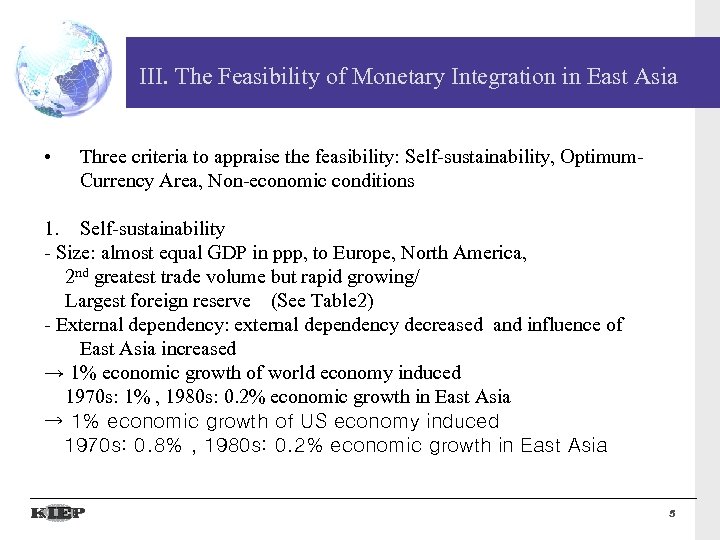
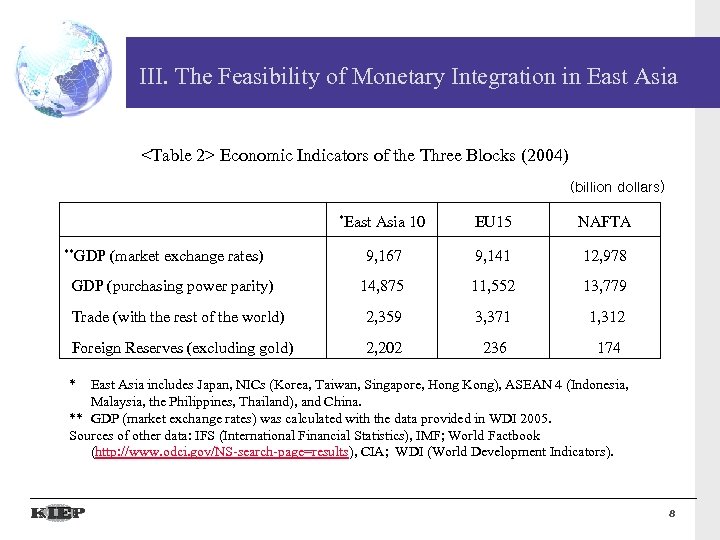
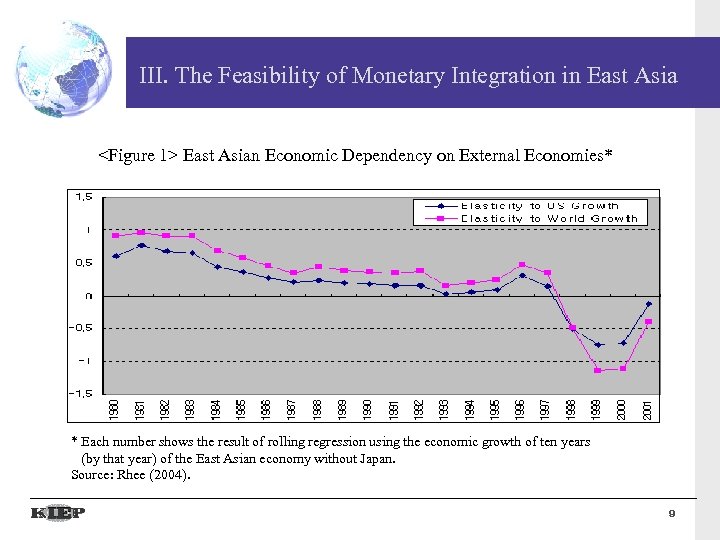
III. The Feasibility of Monetary Integration in East Asia • Three criteria to appraise the feasibility: Self-sustainability, Optimum. Currency Area, Non-economic conditions 1. Self-sustainability - Size: almost equal GDP in ppp, to Europe, North America, 2 nd greatest trade volume but rapid growing/ Largest foreign reserve (See Table 2) - External dependency: external dependency decreased and influence of East Asia increased → 1% economic growth of world economy induced 1970 s: 1% , 1980 s: 0. 2% economic growth in East Asia → 1% economic growth of US economy induced 1970 s: 0. 8% , 1980 s: 0. 2% economic growth in East Asia 5
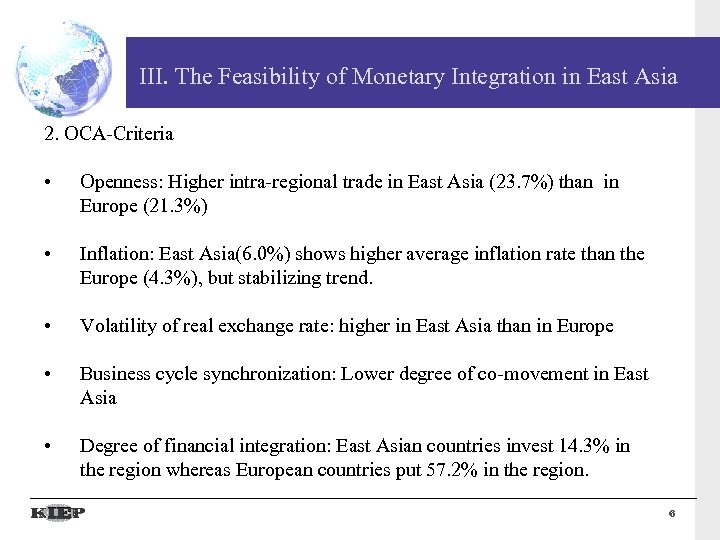
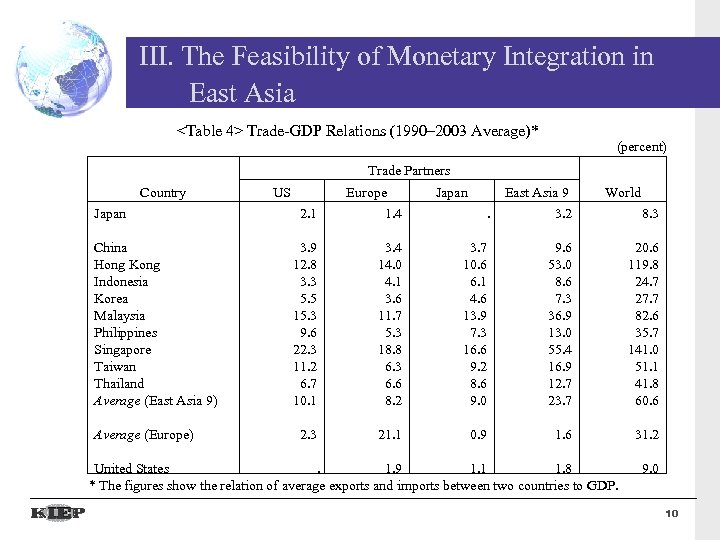
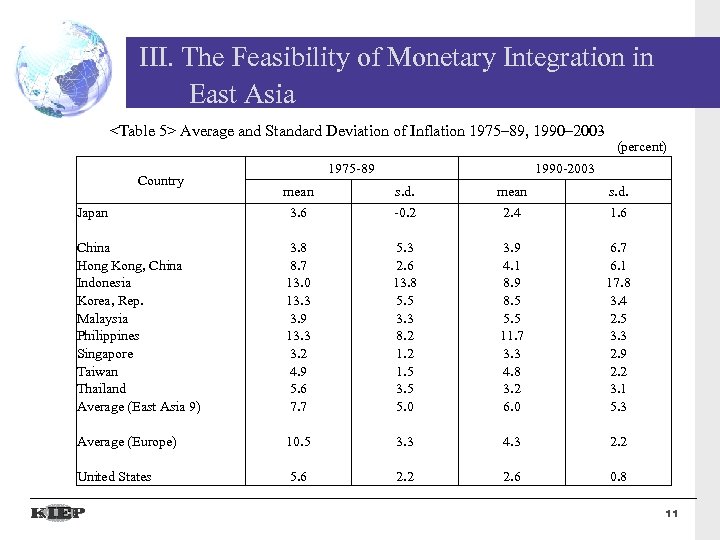
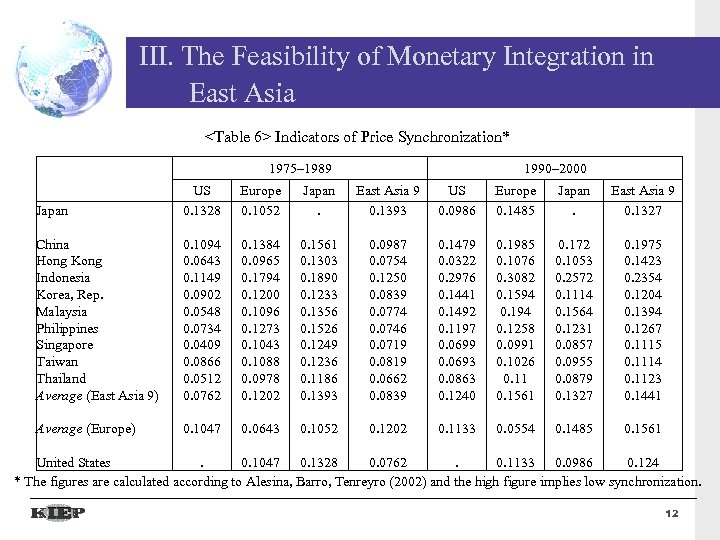
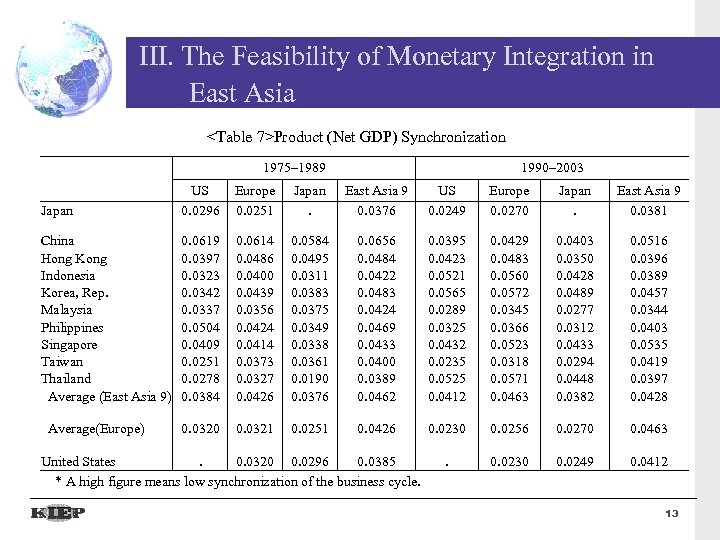
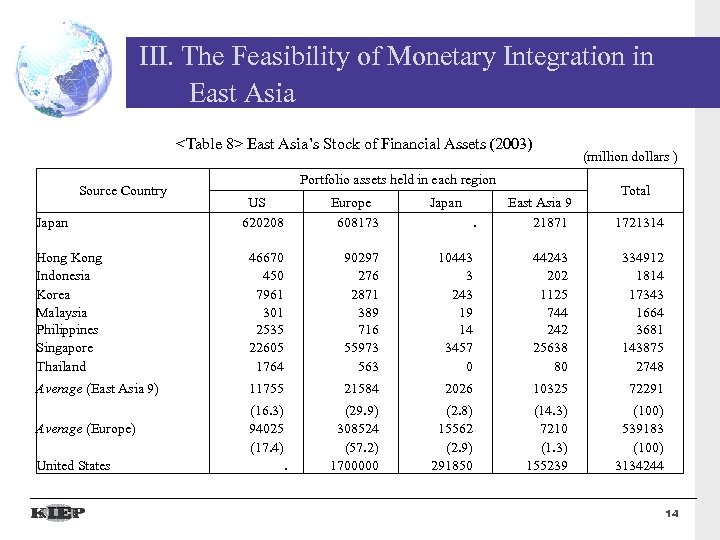
III. The Feasibility of Monetary Integration in East Asia 2. OCA-Criteria • Openness: Higher intra-regional trade in East Asia (23. 7%) than in Europe (21. 3%) • Inflation: East Asia(6. 0%) shows higher average inflation rate than the Europe (4. 3%), but stabilizing trend. • Volatility of real exchange rate: higher in East Asia than in Europe • Business cycle synchronization: Lower degree of co-movement in East Asia • Degree of financial integration: East Asian countries invest 14. 3% in the region whereas European countries put 57. 2% in the region. 6
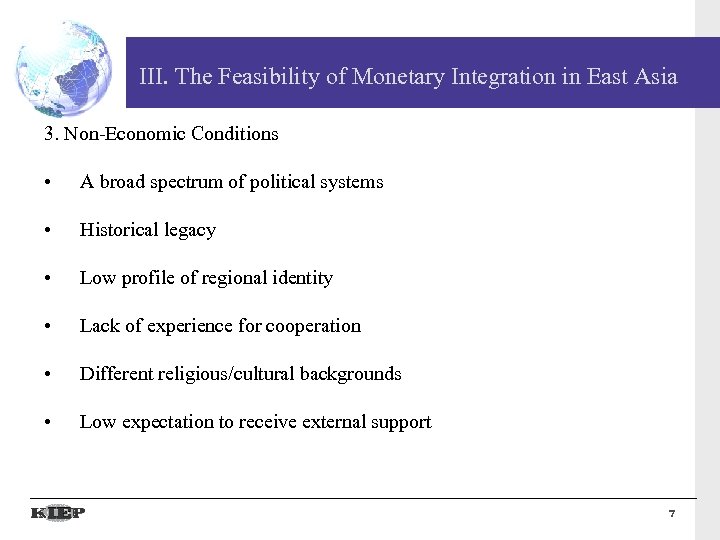
III. The Feasibility of Monetary Integration in East Asia 3. Non-Economic Conditions • A broad spectrum of political systems • Historical legacy • Low profile of regional identity • Lack of experience for cooperation • Different religious/cultural backgrounds • Low expectation to receive external support 7
III. The Feasibility of Monetary Integration in East Asia
Economic Indicators of the Three Blocks (2004) (billion dollars) *East Asia 10 EU 15 NAFTA **GDP (market exchange rates) 9, 167 9, 141 12, 978 GDP (purchasing power parity) 14, 875 11, 552 13, 779 Trade (with the rest of the world) 2, 359 3, 371 1, 312 Foreign Reserves (excluding gold) 2, 202 236 174 * East Asia includes Japan, NICs (Korea, Taiwan, Singapore, Hong Kong), ASEAN 4 (Indonesia, Malaysia, the Philippines, Thailand), and China. ** GDP (market exchange rates) was calculated with the data provided in WDI 2005. Sources of other data: IFS (International Financial Statistics), IMF; World Factbook (http: //www. odci. gov/NS-search-page=results), CIA; WDI (World Development Indicators). 8
III. The Feasibility of Monetary Integration in East Asia East Asian Economic Dependency on External Economies* * Each number shows the result of rolling regression using the economic growth of ten years (by that year) of the East Asian economy without Japan. Source: Rhee (2004). 9
III. The Feasibility of Monetary Integration in East Asia
Trade-GDP Relations (1990– 2003 Average)* (percent) Trade Partners Country Japan China Hong Kong Indonesia Korea Malaysia Philippines Singapore Taiwan Thailand Average (East Asia 9) Average (Europe) US 2. 1 Europe 1. 4 Japan East Asia 9. 3. 2 World 3. 9 12. 8 3. 3 5. 5 15. 3 9. 6 22. 3 11. 2 6. 7 10. 1 3. 4 14. 0 4. 1 3. 6 11. 7 5. 3 18. 8 6. 3 6. 6 8. 2 3. 7 10. 6 6. 1 4. 6 13. 9 7. 3 16. 6 9. 2 8. 6 9. 0 9. 6 53. 0 8. 6 7. 3 36. 9 13. 0 55. 4 16. 9 12. 7 23. 7 20. 6 119. 8 24. 7 27. 7 82. 6 35. 7 141. 0 51. 1 41. 8 60. 6 2. 3 21. 1 0. 9 1. 6 31. 2 United States. 1. 9 1. 1 1. 8 * The figures show the relation of average exports and imports between two countries to GDP. 8. 3 9. 0 10
III. The Feasibility of Monetary Integration in East Asia
Average and Standard Deviation of Inflation 1975– 89, 1990– 2003 Country 1975 -89 (percent) 1990 -2003 Japan mean 3. 6 s. d. -0. 2 mean 2. 4 s. d. 1. 6 China Hong Kong, China Indonesia Korea, Rep. Malaysia Philippines Singapore Taiwan Thailand Average (East Asia 9) 3. 8 8. 7 13. 0 13. 3 3. 9 13. 3 3. 2 4. 9 5. 6 7. 7 5. 3 2. 6 13. 8 5. 5 3. 3 8. 2 1. 5 3. 5 5. 0 3. 9 4. 1 8. 9 8. 5 5. 5 11. 7 3. 3 4. 8 3. 2 6. 0 6. 7 6. 1 17. 8 3. 4 2. 5 3. 3 2. 9 2. 2 3. 1 5. 3 Average (Europe) 10. 5 3. 3 4. 3 2. 2 United States 5. 6 2. 2 2. 6 0. 8 11
III. The Feasibility of Monetary Integration in East Asia
Indicators of Price Synchronization* 1975– 1989 1990– 2000 Japan US 0. 1328 Europe 0. 1052 Japan. East Asia 9 0. 1393 US 0. 0986 Europe 0. 1485 Japan. East Asia 9 0. 1327 China Hong Kong Indonesia Korea, Rep. Malaysia Philippines Singapore Taiwan Thailand Average (East Asia 9) 0. 1094 0. 0643 0. 1149 0. 0902 0. 0548 0. 0734 0. 0409 0. 0866 0. 0512 0. 0762 0. 1384 0. 0965 0. 1794 0. 1200 0. 1096 0. 1273 0. 1043 0. 1088 0. 0978 0. 1202 0. 1561 0. 1303 0. 1890 0. 1233 0. 1356 0. 1526 0. 1249 0. 1236 0. 1186 0. 1393 0. 0987 0. 0754 0. 1250 0. 0839 0. 0774 0. 0746 0. 0719 0. 0819 0. 0662 0. 0839 0. 1479 0. 0322 0. 2976 0. 1441 0. 1492 0. 1197 0. 0699 0. 0693 0. 0863 0. 1240 0. 1985 0. 1076 0. 3082 0. 1594 0. 1258 0. 0991 0. 1026 0. 11 0. 1561 0. 172 0. 1053 0. 2572 0. 1114 0. 1564 0. 1231 0. 0857 0. 0955 0. 0879 0. 1327 0. 1975 0. 1423 0. 2354 0. 1204 0. 1394 0. 1267 0. 1115 0. 1114 0. 1123 0. 1441 Average (Europe) 0. 1047 0. 0643 0. 1052 0. 1202 0. 1133 0. 0554 0. 1485 0. 1561 United States. 0. 1047 0. 1328 0. 0762 . 0. 1133 0. 0986 0. 124 * The figures are calculated according to Alesina, Barro, Tenreyro (2002) and the high figure implies low synchronization. 12
III. The Feasibility of Monetary Integration in East Asia
III. The Feasibility of Monetary Integration in East Asia
East Asia’s Stock of Financial Assets (2003) Source Country Portfolio assets held in each region US 620208 Europe 608173 Hong Kong Indonesia Korea Malaysia Philippines Singapore Thailand 46670 450 7961 301 2535 22605 1764 Average (East Asia 9) Japan Average (Europe) United States Japan (million dollars ) Total . East Asia 9 21871 1721314 90297 276 2871 389 716 55973 563 10443 3 243 19 14 3457 0 44243 202 1125 744 242 25638 80 334912 1814 17343 1664 3681 143875 2748 11755 21584 2026 10325 72291 (16. 3) 94025 (17. 4). (29. 9) 308524 (57. 2) 1700000 (2. 8) 15562 (2. 9) 291850 (14. 3) 7210 (1. 3) 155239 (100) 539183 (100) 3134244 14
III. The Feasibility of Monetary Integration in East Asia
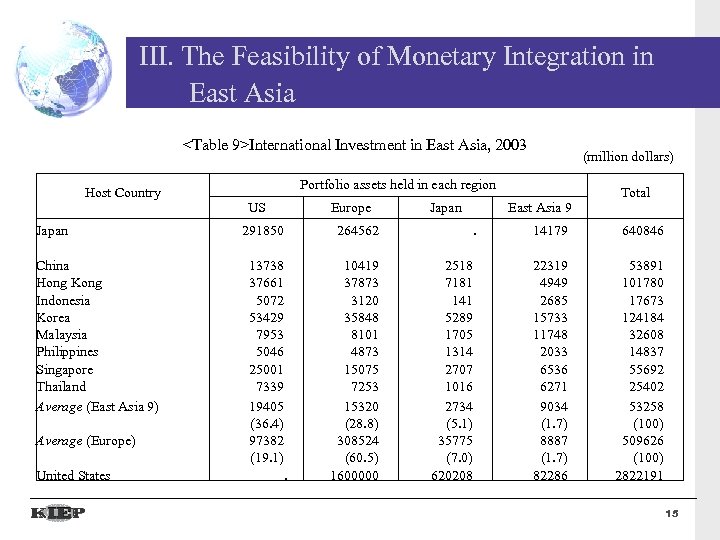
International Investment in East Asia, 2003 Host Country Japan China Hong Kong Indonesia Korea Malaysia Philippines Singapore Thailand Average (East Asia 9) Average (Europe) United States (million dollars) Portfolio assets held in each region US Europe Japan East Asia 9 Total 291850 264562 . 14179 640846 13738 37661 5072 53429 7953 5046 25001 7339 19405 (36. 4) 97382 (19. 1). 10419 37873 3120 35848 8101 4873 15075 7253 15320 (28. 8) 308524 (60. 5) 1600000 2518 7181 141 5289 1705 1314 2707 1016 2734 (5. 1) 35775 (7. 0) 620208 22319 4949 2685 15733 11748 2033 6536 6271 9034 (1. 7) 8887 (1. 7) 82286 53891 101780 17673 124184 32608 14837 55692 25402 53258 (100) 509626 (100) 2822191 15
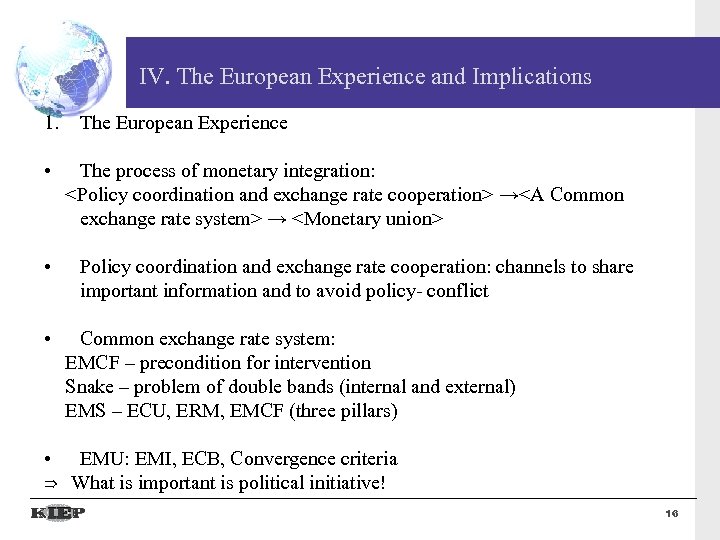
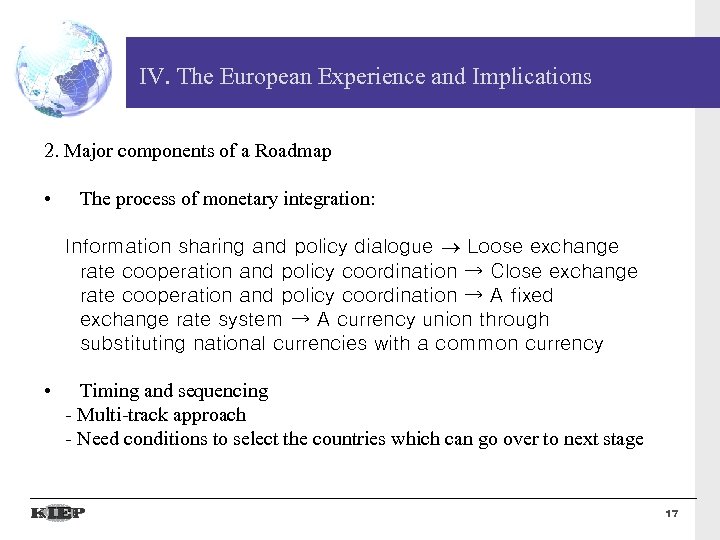
IV. The European Experience and Implications 2. Major components of a Roadmap • The process of monetary integration: Information sharing and policy dialogue Loose exchange rate cooperation and policy coordination → Close exchange rate cooperation and policy coordination → A fixed exchange rate system → A currency union through substituting national currencies with a common currency • Timing and sequencing - Multi-track approach - Need conditions to select the countries which can go over to next stage 17
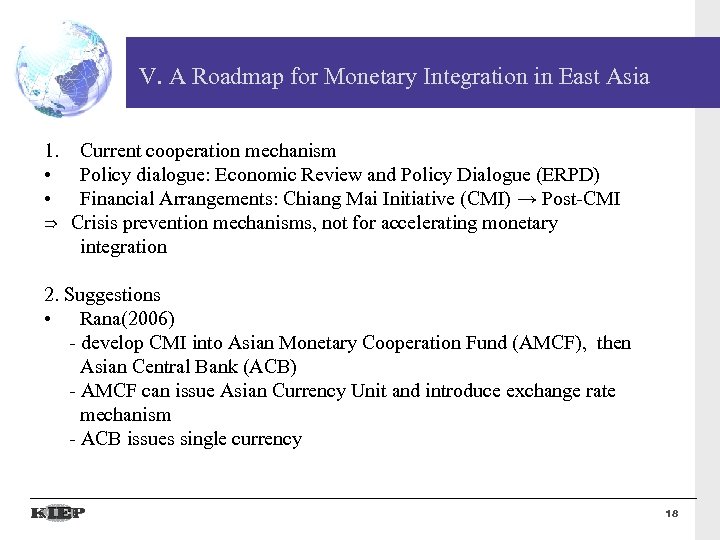
V. A Roadmap for Monetary Integration in East Asia 1. Current cooperation mechanism • Policy dialogue: Economic Review and Policy Dialogue (ERPD) • Financial Arrangements: Chiang Mai Initiative (CMI) → Post-CMI ⇒ Crisis prevention mechanisms, not for accelerating monetary integration 2. Suggestions • Rana(2006) - develop CMI into Asian Monetary Cooperation Fund (AMCF), then Asian Central Bank (ACB) - AMCF can issue Asian Currency Unit and introduce exchange rate mechanism - ACB issues single currency 18
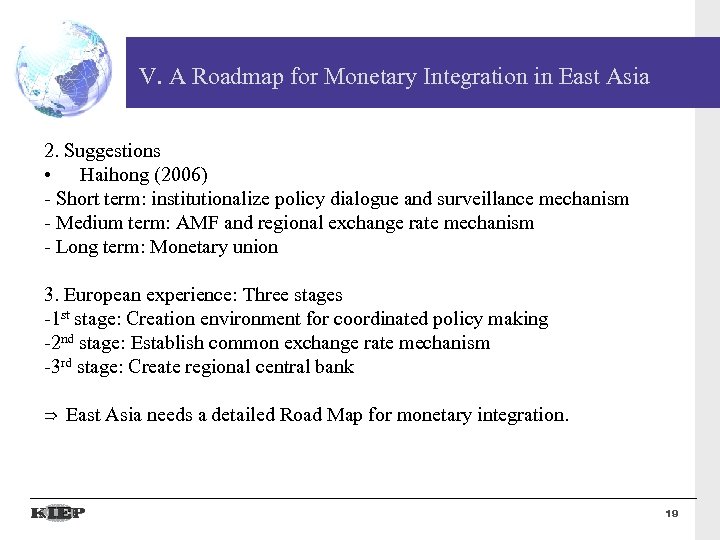
V. A Roadmap for Monetary Integration in East Asia 2. Suggestions • Haihong (2006) - Short term: institutionalize policy dialogue and surveillance mechanism - Medium term: AMF and regional exchange rate mechanism - Long term: Monetary union 3. European experience: Three stages -1 st stage: Creation environment for coordinated policy making -2 nd stage: Establish common exchange rate mechanism -3 rd stage: Create regional central bank ⇒ East Asia needs a detailed Road Map for monetary integration. 19
V. A Roadmap for Monetary Integration in East Asia
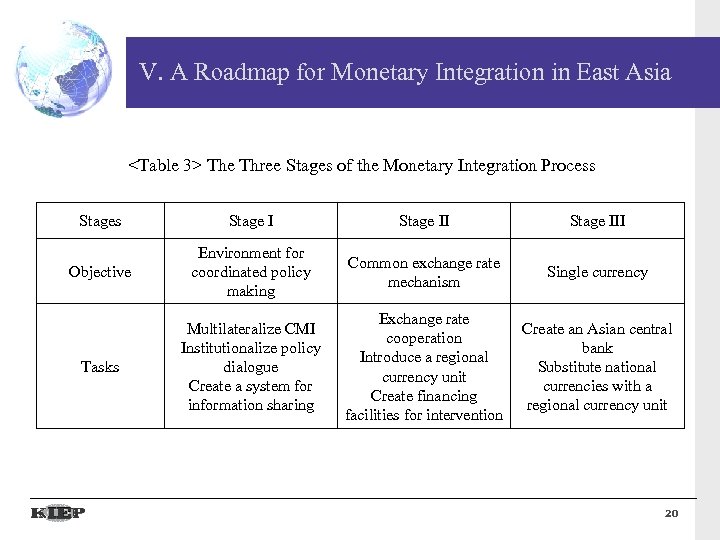
The Three Stages of the Monetary Integration Process Stage III Objective Environment for coordinated policy making Common exchange rate mechanism Single currency Tasks Multilateralize CMI Institutionalize policy dialogue Create a system for information sharing Exchange rate cooperation Introduce a regional currency unit Create financing facilities for intervention Create an Asian central bank Substitute national currencies with a regional currency unit 20
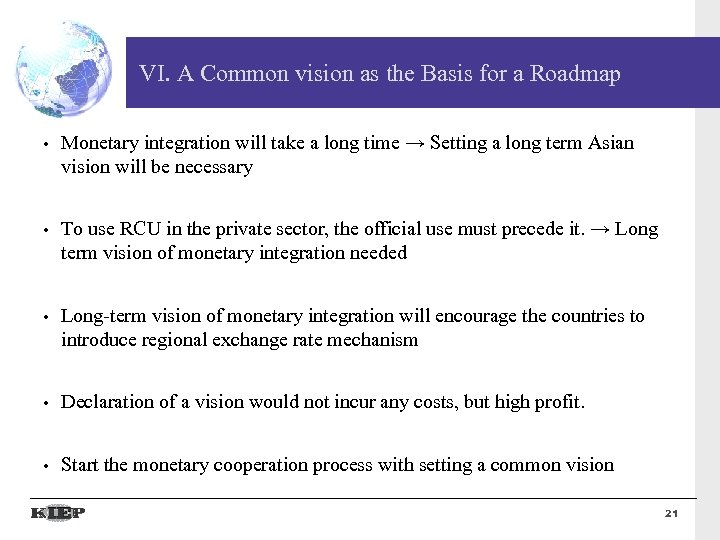
VI. A Common vision as the Basis for a Roadmap • Monetary integration will take a long time → Setting a long term Asian vision will be necessary • To use RCU in the private sector, the official use must precede it. → Long term vision of monetary integration needed • Long-term vision of monetary integration will encourage the countries to introduce regional exchange rate mechanism • Declaration of a vision would not incur any costs, but high profit. • Start the monetary cooperation process with setting a common vision 21
VII. Conclusion • East Asian countries realize the need of regional cooperation - To prevent a possible recurrence of crisis - To maintain exchange rate stability • Lack of roadmap and lack of common vision • The most important thing to start the monetary integration process is to arrive at a common vision for East Asia and draw a roadmap to realize the vision. 22




 Скачать презентацию A Roadmap for East Asian Monetary Integration 2006
 A Roadmap for East Asian Monetary Integration 2006. 10 • Kyungtae Lee and Deokryong Yoon
  List of Contents I. Introduction II. The Need: Why Are We Talking about Monetary Integration in East Asia? III. The Feasibility of Monetary Integration in East Asia IV. The European Experience and Implications V. A Roadmap for Monetary Integration in East Asia VI. A Common Vision as the Basis for a Roadmap VII. Conclusion 2
  II. The Need 1. To stabilize the exchange rate - High proportion of trade in GDP - Avoid competitive devaluation 2. Contagion Effect - High intra-regional trade: 16. 1%→ 23. 7% (China, Japan, Korea, 1993~2003) - High intra-regional investment: 8. 1%→ 18. 7%n(China, Japan, Korea, 1993~2003) 3. Speculative Attack - Small sized currency is easier to attack. 4. Efficient use of regional resources - East Asia is the largest capital exporter and importer 5. New engine of economic growth - Asia accounted for over half of the world’s growth since 2001(in ppp) 3
  II. The Need: Why Are We Talking about Monetary Integration in East Asia?