


 Скачать презентацию A REVOLUTIONARY NEW THEORY IN SPORTS PHYSIOLOGY Project
sports physiology.pptx
- Количество слайдов: 11
 A REVOLUTIONARY NEW THEORY IN SPORTS PHYSIOLOGY Project Done by Andrew Yakymyak Form 7 B LLG
 Traditional explanations For almost a century, scientists have presumed, not unreasonably, that fatigue or exhaustion – in athletes originates in the muscles. Precise explanations have varied but all have been based on the “limitations theory”.
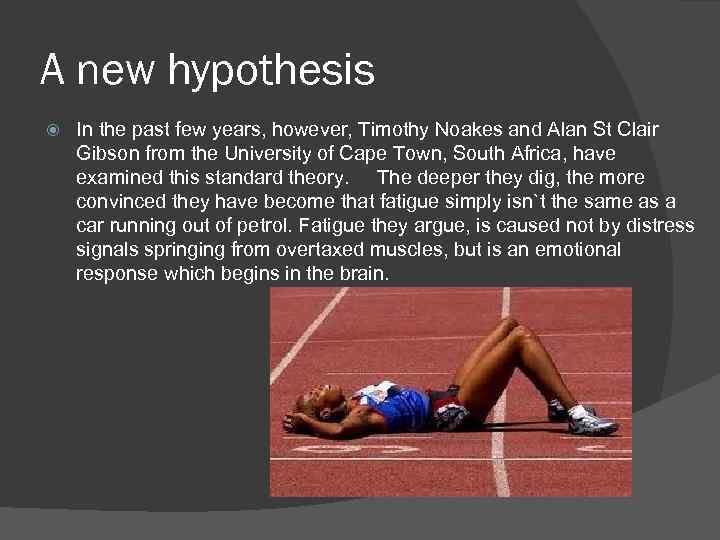 A new hypothesis In the past few years, however, Timothy Noakes and Alan St Clair Gibson from the University of Cape Town, South Africa, have examined this standard theory. The deeper they dig, the more convinced they have become that fatigue simply isn`t the same as a car running out of petrol. Fatigue they argue, is caused not by distress signals springing from overtaxed muscles, but is an emotional response which begins in the brain.
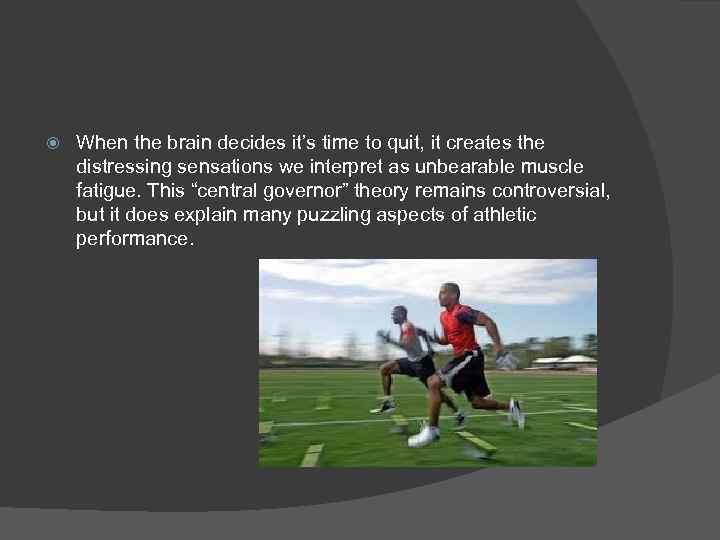 When the brain decides it’s time to quit, it creates the distressing sensations we interpret as unbearable muscle fatigue. This “central governor” theory remains controversial, but it does explain many puzzling aspects of athletic performance.
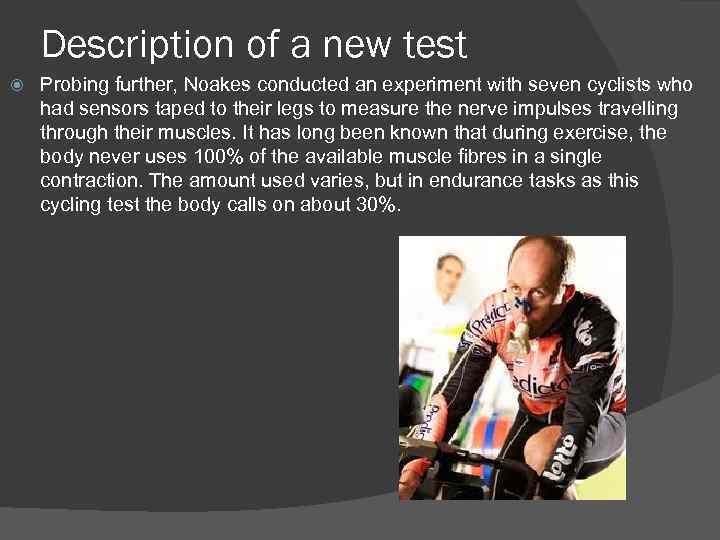 Description of a new test Probing further, Noakes conducted an experiment with seven cyclists who had sensors taped to their legs to measure the nerve impulses travelling through their muscles. It has long been known that during exercise, the body never uses 100% of the available muscle fibres in a single contraction. The amount used varies, but in endurance tasks as this cycling test the body calls on about 30%.
 Interpreting the findings ”The cyclists may have felt completely exhausted, ” Noakes says, “ but their bodies actually had considerable reserves that they could theoretically tap by using a greater proportion of the resting fibres. ” This, he believes, is proof that the brain is regulating the pace of the workout to hold the cyclists well back from the point of catastrophic exhaustion.
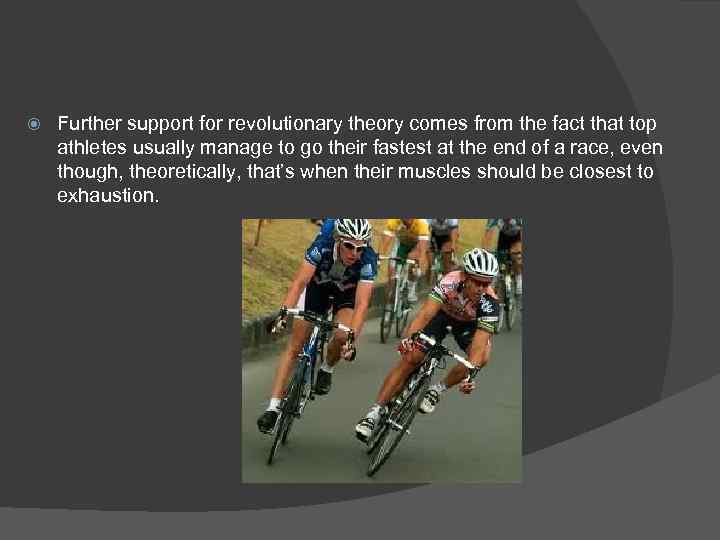 Further support for revolutionary theory comes from the fact that top athletes usually manage to go their fastest at the end of a race, even though, theoretically, that’s when their muscles should be closest to exhaustion.
 However, Noakes believes the end spurt makes no sense if fatigue is caused by muscles poisoning themselves with lactic acids, as it would cause racers to slow down rather than enable them to sprint fir the finish line. In the new theory, the explanation is obvious. Knowing the end is near, the brain slightly relaxes its vigil, allowing the athlete to tap some of the body’s hoarded reserves.
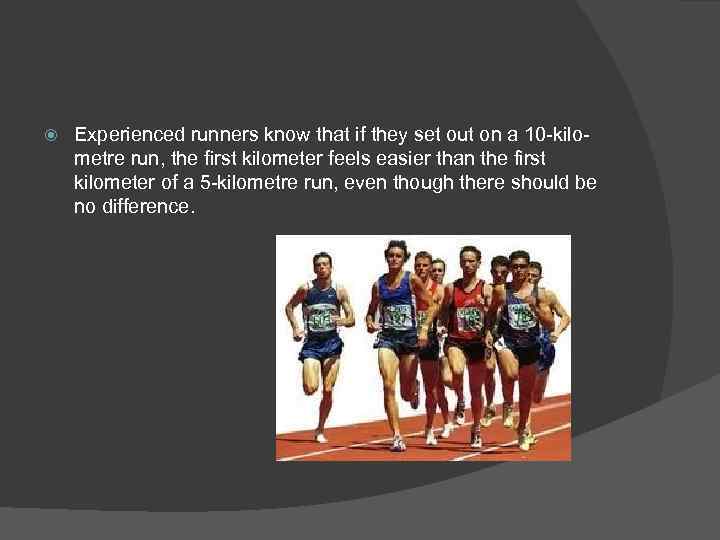 Experienced runners know that if they set out on a 10 -kilometre run, the first kilometer feels easier than the first kilometer of a 5 -kilometre run, even though there should be no difference.
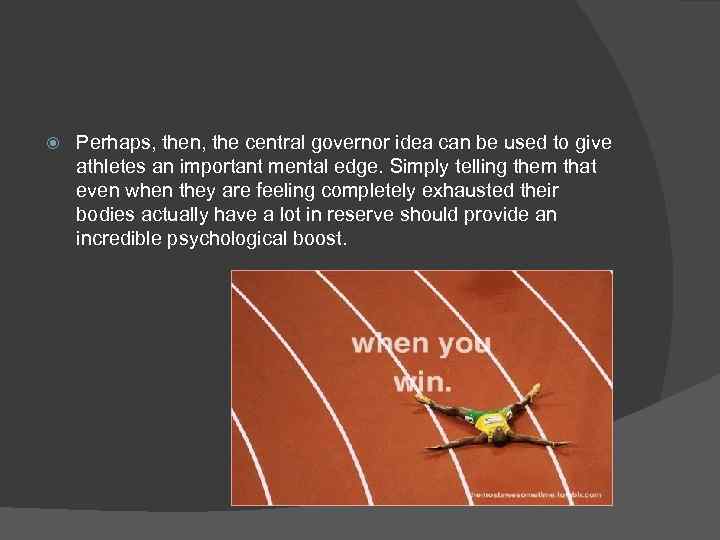 Perhaps, then, the central governor idea can be used to give athletes an important mental edge. Simply telling them that even when they are feeling completely exhausted their bodies actually have a lot in reserve should provide an incredible psychological boost.
 I am grateful for your attention, I hope you’ve found out a lot of useful and interesting information in my report ! The end.