 Скачать презентацию A Review of Transportation Board of Early Education
f6d37e9e05204fcc556e7257c8c983c9.ppt
- Количество слайдов: 13



A Review of Transportation Board of Early Education & Care: Discussion and Vote June 12, 2012

EEC’s Authority to Regulate Transportation l There are two sources of authority for EEC to regulate transportation: l Department of Early Education and Care Regulations • 606 CMR 7. 13 (since 2005) l Policy Statement: • Procedures for the Drop-Off and Pick-up of Children by Transportation Providers and Parent/Program Notification (December 12, 2011) • 1 Provides additional obligations for the Transportation Providers to follow beyond the Regulations.
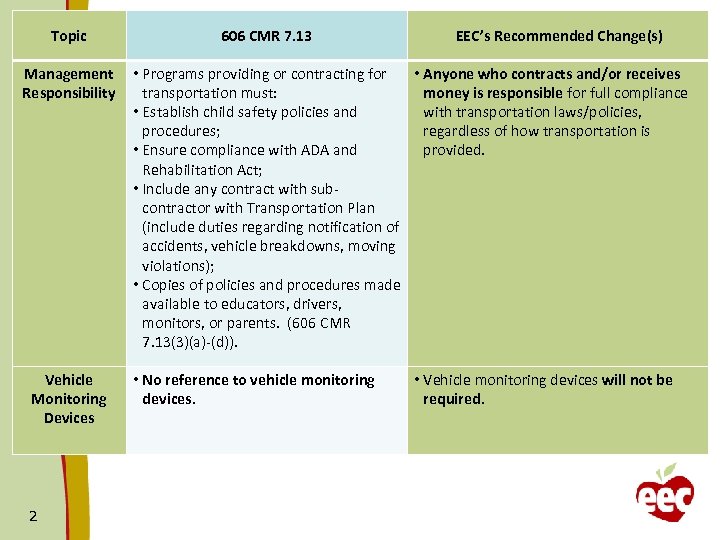
Topic Management Responsibility Vehicle Monitoring Devices 2 606 CMR 7. 13 EEC’s Recommended Change(s) • Programs providing or contracting for • Anyone who contracts and/or receives transportation must: money is responsible for full compliance • Establish child safety policies and with transportation laws/policies, procedures; regardless of how transportation is • Ensure compliance with ADA and provided. Rehabilitation Act; • Include any contract with subcontractor with Transportation Plan (include duties regarding notification of accidents, vehicle breakdowns, moving violations); • Copies of policies and procedures made available to educators, drivers, monitors, or parents. (606 CMR 7. 13(3)(a)-(d)). • No reference to vehicle monitoring devices. • Vehicle monitoring devices will not be required.
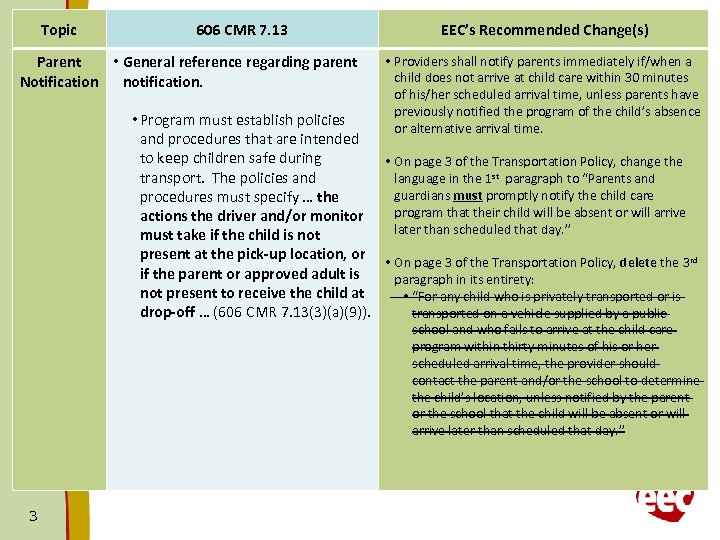
Topic 606 CMR 7. 13 Parent • General reference regarding parent Notification notification. EEC’s Recommended Change(s) • Providers shall notify parents immediately if/when a child does not arrive at child care within 30 minutes of his/her scheduled arrival time, unless parents have previously notified the program of the child’s absence or alternative arrival time. • Program must establish policies and procedures that are intended to keep children safe during • On page 3 of the Transportation Policy, change the transport. The policies and language in the 1 st paragraph to “Parents and guardians must promptly notify the child care procedures must specify … the program that their child will be absent or will arrive actions the driver and/or monitor later than scheduled that day. ” must take if the child is not present at the pick-up location, or • On page 3 of the Transportation Policy, delete the 3 rd if the parent or approved adult is paragraph in its entirety: not present to receive the child at • “For any child who is privately transported or is drop-off … (606 CMR 7. 13(3)(a)(9)). transported on a vehicle supplied by a public school and who fails to arrive at the child care program within thirty minutes of his or her scheduled arrival time, the provider should contact the parent and/or the school to determine the child’s location, unless notified by the parent or the school that the child will be absent or will arrive later than scheduled that day. ” 3
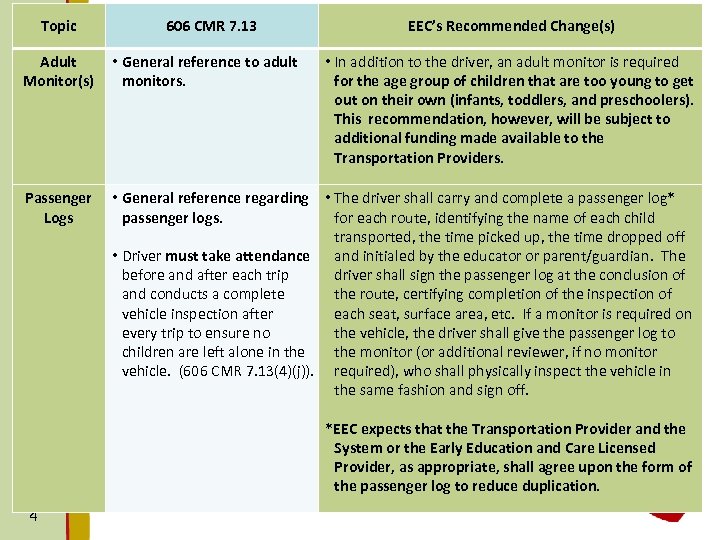
Topic 606 CMR 7. 13 Adult Monitor(s) • General reference to adult monitors. Passenger Logs EEC’s Recommended Change(s) • In addition to the driver, an adult monitor is required for the age group of children that are too young to get out on their own (infants, toddlers, and preschoolers). This recommendation, however, will be subject to additional funding made available to the Transportation Providers. • General reference regarding passenger logs. • The driver shall carry and complete a passenger log* for each route, identifying the name of each child transported, the time picked up, the time dropped off • Driver must take attendance and initialed by the educator or parent/guardian. The before and after each trip driver shall sign the passenger log at the conclusion of and conducts a complete the route, certifying completion of the inspection of vehicle inspection after each seat, surface area, etc. If a monitor is required on every trip to ensure no the vehicle, the driver shall give the passenger log to children are left alone in the monitor (or additional reviewer, if no monitor vehicle. (606 CMR 7. 13(4)(j)). required), who shall physically inspect the vehicle in the same fashion and sign off. *EEC expects that the Transportation Provider and the System or the Early Education and Care Licensed Provider, as appropriate, shall agree upon the form of the passenger log to reduce duplication. 4
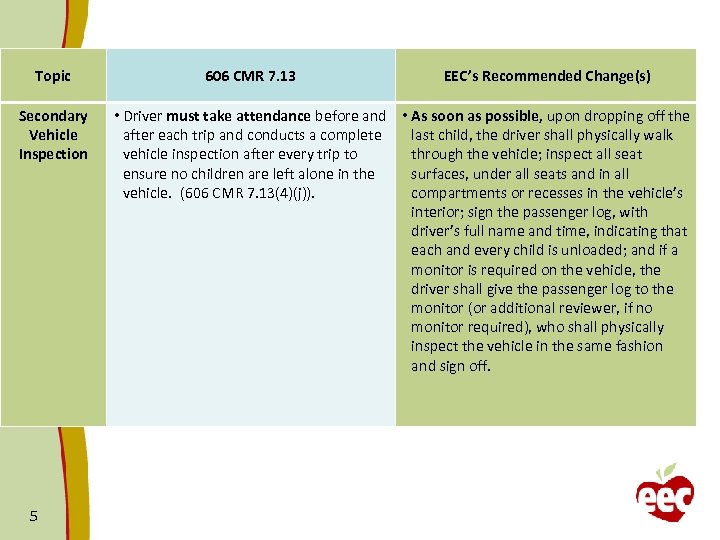
Topic Secondary Vehicle Inspection 5 606 CMR 7. 13 EEC’s Recommended Change(s) • Driver must take attendance before and • As soon as possible, upon dropping off the after each trip and conducts a complete last child, the driver shall physically walk vehicle inspection after every trip to through the vehicle; inspect all seat ensure no children are left alone in the surfaces, under all seats and in all vehicle. (606 CMR 7. 13(4)(j)). compartments or recesses in the vehicle’s interior; sign the passenger log, with driver’s full name and time, indicating that each and every child is unloaded; and if a monitor is required on the vehicle, the driver shall give the passenger log to the monitor (or additional reviewer, if no monitor required), who shall physically inspect the vehicle in the same fashion and sign off.
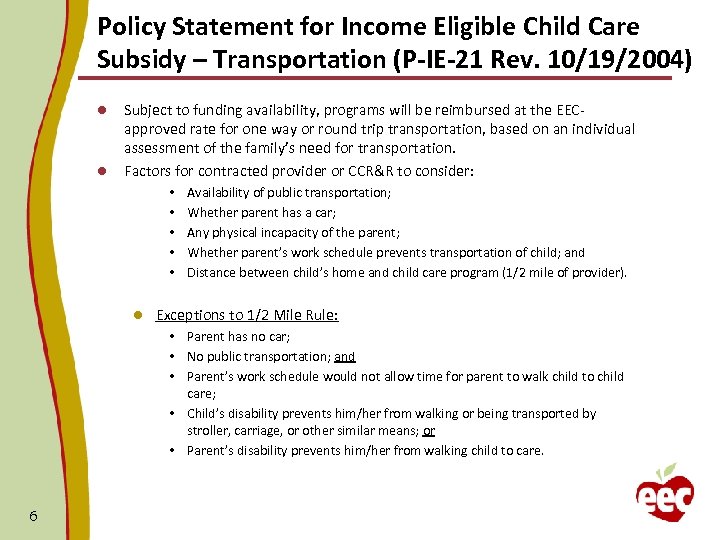
Policy Statement for Income Eligible Child Care Subsidy – Transportation (P-IE-21 Rev. 10/19/2004) l l Subject to funding availability, programs will be reimbursed at the EECapproved rate for one way or round trip transportation, based on an individual assessment of the family’s need for transportation. Factors for contracted provider or CCR&R to consider: • • • l Availability of public transportation; Whether parent has a car; Any physical incapacity of the parent; Whether parent’s work schedule prevents transportation of child; and Distance between child’s home and child care program (1/2 mile of provider). Exceptions to 1/2 Mile Rule: • Parent has no car; • No public transportation; and • Parent’s work schedule would not allow time for parent to walk child to child care; • Child’s disability prevents him/her from walking or being transported by stroller, carriage, or other similar means; or • Parent’s disability prevents him/her from walking child to care. 6
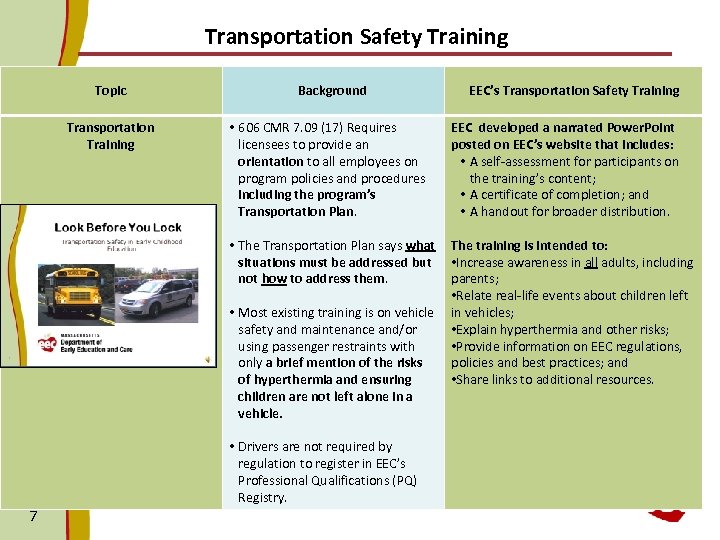
Transportation Safety Training Topic Background Transportation Training • 606 CMR 7. 09 (17) Requires licensees to provide an orientation to all employees on program policies and procedures including the program’s Transportation Plan. • The Transportation Plan says what situations must be addressed but not how to address them. EEC’s Transportation Safety Training EEC developed a narrated Power. Point posted on EEC’s website that includes: • A self-assessment for participants on the training’s content; • A certificate of completion; and • A handout for broader distribution. The training is intended to: • Increase awareness in all adults, including parents; • Relate real-life events about children left • Most existing training is on vehicle in vehicles; safety and maintenance and/or • Explain hyperthermia and other risks; using passenger restraints with • Provide information on EEC regulations, only a brief mention of the risks policies and best practices; and of hyperthermia and ensuring • Share links to additional resources. children are not left alone in a vehicle. • Drivers are not required by regulation to register in EEC’s Professional Qualifications (PQ) Registry. 7
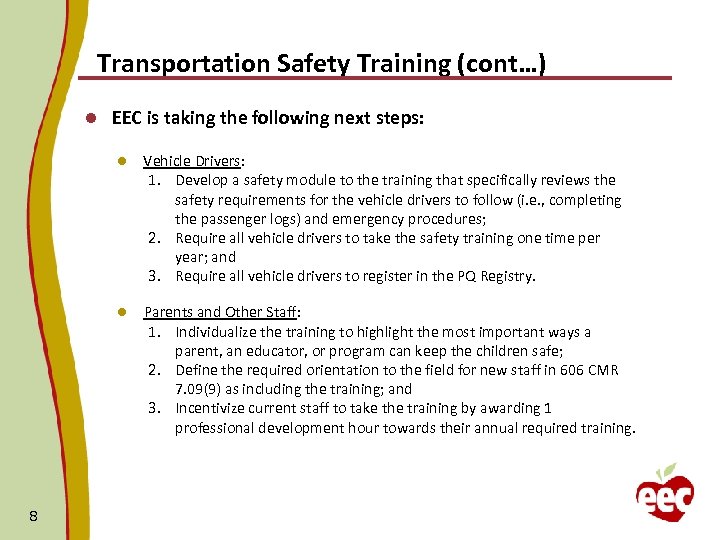
Transportation Safety Training (cont…) l EEC is taking the following next steps: l l 8 Vehicle Drivers: 1. Develop a safety module to the training that specifically reviews the safety requirements for the vehicle drivers to follow (i. e. , completing the passenger logs) and emergency procedures; 2. Require all vehicle drivers to take the safety training one time per year; and 3. Require all vehicle drivers to register in the PQ Registry. Parents and Other Staff: 1. Individualize the training to highlight the most important ways a parent, an educator, or program can keep the children safe; 2. Define the required orientation to the field for new staff in 606 CMR 7. 09(9) as including the training; and 3. Incentivize current staff to take the training by awarding 1 professional development hour towards their annual required training.
Window Tinting for 7 D Vehicles l The Registry of Motor Vehicles requires school pupil transport vehicles under M. G. L. c. 90, § 7 D (“ 7 D vehicles”) to undergo two safety inspections by licensed Safety Inspection Stations each year: one to be performed during the month of October or November and the other during the month of February or March. l As part of the safety inspection, the Inspector checks to see that the 7 D vehicle’s window tinting complies with 540 CMR 4. 04(8)(g): l 9 “Aftermarket tinting or alterations that do not change the transparency beyond that of the standards set forth in 49 CFR Part 571. 205 is acceptable on windows immediately adjacent to the operator and front passenger seat, the windows immediately to the rear of the operator and front passenger seat and the rear window. If the rear window has any aftermarket tinting or alterations, the vehicle must be equipped with two outside rear view mirrors. The windshield may only be tinted down to the AS-1 line usually located in the uppermost six inches of the windshield …”
Financial Impact – EEC Policy Revisions l l The rate of $12. 25 per round trip will support the following recommendations: l Adult Monitor l Secondary Vehicle Inspection (Completed by Monitor) l Contractors must dedicate 1 hour each day towards administrative oversight (i. e. , review policies and procedures) for every 5 children being transported. l 10 The following responsibilities already in place will continue independently of a rate increase: l Management Responsibility l Parent Notification l Passenger Logs l Secondary Vehicle Inspection Vehicle monitoring devices will not be required.
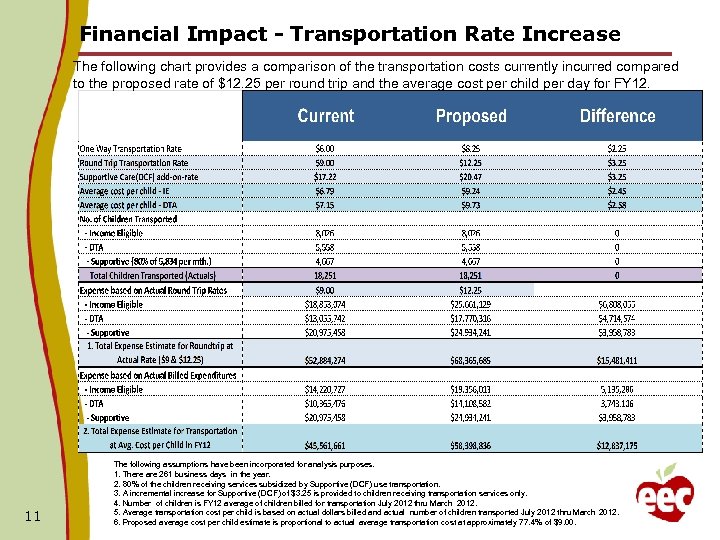
Financial Impact - Transportation Rate Increase The following chart provides a comparison of the transportation costs currently incurred compared to the proposed rate of $12. 25 per round trip and the average cost per child per day for FY 12. 11 The following assumptions have been incorporated for analysis purposes. 1. There are 261 business days in the year. 2. 80% of the children receiving services subsidized by Supportive (DCF) use transportation. 3. A incremental increase for Supportive (DCF) of $3. 25 is provided to children receiving transportation services only. 4. Number of children is FY 12 average of children billed for transportation July 2012 thru March 2012. 5. Average transportation cost per child is based on actual dollars billed and actual number of children transported July 2012 thru March 2012. 6. Proposed average cost per child estimate is proportional to actual average transportation cost at approximately 77. 4% of $9. 00.
Recommendations l l Increase the transportation provider rates to the following: l From $9. 00 to $12. 25 per child for round trips; and l From $6. 00 to $8. 25 per child for one-way trips. l The transportation rate increase would cover two things: (1) as a requirement for the transportation rate increases, contractors must dedicate 1 hour each day towards administrative oversight (i. e. , review policies and procedures) for every 5 children being transported and (2) the Commissioner will implement the Adult Monitors recommendation. l 12 Commissioner will implement the recommended “no-cost” transportation policy changes (i. e. , Management Responsibility, Parent Notification, Passenger Logs, and Secondary Vehicle Inspection). Commissioner will modify the EEC contracts to require the vehicle drivers to: (1) attend the transportation safety training one time per year and (2) enroll in the PQ Registry.
Скачать презентацию A Review of Transportation Board of Early Education
f6d37e9e05204fcc556e7257c8c983c9.ppt